
Sublimation Printer for Apparel: Comparing Print-and-Cut vs Full Roll Systems
Two sublimation printer architectures can print the same jersey artwork and still deliver completely different factory economics. When apparel factories compare a print-and-cut arrangement with a full-roll roll-to-roll line, the deciding factors are rarely print quality alone — they are how much media leaves the building as waste, and how many sellable garments the line releases per shift.
This guide compares the two architectures for garment production using two reference points from the XINFLYING range: the XF-450PRO, positioned as a print-and-cut-friendly platform, and the XF-19E8-PRO, a 1900 mm full-roll industrial sublimation printer built for continuous production. Every model-level figure quoted below comes from XINFLYING product data or from cited third-party sources. Where a configuration is not published for a given model, it is flagged as a specification item to confirm with the supplier rather than an assumed capability.
Problem Definition: What the Architecture Choice Actually Decides
A print-and-cut system and a full-roll system differ in where the separation step happens. In a print-and-cut workflow, the job is printed and then separated so that each printed element corresponds to a defined panel, piece or shape. In a full-roll workflow, printing runs continuously across a fixed web width, and panels are nested inside the roll and separated after transfer or after fabric printing.
That single difference cascades into four operating outcomes that determine whether an investment matches your order book:
- Material utilisation — how much of every metre of transfer paper and fabric ends up inside a sellable garment.
- Order throughput — how many panels or garments the line can release per shift at a defined quality level.
- Labour structure — whether the cutting and separation stage adds headcount in proportion to output.
- Rework cost — what colour drift, a skewed roll or a clogged nozzle costs in lost media and lost slot time.
Full-roll architecture is the default for high-volume textile and soft signage work: roll-to-roll sublimation printers with 1.9 m (1900 mm) widths are treated as standard for those applications (FESPA Insights). Print-and-cut architecture answers a different question — how to keep media consumption closer to the panel shape when the order mix is more granular than the roll.
Industry Background: Why Apparel Capacity Is Being Rebuilt Around This Decision
The global dye sublimation printing market was valued at USD 16.4 billion in 2025 and is projected to reach USD 39.0 billion by 2033, a projected CAGR of 11.5% from 2026 to 2033 (Grand View Research). The equipment slice alone — dye sublimation printers — was valued at USD 1.88 billion in 2025 and is expected to reach USD 2.53 billion by 2030 (Mordor Intelligence), inside a wider large format printer market projected to grow from USD 10.57 billion in 2025 to USD 16.52 billion by 2034 (Fortune Business Insights).
Two structural facts explain why garment factories are the ones making this decision most often. First, Asia Pacific dominated the market in 2025 with a 36.5% revenue share, led by China as the largest country market (Grand View Research), and China's textile and garment exports reached USD 293.6 billion in 2023 — a base that sustains local demand for industrial-scale sublimation capacity. Second, demand for personalised apparel and home decor is the primary driver behind a 13.1% CAGR projected for digital textile sublimation through 2030 (Grand View Research). Personalised sportswear, team kits and short-run decorative collections all push the same requirement: fast changeover without discarding metres of media.
On the supply side, inkjet production printers accounted for 87.3% of the production printer market by type in 2024 (Grand View Research), and Epson leads the digital textile dye sublimation printer segment with a 26.7% share, followed by Mimaki at 18.6% and Roland DG at 15.5% (Data Insights Reports). Where multiple machines share the same industrial print head platform, the architecture — cut-to-shape versus continuous full roll — becomes the real factory-level differentiator.
Colour validation across the whole chain also has a documented reference point: ISO 12647-8:2021 covers validation print processes working directly from digital data, which is the part of the workflow that ultimately decides whether a panel printed on a compact system still matches a panel produced on a full-roll line.
Detailed Solution: How Each Architecture Delivers
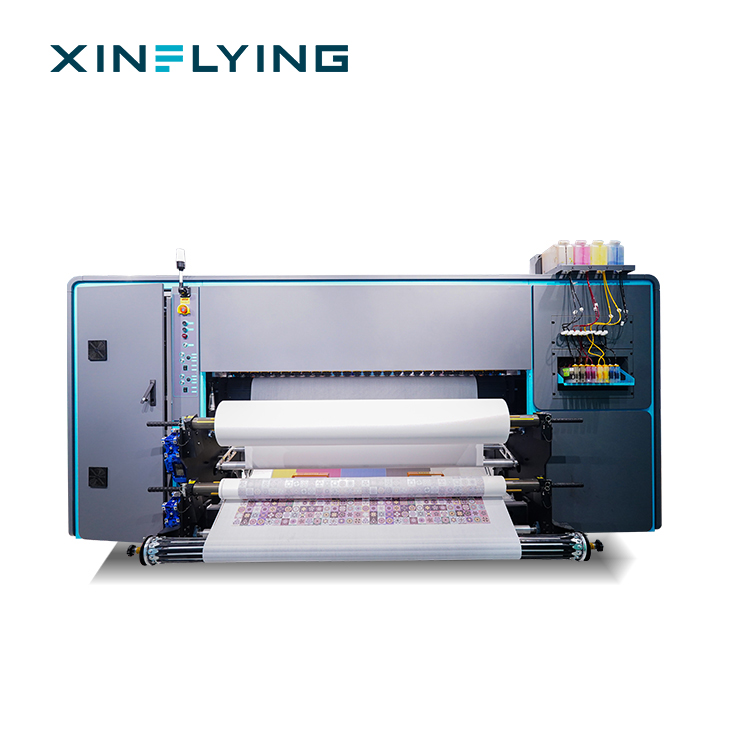
Full-roll reference point: XF-19E8-PRO
XINFLYING — Guangzhou Xin Flying Digital Technology Co., Ltd. — is a digital printing equipment manufacturer founded in 2010 and based in Panyu, Guangzhou, operating a 37,440 m² factory with more than 200 employees, 20 R&D engineers and an export share of 80%. Its XF-19E8-PRO is specified as an industrial textile sublimation printer for continuous production.
The machine runs 8× Epson i3200-A1 print heads in CMYK on a 190 cm (75") print width at 3200 dpi, with rated speeds of 1PASS 306 m²/h and 2PASS 153 m²/h in fastest mode, or 1PASS 210 m²/h and 2PASS 109 m²/h in standard mode, using sublimation ink on sublimation paper.
For full-roll apparel work, the paper-handling and reliability package matters more than peak speed. The XF-19E8-PRO uses US-imported fluorine rubber pressure paper wheels, a Japan THK silent linear guide, and anti-collision devices at both ends — the combination that keeps long runs tracking straight and protects heads during unattended shifts. It carries an external intelligent air-heat integrated dryer, fully sealed automatic moisturising and cleaning, automatic flash spray moisturising, an intelligent print head cleaning and moisturising device, and liquid level plus waste ink alarms. The platform is designed for continuous 24/7 operation in facilities holding 18°C–30°C and 35%–65% RH, drawing 10.2 kW on a 210–230V, 45A supply, with a 3840×1300×1800 mm footprint at 1400 kg net.
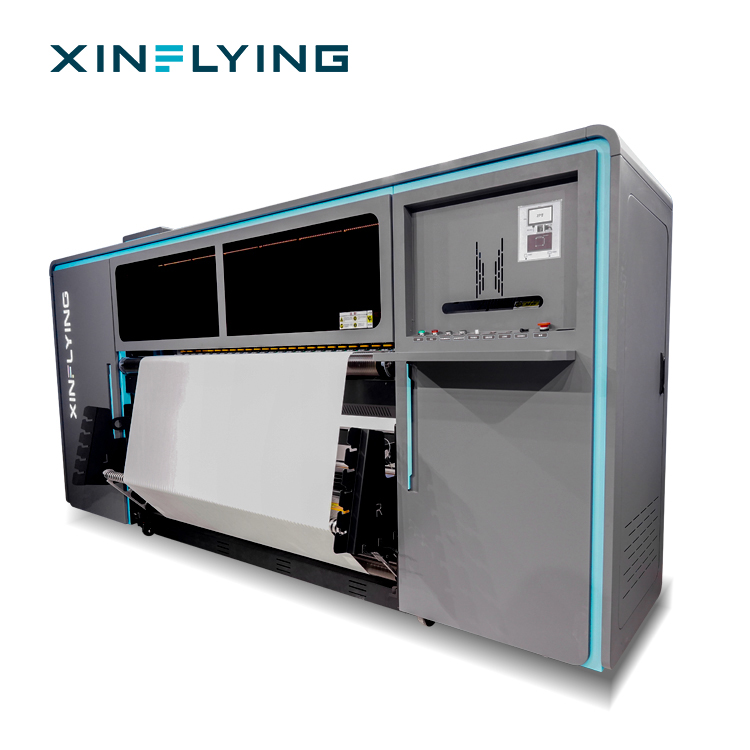
Higher-output full-roll: XF-19E15-PRO
Where an apparel programme is built around long transfer-paper runs, the XF-19E15-PRO extends the same 190 cm / 3200 dpi platform to 15× Epson i3200-A1 heads, rated 1PASS 524 m²/h and 2PASS 254 m²/h (fastest), or 1PASS 394 m²/h and 2PASS 188 m²/h (standard). It loads 1000 m sublimation paper rolls, drives the carriage with a linear motor plus magnetic grid, uses 27 press rollers and an enlarged beam, and is specified for use with a heat press calender and dye sublimation paper. Its documented scenario requirements are high printing accuracy, stable colour reproduction, continuous production stability and consistent print quality — the profile of a factory that has already committed to roll-based throughput. Power draw is 14.5 kW on 210–230V, 45A, with a 1480 kg net weight.
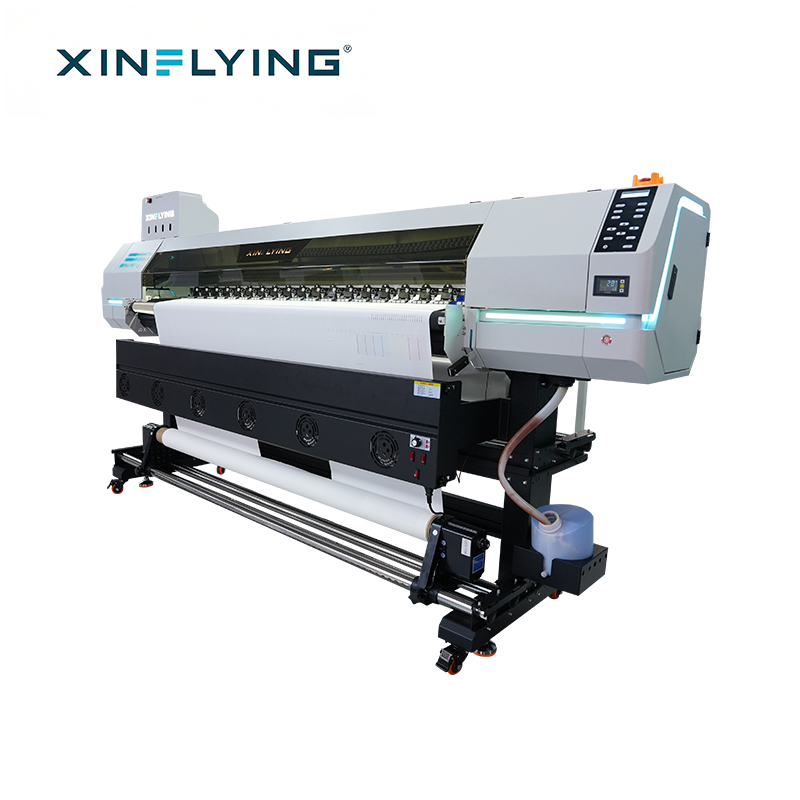
Mid-tier full-roll: XF-O2000-4I32A1
The XF-O2000-4I32A1 is a practical entry into full-roll apparel printing: 4× Epson i3200-A1 heads, a 195 cm (1.95 m) print width, and 2PASS 180 m²/h or 4PASS 92 m²/h using piezoelectric inkjet technology. It accepts heat transfer paper rolls of 1000–1500 m with print media up to 1 mm thickness and 200 kg weight, uses a 220 ml cartridge plus 3 L ink tank arrangement, and applies front, middle and rear break-controlled heating at 8.5 kW on 220V. At approximately 490 kg net, it fits workshops that need industrial width without the utility profile of a 1400 kg machine.
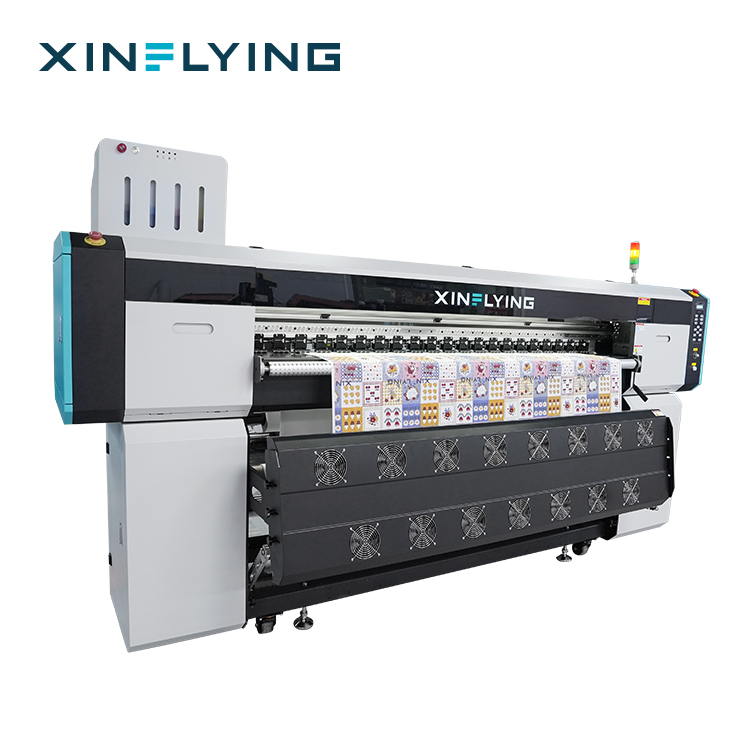
Print-and-cut reference point: XF-450PRO
XINFLYING positions the XF-450PRO as the print-and-cut-friendly option in its range, which is why it sits on the other side of this comparison. The architectural logic is straightforward: because the separation step follows the printed element, media consumption tracks panel shape more closely than a continuous web, and switching jobs does not require completing or swapping a full production roll. That makes the arrangement relevant to panel-based garment construction, sampling rooms and mixed short-run orders.
Material utilisation: what actually consumes media
Material utilisation is the ratio between the area that ends up in a sellable garment and the area of transfer paper and fabric consumed to produce it. In roll-to-roll apparel printing, four levers move that ratio:
- Nesting efficiency inside the web width. A 1900 mm class roll leaves more room to interlock panels than a 1.8 m or 1.3 m class roll. That is why 1.9 m is the standard width for high-volume textile and soft signage work.
- Roll length and changeover frequency. Accepting 1000 m rolls (XF-19E15-PRO) or 1000–1500 m transfer paper rolls (XF-O2000-4I32A1) reduces the number of tail-end waste events per shift compared with short rolls.
- Tracking stability. Skew, drift and paper slip create unusable margins and force reprints. Pressure wheel material, guide quality and anti-collision protection are utilisation features, not cosmetic ones.
- Rework rate. Clogged nozzles, dried ink or unstable ink supply destroy already-consumed media. Sealed moisturising, automatic cleaning and waste ink alarms exist to protect consumed media as much as the print heads.
Print-and-cut shifts the emphasis: because the cut stage defines the boundary of each element, utilisation becomes a question of how tightly the printed layout can be arranged before separation, and how much labour that separation stage adds per order.
Order throughput: converting rated speed into garments per shift
Rated print speed is only one input. A workable planning formula for either architecture is: hourly output × effective production hours × uptime factor × nesting yield = sellable panel area per shift. Rated speeds published for XINFLYING models span 28 m²/h (XF-H1301X-1I32A1, 1× i3200-A1, 130 cm, 4PASS), 52 m²/h (XF-H1802X-2I32A1, 2× i3200-A1, 180 cm, 4PASS), 180 m²/h (XF-O2000-4I32A1, 4 heads, 2PASS), 306 m²/h (XF-19E8-PRO, 8 heads, 1PASS fastest; 210 m²/h standard) and 524 m²/h (XF-19E15-PRO, 15 heads, 1PASS fastest; 394 m²/h standard).
The uptime factor is where the architecture decision is often won or lost. The XF-19E8-PRO is specified for continuous 24/7 operation, which is what allows a full-roll line to absorb peak season without a printing-side shift premium. A print-and-cut line trades part of that continuous throughput for lower media consumption and faster order-level changeover.
Step-by-Step Breakdown: Choosing Between the Two for Your Order Book
Run this sequence before requesting a quotation. It converts order data into a specification instead of a preference.
- Define the panel mix and average panel area. List the garment types you produce — jerseys, shorts, leggings, uniforms — and the average printed area per garment. Panel-based construction and all-over graphics pull in one direction; small logo placement pulls in the other.
- Model roll utilisation. Take your widest common panel set and test nesting inside a 180 cm, 190 cm and 195 cm web. If the width difference saves meaningful paper on your actual mix, the full-roll case strengthens.
- Set the throughput floor. Multiply peak-season daily garments by printed area per garment, then divide by effective hours. This produces the minimum m²/h the machine must sustain — standard-mode ratings are the honest planning number, not fastest-mode figures.
- Check the cut and separation stage. Decide whether separation happens before transfer, after transfer, or after fabric printing. That determines how much the cutting stage constrains the line, and whether a print-and-cut platform or a full-roll platform fits the labour model.
- Verify utilities and environment. Industrial machines are specified within defined envelopes: 18°C–30°C and 35%–65% RH for the XF-19E8-PRO, and 20–35°C with 45–65% RH for the XF-H1301X and XF-H1802X models. Power requirements range from 2 kW (XF-H1301X-1I32A1) and 3.5 kW (XF-H1802X-2I32A1) to 8.5 kW (XF-O2000-4I32A1), 10.2 kW (XF-19E8-PRO) and 14.5 kW (XF-19E15-PRO).
- Plan the transfer stage. Sublimation workflows are only complete with matched consumables and downstream equipment. XINFLYING specifies RIP software, heat press calender, dye sublimation paper, dye sublimation ink, laser cutting machine and substrates — and the XF-19E15-PRO scenario explicitly requires a heat press calender and dye sublimation paper.
Use Cases: How Factories Run These Systems Today
Sportswear manufacturer, Brazil — 15 units, 4 years. The factory produces football jerseys, basketball uniforms and customised sportswear, printing high-resolution patterns, team logos and full-colour designs on polyester before cutting and sewing. Reported outcomes were greater production flexibility on customised orders, reduced dependence on outsourced printing, and more consistent colour across batches. Industrial roll-to-roll capability, stable production performance and colour reproduction were the deciding characteristics.
Sports uniform supplier, Brazil — 8 units, 5 years. This supplier produces customised football kits, training uniforms and team apparel with personalised names, numbers and graphics. The sublimation solution shortened production cycles on customised sportswear while maintaining the vibrant colours and detailed patterns team uniforms require, and it supports personalised sportswear production, small-batch customisation and continuous commercial printing.
Home textile manufacturer — 10 units, 4 years. The manufacturer prints curtains, cushions, decorative fabrics and customised polyester textile products. The systems allowed it to develop customised collections with rich patterns and accurate colour while keeping production flexible — the case profile for large-format textile applications that need detailed patterning and consistent printing quality.
Digital textile printing service provider — 5 units, 3 years. Serving sportswear brands, apparel factories and customised textile businesses, this provider used the equipment to expand production capacity, take on more customer projects and improve response speed on customised textile orders. The stated highlights were reliable equipment performance, production flexibility and compatibility across different polyester textile applications.
Comparison Table: Print-and-Cut vs Full Roll for Apparel
The table below compares the two architectures against the criteria that decide factory performance. All specification values come from XINFLYING product data or the cited industry sources.
| Criterion | Print-and-cut arrangement (ref. XF-450PRO) | Full-roll arrangement (ref. XF-19E8-PRO and family) |
|---|---|---|
| Where separation happens | After printing; printed elements are separated to defined panels or shapes | After transfer or after fabric printing; panels nested inside the roll |
| Typical web width class | Depends on the model — confirm on the datasheet | 190 cm (75") on XF-19E8-PRO; 195 cm on XF-O2000-4I32A1; 1.9 m class is standard for high-volume textile and soft signage (FESPA Insights) |
| Media loading | Not published for XF-450PRO in the data used here | Sublimation paper on XF-19E8-PRO; 1000 m rolls on XF-19E15-PRO; 1000–1500 m transfer paper rolls on XF-O2000-4I32A1 |
| Rated speed reference | Confirm per model | XF-19E8-PRO: 306 m²/h (1PASS fastest), 210 m²/h (1PASS standard). XF-19E15-PRO: 524 m²/h (1PASS fastest), 394 m²/h (1PASS standard) |
| Material utilisation lever | Layout density before separation; avoids continuous-web waste | Nesting inside 1900 mm class width; longer rolls; tracking stability; low rework rate |
| Throughput lever | Cycle time of print + cut at order level | Head count and width; XF-19E8-PRO specified for continuous 24/7 operation |
| Best-fit order profile | Panel-based garments, sampling, mixed short runs | Peak-season sportswear, long transfer-paper runs, continuous commercial printing |
| Environment envelope | Confirm per model | 18°C–30°C, 35%–65% RH (XF-19E8-PRO); 20–35°C, 45–65% RH (XF-H1301X / XF-H1802X) |
| Compliance scope | Same compliance categories apply; the certificate must match the supplied configuration | CE documentation covering electrical safety, EMC and product safety plus RoHS for the EU; FCC and, where applicable, additional safety documentation for the US |
| Model | Print heads | Print width | Speed (fastest) | Speed (standard) | Power | Net weight |
|---|---|---|---|---|---|---|
| XF-H1301X-1I32A1 | 1× Epson i3200-A1 | 130 cm | 4PASS 28 m²/h | — | 2 kW | 140 kg |
| XF-H1802X-2I32A1 | 2× Epson i3200-A1 | 180 cm | 4PASS 52 m²/h | 4PASS 42 m²/h | 3.5 kW | 265 kg |
| XF-O2000-4I32A1 | 4× Epson i3200-A1 | 195 cm | 2PASS 180 m²/h | 4PASS 92 m²/h | 8.5 kW | ≈490 kg |
| XF-19E8-PRO | 8× Epson i3200-A1 | 190 cm (75") | 1PASS 306 m²/h; 2PASS 153 m²/h | 1PASS 210 m²/h; 2PASS 109 m²/h | 10.2 kW | 1400 kg |
| XF-19E15-PRO | 15× Epson i3200-A1 | 190 cm (75") | 1PASS 524 m²/h; 2PASS 254 m²/h | 1PASS 394 m²/h; 2PASS 188 m²/h | 14.5 kW | 1480 kg |
Reading notes: the XF-19E8-PRO and XF-19E15-PRO run at 3200 dpi with sublimation ink, while the XF-O2000-4I32A1 uses a 220 ml cartridge plus 3 L ink tank and supports print media up to 1 mm thickness and 200 kg. Standard-mode figures are the realistic planning numbers for apparel production; fastest-mode figures apply to simpler graphics.
FAQ
Q1. Does the print-and-cut vs full-roll choice change which compliance documents I need?
The compliance categories stay the same; what changes is the equipment configuration the certificate must cover. For the European market, buyers verify CE compliance including applicable electrical safety, electromagnetic compatibility and product safety requirements, and RoHS restrictions on hazardous substances in electrical and electronic components. For the US market, buyers check electromagnetic compatibility and electrical safety documentation such as FCC, plus additional safety certification where the configuration and sales channel require it. In both cases the certificate, test report and technical file must match the exact model and configuration being supplied, because incomplete or mismatched documents can cause customs delays, sales restrictions or additional compliance costs.
Q2. Can an entry or mid-tier machine deliver the throughput of a full-roll industrial line?
No — throughput in roll-to-roll sublimation printing is set mainly by head count and web width. Published XINFLYING ratings show the ladder clearly: the XF-H1301X-1I32A1 with 1× Epson i3200-A1 at 130 cm reaches 28 m²/h (4PASS); the XF-H1802X-2I32A1 with 2 heads at 180 cm reaches 52 m²/h (4PASS); the XF-O2000-4I32A1 with 4 heads at 195 cm reaches 180 m²/h (2PASS) or 92 m²/h (4PASS); the XF-19E8-PRO with 8 heads at 190 cm reaches 306 m²/h (1PASS, fastest) or 210 m²/h (1PASS, standard); and the XF-19E15-PRO with 15 heads at 190 cm reaches 524 m²/h (1PASS, fastest) or 394 m²/h (1PASS, standard). The XF-19E8-PRO is additionally designed for continuous 24/7 operation, which is what converts a higher hourly rating into sustained daily output.
Q3. What drives the cost difference between the two architectures?
The gap is driven by configuration rather than branding. Head count, web width, frame mass and structure, power draw, dryer specification and media handling all scale with the architecture. In the XINFLYING range, power draw rises from 2 kW (XF-H1301X-1I32A1) and 3.5 kW (XF-H1802X-2I32A1) to 8.5 kW (XF-O2000-4I32A1), 10.2 kW (XF-19E8-PRO) and 14.5 kW (XF-19E15-PRO), while net weight rises from 140 kg to 1480 kg. Two further cost lines sit outside the machine itself: media consumption (nesting and roll length determine paper spend per garment) and rework (clogged nozzles, skew or colour drift consume already-purchased paper and fabric). On commercial terms, XINFLYING supports a minimum order of 1 unit, lead times of 5–40 days depending on configuration, OEM/ODM customization covering product branding, machine appearance, colour, logo and packaging, and a monthly production capacity of 1600+ units.
Q4. What should I prepare before running a validation print?
Prepare the full chain, not just the printer. A sublimation workflow requires dye sublimation paper, dye sublimation ink and RIP software for colour profiles and print parameters — Maintop is standard on XINFLYING models, with RIIN for Hoson configurations only and PhotoPrint or Printfactory optionally — plus a heat press calender for transfer. The XF-19E15-PRO scenario explicitly requires a heat press calender and dye sublimation paper. Files are accepted in JPG, TIFF and PDF formats. Control the environment as well: 18°C–30°C with 35%–65% RH for the XF-19E8-PRO, and 20–35°C with 45–65% RH for the XF-H1301X and XF-H1802X models. XINFLYING performs pre-shipment testing before dispatch, so agree in advance which panels, colours and fabrics the validation run should represent.
Q5. How long does delivery and setup take, and what support is included?
Lead time runs 5–40 days depending on the model and configuration, with a minimum order quantity of 1 unit and a monthly production capacity of 1600+ units on the XINFLYING side. Setup follows a defined sequence: place the machine on a stable surface and connect the power supply, install the sublimation ink system and confirm ink flow, install drivers and configure RIP software, run nozzle checks and print head inspection, then complete test prints before starting production. XINFLYING provides over 50 engineers delivering 24/7 online technical support, with local warehouses and technical support in key markets. If you want the comparison run against your own panel mix, request a sample discussion and quote against the model you are evaluating.
Conclusion
The choice between print-and-cut and full-roll sublimation for apparel is a choice about where waste is created and where throughput is capped. Full-roll systems win on sustained output because width and head count scale together — the 1900 mm class is the industry standard width for high-volume textile work, and a machine such as the XF-19E8-PRO pairs that width with 8× Epson i3200-A1 heads, 306 m²/h fastest-mode output, sealed automatic moisturising and 24/7 operating specification. Print-and-cut platforms such as the XF-450PRO answer a different constraint, keeping media consumption close to panel shape and reducing changeover friction on mixed, granular order books.
For most apparel factories the answer is not either/or but sequencing: confirm the panel mix, measure nesting inside 180 cm, 190 cm and 195 cm webs, set a standard-mode throughput floor, then match the machine class to that number. Standard-mode ratings — 210 m²/h on the XF-19E8-PRO, 394 m²/h on the XF-19E15-PRO, 180 m²/h on the XF-O2000-4I32A1 — are the honest planning inputs.
Next Step: Validate the Architecture Against Your Own Order Book
Send your panel mix, target daily output and fabric specification, and we will map it against the XF-450PRO print-and-cut platform, the XF-O2000-4I32A1, the XF-19E8-PRO or the XF-19E15-PRO full-roll line.
Website: www.xin-flying.com · Email: info@xin-flying.com · WhatsApp: +86 188-1322-1357
Download the full product and capability overview: XINFLYING corporate brochure (PDF)
Guangzhou Xin Flying Digital Technology Co., Ltd. — No.7, Xiecun 2nd Industrial Zone, Panyu, Guangzhou, Guangdong. Founded 2010 · 37,440 m² factory · 200+ employees · 80% export share · serving North America, South America, Europe, Asia, the Middle East and Africa.
Have Questions or Need More Details?
Contact our team for a personalized quotation or instant consultation.
Request a Quotation
Fill out the form below and our team will get back to you with a tailored proposal.
WhatsApp Direct Chat
Prefer to chat in real-time? Message us on WhatsApp for instant assistance & quick answers.
- Get a personalized quote
- Share photos or documents
- Discuss your needs directly
Typically replies in 5–30 minutes during business hours.