Sublimation Printers for Soft Signage: A Wide Format CE Guide
Sublimation Printers for Soft Signage: A Wide Format CE Guide
For sign and display manufacturers entering textile graphics, the selection answer is narrower than a general sublimation printer shortlist: choose a roll-to-roll dye sublimation printer whose print width matches your dominant display formats, and confirm that its conformity documentation covers EU Machinery Directive 2006/42/EC — not only LVD, EMC and RoHS. Within the XINFLYING range, the XF-H1301X-1I32A1 is the clearest reference point for that evidence: the model is covered by a CE MD Certificate of Conformity for Machinery Safety Compliance under MD 2006/42/EC, conforming to EN ISO 12100:2010, EN 60204-1:2018/A1:2025 and EN ISO 12643-1:2023.
This guide is written for sign and display manufacturers, fabricators, distributors and print service providers evaluating a large format sublimation printer for display textiles: flags, banners, soft signage panels and decorative printed fabric. It explains where digital textile printing now sits inside the signage segment, what Machinery Directive evidence should look like on a specific machine, how to match width and throughput to display formats, and how XINFLYING documents its wide-format models for the EU market.
Problem Definition: Three Constraints That Stall a Signage Machine Decision
Sign and display buyers rarely struggle to find a sublimation printing machine. They struggle to find one whose width, throughput and conformity paperwork all hold up at the same time. Three constraints decide most projects.
1. Print width versus panel seaming
Display work is driven by finished graphic size. When a job exceeds the machine's print width, production splits into panels that must be aligned and joined, which introduces seam lines that some display specifications reject and adds labour to every unit. A 1.3 m machine and a 1.9 m machine are both commercially viable large sublimation printers — but they serve different order books, not different quality tiers.
2. Certificate scope versus certificate appearance
A CE mark printed on a brochure page is not evidence. Machinery Directive conformity attaches to a specific machine model, a specific certificate number, a named issuing body, named applied standards and a defined validity window. When an importer receives a certificate that lists a different model, or a number that does not appear on the machine's declaration, that documentation cannot be used in customs review or in a distributor's compliance file.
3. Operator safety under production pressure
Display contracts are deadline-driven, and the production environment is unforgiving: operators work close to a moving carriage, heated drying elements and a downstream heat press calender. Machinery Directive conformity is the layer that confirms a structured risk assessment has been carried out on the machine (EN ISO 12100:2010), that machine-level electrical requirements are met (EN 60204-1:2018/A1:2025), and that the graphics industry safety standard EN ISO 12643-1:2023 has been applied. This is documentation about operational safety in high-pressure production environments, not marketing language.
A second, separate layer concerns consumables: MD conformity covers machinery, while ink and paste compliance is certified independently. The XINFLYING OEKO-TEX® ECO PASSPORT certificate SH150194016, issued by TESTEX AG, covers textile printing inks and printing pastes used in the XF-450PRO, complies with EN ISO 17050-1, applies to the global market and is valid to 31 December 2026. Shops that print both display textiles and garment work need both layers.
Industry Background: Why Soft Signage Pulls Wide Format Sublimation Printers Into Display
Digital textile printing has expanded from apparel into the display segment, where the same roll-to-roll logic now supports flags, banners, soft signage panels and decorative printed fabric. The investment case behind that shift is documented in published market research, which is useful context when building a capacity plan — provided the numbers are read with their sources attached.
- Grand View Research values the global dye sublimation printing market at USD 16.4 billion in 2025, projected to reach USD 39.0 billion by 2033, with a CAGR of 11.5% across 2026–2033. The same source puts Asia Pacific at a 36.5% revenue share in 2025, led by China as the largest country market.
- Mordor Intelligence sizes the dye sublimation printers segment specifically at USD 1.88 billion in 2025, expected to reach USD 2.53 billion by 2030.
- Fortune Business Insights values the large format printer market at USD 10.57 billion in 2025, projected to reach USD 16.52 billion by 2034.
- FESPA reports that roll-to-roll sublimation printers with widths of 1.9 m (1900 mm) are the standard for high-volume textile and soft signage applications — the single most useful width benchmark for display buyers.
- On the equipment side, Data Insights Reports recorded Epson leading the digital textile dye sublimation printer market with a 26.7% share in 2024, followed by Mimaki at 18.6% and Roland DG at 15.5%, which is the brand landscape a signage buyer will usually compare against.
- ISO 12647-8:2021 provides the validation print process standard for graphic technology working directly from digital data, which is the colour-consistency reference behind repeatable display output.
Published market-size estimates differ by scope — some cover equipment only, others include consumables and services — so the figures above should be treated as directional planning inputs rather than a single reconciled number. What they consistently show is that display and signage demand is now part of the same textile printing growth curve that apparel drove previously.
Detailed Solution: What “CE Compliant” Actually Means on a Wide Format Sublimation Printer
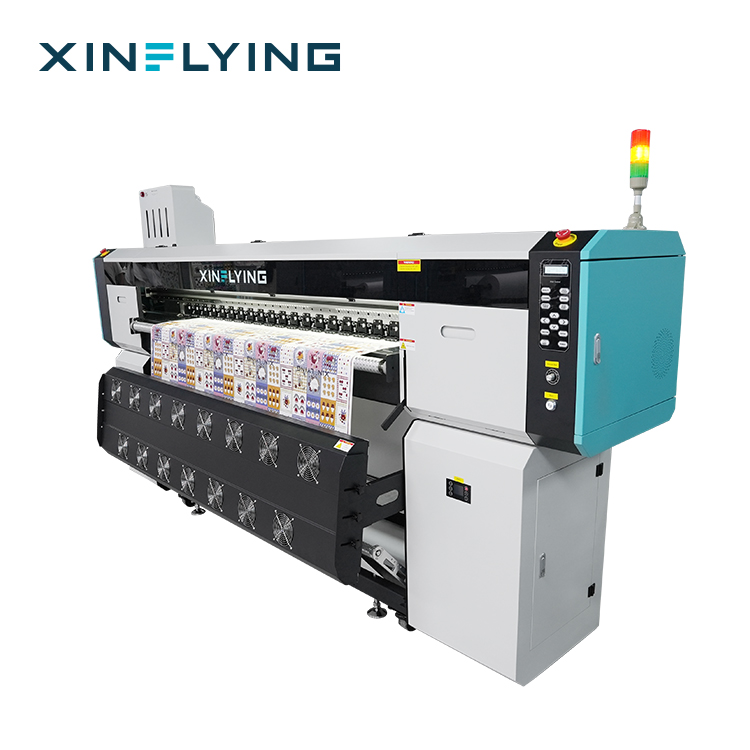
XINFLYING XF-O2000-4I32A1 — 195 cm roll-to-roll platform with four Epson i3200-A1 printheads and front/middle/rear break-controlled heating, applied to clothing, home decor, canvas bags, cushions and flags.
What MD 2006/42/EC requires in practice
Machinery Directive 2006/42/EC applies to machinery placed on the EU market and translates into three practical evidence layers on a digital textile printer:
- Risk assessment under EN ISO 12100:2010. The framework used to identify hazards on the machine as a whole — moving axes, nip points, heated elements, electrical assemblies — and to define how each hazard is eliminated or reduced.
- Electrical equipment of machines under EN 60204-1:2018/A1:2025. The machine-level electrical safety standard covering protective bonding, emergency stop behaviour and safety-related control functions.
- Graphics industry machinery safety under EN ISO 12643-1:2023. The standard written specifically for printing, coating and finishing equipment, which is why it appears alongside the other two on a conforming printer.
The deliverable is a Certificate of Conformity or Attestation of Conformity that names the model, the directive, the applied standards, the issuing body and the validity window. A CE mark on its own demonstrates none of this.
The XF-H1301X-1I32A1 certificate evidence, read line by line
The XF-H1301X-1I32A1 is a useful worked example for signage buyers because its documentation can be checked item by item. The model is covered by a CE MD Certificate of Conformity for Machinery Safety Compliance under MD 2006/42/EC, conforming to EN ISO 12100:2010, EN 60204-1:2018/A1:2025 and EN ISO 12643-1:2023. XINFLYING's CE MD documentation for the range is issued by UDEM, dated 10 June 2026 and valid to 9 June 2031. The same model is also certified under CE certificate M.2026.206.C142475, which covers LVD and EMC compliance and is issued by UDEM for the EU market.

For the sign and display segment this matters twice over. During evaluation it lets a technical buyer verify that the certificate names the exact machine on the purchase order. After installation it becomes the document an operator training file or a customer audit request can reference when a brand owner asks how display graphics were produced. It is also the reason a machine intended for continuous, deadline-driven display work should never be selected on price alone.
The rest of the EU document chain: LVD, EMC and RoHS
MD conformity is the safety anchor, but a complete EU file normally carries three further layers, and XINFLYING's certificates show them clearly:
- Low Voltage Directive: CE LVD certificate TQT1550D271EC, issued by TQT (Shenzhen Tianqi Testing Technology Service Co., Ltd.), covering electrical safety for digital printer products under EN IEC 62368-1:2020/A11:2020.
- Electromagnetic Compatibility: CE EMC Certificate of Compliance TQT1550D270EC, issued by TQT, under EMC Directive 2014/30/EU with EN 55032:2015/A11:2020, EN 55035:2017/A11:2020, EN IEC 61000-3-2:2019+A1:2021 and EN 61000-3-3:2013/A2:2021. A combined LVD & EMC certificate, M.2026.206.C142475, is issued by UDEM and valid to 10 June 2031.
- RoHS: certificate M.2026.206.C142366, issued by UDEM under Directive 2011/65/EU, referencing EN IEC 63000:2018 and the EN IEC 62321 series, valid to 9 June 2031.

Matching width and throughput to signage work
With the document chain resolved, the remaining decision is mechanical. Across the XINFLYING range, four widths cover most display order books:
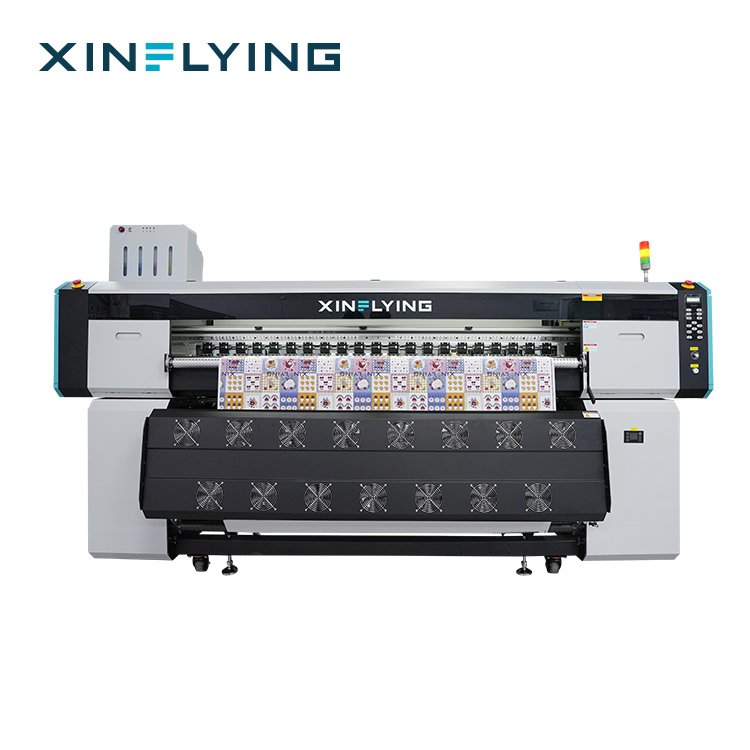
- 130 cm — XF-H1301X-1I32A1. One Epson i3200-A1 printhead, CMYK, fastest speed 4PASS 28 m²/h, Maintop as standard RIP, external constant-temperature automatic drying system, 2 kW, 110/220V at 18A/9A. Suited to narrower display textiles, sampling and small-format display runs.
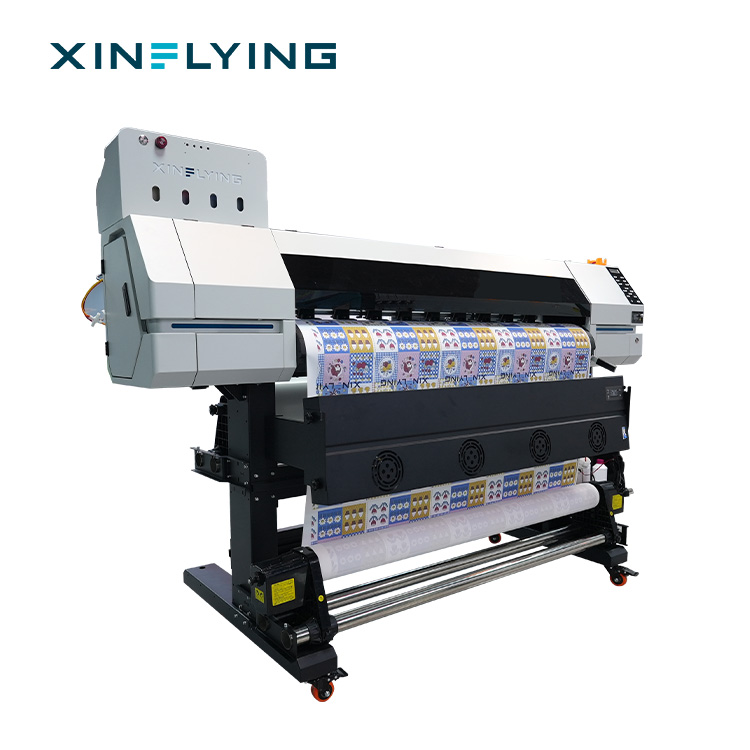
- 180 cm — XF-H1802X-2I32A1. Two Epson i3200-A1 printheads, CMYK+CMYK, fastest 4PASS 52 m²/h (standard 4PASS 42 m²/h), front/middle/rear break-controlled heating, 3.5 kW, 110/220V at 27.2A/13.6A.
- 190 cm — XF-19E8-PRO and XF-19E15-PRO. Both print at 190 cm (75 in) with 3200 dpi resolution. The XF-19E8-PRO runs eight Epson i3200-A1 heads at a fastest 1PASS 306 m²/h (2PASS 153 m²/h), 10.2 kW, 210–230V at 45A, with a Japan THK silent linear guide, anti-collision devices at both ends, fully sealed automatic moisturizing and cleaning, and an external intelligent air-heat integrated dryer. The XF-19E15-PRO runs fifteen Epson i3200-A1 heads at a fastest 1PASS 524 m²/h (2PASS 254 m²/h), 14.5 kW, 210–230V at 45A, loads 1000 m paper rolls, and uses a linear motor with magnetic grid plus 27 press rollers.
- 195 cm — XF-O2000-4I32A1. Four Epson i3200-A1 printheads in CMYK×4, 2PASS 180 m²/h and 4PASS 92 m²/h, piezoelectric inkjet, sublimation ink from a 220 ml cartridge plus 3 L ink tank, heat transfer paper rolls of 1000–1500 m, front/middle/rear break-controlled heating, 8.5 kW on 220V 50/60Hz, and a stated applicable industry that includes flags alongside clothing, home decor, canvas bags and cushions.
Step-by-Step Breakdown: Qualifying a Wide Format Sublimation Printer in Seven Steps
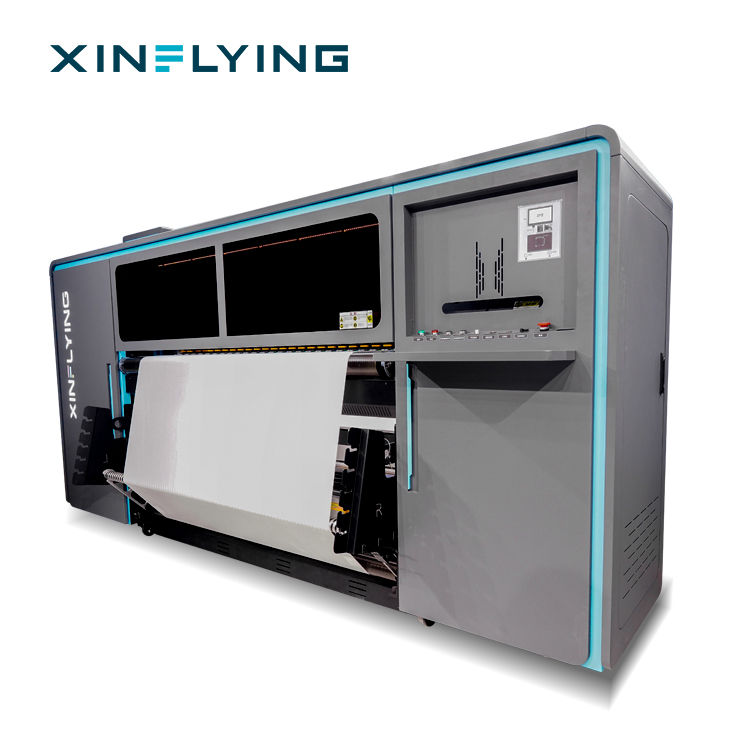
XINFLYING XF-19E8-PRO — 190 cm industrial platform with eight Epson i3200-A1 printheads, THK silent linear guide and external intelligent air-heat integrated dryer.
Step 1 — Map the display portfolio to one dominant width
List the finished sizes that generate most of your revenue, then identify the narrowest machine that produces the majority in a single pass. Treat panel seaming as a cost, not a feature: it consumes labour on every unit and constrains which specifications you can accept.
Step 2 — Set a throughput floor, not a ceiling
Speed figures are only comparable at the same pass mode. On XINFLYING platforms this means 4PASS 28 m²/h on the XF-H1301X-1I32A1, 4PASS 52 m²/h on the XF-H1802X-2I32A1, 2PASS 180 m²/h on the XF-O2000-4I32A1, 1PASS 306 m²/h on the XF-19E8-PRO and 1PASS 524 m²/h on the XF-19E15-PRO. Convert your peak weekly display volume into square metres, then check whether the candidate machine clears it in one shift pattern.
Step 3 — Verify certificate-to-model matching
Before any commercial discussion, request the certificate file and check six items against the quotation: the exact model designation; the certificate number; the directive cited (MD 2006/42/EC); the applied standards (EN ISO 12100:2010, EN 60204-1:2018/A1:2025, EN ISO 12643-1:2023); the issuing body (for XINFLYING, UDEM for the MD documentation); and the issue and expiry dates. A certificate that fails any of these checks is not usable evidence.
Step 4 — Confirm the LVD, EMC and RoHS layers
MD conformity does not replace electrical safety or electromagnetic compatibility. Ask for the CE LVD certificate, the CE EMC certificate and the RoHS certificate, and confirm that each names the model you are buying. A single packaged pack makes this easier: on the XF-19E8-PRO, for example, the file includes CE MD Certificate of Conformity M.2026.206.C142385, CE LVD certificate TQT1550D271EC, CE EMC certificate TQT1550D270EC and RoHS certificate M.2026.206.C142366.
Step 5 — Check media path, drying and ink system
Display textiles are printed in long continuous runs, so drying and roll handling decide whether the machine holds schedule. Compare the drying approach (external constant-temperature automatic drying on the XF-H1301X-1I32A1; external intelligent air-heat integrated dryer on the XF-19E8-PRO and XF-19E15-PRO; front/middle/rear break-controlled heating on the XF-O2000-4I32A1 and XF-H1802X-2I32A1) and the supported media roll lengths, such as 1000–1500 m on the XF-O2000-4I32A1 and 1000 m rolls on the XF-19E15-PRO.
Step 6 — Check installation, power and environment
Industrial platforms make industrial demands. The PRO series runs on 210–230V at 45A (10.2 kW for the eight-head model, 14.5 kW for the fifteen-head model), the XF-O2000-4I32A1 on 220V 50/60Hz at 8.5 kW, and the H-series models on 110/220V. Machine footprints range from 2220×870×1540 mm for the XF-H1301X-1I32A1 to 3840×1570×1800 mm for the XF-19E15-PRO, with net weights from 140 kg to 1480 kg. Recommended operating conditions fall within 18–30°C and 35–65% relative humidity for stable ink performance and colour accuracy.
Step 7 — Validate, then plan lead time and support
Close the evaluation with production evidence rather than specification sheets: request test prints on your own artwork and fabric, confirm pre-shipment testing as the stated quality-control mode, and confirm the commercial terms you will actually operate under — MOQ of 1 unit, lead time of 5–40 days, and the 50+ engineers providing 24/7 online technical support behind the machine.
Use Cases: Where These Machines Earn Their Keep in Display Production
Flag and banner production
The scenario documented for XINFLYING roll-to-roll platforms covers polyester fabric printing, soft signage printing, flag printing and banner printing alongside apparel and home textile work, operated continuously with RIP software, heat press calender, dye sublimation paper and dye sublimation ink in the matched equipment list. That combination — continuous operation plus a defined consumable chain — is what makes a 1.9 m or 1.95 m platform the standard entry point for display fabricators.
Soft signage and interior display textiles
Decorative and interior display work rewards pattern detail and colour consistency more than raw speed. A home textile manufacturer running ten units over four years uses sublimation printing for curtains, cushions, decorative fabrics and customised polyester textile products, and reports developing collections with rich patterns, accurate colours and flexible production capability — a pattern that transfers directly to interior display textiles and decorative wall graphics.
Print service providers adding display capacity
A digital textile printing service provider running five units over three years reports that the investment expanded production capacity, supported more customer projects and improved response speed for customised textile orders, crediting reliable equipment performance, production flexibility and compatibility with different polyester applications. For a service business, that is the real argument for a wide platform: it changes which orders you can quote, not just how fast you print.
Mixed-product shops filling capacity gaps
Display demand is seasonal, and most signage producers carry idle capacity between campaign peaks. The same roll-to-roll platform that prints banner and flag fabric can handle apparel work — sublimation printing for t-shirts, sportswear panels and promotional textiles — which keeps the machine loaded and spreads its cost across two order books. Shops that do this should confirm the consumable-side certification as well as the machinery side: MD conformity covers the machine, while OEKO-TEX® ECO PASSPORT certificate SH150194016 covers textile printing inks and printing pastes used in the XF-450PRO and remains valid to 31 December 2026.
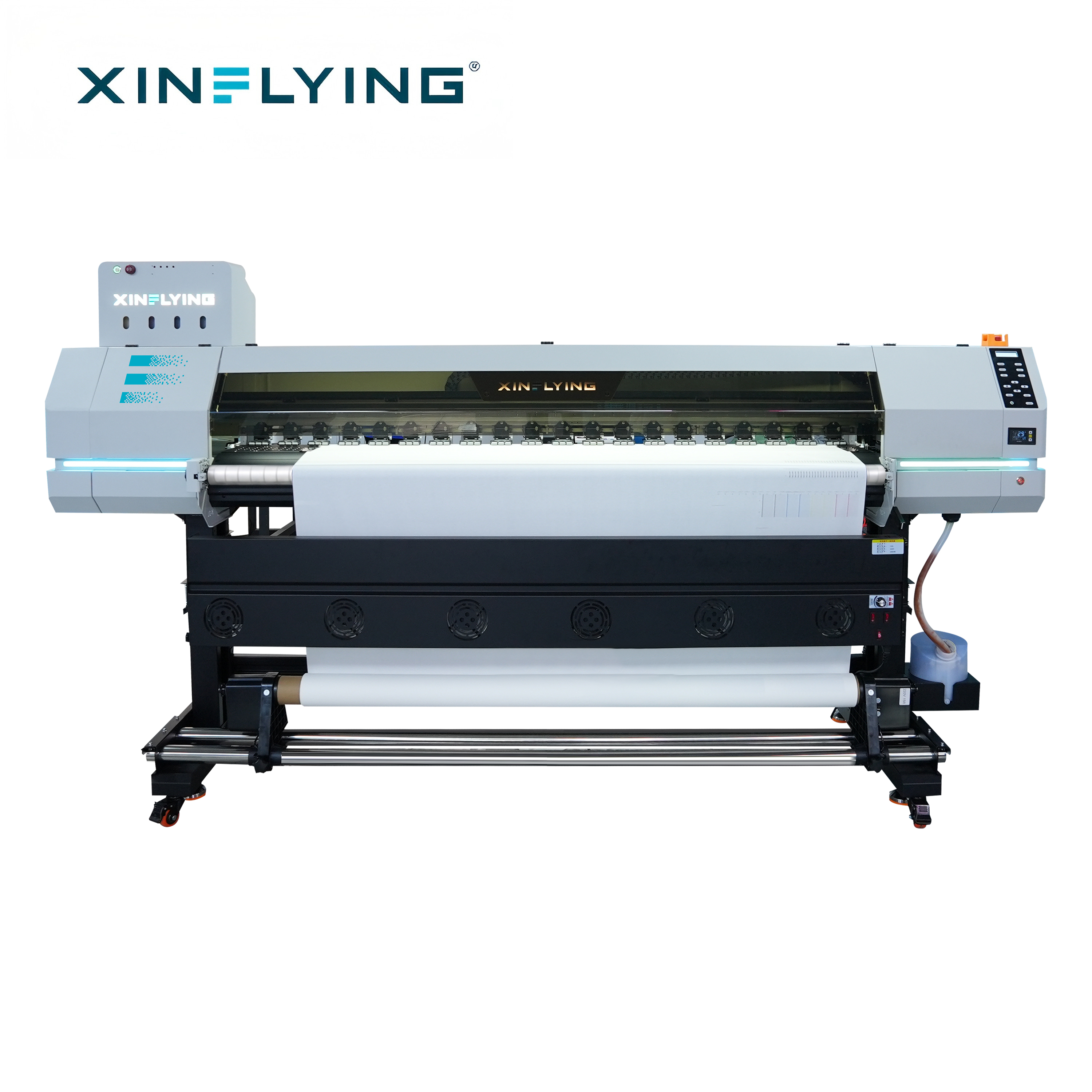
Wide Format Sublimation Printers Compared on Documented Facts
The table below compares XINFLYING's roll-to-roll sublimation platforms using manufacturer specifications and the certificate documentation referenced in this guide. Every value can be checked against the corresponding certificate or specification sheet.
| Model | Print width | Printheads | Fastest print speed | Ink colours | Documented EU conformity evidence | Typical signage fit |
|---|---|---|---|---|---|---|
| XF-H1301X-1I32A1 | 130 cm (1.3 m) | 1 × Epson i3200-A1 | 4PASS 28 m²/h | CMYK | CE MD Certificate of Conformity (MD 2006/42/EC; EN ISO 12100:2010, EN 60204-1:2018/A1:2025, EN ISO 12643-1:2023); CE certificate M.2026.206.C142475 for LVD & EMC | Narrow display textiles, sampling, small-format display runs |
| XF-H1802X-2I32A1 | 180 cm (1.8 m) | 2 × Epson i3200-A1 | 4PASS 52 m²/h (standard 42 m²/h) | CMYK+CMYK | CE MD (EN ISO 12100:2010, EN 60204-1:2018/A1:2025, EN ISO 12643-1:2023); CE LVD & EMC M.2026.206.C142475 (EN IEC 62368-1:2020); RoHS M.2026.206.C142366 | Mid-volume banner and flag work, sampling alongside a wider platform |
| XF-O2000-4I32A1 | 195 cm (1.95 m) | 4 × Epson i3200-A1 | 2PASS 180 m²/h (4PASS 92 m²/h) | CMYK×4 | CE MD (UDEM; EN ISO 12100:2010); CE LVD & EMC M.2026.206.C142475; CE LVD TQT1550D271EC; CE EMC TQT1550D270EC; RoHS M.2026.206.C142366 | Wide banner and flag runs on thin, long-roll media |
| XF-19E8-PRO | 190 cm (75 in) | 8 × Epson i3200-A1 | 1PASS 306 m²/h (2PASS 153 m²/h) | CMYK | CE MD Certificate of Conformity M.2026.206.C142385 (UDEM); CE LVD TQT1550D271EC; CE EMC TQT1550D270EC; RoHS M.2026.206.C142366 | Industrial soft signage at 3200 dpi |
| XF-19E15-PRO | 190 cm (75 in) | 15 × Epson i3200-A1 | 1PASS 524 m²/h (2PASS 254 m²/h) | CMYK | CE MD Certificate of Conformity M.2026.206.C142365 (UDEM); CE LVD TQT1550D271EC; CE EMC TQT1550D270EC; RoHS M.2026.206.C142366 | Highest-volume display textile production |
Note: certification coverage above reflects the certificate documentation associated with each model. Buyers should always confirm that the certificate copy supplied with a specific order names the exact model on the purchase order.
Frequently Asked Questions
Which conformity documents should I verify before ordering a wide format sublimation printer for the EU?
Four document layers should be verified, and each must name the exact machine model: Machinery Directive 2006/42/EC conformity (the CE MD Certificate of Conformity or Attestation of Conformity, tested against EN ISO 12100:2010, EN 60204-1:2018/A1:2025 and EN ISO 12643-1:2023); Low Voltage Directive compliance, for example CE LVD certificate TQT1550D271EC under EN IEC 62368-1:2020/A11:2020; Electromagnetic Compatibility compliance, for example CE EMC certificate TQT1550D270EC under EMC Directive 2014/30/EU; and RoHS compliance, for example certificate M.2026.206.C142366 under Directive 2011/65/EU referencing EN IEC 63000:2018. XINFLYING's combined CE LVD & EMC certificate M.2026.206.C142475, issued by UDEM, is valid to 10 June 2031.
Does the XF-H1301X-1I32A1 hold Machinery Directive 2006/42/EC conformity, and which standards apply?
Yes. The XF-H1301X-1I32A1 meets Machinery Safety Compliance under MD 2006/42/EC and is covered by a CE MD Certificate of Conformity. It conforms to EN ISO 12100:2010 for risk assessment methodology, EN 60204-1:2018/A1:2025 for the electrical equipment of machines, and EN ISO 12643-1:2023, the safety standard for graphic technology machinery. The same model is also certified under CE certificate M.2026.206.C142475 covering LVD and EMC compliance for the EU market. Together these documents cover the operational safety questions that arise in high-pressure, continuous display production.
What print width and speed does soft signage production actually need?
FESPA reports that 1.9 m (1900 mm) roll-to-roll sublimation printers are the standard for high-volume textile and soft signage applications, which makes that width the default benchmark for display work. Speed should be judged at a stated pass mode: XINFLYING platforms are documented at 4PASS 28 m²/h (XF-H1301X-1I32A1), 4PASS 52 m²/h (XF-H1802X-2I32A1), 2PASS 180 m²/h (XF-O2000-4I32A1), 1PASS 306 m²/h (XF-19E8-PRO) and 1PASS 524 m²/h (XF-19E15-PRO). Match the figures to your peak weekly square-metre volume, not to the highest number on a datasheet.
How should I budget for a wide format sublimation printer without over-specifying?
Cost is driven by print width, printhead count, drying system, power supply requirements and the compliance documentation pack — not by brand name alone. A 1.3 m single-head platform such as the XF-H1301X-1I32A1 needs 2 kW on 110/220V at 18A/9A, while a 190 cm fifteen-head platform such as the XF-19E15-PRO needs 14.5 kW on 210–230V at 45A; the electrical supply and floor space implications of that difference are part of the budget, not separate from it. Commercially, XINFLYING states an MOQ of 1 unit, OEM/ODM support covering product branding, appearance, colour, logo and packaging customisation, a monthly capacity of 1600+ units, and a lead time of 5–40 days.
Can I validate print quality and documentation before committing, and how long does delivery take?
Yes. Start with a test print on your own artwork and fabric, then confirm that the certificate file supplied with the quotation names the exact model, certificate number, directive, applied standards, issuing body and validity dates. XINFLYING's stated quality-control mode is pre-shipment testing, the MOQ is 1 unit, and lead time runs 5–40 days, with over 50 engineers providing 24/7 online technical support after installation. To move this forward, request the full certificate pack for the model you are considering and a printed sample run before placing the order — the XINFLYING catalogue is available to download, or you can contact the team directly by email or WhatsApp to confirm which platform matches your display formats.
Conclusion: Width First, Documentation Second, Throughput Third
Digital textile printing has become a mainstream production route for the sign and display segment, and the machines that serve it are no longer general-purpose textile printers. They are wide roll-to-roll platforms whose value depends on three verifiable things: a print width that removes panel seaming from your most common display formats, an EU conformity file whose certificate names the exact model you ordered, and a throughput figure stated at a pass mode you can plan production against.
On the documentation question specifically, the XF-H1301X-1I32A1 shows what a checkable file looks like: CE MD Certificate of Conformity for MD 2006/42/EC with EN ISO 12100:2010, EN 60204-1:2018/A1:2025 and EN ISO 12643-1:2023, issued by UDEM and valid to 9 June 2031, plus CE LVD and EMC coverage under M.2026.206.C142475 and RoHS certificate M.2026.206.C142366 across the wider range. XINFLYING itself was founded in 2010, operates a 37,440 m² facility with 200+ employees and a 20-engineer R&D team, produces 20000+ units annually, exports to 80% of its markets across North America, South America, Europe, Asia, the Middle East and Africa, and supports installations with 50+ engineers.
Request the certificate pack and a sample run
Tell us your dominant display formats and peak weekly square-metre volume, and we will confirm which roll-to-roll sublimation platform fits — and send the matching CE MD, LVD, EMC and RoHS documents for that exact model.
Email: info@xin-flying.com | Tel / WhatsApp: +86 188-1322-1357 | Website: www.xin-flying.com