
Testing Checks: How to Assure Subtle Alignment on Large Format Sublimation
Subtle misalignment on a large format sublimation printer is proven or disproven by measurement, not by a sample print. Before an order is confirmed, a buyer should require a factory acceptance test that records print registration across the full 1900 mm web, on the buyer's own paper, at production speed, and again after a cold restart — with the measured values written into the purchase record.
Most equipment decisions in this category are still made on a demonstration print. That approach answers the wrong question: a short sample shows whether a machine can print, not whether it can hold position across hundreds of metres. The alignment errors that matter in production are small, cumulative, and accelerate with heat, web tension, and speed.
This guide is written for importers, distributors, brand owners, and production managers who are evaluating a sublimation printer supplier and want a repeatable way to test subtle alignment before committing to an order. It defines what alignment actually covers on a roll-to-roll machine, explains which chassis characteristics govern it, sets out an eight-step factory acceptance protocol, and compares chassis construction across four XINFLYING models using published specifications only.
AwarenessSupplier evaluationPrint registrationFactory acceptance test
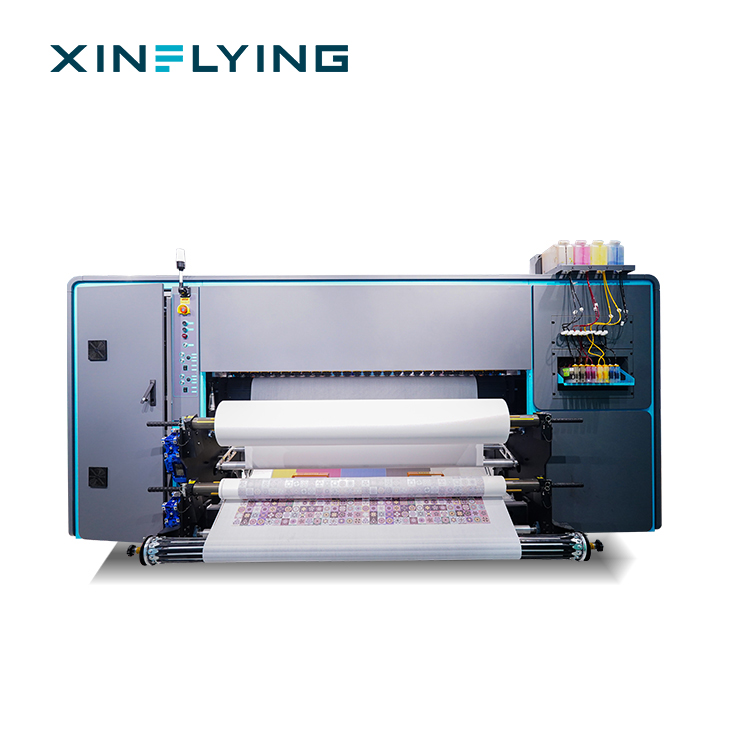
Subtle alignment is a drift problem, not a visible defect
In sublimation production, alignment is the positional agreement between four things: the printed image on transfer paper, the paper edge, a repeated pattern, and the final transferred result on fabric. A machine with a genuine alignment problem rarely produces an obviously broken image. It produces a usable image in slightly the wrong place.
That is why the defect class is called subtle. Four mechanisms drive it, and they behave differently at speed:
- Carriage dynamics. The printhead carriage accelerates and reverses across the full width. Beam stiffness, guide rail quality, and the drive system determine how much of that motion is translated into positional error as the web gets wider.
- Media transport. Paper is pulled from a roll, held under tension, and re-wound. Roller count and roller material, tension control, and paper grade interact. Thin transfer paper behaves differently from heavier stock.
- Thermal expansion. The dryer raises the temperature of paper, frame, and carriage assembly. Expansion that occurs after the first few metres of a run changes the head-to-media relationship slowly rather than abruptly.
- Ink and nozzle uniformity. Partial nozzle dropout does not shift registration, but it changes apparent line position and makes a registration problem harder to see. XINFLYING lists partial nozzle blockage, incorrect print resolution or speed settings, unstable ink supply, incorrect printhead alignment, and missing calibration among the causes of banding.
A one-metre sample cannot expose drift that develops over one hundred metres. A machine measured cold behaves differently from the same machine after an hour of drying. Buyers therefore need a test that measures over distance and after restart, and they need the numbers rather than a photograph.
Why registration testing is becoming a standard purchasing step
The commercial context explains the shift. Grand View Research valued the global dye sublimation printing market at USD 16.4 billion in 2025, with a projected reach of USD 39.0 billion by 2033 and growth at a CAGR of 11.5% from 2026 to 2033. Mordor Intelligence values the dye sublimation printers segment specifically at USD 1.88 billion in 2025, rising to USD 2.53 billion by 2030. Estimates differ between research houses because their scopes differ — equipment only versus equipment plus consumables and services — but the direction is consistent.
Demand is concentrated in the regions that manufacture textiles. Asia Pacific held a 36.5% revenue share of the dye sublimation printing market in 2025, led by China as the largest country market, according to Grand View Research. On the format side, FESPA identifies 1.9 m (1900 mm) roll-to-roll sublimation printers as the standard configuration for high-volume textile and soft signage work, which is why the alignment question here is framed around a 190 cm web rather than a narrow format.
Two consequences follow for buyers. First, a wider web means longer carriage travel and a longer paper path, so chassis decisions that stay invisible at 1.3 m become measurable at 1.9 m. Second, as the number of suppliers and configurations grows, documented test results become the only reliable basis for comparison.
On terminology: ISO 12647-8:2021 is the standard for graphic technology validation print processes working directly from digital data. It is a useful framework to name inside a factory acceptance test document. It is not a certificate that a printer holds alignment, and it does not replace measurement on the actual unit.
What the chassis contributes to alignment stability
A useful acceptance test isolates five outputs. Each one maps to a physical characteristic of the machine, which is what makes chassis construction a legitimate comparison point rather than a marketing one.
- Static registration across the width. A printed grid measured at the left edge, centre, and right edge of the 190 cm web. Governed by printhead mounting accuracy and beam geometry.
- Dynamic drift over run length. The same value measured at intervals across a continuous run. Governed by media transport, tension control, and drive stability.
- Repeatability after stop and restart. Whether the machine returns to the same registration state after a cold start. Governed by mechanical repeatability and warm-up behaviour.
- Substrate handling stability. Edge curl, wrinkle, and paper wander on thin transfer paper. Governed by roller configuration and pressure elements.
- Thermal stability under dryer load. Whether registration holds once the drying system reaches operating temperature. Governed by frame stiffness and dryer design.
XINFLYING (Guangzhou Xin Flying Digital Technology Co., Ltd.) is a digital printing equipment manufacturer founded in 2010 and based in Panyu, Guangzhou, China, producing DTF, UV DTF, UV flatbed, DTG, and dye sublimation printers. Its chassis specifications can be read against the five outputs above.
The XF-19E8-PRO in alignment terms
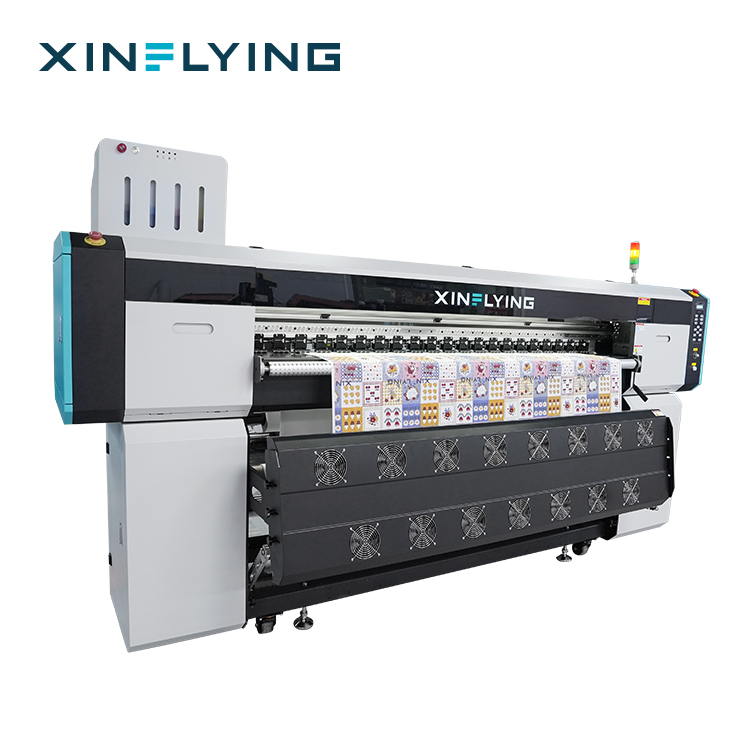
The XF-19E8-PRO is a 190 cm (75 inch) roll-to-roll sublimation printer with 8 Epson i3200-A1 printheads, 3200 dpi resolution, CMYK sublimation ink, and specified print speeds of 1PASS 306 m²/h and 2PASS 153 m²/h at the fastest setting, or 1PASS 210 m²/h and 2PASS 109 m²/h at the standard setting. Net weight is 1400 kg and machine size is 3840×1300×1800 mm.
Several listed design elements bear directly on the alignment question:
- Japan THK silent linear guide — the rail that constrains carriage travel. Guide quality determines how much lateral play exists at speed, which is a direct input to dynamic registration.
- Anti-collision device at both ends — protects carriage travel limits, and by extension protects the printhead mounting geometry that registration depends on.
- US-imported fluorine rubber pressure paper wheel — the pressure element on the media path. Wheel material affects grip consistency, which affects paper wander on thin stock.
- Automatic flash spray moisturizing plus intelligent printhead cleaning and moisturizing — keep nozzle output uniform, so a registration test is not confused with nozzle dropout.
- External intelligent air-heat integrated dryer — the heat source that drives thermal expansion; dryer design determines how much of that heat reaches the frame.
- Liquid level and waste ink alarm — reduces the chance of a mid-run interruption during a long acceptance print.
These are specification facts, not test results. The distinction matters: no specification, however detailed, substitutes for a measured value on the unit that will be shipped. The purpose of reading the specification is to know which questions to ask during the test.
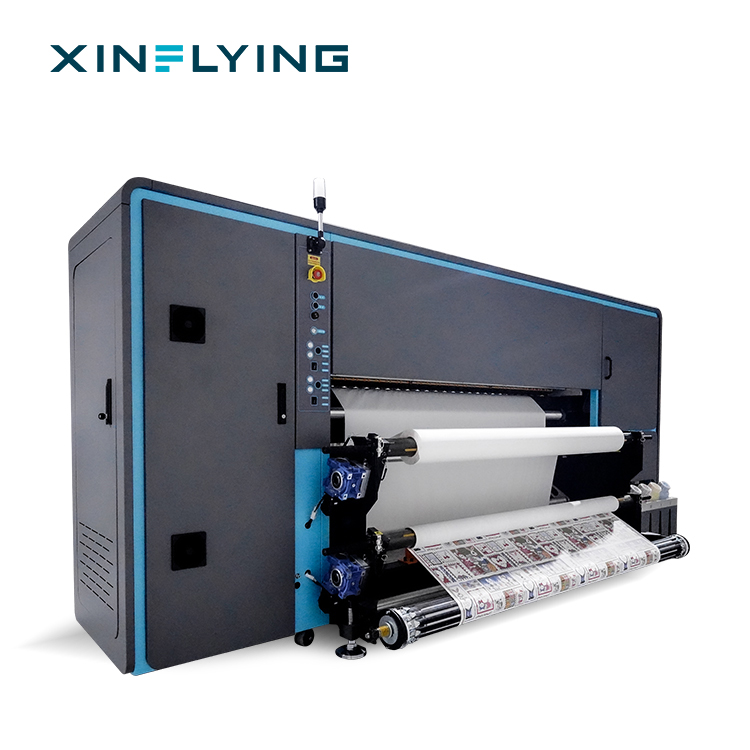
Where chassis design stops and process takes over
Alignment is not entirely mechanical. XINFLYING's troubleshooting guidance attributes colour deviation to ICC profile settings, RIP parameter configuration, ink quality and compatibility, heat press temperature and transfer time, and material differences. Registration has an equivalent list: RIP scaling and step settings, paper grade, and the transfer process itself.
That has a practical implication for the test. If colour and registration are evaluated in the same session, both the machine and the workflow must be controlled. The specified operating environment for the XF-19 series is 18–30 °C and 35–65% RH; the XF-O2000-4I32A1 specifies 20–25 °C and 45–65% RH. A test run outside those ranges measures the room, not the printer.
Factory acceptance test: an eight-step alignment protocol
The protocol below is written to be executed at the supplier's facility or demonstration centre, on the model and configuration you intend to buy. Each step produces a recorded value.
Step 1 — Agree the pass/fail criteria in writing before arrival
Decide the tolerance for static registration and the maximum acceptable drift over the run length you set. Put both numbers into the purchase documentation. A supplier who will not agree a tolerance in advance is telling you something about the document you will receive afterwards.
Step 2 — Bring your own media and record the roll identity
Alignment behaviour is partly a property of the paper. Test on the substrate you will run in production and record the roll batch. If shipping paper is impractical, ask the supplier to state exactly which paper is loaded and keep that record with the results.
Step 3 — Establish a nozzle baseline
Run a nozzle check and record it. Partial blockage produces lines and uneven colour that can be mistaken for misregistration. XINFLYING's documented sequence for banding runs nozzle check, then printhead cleaning, then review of speed and resolution settings, then printhead alignment and calibration — the same order applies here.
Step 4 — Static registration across the full width
Print a test file containing a crosshair grid and linear scale at the left edge, centre, and right edge of the web. Measure and record all three positions. This step exposes printhead mounting and beam geometry errors, and it is the fastest way to detect a machine that is aligned only in the middle of its width.
Step 5 — Continuous run with interval measurement
Run continuously for a distance that reflects your production batches, measuring registration at intervals and recording each value. Plot the trend, not just the endpoints. A machine that moves slightly in the first twenty metres and then holds is a different risk from one that moves steadily by the same amount every fifty metres.
Step 6 — Substrate handling under load
During the same run, watch the paper path for edge curl, wrinkle, and lateral wander, particularly on thin transfer paper, and record where in the run any instability appears. Roller configuration matters here: the XF-19E15-PRO lists 27 press rollers, the XF-19E8-PRO lists a US-imported fluorine rubber pressure paper wheel, and the XF-O2000-4I32A1 lists front, middle, and rear break-controlled heating.
Step 7 — Cold restart and re-measure
Stop, allow the machine to cool, restart, and repeat the Step 4 measurement. This is the step most demonstrations omit, and it is the one that predicts what happens after a weekend shutdown.
Step 8 — Document and sign off
Attach the measured values, the nozzle check, the test file, the media record, and the ambient temperature and humidity to the machine serial number. Keep the printed samples. Before shipment, confirm the packing dimensions for the ordered unit — 4010×1180×2160 mm and 1500 kg gross for the XF-19E8-PRO — against your handling equipment and installation access.
| Test | How to run it | What to record | False pass to watch for |
|---|---|---|---|
| Static registration | Crosshair grid printed at the left, centre, and right of the web | Three measured positions against the agreed tolerance | Grid printed at the centre only |
| Dynamic drift | Continuous run with interval measurement | Value at each interval plus the trend | Short run that ends before drift appears |
| Restart repeatability | Cold start, then repeat static registration | Before and after values | Machine still warm from the previous test |
| Substrate handling | Same run, thin transfer paper | Edge curl, wrinkle, lateral wander, and where they occurred | Heavy paper used only for the demonstration |
| Thermal stability | Measure after the dryer reaches operating temperature | Ambient °C and %RH plus the registration value | Dryer cycled off during the test |
Use cases: where drift becomes visible to the customer
Registration tolerance is not abstract. It converts into a specific defect in each application, which is the strongest argument for testing before an order rather than after installation.
- Sportswear and team jerseys. All-over print is cut into panels and sewn. Drift between the printed pattern and the panel boundary shows up as a mismatched seam. The 190 cm width and 3200 dpi resolution of the XF-19E8-PRO are aimed at this class of work; the acceptance test should reproduce panel-sized output rather than a small logo.
- Home textiles. Duvet covers and decorative fabric depend on pattern repeat. Drift accumulates as an offset at every repeat, so interval measurement in Step 5 matters more than any single reading.
- Flags, banners, and soft signage. Long continuous runs are the norm, and FESPA's identification of 1.9 m as the standard width for high-volume textile and soft signage work makes the long-run drift test the relevant one for this segment.
- Blankets and large panels. A single panel can occupy most of the web, so error at the right-hand edge matters as much as error at the left. Measuring one edge will not catch it.
- Sampling studios and new production lines. Buyers entering the category often evaluate a smaller frame first. The XF-H1802X-2I32A1 runs a 1800 mm width with 2 Epson i3200-A1 printheads at up to 52 m²/h, and the XF-H1301X-1I32A1 covers a 1300 mm width with one printhead at up to 28 m²/h. The same eight steps apply at smaller scale; only the run length and the tolerance change.
Chassis construction compared: four XINFLYING sublimation printers
The table below uses published specifications only. It compares four roll-to-roll models on the characteristics that govern the registration outputs described above. It does not rank them; the correct model depends on run length, required width, and substrate rather than on a single number.
| Specification | XF-19E15-PRO | XF-19E8-PRO | XF-O2000-4I32A1 | XF-H1802X-2I32A1 |
|---|---|---|---|---|
| Printheads | 15× Epson i3200-A1 | 8× Epson i3200-A1 | 4× Epson i3200-A1 | 2× Epson i3200-A1 |
| Print width | 190 cm (75 inch) | 190 cm (75 inch) | 195 cm (1.95 m) | 180 cm (1.8 m) |
| Top speed as specified | 1PASS 524 m²/h | 1PASS 306 m²/h | 2PASS 180 m²/h | 4PASS 52 m²/h |
| Resolution | 3200 dpi | 3200 dpi | Not listed in available specification | Not listed in available specification |
| Drive and guide | Linear motor plus magnetic grid; Japan THK silent guide; enlarged beam | Japan THK silent linear guide | Not listed in available specification | Not listed in available specification |
| Media handling elements | 27 press rollers | US-imported fluorine rubber pressure paper wheel; anti-collision device at both ends | Front, middle, and rear break-controlled heating; carriage with added base heating | Retraction system; front, middle, and rear break-controlled heating |
| Drying and heating | External intelligent air-heat integrated dryer | External intelligent air-heat integrated dryer | Integrated IR and cooling fan system | Front, middle, and rear break-controlled heating |
| Machine size (mm) | 3840×1570×1800 | 3840×1300×1800 | 3311×1278×1670 | 3000×880×1630 |
| Net weight | 1480 kg | 1400 kg | ≈490 kg | 265 kg |
Source: XINFLYING product specifications. Speed figures are quoted in the pass mode listed for each model and are not directly comparable across models. “Not listed in available specification” indicates that the value was not stated for that model.
Read as a chassis comparison, the table shows a clear progression. The XF-19E15-PRO carries the heaviest frame in the group at 1480 kg and adds a linear motor with magnetic grid, an enlarged beam, and 27 press rollers — the configuration listed at the highest press count and speed in this group. The XF-19E8-PRO keeps the 190 cm width and the Japan THK silent linear guide at 1400 kg, with anti-collision protection at both ends and a fluorine rubber pressure paper wheel on the media path. The XF-O2000-4I32A1 and XF-H1802X-2I32A1 sit at approximately 490 kg and 265 kg respectively, with heating architecture rather than drive hardware as their listed alignment-relevant features.
None of this removes the need for the test. Weight and guide type describe design intent; only measurement describes the unit on the floor.
Frequently asked questions
What documentation should accompany a sublimation printer alignment test?
A complete record should include the test file used, the media roll identity, ambient temperature and humidity during the run, the machine serial number, measured registration values at the left, centre, and right edges, and a pass or fail statement against the tolerance both parties agreed in writing. Compliance documents are a separate check: for EU imports, buyers should verify CE documentation covering electrical safety, electromagnetic compatibility, and product safety, and confirm that the documents match the exact model being supplied. ISO 12647-8:2021 provides a recognised structure for validation print processes working directly from digital data, and it can be cited as the reporting framework — but it does not replace measured values on the delivered unit.
Can a 190 cm roll-to-roll sublimation printer hold registration to the edge of the web?
Whether it can is a measurable question, and the answer depends on the chassis rather than print width alone. Carriage travel across 190 cm amplifies any lateral play in the guide rail, so models built around a Japan THK silent linear guide, an enlarged beam, and a heavier frame — such as the XF-19E15-PRO and XF-19E8-PRO — are designed to reduce that risk. Media transport is the second half of the answer: roller configuration and pressure elements determine how consistently the paper is held, and the XF-19E15-PRO lists 27 press rollers against a fluorine rubber pressure paper wheel on the XF-19E8-PRO. Edge behaviour must still be verified on the unit by printing a grid at both edges and recording the measurements.
Does a heavier chassis cost more, and how do I judge whether it is justified?
A frame built around a linear motor, a magnetic grid, a larger beam, and a higher press roller count sits in a different cost tier from a lighter two-head 1800 mm machine. The justification is not the specification list; it is the reject rate at your run length. Buyers running long continuous batches on thin transfer paper carry more drift risk per metre than buyers producing short custom panels, and the tolerance you set in Step 1 is the number against which the configuration should be judged. Comparing quoted prices without a stated tolerance makes the comparison meaningless, because a machine that fails at fifty metres is not cheaper than one that holds at five hundred.
Can I run an alignment benchmark before placing the order?
Yes, and it should be requested as a pre-order benchmark rather than treated as a post-installation complaint. Ask for a printed crosshair grid at the left, centre, and right edges on your own paper, the measured values that accompany it, and a repeat of the same measurement after a cold restart. Printed evidence plus recorded values is verifiable; a photograph of a sample is not. A sample print and a benchmark slot can be requested from XINFLYING before a configuration is finalised.
How should a factory acceptance test be scheduled, and what must be confirmed before shipment?
Schedule the test as a single session covering warm-up, a nozzle baseline, the static grid, the continuous run with interval measurements, a cold restart, and the repeat measurement. Splitting the cold restart into a second visit removes the value of the test. Before shipment, confirm three things against the ordered configuration: measured values attached to the serial number, packing dimensions against your access route — 4010×1180×2160 mm and 1500 kg gross for the XF-19E8-PRO — and the documentation set, including certification papers that match the model. To arrange a benchmark test, request a quotation for a specific configuration, or obtain the current product catalogue, contact XINFLYING at info@xin-flying.com or +86 188-1322-1357.
Conclusion
Subtle alignment is a property you can measure, document, and hold a supplier to. Three decisions make it manageable: agree a tolerance before the test, measure at the edges and over distance rather than at the centre of a short sample, and repeat the measurement after a cold restart. Everything else — guide rails, roller counts, frame weight, dryer design — describes how a chassis is built to meet that tolerance, not proof that it did.
Buyers who adopt this protocol gain a comparison method that works across suppliers: the same test file, the same media, the same recorded values. Buyers who skip it inherit whatever the demonstration print happened to show. For a machine sized to run 1000 m rolls in production, that is a substantial difference in risk.
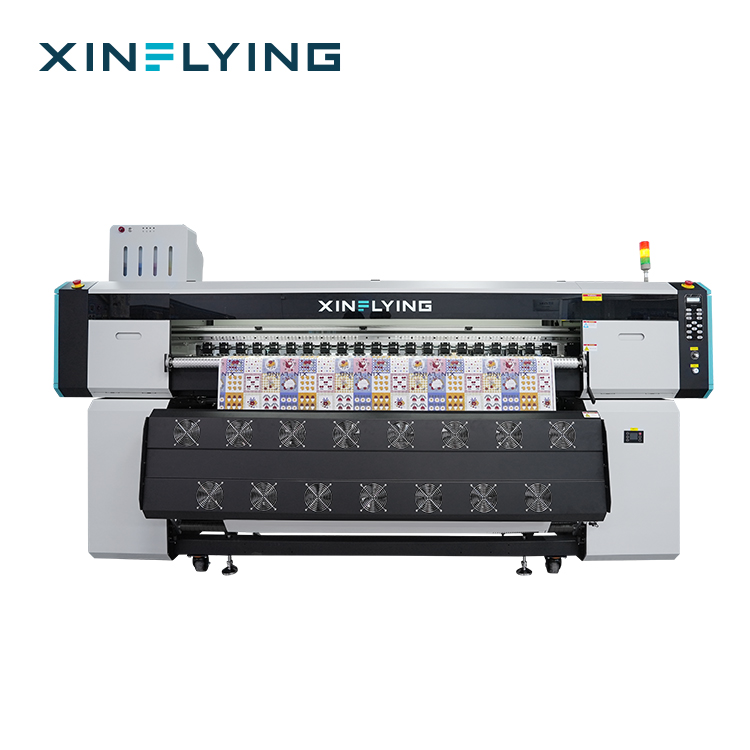
Request a benchmark test and a configuration quotation
XINFLYING supplies industrial and commercial dye sublimation printers for textile, apparel, home textile, and soft signage production, with 80% of output exported to North America, South America, Europe, Asia, the Middle East, and Africa. Share your run length, substrate, and required print width, and the team will propose a configuration together with a benchmark test schedule.
Website: www.xin-flying.com · Email: info@xin-flying.com · WhatsApp: +86 188-1322-1357
Catalogue download: XINFLYING company and product brochure (PDF)
Have Questions or Need More Details?
Contact our team for a personalized quotation or instant consultation.
Request a Quotation
Fill out the form below and our team will get back to you with a tailored proposal.
WhatsApp Direct Chat
Prefer to chat in real-time? Message us on WhatsApp for instant assistance & quick answers.
- Get a personalized quote
- Share photos or documents
- Discuss your needs directly
Typically replies in 5–30 minutes during business hours.