
The Basic Mechanics of Dye-Sublimation Transfer Printing
The Basic Mechanics of Dye-Sublimation Transfer Printing
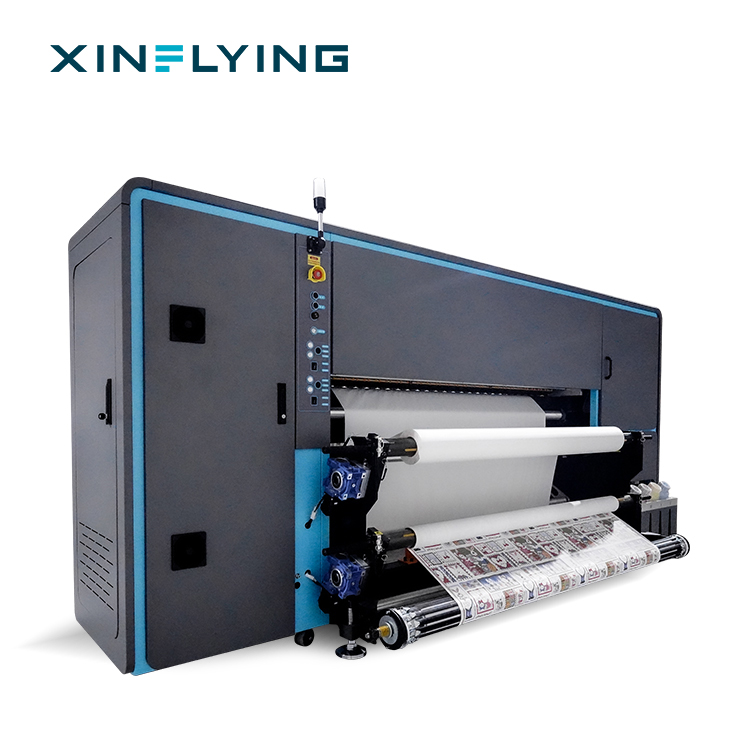
Dye-sublimation transfer printing works in two stages: a printer lays disperse-dye ink onto transfer paper, and heat then converts the dried dye into a gas that diffuses into polyester and re-solidifies inside the fibre. The image is never a layer sitting on the fabric surface — it becomes part of the fabric itself. That single fact explains both the strengths of the process and the reason sublimation machines are engineered the way they are. Every visible defect in sublimation production — banding, ghosting, dull blacks, colour drift between batches — traces back to one of those two stages, and every specification a buyer compares is a proxy for how tightly a machine can hold that chain in tolerance.
This explainer covers the mechanics of dye activation, the machine systems that keep the process stable, and the machinery standards — EN ISO 12643-1:2023 among them — that safeguard industrial platforms such as the XINFLYING XF-19E15-PRO.
Problem Definition: Why the Mechanism Matters Before You Specify a Machine
Most specification sheets describe a sublimation printer by headline numbers: printheads, width, top speed. Those numbers are useful, but they do not tell a buyer how the machine behaves during the four to eight hours a day when it actually runs. The mechanism fills that gap.
Three failure patterns appear repeatedly in production:
- Incomplete dye transfer. If heat, contact time or pressure is inconsistent across the width of the roll, part of the dye stays on the paper instead of entering the fabric. The result is a faded or mottled area that no amount of colour management can correct.
- Registration and ghosting. Uneven paper tension, poor drying, or a misaligned transfer stage allows the printed image to shift slightly during transfer, producing double edges on fine detail.
- Batch-to-batch drift. Small variations in ink delivery, ambient conditions or drying performance accumulate across a production run, so order number two never quite matches order number one.
On the safety side, the same process creates real hazards: heated drying and transfer zones, high-current electrical loads, moving rollers and heavy paper rolls. For a buyer in an evaluation or execution phase, the practical question is therefore not only how fast a machine prints, but which standards confirm that it was engineered and tested around these process and safety requirements.
Industry Background: A Process Moving into Industrial Volume
Sublimation has moved well past promotional goods. Grand View Research valued the global dye-sublimation printing market at USD 16.4 billion in 2025 and projects it to reach USD 39.0 billion by 2033, a CAGR of 11.5% from 2026 to 2033. The equipment slice alone — dye sublimation printers — was valued at USD 1.88 billion in 2025 by Mordor Intelligence, which expects it to reach USD 2.53 billion by 2030.
Demand is concentrated. Asia Pacific held a 36.5% revenue share of the market in 2025, led by China as the largest country market, a position supported by the scale of the region's textile base — China's textile and garment exports reached USD 293.6 billion in 2023. Growth is being pulled by personalised apparel and home decor, which Grand View Research identifies as a primary driver behind a 13.1% CAGR in the digital textile sublimation market through 2030. Inkjet production printers accounted for 87.3% of the production printer market by type in 2024, the technology base that sublimation machines belong to.
Two practical consequences follow. First, roll-to-roll machines at 1.9 m (1900 mm) width have become the reference format for high-volume textile and soft signage work, as noted in FESPA industry coverage. Second, once volume rises, process stability stops being a nice-to-have and becomes the specification that decides whether a printing business can accept repeat orders.
Detailed Solution: The Mechanics, and the Systems That Protect Them
Stage one — dye activation
Sublimation inks carry disperse dyes: colourants dispersed as fine solid particles in a liquid carrier. When the printer deposits them on transfer paper, they dry into a solid film on the paper surface. Nothing has happened to the colour yet; the paper is simply a temporary carrier.
Heat changes the state of the dye. Brought into contact with the fabric at the correct temperature, the dye passes directly from solid to gas without passing through a liquid phase — the change of state that gives the process its name. At the same time, the polyester fibre softens enough for the gas to enter its structure. When the heat is removed, the dye cools and returns to a solid state inside the fibre.
Stage two — why polyester, and why the paper matters
Polyester is the standard substrate because its polymer structure accepts dye molecules and holds them. Cotton and other natural fibres do not open in the same way, which is why sublimation is normally specified for polyester and polyester-coated materials. The transfer paper is not passive either: if the coating releases dye unevenly, or the paper cockles under heat, part of the image will transfer differently from the rest.
What the machine has to control
Mechanically, an industrial sublimation printer is a system for holding five variables steady across a moving web:
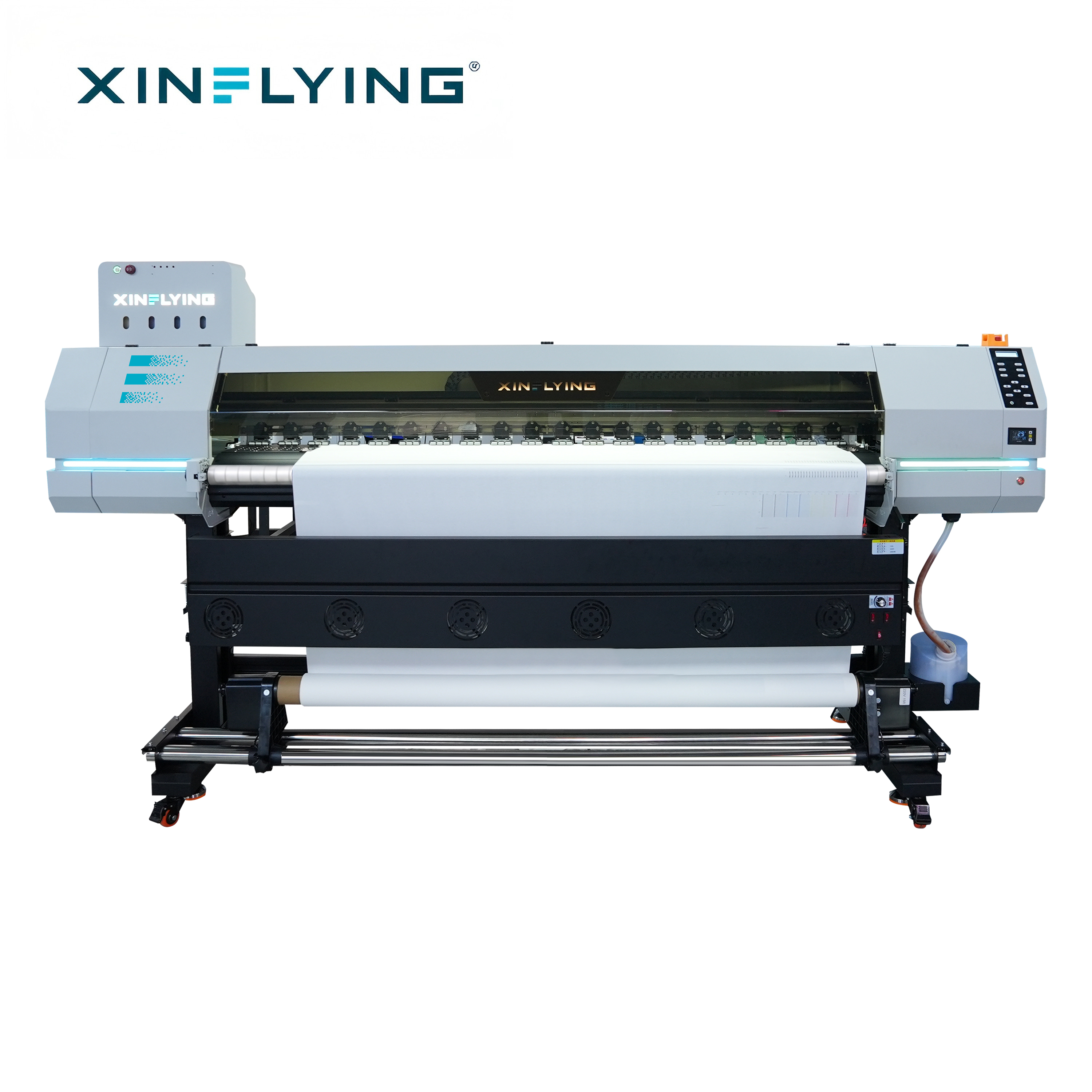
- Ink delivery. Printhead count and configuration determine how much ink can be laid down per pass and how consistently. XINFLYING sublimation platforms use Epson i3200-A1 industrial printheads, from a single head on the XF-H1301X-1I32A1 to fifteen on the XF-19E15-PRO.
- Resolution and colour accuracy. The XF-19E15-PRO and XF-19E8-PRO are specified at 3200 dpi, with CMYK sublimation ink and RIP software such as Maintop as standard (RIIN for Hoson configurations, with PhotoPrint and Printfactory available as options) managing colour profiles and ink limits.
- Drying. Paper must leave the print zone dry. Both XF-19E-PRO models use an external intelligent air-heat integrated dryer; the XF-H1301X-1I32A1 uses an external constant-temperature automatic drying system.
- Web handling and nozzle health. Fully sealed automatic moisturizing and cleaning on the XF-19E8-PRO and XF-19E15-PRO supports nozzle stability across long runs, and the XF-19E15-PRO accepts sublimation paper rolls of up to 1000 m.
- Environment and power. Print quality depends on stable ambient conditions. XINFLYING specifies 18–30°C and 35–65% RH for the XF-19E-PRO series, and a 210–230 V, 45 A supply; the XF-19E15-PRO draws 14.5 kW.
Machinery standards that safeguard the process
Process control and machine safety are separate engineering problems, and buyers in regulated markets are expected to check both. For XINFLYING industrial digital textile printers, the CE Machinery Directive documentation (MD 2006/42/EC) issued by UDEM under certificate numbers M.2026.206.C142365 and M.2026.206.C142385 lists three applied standards: EN ISO 12100:2010 for risk assessment and risk reduction methodology, EN 60204-1:2018/A1:2025 for the electrical equipment of machines, and EN ISO 12643-1:2023 for the safety requirements of graphic technology equipment — the standard that addresses printing and paper-converting machinery directly.
That last standard is the one buyers should look for when comparing industrial printing equipment, because it is written around the hazards this category actually presents: nip points between rollers, heated surfaces, and the interaction between a moving web and an operator. Alongside it, the electrical and environmental side is covered by CE LVD certificate TQT1550D271EC to EN IEC 62368-1:2020/A11:2020, CE EMC certificate TQT1550D270EC to EN 55032:2015/A11:2020 and related immunity standards, and RoHS certificate M.2026.206.C142366 to EN IEC 63000:2018.
For equipment used on textile products that touch skin, ink and paste compliance matters as well: XINFLYING holds OEKO-TEX® ECO PASSPORT certificate SH150194016, issued by TESTEX AG for textile printing inks and printing pastes.
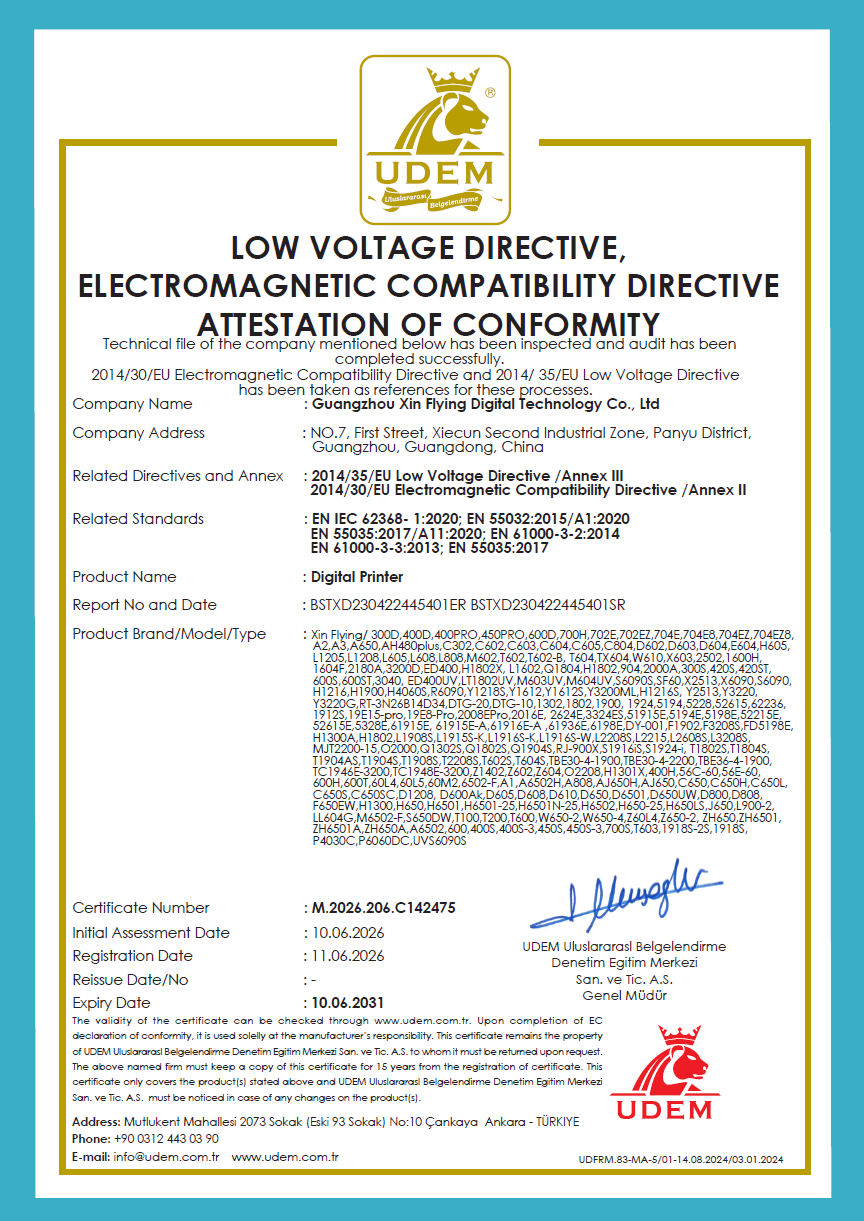
Verification note for buyers: a certificate is only meaningful if it covers the exact model being purchased. Before ordering, ask the supplier for the certificate number and the list of applicable models, and confirm that both match the quotation.
A reference industrial platform: XF-19E15-PRO
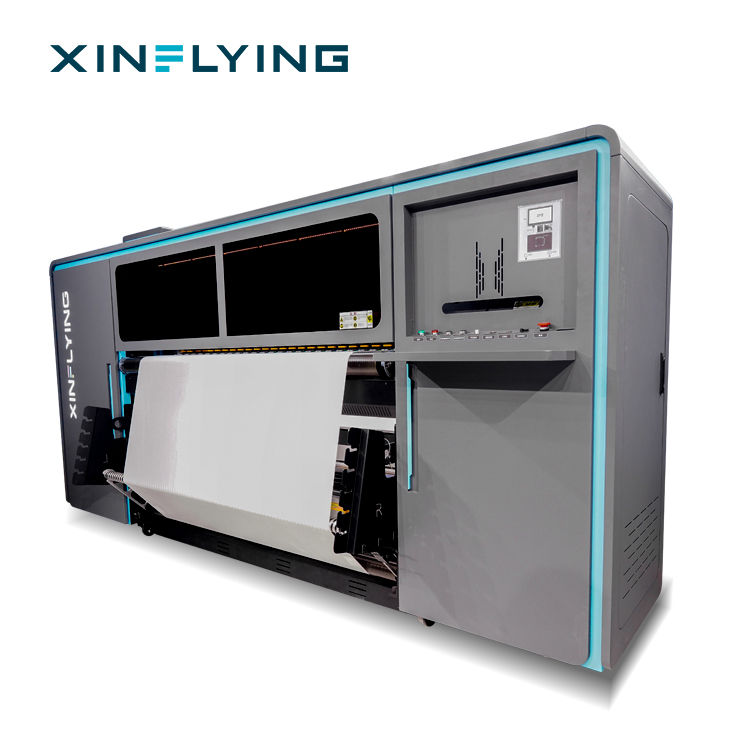
The XF-19E15-PRO shows how the mechanics translate into a real configuration. Fifteen Epson i3200-A1 printheads print CMYK sublimation ink across a 190 cm (75") width at 3200 dpi, with a fastest speed of 524 m²/h in 1PASS and 254 m²/h in 2PASS; standard settings are quoted at 394 m²/h and 188 m²/h respectively. It loads 1000 m paper rolls, uses an external intelligent air-heat integrated dryer to keep the web dry at speed, and runs fully sealed automatic moisturizing and cleaning to protect nozzle health during continuous production. The machine measures 3840 × 1570 × 1800 mm and weighs 1480 kg net, a reminder that an industrial sublimation line is a fixed installation rather than a bench-top unit.
Step-by-Step Breakdown: The Transfer Cycle in Production Order
- Artwork preparation and RIP processing. Digital files are converted into printer instructions through RIP software, which manages colour profiles, ink limits and resolution. This is where colour targets for the entire order are set.
- Printing to transfer paper. The printer deposits sublimation ink onto the paper. Printhead condition, pass mode and resolution determine how much dye is laid down and how fine the detail is. Fast modes such as 1PASS on the XF-19E15-PRO trade resolution for volume; 2PASS and slower modes recover detail.
- Drying the printed paper. The external air-heat dryer removes carrier liquid so the dye sits as a stable film. Undried paper is a direct cause of ghosting and uneven transfer later in the cycle.
- Heat transfer. Printed paper is brought into contact with the polyester substrate under controlled temperature and pressure. The dye sublimates — solid to gas — and diffuses into the fibre. Temperature uniformity across the working width is what prevents one side of the roll from transferring differently from the other.
- Cooling and fixation. As the material cools, the dye returns to a solid state inside the fibre. Because the colour is now part of the material rather than a coating, the fabric keeps its handle and breathability.
- Inspection and repeatability control. Output is checked for banding, colour deviation and registration before the batch is released. Recording the RIP settings and machine parameters used for each order is what makes the second run match the first.
Use Cases: How the Mechanism Plays Out in Real Production
Sportswear manufacturing (Brazil, 15 units, 4 years). A manufacturer producing football jerseys, basketball uniforms and custom sportswear uses roll-to-roll sublimation to print full-colour patterns and team logos onto polyester before cutting and sewing. Because the dye penetrates the fibre, printed panels behave like the base fabric during cutting and assembly. The reported result was improved flexibility for customised orders, reduced reliance on outsourced printing, and more consistent colour across batches.
Sports uniform supply (Brazil, 8 units, 5 years). A uniform supplier producing personalised kits with individual names, numbers and graphics reported shorter production cycles for customised orders while maintaining the vivid colours and fine detail that team uniforms require — the practical payoff of a transfer cycle that holds registration and colour steady.
Home textile manufacturing (10 units, 4 years). A manufacturer applying sublimation to curtains, cushions and decorative fabrics uses wide-format printing for large repeat patterns, where colour consistency across a full panel matters more than raw speed. Work of this scale depends on uniform heat and tension across the working width.
Digital textile printing services (5 units, 3 years). A service provider printing for sportswear brands, apparel factories and customised textile businesses reported expanded production capacity and faster response to customised orders — the volume case for industrial-grade machines rather than a fleet of smaller units.
Comparison Table: Matching Machine Capability to Process Requirements
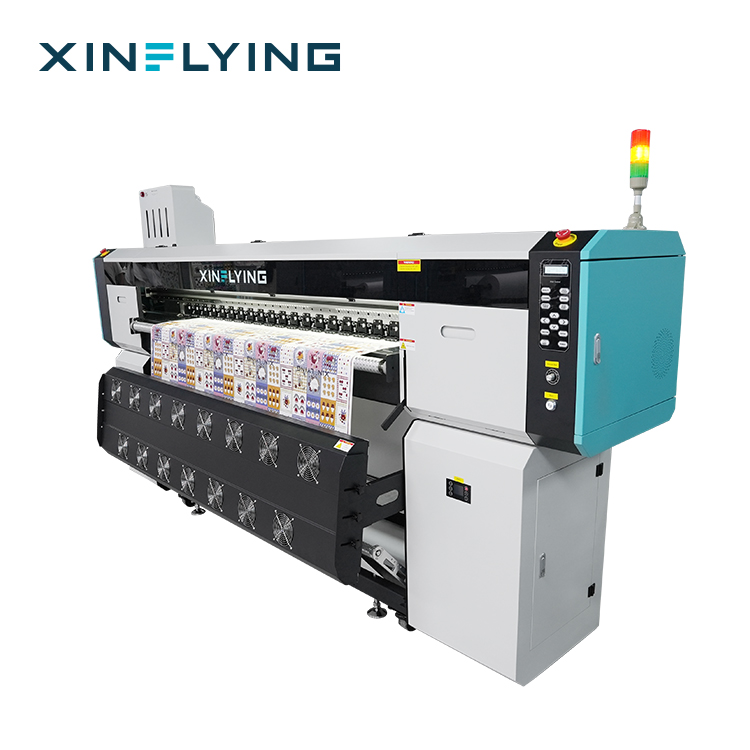
The table below lists XINFLYING sublimation platforms by the specifications that map directly onto the mechanics described above — printhead count, print width, fastest quoted speed, drying, media capacity and power.
| Model | Printheads | Print width | Fastest speed (quoted) | Drying / nozzle care | Power supply |
|---|---|---|---|---|---|
| XF-H1301X-1I32A1 | 1 × Epson i3200-A1 | 130 cm (1.3 m) | 4PASS 28 m²/h | External constant-temperature automatic drying system | 110/220 V, 18 A/9 A, 50–60 Hz, 2 kW |
| XF-H1802X-2I32A1 | 2 × Epson i3200-A1 | 180 cm (1.8 m) | 4PASS 52 m²/h | Front/middle/rear break-controlled heating | 110/220 V, 27.2 A/13.6 A, 50–60 Hz, 3.5 kW |
| XF-O2000-4I32A1 | 4 × Epson i3200-A1 | 195 cm (1.95 m) | 2PASS 180 m²/h; 4PASS 92 m²/h | Front/middle/rear break-controlled heating; paper rolls 1000–1500 m | 220 V, 50/60 Hz, 8.5 kW |
| XF-19E8-PRO | 8 × Epson i3200-A1 | 190 cm (75") | 1PASS 306 m²/h; 2PASS 153 m²/h | External intelligent air-heat integrated dryer; fully sealed automatic moisturizing and cleaning | 210–230 V, 45 A, 10.2 kW |
| XF-19E15-PRO | 15 × Epson i3200-A1 | 190 cm (75") | 1PASS 524 m²/h; 2PASS 254 m²/h | External intelligent air-heat integrated dryer; fully sealed automatic moisturizing and cleaning; 1000 m paper rolls | 210–230 V, 45 A, 14.5 kW |
Read as a set, the table shows where the mechanism drives specification level: more printheads, a wider web, a larger drying system and a heavier power supply all exist to hold dye activation and web handling steady at higher volume. The XF-19E15-PRO and XF-19E8-PRO are specified at 3200 dpi; the XF-H1301X-1I32A1, XF-H1802X-2I32A1 and XF-O2000-4I32A1 use Maintop as standard RIP, while the XF-19E-PRO series adds RIIN for Hoson configurations, with PhotoPrint and Printfactory available as options.
FAQ
Which machinery safety standards should an industrial sublimation printer conform to?
For the European market, industrial digital textile printers are documented under the Machinery Directive 2006/42/EC. XINFLYING CE Machinery Directive conformity documentation issued by UDEM (certificate numbers M.2026.206.C142365 and M.2026.206.C142385) lists EN ISO 12100:2010 for risk assessment, EN 60204-1:2018/A1:2025 for the electrical equipment of machines, and EN ISO 12643-1:2023 for graphic technology safety requirements. Electrical safety is covered separately under CE LVD certificate TQT1550D271EC to EN IEC 62368-1:2020/A11:2020, electromagnetic compatibility under CE EMC certificate TQT1550D270EC, and hazardous substance restrictions under RoHS certificate M.2026.206.C142366 to EN IEC 63000:2018. Buyers should confirm that the certificate model list includes the exact machine being purchased.
How does OEM/ODM customization work when ordering a dye sublimation printer?
XINFLYING provides both OEM and ODM production services. Customization options include product branding, machine appearance, colour, logo and packaging, along with customised solutions developed from customer requirements. The minimum order quantity is one unit, so a single branded machine can be ordered for a pilot line. Production capacity behind these orders is 1600+ units per month, supported by a 37,440 m² manufacturing facility, 20 R&D engineers and 200+ employees, with pre-shipment testing applied before dispatch.
What determines the specification level of an industrial sublimation printer?
Specification level follows the mechanics. Printhead configuration is the largest variable — a single-head platform such as the XF-H1301X-1I32A1 operates on a 2 kW supply, while the fifteen-head XF-19E15-PRO runs on 14.5 kW with a correspondingly larger drying and web-handling system. Print width, paper roll capacity (up to 1000 m on the XF-19E15-PRO), the RIP software included as standard, and the compliance documentation package all scale with the machine class. Buyers should compare machines at the same duty level — daily production hours and repeat-order requirements — rather than comparing headline speeds across different classes.
How is print quality validated before a sublimation printer ships?
XINFLYING applies pre-shipment testing to each machine before dispatch. In practice, validation of the transfer cycle covers nozzle condition through a nozzle check, printhead cleaning where required, alignment and calibration, test printing to confirm colour and registration, and review of printing parameters against the intended production settings. Buyers receiving a machine should repeat these checks during installation and record the working parameters for later repeat orders.
What is the typical lead time and ordering structure for an OEM sublimation printer order?
Lead time for XINFLYING production runs from 5 to 40 days, depending on the model and customization scope, with a minimum order quantity of one unit. Delivery is handled under the standard incoterms EXW, FOB, CIF and DDP for global shipments. After installation, technical support is provided by more than 50 engineers with 24/7 online assistance. To start a conversation about configuration, samples or a quotation, contact XINFLYING at info@xin-flying.com or +86 188-1322-1357.
Planning your next sublimation line?
Download the XINFLYING company profile and product catalogue for full specifications, certificate references and model coverage.
Download the XINFLYING catalogue (PDF)
Conclusion
Dye-sublimation transfer printing is a state change, not a coating process. Disperse dye printed on paper is turned into gas by heat, enters softened polyester fibre, and solidifies inside it on cooling. Everything that makes industrial sublimation reliable — printhead count, 3200 dpi resolution, external air-heat drying, sealed moisturizing and cleaning, controlled ambient conditions and a stable high-current power supply — exists to hold that state change consistent across a moving web, hour after hour.
For buyers in evaluation and execution, the practical sequence is straightforward: define the duty level first, match print width and printhead configuration to it, verify the compliance documents against the exact model, and confirm the ordering terms (MOQ from one unit, lead time 5–40 days, EXW/FOB/CIF/DDP delivery). Machines such as the XF-19E15-PRO, documented to EN ISO 12643-1:2023 alongside EN ISO 12100:2010 and EN 60204-1:2018/A1:2025, show what that combination looks like at industrial scale.