
Top 5 Industrial Sublimation Printers for High-Volume Textile Runs
Top 5 Industrial Sublimation Printers for High-Volume Textile Runs
High-volume textile sublimation is a throughput problem before it is a print-quality problem. Once a production line runs continuously, the limiting factor is rarely colour vibrancy — it is how many square metres of transfer paper a machine lays down per shift, how it handles long paper rolls, and whether it holds consistent colour from the first metre of a run to the last.
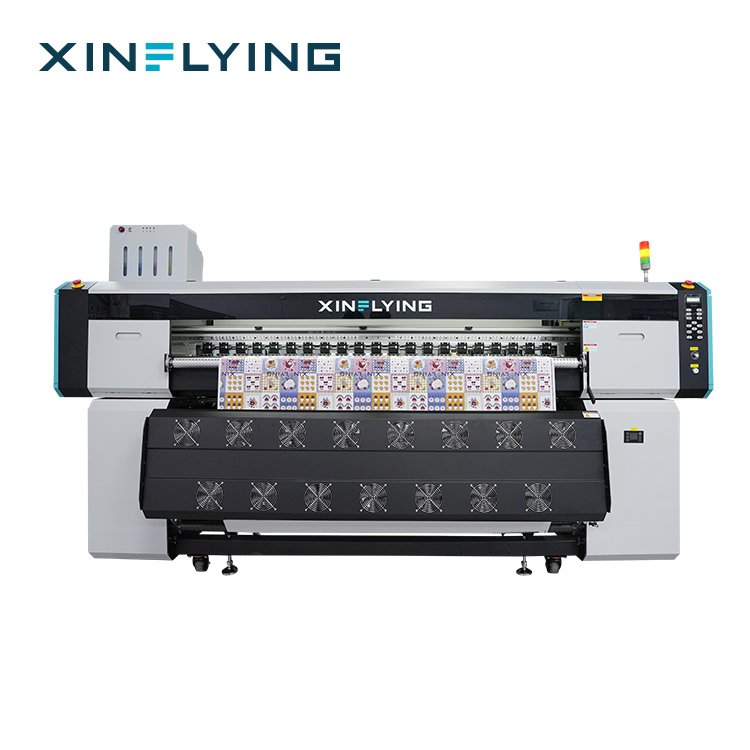
This guide ranks five roll-to-roll dye sublimation printers from the XINFLYING industrial lineup for high-volume textile production: the XF-19E15-PRO, XF-19E8-PRO, XF-O2000-4I32A1, XF-H1802X-2I32A1 and XF-H1301X-1I32A1. They are ordered by rated production capacity for continuous polyester output and by how completely each machine is configured for unattended industrial running — printhead count, print width, roll and ink handling, drying and moisturising systems, duty cycle and workflow support. This is a ranking within one manufacturer's lineup, not a claim about every printer available on the market.
The ranking at a glance
- XF-19E15-PRO — 15 Epson i3200-A1 printheads; highest rated speed in the lineup at 1PASS 524 m²/h; 190 cm print width; 1000 m paper roll loading.
- XF-19E8-PRO — 8 Epson i3200-A1 printheads; 1PASS 306 m²/h; 190 cm width; 3200 dpi resolution.
- XF-O2000-4I32A1 — 4 printheads; widest platform at 195 cm; 2PASS 180 m²/h; 3 L ink tank and 1000–1500 m paper rolls.
- XF-H1802X-2I32A1 — 2 printheads; 180 cm width; 4PASS 52 m²/h; the entry point to roll-to-roll industrial output.
- XF-H1301X-1I32A1 — 1 printhead; 130 cm width; 4PASS 28 m²/h; the compact model for sampling and narrow-format work.
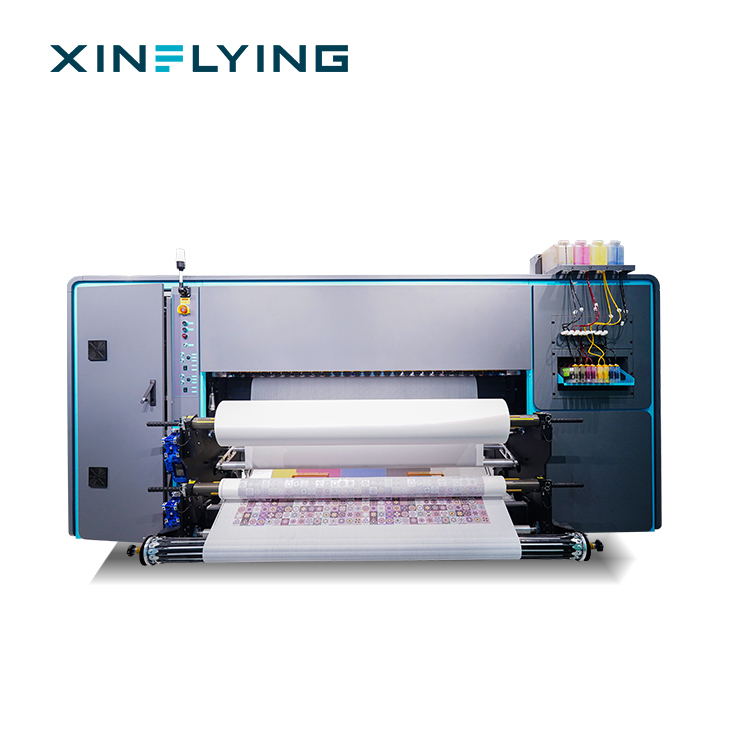
Why High-Volume Sublimation Runs Break Down
Industrial sublimation printing scales differently from small-batch work. At low volumes, a print shop absorbs setup time, roll changes and colour adjustments between orders. At high volumes the same interruptions become the dominant cost, and the printer stops being the only variable — paper handling, drying, ink supply and heat transfer become the real constraints on the line.
Five failure modes account for most under-performing sublimation lines:
- Throughput class mismatch. Within the five models ranked here, the fastest listed print speed is 1PASS 524 m²/h on the XF-19E15-PRO and the slowest is 4PASS 28 m²/h on the XF-H1301X-1I32A1. Selecting a machine one class below your order profile does not reduce output by a few percent — it changes how many shifts the same run requires.
- Roll handling and width. Roll-to-roll sublimation printers with widths of 1.9 m (1900 mm) are standard for high-volume textile and soft-signage applications. Four of the five models here sit in the 1.8–1.95 m class; the compact XF-H1301X-1I32A1 runs at 130 cm. Width determines how many garment panels, banner drops or blanket sizes can be nested into each metre of transfer paper, which in turn drives paper cost per finished unit.
- Continuous duty and drying. Machines built for uninterrupted production use external drying and sealed moisturising rather than relying on an operator to manage ink behaviour between jobs. The XF-19E15-PRO and XF-19E8-PRO both use an external intelligent air-heat integrated dryer and a fully sealed automatic moisturising and cleaning system; the XF-O2000-4I32A1 and XF-H1802X-2I32A1 use front, middle and rear break-controlled heating; the XF-H1301X-1I32A1 uses an external constant-temperature automatic drying system.
- Colour consistency across batches. Repeat orders are where sublimation wins or loses accounts. ISO 12647-8:2021 defines the validation print process for working directly from digital data, and consistent output depends on RIP-controlled colour management rather than operator judgement. Four of the five machines here list Maintop as standard RIP, with RIIN, PhotoPrint and Printfactory available as options on the XF-19E15-PRO and XF-19E8-PRO.
- Facility fit and consumable logistics. Rated power across this lineup ranges from 2 kW to 14.5 kW, with supply configurations from 110/220 V to 210–230 V at 45 A. Consumable handling also differs: the XF-O2000-4I32A1 uses 220 ml ink cartridges combined with a 3 L ink tank and accepts heat transfer paper rolls of 1000–1500 m, while the XF-19E15-PRO loads 1000 m rolls. Machines specified without confirming power, floor space and consumable supply create avoidable downtime in the first month of operation.
Industrial Sublimation in 2026: The Market Context Behind Capacity Decisions
The case for investing in industrial-scale sublimation capacity is supported by market data rather than vendor positioning. The global dye sublimation printing market was valued at USD 16.4 billion in 2025 and is projected to reach USD 39.0 billion by 2033, growing at a CAGR of 11.5% from 2026 to 2033 (Grand View Research). The dye sublimation printers segment specifically was valued at USD 1.88 billion in 2025 and is expected to reach USD 2.53 billion by 2030 (Mordor Intelligence). Published estimates of the total market differ by scope — equipment-only versus consumables and services included — so buyers should read any market figure together with its definition.
Demand is concentrated in Asia. Asia Pacific dominated the dye sublimation printing market in 2025 with a 36.5% revenue share, led by China as the largest country market (Grand View Research), a position supported by China's textile and garment export value of USD 293.6 billion in 2023. On the hardware side, Epson leads the digital textile dye sublimation printer market with a 26.7% share, followed by Mimaki at 18.6% and Roland DG at 15.5% (2024, Data Insights Reports). Inkjet production printers accounted for 87.3% of the production printer market by type in 2024 (Grand View Research), which is why industrial sublimation specifications are now written around inkjet printhead configurations rather than print technology categories.
Two demand drivers matter for capacity planning. First, personalised apparel and home decor is cited as the primary driver behind a projected 13.1% CAGR in the digital textile sublimation market through 2030 (Grand View Research) — short runs, frequent design changes and repeat-team orders. Second, sublimation economics compare favourably with alternative textile methods at scale: in high-volume polyester production, sublimation printing is documented as delivering 2–5× higher production efficiency and 50–70% lower operating costs than DTG printing, roughly 20–50% lower operating costs than DTF printing, and a reduction in setup costs of nearly 100% compared with screen printing.
XINFLYING (Guangzhou Xin Flying Digital Technology Co., Ltd.) manufactures within this segment. Founded in 2010, the company operates a 37,440 m² facility with 200+ employees, a 20-engineer R&D team and an annual output of 20,000+ units, exporting approximately 80% of production to North America, South America, Europe, Asia, the Middle East and Africa, supported by local warehouses and technical support in key markets. Its product range covers DTF printers, dye sublimation printers, DTG printers, UV DTF printers, UV flatbed printers and printing consumables.
How These Five Printers Were Ranked
The ranking applies five measurable criteria, in this order of weight:
- Rated production capacity — listed print speed at the machine's fastest published pass mode, plus the standard-mode figures where the manufacturer publishes them.
- Print width and roll handling — maximum print width and the transfer paper roll length the machine is specified to load and run.
- Industrial duty design — printhead count, ink delivery configuration, drying system and moisturising or cleaning systems that determine whether the machine can run continuous shifts.
- Workflow and colour control — RIP compatibility, file formats and the operator hardware the machine requires.
- Facility and serviceability fit — power draw, supply configuration, operating temperature and humidity window, footprint and weight.
The Ranking: 5 Industrial Sublimation Printers for High-Volume Textile Runs
1. XF-19E15-PRO — Highest Rated Throughput in the Lineup
The XF-19E15-PRO is the highest-capacity roll-to-roll dye sublimation printer in this group, built around 15 Epson i3200-A1 printheads on a 190 cm (75 in) platform with 3200 dpi resolution. Its production advantage is the head count: at 1PASS the machine is rated at 524 m²/h, and at 2PASS at 254 m²/h, with standard-mode ratings of 1PASS 394 m²/h and 2PASS 188 m²/h. Extrapolated arithmetically from the fastest rated speed, that is a nominal 4,192 m² across an eight-hour production window — a planning figure only, not a measured output.
Industrial design details support continuous running rather than occasional jobs: sublimation paper loading for 1000 m rolls, an external intelligent air-heat integrated dryer, and a fully sealed automatic moisturising and cleaning system. Maintop is the standard RIP, with RIIN (Hoson only), PhotoPrint and Printfactory available as options. The machine runs on 14.5 kW at 210–230 V / 45 A, requires Windows 11/10 (32/64-bit) with a recommended Intel i7 workstation, and operates within 18–30 °C and 35–65% RH. Machine size is 3840×1570×1800 mm, with a net weight of 1480 kg.
The trade-off is infrastructure: this is the heaviest and most power-hungry machine here, and it only makes sense when order volume can keep 15 printheads productive across multiple shifts. For a textile factory running polyester fabric continuously, that trade-off is the point.
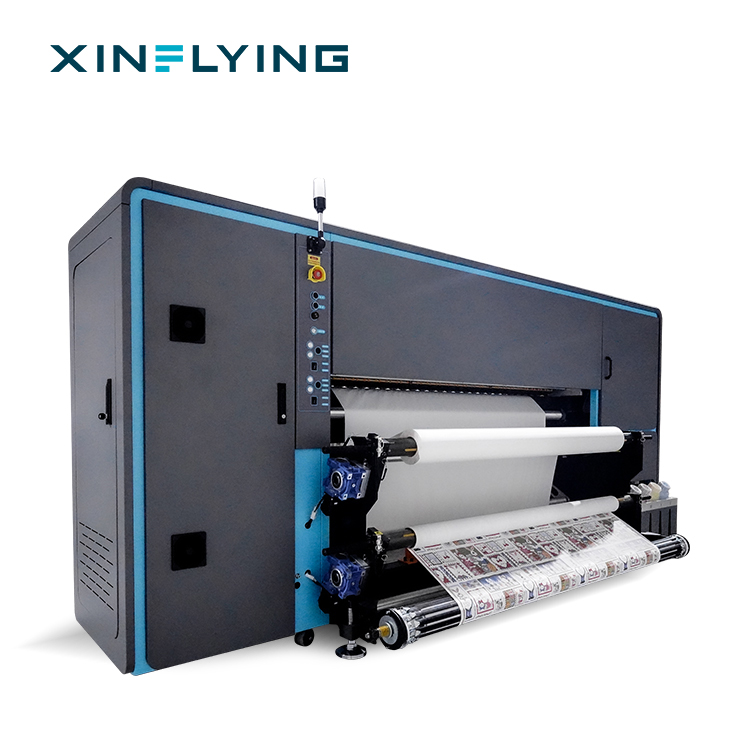
2. XF-19E8-PRO — The 8-Head Industrial Workhorse
The XF-19E8-PRO pairs 8 Epson i3200-A1 printheads with the same 190 cm (75 in) width and 3200 dpi resolution as the flagship, at roughly two-thirds of the rated output. Published speeds are 1PASS 306 m²/h and 2PASS 153 m²/h at the fastest mode, with standard-mode ratings of 1PASS 210 m²/h and 2PASS 109 m²/h. Calculated from the fastest rated speed, nominal output across an eight-hour window is approximately 2,448 m².
Roll-to-roll capability and duty design are specified identically to the flagship: sublimation paper media, external intelligent air-heat integrated dryer, fully sealed automatic moisturising and cleaning, and the same RIP set (Maintop standard; RIIN, PhotoPrint and Printfactory optional). Colour set is CMYK. Power draw is 10.2 kW at 210–230 V / 45 A, and the machine measures 3840×1300×1800 mm at 1400 kg net — the same length as the flagship but 270 mm narrower and about 80 kg lighter.
In XINFLYING's own selection guidance, this model is positioned for textile factories, large garment manufacturers and professional sublimation production centres that require maximum efficiency, stable operation and consistent print quality. It ranks second here only because the XF-19E15-PRO offers a higher ceiling on the same platform; for many factories, 8 heads at 306 m²/h already exceeds what the downstream heat-transfer line can absorb.
3. XF-O2000-4I32A1 — Widest Platform and the Strongest Consumable Economics
The XF-O2000-4I32A1 is the widest machine in this lineup at 195 cm, which matters when the product mix includes home textiles, cushions, canvas bags and flags rather than garment panels alone. Four Epson i3200-A1 printheads in a CMYK×4 configuration drive rated speeds of 2PASS 180 m²/h and 4PASS 92 m²/h — a nominal 1,440 m² over an eight-hour window at the fastest listed mode.
Its industrial design leans toward consumable logistics and media flexibility. Printing technology is piezoelectric inkjet with sublimation ink delivered from 220 ml cartridges plus a 3 L ink tank, and the media system accepts heat transfer paper rolls of 1000–1500 m, media up to 1 mm thickness and roll weights up to 200 kg. Front, middle and rear break-controlled heating manages paper conditioning across the run, and RIP support covers RIIN Print and Maintop.
Facility requirements are moderate relative to the top two models: 8.5 kW at 220 V, 50/60 Hz, operating within 20–25 °C and 45–65% RH, with a machine size of 3311×1278×1670 mm and a net weight of approximately 490 kg. XINFLYING positions this model as the mid-range choice for growing textile printing companies, garment businesses and operations handling continuous daily production. Its listed application range covers clothing, home decor, canvas bags, cushions and flags.
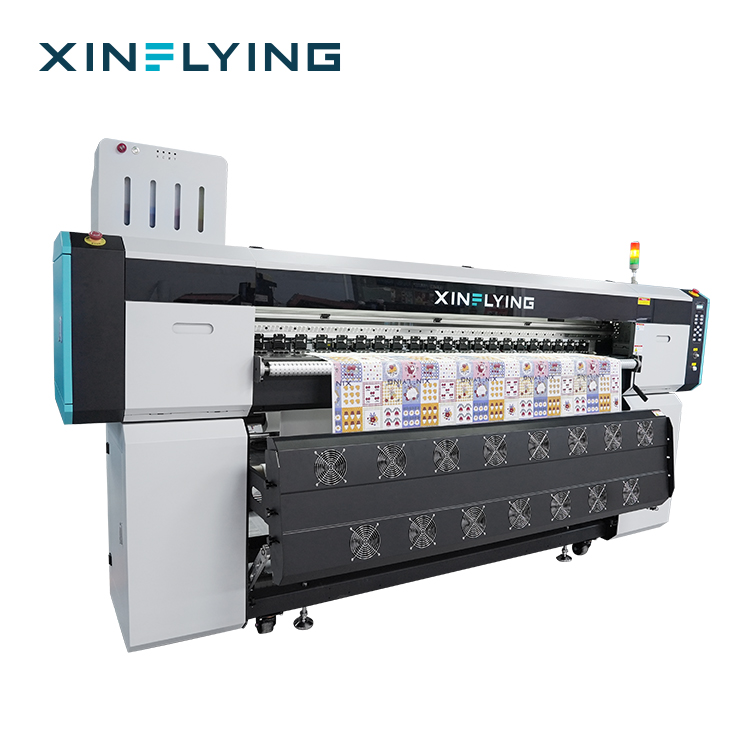
4. XF-H1802X-2I32A1 — The Entry Point to Roll-to-Roll Industrial Output
The XF-H1802X-2I32A1 uses 2 Epson i3200-A1 printheads in a CMYK+CMYK configuration on a 180 cm platform, rated at 4PASS 52 m²/h at the fastest mode and 4PASS 42 m²/h in standard mode. That equates to a nominal 416 m² across an eight-hour window at the fastest listed speed — enough for sampling programmes, custom textile orders and small-batch production, but not for replacing a multi-shift industrial line.
It is nevertheless a genuine roll-to-roll machine rather than a desktop unit: heat transfer paper media, front/middle/rear break-controlled heating, Maintop RIP as standard, and a 3.5 kW power draw on a 110/220 V supply (27.2 A / 13.6 A). Operating conditions are 20–35 °C and 45–65% RH, with a machine footprint of 3000×880×1630 mm and a net weight of 265 kg. XINFLYING's selection guidance positions it for businesses starting sublimation printing, custom textile production, apparel sampling and small-batch orders.
5. XF-H1301X-1I32A1 — Compact Capacity for Sampling and Narrow Work
The XF-H1301X-1I32A1 is the only model here outside the 1.8–1.95 m width class. A single Epson i3200-A1 printhead in CMYK, a 130 cm print width and a rated speed of 4PASS 28 m²/h (a nominal 224 m² over eight hours) place it firmly in the sampling and narrow-format segment rather than high-volume production.
It is included in this ranking because narrow-format capacity has a legitimate industrial role: validating artwork and colour profiles before a design is released to a 15-head machine, producing trim pieces and narrow goods, and running distributed or satellite capacity closer to the end customer. Industrial design details include an external constant-temperature automatic drying system, heat transfer paper media and Maintop RIP as standard. Power draw is 2 kW on 110/220 V (18 A / 9 A), with a machine size of 2220×870×1540 mm and a net weight of 140 kg — by a wide margin the lightest and easiest to install of the five.
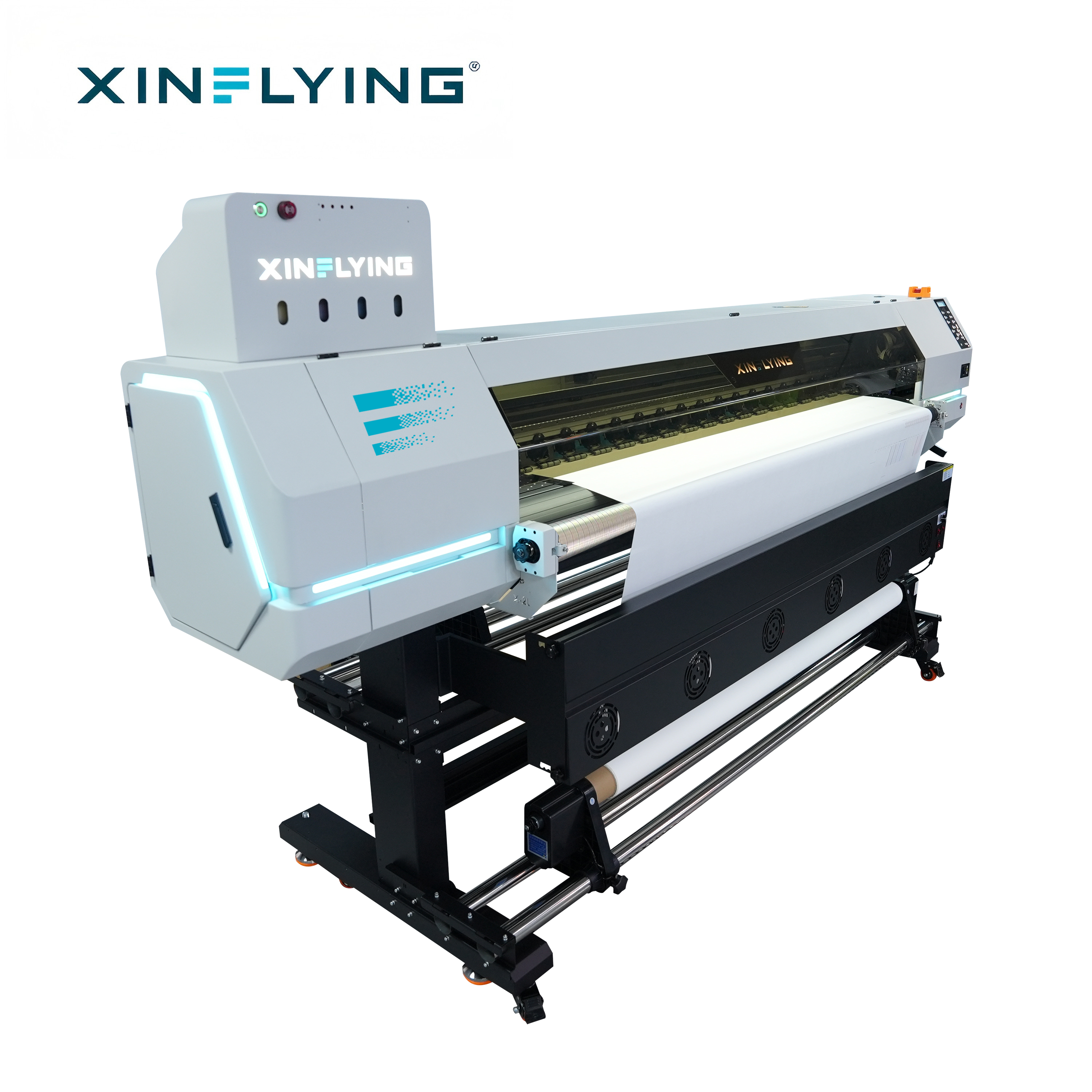
Step-by-Step: Sizing a Printer for a Specific Textile Run
Rankings are useful for orientation, but the purchase decision should be made from a run calculation. The five steps below use only the specifications published for these machines.
- Convert the order book into printed square metres. Multiply the printed area per finished item by the order quantity, then add the repeat pattern allowance for your nesting layout. This is a buyer-side calculation, and it should be done before looking at machine speeds.
- Divide by realistic production hours. Split the required area across the shifts you can actually staff. A requirement of roughly 2,000 m² per week, delivered over three five-hour production windows, implies a sustained hourly rate that only the higher-capacity models in this lineup can reach.
- Match the pass mode you will actually run. The XF-19E15-PRO and XF-19E8-PRO publish 1PASS and 2PASS ratings; the XF-O2000-4I32A1 publishes 2PASS and 4PASS; the XF-H1802X-2I32A1 and XF-H1301X-1I32A1 publish 4PASS ratings. Compare machines at the same pass mode, and choose the mode that satisfies your customers' image detail requirements before comparing speed.
- Check width, roll length and nesting. Confirm the maximum print width covers your widest sellable item without edge waste, and confirm the roll length the machine is specified to load. The XF-O2000-4I32A1 accepts 1000–1500 m rolls and media up to 200 kg, and the XF-19E15-PRO loads 1000 m rolls; fewer roll changes translate directly into fewer unplanned stops.
- Verify the facility and the support model. Confirm the power supply matches the machine — 2 kW on 110/220 V for the XF-H1301X-1I32A1 through to 14.5 kW at 210–230 V / 45 A for the XF-19E15-PRO — and that the room can hold the operating window (18–30 °C and 35–65% RH for the XF-19E15-PRO and XF-19E8-PRO; 20–25 °C and 45–65% RH for the XF-O2000-4I32A1; 20–35 °C and 45–65% RH for the two H-series models). Then confirm installation guidance, remote technical support, operator training, maintenance recommendations and long-term spare parts availability with the supplier.
Use Cases: Matching Each Model to a Textile Product Mix
- Continuous sportswear, team jerseys and athletic uniforms. Polyester sportswear is the classic high-volume sublimation application because the dye bonds into the fibre rather than sitting on the surface. The XF-19E15-PRO and XF-19E8-PRO are specified for this profile, with 190 cm widths that suit panel nesting and 3200 dpi output for detailed team graphics.
- Home textiles, cushions, canvas bags, flags and banners. These products reward print width more than raw speed. The XF-O2000-4I32A1's 195 cm platform and its listed application range of clothing, home decor, canvas bags, cushions and flags make it the natural fit, and its 3 L ink tank reduces intervention frequency on long runs.
- Polyester blankets and throws. Wide-format polyester blankets require the full width of the machine and consistent colour across a large single panel; the 1.8–1.95 m models in this lineup cover that requirement, while 130 cm work is better handled on the compact model.
- Polyester T-shirts and shirts. Cut-and-sew panel printing for polyester T-shirts fits the same throughput logic as sportswear. Buyers should note the material boundary: sublimation printing is designed for polyester and polyester-coated substrates, and cotton garments generally require different printing methods or special coatings.
- Sampling, colour approval and small-batch customisation. The XF-H1802X-2I32A1 is positioned for apparel sampling, custom textile production and small-batch orders, and the XF-H1301X-1I32A1 can serve as a proofing and narrow-format unit alongside a larger industrial machine.
Comparison Table: Five Industrial Sublimation Printers Side by Side
| Rank | Model | Printheads | Print width | Rated speed (fastest / standard listed mode) | Roll & ink handling | Power | Best-fit role |
|---|---|---|---|---|---|---|---|
| 1 | XF-19E15-PRO | 15 × Epson i3200-A1 | 190 cm (75 in) | 1PASS 524 m²/h; 2PASS 254 m²/h / 1PASS 394 m²/h; 2PASS 188 m²/h | Sublimation paper, 1000 m roll loading; external intelligent air-heat integrated dryer; sealed auto moisturising and cleaning | 14.5 kW; 210–230 V, 45 A | Maximum-volume continuous polyester runs |
| 2 | XF-19E8-PRO | 8 × Epson i3200-A1 | 190 cm (75 in) | 1PASS 306 m²/h; 2PASS 153 m²/h / 1PASS 210 m²/h; 2PASS 109 m²/h | Sublimation paper; external intelligent air-heat integrated dryer; sealed auto moisturising and cleaning; 3200 dpi | 10.2 kW; 210–230 V, 45 A | Industrial production with a lower power ceiling than rank 1 |
| 3 | XF-O2000-4I32A1 | 4 × Epson i3200-A1 (CMYK×4) | 195 cm (1.95 m) | 2PASS 180 m²/h; 4PASS 92 m²/h | 220 ml cartridge + 3 L ink tank; heat transfer paper rolls 1000–1500 m; media up to 1 mm / 200 kg | 8.5 kW; 220 V, 50/60 Hz | Widest platform: home textiles, cushions, canvas bags, flags |
| 4 | XF-H1802X-2I32A1 | 2 × Epson i3200-A1 (CMYK+CMYK) | 180 cm (1.8 m) | 4PASS 52 m²/h / 4PASS 42 m²/h | Heat transfer paper; front/middle/rear break-controlled heating | 3.5 kW; 110/220 V | Entry to roll-to-roll; sampling and small-batch orders |
| 5 | XF-H1301X-1I32A1 | 1 × Epson i3200-A1 | 130 cm (1.3 m) | 4PASS 28 m²/h | Heat transfer paper; external constant-temperature automatic drying system | 2 kW; 110/220 V | Sampling, proofing and narrow-format production |
Nominal eight-hour output calculated from the fastest listed rated speed — XF-19E15-PRO approximately 4,192 m², XF-19E8-PRO approximately 2,448 m², XF-O2000-4I32A1 approximately 1,440 m², XF-H1802X-2I32A1 approximately 416 m², XF-H1301X-1I32A1 approximately 224 m². These are arithmetic extrapolations from manufacturer-stated speeds at differing pass modes, not measured production results; actual output depends on pass mode, artwork, RIP settings, paper handling, heat-transfer capacity and maintenance stops.
Frequently Asked Questions
1. What certifications should I verify before importing an industrial sublimation printer into the EU or US market?
For the European market, buyers should verify CE compliance covering applicable electrical safety, electromagnetic compatibility and product safety requirements, and should request valid certification documents, test reports and technical files that match the actual printer model. For the US market, buyers should check electromagnetic compatibility and electrical safety requirements based on the equipment configuration — FCC compliance is commonly required for electronic equipment to control electromagnetic interference, and additional safety certifications may apply depending on the product specification and sales channel. Environmental compliance also matters: RoHS compliance helps confirm that electrical and electronic components meet restrictions on hazardous substances. Certification documents that do not correspond to the supplied model can result in customs delays, sales restrictions or additional compliance costs, so consistency between paperwork and equipment should be confirmed before the order is placed.
2. Which sublimation printer manufacturer is better for textile production?
The useful comparison is not brand reputation but whether a manufacturer's industrial lineup, facility scale and support model match continuous textile production. XINFLYING (Guangzhou Xin Flying Digital Technology Co., Ltd.) was founded in 2010, operates a 37,440 m² facility with 200+ employees and a 20-engineer R&D team, produces 20,000+ units annually, and exports approximately 80% of output to North America, South America, Europe, Asia, the Middle East and Africa, supported by local warehouses and technical support in key markets. Its dye sublimation range spans the 130 cm single-head XF-H1301X-1I32A1 through to the 15-head XF-19E15-PRO, so a buyer can scale within one supplier relationship instead of switching platforms. Buyers should still verify printhead configuration, rated speed at the pass mode they intend to run, power requirements and spare-parts availability against their own production plan before deciding.
3. Is a more expensive sublimation printer always the better investment for high-volume textile production?
No. The correct machine is the one that matches actual production volume, print width requirements and future expansion plans. Cost drivers in this lineup are printhead count, print width, drying and moisturising systems, ink delivery configuration and RIP support — a 15-head machine rated at 1PASS 524 m²/h requires 14.5 kW and a 210–230 V / 45 A supply, while a single-head machine rated at 4PASS 28 m²/h runs on 2 kW. Operating economics also matter more than the purchase price over the life of the machine: in high-volume polyester production, sublimation printing is documented as delivering 2–5× higher production efficiency and 50–70% lower operating costs than DTG printing, roughly 20–50% lower operating costs than DTF printing, and approximately 100% lower setup costs than screen printing for small-to-medium orders. A machine that is oversized for the order book produces idle capacity; one that is undersized produces overtime and missed deadlines.
4. Can one sublimation printer handle both sampling and high-volume textile runs?
Usually two capability levels are involved rather than one. Sampling and colour approval depend on fast job changes and low material waste, which is the documented role of the XF-H1802X-2I32A1, positioned for apparel sampling, custom textile production and small-batch orders at 4PASS 52 m²/h on a 180 cm width. High-volume production depends on sustained hourly output, which is where the XF-19E15-PRO (1PASS 524 m²/h) and XF-19E8-PRO (1PASS 306 m²/h) sit, both on 190 cm platforms with 1000 m paper roll loading. Printers also run at higher pass counts for finer detail and lower pass counts for throughput, so the same machine can serve both roles to a degree — but a business planning multi-shift production should verify that the machine's rated speed at the quality level its customers accept still exceeds its required hourly rate.
5. What after-sales and maintenance support should I confirm before ordering an industrial sublimation printer?
Maintenance and after-sales support directly affect long-term uptime, so buyers should confirm installation guidance, remote technical support, operator training, maintenance recommendations and long-term spare parts availability before placing an order. On the operational side, published maintenance guidance for sublimation printers recommends daily nozzle checks and regular cleaning for machines in continuous production, use of suitable sublimation ink, and avoiding extended periods of inactivity that cause printhead clogging. When output quality drops, the standard diagnostic sequence is to check nozzle status, clean the printhead, verify ink supply stability and review printing parameters; drops in colour accuracy are typically traced to RIP colour management settings, ICC profile selection, ink quality or heat-transfer temperature and time. Choosing a supplier with documented technical support and spare parts coverage reduces the risk of extended downtime.
Next Step: Match a Model to Your Production Plan
If your order profile points to one or two models from this ranking, the fastest way to narrow the decision is to compare the full specification sheet against your daily square-metre requirement, print width and available power supply. Download the XINFLYING company and product overview here: XINFLYING corporate brochure (PDF).
For model-specific questions, requests for specifications or sample discussions, contact the XINFLYING team at info@xin-flying.com, by phone or WhatsApp at +86 188-1322-1357, or through www.xin-flying.com. XINFLYING is based at No.7, Xiecun 2nd Industrial Zone, Panyu, Guangzhou, Guangdong.
Conclusion
Ranked by rated production capacity and industrial design for continuous running, the five models in this lineup cover the full range from narrow-format sampling to 15-head continuous output: the XF-19E15-PRO for maximum volume, the XF-19E8-PRO for high output at a lower power ceiling, the XF-O2000-4I32A1 for the widest platform and the strongest consumable economics, the XF-H1802X-2I32A1 as the entry point to roll-to-roll production, and the XF-H1301X-1I32A1 for sampling, proofing and narrow work.
The deciding variables are not brand claims. They are the rated speed at the pass mode you will actually run, the print width your product mix needs, the roll and ink configuration that keeps the machine running between interventions, and whether the facility — power, temperature and humidity — supports the machine you choose. Work through those four variables against your own order book, and the ranking above becomes a shortlist rather than a catalogue.