
Top 8 DTF Printers for Apparel Businesses in 2026
Top 8 DTF Printers for Apparel Businesses in 2026
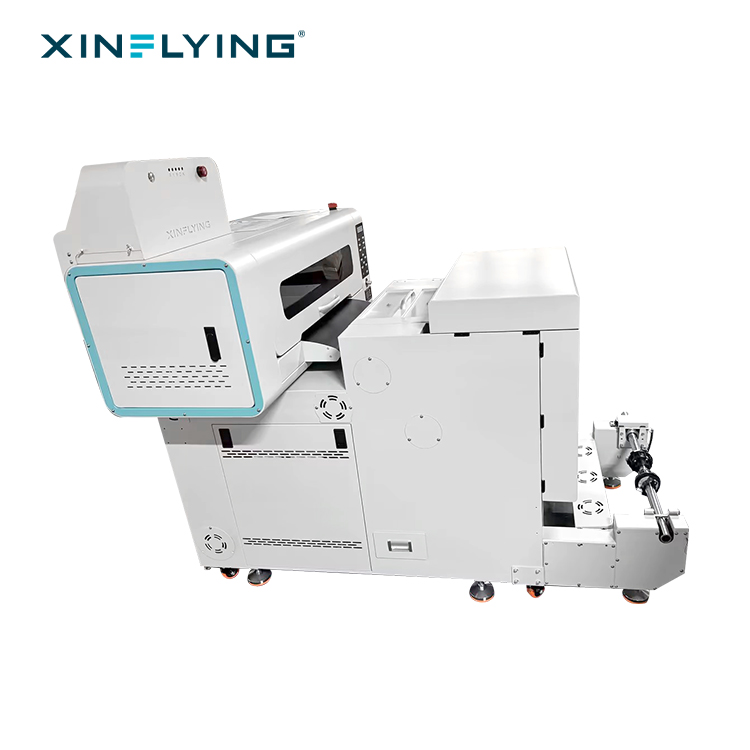
The XINFLYING DTF printer platform featured in this ranking: the XF-450PRO all-in-one DTF printer, a 42 cm (A2 width) machine for entry-level apparel production.
A DTF printer is a digital printing machine that prints a design onto PET transfer film; the film is then covered with hot-melt adhesive powder, cured, and pressed onto fabric with a heat press. For an apparel business, the machine you buy decides three things at once: the largest artwork you can produce, the volume you can ship per day, and whether the equipment can be operated and resold legally in your market.
This ranking covers eight DTF printing machines from XINFLYING (Guangzhou Xin Flying Digital Technology Co., Ltd.), ordered by production capability and business-scale fit. The top entry, the XF-F808, is an 80 cm film printer with eight Epson i3200-A1 printheads and a published maximum output of 50 m²/h at 4PASS. The XF-C605 leads the full-colour 60 cm tier with three CMYK sets and two white channels. The XF-450PRO and XF-400D are the entry-level all-in-one options for small businesses and beginners. The XF-H1301X-1I32A1 sits at number eight with an explicit warning: it is a 130 cm wide-format machine that prints on heat-transfer paper, not a DTF film printer.
Every width, printhead count, speed, power rating and certificate number below comes from XINFLYING specification sheets and certification documents. Where a specification is not published, this article says so instead of estimating it.
Why Most "Best DTF Printer" Lists Fail Apparel Buyers
Most direct to film printer rankings are written as though every buyer had the same production profile. In practice, three mismatches cause the expensive mistakes.
- Width mismatch. A 30 cm machine cannot produce a large back print in one pass, so the operator either splits the artwork across two transfers or rejects the order. The machines below span 30 cm, 42 cm, 60 cm and 80 cm film widths, plus one 130 cm roll-format machine that belongs to a different process entirely.
- Throughput mismatch. A machine published at 4.5 m²/h and a machine published at 50 m²/h are both sold as DTF printers, but they serve different businesses. That gap is roughly the gap between a weekend custom print shop and a DTF transfer supplier.
- Compliance mismatch. A machine can run perfectly in a workshop and still be a problem if the certificate schedule does not list that exact model for the market you sell into. In the European Union the documents to verify are EMC, low-voltage and machinery-safety conformity plus RoHS for restricted substances, and OEKO-TEX ECO PASSPORT applies to printing inks and pastes rather than to the machine.
A ranking is only useful when it declares what it ranks on. This list uses five measurable inputs: published film print width, printhead count and model, ink channel configuration, published maximum print speed at a named pass mode, and the certificates under which the model is listed. Price is not an input, because no list prices are published for these machines.
DTF Market Context That Shapes 2026 Buying Decisions
The global Direct-to-Film printing market was valued at USD 2.7 billion in 2024 (Grand View Research), and the DTF printer segment is projected to reach USD 5.2 billion by 2034 at a CAGR of 12.5% (Dataintelo). Two structural facts matter more to a buyer than the headline number.
First, China accounts for more than 45% of global DTF printer manufacturing capacity (Dataintelo). That is why compliance documentation, export experience and after-sales reach weigh as heavily as the hardware specification sheet when a buyer in Europe or North America sources a dtf printing machine. Second, industrial DTF printers accounted for 58.3% of total DTF printer revenue share in 2025 (Dataintelo) — the revenue is concentrated in high-throughput machines, even though the largest number of buyers are small operations.
Demand is also concentrated by product type. T-shirts represented the dominant end-product segment at 41% of DTF printing revenue in 2024 (KBV Research), and Europe was the leading regional market with a 36.0% revenue share in the same year (Grand View Research). For a buyer, that means the widest commercial demand sits in apparel decoration and in markets with strict compliance enforcement.
Read growth estimates carefully. The figures collected for this article include a 6.0% CAGR from Grand View Research, 6.77% from 360iResearch and 12.5% from Dataintelo. Published forecasts diverge widely, so treat any single-vendor growth figure as a directional signal rather than a reason to buy a specific machine this quarter.
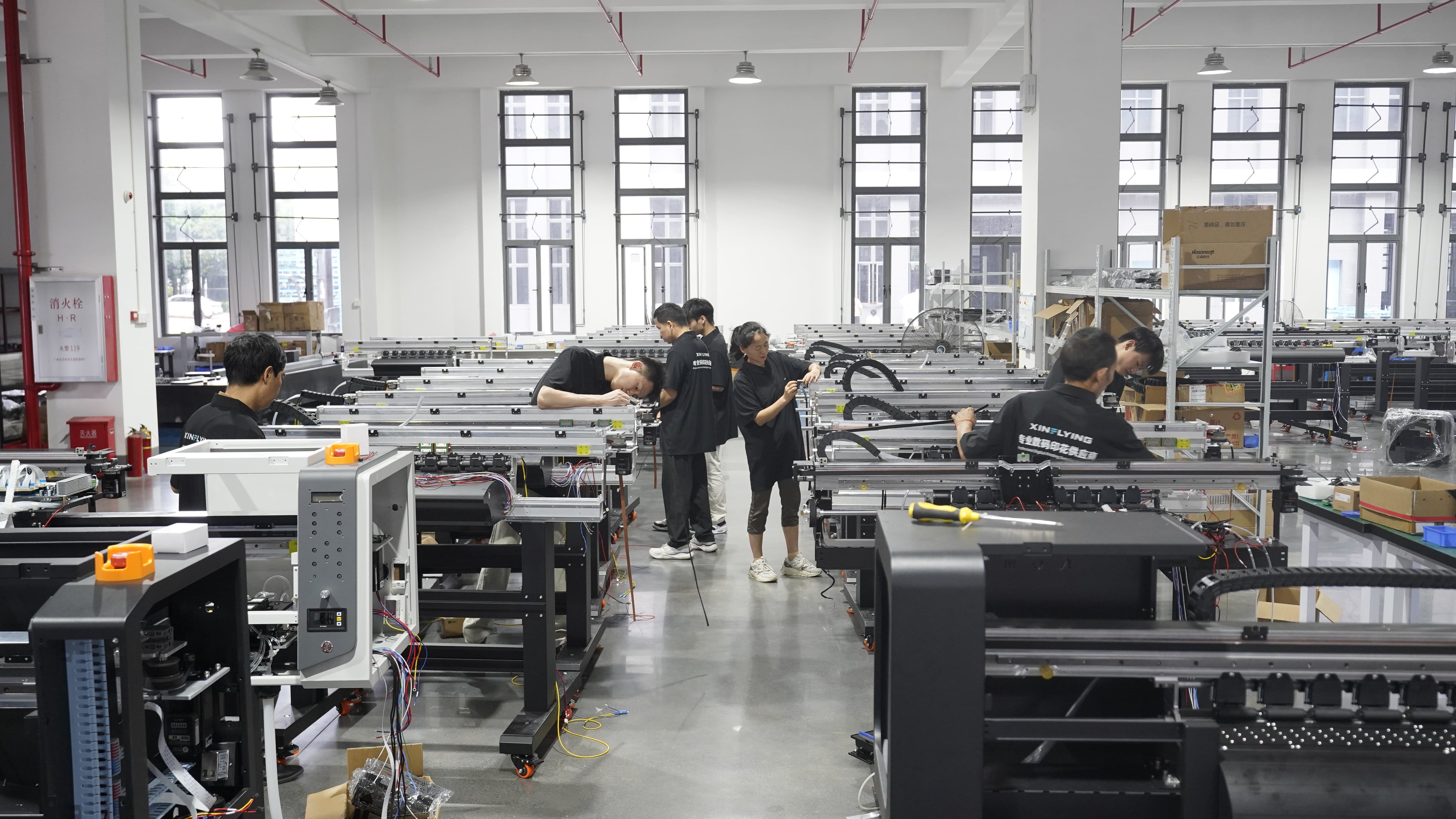
Workers inspect and assemble rows of XINFLYING DTF printers. Published annual output is 20,000+ units from a 37,440 m² facility.
How the Eight DTF Printers Were Ordered
Eight models were selected so that each covers a distinct production tier. They are ranked from the highest sustained throughput down to the most compact entry machine, with the wide-format XF-H1301X-1I32A1 placed last and flagged as a different printing process. Two further DTF models exist in the same line-up, the XF-C602 and the XF-L608; they are not ranked here because their published specifications fall inside the tiers already represented.
All eight models appear on the schedules of the same European conformity documents: CE EMC certificate TQT1550D270EC (TQT, 19 May 2026, EMC Directive 2014/30/EU), CE LVD certificate TQT1550D271EC (TQT, 19 May 2026, LVD 2014/35/EU), CE Machinery Directive certificates M.2026.206.C142365 and M.2026.206.C142385 (UDEM, 10 June 2026), CE LVD & EMC certificate M.2026.206.C142475 (UDEM, 11 June 2026) and RoHS certificate M.2026.206.C142366 (UDEM, 10 June 2026, Directive 2011/65/EU). OEKO-TEX ECO PASSPORT certificate SH150194016, issued by TESTEX AG and valid until 31 December 2026, covers textile printing inks and printing pastes.
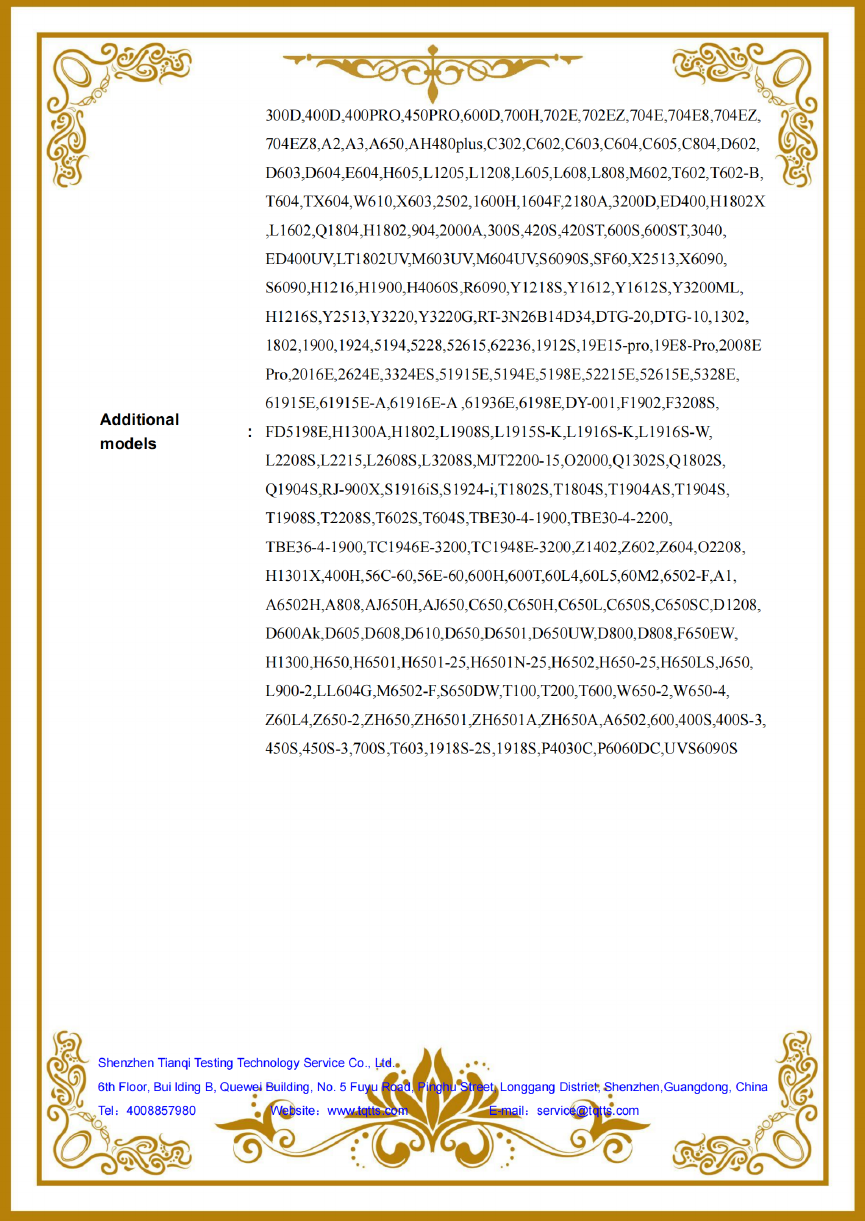
XINFLYING CE EMC Certificate of Compliance TQT1550D270EC, issued by TQT on 19 May 2026. Buyers should confirm that the certificate schedule lists the exact model being ordered.
Rank 1 — XF-F808: Heavy-Duty 80 cm DTF Printer
- Film print width: 80 cm (31 in) — the widest DTF film machine in this line-up
- Printheads: 8 × Epson i3200-A1
- Ink configuration: CMYK + CMYK + CMYK + CMYK + W + W + W + W
- Published maximum speed: 50 m²/h at 4PASS
- Power: 2 kW; 110–220 V; 9 A / 18 A; 50/60 Hz
- RIP: RIIN / PrintFactory as standard; Maintop, PhotoPrint, CADlink optional
- File formats and interface: TIFF, PDF, PNG; USB 3.0; Windows 10/11 (64-bit)
- Machine size: 2450 × 910 × 1745 mm; net 440 kg; gross 596 kg
- Operating environment: 20–30 °C, 45–65% RH
The XF-F808 is the machine to shortlist when the limiting factor is print width rather than machine count. Eight printheads across an 80 cm film path let an operator run more panels per roll, and the four white channels reduce how often a long white-ink job forces a pause. It suits DTF transfer suppliers running continuous film production, garment factories adding an in-house decoration line, and any business whose current bottleneck is queueing transfers rather than printing them.
The trade-off is physical. A 596 kg gross shipping weight and a 2 kW draw mean floor planning, freight planning and electrical provisioning happen before the purchase order. Four white channels also mean four channels to keep in circulation during idle periods.
Rank 2 — XF-C605: Full-Colour 5-Printhead 60 cm DTF Printer
- Film print width: 60 cm (24 in)
- Printheads: 5 × Epson i3200-A1
- Ink configuration: CMYK + CMYK + CMYK + W + W
- Published speed: 36 m²/h at 6PASS (fastest); 28 m²/h at 6PASS (standard)
- Power: 1.6 kW; 110–220 V; 7 A / 14.5 A; 50/60 Hz
- Ink maintenance: automatic moisturizing function (optional)
- Machine size: 1670 × 815 × 1600 mm
- Weight: 300 kg net / 355 kg gross (integrated); 227 kg + 120 kg net / 273 kg + 150 kg gross (split)
- Packing options: split or integrated
Full-colour needs usually mean one of two things: artwork with deep, layered colour, or a high proportion of white ink on dark garments. The XF-C605 addresses both with three CMYK sets and two white channels on a 60 cm dtf transfer printer platform, published at 36 m²/h at 6PASS. For an apparel business where colour depth decides whether a job is accepted, this is the 60 cm model that removes that limit.
The cost of that capability is maintenance surface. Three colour sets and two white channels mean more ink lines to keep in circulation, and the split packing option (227 kg + 120 kg) may be necessary for sites without forklift access. XINFLYING also supplies this machine as the XF-C605 + XF-A6502H package, which adds an automatic powder recycling system, smart touchscreen control, a built-in fume purifier and professional RIP software for continuous production environments.
Rank 3 — XF-F606: Six-Printhead 60 cm DTF Printer with a 6-Colour Option
- Film print width: 60 cm (24 in)
- Printheads: 6 × Epson i3200-A1
- Ink configuration: CMYK + CMYK + CMYK + W + W + W, or CMYK + CMYK + ORGB + ORGB + W + W
- Published maximum speed: 28 m²/h at 6PASS
- RIP: Maintop, RIIN
- Image formats: JPG, TIF, PDF
- Computer requirement: Windows 7+, HDD ≥500 GB, ATI discrete GPU, RAM ≥8 GB, Intel i7
- Machine size: 1710 × 800 × 1615 mm; net 171 kg; gross 216.7 kg
- Operating environment: 15–30 °C, 35–65% RH
The XF-F606 is the only machine in this ranking with a published orange, red, green and blue channel option. That matters to businesses selling artwork where a six-colour ink set changes the result — vivid sportswear graphics, promotional products and photo-based prints that otherwise need post-processing. The alternative configuration, three CMYK sets and three white channels, pushes the same hardware in the opposite direction: maximum white coverage and colour laydown.
Two trade-offs are worth stating plainly. The published operating window is the narrowest in this list at 15–30 °C and 35–65% RH, and the RIP computer requirement (Intel i7, 8 GB RAM, ATI discrete GPU) is higher than the other models. The extra channels only earn their keep if the artwork actually uses them.
Rank 4 — XF-C604: The Four-Printhead 60 cm Workhorse
- Film print width: 60 cm (24 in)
- Printheads: 4 × Epson i3200-A1
- Ink configuration: CMYK + CMYK + W + W
- Published speed (fastest): 38 m²/h at 4PASS; 26 m²/h at 6PASS; 20 m²/h at 8PASS
- Published speed (standard): 27 m²/h at 4PASS; 18 m²/h at 6PASS; 13 m²/h at 8PASS
- Power: 1.6 kW; 110–220 V; 7.2 A / 14.5 A; 50/60 Hz
- Ink maintenance: automatic moisturizing function (optional)
- Machine size: 1670 × 815 × 1600 mm; net 180 kg; gross 235 kg
The XF-C604 is the pragmatic commercial DTF printer: four printheads in a dual CMYK plus dual white layout, published at 38 m²/h at 4PASS when a job does not require the highest resolution mode. For a growing print shop, this is the most direct step up from a dual-printhead machine without jumping into the five- and six-printhead tier.
Its limitation is colour architecture, not speed: there is no third colour set, so for maximum saturation on demanding artwork the XF-C605 remains the better 60 cm option.
Rank 5 — XF-702E: The Most Power-Efficient 60 cm DTF Printer
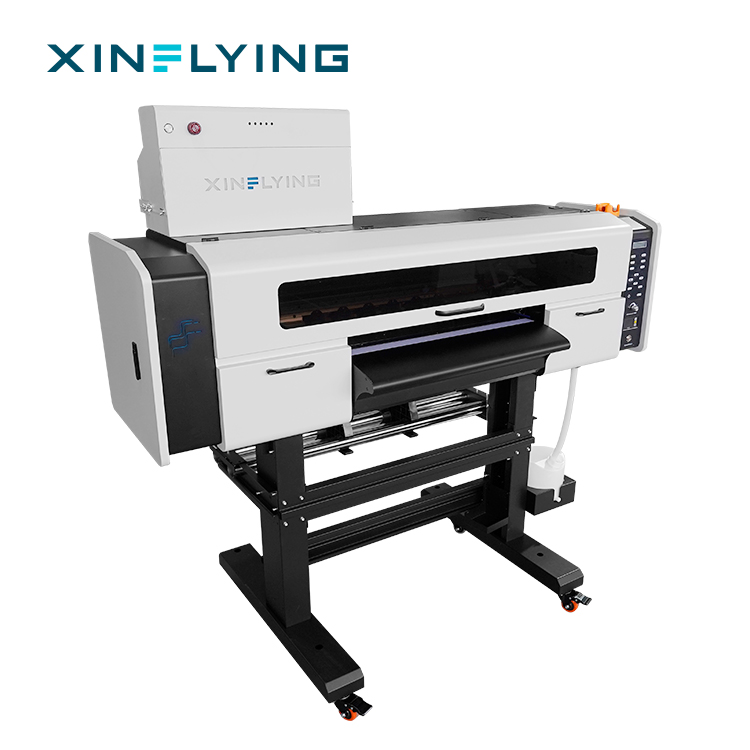
XINFLYING XF-702E: a 60 cm (24 in) dual-printhead DTF printer with a published draw of 0.8 kW and standard automatic moisturizing.
- Film print width: 60 cm (24 in)
- Printheads: 2 × Epson i3200-A1 (dual printhead configuration)
- Ink configuration: CMYK + W
- Published speed (fastest): 13 m²/h at 6PASS; 10 m²/h at 8PASS; 7 m²/h at 12PASS
- Published speed (standard): 10 m²/h at 6PASS; 8 m²/h at 8PASS; 5 m²/h at 12PASS
- Ink maintenance: automatic moisturizing function (standard)
- Power: 0.8 kW; 110–220 V; 5 A / 10 A; 50/60 Hz
- Machine size: 1700 × 850 × 1350 mm; net 158 kg; gross 194 kg
Two numbers define the XF-702E: 60 cm of film width and a 0.8 kW published draw. For a small business moving up from a compact machine, that combination means commercial-grade width without a workshop rewire, which is why it is the entry point to the 60 cm tier rather than the four- and five-printhead models above it. XINFLYING also supplies it as the XF-702E + XF-Z650-2 package with an automatic powder shaker and curing system, auto moisture retention, a white ink circulation system and RIP software support.
The honest ceiling: two printheads limit maximum output, so this machine suits daily custom work and regular short runs, not contract volume that arrives in single large batches.
Rank 6 — XF-450PRO: The A2 All-in-One DTF Printer for Beginners
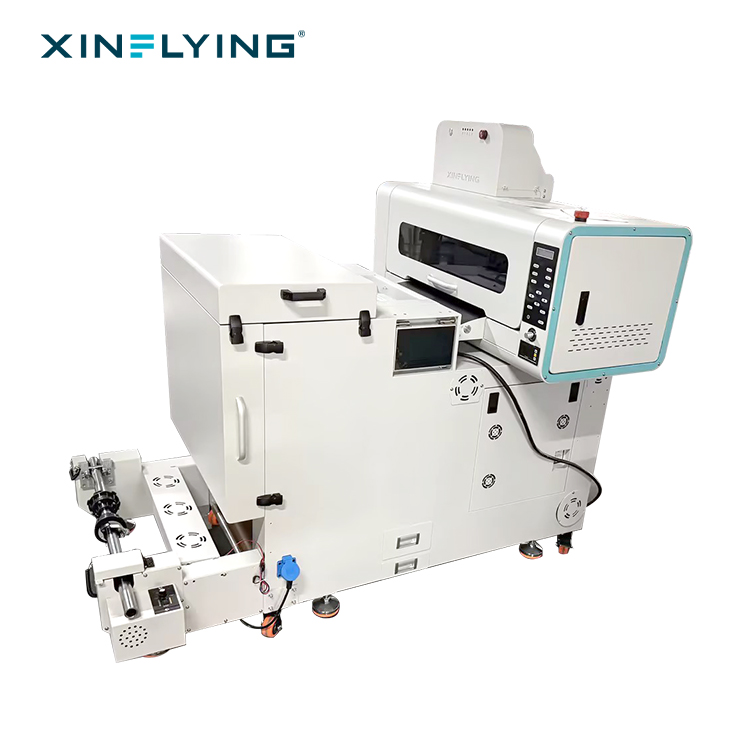
XINFLYING XF-450PRO: a 42 cm (A2 width) all-in-one DTF printer with integrated powder shaking and drying.
- Film print width: 42 cm (16.5 in) — the A2 width
- Printheads: 2 × Epson i1600-A1
- Ink configuration: CMYK + W
- Published speed (fastest): 11 m²/h at 6PASS; 9 m²/h at 8PASS; 7 m²/h at 12PASS
- Published speed (standard): 9 m²/h at 6PASS; 7 m²/h at 8PASS; 5 m²/h at 12PASS
- Workflow: integrated powder shaker and dryer, white ink circulation system, RIIN / PrintFactory RIP
- Power: 3.5 kW; 110–220 V; 16 A / 32 A; 50–60 Hz
- Machine size: 1950 × 1065 × 1350 mm; net 250 kg; gross 280 kg
- Packing size: 1300 × 1100 × 1200 mm (integrated)
For dtf printer for beginners questions, the XF-450PRO is the model in this list that removes the most steps. Printing, powder shaking and drying are combined in one all-in-one A2 configuration, which is why it fits startups, small custom print shops and businesses entering apparel printing without a separate shaker line and the floor space that goes with it.
There is one number on this machine that surprises buyers: 3.5 kW, the highest published draw in the ranking, because the shaker and dryer are integrated. Check the electrical supply at the installation point before ordering rather than after delivery. For buyers who want 60 cm width from the start, the XF-702E above is the more efficient alternative at 0.8 kW.
Rank 7 — XF-400D: The Compact 30 cm DTF Printer
- Film print width: 30 cm (12 in)
- Printheads: 2 × Epson i1600-A1 or XP600
- Ink configuration: CMYK + W
- Published speed (fastest): 4.5 m²/h at 6PASS; 3.5 m²/h at 8PASS
- Published speed (standard): 2.5 m²/h at 6PASS; 1.5 m²/h at 8PASS
- Power: 0.5 kW; 110–220 V; 2.3 A / 4.5 A; 50/60 Hz
- Machine size: 960 × 770 × 1220 mm; net 60 kg; gross 95 kg
The XF-400D is the smallest machine in the ranking: 30 cm of film width, a 0.5 kW draw, and a 60 kg net weight that one person can move. It fits home-based and studio setups, sample-making, and low-volume personalised orders, and it is the lowest-cost way to learn the DTF workflow before committing to a 60 cm production machine.
Its published throughput is also the lowest here. Treat it as a validation and small-batch machine; if your order book already contains regular 60 cm work, buy the XF-702E instead of buying the XF-400D twice.
Rank 8 — XF-H1301X-1I32A1: 130 cm Wide-Format Machine, Not a DTF Printer
- Print width: 130 cm (1.3 m) on heat-transfer paper
- Printheads: 1 × Epson i3200-A1
- Ink configuration: CMYK
- Published maximum speed: 28 m²/h at 4PASS
- Drying: external constant-temperature automatic drying system; RIP Maintop as standard
- Power: 2 kW; 110/220 V; 18 A / 9 A; 50–60 Hz
- Machine size: 2220 × 870 × 1540 mm; net 140 kg; gross 200 kg
- Operating environment: 20–35 °C, 45–65% RH
This model is ranked last for a reason that needs to be said out loud. Buyers searching for a DTF printing machine frequently end up comparing it, because it appears in the same product family and on the same certificates. But the published specification classifies the XF-H1301X-1I32A1 as a wide-format roll printer that prints on heat-transfer paper for polyester-based textile production — not a PET-film DTF machine with powder and heat-press transfer.
If your workflow is DTF film, powder and heat press, this is the wrong machine. If your apparel business runs 130 cm polyester rolls and you already operate a sublimation workflow, it is the correct one. That distinction, stated before purchase rather than after, prevents the most expensive mistake in this category.
How to Choose From This List: Five Steps
Step 1 — Fix your maximum print width first. Measure the largest artwork you are regularly asked to produce, then map it to the ranked widths: 30 cm (XF-400D), 42 cm / A2 (XF-450PRO), 60 cm (XF-702E, XF-C604, XF-C605, XF-F606) or 80 cm (XF-F808). Width is the one specification that cannot be upgraded later.
Step 2 — Convert your order book into square metres per hour, not pieces per day. Published fastest speeds in this list run from 4.5 m²/h (XF-400D) and 11 m²/h (XF-450PRO) through 13 m²/h (XF-702E), 28 m²/h (XF-F606), 36 m²/h (XF-C605) and 38 m²/h (XF-C604) to 50 m²/h (XF-F808). Compare those figures at the pass mode you will actually run, not at the fastest published setting.
Step 3 — Decide whether you need extra colour channels. Ink architecture moves through single CMYK + white (XF-400D, XF-450PRO, XF-702E), dual CMYK + dual white (XF-C604), triple CMYK + dual white (XF-C605), triple CMYK + triple white or orange/red/green/blue (XF-F606), and quad CMYK + quad white (XF-F808). More channels mean more capability and more maintenance discipline.
Step 4 — Check the certificate schedule against your market. Confirm that the CE EMC, CE LVD, CE Machinery Directive and RoHS documents list the exact model you are ordering, and remember that OEKO-TEX ECO PASSPORT covers printing inks and pastes. This step is documentation work, and it prevents customs and resale problems that no print quality advantage can offset.
Step 5 — Verify power, environment and floor loading before price. Published power draw ranges from 0.5 kW to 3.5 kW; net machine weight ranges from 60 kg to 440 kg; most models are specified for 20–30 °C and 45–65% RH, while the XF-F606 is specified for 15–30 °C and the XF-H1301X for 20–35 °C.
Where These DTF Printers Are Already Working
Published case profiles from XINFLYING show four different apparel business profiles running the same printing technology. They are useful because they show how differently the same machine category is deployed.
- Print-on-demand business owner, United States. Five DTF printing units in operation for five years, producing customised T-shirts, hoodies, sweatshirts and other personalised apparel from online orders. Printing after an order is received reduced inventory pressure and dependence on external printing suppliers, and the business gained more control over production schedules and order fulfilment speed.
- Custom apparel printing business, United States. Two DTF printing units in operation for three years, producing customised T-shirts, hoodies and bags with full-colour graphics. The profile suits personalised apparel production with flexible order quantities and detailed graphics, and it handles both small-quantity orders and repeat production.
- DTF transfer supplier, United States. Thirty DTF printer units in operation for one year, producing transfer films with various designs and logos for downstream garment decorators. The result reported is improved transfer production capacity with stable print quality across a larger number of apparel customisation orders.
- Garment manufacturing factory, global markets. Twenty DTF printing units in operation for two years, adding logos, patterns and customised graphics to finished garments before delivery to brands and distributors. The attraction was a flexible decoration method for customised orders, sampling production and short-run garment projects, with compatibility across different fabrics.
Read across those profiles and the ranking becomes easier to use. A thirty-unit film-production profile points to the multi-head end of the list — XF-F808, XF-C605 and XF-F606. A two-unit custom apparel profile sits in the compact end, where the XF-450PRO or XF-400D covers the work and the XF-702E is the natural next machine when 60 cm orders start arriving regularly.
Comparison Table: Eight DTF Printers Side by Side
All eight models appear on the same CE EMC, CE LVD, CE Machinery Directive and RoHS certificate schedules listed earlier. Power figures and speeds are published specifications; "not published" means the specification sheet does not state a value.
| Rank | Model | Print width | Printheads | Ink configuration | Published max speed | Power | Net weight |
|---|---|---|---|---|---|---|---|
| 1 | XF-F808 | 80 cm (31 in) | 8 × Epson i3200-A1 | CMYK ×4 + W ×4 | 50 m²/h (4PASS) | 2 kW | 440 kg |
| 2 | XF-C605 | 60 cm (24 in) | 5 × Epson i3200-A1 | CMYK ×3 + W ×2 | 36 m²/h (6PASS) | 1.6 kW | 300 kg integrated / 227 + 120 kg split |
| 3 | XF-F606 | 60 cm (24 in) | 6 × Epson i3200-A1 | CMYK ×3 + W ×3, or CMYK ×2 + ORGB ×2 + W ×2 | 28 m²/h (6PASS) | Not published (110–220 V, 50/60 Hz) | 171 kg |
| 4 | XF-C604 | 60 cm (24 in) | 4 × Epson i3200-A1 | CMYK ×2 + W ×2 | 38 m²/h (4PASS) | 1.6 kW | 180 kg |
| 5 | XF-702E | 60 cm (24 in) | 2 × Epson i3200-A1 | CMYK + W | 13 m²/h (6PASS) | 0.8 kW | 158 kg |
| 6 | XF-450PRO | 42 cm (16.5 in) | 2 × Epson i1600-A1 | CMYK + W | 11 m²/h (6PASS) | 3.5 kW (integrated shaker and dryer) | 250 kg |
| 7 | XF-400D | 30 cm (12 in) | 2 × Epson i1600-A1 or XP600 | CMYK + W | 4.5 m²/h (6PASS) | 0.5 kW | 60 kg |
| 8 | XF-H1301X-1I32A1 | 130 cm (1.3 m) on heat-transfer paper | 1 × Epson i3200-A1 | CMYK | 28 m²/h (4PASS) | 2 kW | 140 kg |
One external reference point. For buyers comparing beyond this line-up, third-party published data lists the Epson SureColor F1070 with a 2400 × 1200 DPI resolution, positioned for the entry-level small business market (source: Axo Transfers). It is included here as a published reference figure, not as a ranking within this list.
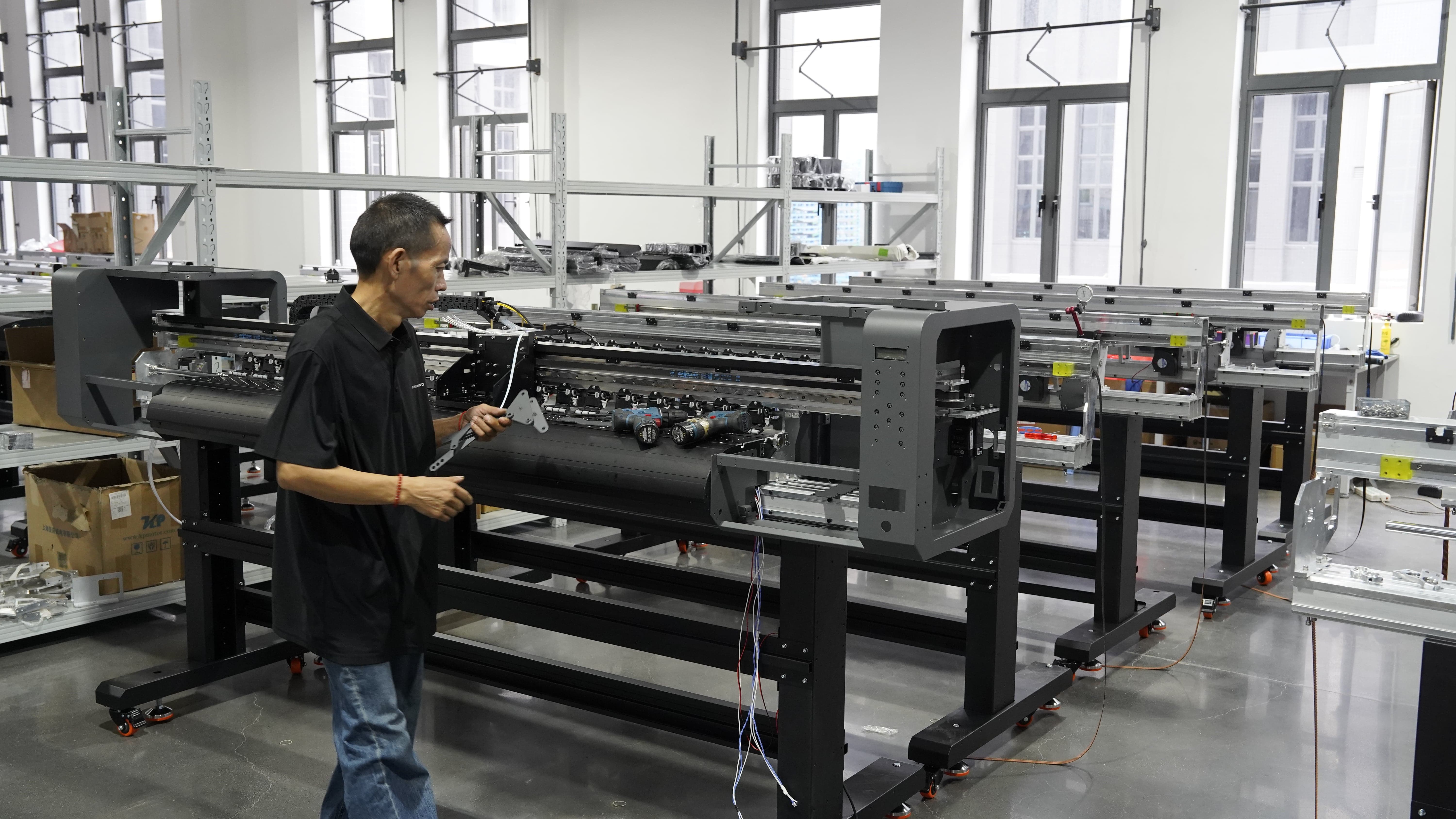
A technician installs and adjusts mechanical components inside a XINFLYING DTF printer. Pre-shipment testing is performed on each DTF printer before delivery.
Quality Control, Capacity and Customisation Behind the Ranking
Specifications only become useful when the machine arrives in the same configuration that was ordered. XINFLYING operates from a 37,440 m² facility in Guangzhou with 200+ employees, a team of 20 R&D engineers and a published annual output of 20,000+ units; the export ratio is 80%, with main markets in North America, South America, Europe, Asia, the Middle East and Africa. Quality control includes pre-shipment testing on each DTF printer before delivery.
For distributors and multi-unit buyers, two further numbers matter. Monthly production capacity is 1,600+ units with a published lead time of 5–40 days, and OEM/ODM customisation covers product branding, machine appearance, colour, logo and packaging, with customised solutions based on customer requirements and a minimum order quantity of one unit. After delivery, more than 50 engineers provide 24/7 online technical support.
Frequently Asked Questions
Are the DTF printers in this list CE certified, and which certificates cover them?
All eight ranked models appear in the schedules of the same European conformity documents: CE EMC certificate TQT1550D270EC issued by TQT on 19 May 2026 under EMC Directive 2014/30/EU; CE LVD certificate TQT1550D271EC issued by TQT on 19 May 2026 under LVD 2014/35/EU; CE Machinery Directive certificates M.2026.206.C142365 and M.2026.206.C142385 issued by UDEM on 10 June 2026; CE LVD & EMC certificate M.2026.206.C142475 issued by UDEM on 11 June 2026; and RoHS certificate M.2026.206.C142366 issued by UDEM on 10 June 2026 under Directive 2011/65/EU. The OEKO-TEX ECO PASSPORT certificate SH150194016 from TESTEX AG, valid until 31 December 2026, covers textile printing inks and printing pastes rather than the printers. Before ordering, confirm that the certificate schedule lists the exact model you are buying.
Which DTF printer in this list handles the highest production volume?
The XF-F808 is the highest-throughput model in the ranking: eight Epson i3200-A1 printheads, an 80 cm film width and a published maximum of 50 m²/h at 4PASS. Behind it, the 60 cm tier steps from the XF-702E (2 printheads, 13 m²/h at 6PASS) to the XF-C604 (4 printheads, 38 m²/h at 4PASS), the XF-C605 (5 printheads, 36 m²/h at 6PASS) and the XF-F606 (6 printheads, 28 m²/h at 6PASS). Printhead count alone does not determine output — film width, pass mode and ink configuration all change the result.
Do bigger DTF printers cost more to run?
Published power draw in this list ranges from 0.5 kW (XF-400D) and 0.8 kW (XF-702E) up to 2 kW (XF-F808) and 3.5 kW (XF-450PRO, where the powder shaker and dryer are integrated). Ink channel configuration also changes running discipline: the XF-C605 uses three CMYK sets and two white channels, while the XF-450PRO, XF-400D and XF-702E use a single CMYK set plus white. No list prices are published for these machines, so the practical comparison is capacity against your actual order volume, power supply and floor space — request a quotation for the specific configuration you are considering.
Can I validate print quality and configuration before ordering?
The minimum order quantity for these DTF printers is one unit, and pre-shipment testing is performed on each machine before delivery. Buyers should request printed samples and confirm the printhead model, ink configuration, RIP software and print width in writing before placing the order. RIIN or PrintFactory RIP is standard on most models, with Maintop, PhotoPrint and CADlink available as options across the 60 cm and 80 cm machines.
What is the lead time, and what support comes after delivery?
Published lead time is 5–40 days from a monthly production capacity of 1,600+ units, produced at a 37,440 m² facility with 200+ employees and 20 R&D engineers. OEM/ODM customisation is available, covering product branding, machine appearance, colour, logo and packaging, with a minimum order quantity of one unit. After delivery, more than 50 engineers provide 24/7 online technical support. To turn this shortlist into a specification, contact XINFLYING at info@xin-flying.com or +86 188-1322-1357 on WhatsApp, or download the company catalogue below.
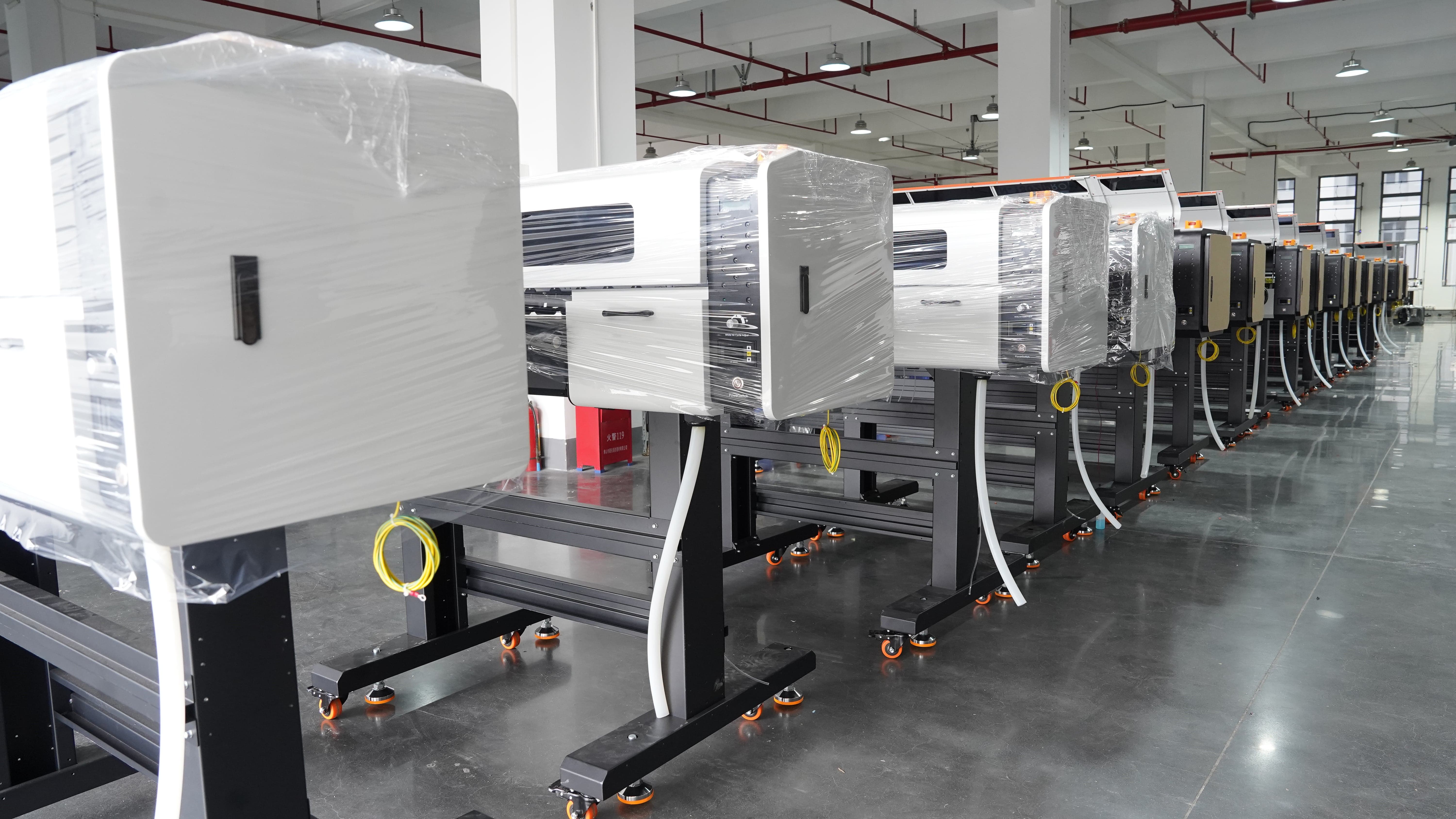
Completed XINFLYING DTF printers wrapped and prepared for international shipment. Published monthly capacity is 1,600+ units with a 5–40 day lead time.
Conclusion: Match the Machine to the Order Book, Not to the Brochure
The eight machines in this ranking cover one continuous production path. The XF-400D and XF-450PRO introduce the DTF workflow at 30 cm and 42 cm. The XF-702E opens the 60 cm tier at 0.8 kW. The XF-C604, XF-C605 and XF-F606 add printheads, colour channels and white-ink capacity as order volume grows. The XF-F808 removes the width limit entirely at 80 cm and 50 m²/h. The XF-H1301X-1I32A1 sits outside that path on purpose, because it belongs to a different printing process.
If one rule survives this ranking, it is this: choose the machine whose published width and throughput match the orders you already receive, and confirm the certificate schedule for the model you specify. Everything else — colour channels, speed at a given pass mode, power draw — follows from that match.
Next Step: Sample, Quotation and Catalogue
XINFLYING (Guangzhou Xin Flying Digital Technology Co., Ltd.) has manufactured digital printing equipment since 2010, including DTF printers, UV DTF printers, DTG printers, dye sublimation printers, UV flatbed printers and printing consumables. Minimum order quantity is one unit, lead time is 5–40 days, and every DTF printer undergoes pre-shipment testing before delivery.
Request a sample print, a configuration-specific quotation, or distributor and OEM/ODM terms through:
- Email: info@xin-flying.com
- WhatsApp and telephone: +86 188-1322-1357
- Website: www.xin-flying.com
- Catalogue (PDF): download the XINFLYING company catalogue
Specify the model, the film width and the market you sell into, and the technical team can confirm the matching certificate documents and accessory package for that configuration.