
Understanding Risk Assessment for Large Format Printers
Direct answer: a risk assessment for a large format printer is the manufacturer's documented engineering record, produced under Directive 2006/42/EC and structured by EN ISO 12100:2010, that fixes the limits of the machine, identifies every foreseeable hazard, estimates and evaluates the associated risk, and records how that risk is reduced. Its outputs are the technical file, the information for use and the EC Declaration of Conformity that allow the CE mark to be placed on the equipment. For a roll-to-roll dye sublimation printer such as the XF-O2000-4I32A1, this record is what connects a 195 cm, 8.5 kW production line to the paperwork an importer needs at the border.
Most buyers meet the subject at the worst possible moment: a customs broker, a distributor's quality manager or a customer's EHS team asks for the technical file, and what gets sent back is a PDF certificate that names no model. This guide is written from the buying side. It explains what the process contains, which documents it produces, how Xinflying (Guangzhou Xin Flying Digital Technology Co., Ltd., founded 2010 in Panyu, Guangzhou) documents the XF-O2000-4I32A1, and what to request before a purchase order is released.
What a Risk Assessment for a Large Format Printer Actually Is
Risk assessment is a process, not a single document. EN ISO 12100:2010 is the harmonised standard that defines the method and runs it as an iterative loop: determine the limits of the machine, identify hazards, estimate risk, evaluate risk, reduce risk, validate the result, and document the whole chain. The loop repeats until the remaining risk is judged acceptable.
Three deliverables are routinely confused with one another:
- The risk assessment — the manufacturer's own analysis and risk-reduction logic, including the hazard list and the measures chosen against each hazard.
- The technical file — the compiled evidence package: drawings, component certificates, calculation notes, test records, the risk assessment itself and the information for use.
- The certificate and EC Declaration of Conformity — the formal statement, and where applicable the third-party attestation, that the conformity route was completed for a named model.
In practice the buyer only ever sees the third item. The first two are what a market surveillance authority asks for when a machine is inspected, installed or resold. That asymmetry is the source of almost every documentation dispute in this equipment category.
The Problem: The Document Gap in Sublimation Printing
A wide format sublimation printer is not a single-hazard machine. It concentrates several hazard families inside one frame, and each of them has to be addressed separately in the assessment. Using the XF-O2000-4I32A1 as a concrete example, the hazard-relevant characteristics listed in its specification are:
- Thermal load — front, middle and rear break-controlled heating inside a machine that runs continuous media at production speed.
- Electrical load — 8.5 kW at 220 V, 50/60 Hz, which changes the sizing of protective earthing, conductor rating and isolation requirements compared with a small-format unit.
- Mechanical mass and stored energy — a net machine weight of approximately 490 kg and a packed gross weight of approximately 675 kg, plus media rolls supported in the 1,000–1,500 m range.
- Chemical handling — sublimation ink supplied through 220 ml cartridges and a 3 L ink tank, with the associated filling, spill and storage tasks.
- Continuous operation — a 195 cm print width and 2PASS 180 m²/h output imply production duty cycles in which guards are opened, media is re-threaded and consumables are swapped far more often than on a prototype machine.
Three failure modes recur when this documentation is audited:
- Scope mismatch. A certificate exists but the product list does not name the model and configuration actually delivered. The document is real; it simply does not cover the machine on the floor.
- Stale assessment after modification. A machine is rebranded, fitted with a different unwinding arrangement, or delivered with a customised drying configuration, and the original risk assessment is never re-run. The CE file on paper no longer describes the machine on site.
- Unreachable technical file. The assessment exists at the factory but cannot be produced to the importer within a reasonable time, which is functionally the same as not having it.
Industry Background: Why Documentation Is Now Checked at Model Level
Two pressures are converging on this equipment category. The first is volume. Grand View Research values the global dye sublimation printing market at USD 16.4 billion in 2025, projected to reach USD 39.0 billion by 2033, and reports a projected CAGR of 11.5% from 2026 to 2033. The same source places Asia Pacific at a 36.5% revenue share in 2025, led by China as the largest country market. Mordor Intelligence values the dye sublimation printer segment specifically at USD 1.88 billion in 2025, expected to reach USD 2.53 billion by 2030.
The second pressure is standardisation of format. FESPA industry insights describe roll-to-roll sublimation printers with widths of 1.9 m (1900 mm) as the standard format for high-volume textile and soft signage work. A standard format means comparable machines crossing borders in comparable configurations — which is precisely the condition under which authorities and distributors stop checking a brand and start checking a model.
The practical consequence for a buyer is simple. When a category becomes standardised, the differentiator stops being the print width and becomes the completeness of the conformity record attached to that specific model.
The Solution: How Xinflying Documents the XF-O2000-4I32A1
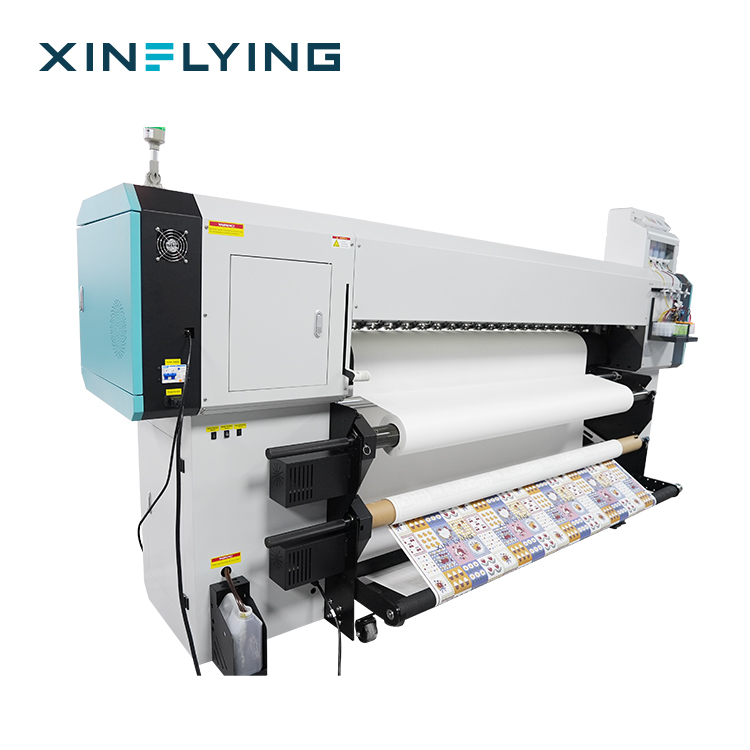
Xinflying is a digital printing equipment manufacturer founded in 2010, operating a 37,440 m² facility with 200+ employees, an R&D team of 20 engineers and an annual output of 20,000+ units, exporting to North America, South America, Europe, Asia, the Middle East and Africa. The XF-O2000-4I32A1 is one of its roll-to-roll dye sublimation models, and it is covered by a documentation set rather than a single certificate.
The machine itself, as specified in the catalogue, is configured as follows:
- Print heads: 4 × Epson i3200-A1, piezoelectric inkjet
- Ink colours: CMYK + CMYK + CMYK + CMYK; sublimation ink via 220 ml cartridge and 3 L ink tank
- Print speed: 2PASS 180 m²/h; 4PASS 92 m²/h
- Print width: 195 cm (1.95 m)
- Media: heat transfer paper, supporting rolls of 1,000–1,500 m; media specification lists 1 mm thickness and 200 kg
- Heating: front / middle / rear break-controlled heating
- Power: 8.5 kW, 220 V, 50/60 Hz
- Operating environment: 20–25 °C, 45–65% RH
- Machine size: 3,311 × 1,278 × 1,670 mm; packing size 3,640 × 760 × 1,740 mm
- Weight: approximately 490 kg net / 675 kg gross
Against that configuration, the compliance layer is built from the following documents, all of which name the XF-O2000-4I32A1 in their product lists:
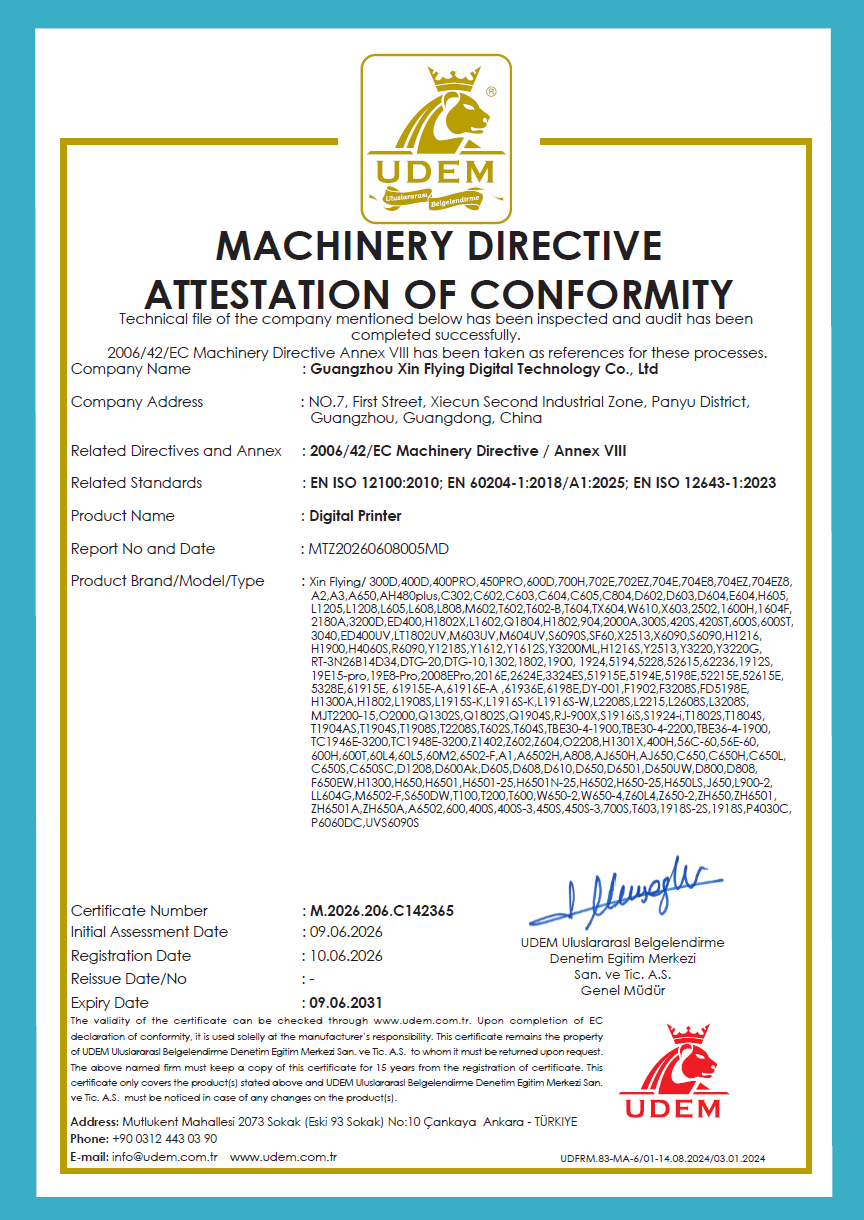
- CE Machinery Directive Certificate of Conformity M.2026.206.C142365, issued by UDEM, scope: Machinery Safety Compliance (MD 2006/42/EC), with the harmonised standards EN ISO 12100:2010, EN 60204-1:2018/A1:2025 and EN ISO 12643-1:2023. Issue date 2026-06-10, valid to 2031-06-09.
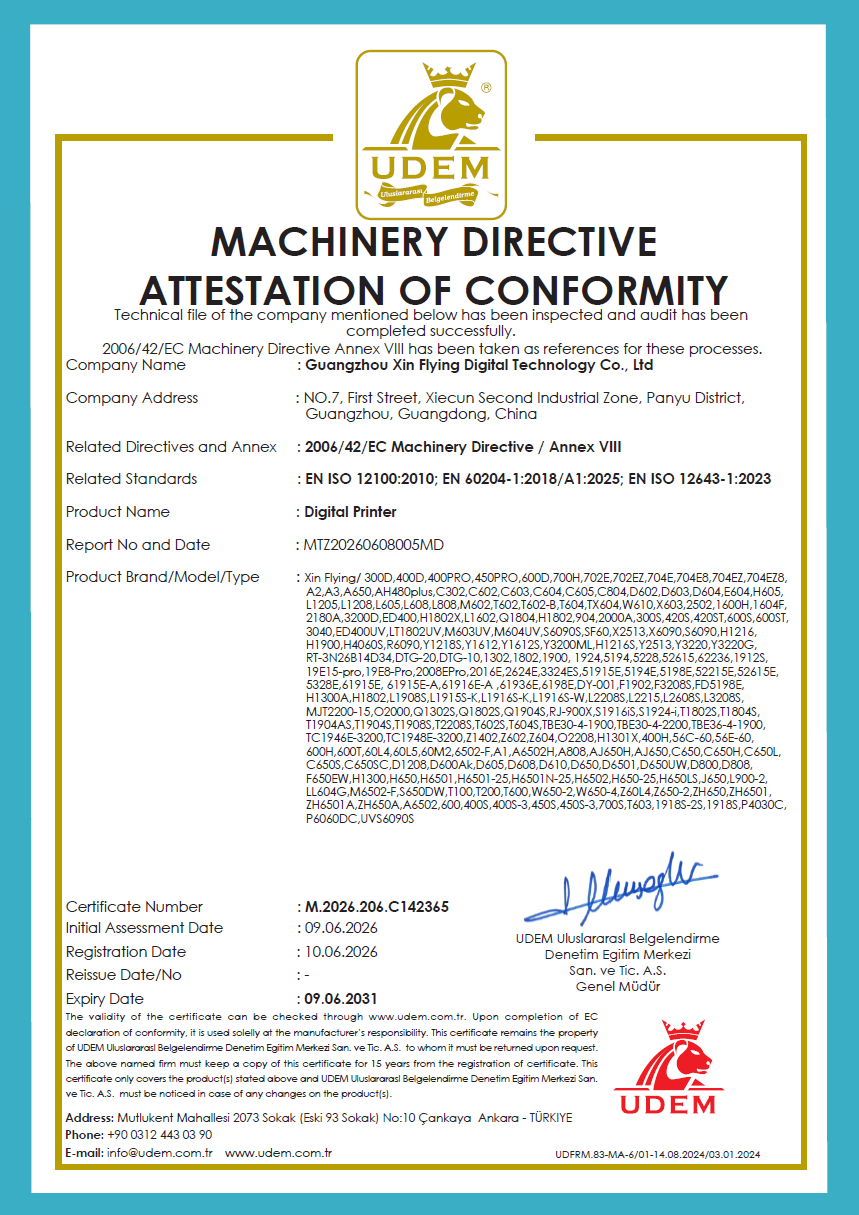
- A second CE MD attestation, M.2026.206.C142385, referencing the same standard set and the same validity period.
- CE Low Voltage Directive Certificate of Compliance TQT1550D271EC, issued by TQT (Shenzhen Tianqi Testing Technology Service Co., Ltd.) against EN IEC 62368-1:2020/A11:2020.
- CE EMC Certificate of Compliance TQT1550D270EC, issued by TQT against EN 55032:2015/A11:2020, EN 55035:2017/A11:2020, EN IEC 61000-3-2:2019+A1:2021 and EN 61000-3-3:2013/A2:2021.
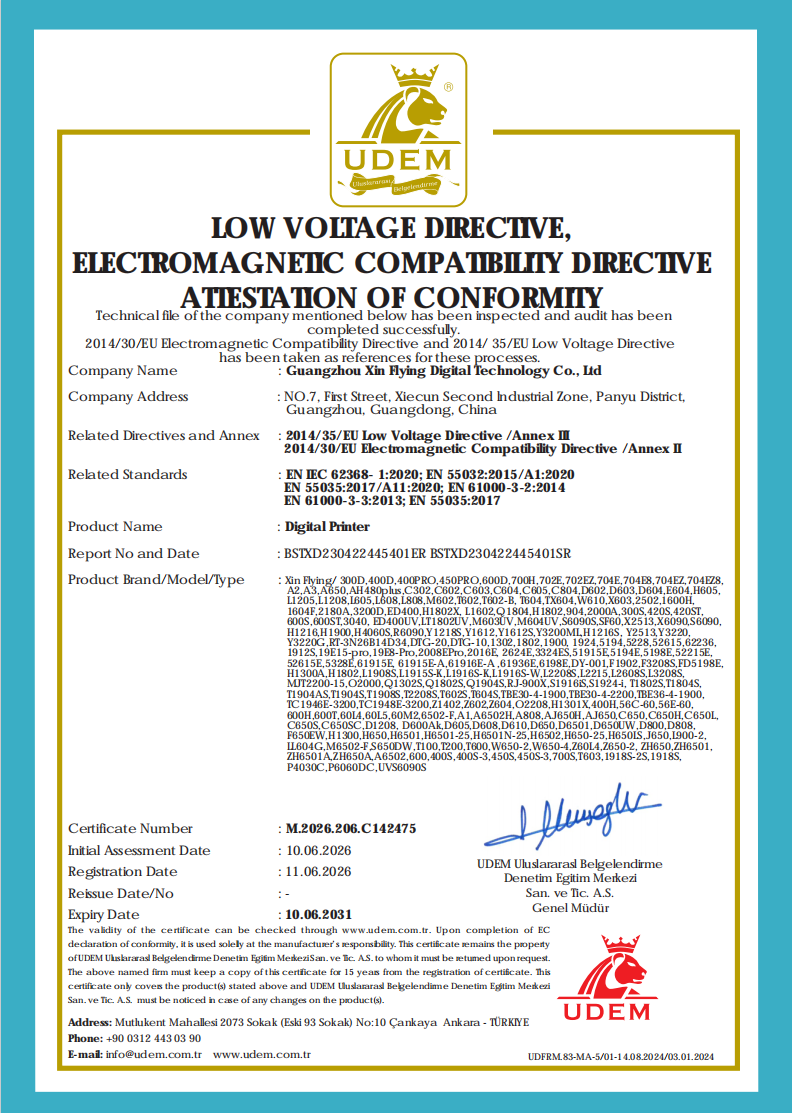
- Combined LVD & EMC attestation M.2026.206.C142475, issued by UDEM, covering LVD 2014/35/EU and EMC 2014/30/EU.
- RoHS Compliance Certificate M.2026.206.C142366, issued by UDEM against Directive 2011/65/EU and EN IEC 63000:2018, valid to 2031-06-09.
- OEKO-TEX® ECO PASSPORT SH150194016, issued by TESTEX AG, covering textile printing inks and printing pastes, valid to 2026-12-31.
A distinction worth holding onto: the OEKO-TEX ECO PASSPORT addresses the ink and the printed article, not the mechanical safety of the machine. It answers a different question from the Machinery Directive file, and buyers who treat the two as interchangeable usually discover the difference during a customer audit rather than a customs check.
Manufacturing documentation is supported by production-side facts that matter when a conformity file is being defended: OEM and ODM production services, customization covering product branding, machine appearance, colour, logo, packaging and custom solutions based on customer requirements, a minimum order quantity of one unit, a monthly capacity of 1600+ units, a lead time of 5–40 days, pre-shipment testing as the acceptance criterion, and after-sales support delivered by over 50 engineers with 24/7 online technical assistance.
Step-by-Step: Running the EN ISO 12100:2010 Process on a Sublimation Printer
The process is repeatable. Applied to a large format roll-to-roll machine, it looks like this.
Step 1 — Fix the limits of the machine
Before a single hazard is listed, the assessment has to state what the machine is and is not designed to do. That means intended use, reasonably foreseeable misuse, space limits, power limits, environmental limits and the operating duty cycle. For the XF-O2000-4I32A1, the declared limits are a 20–25 °C, 45–65% RH operating window, a 220 V / 50–60 Hz supply at 8.5 kW, a 3,311 × 1,278 × 1,670 mm footprint, and media rolls in the 1,000–1,500 m range. Every later decision — guard design, thermal clearance, earthing, ventilation — is judged against these limits, so vague limits produce a vague assessment.
Step 2 — Identify hazards
Hazard identification works through the whole life cycle: transport, installation, commissioning, normal production, cleaning, maintenance, media re-threading, ink and consumable replacement, and end of life. On a sublimation line the recurring categories are mechanical (roller nips, moving carriage, media tension, the 675 kg packed mass handled during unloading), thermal (the front/middle/rear heating zones and adjacent surfaces), electrical (the 8.5 kW supply), ergonomic (roll loading and print-head access at height), and substance-related (sublimation ink handling through cartridge and 3 L tank). Each category is recorded with the task and the life-cycle phase in which it occurs.
Step 3 — Estimate and evaluate risk
Each hazard is then assigned an estimated risk from the severity of the possible harm and the probability of that harm occurring, and evaluated against the criteria adopted by the manufacturer. The output of this step is a decision: risk acceptable, or risk to be reduced. Writing the evaluation down is what makes the assessment auditable — an undocumented judgement cannot be reviewed by an authority or by a customer.
Step 4 — Reduce risk using the three-step hierarchy
EN ISO 12100:2010 does not accept guarding as the first answer. Risk reduction follows a fixed order:
- Inherently safe design — remove the hazard at source where the design allows, rather than guarding it afterwards.
- Safeguarding and complementary protective measures — fixed or interlocked guards, protective earth bonding, stop functions and other measures that keep people away from the hazard that remains.
- Information for use — markings on the machine, warnings in the manual, and instructions for installation, use, maintenance and training, applied to residual risk that could not be designed or guarded away.
The assessment records which of these apply to the specific model and configuration. Residual risk is communicated, not eliminated, and that is a normal and accepted outcome of the process.
Step 5 — Validate the assessment
Validation checks two things: that each chosen measure actually performs its function, and that the measure did not introduce a new hazard. A guard that makes media threading impractical will be defeated in daily production, and a defeated guard is a worse outcome than the hazard it was meant to control. Validation is where the production reality of a 24/7 sublimation line has to enter the document.
Step 6 — Compile the technical file and issue the declaration
The technical file assembles the drawings, component certificates, calculation notes, test records, the risk assessment and the information for use. The manufacturer then issues the EC Declaration of Conformity and places the CE mark. The file is retained and produced on request to the competent authorities of the member states.
Step 7 — Hand over the information for use
The last step is the one buyers feel most directly. Installation requirements, the declared operating environment, maintenance intervals, spare-part references, training needs and residual-risk warnings must travel with the machine, in a language accepted by the destination market. For the XF-O2000-4I32A1, the declared environment of 20–25 °C and 45–65% RH is part of this handover: a site that cannot hold that window has an installation problem that the risk assessment already anticipated.
What the Buyer Should Request, and What Each Document Proves
A structured request shortens the evaluation considerably. Ask for the following, in writing, before the order:
- The EC Declaration of Conformity with the exact model designation and serial number of the unit being shipped.
- The certificate copies with number, issuing body, scope and validity dates, and the product list page that names your model.
- The harmonised standard list actually applied, so your own EHS team can map it to site requirements.
- Confirmation of how long the technical file can be produced after delivery, and who holds it.
- The information for use in the language your market requires, in its final delivered form.
- Written confirmation of who issues the declaration if the machine is rebranded or customised.
Each document answers a different question. A CE MD certificate proves the machinery safety route was completed against EN ISO 12100:2010 and its companion standards. An LVD certificate proves the electrical safety route. An EMC certificate proves the emission and immunity route. A RoHS certificate proves substance restriction. None of them replaces the technical file, and the technical file does not replace the declaration — the file is the evidence behind the statement.
Use Cases
EU importer placing a 1.9 m class machine on the market
The importer needs the declaration to name the exact model and the certificate product list to include it. With the XF-O2000-4I32A1 appearing on CE MD M.2026.206.C142365, on LVD TQT1550D271EC, on EMC TQT1550D270EC and on RoHS M.2026.206.C142366, the model-level check can be closed before the container is booked rather than after arrival.
Print shop integrating the machine into an existing production line
The employer's own site-level assessment needs the machine's declared limits as input: the 8.5 kW supply, the 20–25 °C and 45–65% RH window, the 3,311 × 1,278 × 1,670 mm footprint and the media roll handling weight. A supplier that can supply those limits in writing, together with the residual-risk information, shortens the site assessment by weeks.
Private-label buyer using OEM or ODM production
Customization at Xinflying covers product branding, machine appearance, colour, logo, packaging and custom solutions based on customer requirements, from a minimum of one unit. When the machine carries a new brand, the documentation question must be settled contractually: which party issues the declaration for the rebranded model, and which party holds the updated risk assessment. Leaving this open is the single most common source of a stale conformity file.
Fleet operators and multi-site producers
A sportswear manufacturer in Brazil running 15 units over four years uses sublimation printing for football kits, training uniforms and personalised team apparel; the documented benefit is improved production flexibility for customised orders, reduced dependence on outsourced printing, and more consistent colour quality across batches. In a fleet of that size, the conformity record is a maintenance asset: it defines which revisions of a model share one documentation set and which do not.
Comparison Table: Documents Held for the XF-O2000-4I32A1
| Document | Certificate number | Issuing body | Scope and standards | Validity |
|---|---|---|---|---|
| CE MD Certificate of Conformity | M.2026.206.C142365 | UDEM | Machinery Safety Compliance (MD 2006/42/EC); EN ISO 12100:2010, EN 60204-1:2018/A1:2025, EN ISO 12643-1:2023 | Issued 2026-06-10; valid to 2031-06-09 |
| CE MD Certificate of Conformity | M.2026.206.C142385 | UDEM | Machinery Safety Compliance (MD 2006/42/EC); EN ISO 12100:2010, EN 60204-1:2018/A1:2025, EN ISO 12643-1:2023 | Issued 2026-06-10; valid to 2031-06-09 |
| CE LVD Certificate of Compliance | TQT1550D271EC | TQT (Shenzhen Tianqi Testing Technology Service Co., Ltd.) | Electrical safety, LVD 2014/35/EU; EN IEC 62368-1:2020/A11:2020 | Issued 2026-05-19 |
| CE EMC Certificate of Compliance | TQT1550D270EC | TQT | EMC Directive 2014/30/EU; EN 55032:2015/A11:2020, EN 55035:2017/A11:2020, EN IEC 61000-3-2:2019+A1:2021, EN 61000-3-3:2013/A2:2021 | Issued 2026-05-19 |
| CE LVD & EMC Attestation of Conformity | M.2026.206.C142475 | UDEM | LVD 2014/35/EU and EMC 2014/30/EU combined | Issued 2026-06-11; valid to 2031-06-10 |
| RoHS Compliance Certificate | M.2026.206.C142366 | UDEM | RoHS Directive 2011/65/EU; EN IEC 63000:2018 and EN IEC 62321 series | Issued 2026-06-10; valid to 2031-06-09 |
| OEKO-TEX® ECO PASSPORT | SH150194016 | TESTEX AG | Textile printing inks and printing pastes; OEKO-TEX ECO PASSPORT, EN ISO 17050-1 | Issued 2025-12-11; valid to 2026-12-31 |
The table also shows why expiry management belongs in the purchasing file rather than in a folder: the machine-safety, electrical, EMC and RoHS documents run to 2031, while the OEKO-TEX ECO PASSPORT for inks expires at the end of 2026 and must be renewed on a different cycle. Mixing the two renewal rhythms is a predictable source of last-minute supplier chasing.
Frequently Asked Questions
Who is responsible for carrying out the risk assessment of a large format sublimation printer under 2006/42/EC?
The manufacturer who places the machine on the market. That party compiles the technical file, which contains the risk assessment carried out according to EN ISO 12100:2010, and issues the EC Declaration of Conformity. For the XF-O2000-4I32A1, Xinflying holds CE Machinery Directive Certificate of Conformity M.2026.206.C142365 issued by UDEM, covering Machinery Safety Compliance (MD 2006/42/EC) against EN ISO 12100:2010, EN 60204-1:2018/A1:2025 and EN ISO 12643-1:2023, issued 2026-06-10 and valid to 2031-06-09, with the model named in the certificate product list. A second attestation, M.2026.206.C142385, references the same standard set and validity period.
Can the documentation be adapted when the machine is produced through OEM or ODM?
Xinflying provides OEM and ODM production services, and customization covers product branding, machine appearance customization, colour customization, logo customization, packaging customization and customized solutions based on customer requirements, with a minimum order quantity of one unit. When a configuration or the machine's identity changes, the risk assessment and the declaration have to be reviewed by whichever party places the resulting machine on the market, so the buyer should confirm in writing who issues the declaration for the customised model and who retains the updated technical file.
Does the order volume affect whether the full documentation set applies?
The certificate scope is defined by model, not by order quantity, and the XF-O2000-4I32A1 is listed by model on the CE MD, LVD, EMC and RoHS documents. Xinflying accepts orders from a minimum of one unit, with a monthly production capacity of 1600+ units and a lead time of 5–40 days, so a single-machine order and a multi-unit order draw on the same model-level documentation.
How can I verify the documentation and the machine before shipment?
Request the certificate copies with number, issuing body, scope and validity dates, and check that the product list page names your exact model; then match the model designation against the EC Declaration of Conformity for the unit being built. The acceptance criterion for the shipment is pre-shipment testing, and Xinflying supports the process with over 50 engineers providing 24/7 online technical support for installation and commissioning questions. Verifying the documents at order stage rather than at arrival keeps the compliance check inside the same window as the technical review.
What is the delivery lead time, and can the machine be shipped on DDP terms?
Lead time is 5–40 days depending on configuration and order position, against a monthly capacity of 1600+ units. Products are delivered using the standard Incoterms EXW, FOB, CIF and DDP, which apply to global deliveries, so a full DDP arrangement is available where the buyer prefers the supplier to handle carriage and import formalities. If you want the complete document set and the machine specification reviewed together before committing, you can download the Xinflying company and product brochure or send the target model and destination market for a quotation.
Conclusion
A risk assessment for a large format printer is not a formality attached to a CE sticker. It is the engineering record that decides whether a 195 cm, 8.5 kW roll-to-roll sublimation printer can be lawfully placed on the EU market, installed on a production floor and defended in a customer audit. Under Directive 2006/42/EC and the EN ISO 12100:2010 method, the process runs from fixed machine limits through hazard identification, risk estimation, the three-step reduction hierarchy and validation, and ends in a technical file, an EC Declaration of Conformity and a set of information for use that travels with the equipment.
The XF-O2000-4I32A1 is documented at model level: CE MD Certificate of Conformity M.2026.206.C142365 and M.2026.206.C142385 against EN ISO 12100:2010, EN 60204-1:2018/A1:2025 and EN ISO 12643-1:2023; LVD TQT1550D271EC; EMC TQT1550D270EC; combined LVD & EMC M.2026.206.C142475; RoHS M.2026.206.C142366; and OEKO-TEX® ECO PASSPORT SH150194016 for the ink. For a buyer, the work is to request those documents by number, confirm the model appears in each product list, and settle in writing who owns the assessment if the machine is customised.
Next step: review the file against your own market
Xinflying (Guangzhou Xin Flying Digital Technology Co., Ltd.) supplies DTF printers, dye sublimation printers, DTG printers, UV DTF printers, UV flatbed printers and complete digital printing solutions, with OEM and ODM production from a minimum of one unit and delivery on EXW, FOB, CIF or DDP terms.
Download the company and product brochure: Xinflying company introduction (PDF)
Technical and quotation enquiries: info@xin-flying.com · Tel / WhatsApp +86 188-1322-1357
Website: www.xin-flying.com
Address: No.7, Xiecun 2nd Industrial Zone, Panyu, Guangzhou, Guangdong
Send your destination market, target model and configuration, and the team will return the certificate numbers, validity dates and the model-level page that applies to your order.
Have Questions or Need More Details?
Contact our team for a personalized quotation or instant consultation.
Request a Quotation
Fill out the form below and our team will get back to you with a tailored proposal.
WhatsApp Direct Chat
Prefer to chat in real-time? Message us on WhatsApp for instant assistance & quick answers.
- Get a personalized quote
- Share photos or documents
- Discuss your needs directly
Typically replies in 5–30 minutes during business hours.