
Verifying a Sublimation Printer Supplier's CE Certifications: A Practical Guide
Verifying a Sublimation Printer Supplier's CE Certifications: A Practical Guide
A CE mark on a dye sublimation printer is a manufacturer's declaration, not a certificate issued by the European Union. That single distinction explains most of the confusion in equipment sourcing. Buyers ask for "the CE certificate", receive a PDF with a logo and a reference number, file it, and move on - while the document that actually determines whether a machine can be placed on the EU market is a declaration whose accuracy nobody has checked.
This guide is written for importers, distributors, brand owners and production managers who buy wide-format textile printing equipment from manufacturers outside the EU. It explains what a verifiable CE document set contains, how to test each layer, and how the same workflow applies to a specific machine such as the XF-19E15-PRO - or to any other model designation that appears in a quotation.
XINFLYING (Guangzhou Xin Flying Digital Technology Co., Ltd.) is a digital printing equipment manufacturer founded in 2010 and based in Panyu, Guangzhou, producing DTF printers, UV DTF printers, UV flatbed printers, DTG printers and dye sublimation printing solutions for apparel, home textile and industrial printing applications. Its product range is published at xin-flying.com.
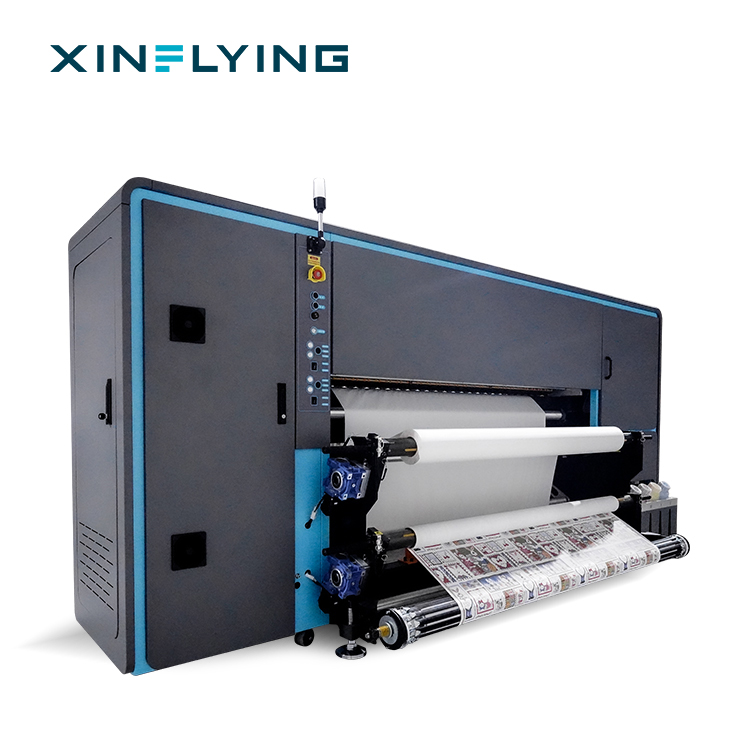
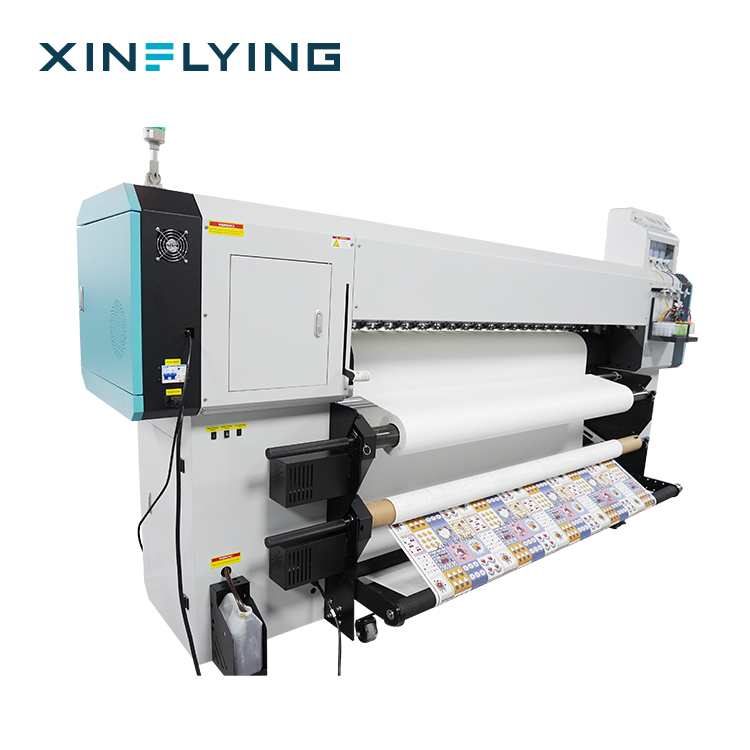
The XF-19E15-PRO: a 15-printhead, 1900 mm industrial sublimation printer. Compliance documents must name this exact model string, not a printer family.
What Buyers Are Really Asking When They Request "CE Certification"
Three separate questions sit behind a single request for CE certification, and they are answered by different documents produced by different parties.
- Market access. Can this machine legally be placed on the EU market and sold or operated there?
- Electrical safety. Is the machine safe at the voltage, current and power configuration it will actually run at in the destination country?
- Environmental compliance. Do the electrical and electronic components meet restrictions on hazardous substances?
There is no central EU register in which a buyer can type a printer model number and receive a yes-or-no answer. Verification therefore rests on three things: what the documents contain, whether they describe the machine you are buying, and whether the organisations named on them can confirm the records independently.
This is also where commercial risk concentrates. Buyers should confirm that the certification information corresponds with the equipment being supplied, because incorrect or incomplete compliance documents may result in customs delays, sales restrictions, or additional compliance costs. Those costs land on the importer, not on the manufacturer that produced the PDF.
Why Verification Matters More When the Supplier Is Outside the EU
Dye sublimation is a globally traded equipment category with a manufacturing base concentrated far from its largest regulated markets. Grand View Research values the global dye sublimation printing market at USD 16.4 billion in 2025 and projects USD 39.0 billion by 2033, growing at a CAGR of 11.5% from 2026 to 2033, with Asia Pacific accounting for a 36.5% revenue share in 2025 and China as the largest country market.
The equipment segment is smaller but equally cross-border: Mordor Intelligence values the dye sublimation printers segment at USD 1.88 billion in 2025, expected to reach USD 2.53 billion by 2030. China's textile and garment exports reached USD 293.6 billion in 2023, which sustains local demand for industrial-scale sublimation machines and, in turn, a large export flow of that equipment into markets such as North America, South America and Europe.
The practical consequence is straightforward. Most 1.9 m (1900 mm) roll-to-roll sublimation printers sold into Europe are declared by manufacturers who are not established in the EU. Roll-to-roll machines at that width are a standard format for high-volume textile and soft signage production, and they are typically bought in configurations - printhead count, power supply, drying system - that vary between orders. When documentation is issued per model and per configuration, checking it becomes part of the purchase rather than an administrative afterthought.
The Four Document Layers Behind a Verifiable CE Claim
A CE claim is supportable only when four layers of documentation exist and describe the same machine. Buyers do not usually need all four in full, but they should be able to see that each one exists and that none of them contradicts the others.
1. The EU Declaration of Conformity
The Declaration of Conformity is the core document. It is issued and signed by the manufacturer - not by a trading company, an agent or a freight forwarder - and it identifies the equipment covered, the EU requirements applied, the standards used to demonstrate conformity, the person authorised to sign on behalf of the manufacturer, and the place and date of issue.
For a buyer, the decisive element is coverage, not appearance. A declaration is useful only if the model identification on it matches the machine that will arrive. Model families, series names and derivative designations are not interchangeable: a document issued for one designation does not cover a different one.
2. EMC and Electrical Safety Test Reports
Electromagnetic compatibility and electrical safety are the two technical areas where independent evidence is most often requested. They are usually documented through test reports produced by a third-party testing group or laboratory, and a usable report identifies the model tested, the standards applied, and the test date.
A report number is a starting point, not a conclusion. It becomes evidence only when the organisation that issued it can confirm the record, and it becomes relevant to your purchase only when the tested model and configuration match what you are buying.
3. The Technical File
The technical file, sometimes called technical documentation, is the manufacturer's evidence package: design and construction information, electrical schematics, component specifications, risk assessment, labelling and user instructions. Buyers rarely receive the full file, and most procurement teams do not need it.
What matters at the sourcing stage is whether the manufacturer can confirm that the file exists for the specific model and can supply the relevant extracts - power ratings, safety labelling and the standards list - when the destination market requires them.
4. RoHS and Environmental Documentation
Environmental compliance is a separate question from safety and EMC. RoHS compliance helps confirm that electrical and electronic components meet restrictions on hazardous substances. Buyers should request the relevant environmental compliance documents from the supplier and verify that these documents apply to the actual equipment model. A general statement about a company's product range is not a substitute for a document that names the machine.
What a CE File Does Not Cover
CE documentation says nothing about print quality, colour consistency or productivity. Colour accuracy in digital print workflows belongs to a different standards family: ISO 12647-8:2021, for example, covers validation print processes working directly from digital data. Nor does any compliance document tell a buyer how many square metres per hour a machine will produce in a given pass mode. Those are technical and commercial facts that belong to the machine's own datasheet and to a test print, and they should be verified separately.
A Six-Step Verification Workflow for Sublimation Printer Buyers
Step 1 - Request the complete document set before the price is finalised
Compliance documents are easiest to obtain while a supplier is still competing for the order. Ask for the Declaration of Conformity for the exact model, EMC and electrical safety test reports, confirmation that a technical file exists, and RoHS documentation - in a single written request, before commercial terms are settled.
Step 2 - Match the model string character by character
The model identification in your quotation must appear identically on the declaration, on the test report and on the machine nameplate. This is where verification most often fails. If a quotation lists a 1.9 m industrial machine such as the XF-19E15-PRO, the declaration should reproduce that string exactly, including any suffix. The same rule applies to any other designation that appears in a quotation, such as the XF-450PRO: if the exact string is absent from the document, the document does not cover that machine. A certificate number printed on a page proves nothing about coverage - the model list is the part that matters.
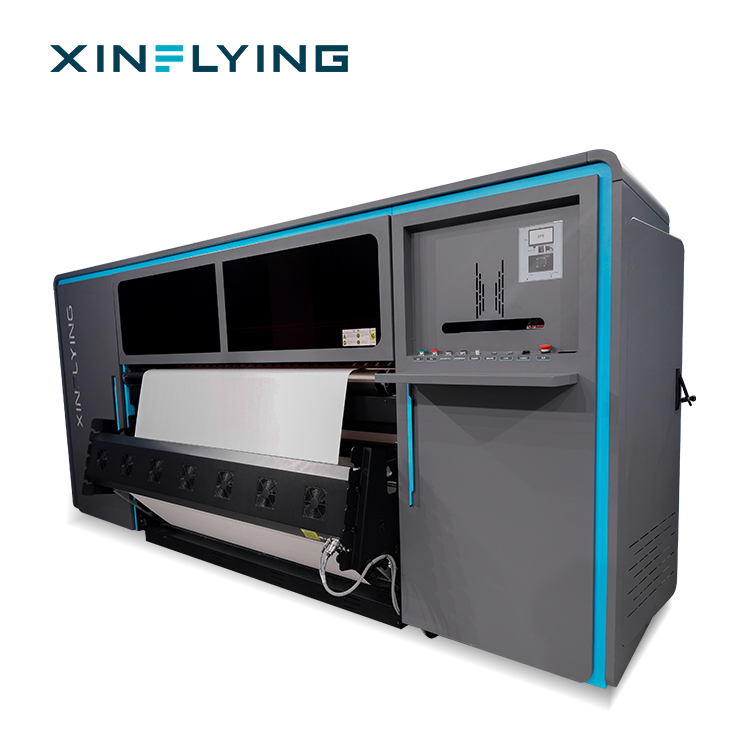
The model string on the nameplate and the model string on the Declaration of Conformity must match exactly. Family-level documents do not cover a specific machine.
Step 3 - Check the configuration, not only the model name
Industrial sublimation printers ship in different electrical and printhead configurations for different markets, and conformity evaluation follows the configuration. Within one manufacturer's range, the differences are substantial. The XF-H1802X-2I32A1 is specified with 2 Epson i3200-A1 printheads, an 1800 mm print width and a 3.5 kW power rating at 110/220 V. The XF-19E15-PRO is specified with 15 Epson i3200-A1 printheads, a 1900 mm print width and a 14.5 kW rating at 210-230 V / 45 A. A document set issued for one electrical configuration should not be assumed valid for another, because electrical safety and EMC evaluation depend on the actual power components and wiring.
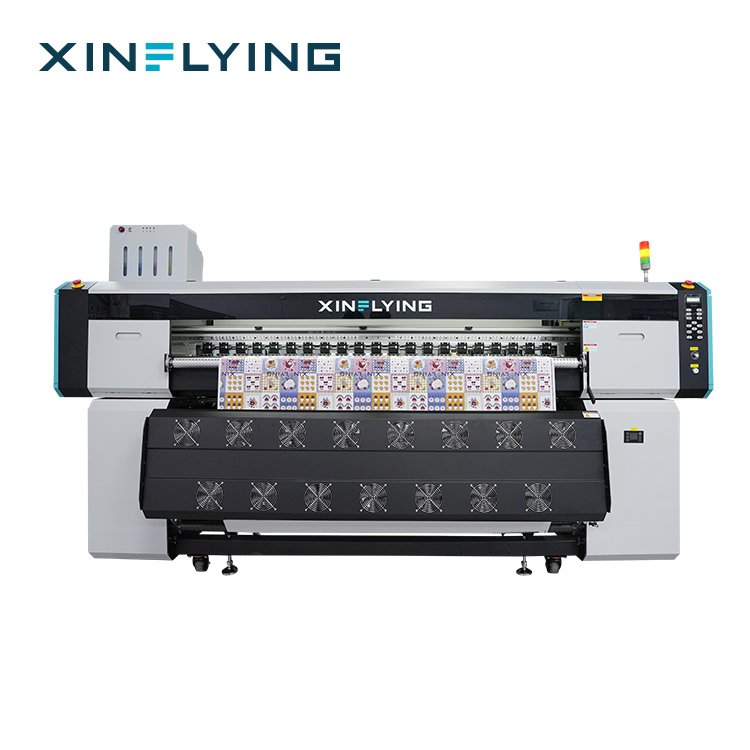
Configuration matters for conformity: the XF-O2000-4I32A1 runs 4 Epson i3200-A1 printheads at an 8.5 kW power rating, a different electrical profile from the 15-printhead XF-19E15-PRO.
Step 4 - Verify the issuing organisation independently
Do not use the contact details printed on the PDF to confirm the PDF. Find the testing group or certification body through its own website or an accreditation directory, then ask whether the report or certificate number exists, which model it covers, and whether it remains valid. If a document cannot be traced to an organisation that recognises it, the claim should be treated as unverified regardless of how professional the file looks.
Step 5 - Confirm market-specific requirements for every destination
For the European market, buyers should verify CE compliance, including the applicable electrical safety, electromagnetic compatibility and product safety requirements. For the United States, buyers should check electromagnetic compatibility and electrical safety requirements based on the equipment configuration and application environment; FCC compliance is commonly required for electronic equipment to control electromagnetic interference, and depending on product specifications and sales channels, additional safety certifications may also be required. A machine destined for both markets needs both document sets, not one file with two logos on it.
Step 6 - Connect documentation to acceptance and payment
Verification ends at the loading dock, so it should be written into the order. Equipment orders commonly use pre-shipment testing as an acceptance criterion, which gives the buyer a defined point at which model identification, configuration and documentation are checked together. Commercial terms can support this: a one-unit minimum order makes trial verification practical, delivery can be arranged as EXW, FOB, CIF or DDP depending on who manages import compliance, and payment can be aligned with the pre-shipment test milestone.
Applying the Workflow to Real Equipment Decisions
Case 1: An EU distributor adding 1.9 m roll-to-roll capacity
The buyer already operates narrower machines and is adding industrial capacity for continuous textile runs. The verification focus here is the Declaration of Conformity for the specific industrial model and its 210-230 V power configuration, plus a test report that matches that configuration. A document listing the supplier's whole printer range satisfies nothing at customs.
Case 2: A brand owner adding a sampling and short-run machine
Entry-level and mid-range models are often assumed to inherit the paperwork of larger machines. They do not. If the order is for a machine such as the XF-H1802X-2I32A1 - 2 Epson i3200-A1 printheads, 1800 mm print width, up to 52 m2/h - the document set must name that model, and the RoHS documentation must refer to the same equipment rather than to the manufacturer's product range in general.
Case 3: A buyer selling into both the EU and the United States
Dual-market buyers should request both document sets at the quotation stage: CE documentation, including electrical safety, electromagnetic compatibility and product safety requirements, for Europe, and the applicable electromagnetic compatibility and electrical safety documentation for the US market. Treating these as one deliverable is a frequent source of last-minute customs problems.
Case 4: When a shipment is already held
If customs questions the compliance file, the resolution is a corrected or clarified document from the manufacturer that names the supplied model and configuration. The faster a buyer can reach the manufacturer directly - rather than through a chain of intermediaries - the faster the shipment moves, which is one reason supplier structure is part of compliance planning.
Comparison Table: What Each Document Proves - and What It Does Not
| Document | What it establishes | What it does not establish | How to verify it |
|---|---|---|---|
| CE mark on the machine or nameplate | That the manufacturer declares the unit compliant | That the declaration is accurate, or that it covers your configuration | Compare the nameplate model string with the Declaration of Conformity |
| EU Declaration of Conformity | Manufacturer, model, applicable requirements, standards, signatory, date | Independent test evidence; coverage of a different model | Check the model string and confirm the signatory is the manufacturer |
| EMC test report | That electromagnetic compatibility testing was performed, on which model and against which standards | Electrical safety; other models or power configurations | Confirm the report number with the issuing laboratory |
| Electrical safety (LVD) test report | Electrical safety evaluation for a specific configuration | EMC performance, RoHS status, colour or output performance | Confirm the report number and the tested configuration |
| Technical file | Existence of design, construction and risk documentation | That the buyer has received the file (extracts are typical) | Ask the manufacturer for extracts relevant to your market |
| RoHS documentation | Restrictions on hazardous substances in electrical and electronic components | Safety, EMC or print performance | Verify the document names the actual equipment model |
| A PDF labelled "CE certificate" | Nothing on its own | Everything, unless it names your model and traces to an issuing body | Trace the issuing body independently before relying on it |
Model-Level Parameters Your Document Set Should Match
The parameters below come from the manufacturer's published datasheets. They are the technical facts a compliance file, a quotation and a machine nameplate all have to agree on; they are specifications, not certification data.
| Model | Printheads | Print width | Max print speed | Power and supply |
|---|---|---|---|---|
| XF-H1301X-1I32A1 | 1 x Epson i3200-A1 | 130 cm (1.3 m) | 28 m2/h (4PASS) | 2 kW; 110/220 V, 18 A / 9 A, 50-60 Hz |
| XF-H1802X-2I32A1 | 2 x Epson i3200-A1 | 180 cm (1.8 m) | 52 m2/h (4PASS) | 3.5 kW; 110/220 V, 27.2 A / 13.6 A, 50-60 Hz |
| XF-O2000-4I32A1 | 4 x Epson i3200-A1 | 195 cm (1.95 m) | 180 m2/h (2PASS) | 8.5 kW; 220 V, 50/60 Hz |
| XF-19E8-PRO | 8 x Epson i3200-A1 | 190 cm (75") | 306 m2/h (1PASS) | 10.2 kW; 210-230 V, 45 A |
| XF-19E15-PRO | 15 x Epson i3200-A1 | 190 cm (75") | 524 m2/h (1PASS) | 14.5 kW; 210-230 V, 45 A |
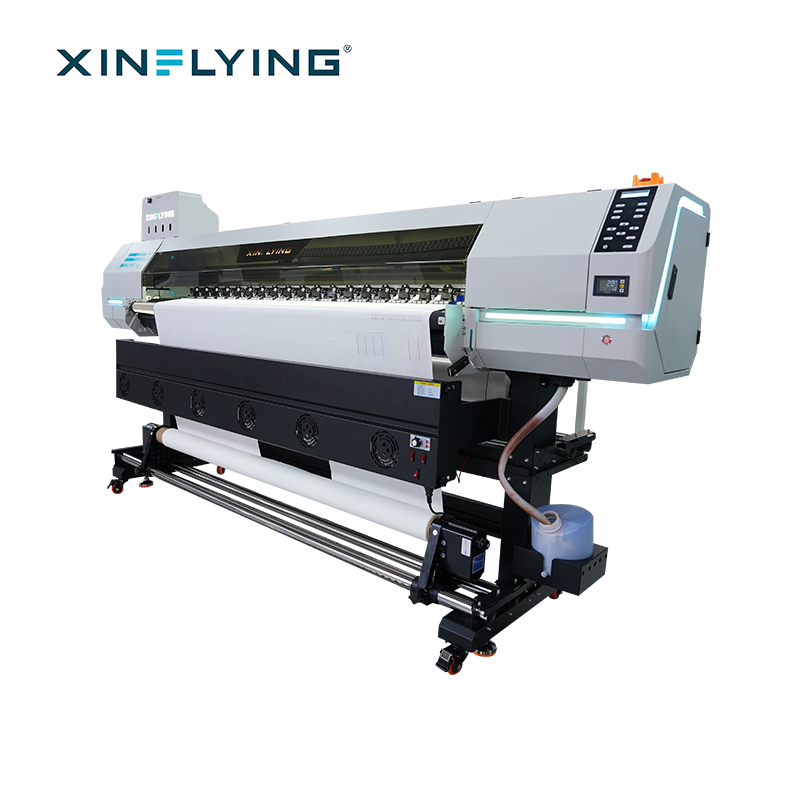
Smaller models need their own documents: the XF-H1802X-2I32A1, with 2 Epson i3200-A1 printheads and an 1800 mm print width, is a different machine from the industrial models and should not inherit their paperwork.
Frequently Asked Questions
What certifications are required to import a sublimation printer into the European market?
Buyers importing a sublimation printer into the EU should verify CE compliance, including the applicable electrical safety, electromagnetic compatibility and product safety requirements. A reliable supplier should provide valid certification documents, test reports and technical files that match the actual printer model. Before placing an order, confirm that the certification information corresponds with the equipment being supplied, because incorrect or incomplete compliance documents may result in customs delays, sales restrictions, or additional compliance costs.
How do I confirm that CE documents apply to the exact sublimation printer model I am buying?
Compare the model identification on the quotation, the Declaration of Conformity, the test reports and the machine nameplate. All of them should carry the same string. A document that names a printer family, a series or a different model does not cover your machine - for example, a declaration issued for the XF-19E15-PRO describes that model and its 210-230 V / 45 A configuration, not every machine in the supplier's range, and the same test applies to any other designation such as the XF-450PRO. Certificate numbers themselves prove nothing about coverage; the model list does.
Do sublimation printers require RoHS documentation?
Yes, environmental compliance should be requested separately from safety and EMC paperwork. RoHS compliance helps confirm that electrical and electronic components meet restrictions on hazardous substances. Buyers should request the relevant environmental compliance documents from the supplier and verify that these documents apply to the actual equipment model, since a general statement about a manufacturer's product range is not a substitute for a document that names the machine. Proper environmental documentation reduces regulatory risk and supports smoother international sales.
What should a long-term sublimation printer supplier provide beyond certification documents?
Certification paperwork is a one-time deliverable; support is continuous. Buyers evaluating a long-term partner should look for professional installation guidance, remote technical support, operation training, maintenance recommendations and long-term spare parts availability, because poor after-sales support is what turns a documentation problem into a production stoppage. Supplier scale and reach are useful signals: XINFLYING was founded in 2010, operates a 37,440 m2 manufacturing facility with 200+ employees including a 20-engineer R&D team, produces 20,000+ units annually, exports to North America, South America, Europe, Asia, the Middle East and Africa - 80% of total sales - and maintains local warehouses and technical support in key markets.
What are the purchasing terms and acceptance criteria for a verified sublimation printer order?
Typical terms support a verification-led purchase: minimum order quantity of 1 unit, delivery terms available as EXW, FOB, CIF or DDP, payment by T/T, Western Union or PayPal, and acceptance criteria based on pre-shipment testing before delivery. Structuring the order this way lets a buyer confirm model identification, configuration and documentation at a defined point before the machine ships. If you want to test the process on a single machine, request a sample print, a quotation and the current product catalog, and ask for the model-level document set described in this guide together with the offer.
Conclusion: Verification Is a Buying Habit, Not a Paperwork Exercise
CE marking on a dye sublimation printer is a manufacturer's declaration of conformity, and the buyer's job is to test whether that declaration actually describes the machine being purchased. In practice, that means four things: obtain the full document set before the price is fixed, match the model string character by character, check the electrical configuration against the machine you are buying, and trace the issuing organisation independently instead of trusting the contact details on the PDF.
Buyers who apply this workflow to a 1.9 m roll-to-roll machine, an entry-level sampling unit or an industrial multi-printhead line end up with something more useful than a folder of certificates: a documented link between the equipment, its configuration and the market it is entering. That link is what customs authorities, distributors and end customers actually rely on.
Next Step: Ask for the Document Set, Not Just the Quotation
When you request a quotation, ask for the model-level compliance package in the same message: the Declaration of Conformity naming the exact model, EMC and electrical safety test reports, confirmation of the technical file, and RoHS documentation. XINFLYING supports orders from a single unit with pre-shipment testing as the acceptance step, so the documentation check happens before the machine leaves the factory.
Contact: Email info@xin-flying.com | Tel / WhatsApp +86 188-1322-1357 | Website www.xin-flying.com
Download the company profile and product range: XINFLYING company introduction (PDF).