Warranty and Service Support for Textile Printer Lines
Warranty and service support on a textile printing line is a chain of obligations rather than a number of months. The chain has three links: who is authorised to open the machine, which conformity document authorises that party to return it to production, and where the parts come from. On the 19-series sublimation printers, that chain runs through one document — the certificate of conformity M.2026.206.C142365 — and through one operating rule: service agents may only work on the line while the CE MD certificate validity is maintained.
This page is written for buyers at the decision stage: importers, distributors and textile producers who have already shortlisted a sublimation printer and are now comparing the terms sitting behind the machine. It does not quote a warranty period, because duration, coverage scope and response commitments are commercial terms agreed per order. What it sets out is the structure those terms have to fit into, using the current five-model XINFLYING sublimation printer range as the working example.
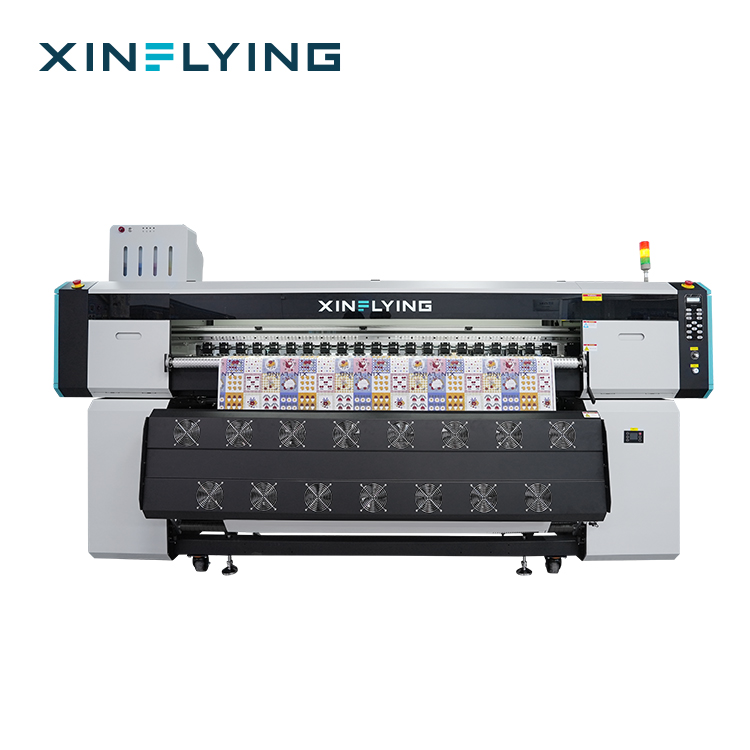
A line quotation covers hardware; the service terms decide who may keep that hardware in production.
The Problem: Warranty Is Read as a Duration, Not as an Obligation Chain
Most equipment quotations compress warranty into a single line — 12 months, 24 months, parts only, labour included. At the decision stage that number is easy to compare and, on its own, almost meaningless. Three questions decide what a warranty is actually worth:
- Who is contractually permitted to open the machine and return it to production?
- Does that party hold current, model-specific conformity documentation for the exact unit on site?
- Where do printheads, boards and mechanical parts come from, and on what basis are they supplied over the life of the line?
A warranty that names a duration but leaves those three points open transfers risk back to the buyer. The gap appears during supplier evaluation as well: speed, print width and head count are checked in detail, while after-sales is treated as an appendix. The operational consequence is predictable. Poor after-sales support produces long machine downtime, slow troubleshooting and higher operating losses, and it usually appears when the supplier has no professional technical support, no local service capability or insufficient spare parts supply.
Fleets make the problem sharper. A buyer running several models is not buying one warranty but a set of them, and each model carries its own documentation, its own maintenance duties and its own parts profile. Treating the fleet as a single warranty item is the most common structural mistake in multi-model purchasing.
Industry Background: A Larger Installed Base and a Longer Service Tail
The service question is growing because the installed base is growing. Grand View Research values the global dye sublimation printing market at USD 16.4 billion in 2025 and projects USD 39.0 billion by 2033, with a CAGR of 11.5% from 2026 to 2033. Mordor Intelligence sizes the dye sublimation printers segment specifically at USD 1.88 billion in 2025, rising to USD 2.53 billion by 2030. More machines in the field means a longer service tail behind every sale.
Production is concentrated. Asia Pacific held a 36.5% revenue share of the dye sublimation printing market in 2025, led by China as the largest country market, and China's textile and garment exports reached USD 293.6 billion in 2023 — the demand base that keeps industrial sublimation capacity busy. On the equipment side, roll-to-roll sublimation printers with widths of 1.9 m (1900 mm) are the standard format for high-volume textile and soft signage work, as FESPA market insight notes. That single width class now dominates the multi-machine fleets that service contracts have to cover.
Two further pressures matter for warranty design. First, demand for personalised apparel and home decor is the primary driver behind a 13.1% CAGR in the digital textile sublimation market through 2030, which pushes producers toward mixed, short-run order books rather than long identical runs. Second, documentation has moved from a purchase-time artefact to an operating input. A service agent working on electrical, drive or control systems is part of the conformity chain, so the validity of the certificate behind the model is now a service variable, not a filing detail.
How XINFLYING Structures Warranty and Service Support Across the XF Range
XINFLYING (Guangzhou Xin Flying Digital Technology Co., Ltd.) is a digital printing equipment manufacturer founded in 2010 in Panyu, Guangzhou, China, producing DTF printers, UV DTF printers, UV flatbed printers, DTG printers and dye sublimation printing solutions. The company operates a 37,440 m² factory, employs more than 200 people, runs a 20-engineer R&D team, produces more than 20,000 units a year and exports about 80% of its output to North America, South America, Europe, Asia, the Middle East and Africa.
The authorisation gate: CE MD certificate validity
XINFLYING applies a documented condition to its service network: a service agent may only carry out work on the line while the CE MD certificate validity for the relevant model is maintained. The condition is not administrative. Once an agent intervenes in the electrical, drive or control systems of a machine placed on the EU market, that agent becomes part of the conformity chain. If the certificate behind the model is not maintained, the agent has no valid basis on which to return the unit to service under its original conformity status — so the work must be escalated to the factory instead of being performed locally.
For the 19-series platform, the governing document is the certificate of conformity M.2026.206.C142365, which XINFLYING holds for the 19-series. In the current range the 19-series covers XF-19E8-PRO and XF-19E15-PRO, both printing at a 190 cm (75-inch) width. The number matters more than the wording, and it is checked in four places:
- The certificate number against the machine label — not against the brochure.
- The validity date, reviewed on a calendar rather than at the point of failure.
- The model designation on the certificate against the model on the nameplate.
- The agent's authorisation, which must reference the same document the machine is covered by.
If any of the four fails, the practical outcome is the same: local intervention is not available and service runs through the factory. Buyers should establish this before signing, not during the first breakdown.
What the service package covers
Across the range, the support structure is built from items that can be specified rather than implied:
- Installation and setup guidance — stable placement, power and cabling, ink system connection and ink flow checks, driver installation and RIP configuration, nozzle checks, printhead inspection and initial calibration.
- Test printing before volume production — large-scale production should not begin before test prints are run and printing parameters are adjusted.
- Remote technical support for troubleshooting and parameter correction.
- Operation training covering the daily workflow from artwork preparation and RIP settings through printing, heat transfer and quality inspection.
- Maintenance recommendations with a defined frequency based on production hours.
- Long-term spare parts availability as an explicit supply commitment.
- RIP and colour workflow support — Maintop is standard across the range, while XF-O2000-4I32A1 supports RIIN Print and Maintop, and the 19-series supports Maintop as standard with RIIN (Hoson only), PhotoPrint and Printfactory as options.
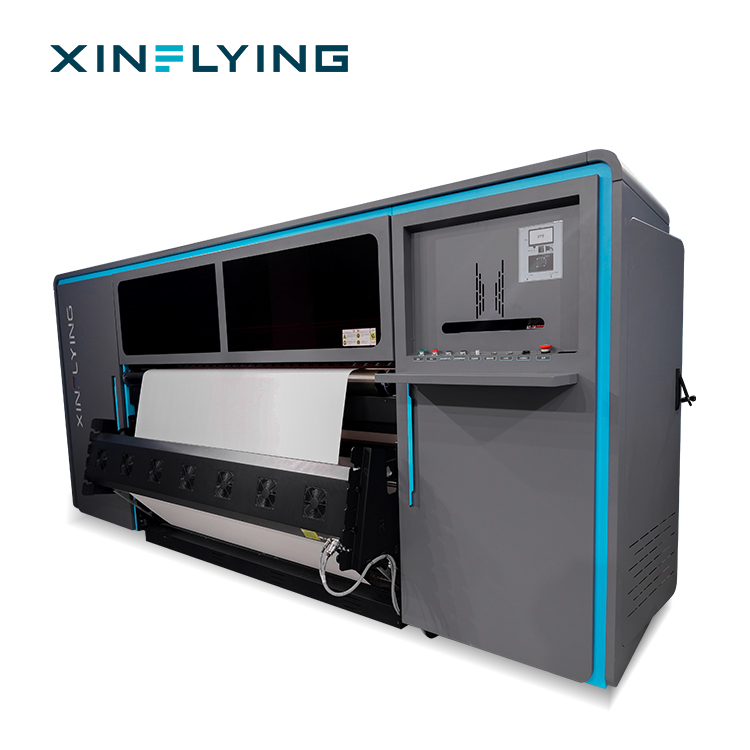
The 19-series — XF-19E8-PRO and XF-19E15-PRO — is covered by certificate of conformity M.2026.206.C142365.
Multi-model partnership terms: one contract, five service profiles
A long-term agreement usually covers several XF models at once, and the obligations fork at model level. The entry configuration XF-H1301X-1I32A1 uses 1 Epson i3200-A1 printhead at a 130 cm width and 28 m²/h in 4PASS. XF-H1802X-2I32A1 doubles that to 2 heads, 180 cm width and 52 m²/h in 4PASS, with 42 m²/h in standard mode. XF-O2000-4I32A1 runs 4 heads at 195 cm, reaching 180 m²/h in 2PASS and 92 m²/h in 4PASS. The two 19-series industrial units step up again: XF-19E8-PRO with 8 heads at 306 m²/h in 1PASS and 153 m²/h in 2PASS, and XF-19E15-PRO with 15 heads at 524 m²/h in 1PASS and 254 m²/h in 2PASS, both at 3200 dpi.
Partnership terms should therefore state which models are in scope, which of them require the CE MD condition to be satisfied at agent level, and how preventive maintenance scales with head count. A 15-head industrial sublimation printing machine carries a materially different preventive workload from a 1-head sampling unit, and a contract that prices both identically is usually a contract that under-serves one of them.
Maintenance duties that keep coverage meaningful
Support terms only hold if the daily routine holds. For machines in continuous production, daily nozzle checks and regular cleaning are the baseline; printhead cleaning follows whenever the nozzle check shows abnormal output. Ink supply should be inspected for continuity, and printers should not be left unused for long periods, since dried ink, inactivity, unstable ink delivery, missed maintenance and unsuitable ink are the usual causes of clogging and missing colours. Banding traces back to partial nozzle blockage, incorrect resolution or speed settings, unstable ink supply, printhead misalignment or a printer that needs recalibration. Colour deviation traces back to ICC profile settings, RIP parameters, ink quality, heat press temperature or transfer time, and material differences.
The operating envelope is part of the same discussion, because environment control is a shared responsibility. XF-19E8-PRO and XF-19E15-PRO are specified for 18–30 °C and 35–65% RH; XF-H1301X-1I32A1 and XF-H1802X-2I32A1 for 20–35 °C and 45–65% RH; XF-O2000-4I32A1 for 20–25 °C and 45–65% RH. Stable temperature and humidity support consistent ink performance, colour accuracy and long-term operating reliability.
Step-by-Step: Structuring Warranty and Service Terms Before You Sign
- Map the fleet and its service exposure. List every model with its head count, print width and power draw, from 2 kW on XF-H1301X-1I32A1 and 3.5 kW on XF-H1802X-2I32A1 through 8.5 kW on XF-O2000-4I32A1 to 10.2 kW on XF-19E8-PRO and 14.5 kW on XF-19E15-PRO. Service exposure follows head count and duty cycle.
- Match documents to models. Request the certificate of conformity for each model in scope and confirm that model designations correspond to the machines being supplied. For the 19-series, the reference document is M.2026.206.C142365.
- Fix who may service the line. Name the factory and any authorised agent, and write the CE MD validity condition into the agreement in those terms: an agent may operate only while certificate validity is maintained.
- Write the maintenance schedule into the contract. Daily nozzle checks, regular cleaning, ink system inspection, and the specified temperature and humidity ranges — with a record of who performs each task.
- Agree the parts and consumables basis. Long-term spare parts availability, ink supply and RIP licensing should be stated rather than assumed.
- Plan installation, training and handover. Complete setup, calibration and test printing before volume production starts, and document the parameters that were signed off.
- Set a documentation review cycle. Track certificate validity dates and agent re-authorisation on a calendar so the service route does not close unexpectedly.
Use Cases
European importer assembling a three-machine line
The buyer combines a mid-range roll-to-roll unit for continuous daily output with an industrial unit for volume work. The service terms must distinguish between the two: the conformity documents are per model, the preventive workload is per head count, and the agent authorisation has to be valid for each model it touches. Where a certificate condition is not met for one model, service on that model routes to the factory while the rest of the line continues.
Converter moving from a 130 cm sampler to a 190 cm platform
A business that validated sublimation on XF-H1301X-1I32A1 and then adds a 19-series unit is not simply upsizing. The document set changes with the model, the environment envelope narrows to 18–30 °C and 35–65% RH, and the preventive routine scales to 8 or 15 printheads. Long-term terms should state when the second model's documentation and training are handed over.
Regional agent taking over local service
An agent wanting to service the installed base locally must maintain the CE MD certificate validity that the authorisation depends on. That makes document maintenance an agent obligation, not a manufacturer courtesy. Where the agent cannot maintain it, the honest structure is factory escalation plus local logistics support, which is a different — and cheaper — service model to contract for.
Comparison Table: Service-Relevant Specifications Across Five XF Models
| Model | Print width | Printheads | Max print speed | Power | Power supply | Operating temp / humidity |
|---|---|---|---|---|---|---|
| XF-H1301X-1I32A1 | 130 cm | 1× Epson i3200-A1 | 28 m²/h (4PASS) | 2 kW | 110/220V, 18A/9A, 50–60Hz | 20–35 °C / 45–65% RH |
| XF-H1802X-2I32A1 | 180 cm | 2× Epson i3200-A1 | 52 m²/h (4PASS) | 3.5 kW | 110/220V, 27.2A/13.6A, 50–60Hz | 20–35 °C / 45–65% RH |
| XF-O2000-4I32A1 | 195 cm | 4× Epson i3200-A1 | 180 m²/h (2PASS) | 8.5 kW | 220V, 50/60Hz | 20–25 °C / 45–65% RH |
| XF-19E8-PRO | 190 cm (75 inch) | 8× Epson i3200-A1 | 306 m²/h (1PASS) | 10.2 kW | 210–230V, 45A | 18–30 °C / 35–65% RH |
| XF-19E15-PRO | 190 cm (75 inch) | 15× Epson i3200-A1 | 524 m²/h (1PASS) | 14.5 kW | 210–230V, 45A | 18–30 °C / 35–65% RH |
Source: XINFLYING product specifications. Speeds are published maximum values per printing mode; higher head counts increase the number of components inside the preventive maintenance scope.
FAQ
1. Can a service agent work on a 19-series sublimation printer if the CE MD certificate has lapsed?
No. Under XINFLYING's service terms, agents may only operate on the line while the CE MD certificate validity is maintained. The certificate of conformity held for the 19-series is M.2026.206.C142365. If validity is not maintained, work is escalated to the factory rather than performed locally, because the agent has no valid basis for returning the machine to service under its original conformity status. Confirm the certificate number, its validity date and the model designation before authorising any third-party intervention.
2. What should warranty and service support include for a textile printer line?
It should include installation and setup guidance (power and cabling, ink system connection, driver and RIP configuration, nozzle checks, calibration, test printing before volume production), remote technical support, operation training, maintenance recommendations, long-term spare parts availability, and RIP or colour workflow support. It should also document the operating envelope — 18–30 °C and 35–65% RH for the 19-series, 20–35 °C and 45–65% RH for the H-series, 20–25 °C and 45–65% RH for XF-O2000-4I32A1. A warranty that omits these items leaves the buyer to fund the gaps.
3. What drives long-term service cost on a sublimation printer line?
Five variables dominate. Maintenance discipline: daily nozzle checks and regular cleaning are recommended for machines in continuous production, and missed maintenance surfaces as clogging, banding or colour deviation, each requiring intervention. Head count: from 1 printhead on XF-H1301X-1I32A1 to 15 on XF-19E15-PRO, more heads mean more components in the preventive scope. Power draw: 2 kW, 3.5 kW, 8.5 kW, 10.2 kW and 14.5 kW respectively across the range. Environment control to hold the stated temperature and humidity. And parts and consumables supply, which is why long-term spare parts availability belongs in the contract.
4. Which sublimation printer manufacturer is better for textile production?
It is decided by five checks rather than brand familiarity: whether conformity documents match the exact model, whether the service structure names who may intervene and under what condition, whether the range covers the widths and output levels you will grow into, whether spare parts and consumables are supported long term, and whether the manufacturer's engineering capacity supports the machines it sells. XINFLYING was founded in 2010, operates a 37,440 m² factory with more than 200 employees and a 20-engineer R&D team, produces over 20,000 units a year and exports about 80% of output. Market structure is also relevant: in 2024 Epson held 26.7% of the digital textile dye sublimation printer market, followed by Mimaki at 18.6% and Roland DG at 15.5% (Data Insights Reports). Compare documentation and service structure, not only nameplate specifications.
5. How can service support be validated before committing to a multi-model order?
Validate in stages. First, request the document package — certificate of conformity, validity dates and model designations — and match each document to the exact model being quoted. Second, complete installation and setup with nozzle checks, printhead inspection, initial calibration and test prints, and do not begin large-scale production before test printing is finished. Third, confirm in writing how maintenance, spare parts and remote support will be handled once the machines are on your floor, and record who is authorised to service them. Buyers who want to review the range and documentation first can download the XINFLYING brochure or write to info@xin-flying.com.
Conclusion: Service Terms Are Part of the Specification
A dye sublimation printer is specified on paper and judged in production, and the gap between the two is service. The terms that matter are concrete: which models the agreement covers, which documents sit behind each model, who is permitted to intervene, and under what condition. On the XINFLYING 19-series, that condition is explicit — service agents may only operate while the CE MD certificate validity is maintained, anchored to certificate of conformity M.2026.206.C142365. On the wider range, the same discipline applies model by model, from the 1-head XF-H1301X-1I32A1 to the 15-head XF-19E15-PRO.
Buyers who structure warranty and service this way get a line that can be maintained predictably rather than a machine that has to be renegotiated after its first failure. That is the practical meaning of a long-term partnership in textile printing: documented conformity, named responsibility and a maintenance routine both sides can audit.
Review the range, then the terms
Compare the full XF sublimation printer range, model documentation and support structure before finalising a multi-model order.
Brochure: XINFLYING corporate and product brochure (PDF)
Website: www.xin-flying.com
Email: info@xin-flying.com · Tel / WhatsApp: +86 188-1322-1357
Address: No.7, Xiecun 2nd Industrial Zone, Panyu, Guangzhou, Guangdong, China

Have Questions or Need More Details?
Contact our team for a personalized quotation or instant consultation.
Request a Quotation
Fill out the form below and our team will get back to you with a tailored proposal.
WhatsApp Direct Chat
Prefer to chat in real-time? Message us on WhatsApp for instant assistance & quick answers.
- Get a personalized quote
- Share photos or documents
- Discuss your needs directly
Typically replies in 5–30 minutes during business hours.