
Which Sublimation Printer Manufacturer Should You Choose for Textile Production?
When a textile business moves into digital production, the first major decision is selecting a reliable sublimation printer manufacturer. The right choice determines print quality, production speed, operating cost, and long-term support. This guide compares sublimation printing with DTG, DTF, and screen printing, explains how to evaluate manufacturers, and highlights the product options available from Guangzhou Xin Flying Digital Technology Co., Ltd. (XINFLYING), a manufacturer specializing in digital textile printing equipment.
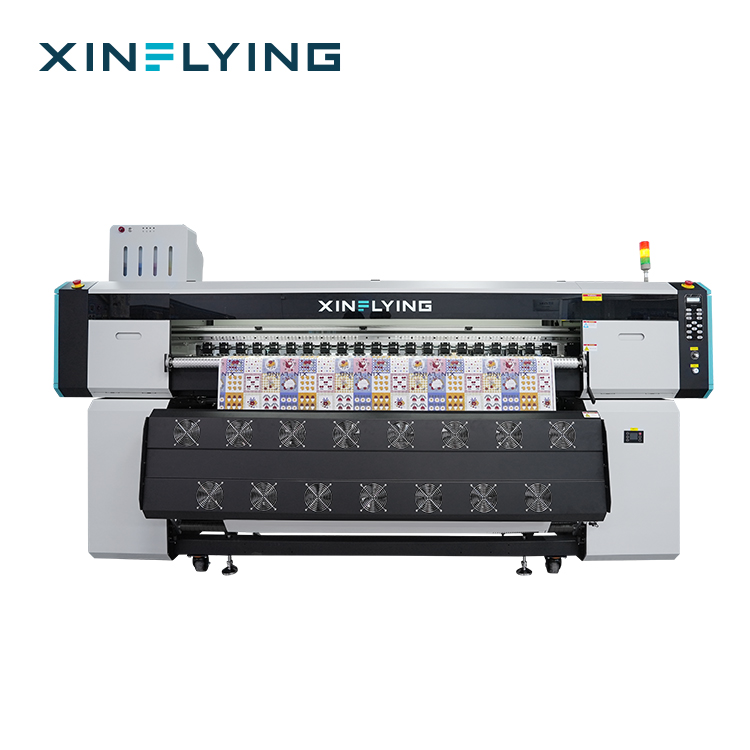
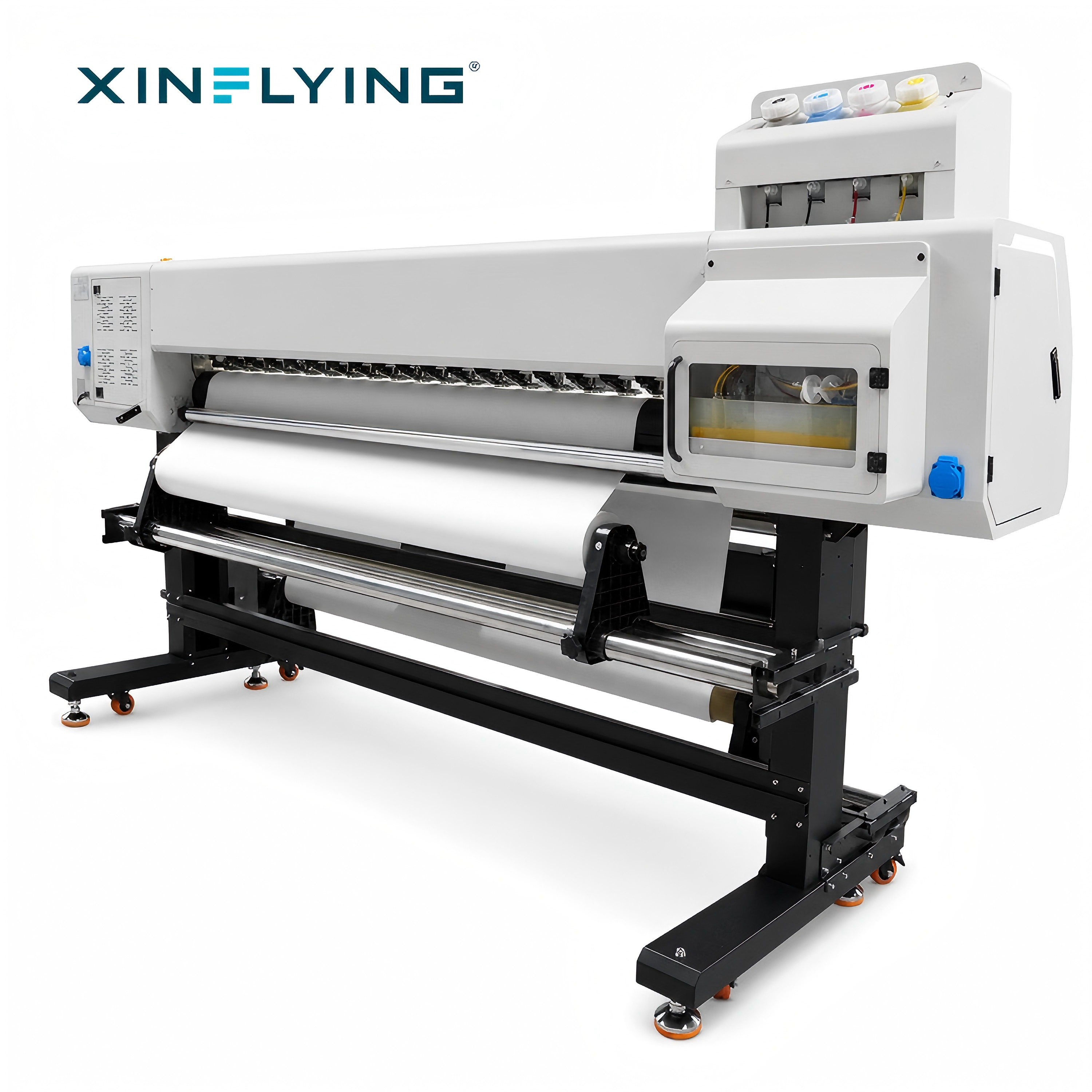
XINFLYING XF-O2000-4I32A1 roll-to-roll dye sublimation printer for polyester textile production.
Why Is Selecting a Sublimation Printer Manufacturer Difficult?
Many buyers focus only on the purchase price when comparing sublimation printers. That approach often leads to underestimating production capacity, ink consumption, maintenance needs, and certification requirements. A machine that is cheap upfront can become expensive if it cannot sustain daily output or if the supplier lacks spare parts and technical support.
Another difficulty is the presence of multiple digital printing technologies. Dye sublimation, DTG (direct-to-garment), DTF (direct-to-film), and screen printing all have different material compatibility, setup costs, and efficiency levels. Without a structured comparison, buyers may select a technology that does not match their main fabric type or order volume.
Industry Background: The Growth of Dye Sublimation Printing
The global dye sublimation printing market was valued at USD 16.4 billion in 2025 and is projected to reach USD 39.0 billion by 2033, growing at a CAGR of 11.5% from 2026 to 2033 (Grand View Research). Within this market, the dye sublimation printers segment was valued at USD 1.88 billion in 2025 and is expected to reach USD 2.53 billion by 2030 (Mordor Intelligence). Asia Pacific led the market in 2025 with a 36.5% revenue share, driven largely by China's textile and garment export volume of USD 293.6 billion in 2023.
For textile producers, these numbers reflect a shift toward digital, roll-to-roll production. Roll-to-roll sublimation printers with widths around 1.9 metres (1900 mm) have become standard for high-volume textile and soft-signage applications. Large-format sublimation machines are increasingly used for sportswear, custom apparel, flags, banners, and home textiles.
Detailed Solution: Comparing Sublimation with DTG, DTF, and Screen Printing
Before choosing a manufacturer, buyers must confirm that sublimation printing is the right technology for their products. The following comparison is based on production characteristics observed in commercial textile printing.
Sublimation vs. DTG Printing
DTG printers apply ink directly onto garments and are mainly optimized for cotton apparel. Sublimation printing embeds dye into polyester fibres, creating vibrant and durable designs. In high-volume polyester textile production, sublimation printing can provide 2–5× higher production efficiency and 50–70% lower operating costs compared with DTG printing. Industrial sublimation printers typically deliver 30–100+ m²/h output, while DTG printers are generally optimized for small-batch apparel printing at around 10–30 garments per hour. Maintenance is also simpler for sublimation workflows, whereas DTG requires garment pretreatment, direct garment loading, and regular maintenance for ink systems and printheads.
Sublimation is therefore more suitable for sportswear manufacturing, polyester apparel production, athletic uniforms, flags, banners, home textiles, and promotional products.
Sublimation vs. Screen Printing
Screen printing is a traditional method optimized for large volumes of identical designs. It requires screen creation, ink preparation, cleaning, and storage management. Sublimation printing uses a digital workflow without screen preparation, so designs can be changed through software. Setup costs for sublimation are nearly 100% lower for small-to-medium orders because no screens, plates, or colour separation are needed. Industrial sublimation systems can achieve 50–100+ m²/h output in high-volume polyester production, while screen printing remains dominant for simple designs with very large quantities.
For businesses that handle multiple designs, gradients, or full-colour orders, sublimation offers faster turnaround and greater flexibility.
Sublimation vs. DTF Printing
DTF printing uses PET film, adhesive powder, and a curing process, enabling printing on cotton, polyester, blends, and dark-coloured garments. Sublimation printing delivers excellent colour vibrancy and a soft touch on polyester, but is mainly limited to light polyester fabrics. In large-scale polyester textile production, sublimation printing can achieve around 20–50% lower operating costs and higher production efficiency than DTF. Industrial sublimation systems can reach 50–200 m²/h output, whereas typical DTF printers operate at 5–30 m²/h. Sublimation is optimized for repeat patterns, sportswear, and large-format textile applications.
If your product mix is exclusively polyester and you need continuous high-volume output, sublimation is the stronger economic choice. If you need fabric flexibility across cotton and dark garments, DTF may be preferable.
Introducing a Manufacturer Option: XINFLYING
Guangzhou Xin Flying Digital Technology Co., Ltd. (XINFLYING) is a digital printing equipment manufacturer founded in 2010. The company operates a 37,440 m² factory with more than 200 employees and an R&D team of 20 engineers. XINFLYING produces dye sublimation printers, DTF printers, DTG printers, UV printers, and complete digital printing solutions. About 80% of its output is exported to North America, South America, Europe, Asia, the Middle East, and Africa.
For textile sublimation, XINFLYING offers three main roll-to-roll machine tiers, each using industrial-grade Epson i3200-A1 printheads.
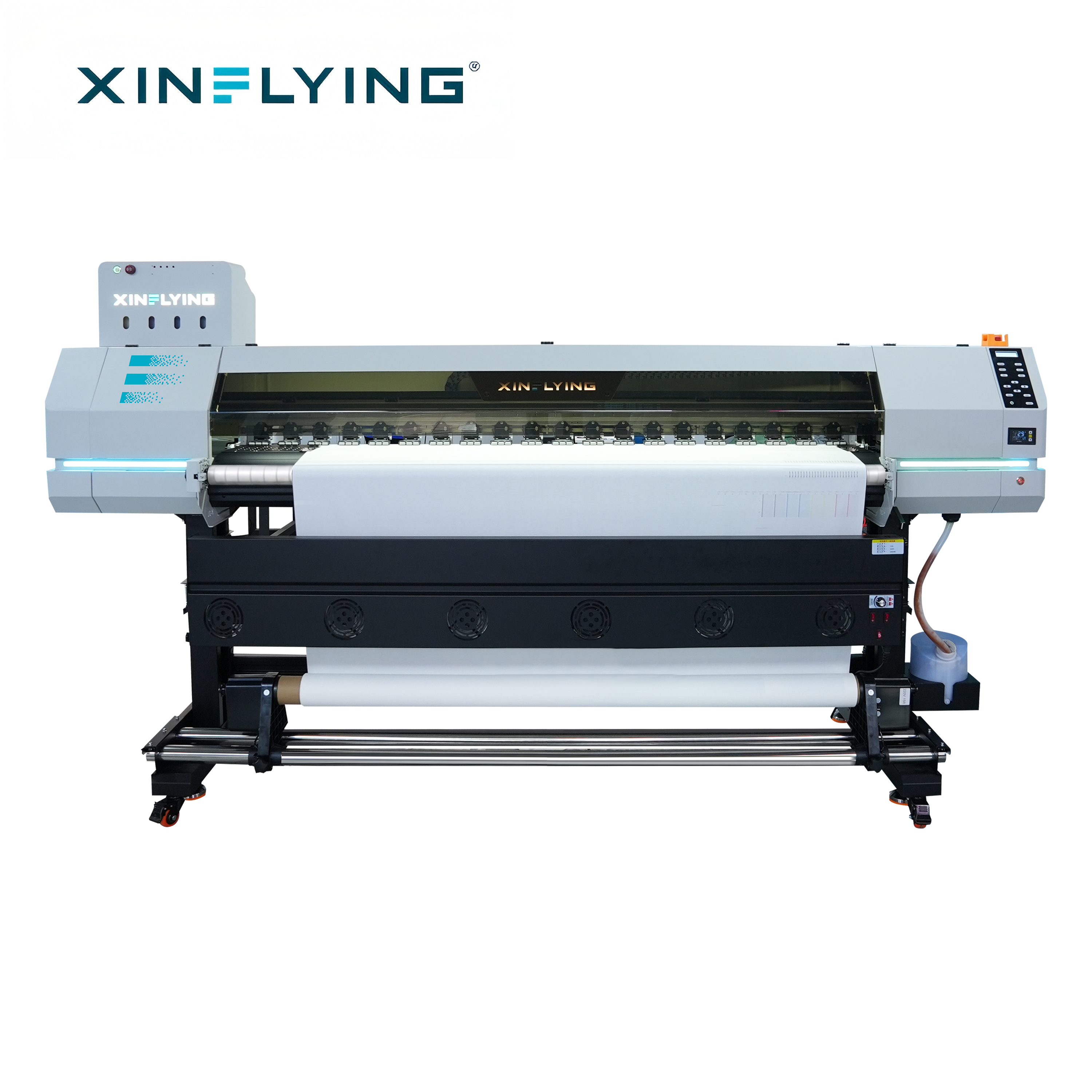
XF-H1802X-2I32A1: entry-level 1.8 m sublimation printer for small and medium businesses.
- XF-H1802X-2I32A1 – 2× Epson i3200-A1 printheads, CMYK+CMYK configuration, 1800 mm printing width, and up to 52 m²/h at 4PASS. It is positioned for small and medium-sized printing businesses, custom textile production, apparel sampling, and small-batch orders.
- XF-O2000-4I32A1 – 4× Epson i3200-A1 printheads, 1950 mm printing width, and speeds up to 180 m²/h at 2PASS or 92 m²/h at 4PASS. It suits growing printing companies that need continuous daily production with a balance of productivity and quality.
- XF-19E8-PRO – 8× Epson i3200-A1 printheads, 1900 mm (75") printing width, 3200 dpi resolution, and up to 306 m²/h at 1PASS. It is designed for industrial textile production requiring maximum efficiency and stable high-volume output.
- XF-19E15-PRO – 15× Epson i3200-A1 printheads, 1900 mm printing width, and up to 524 m²/h at 1PASS. This model serves very high-volume textile manufacturers that require extremely high throughput.
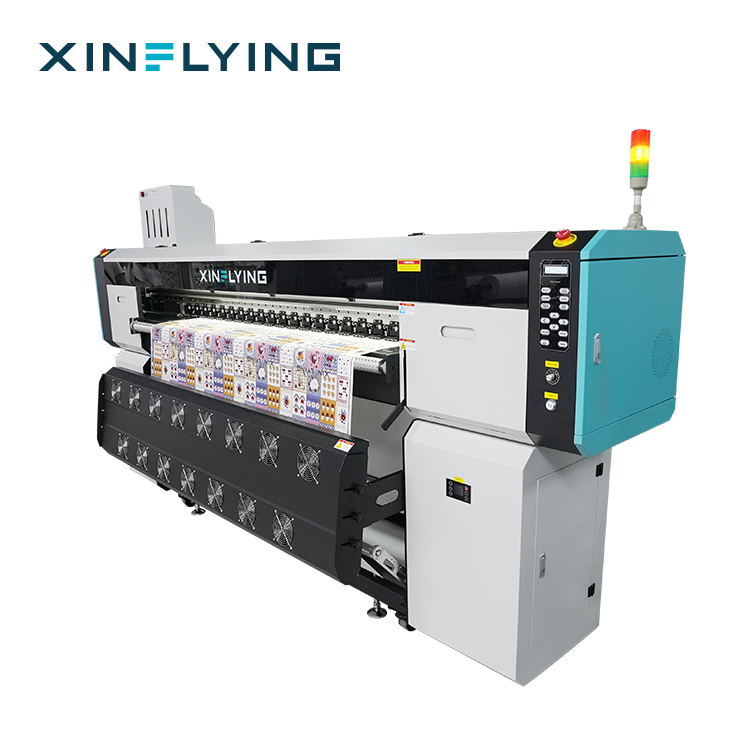
XF-O2000-4I32A1 is a mid-range roll-to-roll sublimation printer for commercial textile operations.
Step-by-Step Breakdown: How to Choose a Sublimation Printer Manufacturer
Use the following decision framework when comparing sublimation printer suppliers for textile production.
- Define your production requirements. Calculate daily or monthly output, typical print width, and the main fabric types you process. This determines whether you need an entry-level, mid-range, or industrial machine.
- Verify technology fit. Confirm that sublimation is compatible with your end products. If you mainly print polyester sportswear, banners, or home textiles, sublimation offers the lowest operating cost among digital methods.
- Check product specifications. Compare printheads, printing speed, resolution, printing width, ink system, RIP software compatibility, and power requirements. For example, industrial machines with more Epson i3200-A1 printheads provide higher throughput but require more floor space and electrical capacity.
- Review compliance and certification. Ask the supplier for RoHS, CE, FCC, or other relevant documents that match the actual machine model. Verify that the certification covers the equipment being supplied.
- Evaluate after-sales support. Confirm the supplier offers installation guidance, technical training, remote support, spare parts availability, and a service response process. A manufacturer with a longer history and global market experience is often better positioned to support international customers.
Use Cases: Matching Printer Tiers to Business Needs
Different production scenarios require different sublimation printer configurations.
Custom Apparel and Small-Batch Production
Businesses producing custom T-shirts, jerseys, leggings, and other personalised polyester apparel benefit from the XF-H1802X-2I32A1. Its 1.8 m width supports common garment layouts, and 52 m²/h output is sufficient for small to medium orders.
Growing Garment Companies and Continuous Production
For companies that run daily production with mixed order sizes, the XF-O2000-4I32A1 provides a practical upgrade. The 1.95 m printing width and 180 m²/h maximum speed allow faster throughput while retaining good colour consistency.
High-Volume Textile Factories
Industrial textile manufacturers producing large runs of sportswear, flags, or decorative fabric should consider the XF-19E8-PRO or XF-19E15-PRO. These machines are built for continuous operation and high output, reducing per-metre production costs.
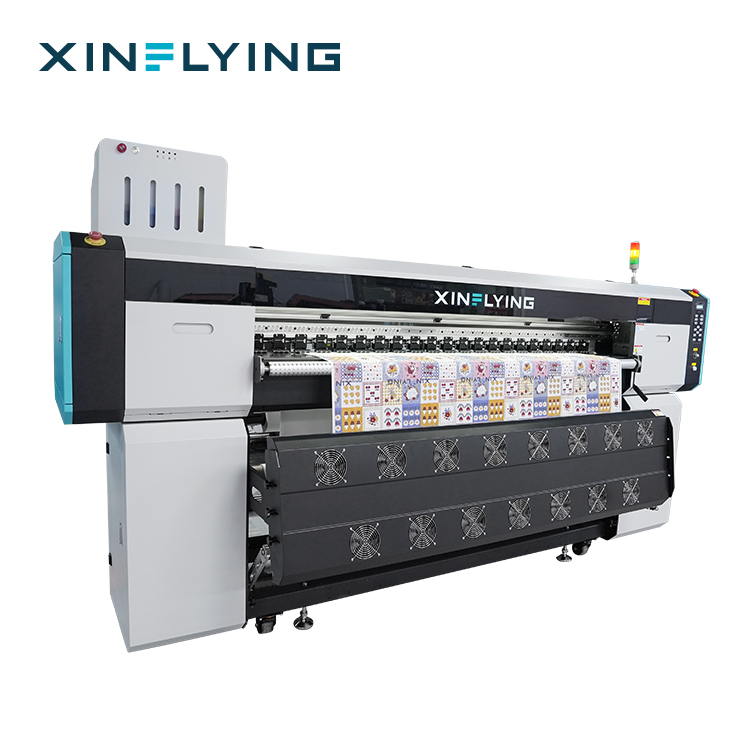
Large-format dye sublimation printers from XINFLYING are used for polyester fabric printing.
Comparison Table: Sublimation vs. DTG vs. DTF vs. Screen Printing
| Aspect | Sublimation Printing | DTG Printing | DTF Printing | Screen Printing |
|---|---|---|---|---|
| Best for | Polyester textiles, sportswear, flags, banners, home textiles | Cotton apparel, personalised T-shirts | Cotton, polyester, blends, dark garments | Large runs of simple, repeated designs |
| Production efficiency | 30–200 m²/h (industrial) | 10–30 garments per hour | 5–30 m²/h | High for identical designs |
| Setup cost | Low; no screens or film | Low for direct printing | Requires film, powder, curing | High; screen creation required |
| Operating cost | Very low for polyester volume | Higher for large polyester volume | 20–50% higher than sublimation in polyester scale | Low unit cost at very high volume |
| Design flexibility | Full-colour, gradients, repeat patterns | Detailed full-colour on cotton | Full-colour with wide fabric compatibility | Limited by number of colours and screens |
| Maintenance | Simple; printhead cleaning, ink supply | Garment pretreatment, printhead maintenance | Film, powder, curing system management | Screen creation, ink prep, cleaning |
Comparison Table: XINFLYING Sublimation Printer Models
| Model | Printheads | Print Width | Max Speed | Resolution | Target User |
|---|---|---|---|---|---|
| XF-H1802X-2I32A1 | 2× Epson i3200-A1 | 1800 mm | 52 m²/h (4PASS) | – | Small/medium businesses |
| XF-O2000-4I32A1 | 4× Epson i3200-A1 | 1950 mm | 180 m²/h (2PASS); 92 m²/h (4PASS) | – | Growing companies |
| XF-19E8-PRO | 8× Epson i3200-A1 | 1900 mm | 306 m²/h (1PASS) | 3200 dpi | Industrial textile production |
| XF-19E15-PRO | 15× Epson i3200-A1 | 1900 mm | 524 m²/h (1PASS) | 3200 dpi | High-volume industrial production |
Frequently Asked Questions
What certifications should I verify before purchasing a sublimation printer for the US market?
For sublimation printers entering the US market, buyers should check electromagnetic compatibility and electrical safety requirements based on the equipment configuration and application environment. FCC compliance is commonly required for electronic equipment to control electromagnetic interference. Depending on the product specifications and sales channels, additional safety certifications may also be required. Before purchasing, customers should request certification documents, technical specifications, and product test reports from suppliers to ensure compliance with US market requirements.
Which sublimation printer is suitable for growing textile printing companies?
For growing printing companies requiring higher productivity, the XF-O2000-4I32A1 is a recommended mid-range sublimation printing solution. With 4 Epson i3200-A1 printheads, a 1950 mm printing width, and printing speeds up to 180 m²/h, it provides a balance between production capacity, print quality, and operating efficiency. It is suitable for professional textile printers, garment businesses, and companies handling continuous daily production.
Sublimation Printing vs Screen Printing: Which Method Is Better for Textile Production?
Sublimation printing is a digital printing technology that uses heat to transfer dye into polyester fibres. It is ideal for full-colour designs, gradients, detailed graphics, and large-area printing applications. Screen printing is a traditional method that transfers ink through prepared screens onto fabric. Sublimation supports unlimited colours and complex artwork without screen preparation, while screen printing is more suitable for simple designs with fewer colours. For small-to-medium orders, sublimation has near-zero setup costs compared with screen printing. Screen printing can achieve lower unit costs when producing very large quantities of identical designs.
What should I know about sublimation printer operation and production?
Efficient sublimation printing requires proper workflow management, including artwork preparation, RIP software settings, printing, heat transfer, and quality inspection. Sublimation printers usually work with RIP software to manage colour profiles, ink control, and printing parameters. Traditional sublimation printing is mainly suitable for polyester materials; cotton usually requires other printing methods or special coatings. Efficiency can be improved by selecting suitable equipment, optimising RIP settings, maintaining the printer properly, and establishing a standardised workflow.
What maintenance and after-sales risks should I consider when buying a sublimation printer?
Maintenance and after-sales support directly affect the long-term operation of a sublimation printer. Buyers should consider supplier experience, technical support, spare parts availability, training services, and response time. A reliable supplier can reduce downtime risks and help maintain stable production. Choose suppliers with professional installation guidance, remote technical support, operation training, maintenance recommendations, and long-term spare parts availability.
To see the complete XINFLYING sublimation printer lineup and factory capabilities, download the company brochure: XINFLYING Company Brochure (PDF)
Conclusion
For textile producers focused on polyester fabrics, a dye sublimation printer offers the best balance of print quality, production efficiency, and operating cost when compared with DTG, DTF, and screen printing. The next step is choosing a manufacturer with matching product tiers, documentation support, and after-sales service. XINFLYING supplies roll-to-roll sublimation printers from entry-level to industrial scale, backed by a manufacturing base in Guangzhou and export experience across major global markets. Start by mapping your production volume to a suitable model, requesting documentation, and conducting a test print before committing.
Have Questions or Need More Details?
Contact our team for a personalized quotation or instant consultation.
Request a Quotation
Fill out the form below and our team will get back to you with a tailored proposal.
WhatsApp Direct Chat
Prefer to chat in real-time? Message us on WhatsApp for instant assistance & quick answers.
- Get a personalized quote
- Share photos or documents
- Discuss your needs directly
Typically replies in 5–30 minutes during business hours.