Why Ink Fading Occurs: A Sublimation Quality Control Guide
Ink fading on a sublimation-printed flag is the end of a process, not a single defect. When colours lose density after a few weeks outdoors, or brightness disappears after a wash cycle, the cause normally sits at one of four control points: how completely the dye diffused into the fibre during transfer, what that fibre actually is, which ink was loaded into the machine, and whether the ink on the floor still matches its documentation.
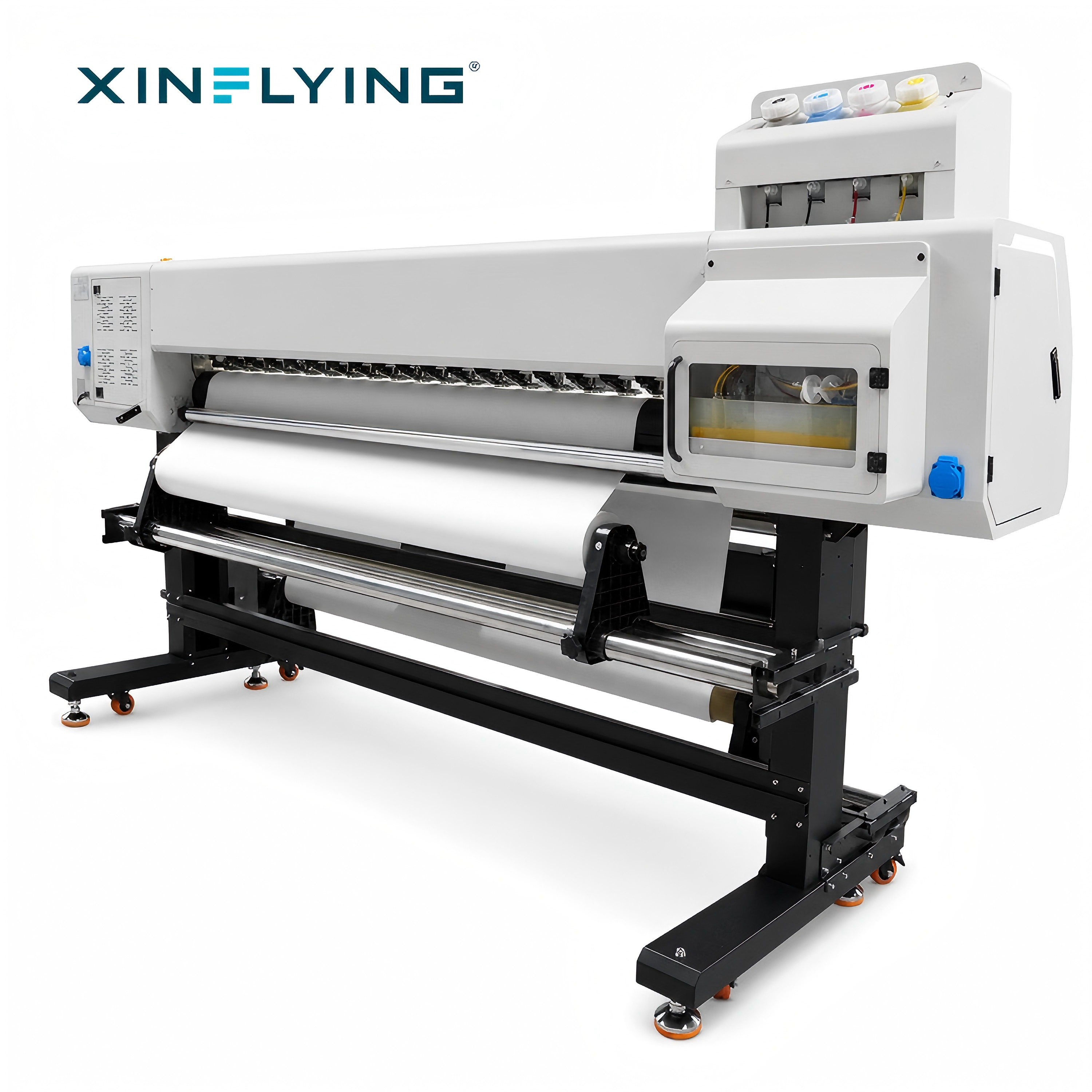
A dye sublimation printer does not place colour on top of fabric. It prints dye onto transfer paper, and heat then turns the solid dye into gas that penetrates polyester fibres and locks into them as the material cools. Because the colour ends up inside the fibre rather than on its surface, a correctly produced sublimation print is durable. When printed colour fades, the transfer process did not complete — and that is something a print manager, a buyer or an importer can check, record and prevent.
What Ink Fading Looks Like — and What It Is Not
Not every colour complaint is fading, and misdiagnosing the fault wastes material and production time. Four patterns are routinely mixed up:
- True fading. Print density drops over weeks outdoors or after repeated washing. Outlines usually stay sharp; the colour is simply weaker. This points to incomplete dye penetration, a substrate with limited polyester affinity, or ink that does not suit the end use.
- Colour shift between batches. The very first print already deviates from the approved target. Typical causes are incorrect ICC colour profile settings, RIP parameters that were not configured for the ink and material, incompatible or inconsistent ink, and differences in heat-press temperature or transfer time.
- Banding and horizontal lines. Visible lines or uneven colour fields are normally mechanical: partial printhead nozzle blockage, incorrect print resolution or speed settings, unstable ink supply, or printhead alignment that needs calibration.
- Missing or incomplete colour. This usually indicates printhead clogging caused by dried ink, long idle periods, unstable ink delivery, skipped maintenance or unsuitable ink — not a fading mechanism at all.
Separating these four patterns is the first quality-control step, because each has a different remedy. Fading is a penetration and end-use problem; the others are workflow or hardware problems that can often be corrected within a single shift.
The Six Causes of Sublimation Ink Fading
1. Incomplete Dye Diffusion During Transfer
Transfer is where fastness is decided. Temperature, dwell time and pressure have to be matched to the fabric, the transfer paper and the ink. When transfer energy is too low — or uneven across a wide drum or calender — part of the dye never converts to gas, so it stays close to the surface, where washing, abrasion and ultraviolet exposure reach it first. On wide flag panels the failure is often not uniform: one edge can fade before the centre, which is a signature of uneven heat or pressure across the working width.
2. Substrate Composition and Finish
Sublimation chemistry depends on polyester. Dye molecules penetrate and bond with polyester fibres; cotton and other natural fibres offer little affinity, and blends dilute the effect. Finishing agents such as heavy softeners or sizing can also sit between the dye and the fibre. Before blaming the printer, confirm the polyester content of the exact fabric roll used for the order and run a test print on that roll rather than on a reference sample from a different lot.
3. Ink Quality and Ink Chemistry
Ink is not interchangeable. Diluted, expired or non-sublimation ink, and ink with poor dye dispersion, produce weak colour and unpredictable fastness. Substituting ink also breaks the documentation chain: if the production ink is not the ink covered by the supplier's certificate, the paper trail supporting an export order no longer applies to the goods being shipped.
4. Drying and Handling on Roll-to-Roll Production
Heavy ink loads on fast roll-to-roll output require controlled drying. Where drying is insufficient, printed paper can smear, dye can migrate before transfer, and results vary between the start and the end of a roll. Machine architecture therefore affects fading control: the XF-19E8-PRO and XF-19E15-PRO use an external intelligent air-heat integrated dryer, the XF-H1301X-1I32A1 uses an external constant-temperature automatic drying system, and the XF-O2000-4I32A1 and XF-H1802X-2I32A1 apply front, middle and rear break-controlled heating across the print width.
5. Colour Management Faults Mistaken for Fading
Profiles and print parameters decide whether output matches the design. Incorrect ICC settings, RIP parameters that do not suit the ink and material, ink compatibility issues, and different heat-press conditions all shift colour. These faults appear immediately rather than over time, which distinguishes them from genuine fading — yet they are frequently reported in the same words. A fading claim should therefore always be documented with the date, the wash or exposure history, and the batch data.
6. End-Use Conditions and Environment
The application sets the limit. Outdoor flags face ultraviolet radiation and rain; promotional textiles face repeated washing, sometimes with bleach; stored rolls face heat and humidity. A specification that is adequate for an indoor cushion may be inadequate for a flag that hangs in direct sun through a full season, so fabric, ink and transfer recipe have to be selected together for the intended service life.
Industry Background: Why Colour Fastness Became a Commercial Question
Colour fastness moved from a workshop topic to a commercial one because the market grew and professionalised. Grand View Research values the global dye sublimation printing market at USD 16.4 billion in 2025 and projects USD 39.0 billion by 2033, with a CAGR of 11.5% from 2026 to 2033. The dye sublimation printer segment alone was valued at USD 1.88 billion in 2025 and is expected to reach USD 2.53 billion by 2030, according to Mordor Intelligence. Asia Pacific held a 36.5% revenue share in 2025, led by China, and China's textile and garment exports reached USD 293.6 billion in 2023 — a base that keeps ink and equipment documentation relevant for importers.
Research houses scope this market differently, so headline values diverge between reports; the direction is consistent. Grand View Research attributes a 13.1% CAGR in the digital textile sublimation market through 2030 largely to demand for personalised apparel and home decor. On the equipment side, Data Insights Reports places Epson at 26.7% share of the digital textile dye sublimation printer market in 2024, ahead of Mimaki at 18.6% and Roland DG at 15.5%. Much of the industry therefore runs on a small number of printhead platforms, which is precisely why ink choice and process control — not the badge on the chassis — determine how a printed flag behaves after a season outdoors.
Format standardisation reinforced the same trend. A 1.9 m (1900 mm) roll-to-roll width is the accepted working format for high-volume textile and soft signage production, which is why mills and flag producers evaluate 1.9 m class machines such as the XF-19E8-PRO and XF-19E15-PRO, both rated at a 190 cm print width and 3200 dpi.
Market data: Grand View Research (dye sublimation printing market, 2025–2033; digital textile printing CAGR; Asia Pacific share), Mordor Intelligence (dye sublimation printer segment, 2025–2030), Data Insights Reports (digital textile dye sublimation printer market shares, 2024), The Cannata Report (China textile and garment exports, 2023), FESPA (1.9 m roll-to-roll format). Estimates differ between research houses and are reported here as published.
The Compliance Layer: Verify the Ink, Not Only the Machine
A fading complaint handled badly turns into a paperwork question, which is why buyers need two separate document sets: one for the machine and one for the ink.
Machine compliance belongs to the equipment. XinFlying's CE EMC Certificate of Compliance (TQT1550D270EC, issued by TQT) covers EMC Directive 2014/30/EU; the CE LVD Certificate of Compliance (TQT1550D271EC) covers LVD 2014/35/EU against EN IEC 62368-1:2020/A11:2020; the CE Machinery Directive Attestation of Conformity (M.2026.206.C142365, issued by UDEM) references EN ISO 12100:2010, EN 60204-1:2018/A1:2025 and EN ISO 12643-1:2023; and the RoHS Attestation of Conformity (M.2026.206.C142366, issued by UDEM) covers Directive 2011/65/EU.
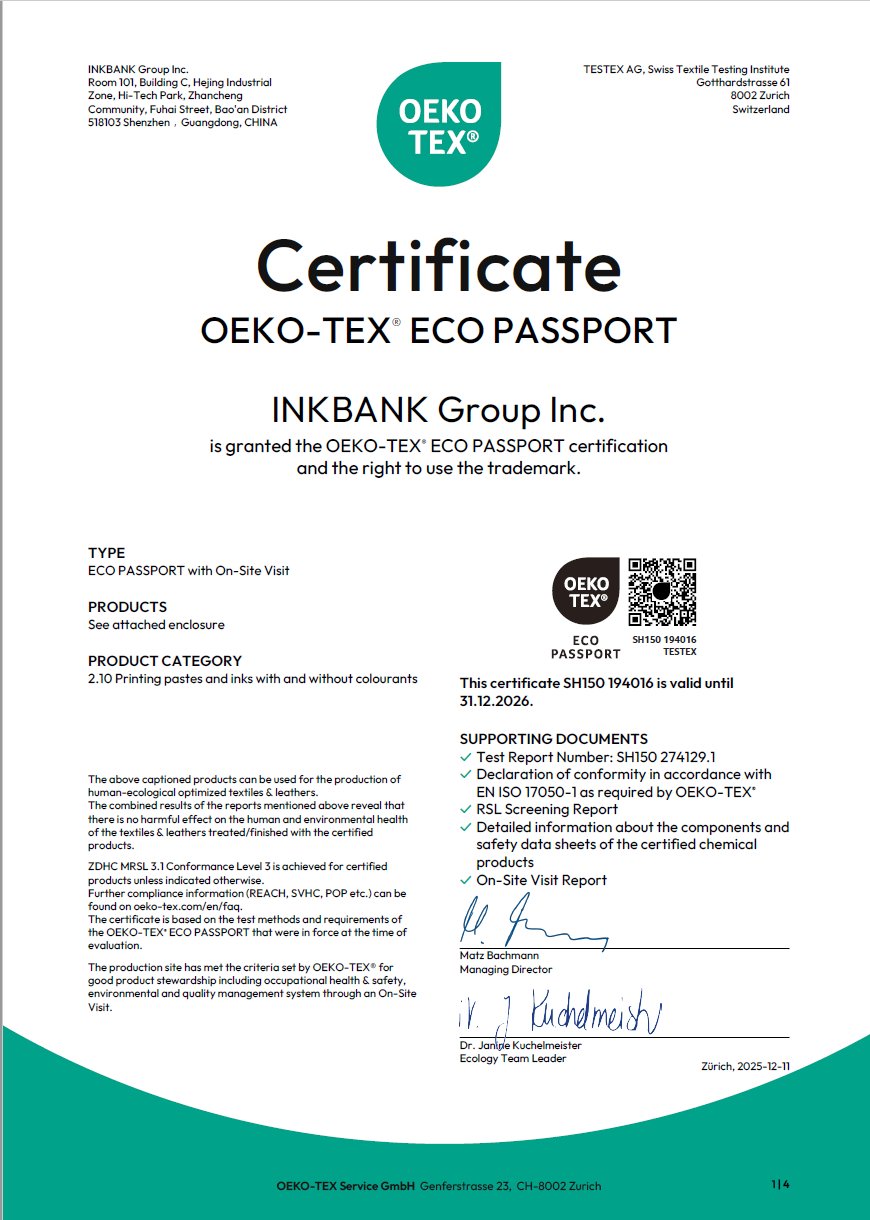
Ink compliance belongs to the chemistry, and this is the part most often missing from a quotation. XinFlying's OEKO-TEX® ECO PASSPORT certificate SH150194016, issued by TESTEX AG, is scoped to textile printing inks and printing pastes and remains valid until 31 December 2026. The model coverage associated with that ink documentation lists the printer models it applies to — including the XF-450PRO, together with the XF-H1301X-1I32A1, XF-H1802X-2I32A1, XF-O2000-4I32A1, XF-19E8-PRO and XF-19E15-PRO.
Two points deserve emphasis. First, ECO PASSPORT is a chemical-safety document for the ink and the printing paste; it is not a wash-fastness certificate, so it should be read as evidence about what is inside the ink rather than a promise about how long a flag will last. Second, the document only holds while the ink actually run in production is the ink the certificate describes. Four questions settle the check: does the scope cover inks and printing pastes, does the model list include the machine being supplied, is the certificate still within its validity period, and does the ink batch used on the order match the certified product identity.
Where a measurable process reference is required, ISO 12647-8:2021 defines validation of print processes working directly from digital data. It is not a fastness standard, but it gives a buyer a recognised way to ask whether a print condition is repeatable rather than merely acceptable on the day of the site visit.
A Step-by-Step Sublimation Quality Control Workflow
The sequence below is built for print shops, flag producers and importers who need to answer a fading complaint with evidence instead of opinion.
- Define the claim in writing. Record where the product was used, how long it was exposed, whether it was washed and under what conditions, and which batch it came from. Fading claims that cannot be tied to a batch cannot be corrected.
- Verify ink identity and documentation. Match the ink batch on the floor against the certificate that covers it — for example OEKO-TEX® ECO PASSPORT SH150194016, valid until 31 December 2026 — and confirm that the machine model sits inside the certificate's model coverage.
- Confirm the substrate. Check polyester content and finishing on the exact roll used. Where the fibre content is unsuitable, no transfer adjustment will repair fastness.
- Validate the digital front end. Confirm the ICC profile and RIP parameters against the ink and fabric combination. The printer families quoted here run Maintop as standard, with RIIN, Printfactory, PhotoPrint and CADlink available as options on models such as the XF-19E8-PRO, XF-19E15-PRO and XF-O2000-4I32A1, so the profile set must match the software actually installed.
- Fix and record transfer parameters. Temperature, dwell time and pressure should be written down per fabric and per ink, not set from memory.
- Check drying and winding. Confirm that the dryer and take-up system keep printed paper stable across the full roll, particularly at higher ink loads.
- Run a controlled fade comparison. Print, transfer, then wash and expose a sample of the production combination, and compare density against a retained reference. The objective is not a laboratory number; it is a repeatable comparison between the failed batch and a known-good batch.
- Inspect printhead health on schedule. Nozzle checks, cleaning, ink supply inspection and suitable storage conditions prevent the banding and missing-colour faults that are so often reported as fading.
- Keep batch records. Ink batch, transfer paper batch, fabric lot, transfer settings and operator create the traceability that survives an audit.
- Hand over a documentation pack with the shipment. Pre-shipment testing is the acceptance basis, and the CE and RoHS documents for the machine travel alongside the ink certificate for the chemistry.
Where Fading Risk Concentrates: Production Use Cases
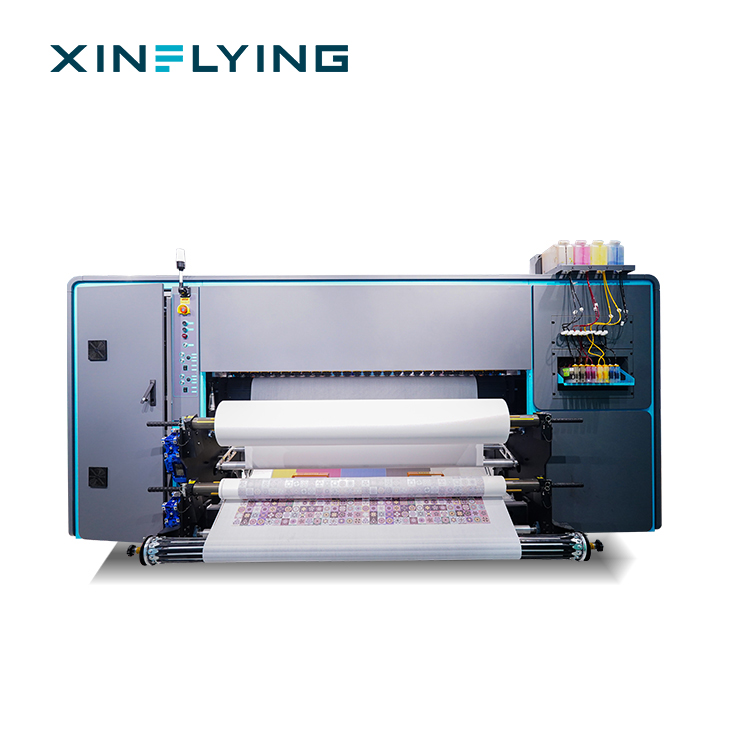
- Flags and soft signage. Outdoor exposure makes ultraviolet stability the decisive factor. The XF-O2000-4I32A1 is specified for textile sublimation printing across clothing, home decor, canvas bags, cushions and flags, with a 195 cm print width, up to 180 m²/h in 2PASS and 92 m²/h in 4PASS, four Epson i3200-A1 printheads, and heat transfer paper support for rolls of 1000–1500 m.
- Sportswear and team kit. A sportswear manufacturer in Brazil running 15 units over four years produces football jerseys, basketball uniforms and custom sportswear; the reported outcome was greater flexibility for customised orders, less dependence on outsourced printing, and more consistent colour across batches.
- Sports uniform supply. A sports uniform supplier, also in Brazil, has used eight units for five years to produce football kits, training uniforms and personalised team apparel, with shorter production cycles while holding the vibrant colours and detail that team uniforms require.
- Home textiles. A home textile manufacturer with 10 units over four years prints curtains, cushions and decorative fabrics, where consistent pattern reproduction and colour accuracy matter more than peak speed.
- Printing service providers. A digital textile printing service provider running five units for three years uses the capacity to serve sportswear brands, apparel factories and custom textile businesses, and reports faster response on customised orders.
Comparing Models That Matter to Colour-Fastness Control
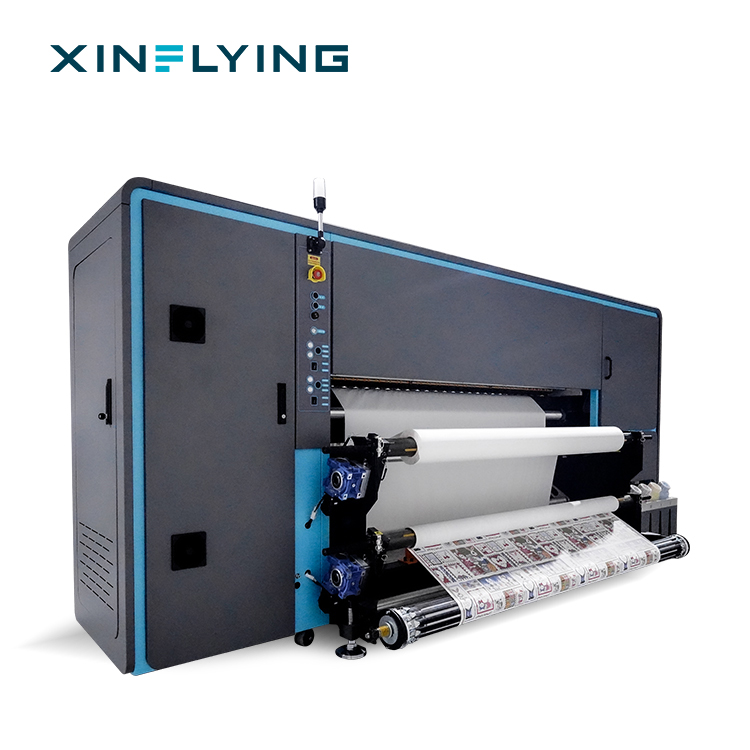
Model selection changes how easily a quality-control routine can be applied, because print width, drying architecture and head count determine how uniformly transfer conditions can be held across a roll.
| Model | Type & print width | Printheads | Fastest rated speed | Media | Typical production role |
|---|---|---|---|---|---|
| XF-H1301X-1I32A1 | Dye sublimation, 130 cm (1.3 m) | 1 × Epson i3200-A1 | 4PASS 28 m²/h | Heat transfer paper | Compact roll-to-roll production, sampling and short runs |
| XF-H1802X-2I32A1 | Dye sublimation, 180 cm (1.8 m) | 2 × Epson i3200-A1 | 4PASS 52 m²/h | Heat transfer paper | Small and medium textile printing businesses |
| XF-O2000-4I32A1 | Dye sublimation, 195 cm (1.95 m) | 4 × Epson i3200-A1 | 2PASS 180 m²/h (4PASS 92 m²/h) | Heat transfer paper, 1000–1500 m rolls | Continuous daily production; listed applications include flags, cushions, canvas bags and home decor |
| XF-19E8-PRO | Dye sublimation, 190 cm (75"), 3200 dpi | 8 × Epson i3200-A1 | 1PASS 306 m²/h (2PASS 153 m²/h) | Sublimation paper | Industrial textile sublimation production |
| XF-19E15-PRO | Dye sublimation, 190 cm (75"), 3200 dpi | 15 × Epson i3200-A1 | 1PASS 524 m²/h (2PASS 254 m²/h) | Sublimation paper, loads 1000 m rolls | High-volume industrial production |
| XF-450PRO | DTF printer, 42 cm (16.5") | 2 × Epson i1600-A1 | 6PASS 11 m²/h | DTF PET film | Garment and textile customisation; listed in the OEKO-TEX ink certificate model coverage |
Specifications as published by the manufacturer. All six models appear in the model coverage associated with OEKO-TEX® ECO PASSPORT certificate SH150194016 for textile printing inks and printing pastes; equipment compliance is documented separately through CE EMC (TQT1550D270EC), CE LVD (TQT1550D271EC), CE Machinery Directive (M.2026.206.C142365) and RoHS (M.2026.206.C142366).
FAQ: Sublimation Ink, Fading and Supplier Capability
Does OEKO-TEX ECO PASSPORT SH150194016 cover the printing ink or the printer itself?
It covers the ink chemistry. OEKO-TEX® ECO PASSPORT certificate SH150194016, issued by TESTEX AG, is scoped to textile printing inks and printing pastes and is valid until 31 December 2026. The models associated with that ink documentation include the XF-450PRO, together with the XF-H1301X-1I32A1, XF-H1802X-2I32A1, XF-O2000-4I32A1, XF-19E8-PRO and XF-19E15-PRO. Machine compliance is handled by separate documents: CE EMC (TQT1550D270EC), CE LVD (TQT1550D271EC), CE Machinery Directive (M.2026.206.C142365) and RoHS (M.2026.206.C142366).
What OEM and ODM capability should an OEM dye sublimation printer manufacturer provide?
An OEM/ODM programme should cover product branding, machine appearance, colour, logo and packaging customisation, plus solutions developed around the buyer's requirements. Guangzhou Xin Flying Digital Technology Co., Ltd. (XINFLYING), founded in 2010 and based in Panyu, Guangzhou, provides OEM and ODM production with a monthly capacity above 1,600 units, a minimum order of one unit, lead times of 5–40 days, pre-shipment testing as the acceptance basis, and more than 50 engineers delivering 24/7 online technical support.
Why do sublimation prints lose colour after washing?
In most cases the dye never fully penetrated the fibre: transfer energy was too low or uneven, the substrate carried too little polyester, the ink was incompatible or inconsistent with the setup, or heat-press temperature and time did not match the material. Immediate colour deviation points to RIP colour management and ICC profile settings, whereas prints that are strong on delivery and weaker after washing point to transfer energy and fibre penetration. The remedy is a controlled test on the production fabric: verify nozzles and ink supply, transfer at recorded parameters, then wash a sample and compare density against a retained reference.
What are the minimum order and sample terms for a sublimation printer?
MOQ is one unit. Delivery follows standard incoterms — EXW, FOB, CIF or DDP — and payment can be made by T/T, Western Union or PayPal. Acceptance is based on pre-shipment testing, so the machine is inspected before it leaves the factory. For OEM/ODM programmes the lead time ranges from 5 to 40 days depending on configuration and customisation scope.
How do I start a project with certified ink documentation and a sample print test?
Start with the application rather than the price: fabric, end use, print width and expected volume determine the machine class, and the ink documentation has to match both the machine and the batch. XinFlying supplies CE EMC, CE LVD, CE Machinery Directive and RoHS documents for the equipment together with OEKO-TEX® ECO PASSPORT SH150194016 for the textile printing ink, and supports sample and quotation requests through info@xin-flying.com or the company website at www.xin-flying.com. The product catalogue can be downloaded from the link at the end of this guide.
Conclusion
Ink fading is a process-control outcome. Work the six causes in order — transfer energy, substrate, ink chemistry, drying, colour management, end use — and record each of them, and the fading complaint leaves the customer conversation. Keep the documentation aligned at the same time: machine certificates for the equipment, and an ink certificate whose scope, model coverage and validity date still describe what is running on the press. A sublimation printer that produces strong colour on day one is common; one that produces the same colour after a season outdoors is the result of disciplined quality control.

Need a sample, a quotation, or the full ink certification pack?
XinFlying — Guangzhou Xin Flying Digital Technology Co., Ltd. | www.xin-flying.com
Email: info@xin-flying.com | Tel / WhatsApp: +86 188-1322-1357
No.7, Xiecun 2nd Industrial Zone, Panyu, Guangzhou, Guangdong
Have Questions or Need More Details?
Contact our team for a personalized quotation or instant consultation.
Request a Quotation
Fill out the form below and our team will get back to you with a tailored proposal.
WhatsApp Direct Chat
Prefer to chat in real-time? Message us on WhatsApp for instant assistance & quick answers.
- Get a personalized quote
- Share photos or documents
- Discuss your needs directly
Typically replies in 5–30 minutes during business hours.