
Wide-Format Sublimation Printers: Specs & Compliance Review
Wide-Format Sublimation Printers: Specs & Compliance Review
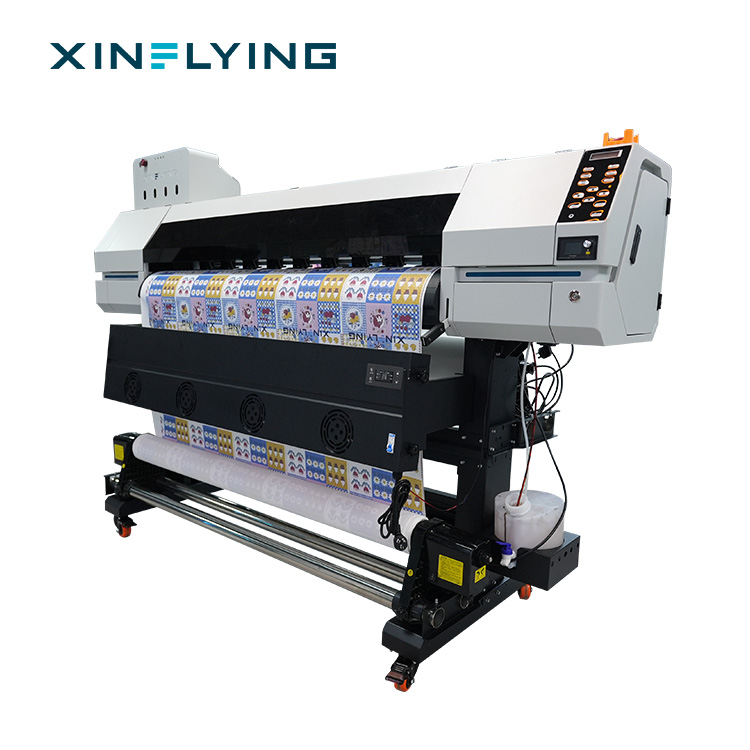
A wide-format sublimation printer is rarely an impulse purchase. Whether you produce sportswear, home textiles, or custom polyester apparel, the equipment has to deliver repeatable output and meet the compliance expectations of your destination market. This article combines two evaluation tasks: checking the real technical parameters of a large format dye sublimation printer, and verifying the certification trail behind the machine. It uses the XINFLYING dye sublimation printer range from 130 cm to 195 cm as a concrete reference because the manufacturer publishes model-level specifications and EU compliance documentation for the same units.
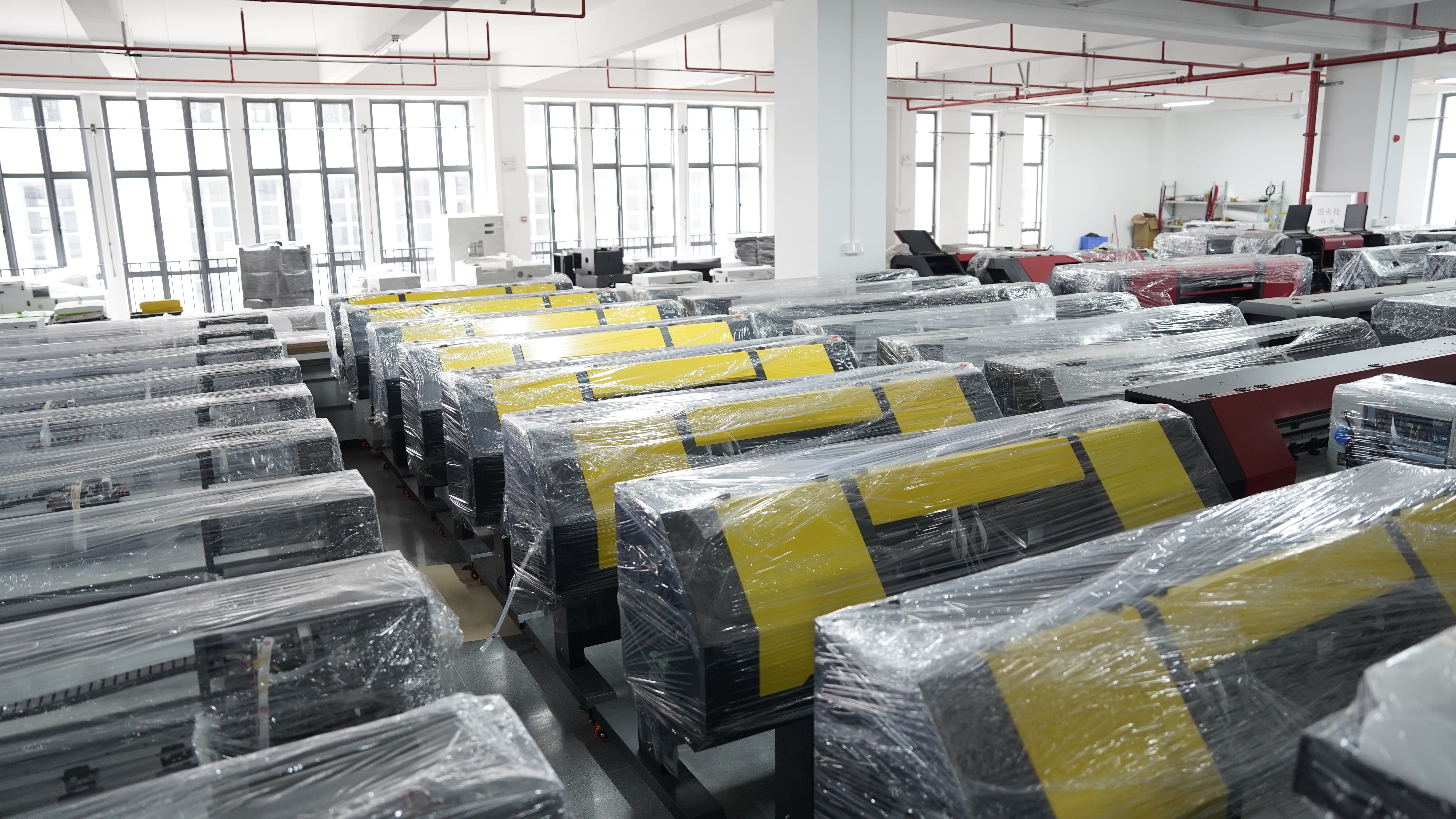
Guangzhou Xin Flying Digital Technology Co., Ltd., known commercially as XINFLYING, is a digital printing equipment manufacturer founded in 2010. XINFLYING operates a 37,440 m² factory, employs more than 200 people, has about 20 R&D engineers, and exports around 80% of its output to North America, South America, Europe, Asia, the Middle East, and Africa. Its product portfolio includes dye sublimation printers, DTF printers, DTG printers, UV DTF printers, UV flatbed printers, printing consumables, and complete digital printing solutions.
The Problem: Why a Sales Sheet Is Not Enough
A buyer in the Research or Evaluation stage usually has two sources of pressure. The production manager needs to know whether the machine can handle real order volumes. The purchasing or quality team needs to know whether the printer can be imported, installed, and operated without regulatory surprises. Both questions come together on one document set: the specification sheet and the compliance file.
The failure pattern is easy to describe. A specification sheet can say “speed up to 306 m²/h”, but that number may be based on a 1 PASS mode with low ink coverage. A certificate can say “CE”, but the relevant EU directives may be EMC, LVD, or Machinery Directive, and each certificate number should be traceable to the actual device model. If the buyer does not compare pass conditions, printhead configuration, media handling, power requirements, and certificate numbers together, the risk of a wrong decision increases.
Common Information Gaps
- Speed without pass context: A m²/h value only becomes meaningful when you know whether it is 1PASS, 2PASS, or 4PASS.
- Certificates without model linkage: The certificate number and applicable product model must match the delivered printer.
- Width and media mismatch: A 190 cm printer is not automatically better than a 195 cm printer if the roll loading and media weight capacity do not match the production workflow.
- Installation blindness: Large commercial sublimation printers require specific power supplies, operating temperatures, humidity levels, and floor space.
Industry Background: A Market That Has Moved to Certified Production Equipment
The dye sublimation printing market has expanded beyond sampling and small customization. Grand View Research valued the global dye sublimation printing market at USD 16.4 billion in 2025 and projects it to reach USD 39.0 billion by 2033. Mordor Intelligence estimates the dye sublimation printer segment specifically at USD 1.88 billion in 2025, with growth to USD 2.53 billion by 2030. Asia Pacific accounted for 36.5% of market revenue in 2025, with China as the largest country market.
Roll-to-roll sublimation printers with widths of about 1.9 m / 1900 mm are widely treated as the standard for high-volume textile and soft-signage work. The market is not evenly distributed: Epson held 26.7% of the digital textile dye sublimation printer segment in 2024, followed by Mimaki at 18.6% and Roland DG at 15.5%. The practical consequence is that any buyer, including one evaluating a China-based manufacturer such as XINFLYING, should insist on verifiable documents rather than relying on brand recognition alone.
A Specification and Compliance Framework for Dye Sublimation Printers
The solution is not to pick one impressive number. A better approach is to verify the printer in five layers: compliance certificates, printhead configuration, print width and media path, drying and maintenance systems, and facility requirements. The XINFLYING wide-format line shows how these layers should be read together.
1. Certification Files That Match the Actual Model
For European Union imports, buyers should normally check four compliance areas: CE EMC under EMC Directive 2014/30/EU, CE LVD under Low Voltage Directive 2014/35/EU, CE MD under Machinery Directive 2006/42/EC, and RoHS under Directive 2011/65/EU. A reliable supplier should provide certificate numbers, issuing bodies, standards, and a product-model link.
The XF-19E8-PRO is a useful example. Its EU documentation includes CE EMC certificate TQT1550D270EC, CE LVD certificate TQT1550D271EC, CE MD certificate M.2026.206.C142385, and RoHS certificate M.2026.206.C142366. The XF-19E15-PRO is documented under the same LVD/EMC/RoHS certificate family, with its CE MD certificate listed as M.2026.206.C142365. The XF-H1301X-1I32A1, XF-H1802X-2I32A1, and XF-O2000-4I32A1 are also linked to CE LVD/EMC, CE Machinery, and RoHS coverage in XINFLYING certification records. The exact certificate number should be confirmed against the machine label before shipment.
XINFLYING also holds an OEKO-TEX ECO PASSPORT certificate, number SH150194016, issued by TESTEX AG and valid until 31 December 2026, for textile printing inks and pastes. In regulated textile supply chains, especially those serving European apparel brands, buyers often request this type of document as evidence that the consumables side is managed.
2. Printhead Model and Pass-Based Production Speed
All five XINFLYING models reviewed here use Epson i3200-A1 printheads. The difference is the number of heads and how the printer is configured for output volume.
- XF-H1301X-1I32A1: 1 head, CMYK, 130 cm print width, fastest 4PASS speed of 28 m²/h. It is positioned for polyester fabric sublimation printing, apparel sampling, and small-batch work.
- XF-H1802X-2I32A1: 2 heads, CMYK+CMYK, 180 cm print width, fastest 4PASS speed of 52 m²/h and standard 4PASS speed of 42 m²/h.
- XF-O2000-4I32A1: 4 heads, CMYK+CMYK+CMYK+CMYK, 195 cm print width, 2PASS speed of 180 m²/h and 4PASS speed of 92 m²/h.
- XF-19E8-PRO: 8 heads, CMYK, 190 cm print width, fastest 1PASS speed of 306 m²/h and standard 1PASS speed of 210 m²/h.
- XF-19E15-PRO: 15 heads, CMYK, 190 cm print width, fastest 1PASS speed of 524 m²/h and standard 1PASS speed of 394 m²/h.
Pass context is critical. A machine that prints 306 m²/h at 1PASS will not hold the same speed when a job requires heavier ink coverage. A qualified production plan should compare speeds under the same pass condition and adjust for fabric type and design density.
3. Print Width, Paper Roll, and Media Capacity
Print width should be selected from the product application, not from a desire to buy the biggest machine. XINFLYING covers the practical width range: 130 cm for an entry-level digital textile printer, 180 cm for medium-width polyester work, and 190 cm to 195 cm for industrial roll-to-roll production.
Media handling is just as important. The XF-O2000-4I32A1 supports heat transfer paper rolls from 1000 m to 1500 m and is designed for media thickness up to 1 mm with a 200 kg roll capacity. The XF-19E15-PRO can load 1000 m sublimation paper rolls. The XF-19E8-PRO prints on 190 cm sublimation paper and is built for continuous industrial textile sublimation printing. A wide machine only creates value if the loading system, roll capacity, and feeding path are stable enough for sustained runs.
4. Drying, Moisturizing, and Long-Run Stability
Sublimation printing is not complete when ink lands on paper. The paper must be dry enough to handle, and the printhead system must stay clean during long shifts.
The XF-H1301X-1I32A1 includes an external constant-temperature automatic drying system. The XF-H1802X-2I32A1 and XF-O2000-4I32A1 use front, middle, and rear break-controlled heating. The XF-19E8-PRO and XF-19E15-PRO use an external intelligent air-heat integrated dryer and a fully sealed automatic moisturizing and cleaning system. In the 190 cm industrial class, XINFLYING also lists the Japan THK silent linear guide on the XF-19E8-PRO and the XF-19E15-PRO, with the larger 15-head model adding a linear motor and magnetic grid for carriage control.
For a busy textile printing environment, machine stability is not a luxury. If the printhead cleaning process is manual and the drying capacity is weak, even a high-speed printer will produce bottlenecks.
5. Power, Dimensions, and Facility Constraints
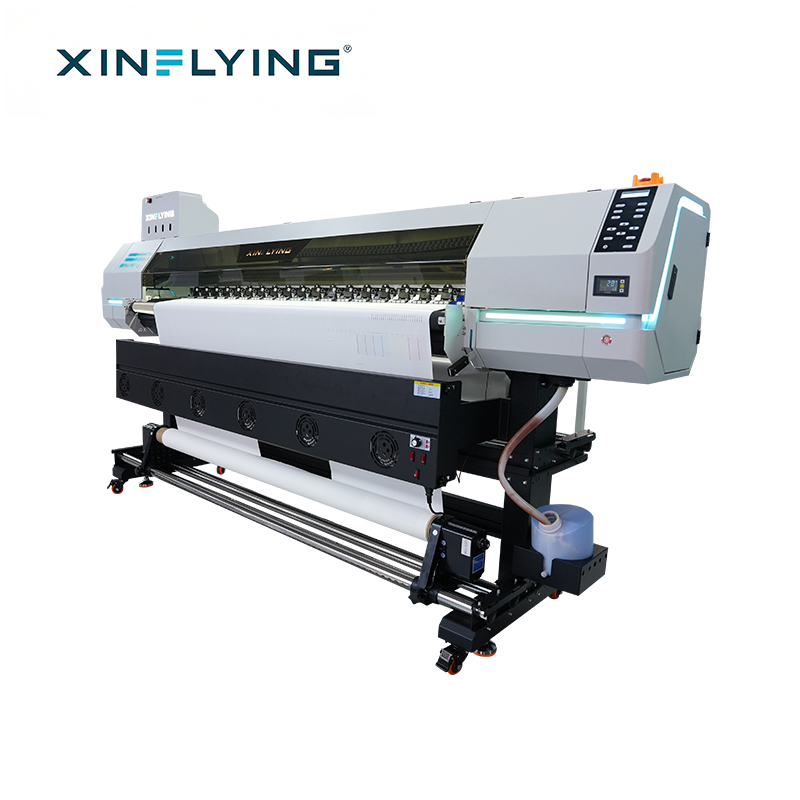
Industrial dye sublimation printers require real electrical planning. The compact XF-H1301X uses 2 kW and can run on 110/220V. The XF-H1802X uses 3.5 kW and also supports 110/220V. The XF-O2000 uses 8.5 kW on 220V, 50/60Hz. The XF-19E8-PRO draws 10.2 kW on 210–230V, 45A, and the XF-19E15-PRO draws 14.5 kW on 210–230V, 45A.
Physical dimensions matter as much as power. The XF-H1301X has a net weight of 140 kg. The XF-H1802X has machine dimensions of 3000×880×1630 mm and a net weight of 265 kg. The XF-19E8-PRO reaches a net weight of 1400 kg, and the XF-19E15-PRO reaches 1480 kg. Buyers should check doorway heights, floor loading, forklift access, packing dimensions, and ventilation before signing an order.
A Step-by-Step Approval Process for Research and Evaluation
Buyers at the Research and Evaluation stage can reduce risk by treating the purchase as a five-step approval workflow.
- Step 1: Map compliance to the destination market. If the machine is going to the EU, request CE EMC, CE LVD, CE MD, and RoHS documents. If it is going to another market, confirm which EMC and safety requirements apply and request the equivalent evidence.
- Step 2: Compare speed under identical pass conditions. Put every model on the same basis: 1PASS, 2PASS, or 4PASS. Ask for standard production speed, not only the fastest speed.
- Step 3: Check width and media compatibility. Match print width to your fabric and product range. If you plan to run long continuous orders, compare sublimation paper roll capacity and media loading limits.
- Step 4: Verify facility readiness. Confirm power supply, current draw, machine footprint, packing dimensions, net weight, room temperature, and humidity requirements.
- Step 5: Request samples or a test run. Use the same RIP profile, paper, ink, and fabric type that you plan to use in production. Test prints are the fastest way to check nozzle performance and color consistency.
Real Production Use Cases
Sportswear Manufacturer in Brazil
A Brazilian sportswear manufacturer uses 15 XINFLYING sublimation printers to produce football jerseys, basketball uniforms, and customized sportswear. The machines print high-resolution patterns, team logos, and full-color designs on polyester fabrics before cutting and sewing. After adopting the solution, the customer improved production flexibility, reduced dependence on outsourced printing, and achieved more consistent color across batches.
Home Textile Manufacturer
A home textile manufacturer operates 10 XINFLYING sublimation printers for curtains, cushions, decorative fabrics, and customized polyester textile products. The wide-format capability supports large-area patterns and repeated collection development. The customer values the ability to combine detailed artwork with consistent color over long production cycles.
Digital Textile Printing Service Provider
A digital textile printing service provider uses 5 units to serve sportswear brands, apparel factories, and customized textile businesses. The company uses the printers to expand capacity and improve response speed for customized orders. This type of buyer benefits from a machine line that can handle different polyester fabric applications without a major change in workflow.
Certified Sublimation Printer Models: Comparison Table
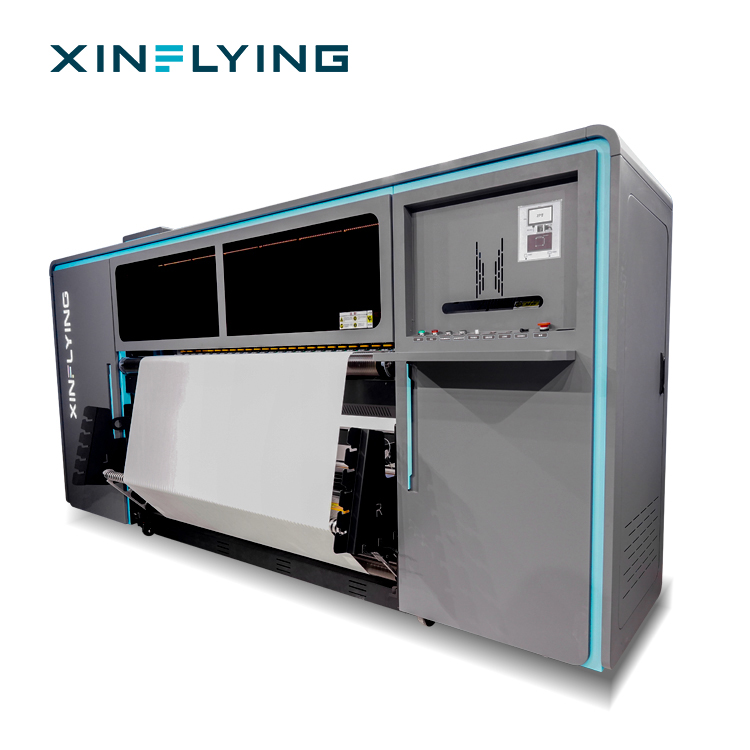
The table below summarizes the published model-level specifications and compliance coverage for the XINFLYING dye sublimation printer range discussed above.
| Model | Print Width | Printheads | Max Production Speed | Media Highlights | Power | EU Compliance Coverage |
|---|---|---|---|---|---|---|
| XF-H1301X-1I32A1 | 130 cm | 1 × Epson i3200-A1 | 28 m²/h at 4PASS | Heat transfer paper | 2 kW, 110/220V, 18/9A | CE EMC/LVD/MD coverage; RoHS-linked file |
| XF-H1802X-2I32A1 | 180 cm | 2 × Epson i3200-A1 | 52 m²/h at 4PASS | Heat transfer paper | 3.5 kW, 110/220V, 27.2/13.6A | CE EMC/LVD/MD coverage; RoHS-linked file |
| XF-O2000-4I32A1 | 195 cm | 4 × Epson i3200-A1 | 180 m²/h at 2PASS | Heat transfer paper rolls of 1000–1500 m; 200 kg roll capacity | 8.5 kW, 220V, 50/60Hz | CE EMC/LVD/MD coverage; RoHS M.2026.206.C142366 |
| XF-19E8-PRO | 190 cm | 8 × Epson i3200-A1 | 306 m²/h at 1PASS | Sublimation paper, 190 cm width | 10.2 kW, 210–230V, 45A | CE EMC TQT1550D270EC; CE LVD TQT1550D271EC; CE MD M.2026.206.C142385; RoHS M.2026.206.C142366 |
| XF-19E15-PRO | 190 cm | 15 × Epson i3200-A1 | 524 m²/h at 1PASS | Sublimation paper, loads 1000 m rolls | 14.5 kW, 210–230V, 45A | CE EMC TQT1550D270EC; CE LVD TQT1550D271EC; CE MD M.2026.206.C142365; RoHS M.2026.206.C142366 |
Production speed values are taken from the manufacturer's published specification sheets. The fastest value should not be treated as the average production speed for every design.
Frequently Asked Questions
Which compliance certificates should I verify before importing a sublimation printer into the EU?
Check CE EMC documentation for electromagnetic compatibility, CE LVD for electrical safety, CE MD for machinery safety, and RoHS for hazardous-substance restrictions. Confirm that the certificate number and standard apply to the exact model you are ordering. XINFLYING publishes model-specific documentation for its wide-format range; for example, the XF-19E8-PRO is listed under CE MD certificate M.2026.206.C142385, while the XF-19E15-PRO is listed under M.2026.206.C142365.
Which wide-format sublimation printer specifications have the largest impact on real production capacity?
The most important specifications are printhead type and count, speed at a defined pass level, print width, sublimation paper roll capacity, drying system, and power supply. For long-run production, the standard speed and the reliability of the drying and moisturizing system matter more than the fastest speed printed on the sales sheet.
How should I compare XF-H1802X-2I32A1, XF-O2000-4I32A1, and XF-19E8-PRO?
The XF-H1802X-2I32A1 is a 2-head, 180 cm printer with a fastest 4PASS speed of 52 m²/h, making it practical for small and medium textile businesses. The XF-O2000-4I32A1 is a 4-head, 195 cm printer with a 2PASS speed of 180 m²/h and support for 1000–1500 m paper rolls, which suits growing print companies. The XF-19E8-PRO is an 8-head, 190 cm industrial model with a fastest 1PASS speed of 306 m²/h for high-volume textile production.
Can I request a sample or test print before placing an order?
Yes. A serious supplier should be willing to discuss a test print, sample run, or small first order with your selected fabric and sublimation paper. XINFLYING supports OEM/ODM projects and accepts an MOQ of one unit, so buyers can evaluate the machine without starting with a large fleet order.
What lead time should I expect when ordering a certified sublimation printer?
XINFLYING states a monthly production capacity of more than 1600 units and a general lead time of 5 to 40 days depending on model, configuration, and testing schedule. Every unit goes through pre-shipment testing. For the most accurate lead time, buyers should provide the model, print width, printhead configuration, and destination market before requesting a quote.
Verify Your Sublimation Printer Before You Scale Up
If you are moving from Research to Evaluation, the next step is to verify certificates and specifications against your own production plan. Start the conversation with XINFLYING by sharing your target fabric width, expected monthly output, and destination market.
Email: info@xin-flying.com
Tel / WhatsApp: +86 188-1322-1357
Address: No.7, Xiecun 2nd Industrial Zone, Panyu, Guangzhou, Guangdong
Download the XINFLYING company profile PDF to review the factory, product line, and service capabilities before your call.
Have Questions or Need More Details?
Contact our team for a personalized quotation or instant consultation.
Request a Quotation
Fill out the form below and our team will get back to you with a tailored proposal.
WhatsApp Direct Chat
Prefer to chat in real-time? Message us on WhatsApp for instant assistance & quick answers.
- Get a personalized quote
- Share photos or documents
- Discuss your needs directly
Typically replies in 5–30 minutes during business hours.