
XF-19E15-PRO vs XF-O2000-4I32A1: Heads, Speed and Compliance Compared
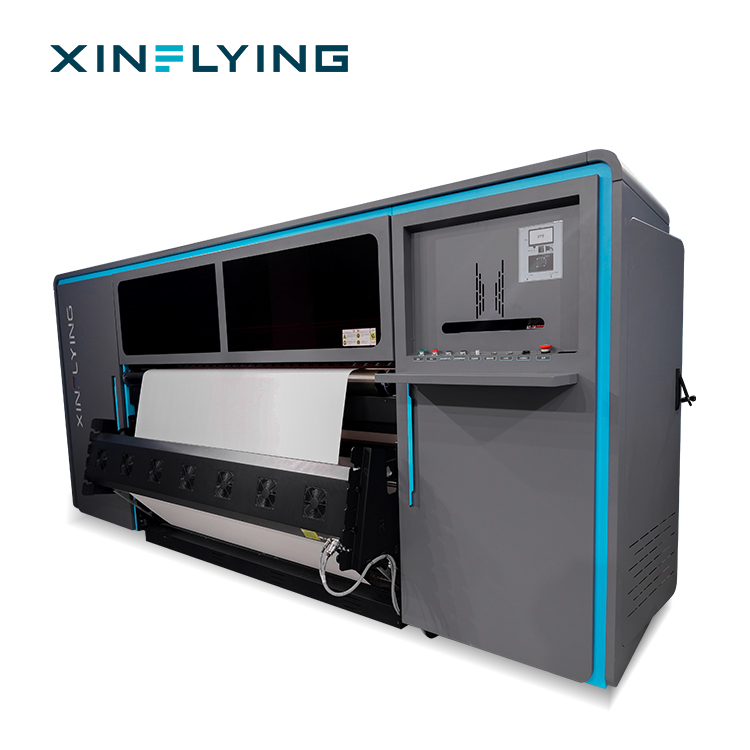
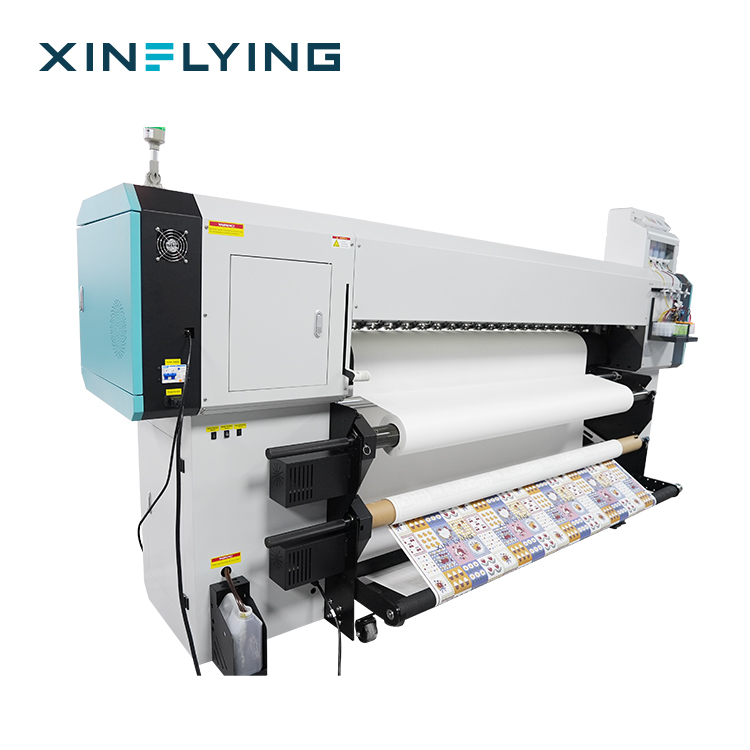
Short answer. Both machines print dye sublimation transfer paper in a roll-to-roll line, but they answer two different purchase briefs. The XF-19E15-PRO is the throughput engine: 15 Epson i3200-A1 printheads, a 190 cm (75 in) print width, 524 m²/h at 1PASS and 254 m²/h at 2PASS in fastest mode, 3200 dpi, a linear motor with magnetic grid and 27 press rollers, drawing 14.5 kW from a 210–230 V, 45 A supply. The XF-O2000-4I32A1 is the width-and-footprint engine: 4 Epson i3200-A1 printheads, a 195 cm (1.95 m) print width, 180 m²/h at 2PASS and 92 m²/h at 4PASS, front/middle/rear break-controlled heating with added base heating on the carriage, 8.5 kW from 220 V, and a net weight of roughly 490 kg.
On European compliance the two models do not compete at all. The same CE LVD certificate and the same CE EMC certificate from Shenzhen Tianqi Testing Technology Service Co., Ltd. (TQT) list both machines, and the CE Machinery Directive attestations from UDEM list both as well. Compliance is a document-checking task here, not a differentiator between the models.
Problem definition: why these two spec sheets resist a straight comparison
Buyers who put these two engines side by side usually run into the same three obstacles, and each one can lead to a wrong shortlist decision.
- The speed labels are not aligned. The XF-19E15-PRO publishes 1PASS and 2PASS figures. The XF-O2000-4I32A1 publishes 2PASS and 4PASS figures. Reading 524 m²/h against 180 m²/h compares a one-pass mode with a two-pass mode, which is not a like-for-like test and will overstate the gap.
- The width gap looks trivial but is not cosmetic. 190 cm versus 195 cm is a 5 cm difference on paper, yet the two machines sit in different weight and power classes: 1,480 kg net against roughly 490 kg net, and 14.5 kW against 8.5 kW.
- Compliance is assumed to scale with price and weight. A common assumption is that the heavier, faster machine must carry a wider or different certificate set. For these two models that assumption is wrong: they appear on the same LVD and EMC certificate numbers from TQT and on the same Machinery Directive attestations from UDEM.
The practical consequence is that a buyer cannot settle this decision by scanning a single headline number. The decision has to be rebuilt from mode-matched transfer speeds, print width against the real product mix, electrical and floor capacity, and then a document check that is identical for both machines.
Industry background: what a sublimation engine is actually asked to do
Dye sublimation printing does not place ink on a fabric surface. Designs are printed onto transfer paper with dye sublimation ink, and a heat press calender then converts the printed dye into gas so it bonds into polyester fibres. The printer therefore has one job inside a longer line: lay down a consistent, correctly profiled image on paper at a rate the calender downstream can absorb without creating a bottleneck or a queue of printed rolls.
In commercial textile production, that line is expected to keep running. XINFLYING documents its sublimation applications around 24/7 operation in a controlled indoor environment of 18–30 °C and 35–65% RH, with RIP software, a heat press calender, dye sublimation paper and dye sublimation ink treated as matched equipment rather than optional extras. Typical output covers polyester sportswear, team jerseys, activewear, custom apparel, home textiles, decorative fabric, soft signage, flags and banners.
Two consequences follow from that context, and both matter for this comparison. First, throughput has to be matched to the calender and to the order profile, not maximised on its own — a 15-head engine feeding an undersized calender simply builds work-in-progress. Second, print width determines how many panels fit across a roll and how much edge trim is wasted, which is exactly where a 5 cm difference can matter for specific products and not at all for others.
The wider industry direction is also relevant. Digital roll-to-roll sublimation has moved from sampling and short runs into mainstream production for polyester apparel and home textiles, which raises the value of documented compliance, documented operating conditions and documented maintenance routines — because those are the items a buyer cannot verify by looking at the machine.
Detailed solution: the two engines, component by component
Head technology in the XF-19E15-PRO
The XF-19E15-PRO is a 15-head machine built on Epson i3200-A1 printheads with CMYK ink, a stated resolution of 3200 dpi, and a variable ink drop with 3200 nozzles per head as listed in its published specification. The carriage runs on a linear motor with magnetic grid rather than a belt, travels on a Japan THK silent linear guide, and feeds paper through 27 press rollers under an enlarged beam. Ink delivery is supported by a fully sealed automatic moisturizing and cleaning system, and drying is handled by an external intelligent air-heat integrated dryer.
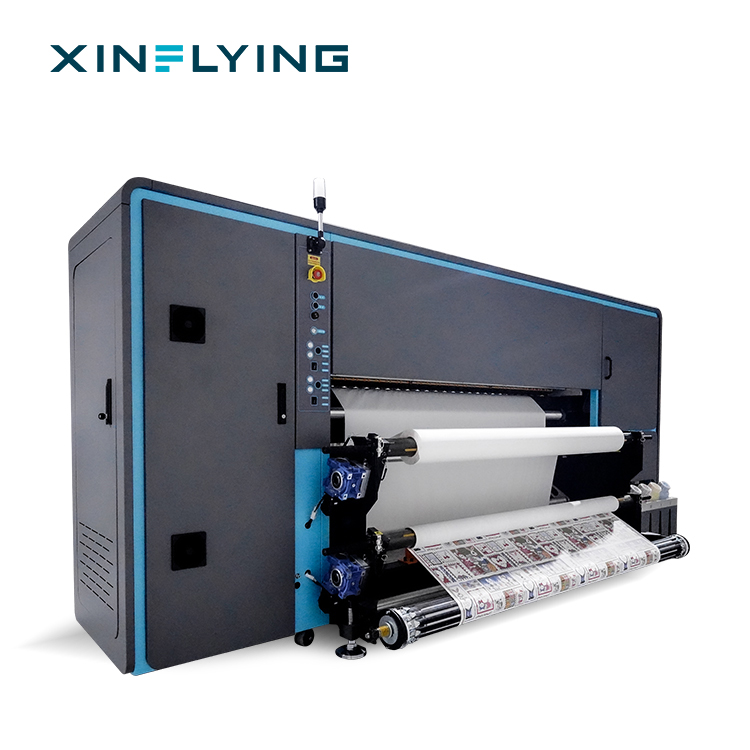
Its published output figures are 524 m²/h at 1PASS and 254 m²/h at 2PASS in fastest mode, or 394 m²/h at 1PASS and 188 m²/h at 2PASS in standard mode. The machine loads 1000 m rolls of sublimation paper, occupies 3840 × 1570 × 1800 mm, weighs 1,480 kg net and 1,580 kg gross, and packs at 3970 × 1150 × 2130 mm. Electrical demand is 14.5 kW on a 210–230 V, 45 A supply. RIP options are Maintop as standard, with RIIN (Hoson only), PhotoPrint and Printfactory available as options. The control PC specification calls for Windows 11/10, an Intel i7 processor, 4 GB RAM, HD 500G, ATI discrete graphics, DVD ROM and gigabit LAN, and the machine accepts JPG, TIFF and PDF files.
Head technology and heat architecture in the XF-O2000-4I32A1
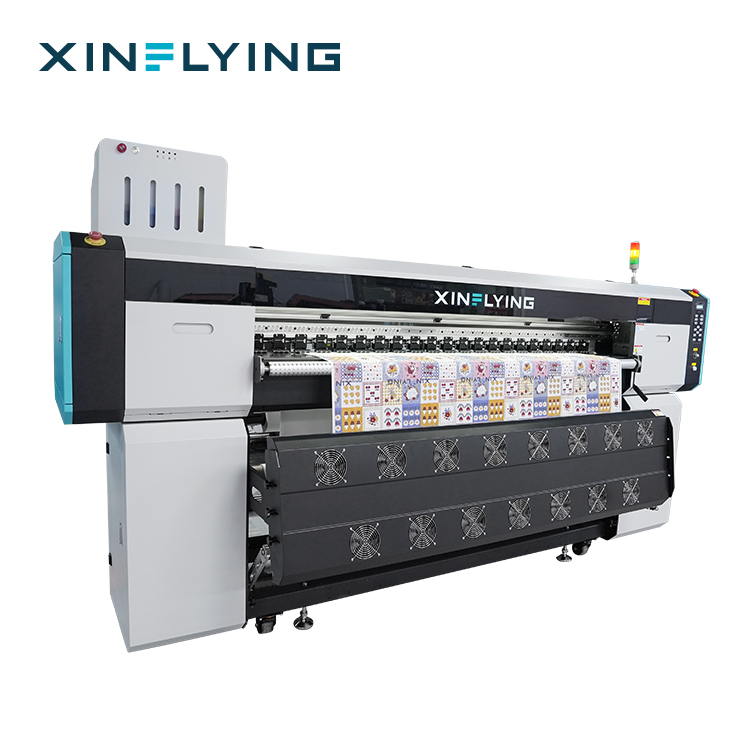
The XF-O2000-4I32A1 is a 4-head piezoelectric inkjet machine using Epson i3200-A1 printheads arranged as four CMYK channel sets (CMYK+CMYK+CMYK+CMYK) across a 195 cm (1.95 m) print width. Its distinguishing engineering is thermal rather than head-count driven: front, middle and rear break-controlled heating, added base heating on the carriage, and an integrated IR and cooling fan system. Ink is supplied from a 220 ml cartridge plus a 3 L ink tank, and the media path accepts heat transfer paper rolls of 1000–1500 m at a stated media thickness of 1 mm and media weight of 200 kg.
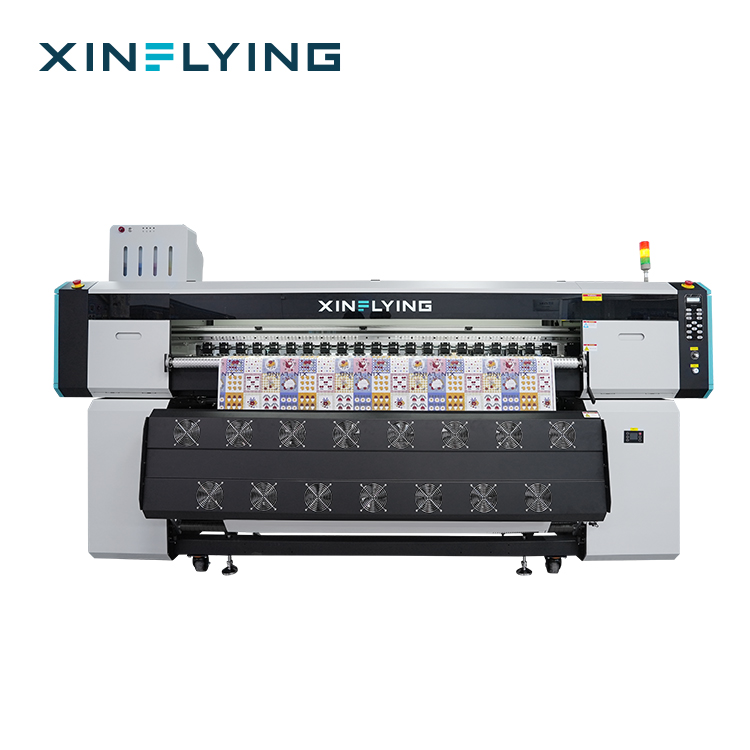
Published speed is 180 m²/h at 2PASS and 92 m²/h at 4PASS. RIP options are RIIN Print and Maintop. Power demand is 8.5 kW on a 220 V, 50/60 Hz supply. The machine measures 3311 × 1278 × 1670 mm, weighs approximately 490 kg net and 675 kg gross, and packs at 3640 × 760 × 1740 mm. The stated operating environment is 20–25 °C and 45–65% RH.
Reading the transfer speed numbers correctly
The only mode both spec sheets publish is 2PASS, and that is where the honest comparison sits: 254 m²/h for the XF-19E15-PRO against 180 m²/h for the XF-O2000-4I32A1 in fastest settings. The 15-head machine also publishes a faster 1PASS tier at 524 m²/h that the 4-head model does not list, while the 4-head model publishes a 4PASS tier at 92 m²/h that the 15-head model does not list. The mode ladder itself is the difference: one engine is documented down to a single-pass mode, the other down to a four-pass mode.
For production planning this changes how a buyer should convert the numbers. A job mix that runs mostly at 2PASS should be costed at 254 versus 180. A job mix that can accept 1PASS output on the 15-head engine has no equivalent setting on the 4-head model. Conversely, work that requires 4PASS quality on the XF-O2000-4I32A1 runs at 92 m²/h, and the comparison should then be made against the 15-head machine at 2PASS rather than at its headline figure. Standard-versus-fastest settings further shift both machines: on the XF-19E15-PRO the standard 1PASS figure is 394 m²/h against 524 m²/h at fastest, and 188 m²/h against 254 m²/h at 2PASS.
Where the 190 cm to 195 cm width difference matters
A 5 cm difference on a 1.9 m web rarely decides product eligibility on its own, but it does affect nesting and trim. The 195 cm width of the XF-O2000-4I32A1 gives marginally more room for panel layouts and for edge trim on wide home textile and soft signage work. Against that, the XF-19E15-PRO combines its 190 cm width with a 1000 m roll loading capability and 27 press rollers, which is a media-handling statement rather than a width statement. In practice the width question should be answered by cutting a real layout: if the product fits inside 190 cm without additional trim waste, width stops being a decision criterion and weight, power and throughput take over.
Compliance: two models, one document set, no rivalry
The regulatory position is the simplest part of this comparison. Both models are listed on the same certificate numbers, so compliance does not separate them and should not be used as a tie-breaker.
| Document | Issuing body | Certificate number | Standard scope | Validity |
|---|---|---|---|---|
| CE LVD Certificate of Compliance | TQT (Shenzhen Tianqi Testing Technology Service Co., Ltd.) | TQT1550D271EC | EN IEC 62368-1:2020/A11:2020 | Issued 19 May 2026 |
| CE EMC Certificate of Compliance | TQT (Shenzhen Tianqi Testing Technology Service Co., Ltd.) | TQT1550D270EC | EN 55032:2015/A11:2020; EN 55035:2017/A11:2020; EN IEC 61000-3-2:2019+A1:2021; EN 61000-3-3:2013/A2:2021 | Issued 19 May 2026 |
| CE MD Certificate of Conformity | UDEM | M.2026.206.C142365 | EN ISO 12100:2010; EN 60204-1:2018/A1:2025; EN ISO 12643-1:2023 | 10 Jun 2026 – 9 Jun 2031 |
| CE MD Certificate of Conformity (second attestation) | UDEM | M.2026.206.C142385 | EN ISO 12100:2010; EN 60204-1:2018/A1:2025; EN ISO 12643-1:2023 | 10 Jun 2026 – 9 Jun 2031 |
| CE LVD and EMC Compliance | UDEM | M.2026.206.C142475 | LVD 2014/35/EU and EMC 2014/30/EU | 11 Jun 2026 – 10 Jun 2031 |
| RoHS Compliance Certificate | UDEM | M.2026.206.C142366 | EN IEC 63000:2018; EN IEC 62321 series | 10 Jun 2026 – 9 Jun 2031 |
| OEKO-TEX ECO PASSPORT | TESTEX AG | SH150194016 | Textile printing inks and printing pastes | 11 Dec 2025 – 31 Dec 2026 |
Two points deserve attention. The LVD and EMC certificates for both models carry TQT certificate numbers, while the Machinery Directive and RoHS attestations carry UDEM numbers — a buyer verifying documents should expect both issuing bodies, not one. And the OEKO-TEX ECO PASSPORT is an ink-and-paste scope document, not a machine safety document, so it should be read alongside the ink specification rather than as an alternative to CE. Because both models are named on the same numbers, the compliance check reduces to confirming that the model string on the document matches the model on the order, and that the validity window covers the delivery date.
Step-by-step breakdown: a six-step evaluation sequence
- Step 1 — Normalise the speed before comparing anything else. Set both machines to 2PASS and compare 254 m²/h against 180 m²/h. Then convert those figures into the required daily square metres for the actual order book, and check whether the 1PASS tier of the XF-19E15-PRO at 524 m²/h is usable for the product mix or whether finishing constraints force 2PASS anyway.
- Step 2 — Size the width against real layouts. Test the widest recurring product against 190 cm and 195 cm. Where the product already fits inside 190 cm, the 5 cm difference is not a decision criterion and should be dropped from the scorecard.
- Step 3 — Check the electrical and floor envelope. The XF-19E15-PRO needs 14.5 kW on 210–230 V, 45 A and occupies 3840 × 1570 × 1800 mm at 1,480 kg net. The XF-O2000-4I32A1 needs 8.5 kW on 220 V, 50/60 Hz and occupies 3311 × 1278 × 1670 mm at roughly 490 kg net. Rigging, floor loading and spare electrical capacity should be confirmed before the machine order, not after.
- Step 4 — Match the RIP and workflow. Maintop appears as standard on the XF-19E15-PRO and as an option on the XF-O2000-4I32A1, which also lists RIIN Print. RIIN on the 15-head model is specified for Hoson only, while PhotoPrint and Printfactory are optional there. Confirm the RIP your prepress team already uses before assuming a like-for-like workflow.
- Step 5 — Check media handling and roll lengths. The XF-19E15-PRO loads 1000 m rolls of sublimation paper. The XF-O2000-4I32A1 supports 1000–1500 m rolls of heat transfer paper at a stated 1 mm thickness and 200 kg media weight, and uses a 220 ml cartridge plus 3 L ink tank. Roll length affects changeover frequency; media thickness and weight affect what the machine can be asked to carry.
- Step 6 — Verify the environmental envelope and the documents. The XF-19E15-PRO is specified for 18–30 °C and 35–65% RH; the XF-O2000-4I32A1 for 20–25 °C and 45–65% RH. A tighter temperature window can require additional climate control in some workshops. Then complete the document check: model string, issuing body, scope and validity for the LVD, EMC, MD and RoHS documents, plus the ink-scope ECO PASSPORT where relevant.
Use cases: which brief maps to which engine
High-volume polyester sportswear and team kits. XINFLYING records a sportswear manufacturer in Brazil running 15 units over four years, printing football jerseys and custom sportswear patterns before cutting and sewing, and reporting improved flexibility for customised orders, reduced dependence on outsourced printing and more consistent colour across batches. A brief of that shape — high daily square metres, colour consistency across repeat orders, continuous operation — is the natural territory of the 15-head XF-19E15-PRO at 2PASS 254 m²/h.
Team uniform suppliers with mixed order sizes. A sports uniform supplier in Brazil is documented running 8 units over five years, producing customised football kits and training uniforms with names, numbers and graphics on shorter production cycles. Where the order book mixes small customisation runs with regular repeat work, the decision usually turns on whether the peak volume justifies the 15-head engine or whether the 4-head XF-O2000-4I32A1 at 180 m²/h at 2PASS covers the peak comfortably.
Home textiles and decorative fabric. A home textile manufacturer is documented running 10 units over four years across curtains, cushions and decorative fabrics, needing detailed patterns and consistent print quality at large format. Wide panels and edge trim push this brief toward the 195 cm width of the XF-O2000-4I32A1, unless volume per shift dominates, in which case width should be tested against the 190 cm platform first.
Printing service providers and soft signage. A digital textile printing service provider is documented running 5 units over three years, servicing sportswear brands and apparel factories, and reporting expanded capacity and faster response on customised orders. Service providers carrying many small jobs tend to value changeover speed and floor space, while providers carrying a few large contracts value headroom — which is precisely the split between the two engines.
Comparison table: verified specifications side by side
| Parameter | XF-19E15-PRO | XF-O2000-4I32A1 |
|---|---|---|
| Printheads | 15 × Epson i3200-A1 | 4 × Epson i3200-A1 |
| Ink colours | CMYK | CMYK+CMYK+CMYK+CMYK |
| Print width | 190 cm (75 in) | 195 cm (1.95 m) |
| Speed, fastest mode | 1PASS 524 m²/h; 2PASS 254 m²/h | 2PASS 180 m²/h; 4PASS 92 m²/h |
| Speed, standard mode | 1PASS 394 m²/h; 2PASS 188 m²/h | Not separately published |
| Resolution | 3200 dpi | Not published in this specification |
| Printing technology | Piezoelectric inkjet with variable ink drop | Piezoelectric inkjet |
| Ink supply | Sublimation ink, fully sealed automatic moisturizing and cleaning | Sublimation ink, 220 ml cartridge + 3 L ink tank |
| Media | Sublimation paper, loads 1000 m rolls | Heat transfer paper, 1000–1500 m rolls; 1 mm thickness, 200 kg |
| Drying and heating | External intelligent air-heat integrated dryer | Front/middle/rear break-controlled heating; base heating on carriage; integrated IR and cooling fan |
| RIP | Maintop standard; RIIN (Hoson only), PhotoPrint, Printfactory optional | RIIN Print; Maintop |
| Power | 14.5 kW | 8.5 kW |
| Power supply | 210–230 V, 45 A | 220 V, 50/60 Hz |
| Machine size | 3840 × 1570 × 1800 mm | 3311 × 1278 × 1670 mm |
| Packing size | 3970 × 1150 × 2130 mm | 3640 × 760 × 1740 mm |
| Net / gross weight | 1480 kg / 1580 kg | ≈490 kg / ≈675 kg |
| Operating environment | 18–30 °C, 35–65% RH | 20–25 °C, 45–65% RH |
| CE LVD and CE EMC | TQT1550D271EC; TQT1550D270EC | TQT1550D271EC; TQT1550D270EC |
| CE MD and RoHS | M.2026.206.C142365 / M.2026.206.C142385; M.2026.206.C142366 | M.2026.206.C142365 / M.2026.206.C142385; M.2026.206.C142366 |
| Documented application fit | Industrial textile sublimation printing, high volume | Textile sublimation for clothing, home decor, canvas bags, cushions and flags |
FAQ
Do the XF-19E15-PRO and XF-O2000-4I32A1 need different EU compliance documents?
No. Both models are listed on CE LVD certificate TQT1550D271EC and CE EMC certificate TQT1550D270EC, issued on 19 May 2026 by Shenzhen Tianqi Testing Technology Service Co., Ltd. (TQT), and both appear on the CE Machinery Directive attestations M.2026.206.C142365 and M.2026.206.C142385 from UDEM as well as the combined CE LVD and EMC document M.2026.206.C142475. RoHS certificate M.2026.206.C142366 from UDEM also covers both. The practical check is not which documents exist, but that the model string on the document matches the model on the order and that the validity window covers delivery.
Can a 4-head 195 cm printer replace a 15-head 190 cm printer?
Only for certain briefs. At the mode both machines publish, 2PASS, the XF-19E15-PRO is rated 254 m²/h and the XF-O2000-4I32A1 is rated 180 m²/h. The 15-head model also publishes a 1PASS tier at 524 m²/h that has no equivalent on the 4-head model, while the 4-head model publishes a 4PASS tier at 92 m²/h. Beyond speed, the 15-head machine carries a linear motor with magnetic grid, a Japan THK silent linear guide and 27 press rollers, whereas the 4-head machine emphasises front, middle and rear break-controlled heating with base heating on the carriage. Where peak output is the binding constraint, the 4-head model does not replace the 15-head model; where floor space, weight and power are binding, it may be the better fit.
What drives the operating-cost difference between the two models?
Four documented factors. First, connected load: 14.5 kW on a 210–230 V, 45 A supply for the XF-19E15-PRO against 8.5 kW on 220 V for the XF-O2000-4I32A1. Second, media handling: 1000 m sublimation paper rolls on the 15-head machine versus 1000–1500 m heat transfer paper rolls on the 4-head machine, which changes changeover frequency. Third, ink supply architecture: sealed automatic moisturizing and cleaning on the 15-head model versus a 220 ml cartridge plus 3 L ink tank on the 4-head model. Fourth, freight and rigging: 1580 kg gross and a 3970 × 1150 × 2130 mm packing size against 675 kg gross and 3640 × 760 × 1740 mm. No prices are quoted in this article because none are published in the specification.
Can we validate the choice with a sample or a test print before ordering?
Yes. XINFLYING supports a minimum order quantity of 1 unit, OEM/ODM customisation covering product branding, machine appearance, colour, logo and packaging, and pre-shipment testing before dispatch. Because both models are configured for the same sublimation workflow, the confirmation step should cover a real layout at 190 cm and 195 cm, a 2PASS run on both machines, and the RIP you intend to use in production.
What is the lead time for either model?
XINFLYING publishes a lead time range of 5–40 days, a monthly capacity of 1600+ units, and after-sales support delivered by more than 50 engineers with 24/7 online technical support. Because the range is wide, delivery should be confirmed against the specific configuration ordered — printhead set, RIP selection, dryer arrangement and any OEM customisation. To start that confirmation, send your product mix, target daily square metres and destination market to info@xin-flying.com or message +86 188-1322-1357 on WhatsApp, and request a configuration-matched quotation with the certificate set attached for the exact model.
Conclusion: the decision rule in one paragraph
Choose the XF-19E15-PRO when volume per shift is the binding constraint and 190 cm covers the product mix: 15 Epson i3200-A1 heads, 524 m²/h at 1PASS and 254 m²/h at 2PASS, 3200 dpi, 27 press rollers, a linear motor with magnetic grid, at the cost of 14.5 kW, 1,480 kg net and a larger footprint. Choose the XF-O2000-4I32A1 when width, floor space, electrical headroom and capital discipline set the brief: 195 cm, 4 heads, 180 m²/h at 2PASS and 92 m²/h at 4PASS, 8.5 kW and roughly 490 kg net, with break-controlled heating across three zones. Do not choose between them on compliance — the LVD and EMC certificates from TQT and the Machinery Directive and RoHS attestations from UDEM cover both models on the same numbers. The three numbers that actually separate the machines are 254 versus 180 m²/h at 2PASS, 190 versus 195 cm, and 14.5 versus 8.5 kW.
Next step. Send your layout, target daily square metres and destination market, and XINFLYING will confirm which of the two engines matches the brief, return the certificate set for that exact model, and arrange a 2PASS sample validation.
Email: info@xin-flying.com · Tel / WhatsApp: +86 188-1322-1357 · Web: www.xin-flying.com
Product catalogue and full specification download: XINFLYING company and product brochure (PDF).
XINFLYING — Guangzhou Xin Flying Digital Technology Co., Ltd., founded 2010, No.7 Xiecun 2nd Industrial Zone, Panyu, Guangzhou, Guangdong, China. 37,440 m² factory, 200+ employees, 20 R&D engineers, 20,000+ units annual output, exports to North America, South America, Europe, Asia, the Middle East and Africa.
Have Questions or Need More Details?
Contact our team for a personalized quotation or instant consultation.
Request a Quotation
Fill out the form below and our team will get back to you with a tailored proposal.
WhatsApp Direct Chat
Prefer to chat in real-time? Message us on WhatsApp for instant assistance & quick answers.
- Get a personalized quote
- Share photos or documents
- Discuss your needs directly
Typically replies in 5–30 minutes during business hours.