
XF-19E15-PRO vs. XF-H1802X-2I32A1: Choosing Your Industrial Scale
XF-19E15-PRO vs. XF-H1802X-2I32A1: Choosing Your Industrial Scale
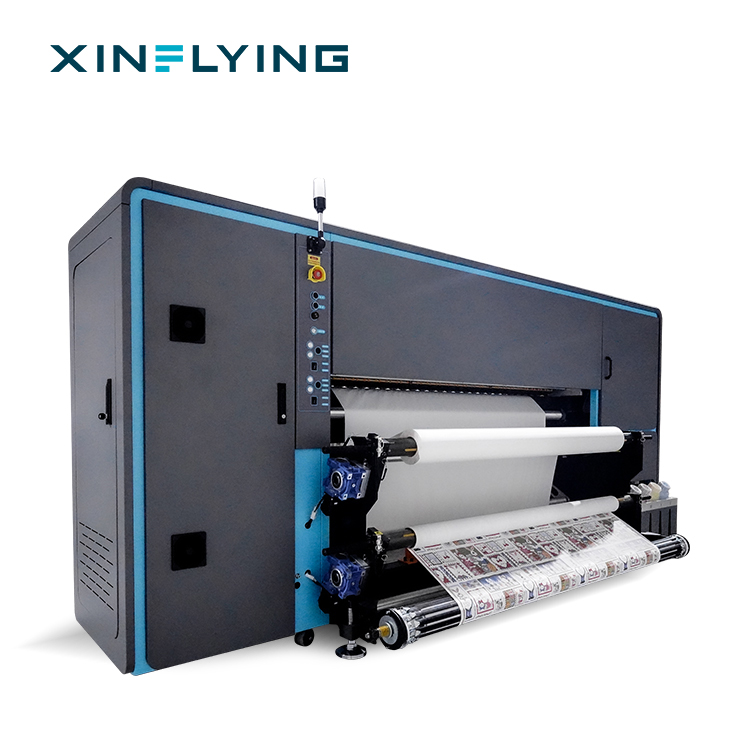
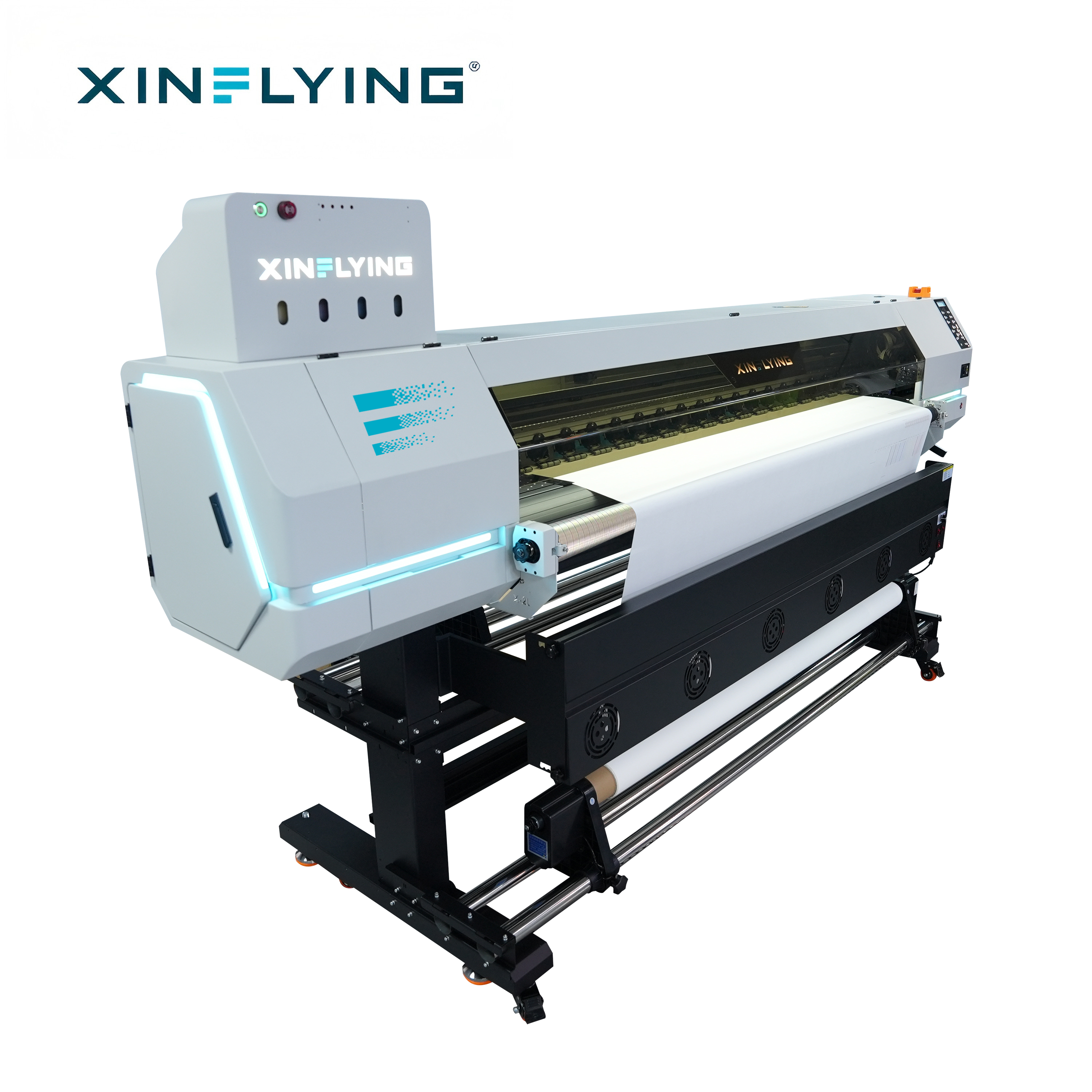
The XF-19E15-PRO and the XF-H1802X-2I32A1 are both roll-to-roll dye sublimation printers manufactured by Xinflying (Guangzhou Xin Flying Digital Technology Co., Ltd.), but they sit in different production scale classes. The XF-19E15-PRO runs 15 Epson i3200-A1 printheads across a 190 cm (75″) print width at a maximum 1PASS speed of 524 m²/h, with a 14.5 kW power draw at 210–230V and 45A. The XF-H1802X-2I32A1 runs 2 Epson i3200-A1 printheads across a 180 cm print width at a maximum 4PASS speed of 52 m²/h, with a 3.5 kW power draw at 110/220V. The width gap between them is only 10 cm. Throughput class, site electrical requirements, machine mass and the EU compliance file you must verify are what actually separate these two machines.
This guide is written for buyers at the research stage — importers, distributors, textile production managers and brand owners who already know they need a commercial sublimation printer and now have to pick a scale. It covers what genuinely differs between the two platforms, how EU market acceptance is documented for each, a six-step decision sequence, the buyer profiles each machine fits, a full specification table, and the questions buyers ask most often before requesting a sample.
Why a 10 cm Width Difference Is Not the Real Difference
The nominal widths are close: 190 cm on the XF-19E15-PRO and 180 cm on the XF-H1802X-2I32A1. Buyers who compare only those two numbers usually make the wrong call, because width controls layout while four other specifications control the business case.
- Throughput class. 15 Epson i3200-A1 printheads at a maximum 524 m²/h in 1PASS mode, versus 2 Epson i3200-A1 printheads at a maximum 52 m²/h in 4PASS mode.
- Electrical envelope. 14.5 kW at 210–230V and 45A, versus 3.5 kW at 110/220V drawing 27.2A at 110V or 13.6A at 220V.
- Physical scale and logistics. 3,840 × 1,570 × 1,800 mm and 1,480 kg net weight, versus 3,000 × 880 × 1,630 mm and 265 kg net weight.
- Documentation and installation scope. A high-current industrial machine and a dual-voltage wide-format machine do not present the same compliance file, or the same site preparation work, to an EU buyer.
In practice the two models answer two different operational questions. The XF-19E15-PRO answers how to produce the most square metres per shift on polyester. The XF-H1802X-2I32A1 answers how to run commercially viable sublimation production — including sampling and short runs — on a supply that may be single-phase or 110V.
Industry Background: Where the 1.9 m and 1.8 m Classes Come From
Roll-to-roll sublimation printers with widths of 1.9 m (1900 mm) are treated as standard for high-volume textile and soft-signage applications (FESPA industry insights). That convention is why search phrases such as 1900mm sublimation printer and 1.9m sublimation printer read like a category rather than a single model. The 180 cm class exists for the same reason narrower formats exist: not every order book needs soft-signage volume, and not every production floor can carry an industrial machine.
The equipment market behind that convention is expanding. Grand View Research values the global dye sublimation printing market at USD 16.4 billion in 2025, projected to reach USD 39.0 billion by 2033 at a CAGR of 11.5% from 2026 to 2033. Within that market, the dye sublimation printer equipment segment was valued at USD 1.88 billion in 2025 and is expected to reach USD 2.53 billion by 2030 (Mordor Intelligence). Asia Pacific held a 36.5% revenue share in 2025, led by China as the largest country market (Grand View Research) — consistent with China's textile and garment exports reaching USD 293.6 billion in 2023. Demand for personalized apparel and home decor is the primary driver behind the 13.1% CAGR projected for digital textile sublimation through 2030 (Grand View Research).
Two caveats matter when you use these figures in an investment case. First, published market sizes differ by scope: Grand View Research reports USD 16.4 billion for 2025, Mordor Intelligence USD 15.22 billion, and Market Research Future USD 42.95 billion for 2024, because some studies include consumables and services while others count equipment only. Treat any single number as directional, and use the printer-segment figure when you are comparing machines. Second, on the technology side, inkjet production printers accounted for 87.3% of the production printer market by type in 2024 (Grand View Research), and colour validation for digital print workflows is standardized under ISO 12647-8:2021, the standard for validation print processes working directly from digital data. That standard becomes relevant the moment a brand buyer asks whether your sublimation output can be reproduced across production batches.
The Two Platforms, Specified
XF-19E15-PRO: a 190 cm industrial platform
- Category: digital textile printer of the sublimation printer type; intended for the industrial textile sublimation printing industry, with high-volume industrial textile sublimation printing as the typical application scenario.
- Printheads: 15 × Epson i3200-A1; ink colours CMYK.
- Print width: 190 cm (75″); resolution 3200 dpi.
- Speed: fastest mode 1PASS 524 m²/h and 2PASS 254 m²/h; standard mode 1PASS 394 m²/h and 2PASS 188 m²/h.
- Media: sublimation paper, loading rolls of 1000 m.
- RIP: Maintop (standard); RIIN (Hoson only), PhotoPrint and Printfactory (optional).
- Drying: external intelligent air-heat integrated dryer. Moisturizing: fully sealed automatic moisturizing and cleaning.
- Power: 14.5 kW; 210–230V, 45A. Operating system: Windows 11/10 (32/64 bit).
- Machine size 3,840 × 1,570 × 1,800 mm; packing size 3,970 × 1,150 × 2,130 mm; net weight 1,480 kg; gross weight 1,580 kg.
- Operating environment: 18–30°C, 35–65% RH.
The engineering behind that configuration is specific rather than generic: i3200-A1 heads with 3,200 nozzles and variable ink drop, a linear motor with magnetic grid, a Japan THK silent guide, 27 press rollers, an enlarged beam, and fully sealed automatic moisturizing and cleaning. For a production manager the relevant reading is media handling stability at speed — the 27 press rollers and enlarged beam are the elements that keep 1000 m paper rolls tracking flat when the machine runs in 1PASS.
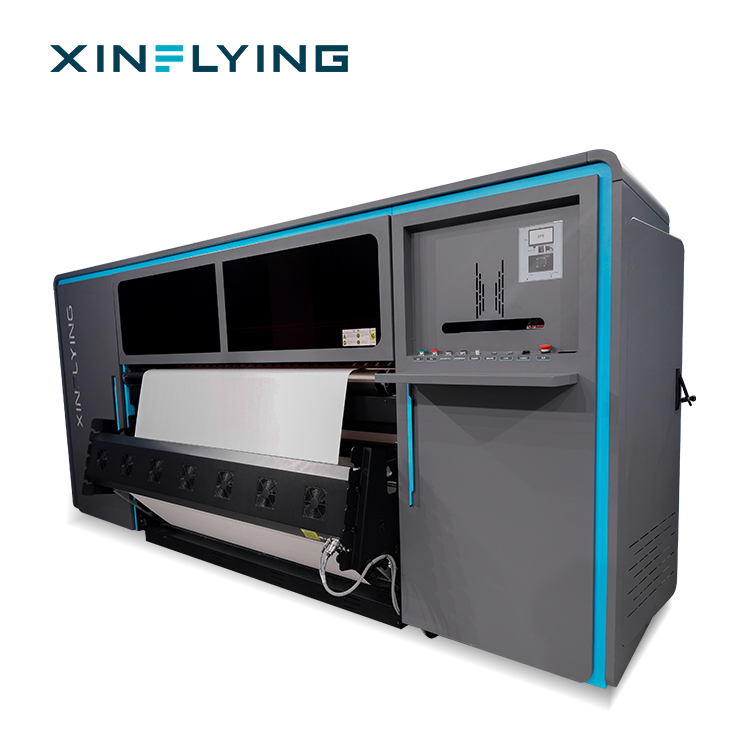
XF-H1802X-2I32A1: a 180 cm wide-format platform
- Category: wide-format digital textile printer manufactured by XinFlying, of the sublimation printer type; intended for the textile sublimation printing industry and designed for textile sublimation printing on polyester fabrics.
- Printheads: 2 × Epson i3200-A1; ink colours CMYK+CMYK.
- Print width: 180 cm.
- Speed: fastest mode 4PASS 52 m²/h; standard mode 4PASS 42 m²/h.
- Media: heat transfer paper. RIP: Maintop (standard).
- Heating: front, middle and rear break-controlled heating.
- Power: 3.5 kW; 110/220V, 27.2A/13.6A, 50–60 Hz.
- Machine size 3,000 × 880 × 1,630 mm; packing size 3,070 × 880 × 850 mm; net weight 265 kg; gross weight 325 kg.
- Operating environment: 20–35°C, 45–65% RH.
Its declared features — Epson i3200-A1 heads, Honson board, aluminum ink rack, retraction system and front/middle/rear break-controlled heating — describe a machine built around control and repeatability rather than maximum area per hour. The 110/220V input is the commercial detail that changes distribution strategy: one machine specification can be commissioned on a 110V supply and on a 220–230V supply, which simplifies stock planning for distributors serving more than one region.
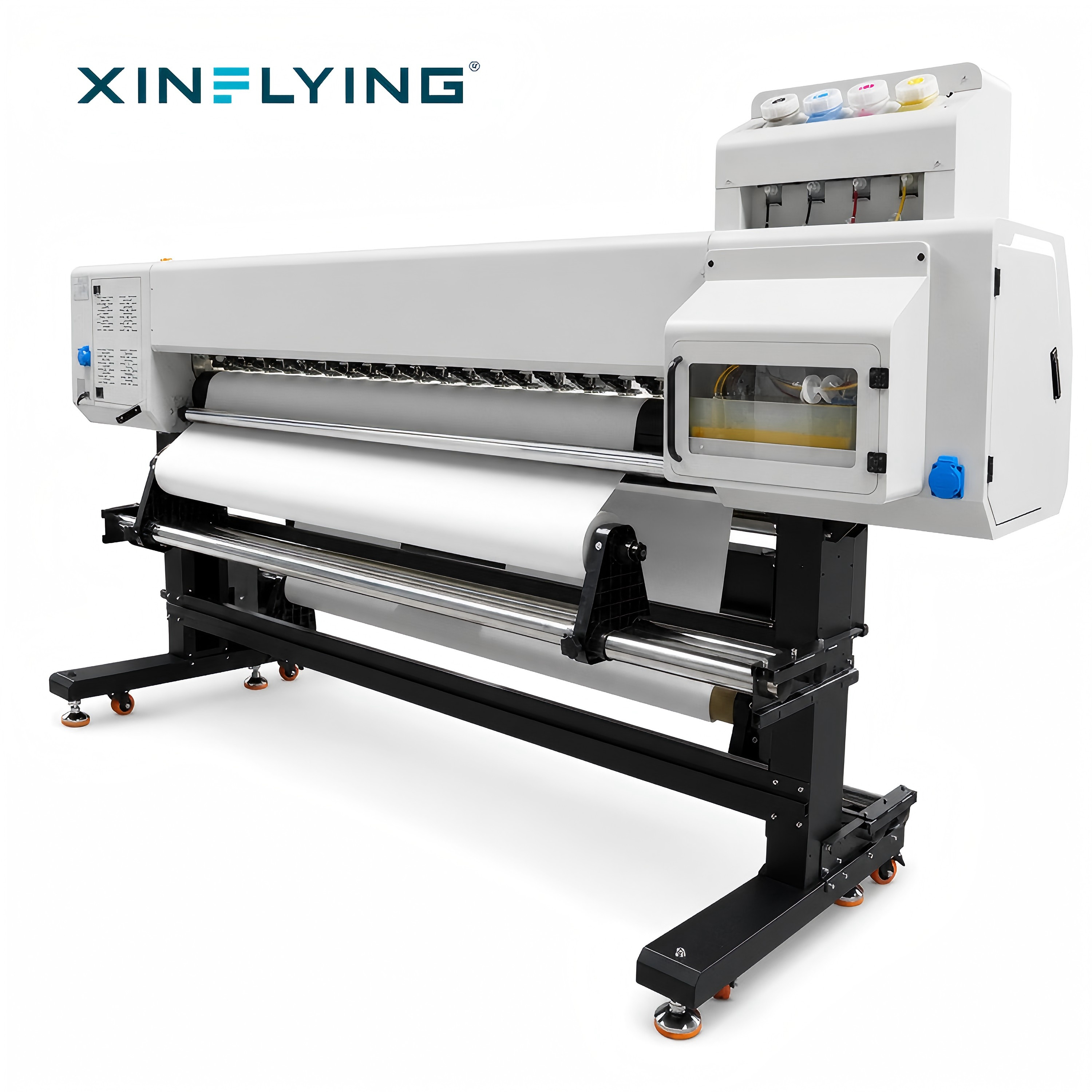
Where the two sit on the Xinflying scale ladder
Xinflying manufactures a wider sublimation range, and placing both models on that ladder is the fastest way to confirm you are comparing the right pair.
| Model | Print width | Printheads | Peak speed | Power |
|---|---|---|---|---|
| XF-H1301X-1I32A1 | 130 cm | 1 × Epson i3200-A1 | 4PASS 28 m²/h | 2 kW |
| XF-H1802X-2I32A1 | 180 cm | 2 × Epson i3200-A1 | 4PASS 52 m²/h | 3.5 kW |
| XF-19E8-PRO | 190 cm | 8 × Epson i3200-A1 | 1PASS 306 m²/h | 10.2 kW |
| XF-19E15-PRO | 190 cm | 15 × Epson i3200-A1 | 1PASS 524 m²/h | 14.5 kW |
| XF-O2000-4I32A1 | 195 cm | 4 × Epson i3200-A1 | 2PASS 180 m²/h | 8.5 kW |
The XF-19E8-PRO and the XF-19E15-PRO share the same 190 cm width; the difference between them is head count, not width. The XF-O2000-4I32A1 is the wider option at 195 cm, intended for clothing, home decor, canvas bags, cushions and flags — useful to know if your product mix runs beyond the 190 cm class rather than below it.
EU Market Acceptance: Two Documentation Paths for Two Different Machines
Importing sublimation printers into the European market requires verification of CE compliance, covering applicable electrical safety, electromagnetic compatibility and product safety requirements. A reliable supplier provides valid certification documents, test reports and technical files that match the actual printer model. Incorrect or incomplete compliance documents can result in customs delays, sales restrictions or additional compliance costs — which is why the documentation path should be decided before the purchase order, not after the container arrives.
Path A — the high-power industrial platform. The XF-19E15-PRO draws 14.5 kW at 210–230V and 45A. That rating creates two separate acceptance requirements that buyers frequently merge into one. The first is the machine file: certification documents and test reports must describe this model at its actual electrical rating. The second is the site installation: the building supply, protective device, cabling and connection point must be able to deliver 45A safely and comply with local installation rules. A machine and a building are approved separately, and the project only starts when both pass.
Path B — the dual-voltage wide-format platform. The XF-H1802X-2I32A1 draws 3.5 kW at 110/220V, 27.2A at 110V or 13.6A at 220V. This is what allows a single model to be commissioned in EU (220–230V) facilities and in 110V markets, and it materially reduces the electrical works needed on site. It does not reduce the compliance obligation: the same CE documentation logic applies, and electromagnetic compatibility and electrical safety documents must still correspond to the model being supplied.
Environmental documentation. RoHS compliance is a separate check from CE and confirms that electrical and electronic components meet restrictions on hazardous substances. Buyers should request environmental compliance documents from the supplier and verify that they apply to the actual equipment model, because these documents are frequently issued at component or series level rather than per model.
A five-point verification drill for either model:
- Confirm the certificate names the exact model designation — XF-19E15-PRO or XF-H1802X-2I32A1 — and the configuration being supplied.
- Record the certificate reference number and the issuing body exactly as printed on the document. A certificate reference belongs to one document and one scope, not to a product family, so a reference issued for one model cannot be presented as covering the other.
- Cross-check the certificate against the machine nameplate and the packing list on arrival, before installation begins.
- Keep the test reports and the technical file in the same folder as the certificate, so a customs or reseller query can be answered with one pack.
- For US-bound units, verify electromagnetic compatibility and electrical safety documentation separately, based on the equipment configuration and application environment.
Step-by-Step: Six Steps to the Right Scale
Use Cases: Which Buyer Profile Fits Which Platform
High-volume polyester production
Sportswear, team jerseys, activewear and continuous roll-to-roll fabric printing are the applications where the XF-19E15-PRO is intended to operate, with high-volume industrial textile sublimation printing as its typical scenario. When throughput, not flexibility, is the bottleneck, the 15-head, 190 cm platform is the scale that matches the order book.
Sampling, short runs and mixed product ranges
Custom apparel, sampling, small-batch orders and businesses moving from heat transfer vinyl or DTG into sublimation are the profile the XF-H1802X-2I32A1 is designed for: 180 cm width, 2 printheads, 265 kg net weight, and a supply requirement most workshops can already meet.
Home textiles, cushions, canvas bags and flags
These product families are listed among the applications of the wider range, including the XF-O2000-4I32A1 at 195 cm. Buyers whose product mix spans home decor and soft signage should check whether they need the 195 cm width class before choosing between the 180 cm and 190 cm platforms.
Distributors and importers serving multiple markets
For a china sublimation printer supply programme, the dual 110/220V input on the XF-H1802X-2I32A1 supports one specification across regions, while the XF-19E15-PRO addresses customers whose factories are already wired for industrial sublimation lines running in continuous production environments.
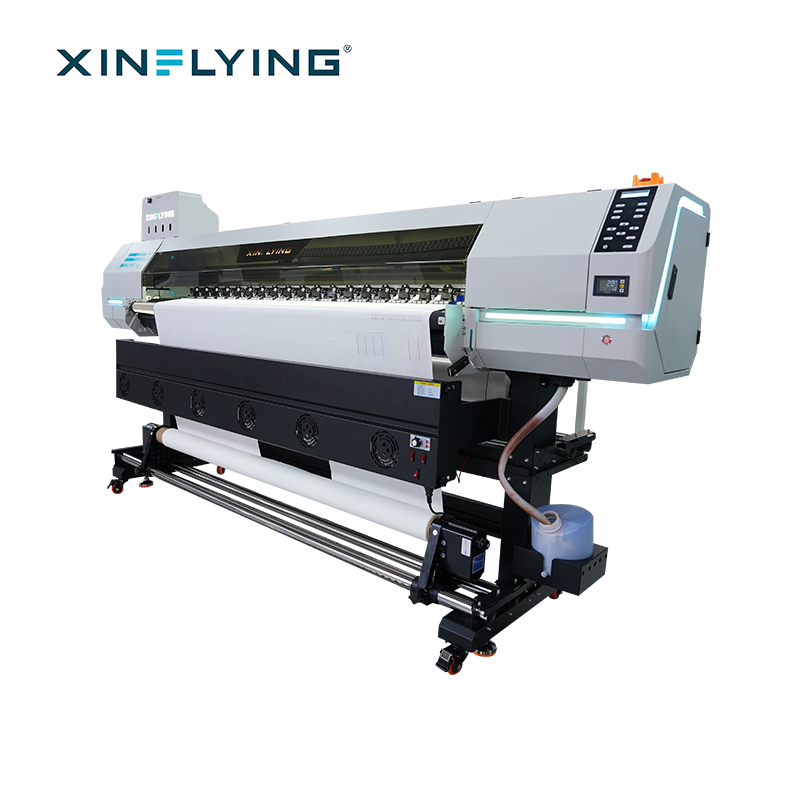
Specification Comparison Table
| Specification | XF-19E15-PRO | XF-H1802X-2I32A1 |
|---|---|---|
| Product category | Digital textile printer, sublimation printer type | Digital textile printer, sublimation printer type |
| Intended industry | Industrial textile sublimation printing (high-volume) | Textile sublimation printing (polyester fabrics) |
| Print width | 190 cm (75″) | 180 cm |
| Printheads | 15 × Epson i3200-A1 | 2 × Epson i3200-A1 |
| Ink colours | CMYK | CMYK+CMYK |
| Peak speed (fastest mode) | 1PASS 524 m²/h; 2PASS 254 m²/h | 4PASS 52 m²/h |
| Standard-mode speed | 1PASS 394 m²/h; 2PASS 188 m²/h | 4PASS 42 m²/h |
| Resolution | 3200 dpi | Not published in the specification available |
| Ink | Sublimation ink | Not published in the specification available |
| Media | Sublimation paper (loads 1000 m rolls) | Heat transfer paper |
| RIP software | Maintop (standard); RIIN (Hoson only), PhotoPrint, Printfactory (optional) | Maintop (standard) |
| Drying / heating | External intelligent air-heat integrated dryer | Front, middle and rear break-controlled heating |
| Moisturizing and cleaning | Fully sealed automatic moisturizing and cleaning | Not published in the specification available |
| Power | 14.5 kW | 3.5 kW |
| Power supply | 210–230V, 45A | 110/220V, 27.2A/13.6A, 50–60 Hz |
| Operating environment | 18–30°C, 35–65% RH | 20–35°C, 45–65% RH |
| Machine size (L × W × H) | 3,840 × 1,570 × 1,800 mm | 3,000 × 880 × 1,630 mm |
| Packing size | 3,970 × 1,150 × 2,130 mm | 3,070 × 880 × 850 mm |
| Net / gross weight | 1,480 kg / 1,580 kg | 265 kg / 325 kg |
| Operating system | Windows 11/10 (32/64 bit) | Not published in the specification available |
| Construction materials | Aluminum alloy, stainless steel, ABS plastic | Aluminum alloy, stainless steel, ABS plastic |
Cells marked as not published reflect the specification data available for that model at the time of writing; they should be confirmed with the supplier before purchase. Shared operating guidance for sublimation production environments — controlled indoor conditions, stable temperature and humidity — applies to both platforms.
Frequently Asked Questions
Do the XF-19E15-PRO and the XF-H1802X-2I32A1 need separate CE documentation for the European market?
In practice, yes. EU importers should verify CE compliance covering applicable electrical safety, electromagnetic compatibility and product safety, and the documentation must match the actual printer model. The two machines are different models with different power ratings and configurations — 14.5 kW at 210–230V and 45A, versus 3.5 kW at 110/220V with 27.2A/13.6A — so a document set that applies to one model does not automatically cover the other. Request valid certification documents, test reports and technical files for the exact model being supplied, record the certificate reference number and issuing body as printed, and confirm that the certificate, the machine nameplate and the packing list agree before shipment. Incomplete or mismatched documents can cause customs delays, sales restrictions or extra compliance costs.
Can the 180 cm XF-H1802X-2I32A1 print the same fabrics as the 190 cm XF-19E15-PRO?
The chemistry is identical because both machines are sublimation printers: dye sublimation printing uses heat to transfer sublimation ink into polyester-based material, and it creates a permanent bond with the fabric rather than printing on top of it. The XF-H1802X-2I32A1 is designed for textile sublimation printing on polyester fabrics, and the XF-19E15-PRO is intended for high-volume industrial textile sublimation printing. Neither model changes the material rule — traditional sublimation works on polyester fabrics and polyester-coated substrates, while cotton normally requires another printing method or a special coating. What differs between the two models is width, throughput, power and media handling, not material compatibility.
What cost drivers should I compare between a 2-head 180 cm printer and a 15-head 190 cm printer?
Compare the entire installation rather than the equipment price alone. The relevant drivers are printhead count (2 versus 15 Epson i3200-A1 units), achievable throughput at the mode you will actually run, power draw and the electrical work it requires (3.5 kW versus 14.5 kW), machine mass and freight (325 kg versus 1,580 kg gross), floor space (3,000 × 880 × 1,630 mm versus 3,840 × 1,570 × 1,800 mm), consumable consumption at different duty cycles, and maintenance labour. Matching capacity to the genuine order book is the discipline that matters: buying a machine that is unsuitable for your production volume typically leads to low production efficiency, inconsistent print quality and higher maintenance costs, while over-specifying beyond your pipeline ties up capital in capacity you cannot yet fill.
How can I validate either model before committing to a full production line?
Run the same commissioning sequence on both machines. Place the printer on a stable working surface and connect the power supply and cables; install the sublimation ink system and confirm ink flows correctly; install the drivers and configure the RIP software; perform nozzle checks, printhead inspection and initial calibration; then run test prints and adjust parameters before mass production. Do not begin large-scale production before test printing is finished, use compatible inks and consumables, and keep the printer environment clean and dust-free. Records of the validated settings pay off later, because repeat orders reproduce reliably only when the parameters behind the first approved print are documented. Both models use Maintop as standard RIP software, with RIIN (Hoson only), PhotoPrint and Printfactory available as options on the XF-19E15-PRO.
What should I confirm with a sublimation printer manufacturer before placing an order?
Confirm manufacturing scale, R&D capability, production capacity and after-sales structure — professional installation guidance, remote technical support, operation training, maintenance recommendations and long-term spare parts availability. Guangzhou Xin Flying Digital Technology Co., Ltd. (Xinflying) was established in 2010 as a professional manufacturer of digital printing equipment and specializes in DTF printers, UV DTF printers, UV printers, DTG printers and dye sublimation printing solutions, with a manufacturing facility covering 37,440 square meters, more than 200 staff, an R&D team of 20 engineers and annual production capacity exceeding 20,000 units. To move from shortlisting to a decision, request the specification sheet for both models, ask for a sample print on your own polyester fabric, and download the Xinflying company brochure for the full equipment range before you finalise the scale.
Conclusion: The Decision Rule in One Sentence
If the constraint in your business is square metres per hour on polyester, the 190 cm, 15-head XF-19E15-PRO is the scale that matches the problem; if the constraint is capital efficiency, mixed product ranges, sampling, or deploying one specification across 110V and 220–230V markets, the 180 cm XF-H1802X-2I32A1 is the platform that matches the problem. Decide the scale first, then verify the compliance file for the exact model you chose — certificate scope, test reports and technical file — and only then commit the production programme.
Next Step: Compare Both Platforms Against Your Own Order Book
Send the specification sheet for the XF-19E15-PRO and the XF-H1802X-2I32A1 to your production and facilities teams, then request a sample print on the polyester fabric you actually run. Xinflying supplies both platforms from Guangzhou Xin Flying Digital Technology Co., Ltd. and can provide model-specific technical data for your EU or US documentation file.
- Company brochure (PDF download): Xinflying corporate introduction
- Email: info@xin-flying.com
- Phone / WhatsApp: +86 188-1322-1357 — start a WhatsApp enquiry
- Website: www.xin-flying.com