
XF-400D vs XF-450PRO DTF Printer: Which CE-Certified Model Fits EU Production?
Both the XF-400D and the XF-450PRO are CE-certified DTF printers from XINFLYING, the brand of Guangzhou Xin Flying Digital Technology Co., Ltd., a digital printing equipment manufacturer founded in 2010 and exporting to Europe, North America, South America, Asia, the Middle East and Africa. In the certification records reviewed for this comparison, both models appear on the same document family: CE LVD certificate TQT1550D271EC, CE EMC certificate TQT1550D270EC, CE Machinery Directive attestation M.2026.206.C142365, RoHS attestation M.2026.206.C142366 and ISO 9001:2015 certificate NOA2215496.
That single fact changes the comparison. For an EU buyer, the choice between these two machines is not "which one carries more CE" — it is which conformity route your market, your sales channel and your production layout actually require, and whether the model line printed on the certificate copy you receive matches the serial number on your packing list. This article works through the documents one by one, shows where the two models genuinely diverge, and gives a verification sequence you can run before you place a purchase order.
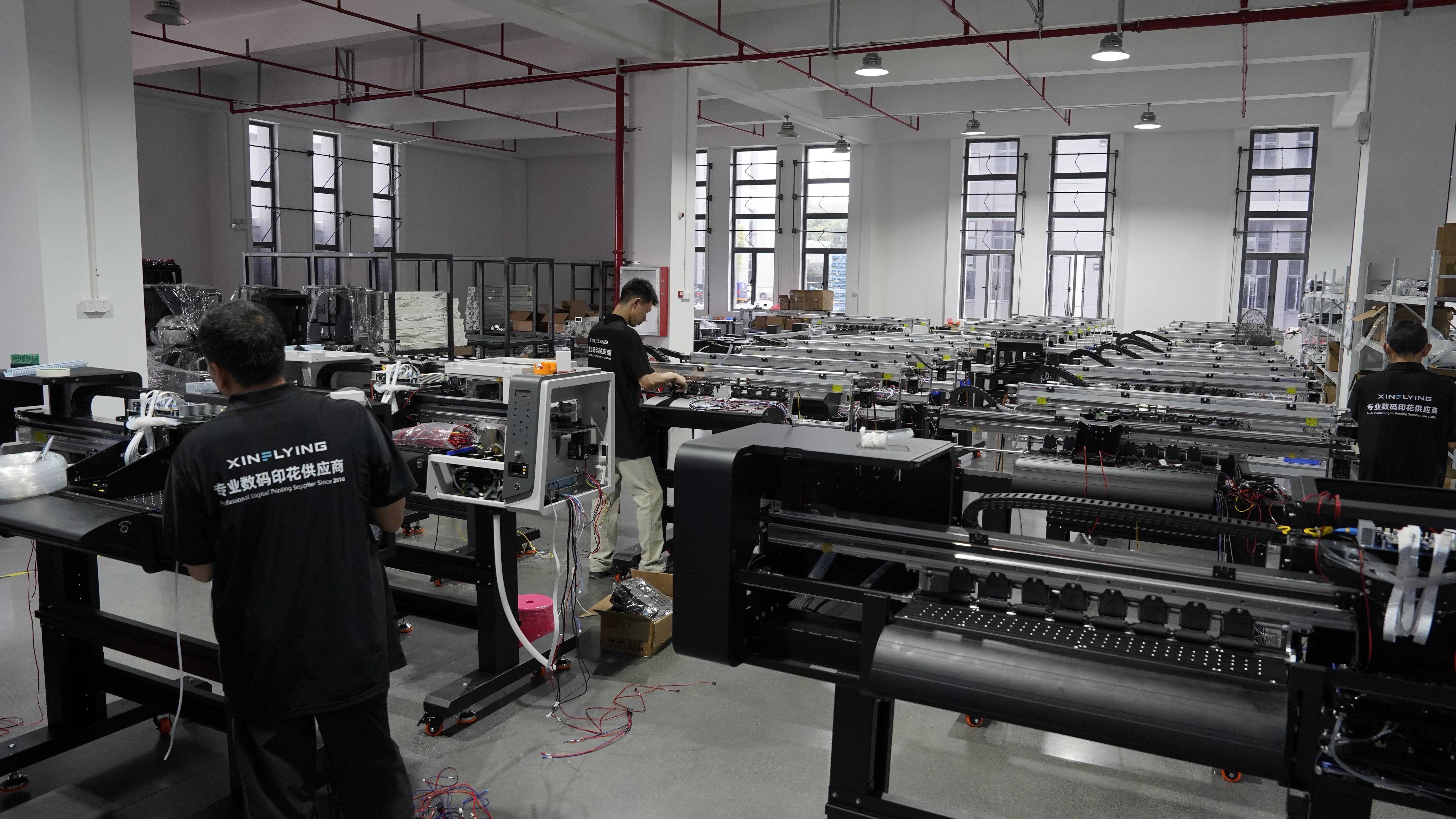
Frame, wiring and electrical assembly stations at the Xinflying production facility — the build stage where LVD and EMC conformity is designed in rather than documented afterwards.
Problem Definition: Why "Both Are CE Certified" Is Not a Comparison
A CE mark on a commercial DTF printing machine is a manufacturer's declaration that the product meets the applicable EU harmonised legislation. It is not a single certificate, and it is not issued by the EU. Behind the mark sits a stack of separate directives — Low Voltage, Electromagnetic Compatibility, Machinery, and the RoHS substance restriction — each with its own standard set, its own test evidence and, in practice, its own certificate number.
This creates three specific problems when a buyer compares two models that both claim CE status.
First, the certificate is supporting evidence, not the legal document. A test laboratory certificate of compliance confirms that a sample was evaluated against named standards. The obligation that sits with the EU importer is different: the importer must be able to hold the manufacturer's declaration of conformity and the technical documentation, and must be able to produce them if a market surveillance authority asks. A supplier who sends one certificate image and calls the file complete has not answered the importer's question.
Second, coverage is often family-level, not model-level. A single certificate commonly lists a series of models. That is normal practice, but it means the buyer has to read the model column rather than the certificate title. If the certificate lists twelve models and you are importing the eleventh, the document still works — provided the certificate in your file is the one that names your model, at the revision that applies.
Third, the directive mix depends on how the machine is used. A standalone direct to film printer connected to a wall socket and operated by trained staff raises a different conformity profile from the same printer bolted into an automated line with a shaker, a conveyor and an integrated heat press. The second case can create a new machine under the Machinery Directive, and the risk assessment then has to cover the combined assembly, not just the printer.
Those three points are the reason a compliance-led comparison of the XF-400D and the XF-450PRO is more useful than a specification sheet comparison.
Industry Background: Europe Is the Largest DTF Region and the Most Documented One
The commercial case for getting EU documentation right is straightforward. Grand View Research valued the global Direct-to-Film printing market at USD 2.7 billion in 2024, and identified Europe as the leading regional market with a 36.0% revenue share in the same year. In other words, more than a third of worldwide DTF revenue is generated in the region with the most formal import documentation requirements.
Supply is concentrated elsewhere. Dataintelo reports that China accounts for more than 45% of global DTF printer manufacturing capacity, which means most EU-bound machines are imported rather than bought domestically. The technical file therefore has to travel with the machine, across a language and documentation boundary, from a manufacturer who may not sell directly into the EU at all.
Two further data points shape what buyers are actually purchasing. Dataintelo puts industrial DTF printers at 58.3% of total revenue share in 2025, driven by throughput requirements — a shift toward production-floor installations where Machinery Directive documentation becomes relevant. KBV Research reports that T-shirts represented 41% of DTF printing revenue in 2024, which keeps the apparel channel, and its brand-owner compliance audits, at the centre of demand.
Treat growth projections with caution. Published CAGR estimates for this category do not agree: Grand View Research at 6.0% for 2025–2030, Dataintelo at 12.5% for 2026–2034, and 360iResearch at 6.77% for 2026–2032. When market forecasts diverge that widely, they are a poor basis for a capital decision. Certificate validity windows, standard revisions and directive scope are stable, checkable facts — which is why they belong at the centre of a machine comparison rather than in an appendix.
Detailed Solution: The XINFLYING EU Document Stack, Certificate by Certificate
XINFLYING operates a 20-person R&D team and more than 50 engineers providing 24/7 online technical support, with an export ratio of 80%. The compliance file below is what an EU importer can request for the XF-400D and the XF-450PRO, and each document answers a different question.
Electrical safety: CE LVD certificate TQT1550D271EC
The Low Voltage Directive 2014/35/EU evidence for both models is CE LVD certificate TQT1550D271EC, issued by TQT (Shenzhen Tianqi Testing Technology Service Co., Ltd.) on 2026-05-19, with the record showing an expiry of 2099-01-01. The harmonised standard cited is EN IEC 62368-1:2020/A11:2020, the safety standard for audio/video, information and communication technology equipment that has become the default electrical safety reference for digital printing hardware.
Why it matters to a buyer: this is the document that answers the electrical safety question for an importer, a distributor's technical reviewer or a retail compliance team. Without it, no amount of factory photography substitutes.
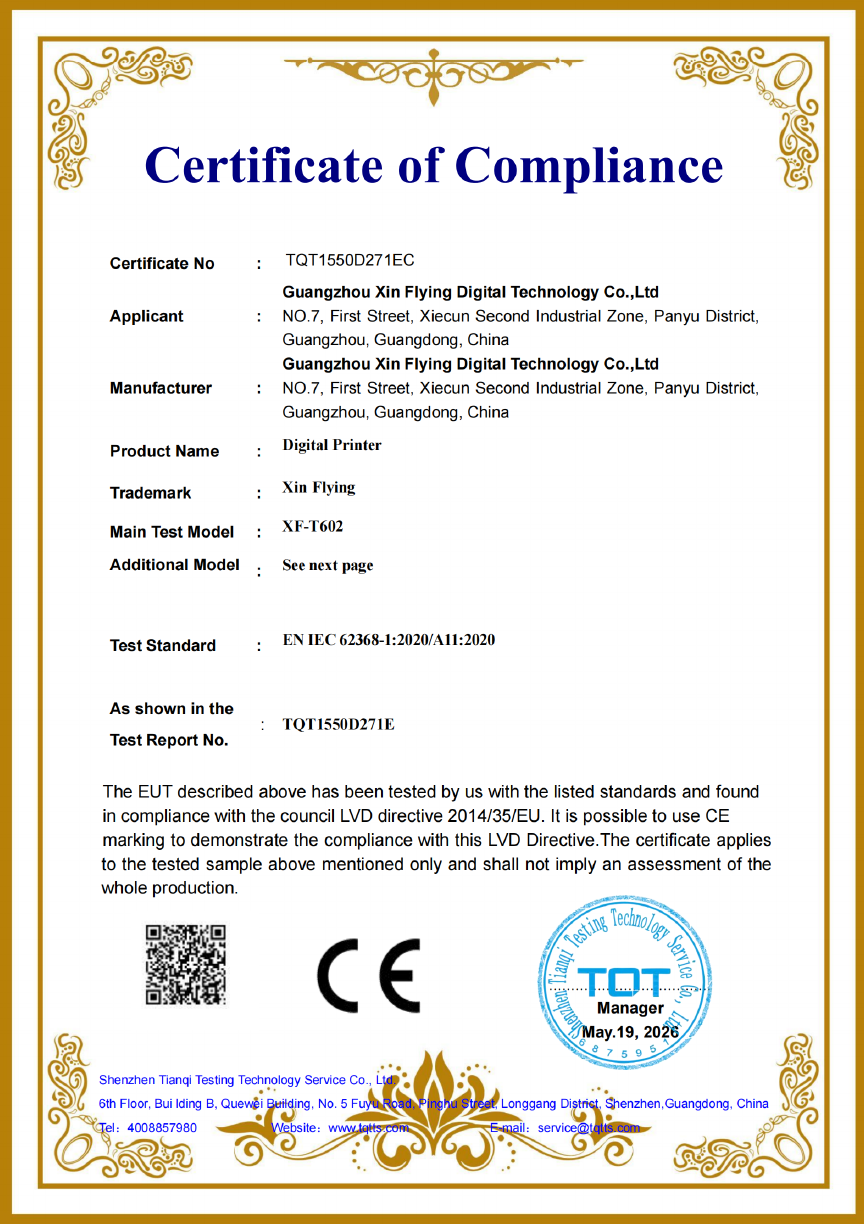
CE LVD certificate TQT1550D271EC, issued by TQT on 2026-05-19 against EN IEC 62368-1:2020/A11:2020. Both XF-400D and XF-450PRO are listed on this certificate.
Electromagnetic compatibility: CE EMC certificate TQT1550D270EC
EMC evidence is CE EMC certificate TQT1550D270EC, also from TQT and also issued on 2026-05-19, covering EMC Directive 2014/30/EU against EN 55032:2015/A11:2020, EN 55035:2017/A11:2020, EN IEC 61000-3-2:2019+A1:2021 and EN 61000-3-3:2013/A2:2021 — emissions, immunity, harmonic current and voltage fluctuation respectively.
This is the most frequently underestimated part of a DTF printing machine file. A machine that shares a workshop with other digital equipment, or that is installed in a retail-adjacent environment, will be assessed on emissions as well as safety. A supplier who can only produce a safety certificate has an incomplete electrical file.
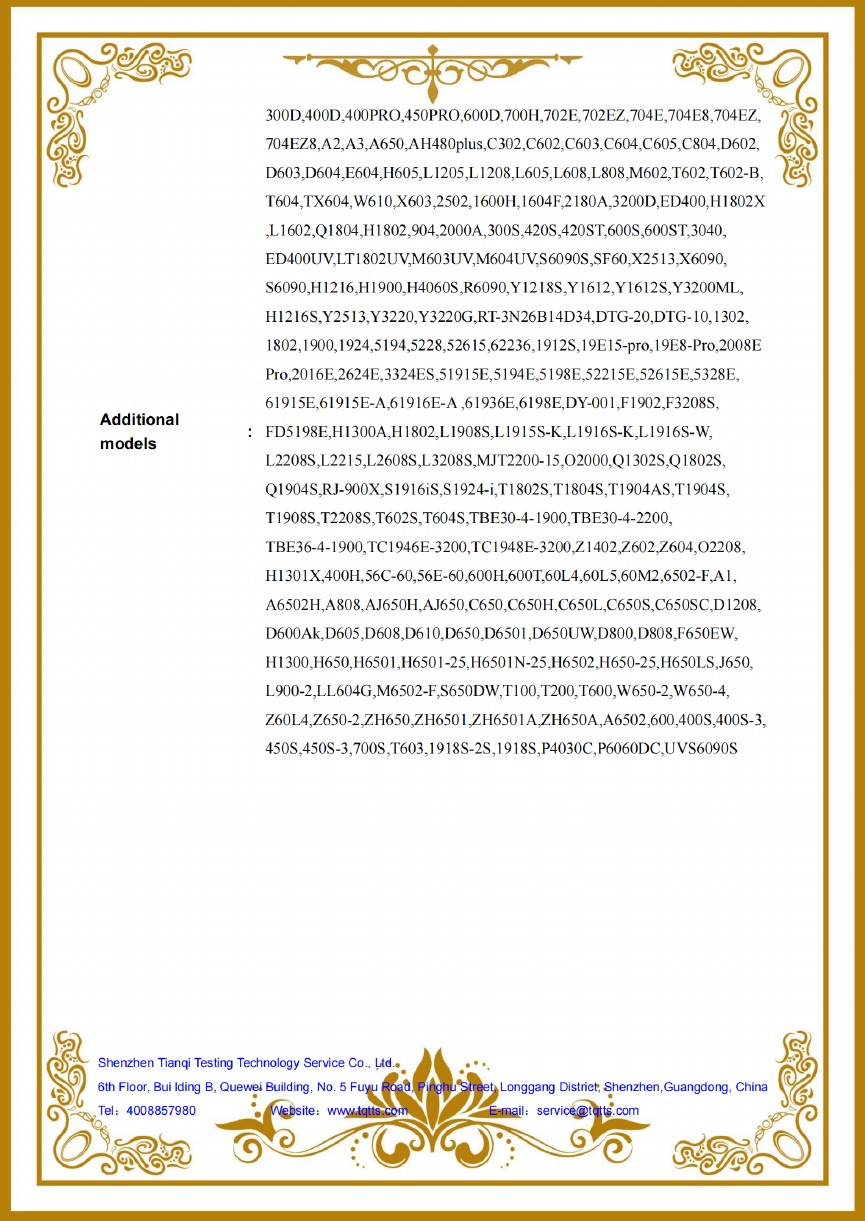
CE EMC certificate TQT1550D270EC against EMC Directive 2014/30/EU, citing EN 55032, EN 55035, EN IEC 61000-3-2 and EN 61000-3-3.
XINFLYING also holds a combined attestation, M.2026.206.C142475, issued by UDEM on 2026-06-11 and valid to 2031-06-10, covering LVD 2014/35/EU and EMC 2014/30/EU together. Buyers who need a single document rather than two can request this one; both models are listed on it.
Machinery safety: CE MD attestation M.2026.206.C142365
Machinery Directive 2006/42/EC coverage is recorded under M.2026.206.C142365, issued by UDEM in June 2026 and valid to 2031-06-09, against EN ISO 12100:2010 (risk assessment and risk reduction), EN 60204-1:2018/A1:2025 (electrical equipment of machines) and EN ISO 12643-1:2023 (safety requirements for graphic technology machinery). A closely related attestation, M.2026.206.C142385, appears in the same family with the same standard set and validity window.
Why it matters to a buyer: EN ISO 12100 is the risk-assessment standard. A Machinery Directive attestation tells you the manufacturer has carried out and documented that assessment for the machine as supplied — guards, interlocks, emergency stop, pinch points, ink handling. This is the document that industrial end users, system integrators and public-procurement buyers ask for. It is also the document that becomes complicated when you integrate the printer into a line, because your integration changes the boundary of the assessment.
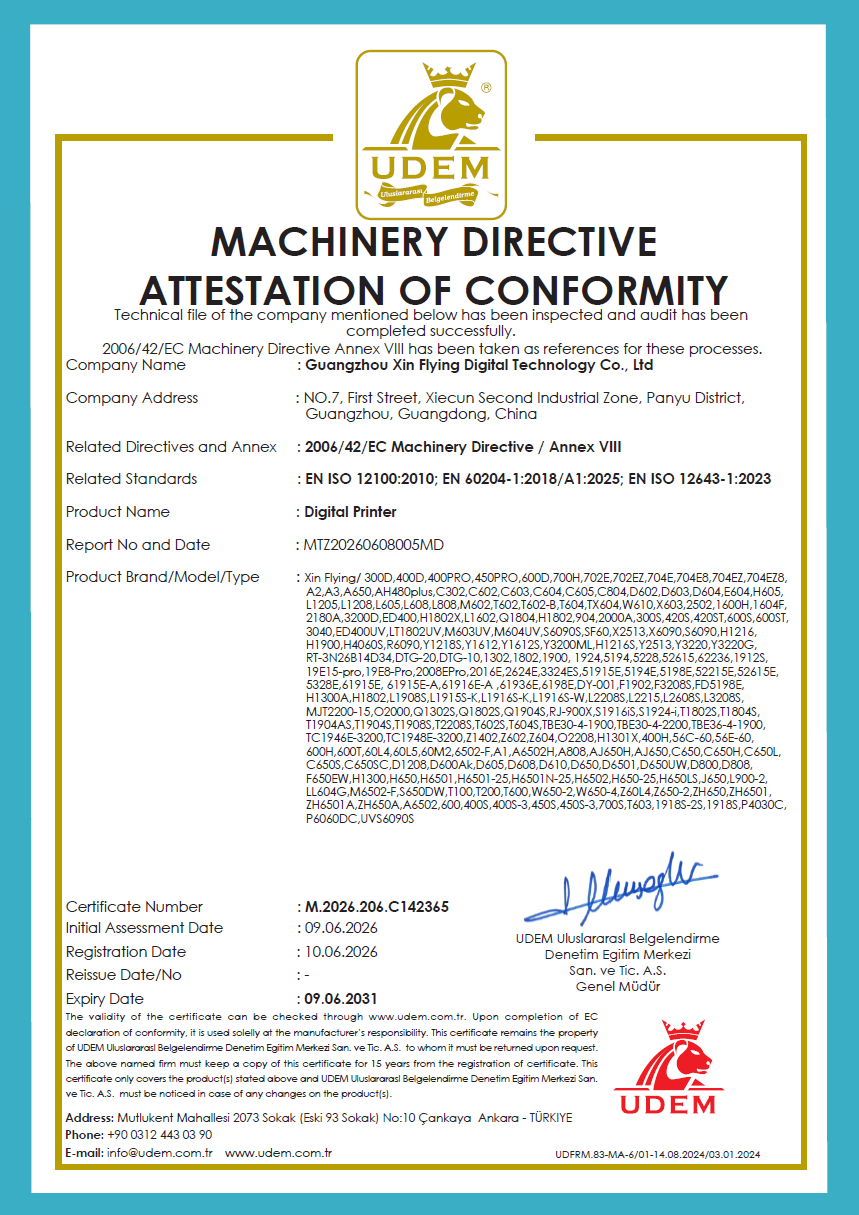
CE MD certificate of conformity M.2026.206.C142365 under Directive 2006/42/EC, citing EN ISO 12100:2010, EN 60204-1:2018/A1:2025 and EN ISO 12643-1:2023.
Substance restriction, quality system and consumables
RoHS. RoHS conformity is recorded under M.2026.206.C142366, issued by UDEM in June 2026 and valid to 2031-06-09, against Directive 2011/65/EU and the EN IEC 63000:2018 assessment standard. This is the document that marketplace compliance teams and brand-owner supplier audits usually request first.
ISO 9001:2015. Certificate NOA2215496, issued by NOA Testing & Certification Group Co., Ltd. against GB/T 19001-2016 / ISO 9001:2015, covers quality management for digital printer and ink sales. The record shows an issue date of 2022-12-26 and an expiry date of 2025-12-25 — meaning that the copy in circulation should be checked for renewal before you place it in a 2026 or 2027 technical file. Ask for the current certificate, not the number.
OEKO-TEX ECO PASSPORT. Certificate SH150194016 from TESTEX AG, valid 2025-12-11 to 2026-12-31, covers textile printing inks and printing pastes. Note the scope carefully: this is a consumables certificate, not a machine certificate. It is relevant when your end customer asks about restricted substances in the printed garment, and it does not replace any part of the machine file.
The file also contains earlier CE certificates — BSTXD211021006201EC from BST Testing (Shenzhen) Co., Ltd. issued 2021-10-18, and CTICAIQ415250900815313DC from CTIC Testing Group (Guangdong) Co., Ltd. issued 2025-08-12 — both covering both models. A well-run buyer asks which certificate the supplier regards as current, then takes that one.
How the XF-400D and XF-450PRO actually differ
This is where the comparison has to be honest. In the records reviewed here, both models are named on every document listed above. The XF-400D is documented through the electrical pair — CE LVD TQT1550D271EC with EN IEC 62368-1:2020/A11:2020, and CE EMC TQT1550D270EC. The XF-450PRO is documented through CE LVD, CE EMC and CE MD, with M.2026.206.C142365 as the Machinery Directive entry point.
The practical contrast is therefore about which documents a buyer pulls forward for a given file, not about one model being better certified than the other. A distributor whose customer asks only for electrical conformity leads with the LVD and EMC pair. A buyer whose integrator or tender requires a machinery risk assessment leads with M.2026.206.C142365. Both models can serve both conversations — but only if the certificate copy in the file actually names the model being shipped.
Documentation discipline that protects you: request the certificate PDFs, not screenshots; check the model column against your order; check the standard revision, not just the certificate title; check the authority name; and check the validity window against your installation date. Four of those five checks take under ten minutes and prevent most post-import compliance disputes.
Step-by-Step Breakdown: Six Verification Steps Before You Sign
- Define the conformity route first. Decide whether the printer will run as a standalone unit or as part of an automated line with a shaker, conveyor or integrated press. Standalone installations lean on LVD and EMC. Integrated installations add the Machinery Directive and shift the risk-assessment burden partly onto you.
- Request documents by number. Ask for TQT1550D271EC, TQT1550D270EC, M.2026.206.C142365, M.2026.206.C142475 and M.2026.206.C142366 by name. A supplier who can produce numbers immediately is working from a managed file; a supplier who has to search for "our CE" is not.
- Read the model line. Confirm that XF-400D or XF-450PRO — whichever you are buying — is listed on each certificate copy, and that the serial number on the shipping documents maps to that model.
- Read the standards column. EN IEC 62368-1:2020/A11:2020 and EN ISO 12100:2010 are specific and current. A certificate citing a superseded edition tells you when the file was last refreshed.
- Check authority, issue date and validity. TQT and UDEM are the issuing bodies in this file. Record the issue dates (2026-05-19 for the LVD and EMC pair; June 2026 for the MD and RoHS attestations) and the validity windows, and re-check any certificate approaching its expiry before your installation date.
- Match the file to the shipped configuration. If you order OEM/ODM customisation — branding, appearance, colour, logo or packaging changes — confirm in writing that the customised configuration stays inside the certified scope. Voltage and plug variants belong in the same conversation. Then require the pre-shipment test record for your unit.
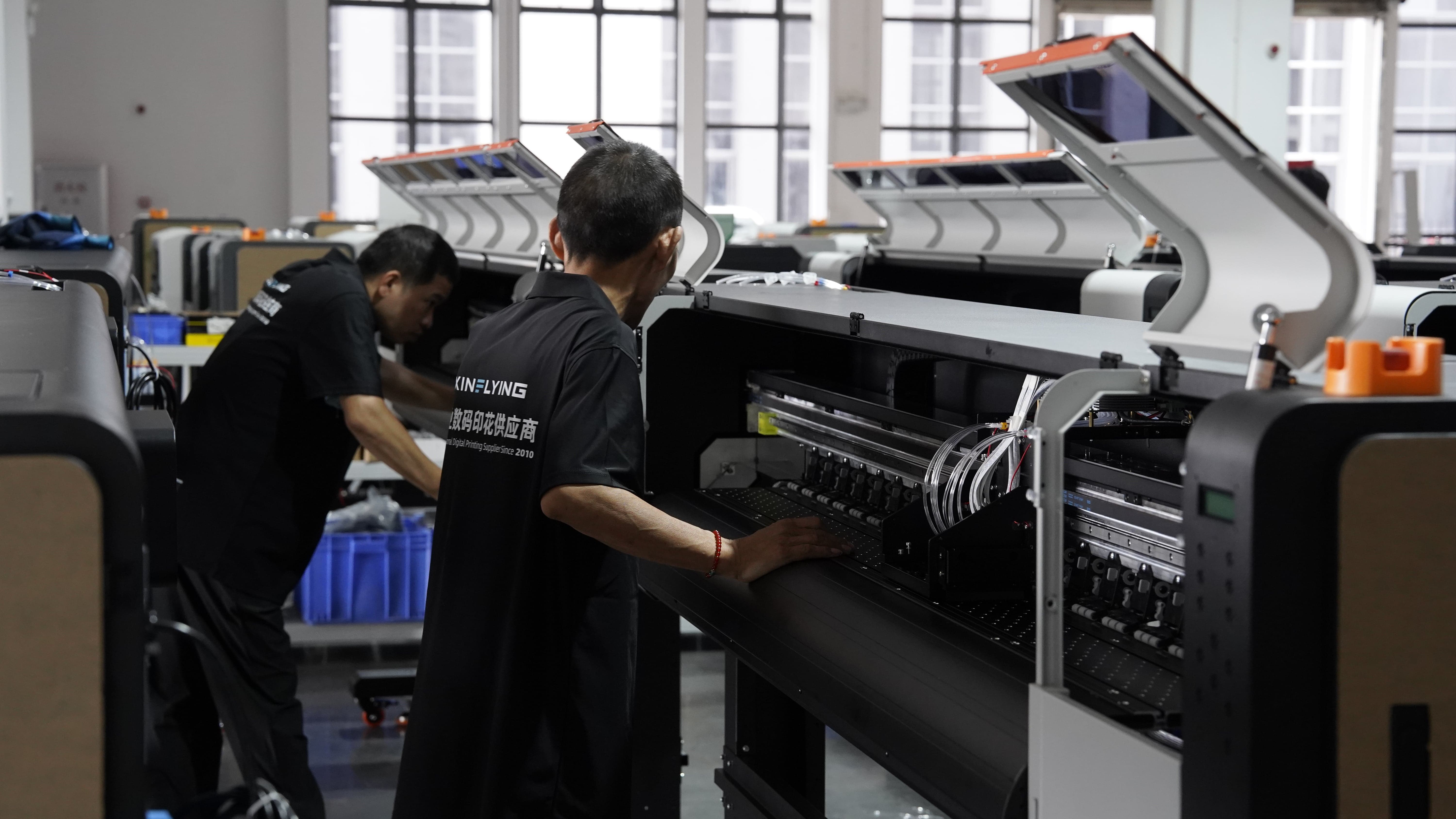
Internal component inspection at Xinflying. Pre-shipment testing is performed on each DTF printer before delivery — the evidence that links a certificate to the specific unit you receive.
Use Cases: Four EU Buyer Profiles and What Each One Needs
Apparel brand owner importing for in-house production. The file that matters is LVD + EMC + RoHS, plus evidence of pre-shipment testing per unit. If the brand sells through marketplaces, the RoHS attestation M.2026.206.C142366 is usually the first document requested. XINFLYING records deployments of this type — a US custom apparel printing business running two DTF printing units for three years on personalised T-shirts, hoodies and bags, and a US Print on Demand business running five units for five years — where the workflow requirement was flexible order quantities and repeat production rather than line integration.
Distributor or reseller. You are re-selling into a market where your own customer will ask you for documents. You need the full stack, with the model line visible, plus ISO 9001 evidence for your supplier audit. A distributor that cannot forward a Machinery Directive attestation loses industrial accounts.
Transfer supplier or industrial decorator. This is the profile where the Machinery Directive attestation M.2026.206.C142365 carries real weight, because the printer sits inside a production process and the buyer's own risk assessment references it. XINFLYING records a US DTF transfer supplier operating 30 units for one year, producing transfer films supplied to downstream decorators — the profile closest to this requirement.
Garment factory adding decoration to finished goods. Here the printer is one station among many, and the compliance question is how it integrates: fabric compatibility, layout, and whether the added machine changes the workshop's risk assessment. XINFLYING records a global garment manufacturing factory running 20 DTF printing units for two years, adding logos and graphics to finished garments before delivery to brands and distributors.
Comparison Table: Certificate Coverage for XF-400D and XF-450PRO
| Document | Directive / standard cited | Certificate no. | Issued by | Validity in record | Models listed |
|---|---|---|---|---|---|
| CE LVD | LVD 2014/35/EU; EN IEC 62368-1:2020/A11:2020 | TQT1550D271EC | TQT (Shenzhen Tianqi Testing Technology Service Co., Ltd.) | Issued 2026-05-19; record shows 2099-01-01 | XF-400D, XF-450PRO |
| CE EMC | EMC 2014/30/EU; EN 55032:2015/A11:2020; EN 55035:2017/A11:2020; EN IEC 61000-3-2:2019+A1:2021; EN 61000-3-3:2013/A2:2021 | TQT1550D270EC | TQT | Issued 2026-05-19; record shows 2099-01-01 | XF-400D, XF-450PRO |
| CE LVD + EMC (combined) | LVD 2014/35/EU and EMC 2014/30/EU | M.2026.206.C142475 | UDEM | 2026-06-11 to 2031-06-10 | XF-400D, XF-450PRO |
| CE MD | MD 2006/42/EC; EN ISO 12100:2010; EN 60204-1:2018/A1:2025; EN ISO 12643-1:2023 | M.2026.206.C142365 | UDEM | June 2026 to 2031-06-09 | XF-400D, XF-450PRO |
| CE MD (related) | MD 2006/42/EC; same standard set | M.2026.206.C142385 | UDEM | June 2026 to 2031-06-09 | XF-400D, XF-450PRO |
| RoHS | Directive 2011/65/EU; EN IEC 63000:2018 | M.2026.206.C142366 | UDEM | June 2026 to 2031-06-09 | XF-400D, XF-450PRO |
| ISO 9001:2015 | GB/T 19001-2016 / ISO 9001:2015 | NOA2215496 | NOA Testing & Certification Group Co., Ltd. | 2022-12-26 to 2025-12-25 — verify current copy | XF-400D, XF-450PRO |
| OEKO-TEX ECO PASSPORT | OEKO-TEX ECO PASSPORT; EN ISO 17050-1 — printing inks and pastes | SH150194016 | TESTEX AG | 2025-12-11 to 2026-12-31 | Consumables scope, not machine scope |
Which Model Should You Specify for EU Production?
On certification evidence alone, this file does not support a preference for one model over the other — both are named on every machine-side document. Where a preference is justified, it comes from the production role and the document your buyer will open first.
If your EU file is electrical-only — a standalone commercial DTF printer in a workshop, sold through a distributor or used in-house — the XF-400D is a rational default. It is documented comprehensively through the CE LVD certificate TQT1550D271EC and the CE EMC certificate TQT1550D270EC, and that pair answers the question your importer will actually ask.
If your buyers, integrators or tender documents require a machinery risk assessment as a matter of policy, specify the XF-450PRO and lead with CE LVD, CE EMC and CE MD coverage, with M.2026.206.C142365 as the reference document. This is a difference in which document you present, not a gap in coverage — the XF-400D also appears on that attestation, and buyers should confirm the model line on the copy they receive either way.
On commercial terms, both models sit inside the same supply framework: MOQ of 1 unit, lead time of 5–40 days depending on configuration, monthly capacity of 1600+ units, annual output of 20,000+ units, OEM/ODM customisation covering branding, appearance, colour, logo and packaging, pre-shipment testing on each unit, and after-sales support from more than 50 engineers with 24/7 online technical assistance.
FAQ
Which CE documents should an EU importer hold for an XF-400D or XF-450PRO?
The machine-side file is built on CE LVD certificate TQT1550D271EC (EN IEC 62368-1:2020/A11:2020), CE EMC certificate TQT1550D270EC (EN 55032, EN 55035, EN IEC 61000-3-2, EN 61000-3-3), CE MD attestation M.2026.206.C142365 (EN ISO 12100:2010, EN 60204-1:2018/A1:2025, EN ISO 12643-1:2023) and RoHS attestation M.2026.206.C142366 (Directive 2011/65/EU). Both models are listed on each of these documents. The certificates are supporting evidence; your own file still needs the manufacturer's declaration of conformity and the technical documentation behind it.
Does integrating the printer into an automated line change which certificates matter?
Yes. Assembling a DTF printer with a shaker, conveyor or integrated heat press can create a new machine under Directive 2006/42/EC, and the risk assessment then has to cover the combined assembly. The XF MD attestation M.2026.206.C142365 covers the printer as supplied. If you integrate, confirm in writing where the certified boundary ends and your own assessment begins, and keep both documents in the same technical file.
Does a broader certificate file change the delivered cost?
This article does not quote prices, and no price figure should be inferred from the certificate list. In practice the compliance-related cost drivers are document handling, any re-testing required if you change voltage, plug type or configuration through OEM/ODM customisation, and the labour of assembling your own technical file. Because XINFLYING offers OEM/ODM customisation across branding, machine appearance, colour, logo and packaging, cost should be quoted against a specific configuration — request a quote for the exact model and configuration you intend to import.
Can I review the certificate copies and a sample before committing?
Yes. Ask for the certificate PDFs with the model column visible — TQT1550D271EC, TQT1550D270EC, M.2026.206.C142365 and M.2026.206.C142366 — together with a sample printed on your own fabric. The minimum order quantity is 1 unit, so sample evaluation does not require a volume commitment.
What is the lead time, and what documentation ships with the machine?
Lead time is 5–40 days depending on model and configuration, against a monthly capacity of 1600+ units and annual output of 20,000+ units. Pre-shipment testing is performed on each DTF printer before delivery, and more than 50 engineers provide 24/7 online technical support after installation. To start a model-specific evaluation, send your EU market requirements and target installation date to info@xin-flying.com or request a quote and sample pack through xin-flying.com, and state whether your file needs the electrical pair only or the full three-directive stack.
Conclusion
The XF-400D and the XF-450PRO are documented under the same CE LVD, CE EMC, CE MD and RoHS certificates, with XF-400D anchored by TQT1550D271EC and TQT1550D270EC, and XF-450PRO presented through CE LVD, CE EMC and CE MD including M.2026.206.C142365. A buyer who compares these two DTF printers by counting certificates will not find a winner, because there is nothing to count.
The decision that does separate them is your conformity route. An electrical-only file for standalone production points to the XF-400D and its LVD/EMC pair. A file that must carry a machinery risk assessment points to the XF-450PRO and the three-directive stack. In both cases the same three checks decide whether the purchase holds up: the model line on the certificate, the standard revision cited, and the validity window against your installation date. Everything else — including the ISO 9001 copy and the ink-scope OEKO-TEX ECO PASSPORT — is documentation discipline that separates a supplier you can audit from one you can only trust.
Request the certificate pack and a production sample
XINFLYING supplies DTF printer machines, dye sublimation printers, DTG printers, UV DTF printers, UV flatbed printers and printing consumables to buyers in Europe, North America, South America, Asia, the Middle East and Africa. Tell us your target market and integration plan, and we will return the matching certificate set — model line visible — with a configuration-specific quote.
Email: info@xin-flying.com | Tel / WhatsApp: +86 188-1322-1357 | Web: www.xin-flying.com
Download the company brochure: XINFLYING Corporate Introduction (PDF)
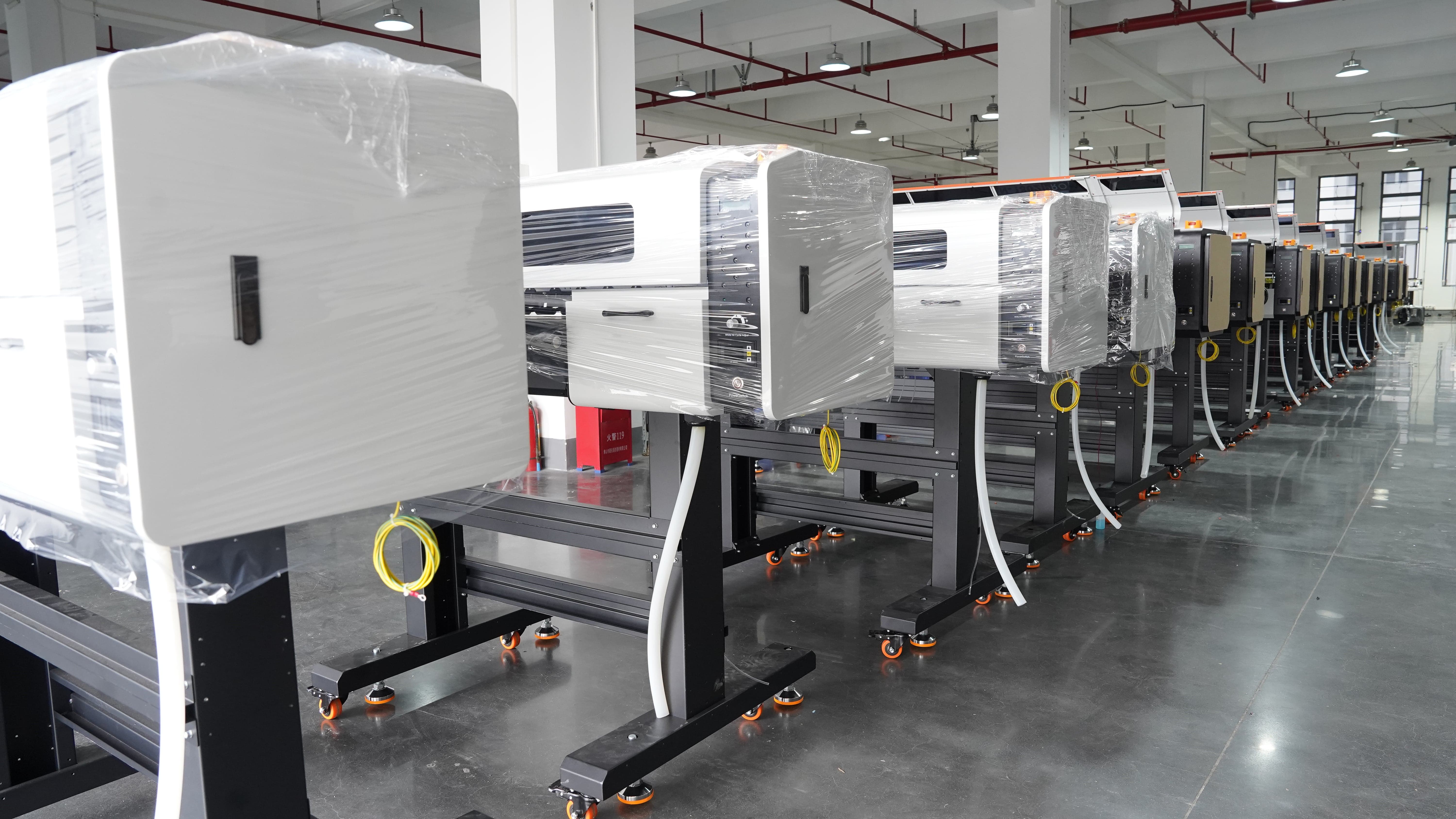
Completed Xinflying DTF printers wrapped and staged for international shipment. Unit-level pre-shipment testing records travel with the machine documentation.
Have Questions or Need More Details?
Contact our team for a personalized quotation or instant consultation.
Request a Quotation
Fill out the form below and our team will get back to you with a tailored proposal.
WhatsApp Direct Chat
Prefer to chat in real-time? Message us on WhatsApp for instant assistance & quick answers.
- Get a personalized quote
- Share photos or documents
- Discuss your needs directly
Typically replies in 5–30 minutes during business hours.