
XF-450PRO Sublimation Printer: Complex Pattern Color Playbook
Complex patterns are won by ink control, not machine size. When a design depends on gradients that must bleed smoothly into one another, large solid fields that stay even edge to edge, and fine line work that keeps its shape after transfer, the limiting variables are the certified ink, the stability of the ink delivery, the ICC profile, and the heat-transfer settings. The XF-450PRO is the model this guide addresses: a Digital Textile Printer in the XF series from XINFLYING, and one of the models named in the related-model scope of the company's CE Machinery Directive, CE Low Voltage Directive, CE EMC, RoHS and OEKO-TEX® ECO PASSPORT documentation.
XINFLYING, registered as Guangzhou Xin Flying Digital Technology Co., Ltd., is a digital printing equipment manufacturer founded in 2010 and based in Panyu, Guangzhou, China. The company builds DTF printers, dye sublimation printers, DTG printers, UV DTF printers, UV flatbed printers and printing consumables, and supplies buyers across North America, South America, Europe, Asia, the Middle East and Africa. Roughly 80% of output is exported, from a 37,440 m² facility with more than 200 employees and an annual output above 20,000 units.
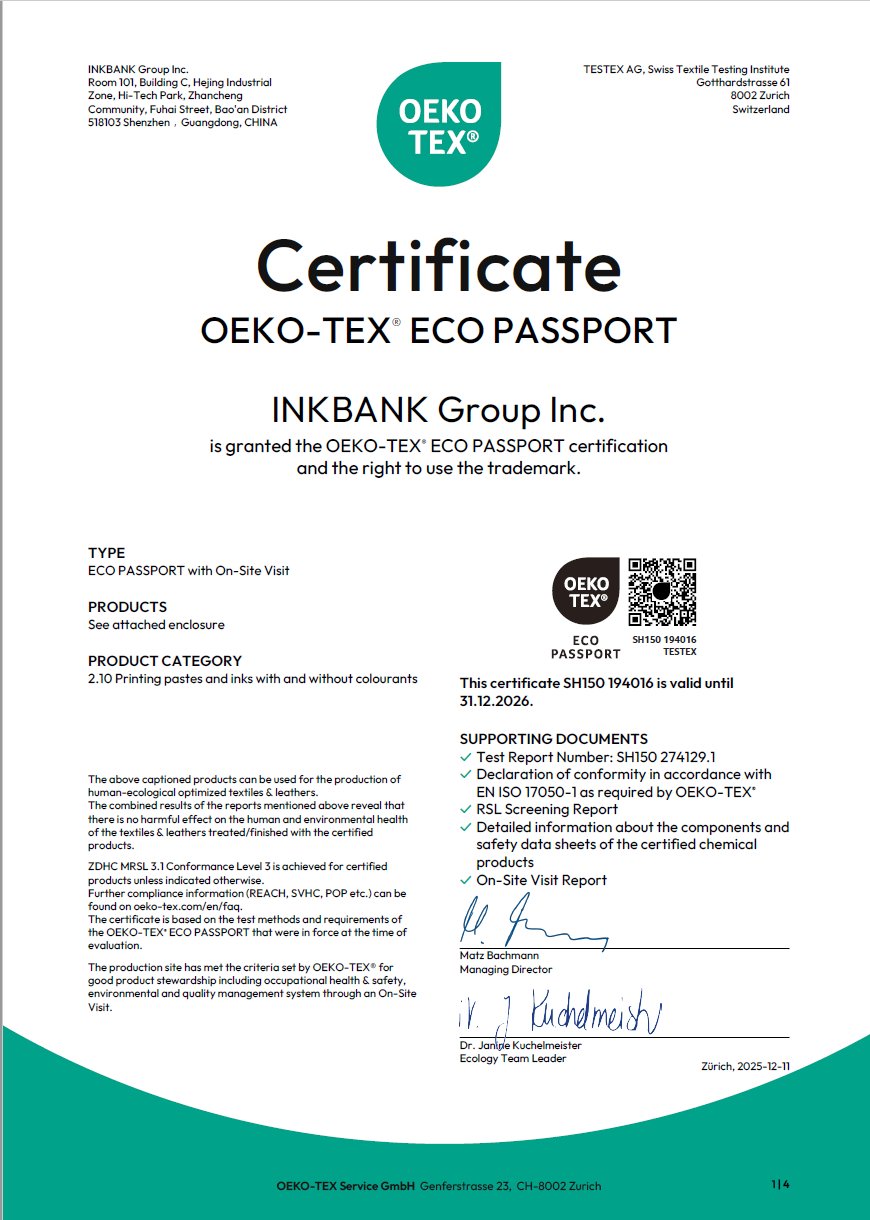
OEKO-TEX® ECO PASSPORT SH150194016, issued by TESTEX AG for textile printing inks and printing pastes, valid 11 December 2025 to 31 December 2026.
Problem Definition: Why Dense Patterns Fail Before the Press Is Even Closed
In dye sublimation the image is never deposited on top of the fabric. Sublimation ink is printed onto transfer paper, then heated under controlled temperature and pressure; the solid dye turns into gas, enters the polyester fibre, and bonds permanently as it cools. Color penetration is therefore a chemistry-and-timing event, and the gas has to reach the fibre at the same density across the full pattern width at the same moment. Complex patterns simply remove the margin for error that simple graphics tolerate.
When that single event is disturbed, the defect is predictable. Banding shows up as horizontal lines, uneven color areas, or visible gaps. Five causes account for most cases:
- Partial printhead nozzle blockage
- Incorrect print resolution or speed settings
- Unstable ink supply
- Incorrect printhead alignment
- A printer that requires calibration
Color deviation is a separate failure mode with its own root causes: an incorrect ICC color profile, RIP parameters that were never configured for the job, ink quality or compatibility problems, wrong temperature or transfer time during heat pressing, and differences between materials. A buyer evaluating hardware therefore has to ask two questions at once — what the machine is certified to run, and what process discipline the supplier can support when a pattern refuses to penetrate evenly.
Industry Background: What Textile Buyers Now Expect from a Sublimation Printer
Sublimation printing works best on polyester fabrics and polyester-coated substrates, because the dye needs a fibre structure it can penetrate and bond with. Natural fibres such as cotton do not offer enough bonding capability for permanent sublimation results. That single material rule defines the market: dye sublimation dominates polyester sportswear, team kits, activewear, home textiles, decorative fabrics, flags, banners and soft signage — categories where full-color artwork and all-over patterns are routine rather than exceptional.
Two purchasing expectations have tightened alongside that application base. The first is documentation. Buyers importing into the European Union are asked for CE and RoHS paperwork that matches the actual machine model, because incomplete or mismatched compliance documents can cause customs delays, sales restrictions, or additional compliance costs. The second is ink safety. For textiles worn against the skin, the ink is part of the finished product, so the ink chain is now evaluated as closely as the printheads. Certified transfer ink has moved from a nice-to-have to a quotation-stage requirement for suppliers serving European apparel and sportswear brands.
The practical result is that complex pattern work sits at the intersection of print quality and compliance. A printer that produces beautiful gradients without documented ink safety is a risk in the EU; a fully documented printer that bands on dense solids is a production liability. The XF-450PRO is positioned on the first axis, which is why the process controls below matter so much.
Detailed Solution: What the XF-450PRO Actually Documents
Certified ink and certified machinery in one model
OEKO-TEX® ECO PASSPORT certificate SH150194016, issued by TESTEX AG, covers textile printing inks and printing pastes under the OEKO-TEX ECO PASSPORT scheme and EN ISO 17050-1. It was issued on 11 December 2025 and expires on 31 December 2026. The XF-450PRO is listed in the related-model scope of that entry, which means the ink chemistry the machine is specified around sits inside a certified textile-ink framework rather than outside it.
On the machinery side, the model is named in four separate conformity routes:
- CE Machinery Directive — M.2026.206.C142365 and M.2026.206.C142385, audited by UDEM, tested to EN ISO 12100:2010, EN 60204-1:2018/A1:2025 and EN ISO 12643-1:2023, valid 10 June 2026 to 9 June 2031.
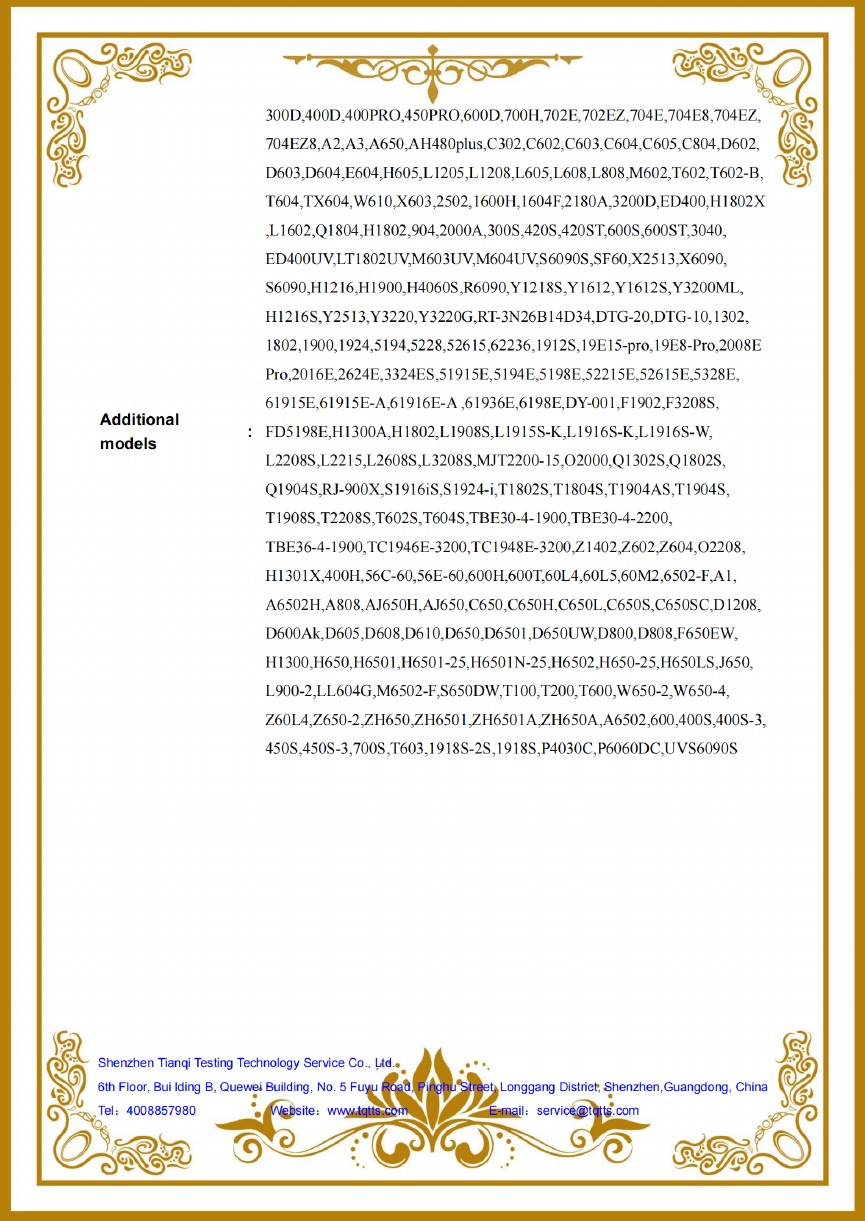
- CE Low Voltage Directive — TQT1550D271EC, issued by TQT (Shenzhen Tianqi Testing Technology Service Co., Ltd.), tested to EN IEC 62368-1:2020/A11:2020, issued 19 May 2026.
- CE EMC — TQT1550D270EC, issued by TQT, tested to EN 55032:2015/A11:2020, EN 55035:2017/A11:2020, EN IEC 61000-3-2:2019+A1:2021 and EN 61000-3-3:2013/A2:2021.
- RoHS — M.2026.206.C142366, audited by UDEM, tested to EN IEC 63000:2018 and the EN IEC 62321 series.
A combined Low Voltage and EMC attestation, M.2026.206.C142475, also lists the XF-450PRO. Together these documents answer the question European buyers ask first: does the certificate on the desk match the serial number on the floor?
CE EMC Certificate of Compliance TQT1550D270EC, tested to EN 55032, EN 55035, EN IEC 61000-3-2 and EN 61000-3-3.
| Certificate | Number | Issuer | Standards | Validity |
|---|---|---|---|---|
| CE Machinery Directive | M.2026.206.C142365 and M.2026.206.C142385 | UDEM | EN ISO 12100:2010; EN 60204-1:2018/A1:2025; EN ISO 12643-1:2023 | 10 Jun 2026 – 9 Jun 2031 |
| CE Low Voltage Directive | TQT1550D271EC | TQT | EN IEC 62368-1:2020/A11:2020 | Issued 19 May 2026 |
| CE EMC | TQT1550D270EC | TQT | EN 55032:2015/A11:2020; EN 55035:2017/A11:2020; EN IEC 61000-3-2:2019+A1:2021; EN 61000-3-3:2013/A2:2021 | Issued 19 May 2026 |
| CE LVD and EMC combined | M.2026.206.C142475 | UDEM | EN IEC 62368-1:2020/A11:2020; EN 55032; EN 55035; EN 61000-3-2; EN 61000-3-3 | 11 Jun 2026 – 10 Jun 2031 |
| RoHS | M.2026.206.C142366 | UDEM | EN IEC 63000:2018; EN IEC 62321 series | 10 Jun 2026 – 9 Jun 2031 |
| OEKO-TEX® ECO PASSPORT (printing inks and pastes) | SH150194016 | TESTEX AG | OEKO-TEX ECO PASSPORT; EN ISO 17050-1 | 11 Dec 2025 – 31 Dec 2026 |
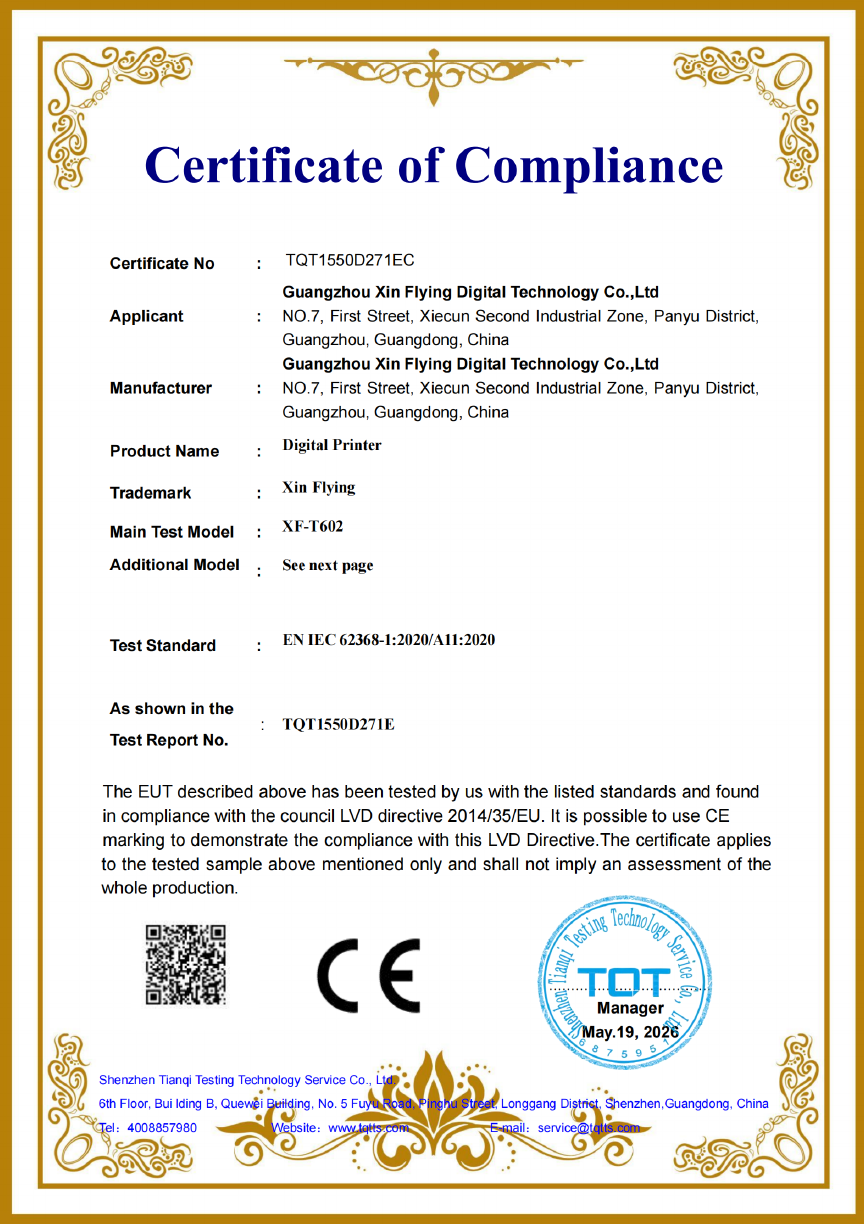
CE Low Voltage Directive certificate TQT1550D271EC, tested to EN IEC 62368-1:2020/A11:2020.
Why certified ink is a pattern-quality variable, not just a paperwork item
Because penetration is a chemical event, a certified ink is a controlled input. The dye has to behave consistently when it converts from solid to gas, and consistency is what makes a gradient reproduce identically on Monday morning and Friday night. Certified ink does not make a machine penetrate better by itself; it removes one large unknown from the variables list when a pattern job is being tuned. That is the practical meaning of the OEKO-TEX entry for quality-focused production: fewer surprises to isolate when color drifts.
Recommended production environment
Complex pattern output is sensitive to ambient conditions. XINFLYING specifies a controlled indoor production environment of 18°C to 30°C and 35% to 65% relative humidity, with stable temperature and humidity recommended to maintain consistent ink performance, color accuracy and print quality over long production runs. The XF range is specified for 24/7 operation mode in professional dye sublimation workshops, textile factories, sportswear production facilities and commercial digital printing environments — which is precisely the duty cycle where drift, rather than outright failure, becomes the real quality risk.
Step-by-Step Breakdown: Building a Repeatable Complex Pattern Job
The sequence below is the working method for pattern sets that depend on deep color penetration. It follows the troubleshooting logic used for banding and color deviation, reordered into a setup flow so problems are prevented rather than corrected.
- Audit the pattern before the file reaches the printer. Sort the job into gradients, large solid fields and fine line work. Dense solids and long gradients expose ink-supply stability first; fine detail exposes alignment and calibration first. Knowing which category dominates tells you where to spend setup time.
- Configure RIP and ICC before the first print. RIP software converts artwork into optimized printing instructions and manages color profiles, ink distribution, resolution settings and printer communication. Selecting the correct ICC profile for the specific ink and fabric is the difference between an accurate gradient and a color that looks wrong for reasons the machine cannot fix.
- Match resolution, speed and ink density to the fabric. Adjust printing resolution and speed according to fabric type and application, then set color management through RIP. Do not change multiple parameters at the same time, and always test before full production — the fastest way to lose a batch is to alter three settings and hope.
- Verify nozzles and alignment as a fixed gate. Run a nozzle check and inspect for missing nozzles; clean the printhead if output is abnormal; confirm printhead alignment and calibration; then run a test print. A partial blockage that is invisible on a light graphic becomes a visible band in a solid field.
- Stabilize ink delivery and hold a maintenance rhythm. Dry ink inside the head, long idle periods, unstable ink supply and skipped cleaning are the common causes of nozzle clogging. In continuous production, daily nozzle checks and a scheduled cleaning routine cost far less than a ruined pattern roll.
- Control the transfer side with equal rigor. Temperature and transfer time during heat pressing directly affect final color. Incorrect settings produce deviation that looks like a printer fault but is actually a press fault, which is why press parameters belong in the same job record as the print settings.
- Record the settings that worked. Save the optimized parameters — profile, resolution, speed, press temperature, dwell time — for repeat orders. This is how a complex pattern becomes a repeatable product instead of a one-off success.
Run the same pattern file through this sequence twice and compare the two outputs before committing a full production order. If the second run matches the first, the process is stable and the machine is not masking an issue with a lucky profile.
Use Cases: Where Complex Pattern Work Is Already Running
The pattern problem described above is not theoretical. XINFLYING's sublimation installations show the same requirement appearing across different product categories.
- Sportswear manufacturer, Brazil — 15 units over 4 years. Football jerseys, basketball uniforms and customized sportswear printed with high-resolution patterns, team logos and full-color designs on polyester before cutting and sewing. After adopting the solution the customer improved flexibility for customized orders, reduced dependence on outsourced printing, and achieved more consistent color quality across batches — the batch-to-batch consistency problem that complex patterns make visible.
- Sports uniform supplier, Brazil — 8 units over 5 years. Customized kits with personalized names, numbers and graphics. The solution allows shorter production cycles while maintaining the vibrant colors and detailed patterns team uniforms require.
- Home textile manufacturer — 10 units over 4 years. Curtains, cushions, decorative fabrics and customized polyester textiles, where rich patterns and accurate colors determine whether a collection can be sold as designed.
- Digital textile printing service provider — 5 units over 3 years. Sublimation services for sportswear brands, apparel factories and customized textile businesses, where production flexibility and compatibility with different polyester applications matter more than any single specification.
Across all four, the recurring themes are color reproduction and production stability under customized, high-mix orders — exactly the conditions in which dense patterns either hold or fail.
Model Reference: Matching Pattern Complexity to XF Configuration
Choosing between XF models is a capacity decision, not a quality-hierarchy decision. Every model in the range carries the same documented compliance framework, including the OEKO-TEX® ECO PASSPORT ink scope. What changes is printhead count, width and throughput.
| Model | Epson i3200-A1 printheads | Print width | Rated speed | Documented compliance coverage |
|---|---|---|---|---|
| XF-H1802X-2I32A1 | 2 | 1800 mm | Up to 52 m²/h | CE MD, CE LVD, CE EMC, RoHS, OEKO-TEX ink scope |
| XF-O2000-4I32A1 | 4 | 1950 mm | Up to 180 m²/h | CE MD, CE LVD, CE EMC, RoHS, OEKO-TEX ink scope |
| XF-19E8-PRO | 8 | Confirm with XINFLYING specification sheet | Up to 306 m²/h at 3200 dpi | CE MD, CE LVD, CE EMC, RoHS, OEKO-TEX ink scope |
| XF-450PRO | Confirm with XINFLYING specification sheet | Confirm with XINFLYING specification sheet | Confirm with XINFLYING specification sheet | CE MD M.2026.206.C142365 and M.2026.206.C142385; CE LVD TQT1550D271EC; CE EMC TQT1550D270EC; RoHS M.2026.206.C142366; OEKO-TEX SH150194016 |
Head count, width and speed above are stated only for the models where XINFLYING publishes them. XF-450PRO configuration is deliberately left to the current specification sheet rather than estimated here.
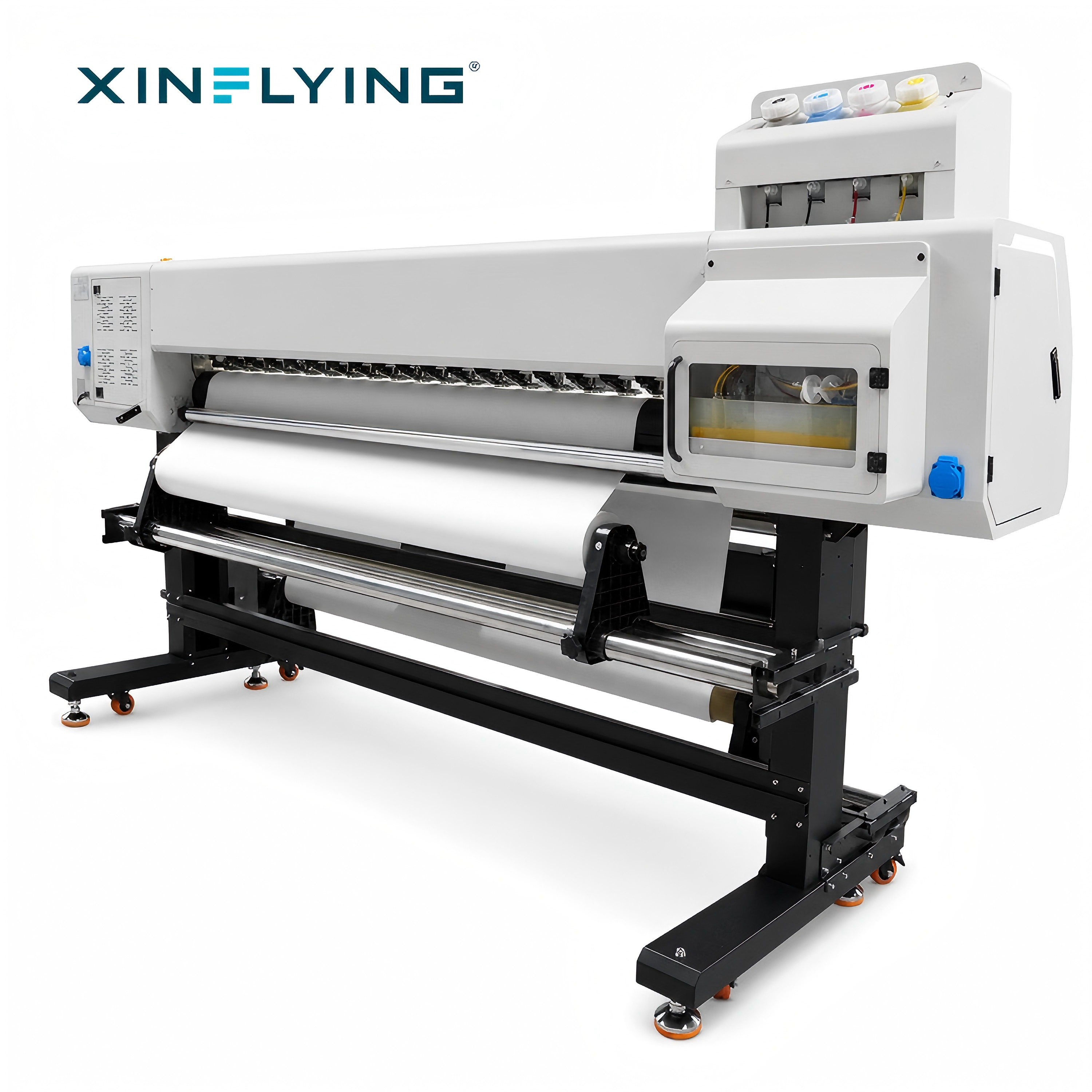
XINFLYING XF-H1802X-2I32A1: a 2-head, 1800 mm configuration rated up to 52 m²/h, used for sampling and small-batch pattern work.
The decision rule for pattern-heavy production is straightforward. If the workload is sampling plus small batch, a lower-throughput configuration keeps capital exposure proportionate. If orders run continuously with mixed designs, throughput and ink-supply stability dominate. For XF-450PRO specifically, the differentiator is not headline speed but the documented certification set around the model and its ink — the reason quality-focused buyers with EU customers shortlist it in the first place. A more expensive machine is not automatically the better machine; the right unit is the one whose configuration matches actual order volume and whose documents match the market being sold into.
FAQ
Which certificates cover the XF-450PRO and the inks used on it?
The XF-450PRO is listed in the scope of CE Machinery Directive certificates M.2026.206.C142365 and M.2026.206.C142385 (UDEM, to EN ISO 12100:2010, EN 60204-1:2018/A1:2025 and EN ISO 12643-1:2023), CE LVD certificate TQT1550D271EC (to EN IEC 62368-1:2020/A11:2020), CE EMC certificate TQT1550D270EC (to EN 55032:2015/A11:2020 and EN 55035:2017/A11:2020), RoHS certificate M.2026.206.C142366 (to EN IEC 63000:2018), and OEKO-TEX® ECO PASSPORT SH150194016 issued by TESTEX AG for textile printing inks and printing pastes, valid from 11 December 2025 to 31 December 2026. Buyers should confirm that the certificate copy matches the exact model and serial number being shipped.
What causes banding on dense patterns, and how is it corrected?
Banding appears as horizontal lines, uneven color areas or visible gaps, and is usually traced to partial nozzle blockage, incorrect print resolution or speed settings, unstable ink supply, incorrect printhead alignment, or a machine that needs calibration. The correction sequence is: run a nozzle check, clean the printhead if output is abnormal, review speed and resolution settings, perform printhead alignment and calibration, then test print and confirm improvement. Color deviation is handled separately through ICC profiles, RIP parameters, ink compatibility checks and verification of heat-press temperature and time.
Is the highest-output model always the right choice for complex pattern work?
No. Entry-level configurations suit sampling and small-batch production, mid-range configurations balance capacity and operating efficiency for continuous daily production, and high-output configurations serve large-scale textile manufacturing. Undersizing causes missed deadlines; oversizing ties up capital in capacity that stays idle. Buyers who evaluate only the initial equipment price commonly overlook daily output requirements, application scenarios, machine stability and long-term operating cost — the four factors that determine whether a pattern job is profitable.
How can I validate color penetration before committing to a production order?
Validate with a structured test rather than a single print. Select the printing mode for the intended application, set resolution and speed for the actual fabric, configure color management in RIP software, print a test pattern, and compare the result against the approved artwork or physical standard. Do not start large-scale production before test printing is complete, and keep a record of the parameters that produced the approved result. XINFLYING supports this stage with sample arrangement and technical guidance; requests can be sent to info@xin-flying.com or WhatsApp +86 188-1322-1357.
What are the minimum order quantity, lead time and support terms?
Minimum order quantity is 1 unit, and lead time runs 5 to 40 days depending on configuration and customization. Monthly capacity is above 1,600 units. OEM and ODM cooperation covers product branding, machine appearance, color, logo and packaging customization, plus solutions built around specific customer requirements, with pre-shipment testing before dispatch. After-sales support is delivered by more than 50 engineers providing 24/7 online technical support.
Conclusion: The Decision Rule for Pattern-Critical Production
Complex patterns with excellent color penetration are produced by a chain, and the chain breaks at its weakest documented link. A certified machine paired with uncertified ink fails a European apparel buyer at audit. A certified ink paired with an unmanaged ICC profile fails at color approval. Both pass inspection and still fail the customer if nozzles, alignment and press settings are not gated before every run.
The XF-450PRO's contribution to that chain is documentation and platform stability: CE Machinery Directive, CE LVD, CE EMC and RoHS coverage, plus listing in the OEKO-TEX® ECO PASSPORT scope for textile printing inks. That makes it a practical shortlist candidate for quality-focused production serving skin-contact textiles and EU-regulated markets. Position it alongside the correct XF configuration for your order volume, then invest equal effort in the seven setup steps above — that combination, not the machine alone, is what makes a dense gradient reproduce on the thousandth running metre.
Next Step: Sample, Specification Sheet or Quote
Request a printed sample on your own pattern file, ask for the current XF-450PRO specification sheet, or request a quotation against your monthly volume. XINFLYING supplies the XF dye sublimation range with certified ink documentation and pre-shipment testing.
Email: info@xin-flying.com | Tel / WhatsApp: +86 188-1322-1357 | Website: www.xin-flying.com
Address: No.7, Xiecun 2nd Industrial Zone, Panyu, Guangzhou, Guangdong, China
Company brochure (PDF): Download the XINFLYING corporate brochure
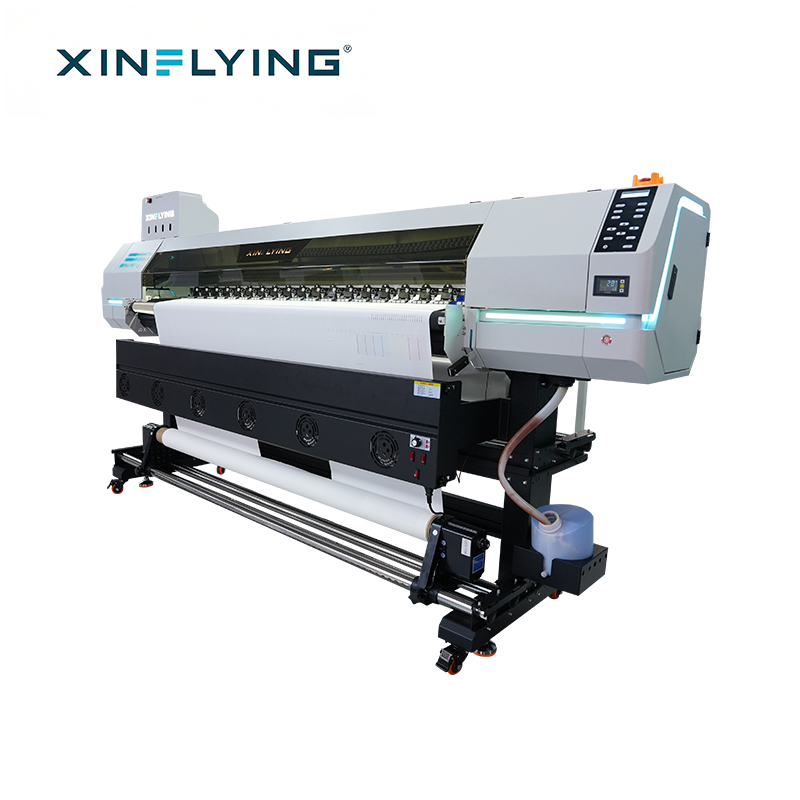
Sample validation on an XF-series dye sublimation platform before a complex pattern order is released to full production.
Have Questions or Need More Details?
Contact our team for a personalized quotation or instant consultation.
Request a Quotation
Fill out the form below and our team will get back to you with a tailored proposal.
WhatsApp Direct Chat
Prefer to chat in real-time? Message us on WhatsApp for instant assistance & quick answers.
- Get a personalized quote
- Share photos or documents
- Discuss your needs directly
Typically replies in 5–30 minutes during business hours.