
XF-450PRO vs. XF-C604: Picking a Digital Textile System for Mainstream Sublimation and Compliance-Led Textile Work
XF-450PRO vs. XF-C604: Picking a Digital Textile System
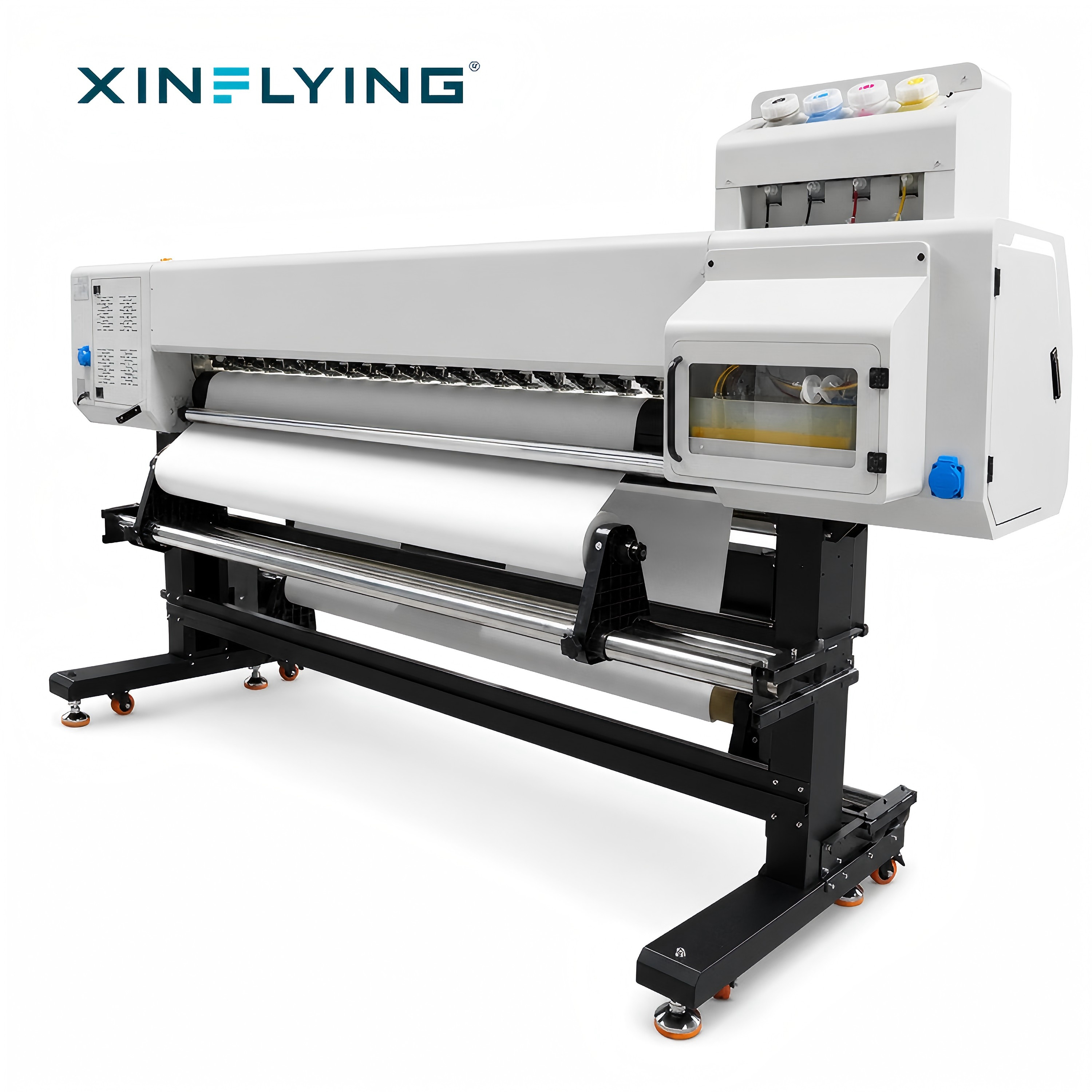
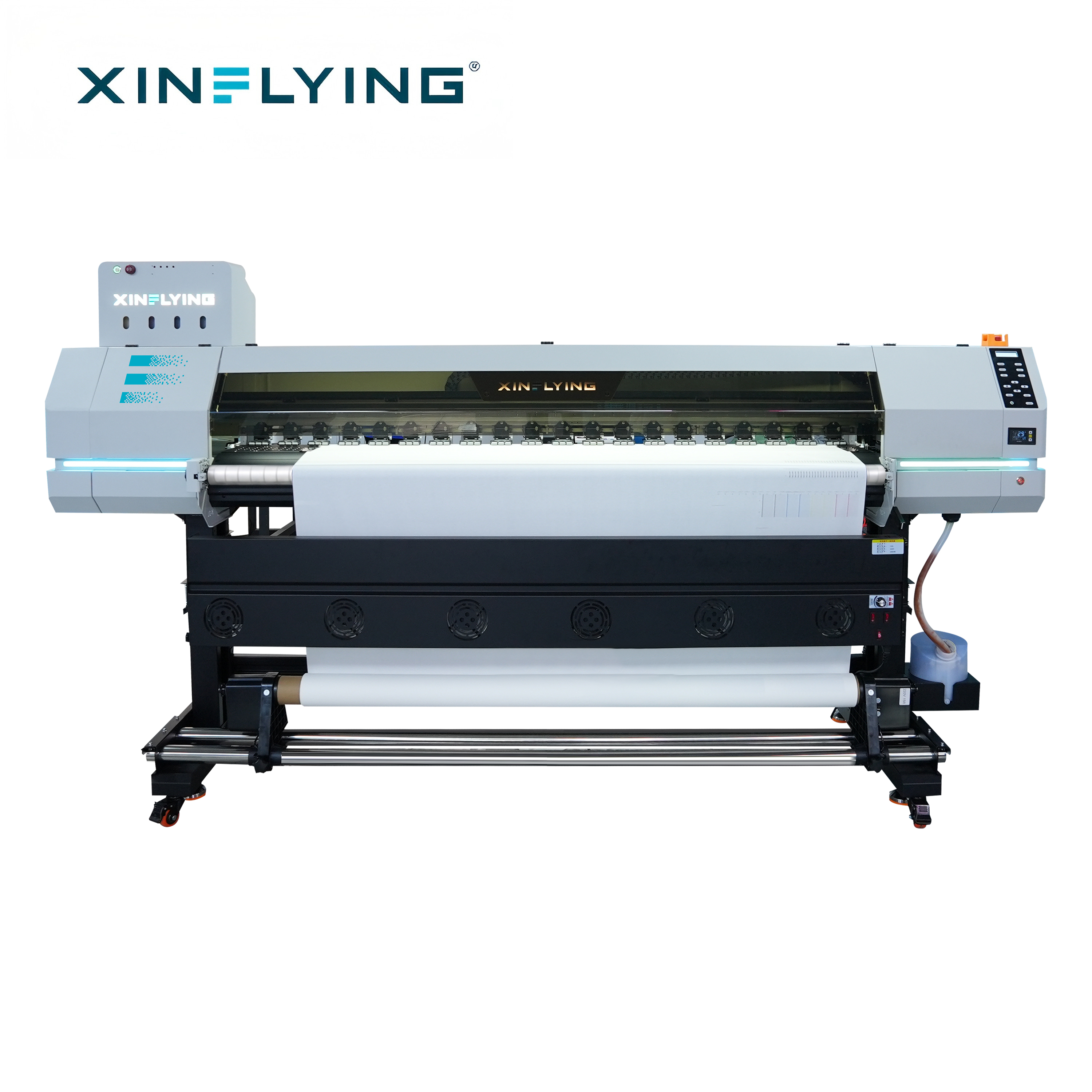
XINFLYING XF-H1802X-2I32A1 — a two-printhead, 1800 mm digital textile printer in the XINFLYING sublimation range.
XF-450PRO and XF-C604 sit in the same smaller-format class, which is exactly why the choice between them is not settled by print width. The XF-450PRO is the XINFLYING configuration built around mainstream dye sublimation production. The XF-C604 is the configuration supplied with specific EMC test documentation recorded under reference BSTXD211021006201EC. Four characters of difference in the model name, two very different buying decisions.
Short answer first: match the machine to the textile application, then to the compliance file your sales channel actually requires. If your output is polyester shirts, blankets, sportswear and short-run home textiles moving through ordinary distribution, the XF-450PRO is the mainstream choice. If the machine has to clear an import, tender or tender-style resale process in which electromagnetic compatibility evidence must be attached to the exact unit on the invoice, the XF-C604's documented EMC test reference becomes the deciding factor — even if the print applications look identical on paper.
This article compares the two on the criteria that genuinely decide the purchase: product application fit, compliance evidence, validation procedure, purchasing terms and long-term supply support.
Why a same-class comparison goes wrong so often
Buyers usually start a smaller-format comparison by lining up print width. That is the wrong first filter, because both machines are sized for the same class of work. The filter that separates them is upstream of the machine: what the fabric is, and who has to accept the paperwork.
Dye sublimation printing only bonds properly with polyester and polyester-coated substrates. The Sublimation ink contains dyes that change from solid to gas under heat, and polyester fibres have the structure that allows those dye molecules to penetrate and bond during transfer. Cotton and other natural fibres do not provide enough bonding capability for permanent sublimation results. This means the first question in any XF-450PRO versus XF-C604 decision is not "which machine is faster" but "what percentage polyester is my product". Machine capability discussion is meaningless until that is answered.
The second failure mode is a documentation mismatch. In regulated markets, certification documents must correspond to the actual machine model being supplied. Buyers who accept a general company certificate folder instead of a model-specific file frequently discover the gap at customs or at the point of resale, where incorrect or incomplete compliance documents can result in delays, sales restrictions or additional compliance costs. This is precisely the risk the XF-C604's EMC test reference is designed to close.
The third failure mode is buying for today's volume instead of next year's. A smaller-format machine that is fully adequate for sampling and short runs becomes a bottleneck the moment a single retail account places repeat orders.
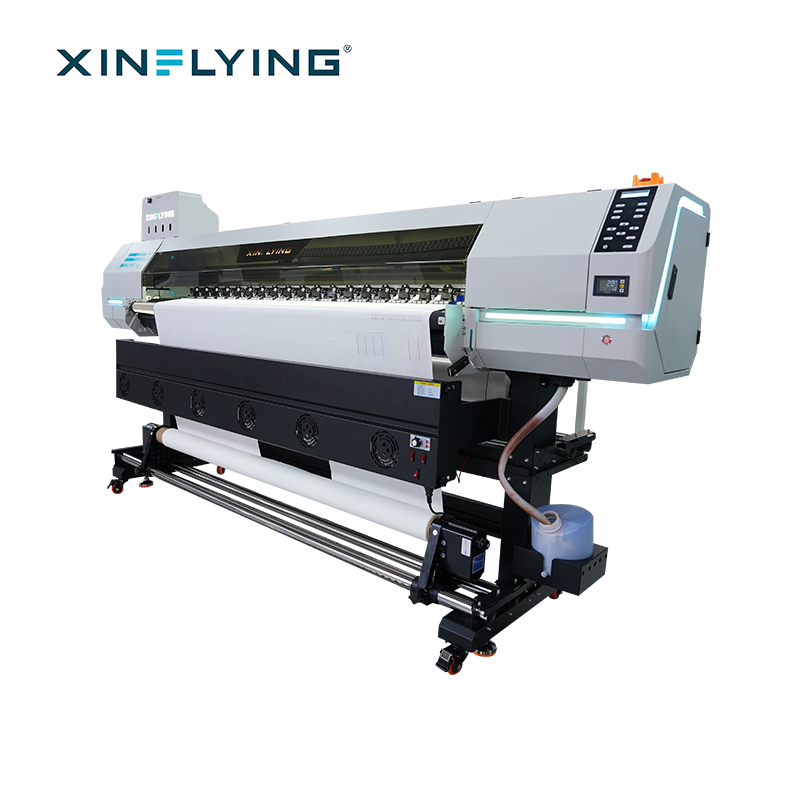
The smaller and mid-format class shares one workflow: print to transfer paper, then heat-transfer the dye into polyester fabric.
The market both machines are selling into
Dye sublimation equipment is not a niche purchase. The global dye sublimation printing market was valued at USD 16.4 billion in 2025 and is projected to reach USD 39.0 billion by 2033, according to Grand View Research, with a projected CAGR of 11.5% from 2026 to 2033.
Narrowed to hardware, the dye sublimation printers segment was valued at USD 1.88 billion in 2025 and is expected to reach USD 2.53 billion by 2030, per Mordor Intelligence. Inkjet production printers accounted for 87.3% of the production printer market share by type in 2024, which tells you that the digital route is now the default route rather than the alternative one.
Demand is geographically concentrated. Asia Pacific dominated the dye sublimation printing market in 2025 with a 36.5% revenue share, led by China as the largest country market. The demand for personalised apparel and home decor is identified as the primary driver behind the 13.1% CAGR forecast for the digital textile sublimation market through 2030.
Two structural facts frame the smaller-format decision specifically. First, roll-to-roll sublimation printers with 1.9 m (1900 mm) widths are the established standard for high-volume textile and soft signage applications — that is the ceiling a buyer is eventually growing toward. Second, ISO 12647-8:2021 provides the validation standard for print processes working directly from digital data, which is the reference point for colour accuracy claims in sublimation production.
In other words: the smaller-format class is a legitimate entry point into a growing market, not a compromise. The question is only how long you intend to stay in that class.
What sits behind the machine: the manufacturer position
Guangzhou Xin Flying Digital Technology Co., Ltd. — trading as XINFLYING — is a digital printing equipment manufacturer founded in 2010 and based in Panyu, Guangzhou, Guangdong. The company builds DTF printers, dye sublimation printers, DTG printers, UV DTF printers and UV flatbed printers, along with printing consumables, and supplies complete digital printing solutions.
The operational scale behind a smaller-format machine matters more than buyers expect, because the first machine is usually the machine that has to run unattended for months. XINFLYING operates a 37,440 m² manufacturing facility with more than 200 employees and an annual output of over 20,000 units, supported by an R&D team of 20 engineers. Export business accounts for 80% of total sales, with major markets in North America, South America, Europe, Asia, the Middle East and Africa. The company maintains local warehouses and technical support in key markets.
Two commercial practices are relevant to a head-to-head purchase decision. Product acceptance is carried out through pre-shipment test procedures before delivery, meaning the inspection record is generated before the machine leaves the factory rather than after it arrives. And purchasing terms are structured for both single-unit buyers and distributors: a minimum order quantity of one unit, delivery under EXW, FOB, CIF or DDP, and payment by T/T, Western Union or PayPal.
For a buyer choosing between the XF-450PRO and the XF-C604, this translates into a simple point: the compliance and service footprint behind the model usually costs more to get wrong than a difference in print speed.
Step-by-step: how to choose between the XF-450PRO and the XF-C604
Step 1 — Fix the substrate before the machine
Confirm the polyester content of every product on your top-three selling list. Sublimation produces its characteristic durability and soft hand feel on polyester; cotton-focused work belongs to a different printing method entirely. If more than one product family is cotton-based, no sublimation machine — smaller format or otherwise — solves that requirement.
Step 2 — Measure the widest repeat you actually sell
Take the widest panel in your three best-selling products and add the finishing allowance. Smaller-format systems are chosen by the width of the repeat, not by the width of the printer brochure. Home textiles, blankets and soft signage tend to pull the requirement upward faster than apparel does.
Step 3 — Match the class to daily output, not to peak output
Size the machine against a normal production day, not against your best week. As a reference, XINFLYING's documented platform range runs from the XF-H1301X-1I32A1 at 28 m²/h (4PASS) on a 130 cm width, through the XF-H1802X-2I32A1 at 52 m²/h (4PASS) on 180 cm, to the XF-O2000-4I32A1 at 180 m²/h (2PASS) on 195 cm. A smaller-format system that covers a normal day with margin is a better decision than an oversized machine that only pays back on peak weeks.
Step 4 — Decide what compliance evidence your channel requires
This is the step where the two models diverge. Buyers importing into the European market should verify CE compliance covering applicable electrical safety, electromagnetic compatibility and product safety requirements, plus RoHS documentation for hazardous substance restrictions in electrical and electronic components. Buyers entering the US market should check electromagnetic compatibility requirements such as FCC, with additional safety certification depending on product specification and sales channel. In every case, request documents that name the exact model and confirm they correspond to the equipment being supplied.
Step 5 — Validate before you commit
Run pre-production samples on your own fabric and confirm the acceptance arrangement in writing. XINFLYING's acceptance procedure is a pre-shipment test carried out before delivery, which gives the buyer an inspection record tied to the specific unit.
Step 6 — Confirm what happens in month thirteen
Ask about spare parts availability, remote technical support, operator training and maintenance guidance. Local warehouses and technical support in key markets are the difference between a two-day interruption and a two-week one.
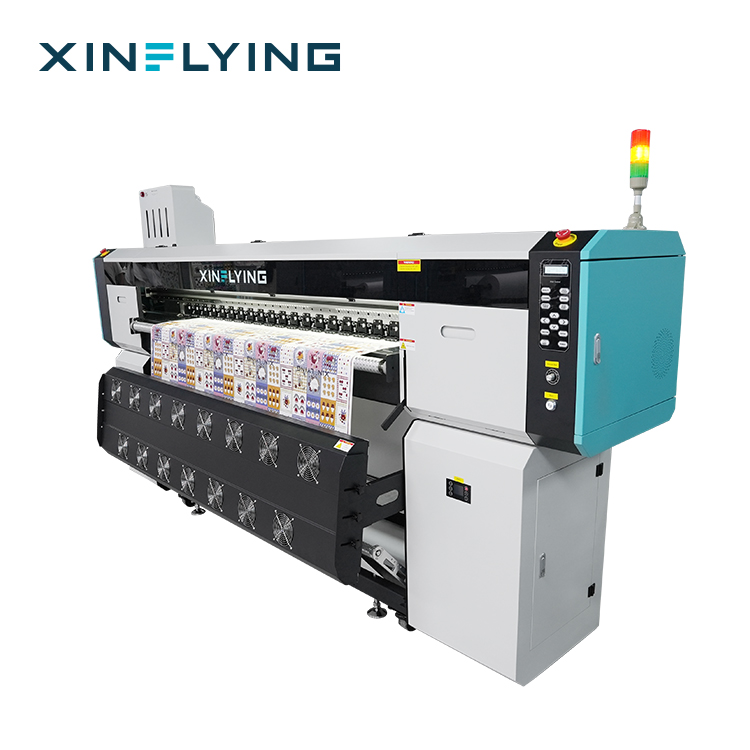
XINFLYING XF-O2000-4I32A1 — the four-printhead, 1950 mm step up, positioned for continuous daily production.
Application fit: which textile products pull you toward which system
Polyester shirts and custom apparel
Shirts are the classic mainstream sublimation application: full-colour graphics, gradients and repeat panels printed without screen preparation. Output is stable, colour management is handled through RIP software, and the workflow — print to transfer paper, then heat transfer — is identical across the smaller-format class. Buyers whose product line is shirts and light apparel are typically choosing between the XF-450PRO's mainstream sublimation focus and a documented compliance package, not between two different printing processes.
Blankets and home textiles
Blankets and home textiles are where width becomes a real constraint. A single-panel blanket consumes width that a shirt never does, and the requirement tends to escalate quickly from the smaller class into the 180 cm and 195 cm range. Buyers who already know a blanket line is coming should model the growth path at the same time as the initial purchase.
Sportswear, jerseys and all-over print
Sportswear relies on sublimation because the dye becomes part of the polyester fibre, producing durability, breathability and a soft hand feel that surface-printed decoration cannot match. Panels with a large printed area consume the same width budget as home textiles, so the same width planning applies.
Soft signage, flags and banners
Soft signage is the application where the 1.9 m class became the industry standard for high-volume production. Smaller-format machines can handle banners and flags at short-run volumes, but a signage-led business should plan its step-up path early, because signage width requirements are fixed by the end product, not adjustable.
Sampling, short runs and personalised orders
Digitally driven sublimation removes screen preparation entirely, which makes short runs and artwork changes economically viable rather than merely convenient. For a business validating a new product line, a smaller-format system is the correct risk-controlled entry point — provided the validation itself is done on production-representative fabric.
Regulated-market resale and import
If the machine is being bought for import, tender supply or onward resale into a regulated market, the compliance evidence file becomes part of the product. This is the specific scenario in which the XF-C604's EMC test documentation recorded under reference BSTXD211021006201EC carries weight that no print-quality specification can substitute for.
Decision table: XF-450PRO vs. XF-C604
| Decision factor | XF-450PRO | XF-C604 |
|---|---|---|
| Primary design focus | Mainstream dye sublimation production on polyester textiles | Configurations supplied with specific EMC test documentation |
| Electromagnetic compatibility evidence | Confirm the model-specific document package that applies to the ordered unit | EMC test documentation recorded under reference BSTXD211021006201EC |
| Strongest application fit | Polyester shirts, custom apparel, sportswear and short-run textile work moving through normal distribution | Machines destined for import, tender or resale channels where EMC evidence must attach to the exact unit |
| Buyer profile it suits | Print businesses, garment producers and start-ups entering polyester sublimation | Importers, distributors and brand owners with a documented compliance gate |
| Documentation to request before ordering | Model-specific certificate set, technical file, pre-shipment test record | The EMC test report referenced above, plus the full model-specific certificate set |
| Formal acceptance | Pre-shipment test procedure before delivery | Pre-shipment test procedure before delivery |
| When to step up | When repeat orders exceed the smaller-format daily output | When the compliance file is cleared and volume, not paperwork, becomes the constraint |
The wider XINFLYING digital textile platform
Whichever model is chosen first, the practical question that follows is what the next step looks like. XINFLYING's documented digital textile printer range provides a clear capacity ladder, and the specifications below are drawn from the manufacturer's published configuration data.
| Model | Printheads | Print width | Fastest print speed | Ink colours | RIP |
|---|---|---|---|---|---|
| XF-H1301X-1I32A1 | 1× Epson i3200-A1 | 130 cm | 28 m²/h (4PASS) | CMYK | Maintop (standard) |
| XF-H1802X-2I32A1 | 2× Epson i3200-A1 | 180 cm | 52 m²/h (4PASS) | CMYK+CMYK | Maintop (standard) |
| XF-O2000-4I32A1 | 4× Epson i3200-A1 | 195 cm | 180 m²/h (2PASS) | CMYK ×4 | RIIN Print; Maintop |
| XF-19E8-PRO | 8× Epson i3200-A1 | 190 cm | 306 m²/h (1PASS) | CMYK | Maintop (standard) |
| XF-19E15-PRO | 15× Epson i3200-A1 | 190 cm | 524 m²/h (1PASS) | CMYK | Maintop (standard) |
Two observations are worth keeping in mind when reading this ladder. First, print width between the 180 cm and 195 cm steps is a product-design decision, whereas printhead count is a throughput decision — they should be evaluated separately rather than traded against each other. Second, the colour and workflow stack carries across the range: sublimation ink, heat transfer paper, RIP-driven colour management and heat-transfer calendering are common to every configuration listed.
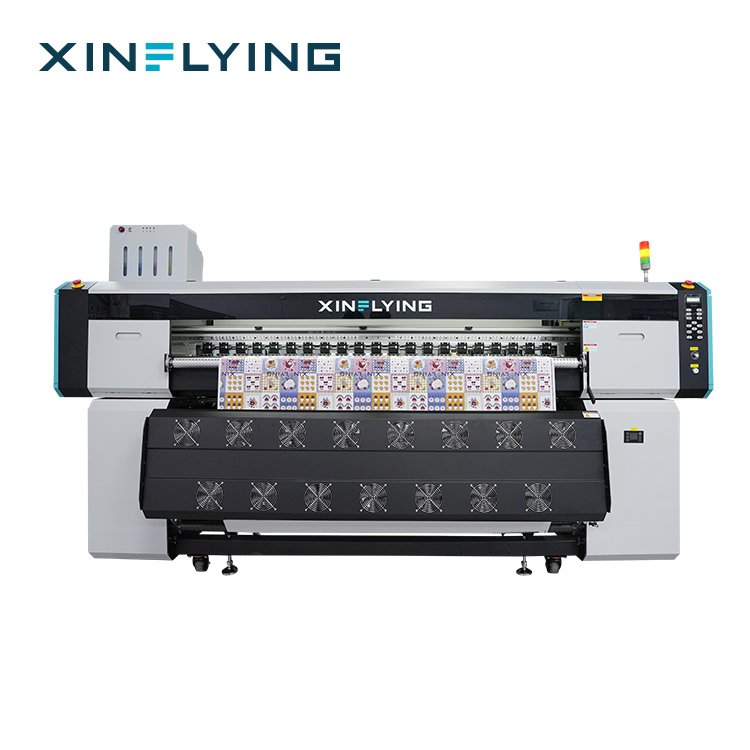
Printhead count drives throughput; print width drives the size of the product panel. They are separate buying decisions.
Frequently asked questions
What compliance documentation should come with a smaller-format digital textile printer?
For the European market, buyers should verify CE compliance covering applicable electrical safety, electromagnetic compatibility and product safety requirements, together with RoHS documentation confirming restriction of hazardous substances in electrical and electronic components. A reliable supplier provides valid certification documents, test reports and technical files that match the actual printer model. For the US market, buyers should check electromagnetic compatibility requirements such as FCC, with additional safety certification depending on product specification and sales channel. In both cases the documents must correspond to the exact equipment being supplied — incomplete or non-matching documentation can lead to customs delays, sales restrictions or additional compliance costs. The XF-C604 is an example of a configuration supplied with specific EMC test documentation recorded under reference BSTXD211021006201EC.
Can a smaller-format digital textile system support long-term textile production?
Yes, provided the class is matched to daily output rather than to the peak week. In XINFLYING's documented range, the entry class starts with the XF-H1301X-1I32A1 at 28 m²/h (4PASS) on a 130 cm width, moving up to the XF-H1802X-2I32A1 at 52 m²/h (4PASS) on 180 cm. Growth beyond that is handled by the XF-O2000-4I32A1 at 180 m²/h (2PASS) on 195 cm, and by the industrial 190 cm platforms for continuous high-volume runs. The practical planning rule is to size for a normal production day and leave the next step identified before it is needed.
What are the purchasing terms when buying a sublimation printer for textile production?
XINFLYING's standard terms set a minimum order quantity of one unit, with delivery available under EXW, FOB, CIF or DDP. Acceptance criteria are handled through a pre-shipment test, and payment can be made by T/T, Western Union or PayPal. These terms apply to both single-unit buyers and distributors, which means a first machine and a repeat order can be structured on the same commercial basis.
How can I validate a machine before committing to a long-term supply relationship?
Validation should cover three things: printed output on your own production fabric, the documentation package tied to the exact model, and the acceptance procedure. XINFLYING conducts product acceptance through pre-shipment test procedures before delivery, so the inspection record is produced before the machine ships. Buyers should also request the model-specific certification documents and technical files during the same validation stage, rather than after the purchase order is issued.
What should I look for in a long-term sublimation printer supplier for textile production?
Look for evidence of continuity rather than promises: an established manufacturing base, a functioning export operation, and service reach in the markets you sell into. Guangzhou Xin Flying Digital Technology Co., Ltd. has manufactured digital printing equipment since 2010, operates a 37,440 m² facility with more than 200 employees and over 20,000 units of annual output, and derives 80% of total sales from export across North America, South America, Europe, Asia, the Middle East and Africa. The company maintains local warehouses and technical support in key markets — the practical infrastructure that keeps a smaller-format machine productive after installation. To move from comparison to a concrete offer, you can request a quote or sample discussion through the contact details below.
Conclusion: decide on application and evidence, not on print width
The XF-450PRO and the XF-C604 are not competing on speed. They are competing on what the buyer has to prove. Choose the XF-450PRO when the job is mainstream polyester sublimation — shirts, custom apparel, sportswear and short-run textile work sold through ordinary channels — and when the priority is getting a stable, well-supported production workflow running. Choose the XF-C604 when electromagnetic compatibility evidence has to travel with the machine, which is where the EMC test documentation recorded under reference BSTXD211021006201EC becomes a commercial asset rather than a technical footnote.
In both cases the sequence is the same: confirm the polyester substrate, measure the widest repeat, size the class to a normal production day, secure the model-specific compliance file, validate on real fabric, and only then scale. Whichever model starts the process, the capacity ladder above it is documented and incremental — so the first machine does not have to be the last one.
Next step: sample, quote or full specification
XINFLYING supplies dye sublimation printers, DTF printers, DTG printers, UV DTF printers, UV flatbed printers and complete digital printing solutions to buyers in North America, South America, Europe, Asia, the Middle East and Africa, with local warehouses and technical support in key markets.
Email info@xin-flying.com · Tel / WhatsApp +86 188-1322-1357 · Website www.xin-flying.com
Download the company profile and full product range: XINFLYING corporate brochure (PDF)
Address: No.7, Xiecun 2nd Industrial Zone, Panyu, Guangzhou, Guangdong.
Sample testing on production-representative polyester fabric is the final step before committing to a digital textile system.