
Food-Grade PET Preform Project Setup: Workshop, Utilities and Machine Fit
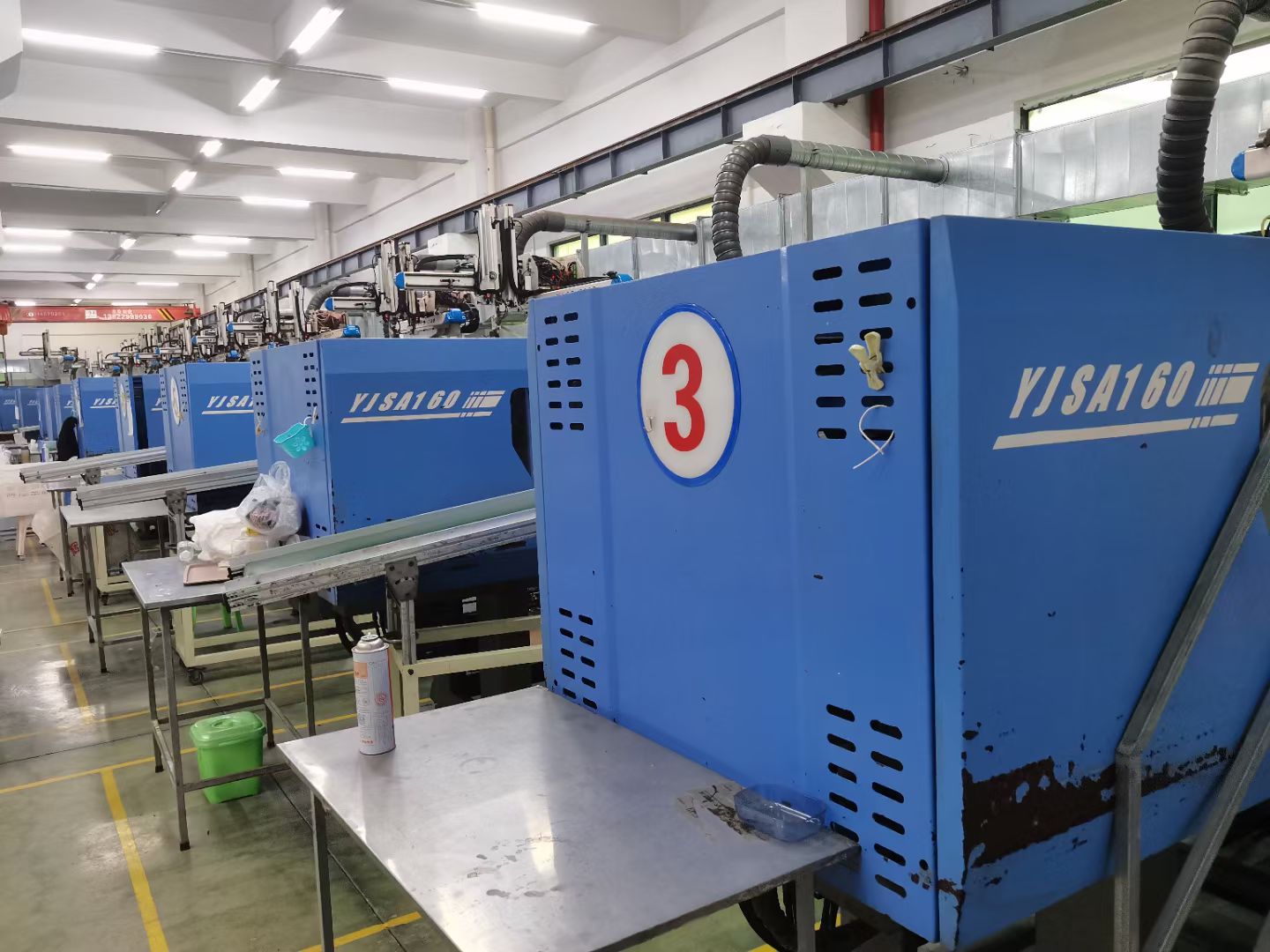
A food-grade PET preform project is usually decided long before the first mold closes. Three conditions have to be right at the same time: a workshop envelope that keeps dust and moisture away from the resin, utilities that hold temperature, cooling and power steady through 24/7 running, and a machine whose tie-bar spacing and shot weight actually match the preform mold you intend to run.
This guide works through those layers in the order a project is built — workshop shell, environment, power, supporting equipment, machine fit — and then compares the Yongjiang YJPT-260, YJPT-318, YJPT-360 and YJHB-400 on the numbers that decide whether a project fits: rated shot weight, tie-bar spacing, screw diameter, motor and heat power, and machine weight.
What 'project fit' means for a PET preform line
A PET preform injection machine melts dried PET pellets and injects the molten plastic into multi-cavity hot runner molds under precise pressure and temperature control. It is built to run in 24/7 continuous mode, producing preforms for water bottles, oil bottles and cosmetic containers. The output of the line is an intermediate product: the preform is the shape that a later blow-molding step turns into a finished bottle.
Project fit, therefore, is not a single machine rating. It is the match between four things: the preform weight and cavity count you intend to run, the mold footprint that has to pass between the tie bars, the drying and cooling capacity behind the machine, and the room and power supply the machine stands in. A project can fail on any one of them while the machine itself is perfectly serviceable.
Why preform projects lose output before the first good shot
The failure modes are predictable, and most of them sit outside the machine specification sheet.
- Moisture uptake. PET resin absorbs water. The documented requirement is that pellets are fully dried to below 0.02% moisture before use. A workshop running above 60% RH is explicitly prohibited for this reason, and the visible results are silver streaks and hydrolysis defects in the preform.
- Temperature drift. The machine is specified for a stable 20–30°C ambient band. A hall that swings outside that band shifts the process and makes weight consistency harder to hold shot after shot.
- Power quality. Voltage fluctuation beyond ±10% on a 380/400V 50Hz three-phase supply undermines the stable servo power that long-cycle, high-speed production depends on.
- Tooling that does not fit. A 96-cavity hot runner mold that cannot pass between the tie bars is not a small problem; it is a different machine.
- Undersized auxiliaries. A chiller or compressor sized for the machine's nameplate but not for the real cycle will cap output regardless of how many cavities the mold has.
Each of these is fixed cheapest at the planning stage. Once the hall is built and the machine is anchored, correcting humidity control or tie-bar clearance becomes a capital project of its own.
Industry background: what the demand side and public specifications indicate
The downstream picture is broad. Commercial research covering the PET preform product market lists bottled water, carbonated soft drinks, juices, edible oils and sauces among the categories the preform industry serves. That matters for setup because the end product determines preform weight, and preform weight — not bottle count — is what converts into shot weight and cavity count.
On the equipment side, one public reference point is useful as a floor rather than a rule. A 2019 CIPET tender specification for a PET preform injection moulding machine set a minimum machine tonnage of 150–200 T, a minimum shot capacity of 750 g, a minimum plasticizing capacity of 50 gm/sec, a minimum injection pressure of 1200 bar, a minimum of 32 preform cores and cavities, and a preform reference of maximum 20 g with a 28 mm neck for 1000 ml bottles.
That document is one public procurement specification from one market, so it should not be read as a global standard. What it does establish is a concrete benchmark: a serious food-grade preform machine is expected to clear roughly 150–200 T of clamping force and 750 g of shot capacity, and to offer at least 32 cavities. All four Yongjiang models discussed below exceed both the 150–200 T tonnage band and the 750 g shot benchmark, so the differentiation between them sits at the higher cavity counts and in the tooling envelope.
Layer 1 — The workshop shell: ISO Class 8 and what it commits you to
For food-grade preform production the workshop requirement is an ISO Class 8 (100,000-class) dust-free environment, free of metal dust and plastic debris. This is a room classification, not a machine feature, and it drives the building budget.
Practically, the shell has to deliver filtered air, controlled air changes and a floor and wall finish that can be cleaned without shedding. Two details are commonly missed during layout. First, utility penetrations — power, chilled water, compressed air, material conveying — must be sealed so the classification survives installation. Second, maintenance access has to be planned inside the controlled zone: if the screw barrel, hopper or mold carriage can only be serviced by opening the room to the general hall, the classification is lost every time a technician works on the machine.
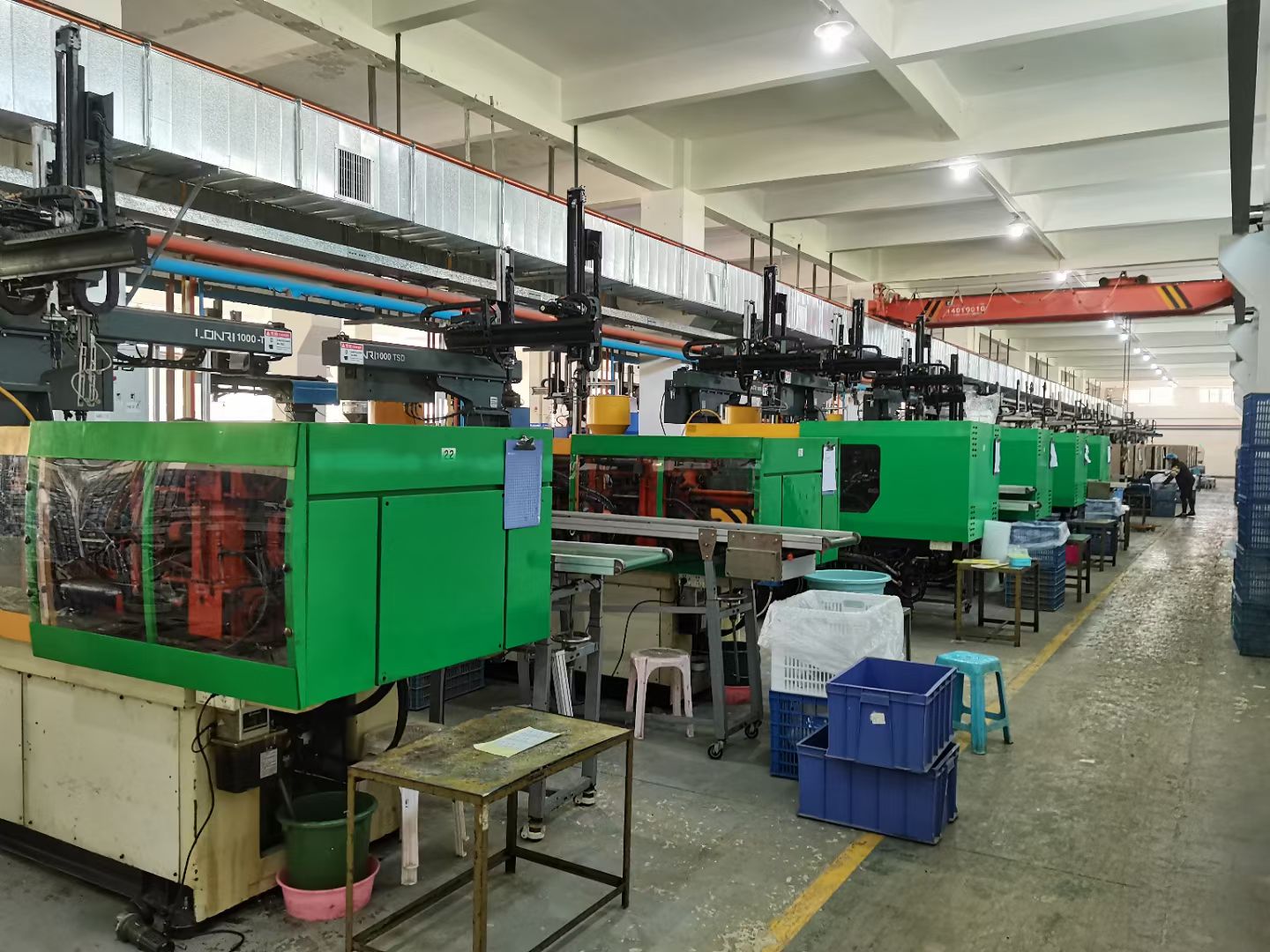
Layer 2 — Ambient temperature 20–30°C and relative humidity 40%–50% RH
The operating environment is specified as a stable ambient temperature of 20–30°C and a relative humidity of 40%–50% RH, with humidity above 60% RH prohibited to prevent PET resin moisture absorption, silver streaks and hydrolysis defects.
These are process numbers, not comfort numbers, and they should be written into the HVAC contract as such. The humidity band is the tighter of the two constraints and deserves a dedicated dehumidification strategy in humid climates.
The machine itself has some headroom for hot sites: it can sustain continuous operation in 35–40°C high-temperature tropical workshops, provided ventilation is good. That headroom applies to the machine, not to the resin. A site that lets the preform-making zone drift to 35°C because the machine tolerates it has not solved the resin side of the problem. In hot-climate projects, the practical split is to keep the machine reliable with ventilation and to keep the resin and the preform quality inside the 20–30°C, 40%–50% RH band with air conditioning and dehumidification.
Layer 3 — Power: 380/400V 50Hz three-phase within ±10%
The supply requirement is 380/400V 50Hz three-phase industrial power with voltage fluctuation within ±10%, providing stable servo power support for long-cycle high-speed production. Yongjiang units are built to this global industrial configuration, and voltage plus logo customization is available as an OEM option for projects with a different site standard.
Two documented power figures matter for plant design. The YJPT-260 lists 42 kW motor power and 35 kW heat power; the YJPT-318, YJPT-360 and YJHB-400 each list 80 kW motor power and 65 kW heat power. Summed as listed, those two published figures come to 77 kW for the YJPT-260 and 145 kW for each of the other three models. That sum is arithmetic on two published ratings, not a complete connected-load calculation — transformer sizing, cable sizing and generator backup must be confirmed against the supplier's electrical documentation for the exact configuration ordered.
The ±10% band is the other discussion point. It is a supply-quality requirement. A site with a weak or unstable grid should treat voltage stabilization as part of the project scope rather than as a commissioning surprise, because unstable supply shows up as injection instability long before it shows up as an electrical fault.
Layer 4 — Supporting equipment matched to the machine
The matched equipment list for a PET preform project is short and specific: the PET preform mold, the hopper dryer, the air compressor and the water chiller. To that core list, the machine's own requirement adds matched mold temperature controllers and hot runner molds, and the line is designed to work with automated cooling robots that shorten the production cycle.
The preform mold
The mold is the element that fixes the machine. Food-grade preform production runs multi-cavity hot runner tooling, and the documented tooling examples in the Yongjiang range cover 48 to 96 cavities, including 96-cavity preform molds. The same specification also calls for quick mold change to handle multi-specification preforms, which is a layout decision as much as a machine decision: crane coverage, mold cart routing and clamping access all belong in the workshop plan.
The hopper dryer
The dryer carries the 0.02% moisture requirement. Since humidity above 60% RH is prohibited at room level, the dryer and the room are working on the same problem from two directions. A dryer specified for average conditions rather than for the actual resin throughput and site humidity will silently reintroduce the defects the room was built to prevent.
The water chiller and mold temperature control
Chilled water and mold temperature controllers set the cooling side of the cycle, which is where cycle time is won or lost on a hot runner preform tool. These should be sized against the mold and the target cycle, not against the machine nameplate alone.
The air compressor
Compressed air is part of the matched equipment set and belongs in the same utility schedule as chilled water and power; its capacity and quality should be confirmed together with the automation around the machine rather than added after commissioning.
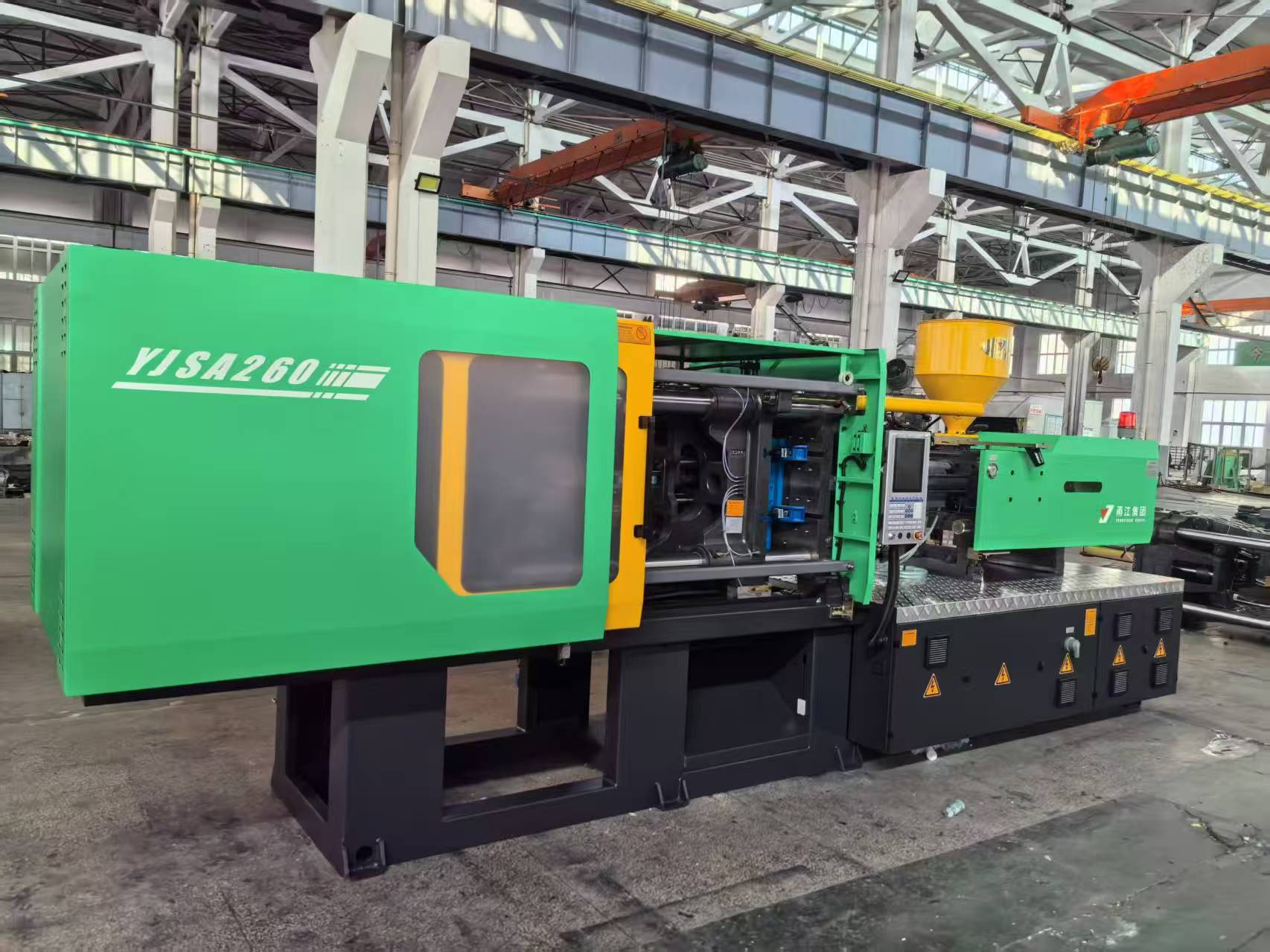
Machine fit: YJPT-260, YJPT-318, YJPT-360 and YJHB-400 compared
The four models below share the same application — food-grade PET preforms on multi-cavity hot runner molds in 24/7 operation — and differ in the dimensions that determine which molds and cavity counts they can carry.
| Model | Screw barrel | Rated shot weight | Tie-bar spacing | Motor power | Heat power | Machine weight |
|---|---|---|---|---|---|---|
| YJPT-260 | 72 mm | 1,400 g | 580 × 580 mm | 42 kW | 35 kW | 9 t |
| YJPT-318 | 77 mm | 1,900 g | 620 × 620 mm | 80 kW | 65 kW | 13 t |
| YJPT-360 | 95 mm | 3,450 g | 680 × 680 mm | 80 kW | 65 kW | 16 t |
| YJHB-400 | 95 mm | 3,450 g | 720 × 720 mm | 80 kW | 65 kW | 16 t |
Reading tie-bar spacing against the mold
Tie-bar spacing sets the widest mold that can be offered to the platens. The progression across the range is 580 × 580 mm on the YJPT-260, 620 × 620 mm on the YJPT-318, 680 × 680 mm on the YJPT-360 and 720 × 720 mm on the YJHB-400. For a given mold design, the useful comparison is the mold's overall footprint including clamping plates against that opening — not the cavity count alone.
The clearest differentiator in the range
The YJPT-360 and YJHB-400 share the same 95 mm screw barrel, the same 3,450 g rated shot weight, the same 80 kW motor power, the same 65 kW heat power and the same 16 t machine weight. On the documented figures, the difference between them is tie-bar spacing: 680 × 680 mm versus 720 × 720 mm. A project that has already settled its shot weight requirement but is carrying a wide mold should be comparing those two numbers, not the tonnage label.
Turning cavity count into a shot weight requirement
The controlling calculation is straightforward and should be done before any model is quoted:
Required shot weight (g) = number of cavities × preform weight (g)
Using the 20 g preform reference from the public tender specification described earlier, the requirement lands as follows. The results below are calculated from those two inputs and are shown against each model's rated shot weight.
| Cavities | Calculated requirement at 20 g preform | YJPT-260 (1,400 g) | YJPT-318 (1,900 g) | YJPT-360 / YJHB-400 (3,450 g) |
|---|---|---|---|---|
| 32 | 640 g | Within rating | Within rating | Within rating |
| 48 | 960 g | Within rating | Within rating | Within rating |
| 72 | 1,440 g | 40 g above rating | Within rating | Within rating |
| 96 | 1,920 g | Above rating | 20 g above rating | Within rating |
Read the other way, the table explains the range: a 32-cavity or 48-cavity water bottle preform project sits comfortably inside the smallest model's rating, a 72-cavity tool needs at least the YJPT-318, and a 96-cavity tool at the 20 g reference calls for the YJPT-360 or YJHB-400 class. Where preforms are heavier than 20 g, the requirement per cavity rises and the supported cavity count falls — the formula, not the model name, tells you where the line is.
Step-by-step: commissioning sequence for a new preform project
- Fix the preform specification first. Preform weight, neck size and intended bottle determine everything downstream. Nothing else should be quoted until this is signed off.
- Set the cavity count and calculate the shot weight requirement. Multiply cavities by preform weight and hold that number against rated shot weights.
- Check the mold footprint against tie-bar spacing. Confirm the mold, including clamping plates, passes the opening of the candidate model.
- Confirm clamping force and plasticizing capacity with the supplier for that specific mold, rather than inferring them from shot weight alone.
- Design the room to ISO Class 8, 20–30°C and 40%–50% RH, with sealed utility penetrations and maintenance access inside the controlled zone.
- Secure the power supply. Confirm 380/400V 50Hz three-phase with fluctuation within ±10%, and size transformer and cabling against the supplier's electrical documentation.
- Schedule the matched equipment. Preform mold, hopper dryer, air compressor, water chiller, mold temperature controllers and hot runner tooling, all sized to the same cycle target.
- Validate resin drying. Prove moisture below 0.02% before production, not after the first rejected preforms.
- Run the pre-shipment test and the site acceptance run. Yongjiang performs 100% testing one week before shipment; the site acceptance run then proves the machine, mold and utilities together under the actual room conditions.
Use cases: matching the project to the model
Mineral water and still water bottles. High-volume, lightweight preforms around the 20 g / 28 mm reference are the classic case for 32-cavity and 48-cavity tools, both of which sit inside the YJPT-260's 1,400 g rating on the calculation above.
Carbonated soft drinks and CSD preforms. The same machine family covers CSD preform molding, but the cavity count must be re-run with the actual CSD preform weight. The formula is unchanged; only the input changes.
Edible oil and sauce bottles. Edible oils and sauces are listed among the categories the preform industry serves. Oil and sauce projects frequently carry their own neck and weight specification, so the cavity count should be recalculated rather than copied from a water bottle line.
Cosmetic containers and packaging industry work. Cosmetic preforms and general packaging preforms follow the same sizing logic, with the added constraint that multi-specification production makes quick mold change a layout requirement rather than a convenience.
Larger-format preforms, including 5-gallon water bottle work. As preform weight per cavity rises, the number of cavities a given shot weight supports falls. A 5-gallon preform project should therefore be sized from its own preform weight and its own mold footprint, not extrapolated from a small-bottle line.
CE machinery safety and regional notes for Spain and Algeria
For EU destinations, including Spain, CE machinery safety compliance is a market-access condition rather than a preference. Yongjiang states CE conformity under certificate CE20260126MD with reference to EN ISO 12100:2010, and holds ISO 9001. Buyers should obtain the declaration and certificate package for the exact model and configuration ordered, and check that the delivered machine matches the certified build.
Spain and Algeria both appear among the application and market notes for this machine configuration, and the low energy consumption and stable injection requirements are consistent across those projects. The documented operating notes also list an export footprint covering the EU, the Middle East and Africa, with 24/7 service support.
Two practical points for these markets. First, the 380/400V 50Hz three-phase supply with ±10% tolerance is the standard configuration, which keeps site electrical work predictable. Second, hot-climate sites should separate machine tolerance from resin tolerance as described earlier: ventilation keeps the machine inside its 35–40°C capability, while air conditioning and dehumidification keep the preform-making zone inside 20–30°C and 40%–50% RH.
On commercial terms, Yongjiang quotes a minimum order of 1 unit with a 30–45 day lead time, OEM customization of voltage and logo, and 100% testing one week before shipment. Manufacturing is based on a 130,000 m² facility with a 25-engineer R&D team, and the company's case records list a water and bottle-making customer running 20 units over a 20-year relationship, described as stable operation with low electricity consumption.
Frequently asked questions
What workshop conditions does a food-grade PET preform injection machine require?
An ISO Class 8 (100,000-class) dust-free workshop free of metal dust and plastic debris, an ambient temperature stable at 20–30°C, and relative humidity of 40%–50% RH. The power supply must be 380/400V 50Hz three-phase with voltage fluctuation within ±10%. These are the conditions under which food-grade preform production is specified.
What happens if workshop humidity exceeds 60% RH?
Humidity above 60% RH is prohibited for this process. PET resin absorbs moisture from the air, and the documented consequences are silver streaks and hydrolysis defects in the preform. For the same reason, PET pellets must be dried to below 0.02% moisture before use, so room humidity control and hopper drying are two parts of one requirement.
How much shot weight do I need for a 48-cavity preform mold?
Multiply cavities by preform weight. At a 20 g preform, a 48-cavity mold requires 960 g of shot weight. That sits inside the 1,400 g rating of the YJPT-260, the 1,900 g rating of the YJPT-318 and the 3,450 g rating of the YJPT-360 and YJHB-400. The figure must still be confirmed against clamping force and mold dimensions for the specific tool.
Which model fits a 96-cavity PET preform mold?
On the shot-weight screen at a 20 g preform, a 96-cavity mold requires 1,920 g, which is above the YJPT-260's 1,400 g and just above the YJPT-318's 1,900 g. The YJPT-360 and YJHB-400, both rated at 3,450 g, clear that requirement. Final approval also depends on tie-bar spacing for the 96-cavity mold footprint and on clamping force.
What supporting equipment has to be ordered with the machine?
The matched equipment set is the PET preform mold, hopper dryer, air compressor and water chiller, together with matched mold temperature controllers and hot runner molds. The line is also designed to work with automated cooling robots. All of it should be sized against the same target cycle and cavity count, not against the machine nameplate alone.
What should a beverage producer check in a Chinese PET preform injection machine before ordering?
Five checks. First, the food-grade environment the machine is specified for — ISO Class 8 workshop, 20–30°C and 40%–50% RH. Second, CE conformity documentation for the exact model, including the certificate reference and the EN ISO 12100:2010 basis. Third, the shot-weight calculation against your own cavity count and preform weight, plus tie-bar spacing for the mold footprint. Fourth, the electrical configuration: 380/400V 50Hz three-phase within ±10%, with voltage customization available. Fifth, the commercial and quality terms — MOQ of 1 unit, 30–45 day lead time, 100% testing one week before shipment, and the 24/7 service arrangement for beverage lines that cannot stop.
How do I get a project-fit review before committing to a machine?
Prepare four inputs: preform weight and neck size, target cavity count, mold footprint, and the site's room and power conditions. Those four answer the fit question directly. Yongjiang reviews PET preform project layouts against these inputs and can supply the full machine catalogue for the YJPT and YJHB ranges as a starting reference.
Next step. If you are sizing a food-grade PET preform project, send your preform weight, cavity count and site conditions to the Yongjiang team for a layout and model review. Ningbo Yongjiang Group can be reached at www.yongjiangimm.com, by email at yongjiangimm@gmail.com, or by phone and WhatsApp on +86 18958305290 (contact: Steven). The full machine catalogue is available for download here: Yongjiang injection molding machine catalogue.
Conclusion
A food-grade PET preform project is a systems decision. The workshop has to hold ISO Class 8, 20–30°C and 40%–50% RH before the machine is even switched on. The power supply has to deliver 380/400V 50Hz three-phase within ±10% so that stable injection is possible across a 24/7 schedule. The hopper dryer, chiller, compressor and hot runner mold have to be sized to the same cycle and the same cavity count.
Only then does the model choice become a clean question. On the documented figures, the YJPT-260 covers 32- and 48-cavity work at the 20 g preform reference; the YJPT-318 extends that to 72 cavities and offers wider tie bars at 620 × 620 mm; the YJPT-360 and YJHB-400 both carry 3,450 g of rated shot weight for 96-cavity class tools, and separate from each other on tie-bar spacing — 680 × 680 mm and 720 × 720 mm respectively. Get those four layers right in that order, and the machine fit stops being a guess.
Have Questions or Need More Details?
Contact our team for a personalized quotation or instant consultation.
Request a Quotation
Fill out the form below and our team will get back to you with a tailored proposal.
WhatsApp Direct Chat
Prefer to chat in real-time? Message us on WhatsApp for instant assistance & quick answers.
- Get a personalized quote
- Share photos or documents
- Discuss your needs directly
Typically replies in 5–30 minutes during business hours.