
PET Preform Injection Machine Suppliers: Output, Depth, Delivery
Verifying a PET preform injection machine supplier is a document-and-factory exercise, not a catalogue comparison. Three questions separate a credible quotation from an optimistic one: can the supplier demonstrate the output it claims, does it have the engineering depth to build around your preform and mould rather than around a catalogue page, and are the delivery terms specific enough to be enforced if the machine does not arrive as promised?
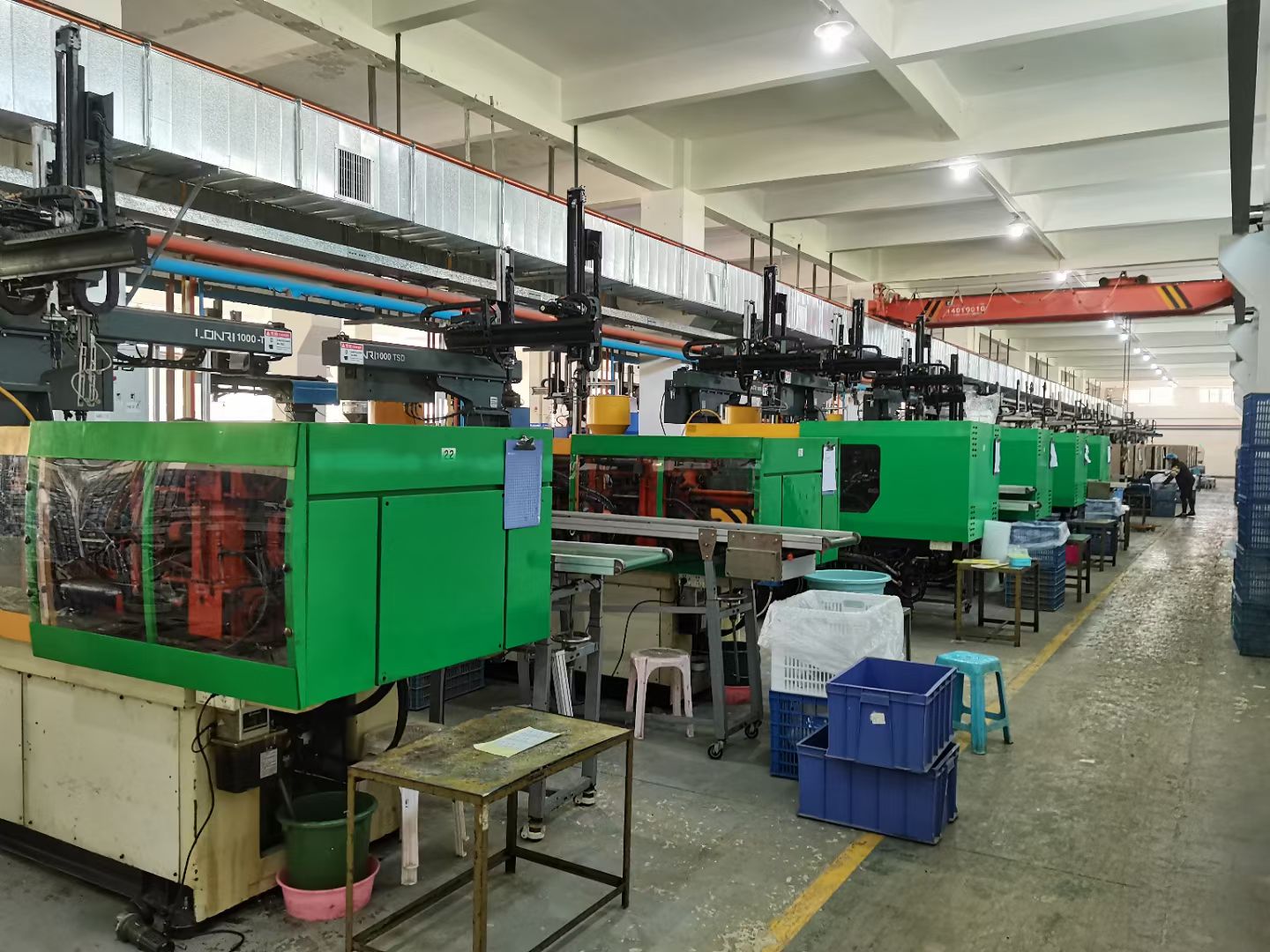
Ningbo Yong Jiang Machine Co., Ltd. (Yongjiang) is a Chinese injection moulding machine manufacturer established in 1985, with more than 35 years of injection moulding machine manufacturing behind it, a 130,000 m² production facility, approximately 200 employees including 25 R&D engineers, and annual output of about 2,000 units. Those are exactly the kind of figures a buyer should ask a supplier to evidence. This guide uses them as a worked example of how to test such claims — not as a reason to skip the test.
Scope of this article: it does not rank suppliers and does not compare brands head to head. It defines what to verify, in what order, what a documented answer looks like, and where a model name stops being useful evidence.
Why the specification sheet cannot verify a supplier
A PET preform injection machine datasheet is a compressed, comparable-looking document: clamping force, cavity count, shot weight, screw diameter, cycle time. Because those numbers look alike across sellers, buyers tend to treat them as the decision. They are not. They describe a configuration envelope, not the supplier's ability to deliver a machine that holds that envelope on your preform, in your factory, on your power supply, for the next several years.
Three failure modes sit behind most disappointing PET preform projects, and none of them appears on a spec sheet.
- Output that exists on paper only. A quoted cycle time is a design target. Whether the supplier can build, test and ship the machine on schedule depends on facility, staffing and build sequencing.
- Engineering depth that stops at the badge. Many sellers offer "OEM"; far fewer can state precisely which items are customized, who approves drawings, and what happens when a preform dimension drifts outside tolerance.
- Commercial terms with no leverage point. A 70% balance due before shipment is normal in this trade, but it is only safe when the pre-shipment acceptance test is defined before the deposit is paid.
Verification therefore runs in this order: output evidence, engineering evidence, delivery evidence. Compliance documents cut across all three, because they must name the exact model being shipped.
Market context that should shape the verification
PET preform equipment is a globally traded, competitive category, which is precisely why supplier claims need checking rather than assuming. Two independent data points frame the buyer's position.
Customs data aggregated from official trade sources put global exports under HS code 847710 (injection-moulding machines) at USD 7.21 billion in 2023 (The Dollar Business, derived from UN Comtrade, 2023). Demand for the preform itself is a separate and slower-moving signal: Mordor Intelligence reports the global PET preform product market at USD 24.33 billion in 2026, growing at a 2.17% CAGR to USD 27.08 billion by 2031. That second figure describes preforms as a product, not injection machines. It is a downstream demand indicator and must not be used as a machine market size or as a price benchmark.
What the preform industry produces is well documented: Fortune Business Insights lists bottled water, carbonated soft drinks, juices, edible oils and sauces among the end categories served. Those categories are not interchangeable from a machine-selection point of view — a light water-bottle preform and a heavier edible-oil preform place different demands on shot capacity, mould design and cycle stability — but the important point for verification is that the supplier should be able to talk about your category, not categories in general.
Institutional buyers already write requirements at this level of specificity. A public tender specification published by CIPET (India, 2019) for a PET preform injection moulding machine listed a minimum machine tonnage of 150–200 T, minimum shot capacity of 750 g, minimum plasticizing capacity of 50 gm/sec, minimum injection pressure of 1,200 bar, at least 32 preform cores and cavities, a maximum preform weight of 20 g and a 28 mm neck size for 1,000 ml bottles. Those values are not a universal recipe, and they do not describe any specific Yongjiang model. They demonstrate the format: a serious requirement is numeric, bounded and answerable in writing.
Check one: output capability
Output capability answers a single question — can this supplier physically build and test the machine you are ordering, in the period it promised? Yongjiang's documented position is a 130,000 m² facility, around 200 employees and annual output of roughly 2,000 units across its injection moulding machine range.
That is meaningful scale, but a careful buyer immediately notices what an annual unit figure does not tell you. It does not tell you how many of those units are PET preform machines, whether the 2,000 units are counted across one shift or several, whether they include trading volume rather than in-house builds, or when your model is scheduled on the line. Nor does 200 staff imply a specific monthly throughput without knowing the shift pattern.
The useful move is to convert the headline number into a schedule commitment. Ask for the build slot allocated to your order, the number of PET preform machines of your configuration built in the previous twelve months, and the testing sequence your unit will go through before it is packed. A supplier that can answer those three questions has an operating system behind its capacity claim; one that cannot is quoting a brochure.
Reading headcount correctly
Around 200 employees with 25 R&D engineers means roughly one in eight staff works in engineering. For a machinery business that is a high ratio, and it matters for preform work because preform tooling and process windows are rarely solved by production labour alone. It also sets a realistic expectation: a 25-engineer team can support customization and application work across a broad product range, but it is not an unlimited bespoke design department. Buyers planning a fundamentally new machine architecture should say so early and expect a separate engineering conversation.
Check two: engineering depth and what "OEM" covers
Engineering depth is the hardest claim to verify because it is qualitative. The practical test is to ask the supplier to separate what it designs from what it assembles, and what it customizes from what it buys in.
Yongjiang's documented scope is OEM production with technical services covering voltage and logo customization. Read precisely, that describes a configuration-level OEM service: the machine is built to the buyer's market requirements rather than shipped unchanged from stock, and the buyer's identity can be carried on the machine. It does not, by itself, mean bespoke clamp design, a proprietary control architecture built to the buyer's specification, or a new mould developed from scratch.
That distinction is where most OEM misunderstandings begin, so put it in writing. A workable OEM annex lists four things:
- Customization items — voltage, logo placement, documentation language, and any other agreed change, each with an acceptance criterion.
- Exclusions — what remains standard and will not be modified.
- Drawing and sample approval — who signs off, at which stage, and how long the buyer has to respond.
- Change control — what happens to price and lead time if the specification changes after the deposit.
On the technical side, Yongjiang's PET series catalogue describes the YJPT series as dedicated to PET preforms, with a modular energy-saving system and a high-capacity injection system using an optimised screw diameter ratio, and the company describes rigid clamping frames intended to carry multi-cavity hot runner moulds in continuous production. These are manufacturer descriptions, not independently tested performance results; their value in verification is that they can be turned into questions — which screw configuration for which preform weight, which mould sizes the frame is intended for, and what the supplier's own commissioning procedure assumes.
Reference installations as engineering evidence
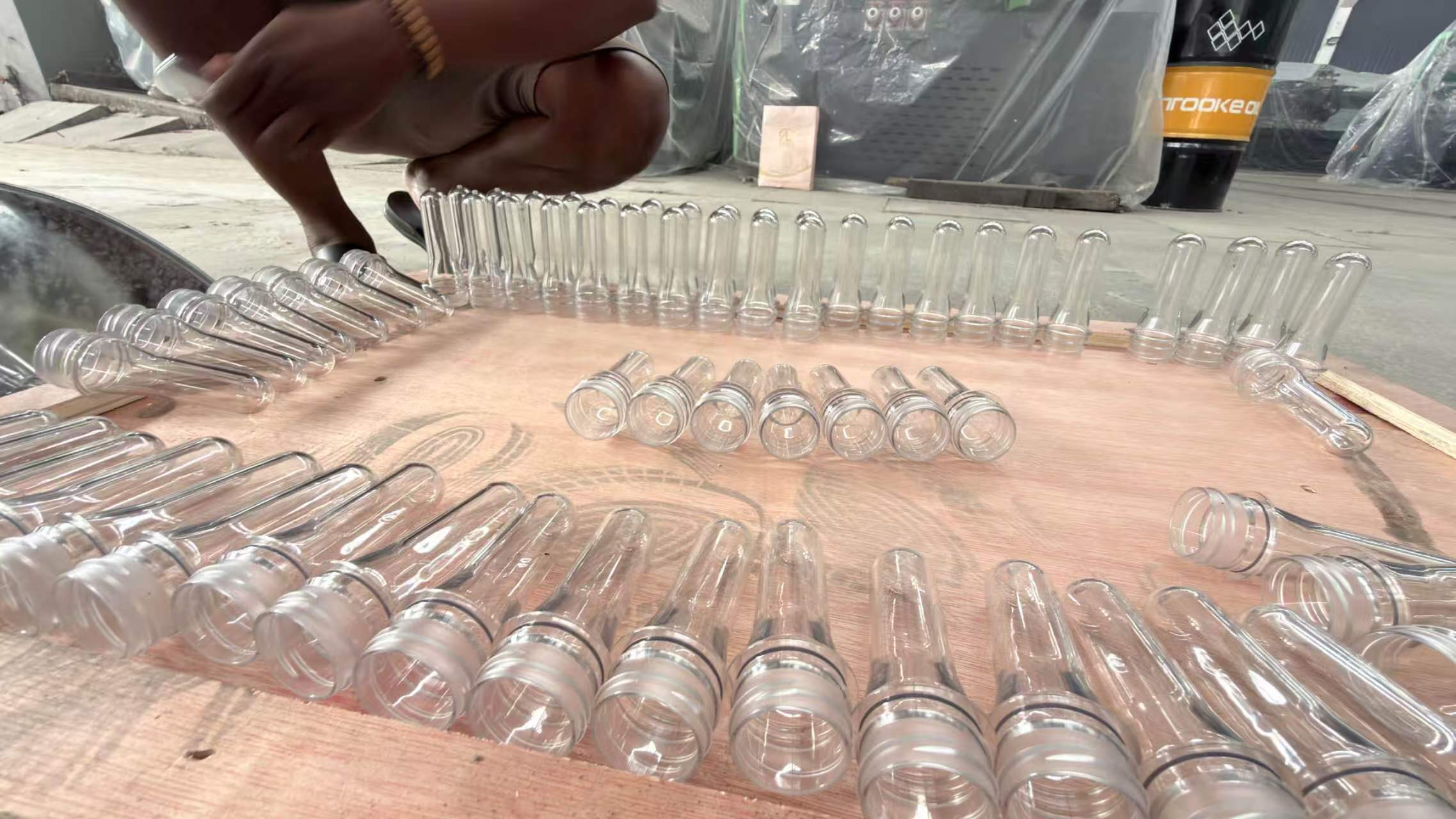
One documented case describes an installation of 20 PET preform injection machines used for PET preform making and water bottle making, with clients originating from Ethiopia, Spain, France and Hungary, among others. That is useful context for the water-bottle segment and for multi-machine projects, because it shows the supplier has handled a volume order rather than single units only. It is not evidence of performance in carbonated soft drink, edible oil or large-container preform work, and it should not be read that way. Where your application differs, ask for references in that application specifically.
Check three: delivery terms that survive a dispute
Delivery terms are where verification becomes enforceable. Yongjiang's documented commercial position is short enough to state in full, and each element changes the buyer's risk position in a specific way.
| Term | Documented position | What it means for the buyer |
|---|---|---|
| Minimum order | 1 unit | Allows a single-machine trial before committing to a multi-machine line, which is useful when the preform design or market is not yet proven. |
| Payment | 30% deposit, 70% before shipment | The balance is settled before the machine leaves the factory, so the pre-shipment acceptance test — not retention of payment — is the buyer's main leverage. Define pass criteria before paying the deposit. |
| Delivery term | FOB Ningbo | Risk and freight cost transfer at the named port. The buyer arranges and insures main carriage, so inland transport, export clearance and loading need to be planned from the buyer's side. |
| Acceptance | Pre-shipment test; 100% test one week before shipment | There is a testing window before packing. It is only useful if the buyer knows what is tested, who witnesses it, and what document records the result. |
| Lead time | 30–45 days | Roughly one to one and a half months from order confirmation. Mould supply, customization and buyer-side drawing approvals sit outside or inside that window depending on what is agreed. |
| Customization | OEM production; voltage and logo customization | Configuration-level OEM. Confirm items, exclusions and approval steps in the OEM annex described above. |
| Support | 24/7 service support | Useful during commissioning. Ask how the channel works in your time zone and what spares are recommended for the first year. |
| Export experience | USA, Canada, Thailand; approximately 59% of output exported | Suggests the documentation, packing and export process is routine rather than improvised. Ask which of these markets matches your voltage, documentation and compliance profile. |
Two of these terms deserve more attention than they usually get. FOB Ningbo is a genuine division of responsibility, not a formality: once the machine is loaded at the named port, the buyer carries the risk, so marine insurance and a clear Incoterms version reference belong in the contract. And a 30/70 structure shifts the burden of proof onto the acceptance test. A 70% balance payable before shipment is workable when the test is defined, witnessed and documented; it is uncomfortable when the test is described only as "pre-shipment test".

A six-step verification sequence
Run the checks in this order. Each step produces a document, and the documents together form the supplier file that the deposit decision should rest on.
- Lock the preform specification. Preform weight, neck finish, wall thickness, resin grade and target bottle application, written down before any model is discussed.
- Obtain a written model-fit statement. The supplier should name the model and explain, against your preform and mould, why it fits — including cavity count and mould dimensions.
- Request output evidence for that model. Build slot, recent production of comparable configurations, and the testing sequence your unit will run before packing.
- Define the OEM scope in writing. Customization items, exclusions, drawing and sample approvals, change control.
- Agree the acceptance test before the deposit. What is measured, to what tolerance, who witnesses, which document is issued, and what happens if it fails.
- Confirm the document set. Certificate and declaration of conformity naming your model, test report, packing list, warranty terms and support route.
| Verification area | Evidence to request | Documented Yongjiang position |
|---|---|---|
| Production capability | Build slot, recent comparable builds, testing sequence | 130,000 m² facility; approximately 200 staff; about 2,000 units per year |
| Engineering depth | OEM scope list, drawing approval flow, screw and mould fit | OEM production; voltage and logo customization; 25 R&D engineers; PET-dedicated YJPT series |
| Compliance documents | Certificate and declaration naming the purchased model | CE certificate CE20260126MD issued by ECM; scope names YJPT-260 and YJHB-400 |
| Commercial terms | Order terms, Incoterms version, insurance allocation | 1-unit MOQ; 30% deposit / 70% before shipment; FOB Ningbo |
| Acceptance | Test protocol with tolerances and pass criteria | Pre-shipment test; 100% test one week before shipment |
| Reference base | Installations in your application and market | 20-unit preform and water-bottle installation; clients including Ethiopia, Spain, France and Hungary |
How model names help, and where they stop
Model names are useful because they anchor a technical discussion. Yongjiang's PET preform machine records include the YJPT-260, YJPT-318, YJPT-360 and YJHB-400. They are a starting point for model fit, not a specification in themselves: a model designation does not tell a buyer the cavity count, mould size, screw configuration or cycle that a specific project will run.
The compliance side is more concrete, and it carries a verification lesson. Yongjiang holds CE certificate CE20260126MD, issued by ECM on 30 January 2026 and valid to 29 January 2031, citing 2006/42/EC (Machinery Directive) together with EN ISO 12100:2010, EN 60204-1:2018+A1:2020 and EN ISO 20430:2020. The certificate's stated scope is the PET preform injection moulding machine, naming models YJPT-260 and YJHB-400.
Note the gap between a product list and a certificate scope. YJPT-318 and YJPT-360 appear in the product records but are not the models named on that certificate. That is not an irregularity — certificates are issued against specific model listings — but it is a reason to ask, for any model you intend to buy and import into a regulated market, for the certificate and declaration of conformity that name that model. Asking this question is also a quick way to see how well a supplier's documentation is controlled.
Matching the machine to the preform you actually sell
Verification should end with an application conversation, because the same supplier can be the right or wrong partner depending on the preform. The end categories are well known — bottled water, carbonated soft drinks, juices, edible oils and sauces — and they pull the configuration in different directions.
- Water bottle preforms are the highest-volume, most cost-sensitive segment, where cycle stability and multi-cavity output dominate. The documented Yongjiang installation base is concentrated here.
- Carbonated soft drink preforms carry pressure requirements that influence wall design and, in turn, the process window the machine must hold consistently.
- Edible oil and sauce preforms are typically heavier and often use larger neck finishes, which changes shot weight requirements and mould design.
- Large-format containers such as 5-gallon applications sit at a different scale again and should be discussed as their own project rather than as a variant of a bottle line.
For each of these, the model-fit statement from step two should be specific: which model, which mould, which cavity count, which preform weight range, and what the supplier assumes about your resin and utilities. A supplier that can only answer at the level of "our machine handles PET" has not yet engaged with your project.
Frequently asked questions
Which compliance documents should accompany a PET preform injection machine?
A CE certificate whose stated scope names the model you are buying, plus the corresponding declaration of conformity referencing the applicable directive and standards. Yongjiang holds CE certificate CE20260126MD, issued by ECM, dated 30 January 2026 and valid to 29 January 2031, citing 2006/42/EC with EN ISO 12100:2010, EN 60204-1:2018+A1:2020 and EN ISO 20430:2020; its scope names models YJPT-260 and YJHB-400. If your order is a YJPT-318 or YJPT-360, request the documentation that names that model before shipment, and check that the certificate number, issue date and model listing match the machine's nameplate.
What does an OEM PET preform injection machine manufacturer actually provide?
OEM production means the machine is built to the buyer's market requirements instead of being taken unchanged from stock. In Yongjiang's documented scope, OEM production is provided together with technical services covering voltage and logo customization — so the OEM annex should list the exact voltage, the logo placement, the documentation language and the approval steps, and should state clearly what remains standard. This level of OEM is a configuration service; it should not be assumed to include a bespoke clamping unit, a new control architecture or a newly developed mould unless the supplier confirms those items separately in writing.
What are the minimum order quantity and payment terms?
The documented terms are a minimum order of 1 unit, a 30% deposit with the 70% balance payable before shipment, and delivery FOB Ningbo. A 1-unit minimum allows a single-machine trial. Because the balance falls due before the machine leaves the factory, the practical protection is the pre-shipment acceptance test rather than withheld payment, so the test protocol should be agreed and attached to the order before the deposit is transferred.
What does the pre-shipment acceptance test involve?
The documented position is that a pre-shipment test serves as the acceptance criterion and that 100% of machines are tested one week before shipment. The specific content — dry cycling, mould trial, preform weight and dimensional checks, electrical and safety verification — should be written into the order with tolerances and pass criteria, together with who witnesses the test and which report is issued. That one-week window is also the realistic point at which corrective work can still be done before packing.
What lead time and after-sales support should I expect?
The documented lead time is 30–45 days, with 24/7 service support after delivery. Buyers should confirm what sits inside that window — mould supply, customization items and buyer-side drawing approvals can each extend it — and should ask how support is delivered in their time zone and which spare parts are recommended for the first year of operation. Approximately 59% of Yongjiang's output is exported, with documented experience in the USA, Canada and Thailand, which is a reasonable indicator that export documentation and packing are routine rather than improvised.
Building the supplier file
Verification ends when the file is complete enough that the deposit is a commercial decision rather than a leap of faith. For a PET preform injection machine, that file contains: a locked preform specification, a written model-fit statement naming the model and mould, output evidence tied to a build slot, an OEM annex listing customization items and exclusions, commercial terms with the Incoterms version and insurance allocation, an acceptance protocol with tolerances and pass criteria, and compliance documents whose scope names the exact model being shipped.
Judged against that standard, Yongjiang's documented position covers most of the ground a buyer needs to start the conversation: manufacturing since 1985 with more than 35 years in injection moulding machines, a 130,000 m² facility, around 200 staff including 25 R&D engineers, roughly 2,000 units per year, PET-dedicated YJPT models, OEM production with voltage and logo customization, 1-unit MOQ, 30/70 payment, FOB Ningbo, a pre-shipment test one week before shipment, 30–45 day lead time, 24/7 support, CE certificate CE20260126MD, and reference installations in preform and water-bottle production.
What remains the buyer's job is the part no supplier can do on their behalf: state the preform precisely, put the acceptance criteria in writing before the deposit, and check that every document names the model actually being built.
For buyers who want the full configuration and specification background before starting that conversation, the Yongjiang product catalogue is available for download, and the company profile, product range and contact details are published at Ningbo Yong Jiang Machine Co., Ltd.
Have Questions or Need More Details?
Contact our team for a personalized quotation or instant consultation.
Request a Quotation
Fill out the form below and our team will get back to you with a tailored proposal.
WhatsApp Direct Chat
Prefer to chat in real-time? Message us on WhatsApp for instant assistance & quick answers.
- Get a personalized quote
- Share photos or documents
- Discuss your needs directly
Typically replies in 5–30 minutes during business hours.