
PET Preform Injection Machine Technical Guide: Sizing Clamping Force, Tie Bar Spacing & Shot Weight
PET Preform Injection Machine Technical Guide: Sizing Clamping Force, Tie Bar Spacing & Shot Weight
Sizing a PET preform injection machine to a mold is a four-number check: rated clamping force, tie bar spacing, screw barrel diameter and shot weight. Clear those four numbers and the machine will run the mold; miss any one of them and no amount of process tuning will recover the cycle. This guide explains how each variable is verified in practice, then applies the method to four high-speed PET preform injection molding machines from Ningbo Yong Jiang Machine Co., Ltd. — the YJPT-260, YJPT-318, YJPT-360 and YJHB-400 — which together cover the 260–400 ton clamping band used for water bottle, oil bottle and cosmetic container preforms.
Ningbo Yong Jiang Machine Co., Ltd. (Ningbo Yongjiang) is a Chinese injection molding machine manufacturer established in 1985, specialising in PET preform machines and PVC fitting machines for more than 35 years. The company operates a 130,000 m² manufacturing facility with approximately 200 staff, including a 25-engineer R&D team, and produces about 2,000 units per year; roughly 59% of that output is exported, with the USA, Canada and Thailand among its listed major markets. The four models discussed here are all built for PET preform manufacturing, all use QT500-A7 steel or steel construction, and all run on the 380/400 V 50 Hz three-phase industrial power standard.
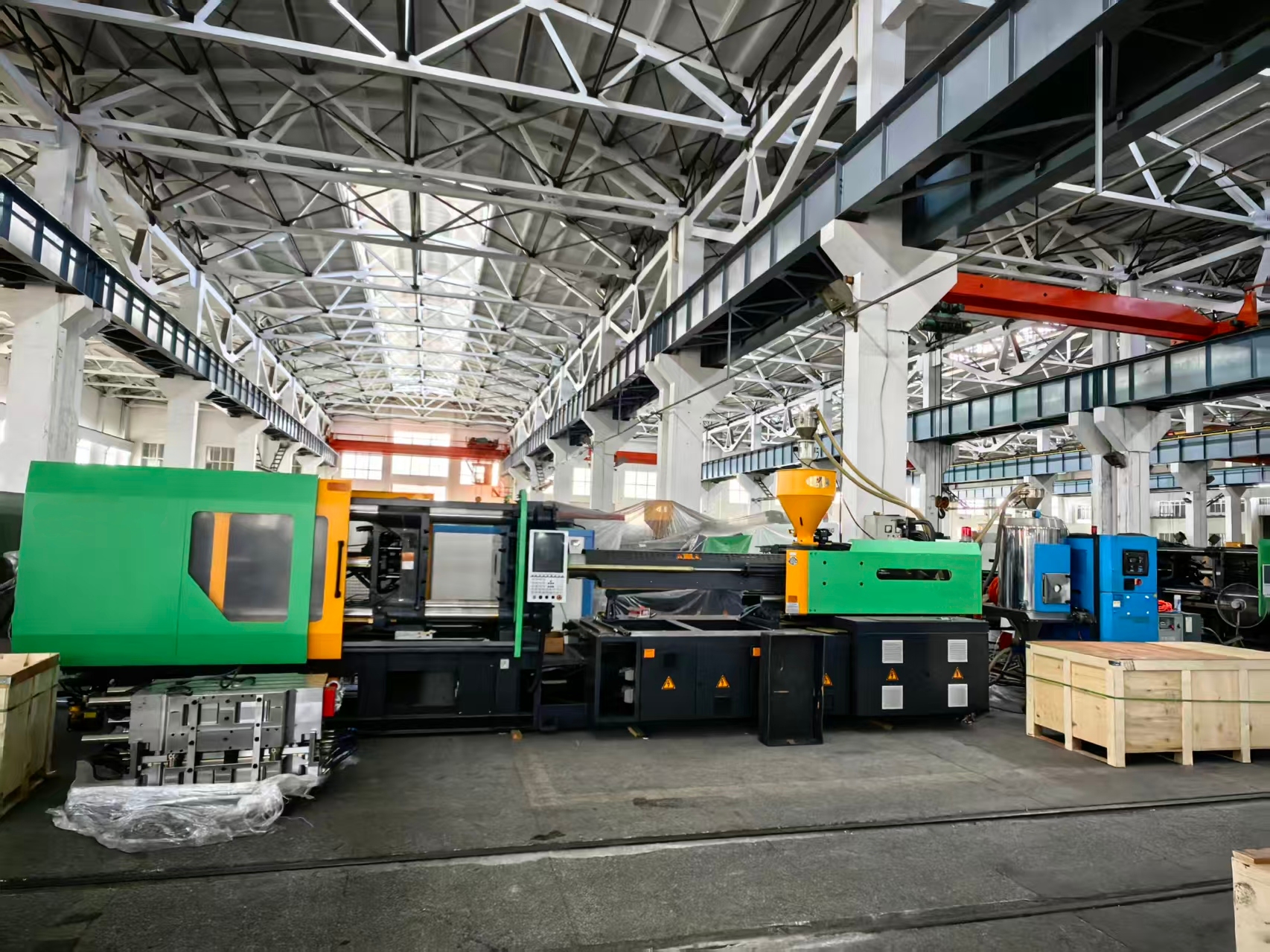
YJHB-400: 400 ton high speed PET preform injection machine, 720 × 720 mm tie bar distance, 3450 g shot weight.
Problem Definition: What a Machine–Mold Mismatch Actually Costs
Sizing errors rarely appear as one dramatic breakdown. They surface as a set of symptoms that operators try to solve with process settings, when the real cause is a specification conflict between the machine and the tool.
- The mold does not physically fit. Tie bar spacing is a hard limit. If the mold's outer envelope is wider than the distance between the tie bars, the tool cannot be mounted, and no tonnage rating compensates for that. Hot runner manifolds and larger mold frames push the envelope out further.
- Flash, mold wear and drifting part weight. Clamping force must hold the mold closed against the separating force created by injection pressure acting over the projected area of every cavity plus the runner. When the margin is too thin, the mold opens slightly during injection and PET flashes into the parting line.
- Short shots and unstable cycles. Shot weight is the total mass the injection unit can deliver per cycle. A 32-cavity mold and a 96-cavity mold making the same preform demand very different shot weight; a machine rated below the total requirement cannot fill every cavity consistently.
- Material defects that look like machine faults. PET is hygroscopic. Pellets must be dried to below 0.02% moisture before processing, and workshop humidity above 60% RH is prohibited because absorbed moisture produces silver streaks and hydrolysis defects in the preform — a quality problem that originates in drying and environment, not in the injection unit.
Oversizing carries its own cost. Committing a 400 ton machine with 80 kW motor power and 65 kW heating power to a mold that would run comfortably on a 260 ton unit ties up capital and energy in tonnage the tool never uses. The objective is not the largest machine available; it is the smallest machine that clears all four checks with margin to spare.
Industry Background: Why Sizing Discipline Matters in 2025–2026
The commercial context explains why buyers now read specification sheets more closely than they did a few years ago. Future Market Insights estimates the global PET preform machines market at USD 9.9 billion in 2025, projected to reach USD 17.3 billion by 2035, with injection molding technology holding a 66.4% share of that market in 2025. Demand is regionally concentrated: Grand View Research reports Asia Pacific as the largest regional market for injection molding machines with a 41.2% revenue share in 2025, led by China.
At the high-output end, Husky Technologies is described in third-party industry analysis as controlling an estimated 55–60% of the global high-output PET preform system market, and high-end systems such as Husky's HyPET 6e and Netstal's PET-LINE comply with international standards including CE, UL, ISO 9001 and EUROMAP 60.1. Those references matter because they set the vocabulary of the sizing conversation — tonnage class, tie bar geometry, shot capacity — against which mid-tonnage suppliers are measured.
Most water bottle, beverage, oil bottle and packaging projects, however, are built in a mid-tonnage band rather than at the high-output frontier. Ningbo Yongjiang's PET preform application scenario is documented for Spain and Algeria alongside a wider export list, and specifies EU CE machinery safety compliance, low energy consumption and stable injection as special requirements. Third-party profiles describe Ningbo Yongjiang Group as a large-scale Chinese injection molding machine enterprise producing over 30 machine types with clamping forces from 40 t to 1600 t (up to 3000 t in specialised series). In that environment, the sizing discipline below is what separates a line that holds its cycle from one that spends its first year in process troubleshooting.
Detailed Solution: The Four Variables That Decide Machine–Mold Fit
1. Clamping force: the tonnage class
Clamping force is the force holding the mold halves together while molten PET is injected. The working rule is straightforward: rated clamping force must exceed the separating force generated by cavity pressure acting across the projected area of all cavities plus the runner. More cavities, larger preforms and higher cavity pressure all push the requirement upward, which is why cavity count and preform size must be settled before a tonnage class is chosen.
In the Yongjiang range, clamping force steps from 260 tons on the YJPT-260, to 318 tons on the YJPT-318, 360 tons on the YJPT-360 and 400 tons on the YJHB-400. Third-party product references describe the YJPT series as specialised for PET preforms, supporting mold configurations from 6 to 72 cavities, with rigid clamping frames designed to hold multi-cavity hot runner molds during 24-hour continuous production.
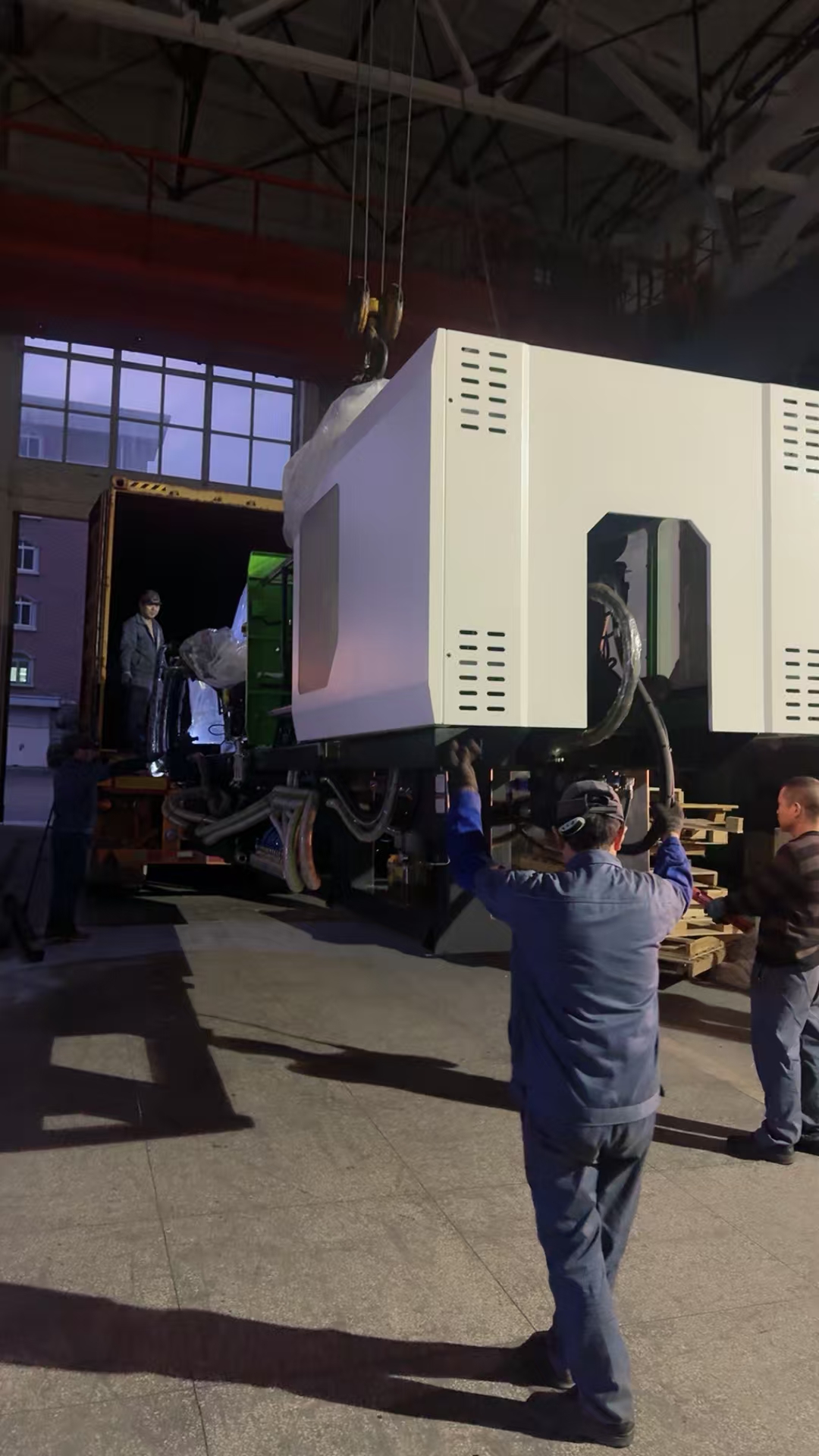
YJPT-260: 260 ton high speed PET preform injection machine, 580 × 580 mm tie bar distance, 1400 g shot weight.
2. Tie bar spacing: the physical envelope
Tie bar distance is the clear square between the four tie bars, and it is the first number to check because it cannot be negotiated. The four models provide 580 × 580 mm (YJPT-260), 620 × 620 mm (YJPT-318), 680 × 680 mm (YJPT-360) and 720 × 720 mm (YJHB-400). A mold's outer dimensions — including its frame and any hot runner manifold extension — must pass inside that envelope. When a mold sits close to the limit, the right decision is to move to the next tie bar size rather than to a higher tonnage inside the same frame.
3. Screw barrel diameter: melt delivery for PET
Screw barrel diameter determines how much material the screw conveys and plasticises per cycle, and how consistently the melt is prepared for a PET preform, where wall thickness uniformity and surface finish become visible in the finished bottle. The range runs from 72 mm on the YJPT-260, through 77 mm on the YJPT-318, to 95 mm on both the YJPT-360 and the YJHB-400. Yongjiang machines use customised plasticising screws, and long-term 24-hour operation requires regular professional maintenance of the special PET screw and the servo system.
4. Shot weight: total mass per cycle
Shot weight is the maximum mass the injection unit can deliver in one cycle, and it must cover the sum of all preform weights in the mold plus the material in the runner system. The four models are rated at 1400 g (YJPT-260), 1900 g (YJPT-318), 3450 g (YJPT-360) and 3450 g (YJHB-400). Two details matter when reading these figures. First, the YJPT-360 and YJHB-400 share the same 3450 g shot weight and 95 mm screw, so the difference between them is clamping force and mold envelope rather than injection capacity. Second, the YJPT-318's 1900 g shot with a 77 mm screw sits deliberately between the 1400 g entry model and the 3450 g high-capacity units.
Step-by-Step Breakdown: How to Size a PET Preform Injection Machine to a Mold
- Collect the mold and preform data first. Record preform weight, neck finish, cavity count, mold outer dimensions, hot runner type, resin grade and target cycle. Sizing without these numbers is guesswork, and the four checks below cannot be completed.
- Calculate total shot weight. Multiply preform weight by cavity count, add the runner allowance, then compare the result with the machine's rated shot weight: 1400 g, 1900 g, 3450 g or 3450 g depending on the model.
- Confirm clamping force. Establish the required clamping force for the mold's projected area and cavity count, then select the model whose rated clamping force — 260 t, 318 t, 360 t or 400 t — covers it with margin.
- Check the tie bar envelope. Compare the mold's outer dimensions against 580 × 580 mm, 620 × 620 mm, 680 × 680 mm or 720 × 720 mm. A mold that satisfies shot weight but not tie bar spacing is a non-starter.
- Verify screw barrel diameter and plasticising demand. Match the 72 mm, 77 mm or 95 mm screw to cavity count, preform weight and cycle time, remembering that the screw must plasticise the next shot while the current shot is injected and cooled.
- Confirm utilities, environment and continuous-operation capability. Check 380/400 V 50 Hz three-phase power with voltage fluctuation within ±10%, plus the matched equipment set: PET preform mold, hopper dryer, air compressor and water chiller, together with mold temperature controllers and hot runner tooling. Confirm workshop conditions — 20–30 °C ambient at 40–50% RH, with humidity above 60% RH prohibited, and an ISO Class 8 (100,000-class) dust-free workshop preferred for food-grade preform production — and pellet drying to below 0.02% moisture before material reaches the machine. The documented operation mode is 24/7, and the machine can sustain continuous operation in 35–40 °C tropical workshops where ventilation is adequate.
Sizing shortcut: if a mold fails only the tie bar check, go up one tie bar size; if it fails only the shot weight check, go up one injection unit; if it fails only the clamping check, the tonnage class is wrong. These are three different corrections, and treating them as one is a common and expensive mistake.
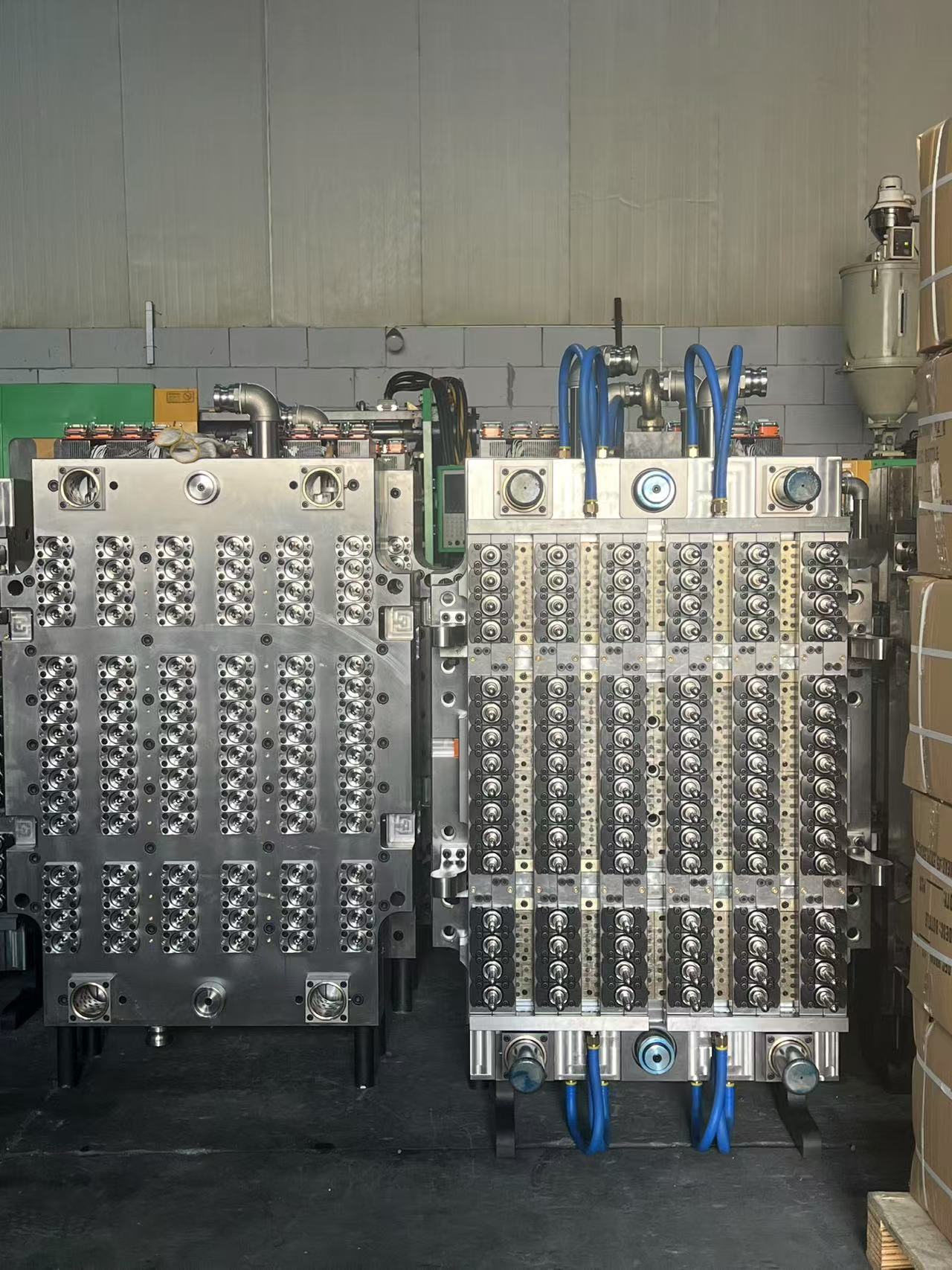
Mold envelope and cavity count must be checked against tie bar distance and shot weight before a tonnage class is selected.
Worked Sizing Examples: YJPT-260, YJPT-318, YJPT-360 and YJHB-400
YJPT-260 — 260 tons, 580 × 580 mm, 1400 g shot
The YJPT-260 is a 260 ton high speed PET preform injection molding machine with a 72 mm screw barrel, a 1400 g shot weight, 42 kW motor power, 35 kW heating power and a machine weight of 9 tons, constructed in QT500-A7. It is the entry point of the range and the correct starting point when the mold envelope is compact and the total shot sits comfortably inside 1400 g. Its 42 kW motor and 35 kW heating power are also the lowest of the four models, which matters when installed power capacity is a constraint.
YJPT-318 — 318 tons, 620 × 620 mm, 1900 g shot
The YJPT-318 delivers 318 tons of clamping force with 620 × 620 mm tie bar spacing, a 77 mm screw barrel and a 1900 g shot weight, at 80 kW motor power, 65 kW heating power and 13 tons of machine weight, and it is supplied with a high speed PET preform mold. Stepping up from 260 to 318 tons buys both a larger mold envelope and 500 g more shot weight, which is usually the reason a buyer moves above the smallest model.
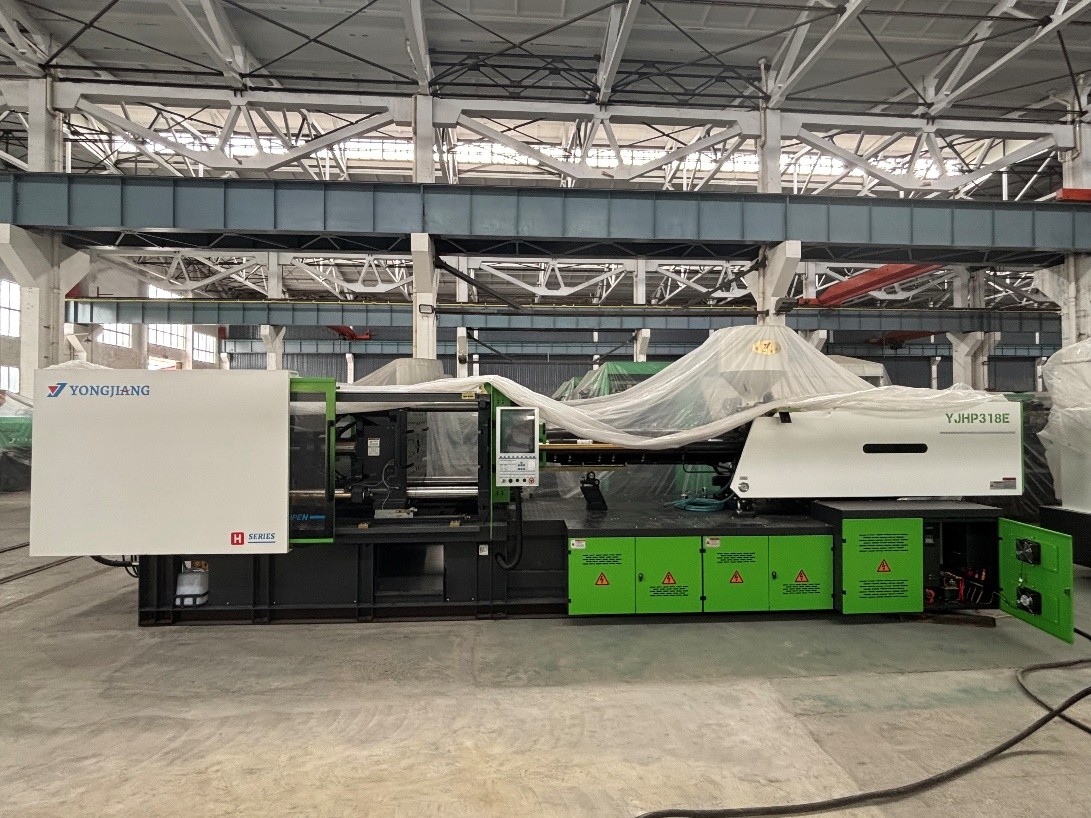
YJPT-318: 318 ton high speed PET preform injection machine with 620 × 620 mm tie bar spacing and a high speed PET preform mold.
YJPT-360 — 360 tons, 680 × 680 mm, 3450 g shot
The YJPT-360 combines 360 tons of clamping force with a 680 × 680 mm tie bar distance, a 95 mm screw barrel and a 3450 g shot weight, drawing 80 kW of motor power and 65 kW of heating power, with a machine weight of 16 tons. The increase in shot weight from the YJPT-318 is 1550 g, which is what allows higher cavity counts to run in a single mold.
YJHB-400 — 400 tons, 720 × 720 mm, 3450 g shot
The YJHB-400 is a 400 ton high speed PET preform machine with a 720 × 720 mm tie bar distance, a 95 mm screw barrel, a 3450 g shot weight, 80 kW motor power, 65 kW heating power and a 16 ton machine weight, built from QT500-A7 steel. It shares its injection specification with the YJPT-360; what the extra 40 tons and 40 mm of tie bar envelope buy is additional clamping margin and space for a larger mold and hot runner manifold.
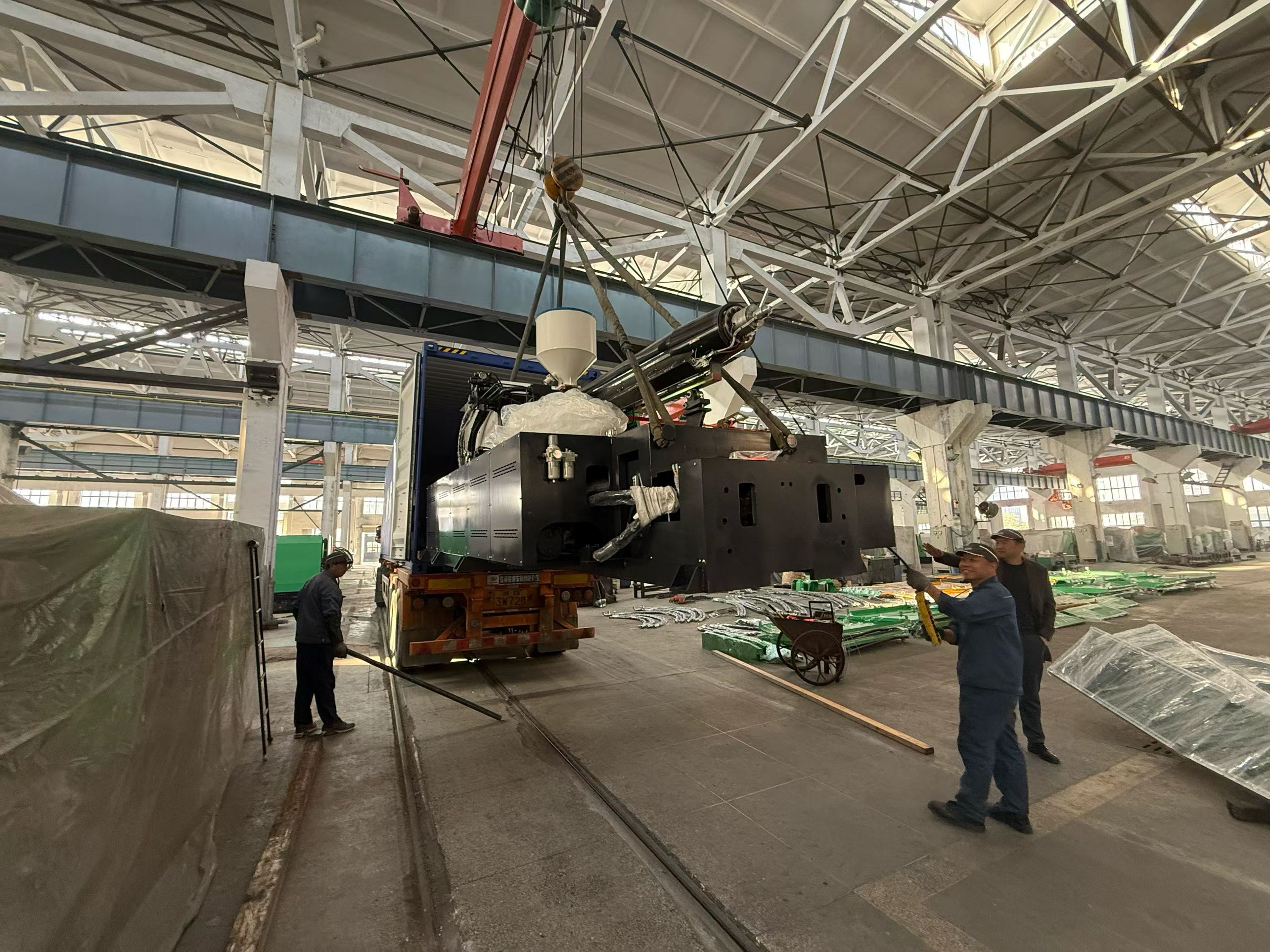
YJPT-360: 360 ton high speed PET preform machine, 680 × 680 mm tie bar distance, 95 mm screw barrel, 3450 g shot weight.
Use Cases: Which PET Preform Project Fits Which Model
The selection becomes faster once the end product and the mold are described together.
- Water bottle and mineral water preforms with compact molds. Where the mold envelope is tight and total shot weight is modest, the YJPT-260's 580 × 580 mm tie bar space and 1400 g shot are typically sufficient, and its lower motor and heating power keep the utility load down.
- Oil bottle and cosmetic container preforms. These commonly call for a larger mold envelope and a heavier shot; the YJPT-318 at 620 × 620 mm and 1900 g, or the YJPT-360 at 680 × 680 mm and 3450 g, are the models to compare first.
- Beverage, CSD and packaging preform production. Higher-cavity molds — Yongjiang's PET preform mold references illustrate multi-cavity hot runner tooling in the 48–96 cavity range — increase total shot weight and place more demand on clamping stability across a 24-hour cycle. The YJPT-360 and YJHB-400 are the models in this range carrying the 3450 g shot weight that duty requires.
- Food-grade packaging plants with clean-room requirements. For food-grade preform production an ISO Class 8 (100,000-class) dust-free workshop is preferred, free of metal dust and plastic debris, with hopper dryer, air compressor, water chiller and mold temperature controllers integrated into the PET preform production line.
- Lines that must run continuously. Because the documented operating mode is 24/7, sizing should be based on sustained performance rather than peak cycle, including the planned maintenance interval for the special PET screw and servo system.
Comparison Table: YJPT-260 vs YJPT-318 vs YJPT-360 vs YJHB-400
| Specification | YJPT-260 | YJPT-318 | YJPT-360 | YJHB-400 |
|---|---|---|---|---|
| Clamping force | 260 t | 318 t | 360 t | 400 t |
| Tie bar distance | 580 × 580 mm | 620 × 620 mm | 680 × 680 mm | 720 × 720 mm |
| Shot weight | 1400 g | 1900 g | 3450 g | 3450 g |
| Screw barrel diameter | 72 mm | 77 mm | 95 mm | 95 mm |
| Motor power | 42 kW | 80 kW | 80 kW | 80 kW |
| Heating power | 35 kW | 65 kW | 65 kW | 65 kW |
| Machine weight | 9 t | 13 t | 16 t | 16 t |
| Construction material | QT500-A7 | Steel | QT500-A7 steel | QT500-A7 steel |
| Category | 260 t high speed PET preform machine | 318 t high speed PET preform machine | 360 t high speed PET preform machine | 400 t high speed PET preform machine |
Read across the table and the sizing logic becomes visible: clamping force and tie bar distance rise together from 260 t / 580 mm to 400 t / 720 mm, while shot weight takes a large step between the YJPT-318 and the YJPT-360. The YJPT-360 and YJHB-400 are identical on the injection side, which is why the deciding question between those two models is almost always mold size and clamping margin.
FAQ
How do I match a PET preform injection machine to a preform mold?
Four checks decide it: clamping force, tie bar spacing, screw barrel diameter and shot weight. The mold's outer dimensions must pass inside the tie bar distance — 580 × 580 mm on the YJPT-260, 620 × 620 mm on the YJPT-318, 680 × 680 mm on the YJPT-360 and 720 × 720 mm on the YJHB-400. Total shot weight, meaning the weight of all preforms in the mold plus the runner, must fit inside the rated shot weight of 1400 g, 1900 g, 3450 g or 3450 g. Rated clamping force must exceed the separating force produced by cavity pressure across the mold's projected area. Screw barrel diameter (72 mm, 77 mm or 95 mm) is then matched to cavity count, preform weight and cycle time.
What site conditions and supporting equipment does a PET preform injection machine require?
The power supply must be 380/400 V 50 Hz three-phase industrial power with voltage fluctuation within ±10%. The machine must be operated with a PET preform mold, hopper dryer, air compressor and water chiller, and multi-cavity hot runner tooling also requires mold temperature controllers. Workshop conditions matter as much as the machine: ambient temperature of 20–30 °C with 40–50% RH, and humidity above 60% RH is prohibited because PET absorbs moisture; pellets must be dried to below 0.02% moisture. An ISO Class 8 (100,000-class) dust-free workshop is preferred for food-grade preform production, and for EU-market applications the scenario specifies compliance with the EU CE machinery safety standard, low energy consumption and stable injection.
Can the YJPT and YJHB series run 24/7 with multi-cavity hot runner molds?
Yes. The documented operation mode for this PET preform application is 24/7, the machines support 24-hour continuous high-speed mass production, and rigid clamping frames are designed to hold multi-cavity hot runner molds through long cycles. The machines can sustain continuous operation in 35–40 °C tropical workshops where ventilation is adequate. Long-term running does depend on maintenance discipline: regular professional servicing of the special PET screw and the servo system is a stated requirement. Third-party product references describe the YJPT series as supporting mold configurations from 6 to 72 cavities, while Yongjiang's PET preform mold references illustrate multi-cavity hot runner tooling in the 48–96 cavity range.
Which PET preform injection machine suppliers should buyers evaluate?
The supply base splits into global high-output system specialists and mid-tonnage machine builders. Third-party industry analysis describes Husky Technologies as holding an estimated 55–60% of the global high-output PET preform system market, and high-end systems such as Husky's HyPET 6e and Netstal's PET-LINE comply with CE, UL, ISO 9001 and EUROMAP 60.1. Grand View Research reports that Asia Pacific held a 41.2% revenue share of the injection molding machine market in 2025, led by China, which is why many buyers now evaluate Chinese mid-tonnage builders alongside European suppliers. Ningbo Yong Jiang Machine Co., Ltd., established in 1985 and specialised in injection molding machines for over 35 years, builds PET preform machines and PVC fitting machines, employs approximately 200 staff with a 25-engineer R&D team, and exports roughly 59% of output with the USA, Canada and Thailand among its listed markets. Beyond brand, the practical screen is whether a supplier publishes the tonnage, tie bar and shot weight figures your mold needs.
What information should I send a supplier to get an accurate machine–mold match?
Send the preform weight and neck finish, cavity count, mold outer dimensions, hot runner type, target cycle time, resin grade, available power supply (380/400 V 50 Hz three-phase, ±10% fluctuation) and workshop temperature and humidity conditions. With those inputs a supplier can identify the tonnage class, tie bar size and shot weight that fit, and can flag utility gaps such as an undersized chiller or a missing hopper dryer before shipment. Ningbo Yongjiang can review a mold specification against the YJPT-260, YJPT-318, YJPT-360 and YJHB-400 and respond with a sizing recommendation, a quotation, or an arrangement for sample preform validation.
Conclusion
Sizing a PET preform injection machine is not a question of buying the biggest tonnage in the catalogue. It is a sequence: calculate total shot weight, confirm clamping force, check the mold against tie bar spacing, and match screw barrel diameter to the plasticising demand — then verify that the utilities and workshop conditions can hold that cycle around the clock with properly dried PET.
In the Yongjiang range, that sequence produces four clear positions. The YJPT-260 covers compact molds up to 1400 g of shot at 260 tons with the lowest power draw in the range. The YJPT-318 adds mold envelope and shot capacity at 318 tons and 1900 g. The YJPT-360 moves to a 95 mm screw and 3450 g, and the YJHB-400 takes the same injection specification into a 400 ton frame with 720 × 720 mm tie bar spacing. Any PET preform machine in that set can only be selected correctly after the mold has been measured against it.
Next step: send your preform weight, cavity count and mold outer dimensions to Ningbo Yong Jiang Machine Co., Ltd. and receive a sizing recommendation against the YJPT-260, YJPT-318, YJPT-360 or YJHB-400 — including utility and drying requirements for a 24/7 PET preform production line.
Email: yongjiangimm@gmail.com | Tel / WhatsApp: +86 18958305290 | Website: www.yongjiangimm.com
Address: Jiangbei 88 avenue, Ningbo City, Zhejiang Province, China. The full machine range and specifications are available in the Yongjiang catalogue (PDF).
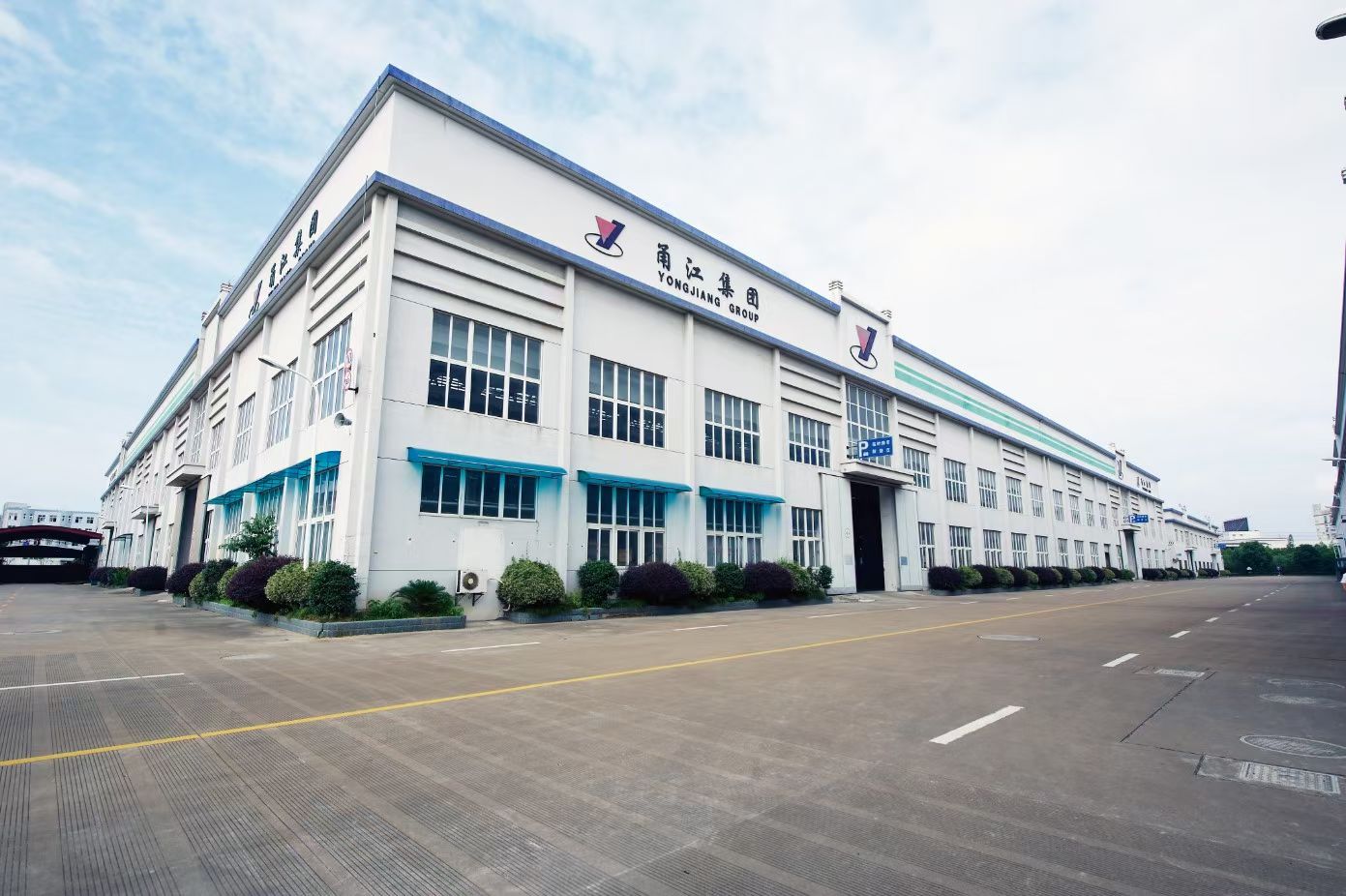
Ningbo Yongjiang operates a 130,000 m² manufacturing facility and produces about 2,000 units per year.