Model 1812 Cosmetic Pouch vs. Knitted Cosmetic Bag: A Head-to-Head Promotional Choice
Two cosmetic items can look equally suitable on a comparison sheet and behave very differently in a campaign. The Model 1812 cosmetic pouch and the T25210 knitted cosmetic bag — the knitted cosmetic bag variation of Yulite's polyester knitted bag — sit close together in purpose and far apart in construction, material story and decoration logic. This head-to-head is written for a brand buyer at decision stage who has already shortlisted both and now needs a defensible reason to choose one.
Short answer. Choose Model 1812 when the program needs a flat printable panel, a defined closure and a fiber the buyer can document. The model is produced as a drawstring cosmetic bag and as a zipper cosmetic pouch, in 100% cotton, polyester, organic cotton, recycled cotton, felt or padded fabric, with logos applied by embroidery, transfer printing, digital printing or silk printing. Choose the T25210 knitted cosmetic bag when the looped knit surface is itself the reason for buying the item. Where both requirements matter, sample both before approving artwork. This comparison makes no price claim and no in-use performance claim, because the supplied product data does not support one.
What each product actually is
Model 1812: one model, two formats, six material options
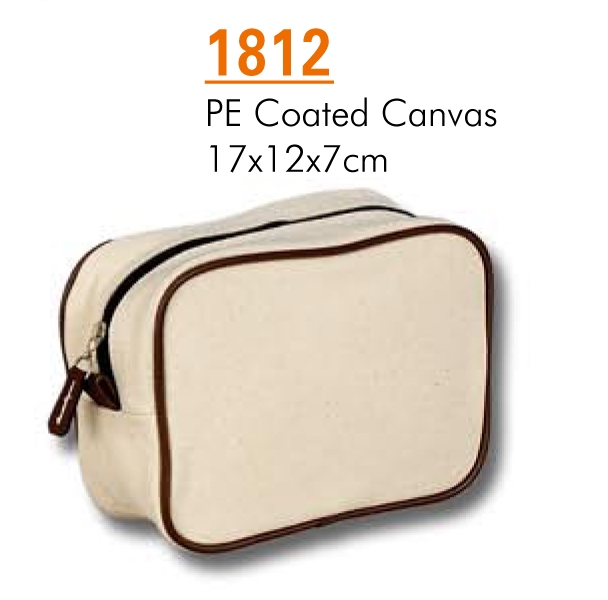
Model 1812 is Yulite's cosmetic pouch model, and it is configurable rather than fixed. It is produced in two formats: a drawstring cosmetic bag that closes by gathering the top of the body, and a zipper cosmetic pouch that closes with a slider and gives the contents a defined opening. The body can be specified in 100% cotton, polyester, organic cotton, recycled cotton, felt or padded fabric, and the logo can be applied by embroidery, transfer printing, digital printing or silk printing.
That configuration is the product. Format decides how the item opens and closes; material decides what the surface looks and feels like; decoration decides what the artwork can do on that surface. Locking the three in that order prevents the common situation in which an approved logo has to be redrawn because the body or the closure was chosen first.
T25210: a knitted cosmetic bag built from polyester knit
The T25210 is a polyester knitted bag, and in its knitted cosmetic bag variation the same knitted construction is applied to a small cosmetic format. Where Model 1812 presents a flat panel built from the chosen material, a knitted body is formed from interlocking yarn loops. That construction gives the surface its own texture, and knitted fabric generally has more give than a flat woven panel of comparable weight.
The consequence for a buyer is straightforward. The knit is not a neutral substrate waiting for a print; it is the feature being purchased, and the decoration brief has to respect it rather than override it.
Why this is a construction decision, not a style decision
Cosmetic pouches are small, handled often and kept well beyond the campaign that produced them. That is why the format decision deserves more attention than the colour card. Three failure modes recur in promotional pouch programs.
- Choosing on unit cost alone. A pouch that saves money but cannot carry the approved artwork, or cannot be documented in line with the sustainability message attached to it, usually costs more to correct than it saved.
- Choosing the decoration method before the substrate. Artwork that looks resolved on screen meets a different reality on a looped knit than on a flat cotton panel. Method and material have to be decided together.
- Treating a material name as a certification. Organic cotton or recycled cotton describes a fiber choice. It does not by itself prove that a specific certificate covers the order, and that has to be checked separately and in writing.
Read correctly, a pouch order is a chain: format, then material, then decoration, then documentation, then sample. Move one link and the others follow.
Industry background: why material evidence is now part of the brief
Branded merchandise is a large, measured market, and the sustainability segment inside it is no longer an occasional request. PPAI and Oxford Economics report that global spending on branded merchandise reached USD 338.3 billion in 2025, and that the industry supported USD 472.3 billion in global GDP. In the United States, ASI's 2024 Counselor State of the Industry data put sustainable products at 13.77% of total promotional industry sales — USD 3.69 billion — a 20% increase on the previous year.
Both figures describe branded merchandise and the US promotional products market overall. Neither measures demand for cosmetic pouches specifically, so they should not be used to size a pouch program. What they do establish is a market in which a material choice is increasingly something a buyer has to justify internally, which turns fiber documentation into a purchasing criterion rather than a marketing extra.
Henan Yulitepromotion Co., Ltd. (Yulite) has manufactured promotional bags since 2008 and exports to more than 86 countries, with main markets in the EU, USA, Japan and Australia. The company holds ISO 9001, OEKO-TEX Standard 100 and GRS certifications and has passed BSCI and SEDEX audits; an SGS onsite verification record dated 2026 lists 18 years in the industry. These are supplier-level credentials, and they are the reason a documented material conversation is possible at all. They are not proof that every item in every material is covered by every certificate.
Construction head-to-head
Drawstring cosmetic bag (Model 1812)
A drawstring body is soft and unstructured: the pouch closes by gathering, so there is no rigid opening and no slider. In promotional use this suits programs where the pouch is one element of a set, or where the item should pack flat and light. The trade-off is presentation. A gathered top reads as casual, and the artwork has to work on a body that is not held in a fixed shape.
Zipper cosmetic pouch (Model 1812)
The zipper format gives a defined opening and an enclosed body, which is what most buyers picture when they specify a cosmetic pouch for a gift-with-purchase or an amenity kit. A slider and tape add construction steps and a second material to specify, because zipper tape and pull are separate components from the pouch fabric. They should be specified together with the body material, not afterwards.
Knitted cosmetic bag (T25210)
The knitted variation carries its structure in the fabric itself. The looped knit gives thickness, texture and a visible direction of yarn, which makes the item read as a textile accessory rather than a printed pouch, and which makes the fabric the dominant visual element. The practical implication is that the decoration brief should be written around the knit, not carried over unchanged from a flat-panel pouch project.
None of these three constructions is inherently better than the others. The drawstring format fits a soft, casual, packable item; the zipper format fits a defined, enclosed gift; the knitted cosmetic bag fits a textile-led gift where surface character is the message.
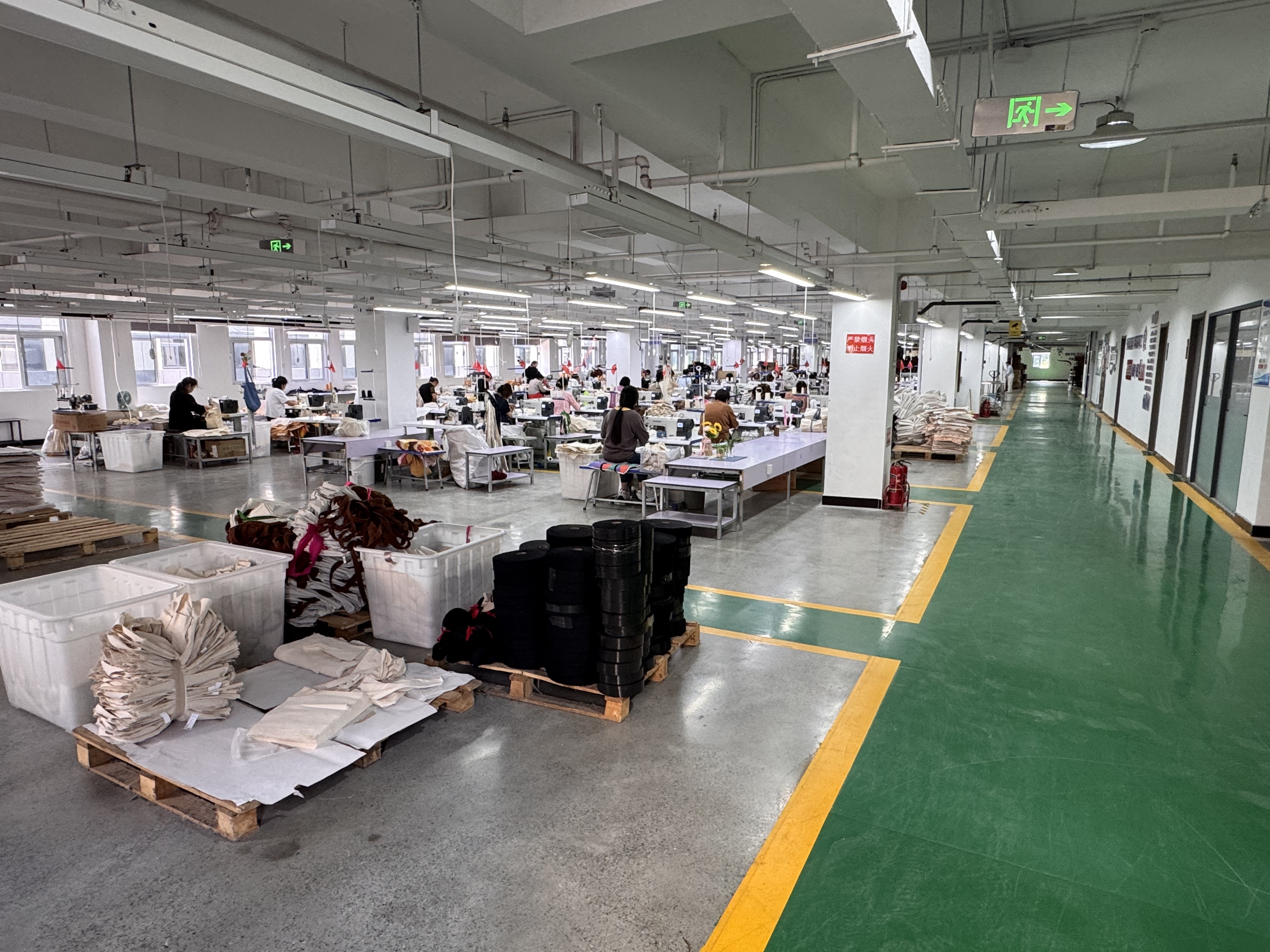
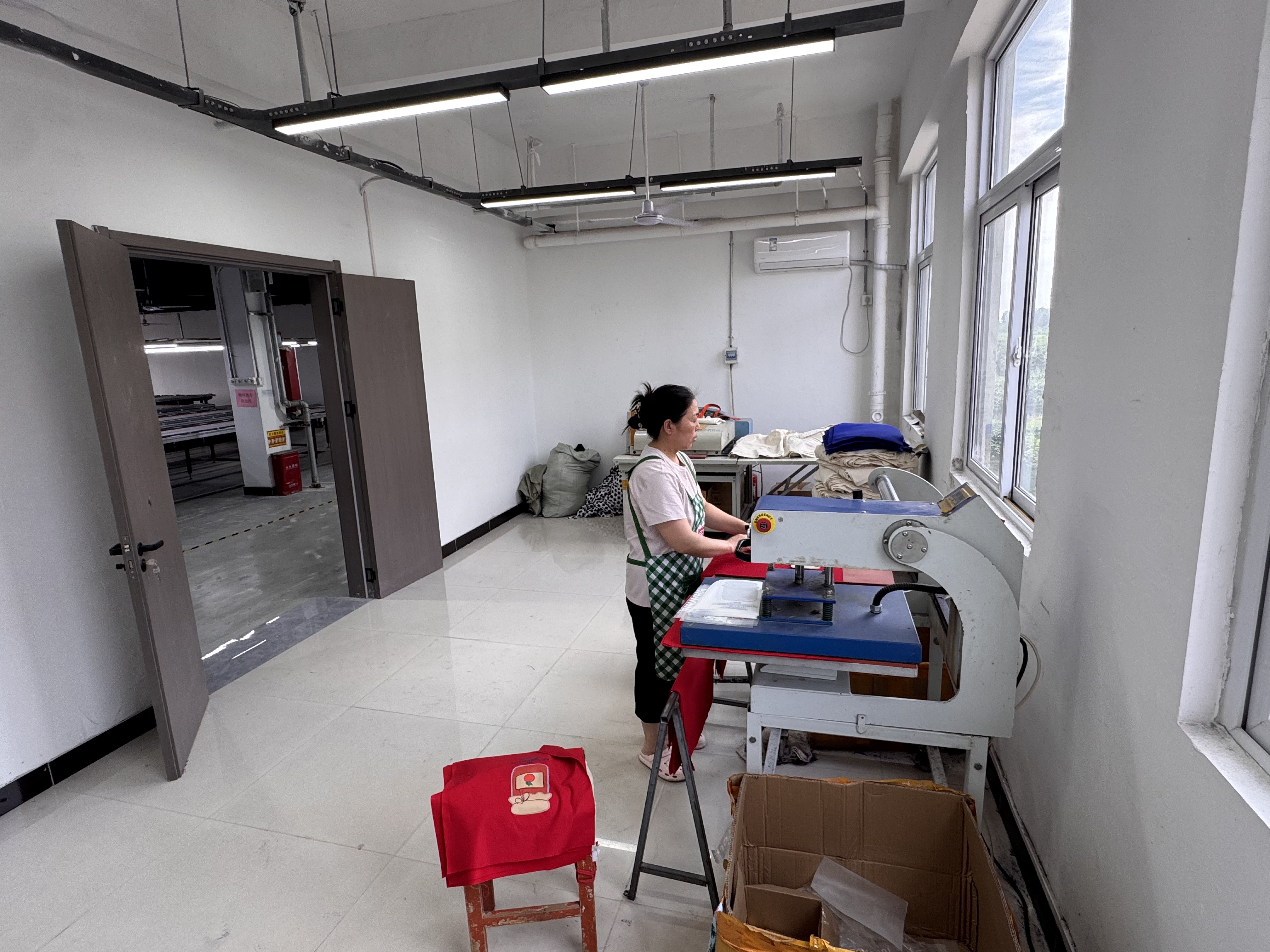
Pouch construction is decided in the sewing line: closure type, body panels and finishing are set before decoration.
The material story behind Model 1812
Model 1812's six material options are not interchangeable finishes. Each one supports a different statement in the campaign copy, and each one carries a different documentation burden.
- 100% cotton — a single natural fiber position, the easiest claim for a consumer to understand.
- Organic cotton — a fiber-sourcing claim that only holds if the sourcing documentation for the specific order holds. Request it before the copy is written.
- Recycled cotton — a recycled-content claim, with the same rule: the claim is only as strong as the paperwork behind the order.
- Polyester — a synthetic option that gives the pouch a consistent, uniform surface, useful when the artwork rather than the fiber is the story.
- Felt — a dense, matte material that gives the pouch body and a non-shiny surface.
- Padded fabric — adds a cushioned layer, changing the hand feel of the pouch and giving decoration a softer, raised surface to sit on.
Storage behaviour belongs in the same conversation, because promotional stock is often bought once and released over several waves. Yulite's material comparison data notes that cotton bags can be stored for up to 10 years without damage, which is relevant if the cotton options are being bought in a single run for a multi-stage campaign.
The T25210 knitted cosmetic bag tells a narrower but sharper material story: polyester knit, presented as knit. It is a texture-first proposition, not a fiber-first one. If the campaign's sustainability message depends on recycled or organic content, Model 1812's material list is where that argument can actually be built.
Certification wording needs a separate check either way. Yulite holds OEKO-TEX Standard 100 and GRS certifications, but the buyer should confirm which certificate covers the specific fabric and the specific order before repeating a certification claim in consumer-facing copy. Yulite's material control includes a lab test on each lot of fabric before mass production, run to control heavy-metal risk, and its documentation includes REACH test reports.
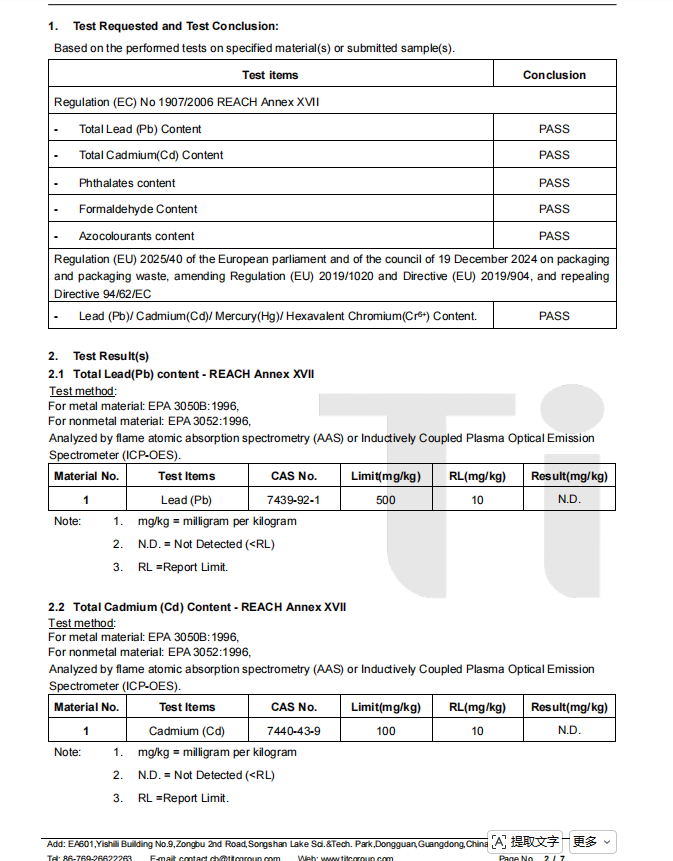
Material claims travel with documents: lot-level test reports support what the campaign copy is allowed to say.
Decoration: where the logo can actually go
Model 1812 lists four logo methods — embroidery, transfer printing, digital printing and silk printing. Yulite's wider decoration set across its bag lines also includes heat transfer printing and screen printing, and the factory runs an independent sampling room with dedicated sample workers, delivering samples within 3 days.
Each method behaves differently, and the choice should follow the artwork rather than the other way round.
- Embroidery builds the mark in thread, producing a raised, tactile finish that suits compact logos, monograms and short brand names, and that works naturally on felt and padded bodies where a flat print would sit on an uneven surface.
- Transfer printing applies a prepared design to the surface under heat, handling multi-colour artwork in one pass with a smooth, defined edge.
- Digital printing prints the artwork directly, which makes it the practical route for detailed or photographic designs and for shorter runs where screen set-up is hard to justify.
- Silk printing pushes ink through a prepared screen, the classic route for solid spot colours and for repeat orders running the same artwork again.
On the T25210 knitted cosmetic bag the logic changes. A looped knit surface is not a flat print field: the texture sits between the artwork and the eye, and the fabric already provides visual interest. Yulite's decoration methods can all be assessed against the knit, but which one suits a given logo has to be established on a physical sample rather than assumed from a flat-panel precedent. A buyer who needs the logo to dominate is usually better served by a flat body; a buyer who wants the knit to lead can keep decoration restrained.
Comparison table: Model 1812 vs. the T25210 knitted cosmetic bag
| Decision factor | Model 1812 cosmetic pouch | T25210 knitted cosmetic bag |
|---|---|---|
| Available formats | Drawstring cosmetic bag; zipper cosmetic pouch | Knitted cosmetic bag, as the cosmetic variation of the polyester knitted bag T25210 |
| Body construction | Flat fabric body built from the chosen material | Knitted body formed from interlocking polyester yarn loops |
| Material options | 100% cotton, polyester, organic cotton, recycled cotton, felt, padded fabric | Polyester knit |
| Closure | Drawstring with gathered top, or zipper with slider | Confirm the closure specification with the supplier for the order |
| Logo methods listed | Embroidery, transfer printing, digital printing, silk printing | Confirm against the knit on a sample; Yulite's methods include heat transfer, screen printing, digital printing and embroidery |
| Surface character | Flat panel; artwork-led | Textured loop surface; material-led |
| Documentation to request | Fiber composition, certificate coverage for the order, lot test report | Yarn composition, certificate coverage for the order, lot test report |
| Brief it typically answers | Beauty gift-with-purchase, amenity kit or retail loyalty gift needing a printed logo and a defined opening | Textile-led gift where knit texture should read as part of an apparel or lifestyle range |
| Sample check before approval | Logo position and legibility on the chosen fabric; closure operation | Logo legibility and hand feel on the knit; closure specification |
Step-by-step: choosing between them in five decisions
- Fix the campaign story first. If the message is a fiber claim such as organic or recycled cotton, Model 1812 is the only one of the two that offers those material options. If the message is textile character, the knitted cosmetic bag carries it without relying on decoration.
- Choose the format. Decide between the drawstring cosmetic bag, the zipper cosmetic pouch and the knitted cosmetic bag before discussing artwork. Closure choice changes the body, the component list and how the item presents in the hand.
- Match material to the claim you have to defend. A sustainability statement needs fiber documentation; a design statement needs a surface that lets the artwork read. Write the claim only after the documentation is in hand.
- Choose decoration against the substrate, then sample. Take the logo through the sampling room in the intended material. Yulite's stated sample turnaround is within 3 days, which makes testing two versions realistic rather than theoretical.
- Lock quality and delivery into the order. Each lot of fabric is lab tested before mass production, and Yulite runs an independent professional quality inspection process. Production risk is managed through a strict order planning system, reserved production time for each order, own power generation equipment so production is not interrupted by power shortage, and sub-factory support to complete orders in parallel.
Where each item fits: conditional use cases
The scenarios below are decision examples, not documented campaign results. They show how the criteria above translate into a brief.
- Beauty brand gift-with-purchase. If a printed logo must stay legible at small size and the pouch will be handled in a retail environment, the zipper version of Model 1812 in cotton or polyester, printed digitally or by silk printing, gives the most controllable result.
- Hotel or airline amenity kit. If the pouch is filled and handed over as a closed item, the zipper cosmetic pouch presents better than a gathered top, and a compact embroidered or single-colour printed mark keeps the unit quiet.
- Subscription box or influencer kit. If the item has to pack flat and be inexpensive to ship, the drawstring cosmetic bag suits the format; if the unboxing should feel like a textile gift, the knitted cosmetic bag does that work through the fabric alone.
- Apparel or lifestyle brand merchandise. If the brand already sells knitwear, the T25210 knitted cosmetic bag extends that texture into an accessory, so the merchandise reads as part of the range rather than as a printed giveaway.
- Sustainability-led campaign. If the message is recycled or organic content, Model 1812 in recycled cotton or organic cotton, with the matching documentation attached, is the version that can be defended in writing.
Quality and compliance checks that apply to both items
Three checks sit above the product choice, because they apply whether the program runs on Model 1812 or on the knitted cosmetic bag.
- Certificate scope. Company-level credentials — ISO 9001, OEKO-TEX Standard 100, GRS, and the BSCI and SEDEX audits held by Yulite — are the starting point. The certificate that matters is the one covering the specific fabric and order, so ask for the reference, the material it covers and its validity.
- Lot-level testing. Heavy-metal risk is controlled by lab-testing each lot of fabric before mass production, and the documentation set includes REACH test reports. This is the evidence behind a chemical-safety statement, so request it with the order rather than after delivery.
- Regulatory scope. Do not over-apply unrelated rules. The US regulation 49 CFR 178.520 sets textile-bag requirements, including codes 5L1, 5L2 and 5L3 and a maximum net mass of 50 kg, for hazardous-material packaging; it is not a promotional-bag standard. Applying it to a cosmetic pouch misstates the compliance position, and confirming the actual destination-market requirements with a compliance specialist is the safer route.
Frequently asked questions
Which certificate can we cite for Model 1812 or the T25210 knitted cosmetic bag?
Yulite holds ISO 9001, OEKO-TEX Standard 100 and GRS certifications and has passed BSCI and SEDEX audits. Those are company-level credentials, so the certificate that matters is the one covering the specific fabric and the specific order: ask for the certificate reference, the material it covers and its validity before repeating a certification claim. Yulite also lab-tests each lot of fabric before mass production to control heavy-metal risk, and its documentation includes REACH test reports.
Can both items carry a custom logo, and does the method change the choice?
Model 1812 lists four logo methods — embroidery, transfer printing, digital printing and silk printing — because its flat fabric body accepts them as configured options. The T25210 knitted cosmetic bag presents a looped knit surface, so the method should be confirmed against a physical sample; Yulite's available methods include heat transfer printing, screen printing, digital printing and embroidery. If a detailed multi-colour logo has to reproduce precisely, the flat-bodied Model 1812 removes a variable. If the knit texture is the point of the item, keep decoration restrained and approve it on a sample.
Which material option supports a sustainability claim?
Within Model 1812, organic cotton and recycled cotton are the options that support a fiber-based sustainability statement, and both depend on order-level documentation. 100% cotton supports a natural-fiber position, polyester and felt keep the message on design rather than fiber, and padded fabric adds a cushioned structure. The T25210 knitted cosmetic bag is a polyester knit, which is a texture-led rather than a fiber-led story. In every case the wording of the claim should match the documentation actually received.
How quickly can we see samples of both?
Yulite runs an independent sampling room with dedicated sample workers and states that samples can be delivered within 3 days. Request both in the same brief — one Model 1812 pouch in the intended material and format, and one knitted cosmetic bag — with the proposed logo applied, because a sample is the only reliable way to judge decoration on a flat panel against decoration on a knit.
China promotional bag manufacturers versus local suppliers for bulk orders: how should we decide?
Treat it as a capability comparison rather than a country comparison. Score each supplier on five points: whether the model and material range covers your brief, including drawstring and zipper pouch formats and material choices such as cotton, organic cotton, recycled cotton, polyester, felt and padded fabric; which decoration methods they can apply and whether they can sample them; what documentation they can attach to the order; how production risk is controlled; and how consistently they can repeat the item on a reorder. On the last two points, Yulite's stated controls are a strict order planning system, reserved production time for each order, own power generation equipment and sub-factory support, alongside an independent quality inspection process. Volume bands, artwork complexity and delivery windows decide whether a nearby supplier or a full-range manufacturer is the better fit, and no price benchmark is established here. For a program built on either of the two items in this comparison, the practical next step is a sample request in your own material and artwork.
Conclusion
The choice comes down to what the item has to prove. If the program has to prove a fiber position and reproduce a logo precisely on a controlled surface, Model 1812 does that through its material list and its four listed decoration methods, in either the drawstring or the zipper format. If the program has to prove that the merchandise belongs in a textile world, the T25210 knitted cosmetic bag makes that argument through construction rather than through print.
Before either is approved, three things should be in hand: a physical sample with the actual artwork applied, confirmation of which certificate covers the specific fabric and order, and a written production and quality plan.
For buyers who want to see the wider range before locking a pouch decision, the 2026 Yulite catalogue (PDF) is available for download and covers the full promotional bag line.
Have Questions or Need More Details?
Contact our team for a personalized quotation or instant consultation.
Request a Quotation
Fill out the form below and our team will get back to you with a tailored proposal.
WhatsApp Direct Chat
Prefer to chat in real-time? Message us on WhatsApp for instant assistance & quick answers.
- Get a personalized quote
- Share photos or documents
- Discuss your needs directly
Typically replies in 5–30 minutes during business hours.