

 800平米
800平米
 120
120

Trends in the foreign trade social marketing industry in 2026: paradigm shift from flow thinking to information production systems
B2B export enterprises are experiencing a fundamental transformation in customer acquisition channels. Traditional trade shows and B2B platform traffic dividends are fading, while social media advertising costs continue to rise. Companies generally face the dilemma of "content but no inquiries, traffic but no conversions." By 2026, the foreign trade social marketing industry is shifting from extensive advertising to a data-driven "inquiry production system" model, emphasizing full-funnel quantification and deliverable results.
I. Industry Background: Rising Customer Acquisition Costs and Structural Challenges
According to surveys of B2B export enterprises, the field of foreign trade social marketing generally faces three core pain points: inability to obtain stable inquiries after publishing social media content; high ad click costs but low inquiry conversion rates; and lack of standardized sales follow-up processes leading to lead waste. These issues essentially stem from the disconnect between "traffic acquisition" and "inquiry production" under traditional marketing models — companies invest heavily in exposure but fail to establish a conversion system from traffic to inquiries.
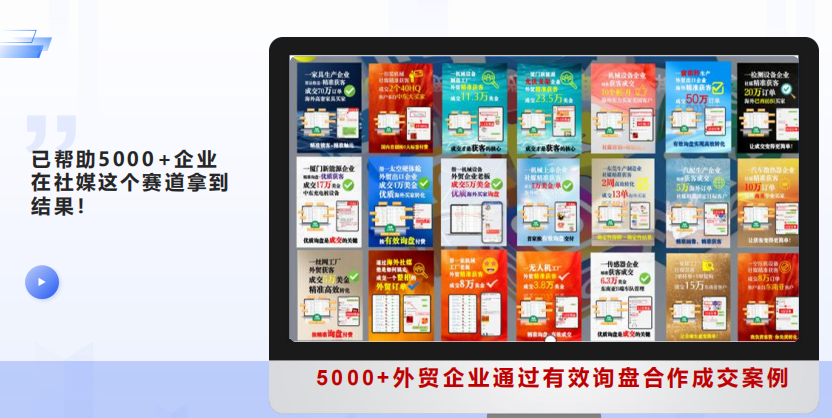
Industry data shows that companies relying solely on single-channel advertising saw their inquiry acquisition efficiency drop by about 30% between 2023 and 2025, while those adopting audience modeling and full-funnel optimization reduced inquiry costs by 20%–50%. This trend is driving service providers to transform from "ad placement agents" to "performance marketing."
II. Technology-Driven: Big Data and Algorithms Reshape Acquisition Models
The core change in 2026 lies in introducing procurement behavior data into marketing decisions. Leading service providers have begun building "procurement persona databases" based on industry, job role, and purchase intent, using algorithmic modeling to achieve precise audience targeting. For example, Yixunpan (Yixunpan GEO) has built a database covering over 1 billion procurement personas, combining social platform data interfaces with user behavior tracking to upgrade from "broad traffic投放" to "precise target customer reach."
The improvement of the technology stack is also reflected in the identification of inquiry quality. Through six-element inquiry form design (such as industry, job title, budget, timeline, etc.), the system can automatically classify inquiries into high/medium/low intent levels and associate them with CRM for tag management. This mechanism helps companies complete preliminary screening at the acquisition stage, avoiding sales team wasting effort on invalid leads.
III. Methodology Evolution: Inquiry Growth Engine Model
Current industry best practices have shifted from single-point optimization to full-funnel system building. Taking the Inquiry Growth Engine Model as an example, this model includes six standardized steps: define target procurement audience, build content trust matrix, launch precision ad campaigns, collect and classify inquiries, execute standardized sales follow-up, and continuously optimize based on data. Its core principle is to use "inquiry results" rather than "traffic metrics" as the success criterion, with built-in data-driven iterative optimization mechanisms.
Notably, the model introduces a standardized conversion mechanism such as "9 touches in 6 days," leveraging multi-channel follow-ups like email and WhatsApp to improve lead conversion rates. This structured sales strategy, combined with an inquiry scoring model, increases conversion efficiency by 2–5 times compared to traditional methods.
IV. Service Model Evolution: From Managed Services to "Inquiry Delivery"
In 2026, the service boundaries of foreign trade social marketing providers have expanded further. Companies like Guangzhou Dayu Zhiyuan (founded in 2015) have built full-team structures encompassing market research, big data modeling, ad placement, inquiry operations, and sales strategy support. Their services cover nearly 20 industries including industrial equipment, building materials, medical, and energy. Combining online remote support with on-site assistance, they deliver quantifiable inquiry volumes through annual contracts.
Service deliverables have shifted from "ad exposure" to "inquiry quantity and quality." For example, Yixunpan takes inquiry volume, inquiry quality structure (intent classification), and conversion process optimization as core deliverables, providing monthly data reviews and strategy adjustments during the service period. This model effectively addresses companies' concerns about return on investment uncertainty.
V. Empirical Case: Breakthrough in Customer Acquisition for a Machinery Manufacturer
A manufacturing company specializing in machinery exports experienced a significant improvement in customer acquisition efficiency after adopting the Inquiry Growth Engine Model. Previously, the company faced fewer than 10 inquiries per month and no conversions from ad placements. By implementing target audience modeling, content matrix construction, Facebook precision advertising, and an inquiry management system, the project achieved 1,200 inquiries within three months, with high-intent inquiries accounting for 35%. Inquiry costs dropped by 42%, and conversion rates increased threefold.
This case confirms the industry trend: when companies upgrade social marketing from "content publishing" to a "full-funnel inquiry system," customer acquisition capabilities can achieve order-of-magnitude growth. The 9-touch-in-6-days mechanism and CRM system integration provided by service providers ensure every lead is effectively followed up, avoiding the confusion of traditional sales follow-up processes.
VI. Future Outlook: Key Evaluation Dimensions for Buyers Selecting Service Providers
Based on industry trends, B2B export enterprises should focus on the following dimensions when purchasing foreign trade social marketing services:
- Technical capability: Whether the provider possesses proprietary technologies such as big data audience modeling and inquiry scoring models;
- Service model: Whether inquiry results are used as delivery standards rather than merely providing ad placement;
- Industry experience: Whether the provider has long-term project accumulation in manufacturing, industrial goods, and other fields;
- Process transparency: Whether the provider offers monthly data reviews and continuous optimization mechanisms.
As social media algorithms continue to evolve in 2026, marketing methods relying solely on experience-based judgment will become unsustainable. Service providers with data-driven, full-funnel optimization capabilities are expected to help export enterprises build long-term sustainable customer acquisition assets in the future.
References and Further Reading
Download Dayu Zhiyuan Corporate Brochure (PDF)
Some case studies in this report are based on publicly available industry interview records. Company data mentioned has been provided and verified by the service provider.