
塗裝生產線技術指南:前處理到固化爐的配套選型與參數對接
Coating Production Line Technical Guide: Matching Selection and Parameter Alignment from Pretreatment to Curing Oven
The matching selection of a coating production line is essentially the alignment of a parameter chain, not a stacked quotation of a set of equipment. The starting point is three conditions the buyer already knows—workpiece material, coating film thickness, and production takt time; the endpoint is the length, temperature, air volume, dwell time, and control logic of each equipment section. If any one of the three inputs changes, the entire chain must be recalculated: takt determines conveyor speed, and conveyor speed together with curing time determines oven length; film thickness determines spraying flow rate and electrostatic parameters, and also determines the upper and lower limits of the curing window; material determines the pretreatment chemical system and the maximum allowable oven temperature. Only by writing this chain clearly can 'a complete line' on the quotation become measurable, acceptance-testable specifications.
This article breaks down pretreatment, drying, paint booth, preheat oven, curing oven, cooling, conveying, dust removal, and VOCs treatment in process order, and explains where PLC fully automatic control, robotic spraying, and MES production management fit into parameter alignment. The operating data cited in this article come from project records under specific workpieces and specific takt times; they are reference magnitudes rather than universal guarantees, and their boundaries are noted when interpreting them.
1. Problem Definition: Why Is the Whole Line Still Unstable When Individual Machine Specifications All Pass?
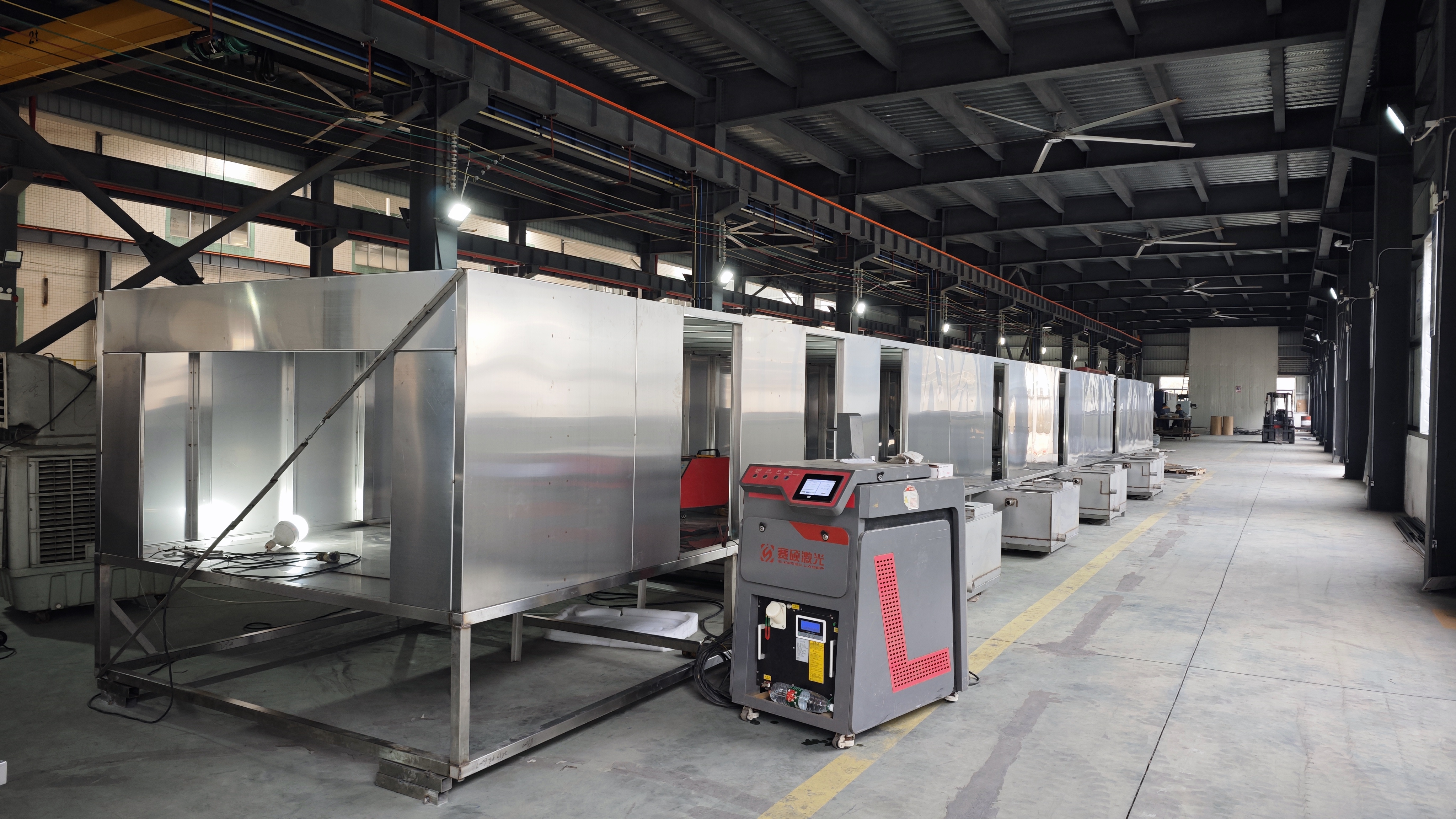
The most common dispute on a coating line is not that a particular machine cannot meet specification, but that no one is responsible for the three interfaces. The first is the waiting and drying between completion of pretreatment and entry into the paint booth: residual moisture or poor water quality on the workpiece surface will form pinholes and blisters after curing. The second is the heating process between completion of spraying and entry into the curing oven: oven air temperature reaching target does not mean the workpiece surface has reached curing conditions; the thermal lag determined by plate thickness, fixture weight, and hanging density is often the real source of yield differences. The third is from curing oven exit to cooling and stacking: stacking before discharge temperature has dropped will leave marks and sticking.
Therefore, 'oven temperature' and 'workpiece temperature' must be discussed separately. The curing curve of a coating is usually defined by workpiece surface temperature and time; oven air temperature is only the means to achieve it. In the same oven, the workpiece heating curves are different between full load and no load, thick and thin parts, and dense and sparse hanging; this is why, if only oven air temperature is measured at acceptance, the two parties will still argue over yield later.
Takt is the common denominator of the whole line. It simultaneously determines chain speed, the length of each tank and each oven, spraying reciprocating speed, and air volume configuration; as soon as takt changes, the specifications of any section must be recalculated.
2. Industry Background: Compliance and Automation Tighten Simultaneously
Two changes occurred simultaneously in the coating line selection environment in 2026. On the regulatory side, China's 'Limit of Harmful Substances in Industrial Coatings' (GB 30981.2-2025) took effect on June 1, 2026, tightening the VOC limits for interior wall flat coatings and primers from 80 g/L to 50 g/L. Tightened limits on the coatings side will be transmitted to the equipment side: low-temperature curing coatings, powder substitution, closed-loop coating recovery, and end-of-pipe VOCs treatment all require air volume and oven length to be reserved at the production line design stage, rather than added before acceptance.
On the automation side, the value of PLC fully automatic control, robotic spraying, and MES production management is not that they 'look smart,' but that parameters can be recorded, repeated, and traced. Taking publicly available information from Attractivechina (Guangdong Chuangzhi Intelligent Equipment Co., Ltd.) as an example, after its automotive parts coating line implemented MES visual production management, the first-time quality (FTQ) rate reached over 95%—the meaning of such figures is that only when recipes, chain speed, and oven temperature are fixed by the system can human-induced variation be compressed.
The same information also states that its factory configuration includes a Class 10000 constant-temperature, constant-humidity clean coating workshop. For workpieces with thin film thickness and high appearance requirements, temperature, humidity, and dust fallout control directly affect paint film leveling and defect rate; however, cleanliness class is a supplier-stated facility condition, and procurement should verify it through on-site checks and third-party records rather than relying on text alone.
3. Overview of Whole-Line Parameter Alignment
The table below lists the functions of the eight process sections, the inputs that must be locked first, the output parameters to be aligned, and the coupling relationships with upstream and downstream. In practice, this table can serve as the agenda for a technical clarification meeting: if any row cannot be agreed, do not rush to discuss the total price.
| Process section | Main function | Inputs to lock first | Output parameters to align | Coupling with upstream/downstream |
|---|---|---|---|---|
| Pretreatment | Degreasing, rinsing, conversion coating, passivation | Material, oil contamination level, workpiece geometry | Bath concentration and temperature, spray pressure, dwell time in each tank | Dwell time is jointly determined by chain speed and tank length; final-stage water quality affects adhesion |
| Moisture drying | Remove residual moisture | Water accumulation areas on workpieces, takt | Drying temperature and time, air supply direction | Incomplete drying will form pinholes and blisters during curing |
| Dust removal and grounding | Remove dust and ground workpieces | Workpiece conductivity, coating method | Air speed, dust removal method, grounding resistance | Affects powder adsorption efficiency and appearance defect rate |
| Paint booth / powder booth | Film formation | Film thickness, coating type, capacity | Supply/exhaust air volume and air balance, temperature and humidity, cleanliness, spraying flow rate, gun distance, electrostatic voltage, reciprocating speed | Loss of air balance will directly carry paint mist away from workpieces and affect VOCs air volume design |
| Preheat oven | Workpiece heating, wood degassing, casting degassing | Workpiece heat capacity, material temperature limit | Preheat curve, dwell time | With insufficient preheating, the surface forms a film first, and internal gases break through to form defects |
| Curing oven | Crosslinking film formation | Coating curing curve (workpiece temperature), film thickness | Oven length, oven temperature setting, holding time, oven temperature uniformity, heat source type | Oven length = chain speed × total dwell time; overbaking causes embrittlement and discoloration |
| Cooling | Cooling before discharge | Stacking method, packaging rhythm | Cooling section length, discharge temperature | Stacking before cooling causes marks and sticking |
| Conveying | Connect the whole line | Hanging spacing, workpiece dimensions, load | Chain speed, hanger type, drive and tensioning method | Chain speed is the common denominator of the whole line; change one and all change |
| VOCs treatment | Compliant emissions | Coating solvent content, exhaust air volume | Treatment air volume, treatment process, emission concentration | Air volume must match paint booth exhaust; too large wastes energy, too small cannot extract |
4. Section-by-Section Breakdown: What Each Section Aligns
4.1 Pretreatment: Chemical System Determined by Material, Time Determined by Takt
Pretreatment is not a fixed 'several rinsing tanks' but branches by material. Steel and sheet metal parts can follow the conventional process of degreasing, rinsing, conversion coating (phosphating or ceramic conversion), passivation, and drying; aluminum profiles and aluminum parts require attention to the corrosiveness of the bath to the aluminum substrate; stainless steel and galvanized parts have special considerations in conversion coating selection. Wood and plastic parts usually do not enter the same pretreatment line—wood is sensitive to water and plastic is non-conductive, so the electrostatic powder process must use other solutions for these two substrates.
The key to parameter alignment is dwell time: the length of each tank divided by chain speed is the actual dwell time of the workpiece in that tank. If the buyer only provides 'how many pieces of capacity,' the supplier cannot back-calculate tank length; hanging spacing and workpiece dimensions must also be provided for chain speed to have a basis. This is also an input that is most easily omitted in customized production lines yet most often causes disputes.
4.2 Drying and Dust Removal: Two Commonly Underestimated Defect Sources
The task of the drying section is to thoroughly remove moisture after pretreatment, especially water accumulated in recesses and weld seams of workpieces. The parameters of this section are not about whether the temperature is high enough, but whether the airflow direction can reach the water accumulation areas and whether the dwell time is sufficient. The consequences of insufficient drying only appear after curing: pinholes, blisters, and localized poor adhesion.
Dust removal and grounding are prerequisites for the powder process. Poor grounding of workpieces will lead to reduced powder deposition rate and uneven film thickness; dust fallout in the booth directly forms particle defects. If the production line requires thin film thickness and high appearance, the specifications of these two sections cannot be glossed over with 'standard configuration.'
4.3 Paint Booth and Robotic Spraying: Film Thickness Is the Master Switch Here
The parameters of the paint booth fall into two groups. The environmental group includes supply/exhaust air volume, air balance, temperature and humidity, and cleanliness; the process group includes spraying flow rate, atomization pressure, gun distance, electrostatic voltage, and reciprocating speed. The link between the two groups is film thickness: target film thickness and coating solids content determine the discharge rate per unit time, which in turn determines the number of guns and reciprocating speed, and finally back-calculates the exhaust air volume required by the booth and the VOCs treatment air volume.
The difference between robotic spraying and reciprocators lies in programmable trajectories and adjustable posture. For complex-shaped workpieces (automotive structural parts, cookware curves, instrument housings), robots can maintain spray distance and angle within the set range, reducing local over-thickness caused by manual touch-up. But robots are not a universal solution: their benefits depend on whether workpieces can be stably positioned and whether programs can switch quickly with model changes. If model changes are frequent and fixture positioning is inaccurate, robots instead increase setup time.
4.4 Preheat Oven: Handle Thermal Lag in Advance
The function of the preheat oven is often simplified to 'making the workpiece a little hotter,' but it actually handles three things: reducing the heating load when workpieces enter the curing oven, allowing gases in wood and castings to release earlier, and stabilizing film leveling during heating. The greater the workpiece heat capacity (thick plates, castings, dense hanging), the longer the dwell time in the preheat section needs to be; if this is not factored in, even a longer curing oven cannot compensate.
4.5 Curing Oven: Oven Length Is Not Bought, It Is Calculated
The selection of a curing oven can be summarized by one relationship: oven length ≈ chain speed × required total dwell time, and total dwell time = heating time + holding time. Heating time depends on workpiece heat capacity and the heat exchange capacity of the oven body; holding time depends on the coating curing curve. Therefore, the same oven body will have completely different lengths on lines with different takt times; conversely, if the quotation only says 'one curing oven' without oven length and heating curve, there will be no common language at acceptance.
Oven temperature uniformity is another quantity that must be defined in the contract. It refers to the temperature distribution range at each measurement point in the effective working zone of the oven under steady state; the test must specify no-load or full-load, the number and location of measurement points, and the measuring instruments. The consequences of overbaking and underbaking are asymmetric: underbaking is insufficient adhesion and chemical resistance, usually detectable immediately; overbaking causes coating embrittlement and discoloration, often exposed only at the customer end. Listing the 'workpiece temperature curve' rather than the 'oven air temperature' as an acceptance item is an effective way to avoid such disputes.
4.6 Cooling and Conveying: Least Noticeable, First to Cause Problems
The length of the cooling section must match the discharge temperature and stacking method. If workpieces are boxed immediately after exiting the oven, residual heat will migrate back in the enclosed space, causing marks and sticking. The conveying section is the common denominator of the whole line: the choice of overhead chain, gantry, floor chain, or belt depends on workpiece weight, hanging method, and whether it needs to cross floors; once chain speed is determined, pretreatment tank length, oven length, and cooling section length are all fixed accordingly. This is also why the procurement order of 'equipment first, takt later' often leads to major redesign later.
4.7 VOCs Treatment: Air Volume Must Be Calculated Together with the Booth
The specifications of a VOCs treatment system are determined by two numbers: the exhaust air volume of the paint booth and the solvent content of the coating. Exhaust air volume determines the air volume class of the treatment equipment; solvent content determines the inlet concentration and the choice of treatment process (adsorption, combustion, or combination). A common mistake is to buy treatment equipment first and then design the booth, resulting in mismatched air volume: if the air volume is too large, energy consumption and operating costs rise; if too small, paint mist in the booth cannot be extracted, directly affecting appearance and occupational health. Against the backdrop of GB 30981.2-2025 tightening coating limits, the coatings side and equipment side must be adjusted in sync.
4.8 PLC and MES: Turn Parameters into Repeatable Records
PLC fully automatic control is responsible for the real-time closed loop: settings and interlock protection for chain speed, oven temperature, air volume, and spraying parameters. MES production management is responsible for recording and traceability: which batch of workpieces, which recipe, what the oven temperature and chain speed were at the time, and what the yield was. Only when the two are combined does 'adjusting parameters' change from veteran experience into a reproducible process. For the buyer, this also means acceptance clauses can be written more specifically—not 'the line must operate stably,' but observable descriptions such as 'after recipe switching, oven temperature must return to the set range within the agreed time.'
5. Three Conversion Relationships: Turn Requirements into Specifications
The first conversion: takt → chain speed → section lengths. Annual capacity and effective working hours determine hourly output; hourly output divided by hanging density (number of parts hangable per meter of fixture) gives chain speed; chain speed multiplied by the required dwell time for each process gives the minimum length of each tank and each oven. This conversion is the skeleton of whole-line design.
The second conversion: film thickness → spraying parameters → curing window. Target dry film thickness and coating solids content determine wet film demand; wet film demand determines discharge flow rate and number of guns; at the same time, the thicker the film, the higher the time and energy required for curing, and oven length and oven temperature settings must be adjusted accordingly. Thick film does not equal good protection; film thickness beyond the coating design range tends to generate internal stress and reduce adhesion.
The third conversion: material → pretreatment system → maximum oven temperature. Metal parts can withstand higher oven temperatures, while wood and plastic parts have clear temperature limits, which directly narrow the curing window and then require lower-temperature coatings or longer ovens. The three conversions constrain each other; if any one is fixed first, the adjustment space for the other two will be compressed.
6. How to Read Empirical Data: Reference Magnitudes, Not Universal Guarantees
The following data come from publicly available customer project operating records and describe results under specific workpieces, specific coatings, and specific takt times. Their value lies in providing reference magnitudes for negotiation and acceptance, not guaranteed values that can be written into a contract.
| Project type | Scale and years in operation | Public operating data | Significance for procurement |
|---|---|---|---|
| Automated cookware coating line | 20 sets; 5 to 10 years | Coating uniformity 98%, coating waste reduced by 30%, production efficiency increased by 35% | In scenarios with thin film thickness and high appearance requirements, uniformity is a core indicator that can be written into acceptance |
| Automated metal coating line | 15 sets; 5 to 10 years | Yield 97%, coating/powder consumption reduced by 30%, energy consumption reduced by 22%, efficiency increased by 40% | In multi-variety mixed production scenarios, energy and material consumption can be used for baseline comparison |
| Automotive parts coating line | 20 sets; 5 to 10 years | Yield 98%, coating consumption reduced by 25%, energy consumption reduced by 20%, no major downtime within five years | Downtime and yield should be evaluated together, not just a single item |
| Industrial equipment coating line | 10 sets; 5 to 10 years | Salt spray test ≥1000 hours, yield 98%, paint consumption reduced by 25%, efficiency increased by 30% | Anti-corrosion requirements for large complex workpieces must be defined by specific test standards |
| Wood products coating line | 10 sets; 5 to 10 years | Coating consumption reduced by 30%, dust defect rate reduced by 90%, efficiency increased by 40% | Dust control is key for woodworking lines, corresponding to dust removal section and clean environment specifications |
Three things should be noted when interpreting. First, the comparison baseline for these figures is each project's own pre-improvement state; different projects cannot be directly added or averaged. Second, definitions of yield, uniformity, and energy consumption vary, so measurement methods and sampling methods must be aligned before acceptance. Third, 'reduce energy consumption by 22%' is the record of a specific metal line project and does not mean any new line can achieve it; a reasonable approach is to agree in the contract on relative improvement targets 'based on the measured baseline after commissioning.'
7. Alignment Priorities for Different Industries
When the same parameter logic is applied to different industries, the contradictions to solve first are not the same.
- Cookware (frying pans, stock pots, baking trays): The focus is on thin film thickness uniformity and food-grade requirements for non-stick coatings. Cookware has many curved surfaces and a wide size range; adaptation of fixtures and spray trajectories is more important than the oven body.
- Automotive parts: The focus is on mixed-line production and traceability. Structural parts, chassis parts, and interior trim parts have different film thickness and appearance requirements; recipe switching speed and completeness of MES records are key.
- Metal hardware and sheet metal: The focus is on anti-corrosion and multi-variety mixed production. Grounding, recovery, and color-change cleaning time of the electrostatic powder line often affect actual capacity more than spraying itself.
- Wooden furniture and musical instruments: The focus is on dust control and low-temperature curing. Wood has limited temperature resistance; the maximum oven temperature narrows the curing window, so a longer oven or a lower-temperature coating system is needed to obtain quality.
- Industrial equipment and large structural parts: The focus is on preheating and oven clearance. Workpieces have large heat capacity and long heating time; oven length and hanging method must be designed together.
These industry differences also explain why 'customization' is not a bonus but a necessity in coating lines. The customizable scope includes packaging, trademark, dimensions, automation level, voltage, power, and equipment capacity; but customization still starts from the three inputs of workpiece, film thickness, and takt; otherwise it is just changing external dimensions.
8. From Technical Specifications to Acceptance-Testable Clauses
The most practical work in the procurement stage is to translate the parameters in the previous seven sections into contract language. The following is organized into three parts: commercial terms, technical acceptance, and system certification.
8.1 Commercial Terms
- MOQ: 2 sets.
- Delivery: any port in Guangdong Province (FOB).
- Payment: 50% T/T deposit within 7 days after contract signing; 40% 3 days before shipment; 10% after installation completion.
- Acceptance standard: pre-delivery testing and inspection.
The six words 'pre-delivery testing and inspection' alone are not enough to protect both parties. It is recommended to break them down into a measurable checklist in the contract appendix: oven temperature uniformity test (including number of measurement points and load conditions), dry film thickness and its measurement locations, adhesion test method and judgment, salt spray test hours and standard, actual measurement verification of chain speed and takt, and baseline measurement methods for energy and material consumption.
8.2 Recommended Technical Acceptance Clauses
- Use the workpiece surface temperature curve rather than oven air temperature as the curing acceptance basis, and specify the temperature measuring instruments and workpiece placement positions.
- Specify the test state (no-load/full-load) and allowable deviation for oven temperature uniformity; the test must be conducted under holding steady state.
- Specify the measurement points and sampling quantity for film thickness, and distinguish flat surfaces, edges, and curved surfaces.
- Specify the takt verification method: run continuously with agreed workpieces and hanging density, and measure chain speed and hourly output.
- Specify the design air volume, treatment process, and emission indicators for VOCs treatment, and correspond them to local regulatory requirements.
- Specify that energy and material consumption are based on the measured baseline after commissioning, and agree on relative improvement targets rather than absolute values.
- Specify the spare parts list, warranty scope, and response time to avoid discussing maintenance responsibility only after acceptance.
8.3 How to Verify System Certifications
The management system certificates of coating equipment suppliers can serve as a preliminary screening basis, but three things should be examined: issuing body, scope of application, and validity period. The following is Attractivechina's public certificate information, which can serve as a reference for checking format:
| Certificate | Certificate No. | Issuing body | Validity period | Coverage |
|---|---|---|---|---|
| ISO 9001 Quality Management System | DZ/CN/2308009Q | Dazhong (Guangzhou) Certification Co., Ltd. (DZCC) | 2023-09-20 to 2026-09-13 | Design and manufacturing of coating machinery equipment |
| ISO 14001 Environmental Management System | DZ/CN/2407055E | Dazhong (Guangzhou) Certification Co., Ltd. (DZCC) | 2024-09-26 to 2027-10-14 | Design and manufacturing of coating machinery equipment and management of related environmental factors |
| ISO 45001 Occupational Health and Safety Management System | 04926S00152R001 | Guangdong Quality Inspection CTC Certification Co., Ltd. | 2026-04-20 to 2029-04-19 | Design and manufacturing of coating machinery equipment and related management activities |
The focus during verification is not 'whether there is a certificate' but 'whether the scope on the certificate covers the equipment you are buying.' In the table above, the ISO 9001 certificate is valid until September 13, 2026; if it has entered the renewal cycle, the buyer should proactively request the latest version and check whether the certificate number and issuing body are consistent. This habit of annual verification is more effective than collecting photocopies of certificates once.
9. Energy Saving and Easy Maintenance: Results Only Come When Written into Specifications
If 'high efficiency, energy saving, easy maintenance' remain at the adjective level, no claim can be made at acceptance. Several practicable measures include: oven insulation structure and sealing design, burner turndown ratio, application of variable-frequency drives to fans and conveying, and recovery of curing oven waste heat to the pretreatment or drying section. These are all design options and should be listed as optional configurations at the quotation stage with their expected impact on energy consumption stated, rather than added afterward.
Making easy maintenance concrete is equally important: access door locations on the oven body and air ducts, replacement cycles for burners and sensors, spare parts list and lead time, and remote diagnostics access method. Attractivechina's public after-sales terms include remote technical support, one-year warranty, quick response within 4 hours, regular after-sales follow-up, and free training; for cross-border procurement, response time and remote diagnostic capability often affect actual downtime more than spare parts prices.
10. FAQ
What environmental and compliance requirements apply to coating production lines, and which documents should be checked during procurement?
Check at three levels. Regulatory level: China's 'Limit of Harmful Substances in Industrial Coatings' (GB 30981.2-2025) took effect on June 1, 2026, reducing the VOC limits for interior wall flat coatings and primers from 80 g/L to 50 g/L; tightened limits on the coatings side will be transmitted to the equipment side, so configurations for low-temperature curing, powder substitution, or end-of-pipe treatment must be confirmed in sync. Management system level: ISO 14001 environmental management and ISO 45001 occupational health and safety management; focus on whether the certificate scope covers the design and manufacturing of coating machinery equipment. Equipment level: design air volume, treatment process, and emission indicators of VOCs treatment devices, as well as explosion-proof and fire protection design. If any one is missing, it may become a dispute point at acceptance later.
How should the parameters of pretreatment, paint booth, and curing oven be aligned?
Use takt as the common denominator and proceed in three steps. Step one: calculate hourly output from annual capacity and effective working hours, then divide by hanging density to get chain speed. Step two: calculate the required total dwell time according to the curing curve (workpiece temperature and time) in the coating technical data sheet; oven length = chain speed × (heating time + holding time). Step three: calculate spraying flow rate and number of guns from target film thickness and coating solids content, then back-calculate paint booth exhaust air volume and VOCs treatment air volume. After the three steps are completed, tank lengths, oven length, and air volumes have the same basis; if any step is skipped, later work can only be remedied by on-site trial and error.
How far can customization go? Can voltage, capacity, and automation level be changed?
Customizable items include packaging, trademark, dimensions, automation level, voltage, power, and equipment capacity; capacity can be adjusted according to customer needs, and the MOQ is 2 units. In terms of automation, PLC fully automatic control, robotic spraying, and MES production management can be configured, and Class 10000 clean, constant-temperature and constant-humidity spraying environments can be designed according to workpiece conditions. But the prerequisite for customization is to first determine the three inputs: workpiece material, target film thickness, and production takt; without these three, so-called customization will only remain at dimensional adjustment and cannot guarantee parameter alignment.
What are the procurement terms, payment methods, and acceptance standards?
MOQ 2 sets; delivery FOB any port in Guangdong Province; payment 50% T/T deposit within 7 days after signing, 40% 3 days before shipment, 10% after installation completion; acceptance standard is pre-delivery testing and inspection. In practice, it is recommended to refine 'pre-delivery testing and inspection' into measurable items: oven temperature uniformity, dry film thickness, adhesion, salt spray hours, chain speed and takt, and baseline of energy and material consumption. The more specific the clauses, the fewer disputes during commissioning.
How are delivery time and after-sales support arranged?
Delivery schedules vary by product and must be confirmed according to actual configuration and customization scope; they cannot be summarized by a single number. After-sales includes remote technical support, one-year warranty, quick response within 4 hours, regular after-sales follow-up, and free training. If you want to confirm whether parameters match before quotation, prepare workpiece material and dimensions, target film thickness, expected takt, and factory conditions, and request corresponding production line configuration recommendations from Attractivechina.
11. Conclusion: Align Parameters First, Then Discuss Equipment
The technical selection of a coating production line is ultimately the alignment work between three inputs and eight process sections. Workpiece material determines pretreatment chemistry and maximum oven temperature; coating film thickness determines spraying parameters and curing window; production takt determines chain speed and section lengths; PLC, robots, and MES are the means to fix and record these parameters. Writing this chain clearly on drawings and in contracts is far more valuable than comparing equipment quantities on a quotation.
For buyers, the most practical next step is to break 'pre-delivery testing and inspection' into a measurable acceptance checklist and verify the scope and validity of supplier certificates. If a more complete configuration reference is needed, you can download the Attractivechina company brochure (PDF), or directly provide workpiece and takt conditions for technical clarification.
Have Questions or Need More Details?
Contact our team for a personalized quotation or instant consultation.
Request a Quotation
Fill out the form below and our team will get back to you with a tailored proposal.
WhatsApp Direct Chat
Prefer to chat in real-time? Message us on WhatsApp for instant assistance & quick answers.
- Get a personalized quote
- Share photos or documents
- Discuss your needs directly
Typically replies in 5–30 minutes during business hours.