
Application guide: non-stick coating for kitchen utensils
Application Guide: Non-Stick Coating for Cookware
Adapting a cookware coating line requires decisions before purchase: which mix of pans, pots, and trays will be processed, what layer scheme will be applied, how film thickness will be controlled, what hanging tooling will be used, and how quality will be accepted. In the documented case of a complete 20-unit line, uniformity reached up to 98%, paint waste was reduced by 30%, and production efficiency improved by 35%. These are configuration references, not automatic results for any plant.
Guangdong Chuangzhi Intelligent Equipment Co., Ltd. (Attractivechina) is a high-tech company headquartered in the Zhaoqing National High-Tech Industrial Development Zone, Guangdong Province. It integrates plant planning, R&D, design, manufacturing, installation, commissioning, and after-sales service, and has more than 30 years of experience in coating line solutions. Its official website is Attractivechina.
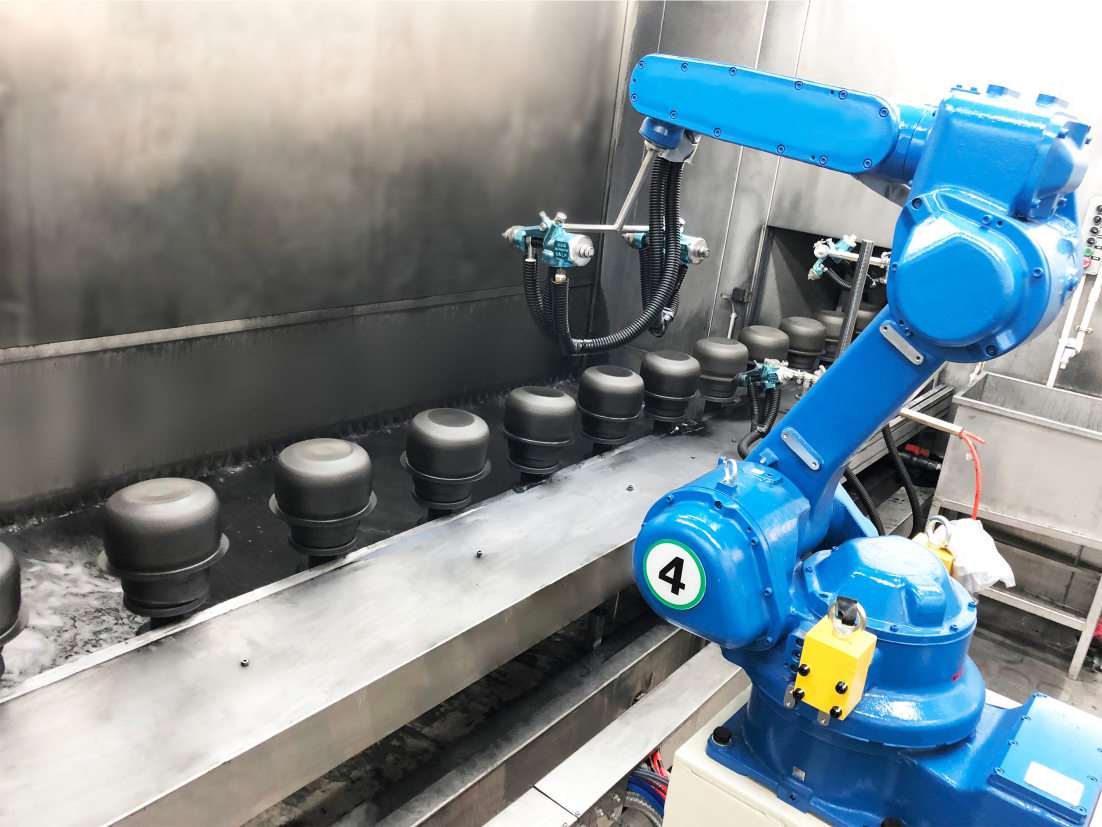
Coating line for rice cooker inner pots: a visual reference for the type of tooling and conveying required for non-stick coating of cookware.
What adapting a non-stick coating line means
A cookware coating line is not an enlarged paint booth. It must simultaneously handle the application of an antioxidant primer, a PTFE non-stick layer, and a high-temperature-resistant topcoat, with thickness control, curing, and handling. The goal is for pans, pots, and trays to come out with a uniform film, correct adhesion, and repeatable non-stick performance.
Adaptation relies on four linked decisions. First, the actual geometry of the product family. Second, the hanging tooling and the distance between parts. Third, the layer recipe and the curing window. Fourth, the inspection criterion and the acceptable defect rate. If any of these decisions is made based only on nominal capacity, the line may produce many parts while also generating rework due to uneven thickness, poorly covered edges, or dust contamination.
The reference case of a complete 20-unit line, applied to pans, pots, and baking trays, shows that adaptation can be measured with concrete indicators: coating uniformity, reduced paint waste, production efficiency, and quality stability during continuous operation. These indicators must be tied to a configuration and a product mix, not to a general promise.
Industrial background: why non-stick is not treated as decorative paint
PTFE is used in non-stick coatings because of its low friction and chemical stability in food-contact applications. In an automatic line, PTFE does not act alone: it is combined with a primer that helps with adhesion and substrate protection, and with a topcoat formulated to withstand service temperatures. Final quality depends on metal cleanliness, the thickness of each layer, spray uniformity, and curing.
The reference architecture described for these projects includes pretreatment, drying equipment, automatic sandblasting machine, spray booth, preheating oven, curing oven, cooling system, conveying system, dust removal, VOC treatment, electrical control, and MES production management system. A Class 10,000 interior cleanroom environment, clean and well ventilated, is also specified, along with fully automated PLC control, robotic spraying, and unmanned flexible production.
This architecture explains why non-stick coating is evaluated as a complete process rather than a single machine. A booth can apply product, but uniformity depends on conveying, hanging, extraction, and curing. Air cleanliness and VOC management are not decorative accessories: they affect repeatability and the project's environmental conditions.
Core problem: different shapes, thickness, and defects
A frying pan has sloped walls and a rim that can create shadow areas. A pot combines a bottom, vertical wall, and handles or rims. A baking tray adds corners and a flat geometry that can accumulate excess. If the line is adjusted for only one of these shapes, the others lose uniformity. The problem is not only spraying more or less material; it is maintaining a controlled film on each geometry and then curing it consistently.
The second problem is the definition of quality. High uniformity does not automatically equal a high approval rate. The documented case reports uniformity of up to 98%, but it also describes a low defect rate as a feature of the configuration. For a new project, both aspects must be verified separately: film uniformity, adhesion, appearance, non-stick performance, and food-use compliance.
The third problem is the material mix. The line datasheet documents aluminum alloy and composite materials such as stainless steel, aluminum alloy, and copper. Each substrate may require specific cleaning, pretreatment, and adhesion. It is not advisable to assume that a recipe validated for an aluminum pan transfers without testing to a tray made of another material or to a pot with a different surface roughness.
Adaptation criteria the project must resolve
1. Real cookware mix and geometry
The starting point is an inventory by product type, diameter, height, material, and finish. The documented line cites non-stick frying pans, rice cooker pot coating, and cake molds, in addition to pots and baking trays in the application case. That list must not become a promise that any part can go through without changes. Adaptation must confirm the tooling, part orientation, and the area receiving the non-stick layer.
2. Thickness and uniformity control
Film thickness is an acceptance criterion, not an adjustment detail. The reference case records precise thickness control and uniformity of up to 98%. The target thickness is not a universal value: it must be set with the coating specification and validated on real samples of pans, pots, and trays. An automatic line can repeat a setting, but it does not by itself correct a poorly defined recipe or a geometry without adequate support.
3. Food-contact coating
The application in the case includes non-stick PTFE, antioxidant spray primer, and a high-temperature-resistant topcoat for cookware. The recorded result indicates that non-stick performance meets international standards for food use. For a new project, it is advisable to request the standard reference applicable to the destination market, the corresponding reports, and material traceability. The phrase food-use compliant must be backed by documents, not only by a commercial description.
4. Adaptability to multiple sizes
The cookware line datasheet documents a standard size of Φ220*160 mm high and a maximum size of Φ300*160 mm high. It also records a hanging method with 4 inner pots per hanger and 20 lids per hanger, plus a distance between parts of 450 to 900 mm. These data make it possible to design load density, but they must be checked against the actual height, diameter, and weight of each reference.
5. Defect rate and repeatability
The low defect rate relies on several conditions: effective pretreatment, dust control, uniform application, sufficient curing, and handling without premature contact. The Class 10,000 cleanroom environment and the dust removal system are part of the documented architecture. To evaluate a supplier, it is not enough to ask about the defect rate; you must define what is considered a defect, how it is measured, and which part is used as the sample.
6. Capacity and production pace
The documented production is 800 to 1000 pieces per hour for the reference configuration. That figure must be read together with the distance between parts, curing time, and size mix. Processing large parts or frequently changing references can reduce the effective pace. The line also records natural gas and electricity consumption, so service availability and VOC extraction must be part of the plant evaluation.
7. Maintenance and support
Easy maintenance is a stated feature of the case, along with precise thickness control, adaptability to multiple sizes, and a low defect rate. The commercial offer documents a 1-year warranty, rapid response within 4 hours, remote technical support, regular follow-up, and free training. It also indicates 100% pre-shipment testing and an MOQ of 2 units. These data must be verified in the final proposal and in the service scope for the installation country.
How the line is configured, step by step
A project sequence aligned with the documented equipment makes it possible to organize the technical decision without turning it into a generic purchasing list.
- Define the parts matrix. Record types, diameters, heights, materials, and volume per shift. Include pans, pots, trays, and lids if they are part of the actual plan.
- Validate samples and the layer scheme. Confirm the antioxidant primer, PTFE non-stick layer, and high-temperature-resistant topcoat with the coating supplier and with real parts.
- Design hanging and conveying. The compatible conveying system, distance between parts, and number of parts per hanger determine exposure and uniformity. The datasheet documents 4 inner pots per hanger and 20 lids per hanger.
- Prepare the surface. Integrate pretreatment, drying, and automatic sandblasting according to the substrate. Cleanliness and roughness must be within specification before applying the primer.
- Apply the primer. The antioxidant spray primer is part of the case scheme. Its function is to promote adhesion and protection; it must not be replaced by a decorative layer without validation.
- Apply the non-stick layer and topcoat. Spraying must cover the bottom, wall, and rim without localized excess. The booth, extraction, and PLC control are part of repeatability.
- Cure and cool. The documented curing oven operates at 1000 mm/min, adjustable from 0.5 to 1.5 m/min. The curing window must be validated with the chemical recipe and film thickness.
- Inspect and handle. Check uniformity, adhesion, appearance, and non-stick performance before packaging. Cooling and subsequent handling prevent marks and defects.
- Commission and train. Installation, commissioning, and training are part of the documented supply scope. Continuous operation requires reference parameters and clear stop criteria.
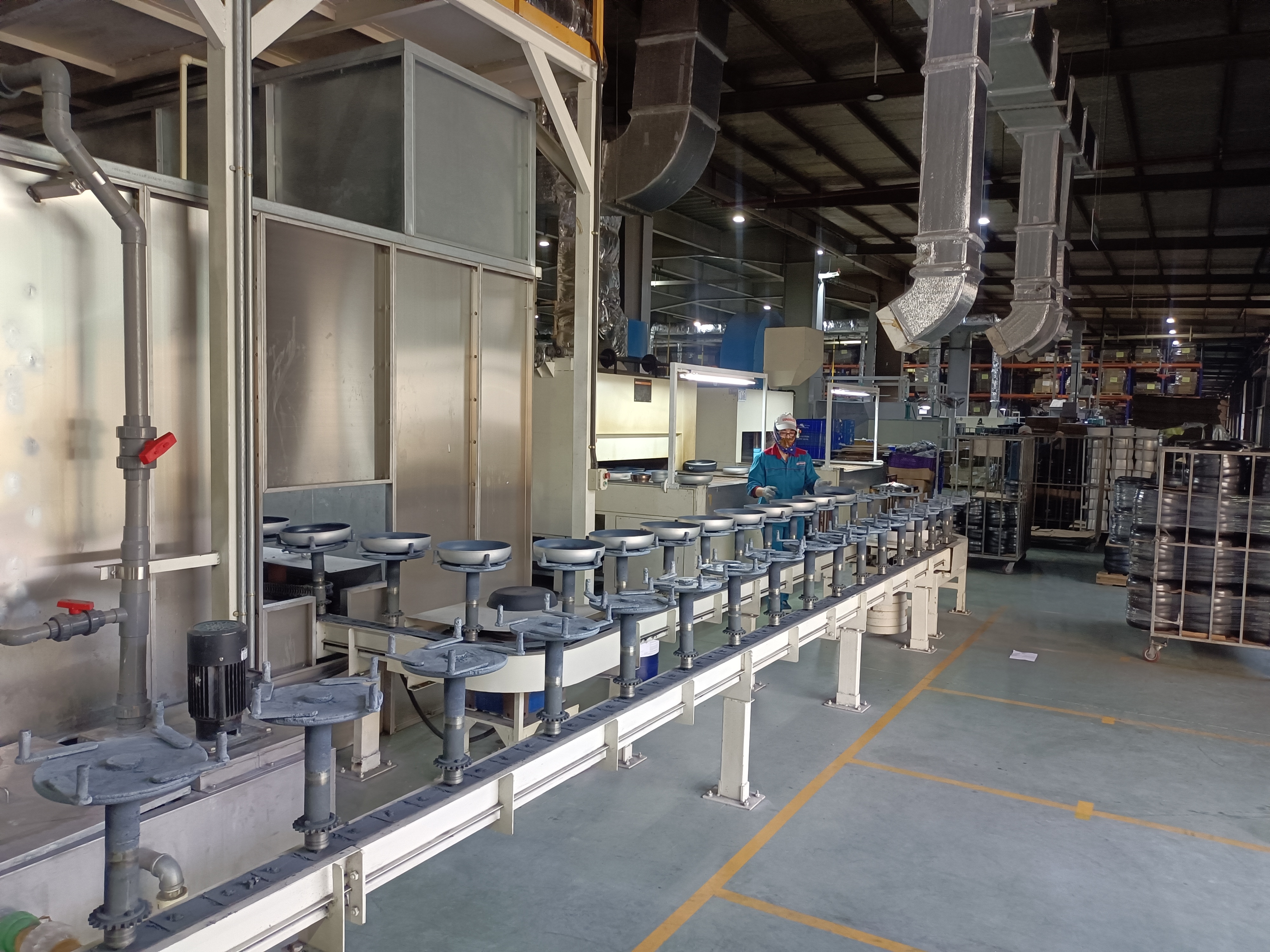
Conveying and hanging determine the exposure of pans, pots, and trays; they are not a secondary element of the line.
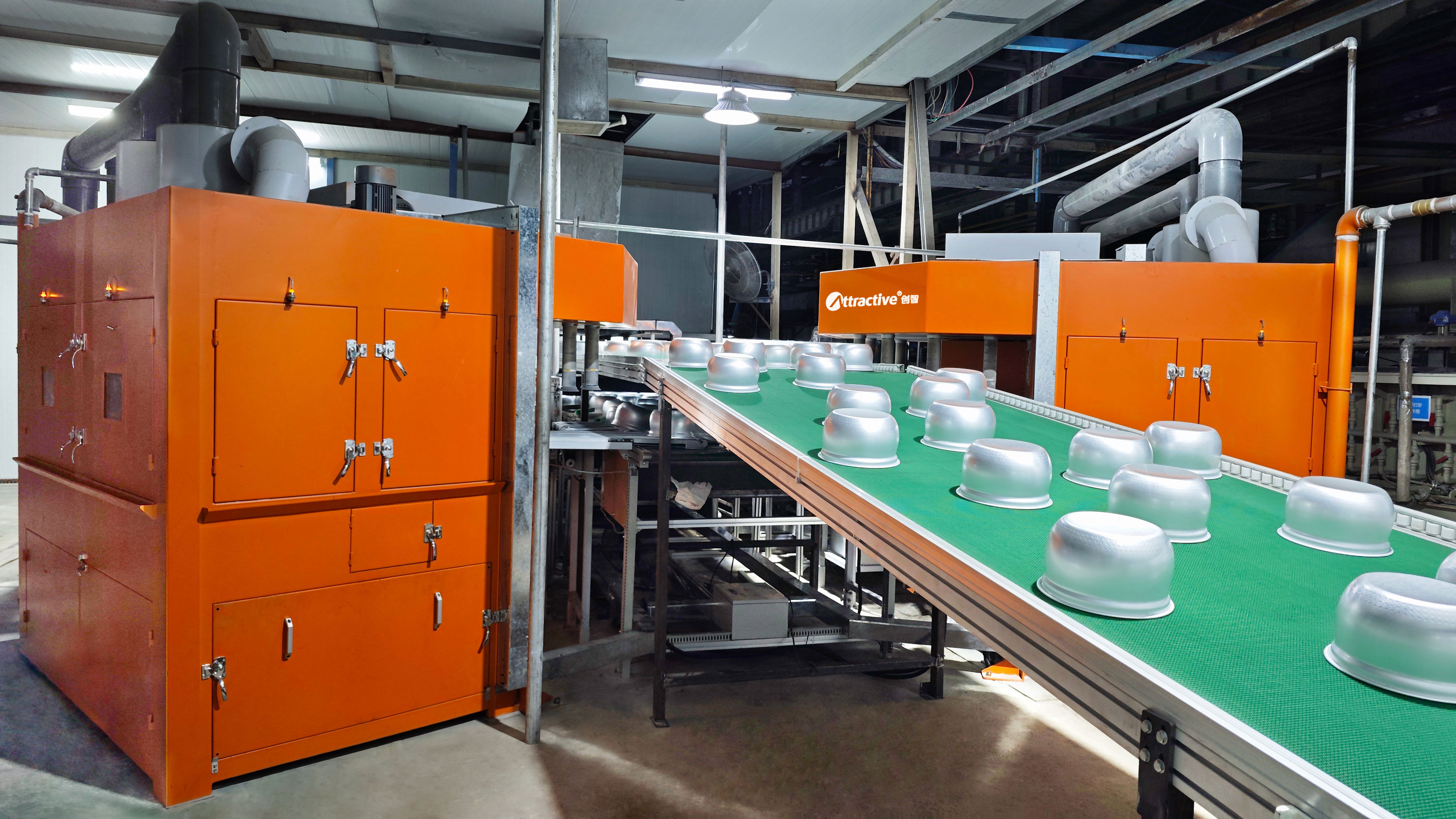
Automatic sandblasting is part of the documented pretreatment architecture for preparing the surface before coating.
Documented parameters that serve as a starting point
The following data belong to the cookware coating line and must be confirmed against the quoted configuration. They are not universal values for any factory.
| Documented data | Value | Reading for the project |
|---|---|---|
| Products cited | Non-stick frying pan, rice cooker pot coating, cake mold | Define the actual mix and do not expand it without testing tooling and recipe. |
| Materials | Aluminum alloy; stainless steel, aluminum alloy, and copper composites | Confirm pretreatment and adhesion for each substrate. |
| Standard size | Φ220*160 mm high | Reference for tooling and load density. |
| Maximum size | Φ300*160 mm high | Verify parts outside the range before committing capacity. |
| Production | 800-1000 pieces/hour | Capacity of the documented configuration; depends on geometry and curing. |
| Distance between parts | 450-900 mm | Influences exposure and film uniformity. |
| Hanging | 4 inner pots per hanger; 20 lids per hanger | Design specific tooling and check stability. |
| Curing oven | 1000 mm/min; adjustable from 0.5 to 1.5 m/min | Validate the curing window with the recipe and thickness. |
| Energy | Natural gas and electricity | Verify utilities, extraction, and plant safety. |
| Structure | Carbon steel; stainless steel booth and piping | Consider cleaning, maintenance, and chemical compatibility. |
The datasheet also records an anodizing line speed of 1200 mm/min. That value should not be transferred without validation to each non-stick stage. The case combines PTFE, primer, and topcoat, and the chemical recipe defines conditions that must be tested on real parts.
Use scenarios: pans, pots, and trays
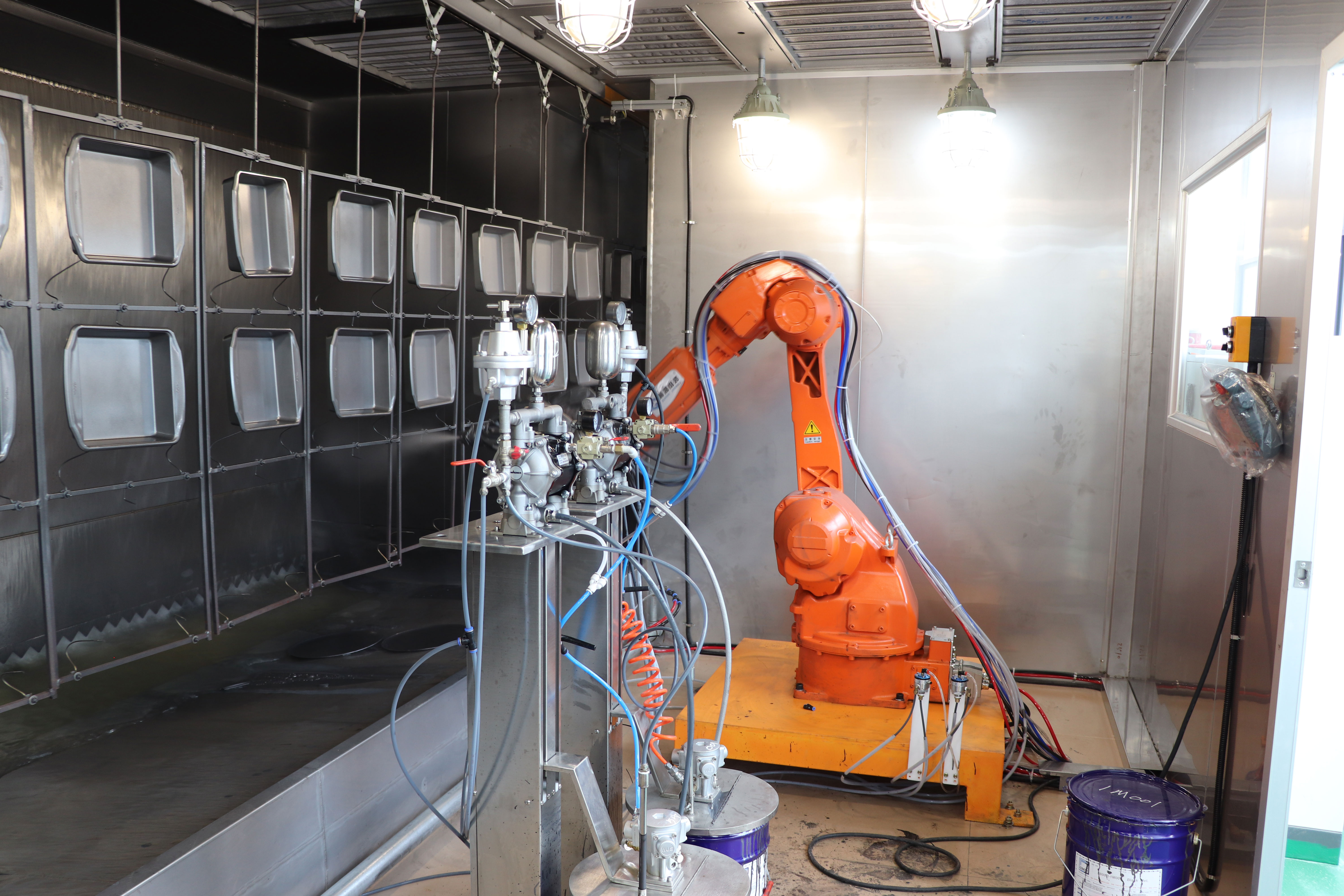
Molds and trays add corners and flat surfaces; tooling must prevent paint accumulation and uncovered areas.
Non-stick frying pans
The frying pan is the most demanding case because of its rim and sloped wall. The non-stick layer must cover the bottom and rise up the wall without accumulations that affect release or appearance. The documented line cites non-stick frying pans and the application of PTFE, antioxidant primer, and high-temperature-resistant topcoat. To validate this scenario, the sample must include the actual diameter, height, and type of rim to be manufactured.
Pots and rice cooker inner pots
Rice cooker inner pots appear in the product datasheet, and the case includes pots within the cookware application. The height and the curved or flat bottom change the distance to the applicator and the exposure. The hanging method of 4 inner pots per hanger is useful data for sizing conveying, but it must be checked with the weight and diameter of each model. A pot that swings during travel can produce uneven thickness.
Trays and cake molds
Cake molds and baking trays benefit from a line that can handle flat surfaces and corners. Adaptability to cookware of various sizes is a stated feature of the case, but it does not eliminate the need for specific tooling. For trays, inspection must look at the center, edges, and corners, because these are areas with different behavior during spraying and curing.
Lids and auxiliary components
The datasheet records 20 lids per hanger. Lids and auxiliary components usually require supports that prevent contact between parts and marks on the visible face. If the project includes lids, they must be included in the inventory from the start; they should not be treated as a later addition because they change load density and effective pace.
Documented case: complete 20-unit line
The reference case corresponds to branded OEM factories, private-label manufacturers, and supporting factories for home appliances. It covers a complete 20-unit automatic cookware coating line, with application of PTFE non-stick coating, antioxidant spray primer, and high-temperature-resistant topcoat for pans, pots, and baking trays. The record includes customers in Russia, Iran, India, Bangladesh, Vietnam, Thailand, and China.
The documented results are concrete: coating uniformity of up to 98%, 30% reduction in paint waste, 35% improvement in production efficiency, and stable continuous operation without major quality complaints. The case also highlights food-use-compliant coating, precise film thickness control, adaptability to cookware of various sizes, low defect rate, and ease of maintenance.
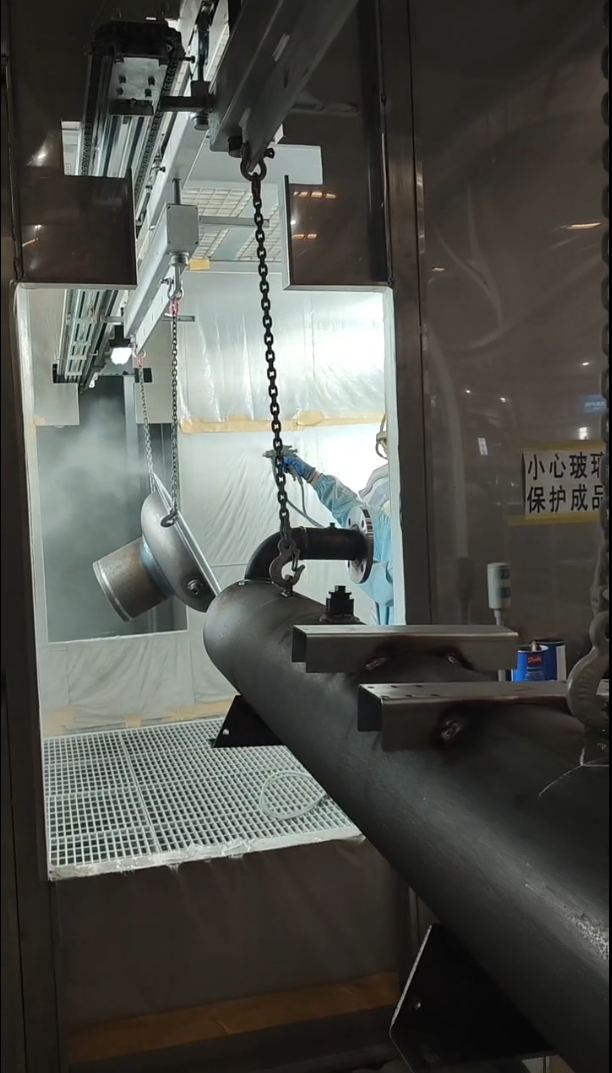
Supporting factories for home appliances are one of the customer profiles considered in the cookware case.
What this case shows: that a complete configuration can integrate pretreatment, multi-layer application, curing, conveying, and control to obtain measurable results across a mix of pans, pots, and trays. What it does not show: that any plant will reach the same values without adjusting tooling, recipe, utilities, and inspection criteria. The correct reading is to use the case as a configuration reference and require validation with your own samples before setting process guarantees.
How to evaluate a supplier and a configuration
Before requesting a quote, it is advisable to turn the case into a verifiable checklist. This avoids comparing only prices or nominal capacity and makes it possible to evaluate whether the custom coating line responds to the actual product.
- Representative samples: pan, pot, and tray with the dimensions, materials, and rims to be manufactured.
- Film specification: target thickness, measurement method, tolerance, and agreed uniformity criterion.
- Food use: standard reference applicable to the destination market, material reports, and traceability of the non-stick layer.
- Tooling and hanging: number of parts per hanger, distance between parts, stability, and contact marks.
- Effective capacity: pieces per hour with the actual mix, not only with one reference part.
- Plant utilities: natural gas, electricity, extraction, VOC treatment, and space for the curing oven.
- Supply quality: 100% pre-shipment testing, scope of installation, commissioning, and training.
- After-sales: 1-year warranty, rapid response within 4 hours, remote technical support, and regular follow-up.
The supplier's manufacturing capacity should also be reviewed. Attractivechina states that it has its own plant of approximately 35,548 m², 280 employees, 54 engineers, and annual production of 60 units, with 79 invention patents in coating and environmental protection equipment. These are contextual data that help evaluate structure and support, but they do not replace technical validation of the line for the specific product.
Frequently Asked Questions
What distinguishes a cookware coating line from a conventional paint line?
The difference lies in the layer scheme and the acceptance criterion. A cookware line must apply antioxidant primer, PTFE non-stick coating, and high-temperature-resistant topcoat, with thickness control and food-use conditions. It must also handle the shapes of pans, pots, and trays without losing uniformity. A decorative paint line may share conveying and a booth, but it does not replace validation of the non-stick recipe or food-contact conformity.
What cookware and sizes does the documented configuration cover?
The line datasheet cites non-stick frying pans, rice cooker pot coating, and cake molds, with a standard size of Φ220*160 mm high and a maximum size of Φ300*160 mm high. The application case includes pans, pots, and baking trays. Any part outside that range or with a special geometry must be evaluated with tooling and sample testing before being added to production.
How is uniformity of up to 98% achieved?
The documented case reports uniformity of up to 98% for a complete 20-unit line, but it does not present that as an automatic result. To reproduce it, surface preparation, distance between parts, hanging, application of each layer, and curing must be controlled. How uniformity is measured must also be defined. The line supports repeatability, but the recipe and validation with real parts are still necessary.
What coatings are applied in the cookware case?
The case applies PTFE non-stick coating, antioxidant spray primer, and high-temperature-resistant topcoat for pans, pots, and baking trays. The recorded result indicates that non-stick performance meets international standards for food use. For a new project, the specific standard reference, the applicable report, and material validation with the destination market must be requested.
What results and limits does the 20-unit case have?
The case records uniformity of up to 98%, 30% reduction in paint waste, 35% improvement in production efficiency, and stable continuous operation without major quality complaints. It also describes a low defect rate, precise thickness control, and adaptability to multiple sizes. The limit is clear: these are results of a documented configuration, not a guarantee for any product mix, material, or plant.
How should an evaluation request for a non-stick line be prepared?
Gather the product matrix with diameters, heights, materials, and volume per shift; indicate whether pans, pots, trays, or lids will be processed; define the layer scheme and intended food use; and prepare samples to validate thickness, uniformity, and adhesion. For an initial evaluation, you can download the corporate catalog in PDF and attach that data to your technical inquiry.
Conclusion
Adapting a cookware coating line is decided with a product matrix, a validated recipe, suitable tooling, and a measurable acceptance criterion. PTFE, antioxidant primer, and high-temperature-resistant topcoat are not evaluated separately from conveying, curing, and air cleanliness. The complete 20-unit line case offers useful references, such as 98% uniformity, 30% less paint waste, and 35% more efficiency, but each plant must confirm those values with its own parts and specifications.
Attractivechina, through Guangdong Chuangzhi Intelligent Equipment Co., Ltd., contributes experience in plant planning, manufacturing, installation, commissioning, and after-sales service for coating lines. To move forward with a technically sound decision, the next step is to compare samples, dimensions, and food-use requirements before setting the configuration.
Next step
If your project includes pans, pots, or trays with non-stick coating, prepare a sample and a list of dimensions. You can review the configuration and download the Attractivechina corporate catalog to review the scope of the line.
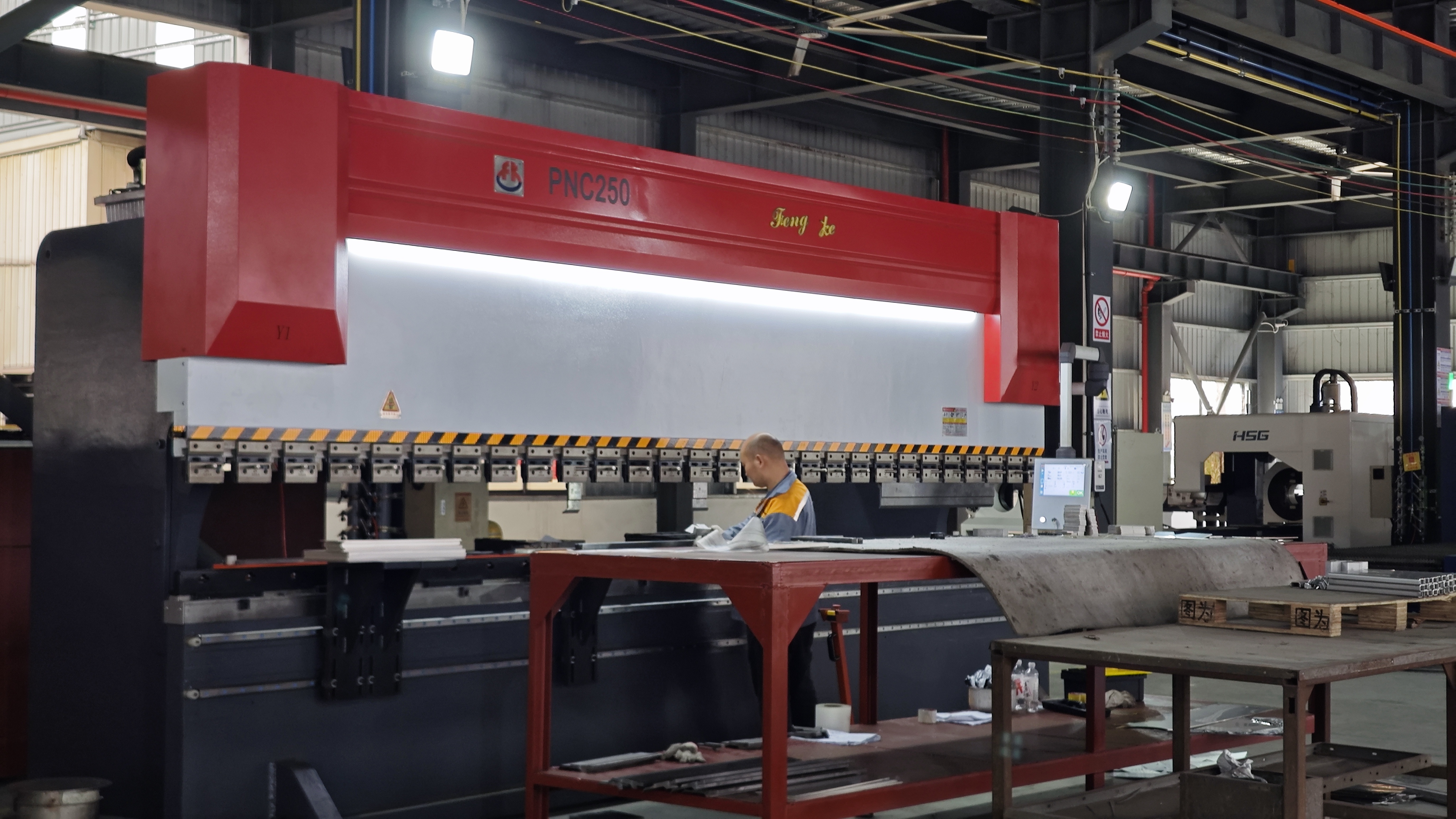
Production equipment: the final evaluation must link capacity, tooling, curing, and plant utilities to the actual cookware mix.
Have Questions or Need More Details?
Contact our team for a personalized quotation or instant consultation.
Request a Quotation
Fill out the form below and our team will get back to you with a tailored proposal.
WhatsApp Direct Chat
Prefer to chat in real-time? Message us on WhatsApp for instant assistance & quick answers.
- Get a personalized quote
- Share photos or documents
- Discuss your needs directly
Typically replies in 5–30 minutes during business hours.