
Automatic coating lines for dishes and metal: comparison and choice for the project
Automatic Coating Line for Cookware or Metal: How to Choose for Your Production Tasks
The compliance of a coating line with production tasks is determined not by the product name, but by the geometry of the workpieces, their material, and the required productivity. An automatic line for kitchen cookware and an automatic line for metal solve different tasks: one is designed for mass coating of compact products—800–1000 pieces per hour—the other for coating large aluminum panels and profiles with an area up to 5000 m² per day. This article provides a comparison based on the actual technical specifications of two configurations that the manufacturer Attractivechina supplies on order for enterprises in various industries.
Why Cookware and Metal Lines Are Compared as Separate Configurations
The equipment of both categories belongs to automated coating lines, but they have different product applications. The coating line for cookware is used in the production of kitchenware and household appliances: non-stick pans, rice cooker liners, baking molds. The metal coating line is used in the construction and household goods industry: doors, windows, steel cabinets, building materials, cabinet components, sheet metal parts, lighting fixtures, aluminum sheets.
A common mistake of a buyer is trying to choose one “more powerful” line, focusing only on the productivity figure. For a cookware line, productivity is expressed in the number of finished products: 800–1000 pieces per hour. For a metal line—in the area to be coated: up to 5000 m² per day with a 20-hour working day. These are different measurement models, because the products are incomparable in size.
Cookware workpieces are made of aluminum alloy and composite materials (stainless steel, aluminum alloy, copper) with a maximum diameter of only Φ300 mm. Metal line workpieces are mainly aluminum panels and profiles up to 7000 mm long, 2000 mm wide, and 2200 mm high. Already at the level of dimensions, it becomes clear that the configurations do not replace each other.
Automatic Coating Line for Cookware: Parameters
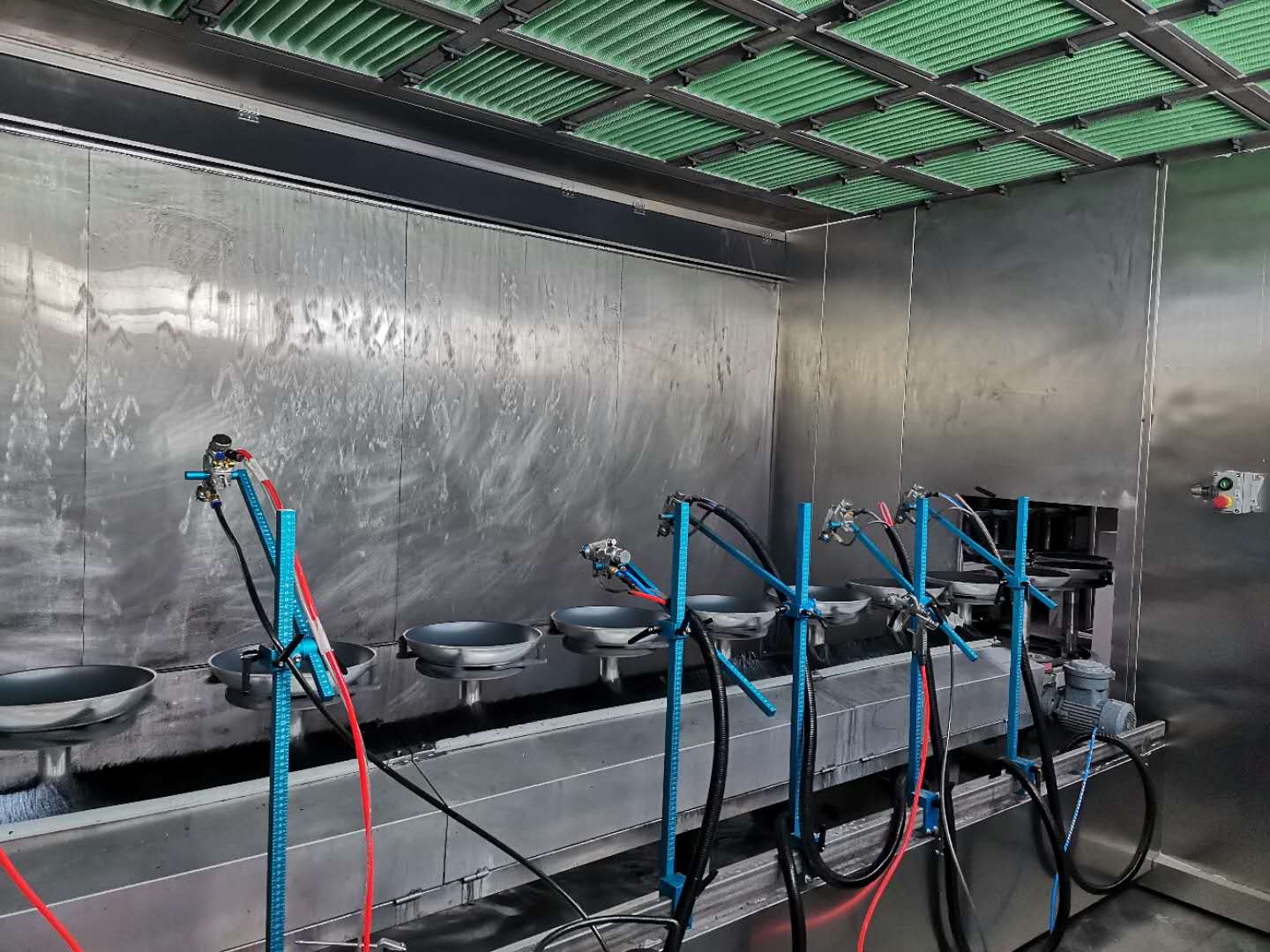
The automatic coating line for cookware is a configuration for enterprises producing non-stick cookware and household appliance elements. It is focused on high serial production of standardized products that can be fixed on conveyor hangers in several pieces.
Product Range and Material of Products
- Products: non-stick frying pan, rice cooker liner, baking mold.
- Material: aluminum alloy, composite materials (stainless steel, aluminum alloy, copper).
- Standard workpiece size: Φ220×160 mm (H).
- Maximum workpiece size: Φ300×160 mm (H).
- Product feature: doesn't warp.
Productivity and Conveyor Logic
The line capacity is 800–1000 pieces per hour. Workpiece pitch is 450–900 mm. The hanging method allows placing 4 inner containers on one hanger and 20 lids on one hanger. This scheme is typical for mass production of non-stick cookware, where piece-by-piece rhythm is important.
Speed Parameters and Power Supply
- Anodizing line speed: 1200 mm/min.
- Linear speed of the table-type curing oven: 1000 mm/min, adjustable from 0.5 to 1.5 m/min.
- Power supply: natural gas and electricity.
Equipment manufacturing materials: carbon steel—main frame, stainless steel—painting booth and pipelines. This combination is typical for both cookware and metal lines.
Automatic Metal Coating Line: Parameters
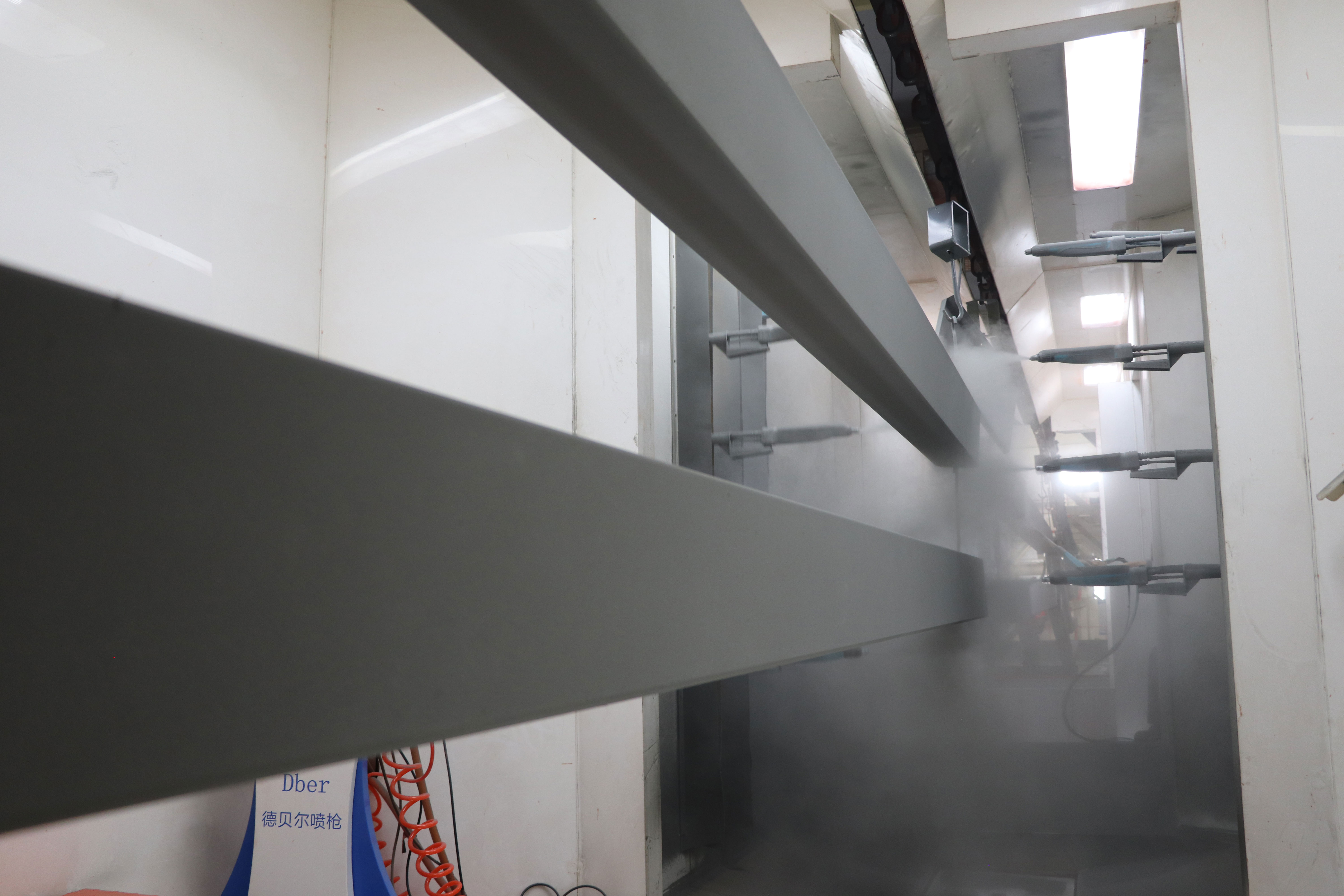
The automatic metal coating line is a configuration for large aluminum panels and profiles, as well as other construction and household products. Unlike the cookware line, here one large workpiece moves on one hanger.
Product Range and Workpiece Material
- Part names: aluminum panel and profile.
- Workpiece material: aluminum.
- Operating mode: 300 days per year, 20 hours per day.
- Maximum workpiece size: 7000 mm (L) × 2000 mm (W) × 2200 mm (H), 1 pc/hanger.
Application Method and Transport
The coating is applied by a reciprocating method with an additional manual section. This is due to the complex geometry of long-length products: the automatic reciprocating machine ensures uniform application on the plane, while the manual area is used for zones inaccessible to the machine.
Workpieces are transported by a mechanized and freely moving conveyor, which allows accumulation of products and curing time without stopping the line.
Productivity and Conveyor Speed
- Maximum productivity for workpieces: 5000 m²/day.
- Conveyor belt speed: 3000 mm/min, adjustable in the range 2000–4000 mm/min.
Comparison Table: Cookware vs Metal
| Parameter | Automatic Coating Line for Cookware | Automatic Coating Line for Metal |
|---|---|---|
| Products | Non-stick frying pans, rice cooker liners, baking molds | Aluminum panels and profiles; doors, windows, steel cabinets, cabinet components, sheet metal |
| Workpiece material | Aluminum alloy, composite materials (stainless steel, aluminum alloy, copper) | Aluminum |
| Maximum workpiece size | Φ300 mm × 160 mm (H) | 7000 mm × 2000 mm × 2200 mm (H), 1 pc/hanger |
| Productivity | 800–1000 pcs/hour | Up to 5000 m²/day |
| Workpiece pitch | 450–900 mm | — |
| Hanging | 4 inner containers per hanger, 20 lids per hanger | 1 pc/hanger |
| Application method | — | Reciprocating + manual application |
| Speed parameters | Anodizing speed 1200 mm/min; curing oven 1000 mm/min (0.5–1.5 m/min) | Conveyor 3000 mm/min (2000–4000 mm/min) |
| Operating mode | — | 300 days per year, 20 hours per day |
| Power supply | Natural gas and electricity | — |
| Industry application | Production of kitchen cookware and household appliances | Construction and household goods industry |
In the table, cells for which there is no confirmed value in the technical data are intentionally left blank. This is an important principle of comparison: when selecting industrial equipment, you must not invent missing characteristics.
Key Differences That Influence the Choice
Productivity Unit
If the production counts finished products in pieces (pans, lids, inserts), the configuration with a capacity of 800–1000 pieces per hour is the benchmark. If the products are long panels and profiles, the area of which is measured in square meters, it is more correct to compare lines by the m²/day indicator.
Size and Hanging Scheme
The cookware line fixes several compact workpieces on one hanger: 4 inner containers or 20 lids. The metal line uses one hanger per workpiece up to 7000×2000×2200 mm. The difference in weight and length determines the design of the conveyor and the supporting system. Trying to place a large panel on a cookware line is impossible due to the hanger dimensions; installing small cookware on a line for large profiles will lead to inefficient use of line area.
Material and Coating Requirements
Cookware made of aluminum alloy requires the application of a non-stick food-grade coating that must comply with standards for food-contact surfaces. Metal panels and profiles are used in the construction and household industry, so the priority becomes the uniformity of the decorative and protective layer over a large area. Both types of lines are manufactured on a carbon steel frame, with the painting booth and pipelines made of stainless steel.
How to Evaluate Which Configuration Suits Your Production
- Determine the final product range. If it is non-stick frying pans, rice cooker liners or baking molds, a cookware coating line is considered. If it is aluminum panels, profiles, doors, windows or steel cabinets—a metal coating line.
- Compare the dimensions with the maximum workpiece size. For cookware, the maximum diameter is Φ300 mm with a height of 160 mm. For metal—length up to 7000 mm, width up to 2000 mm, height up to 2200 mm.
- Check the required production volume. High piece-by-piece output of compact products corresponds to a productivity of 800–1000 pcs/hour. Large flat surfaces and long products are evaluated by area—up to 5000 m²/day.
- Consider the operating conditions. The equipment operates in a clean room of class 10,000 with clean, well-ventilated air. This requirement applies to the entire line, regardless of the type of product.
- Evaluate the possibility of customization. Coating lines can be manufactured according to an individual project: the manufacturer adjusts packaging, logo, size, level of automation, voltage, power, and equipment productivity in accordance with customer requirements.
Project Examples: Cookware and Metal
The choice of configuration is confirmed by industry projects where automatic coating lines are installed. Among the projects implemented for cookware production—20 complete automatic cookware coating lines for plants producing products under their own trademark, private brands, and for household appliance manufacturers. The projects were carried out for enterprises in China, Russia, Iran, India, Bangladesh, Vietnam, and Thailand.
In the metal segment, 15 fully automatic metal coating lines have been implemented for export-oriented hardware factories, metal furniture and building materials companies, manufacturers of bathroom and window fittings, as well as sheet metal parts factories. Based on the results of operation over 5–10 years, the lines provided stable continuous operation without major downtime.
Efficiency indicators in projects confirm that the result depends on the compliance of the line with the nomenclature of workpieces, not on abstract “versatility”.
Who Produces Lines for the Task
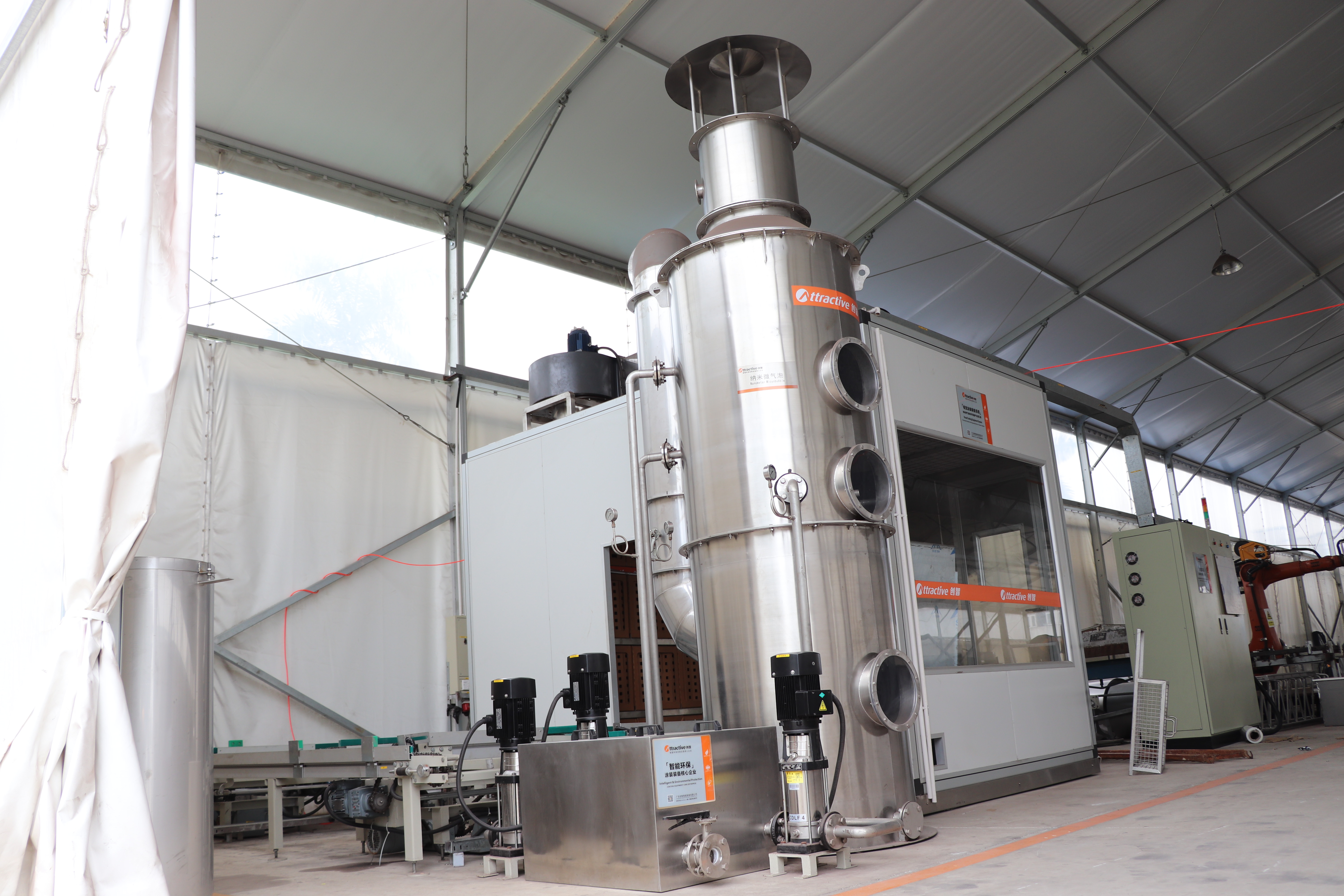
The manufacturer of the lines presented in this comparison is Guangdong Chuangzhi Intelligent Equipment Co., Ltd. (brand Attractivechina), located in the National High-tech Industrial Development Zone of Zhaoqing City, Guangdong Province, China. The company has a production facility of about 35,548 m², a staff of 280 employees, including 54 R&D engineers. Specialization—automated coating lines manufactured to order for automotive components, cookware, wooden furniture, metal, and industrial equipment.
For comparing lines, not only the characteristics are important, but also the production discipline of the supplier: Attractivechina has 79 invention patents in the field of coating equipment and environmental equipment, with the total number of patents exceeding 300. The equipment is exported to countries in Southeast Asia, the Middle East, Latin America, the USA, and Russia.
Frequently Asked Questions When Choosing Between a Cookware Line and a Metal Line
Which line is used for the production of non-stick frying pans?
For non-stick frying pans, rice cooker liners, and baking molds, the automatic cookware coating line is designed. It is designed for workpieces made of aluminum alloy, standard size Φ220×160 mm (H), maximum—Φ300×160 mm (H). The line capacity is 800–1000 pieces per hour with a workpiece pitch of 450–900 mm. The industry application is the production of kitchen cookware and household appliances.
For which workpieces is the automatic metal coating line intended?
This line is designed for aluminum panels and profiles. The list of typical products includes doors, windows, steel cabinets, building materials, cabinet components, sheet metal parts, lighting fixtures, and aluminum sheets. The maximum workpiece size is 7000×2000×2200 mm, one piece is placed on the hanger. The productivity reaches 5000 m² per day with an operating mode of 300 days per year and 20 hours per day.
Can one line be used for both cookware and large metal products?
Direct replacement is impossible due to different dimensions and hanging schemes. The cookware line is focused on compact workpieces with a diameter up to Φ300 mm and a height up to 160 mm, with several products placed on the hanger. The metal line is designed for one workpiece up to 7000 mm long, 2000 mm wide, and 2200 mm high. The choice is determined by the maximum geometry of the workpieces, not the desire to have “one line for everything”.
What are the room requirements for automatic coating lines?
The equipment operates in a clean room of class 10,000 with clean, well-ventilated air. This requirement applies to automatic coating lines regardless of the type of workpieces. Structurally, the main frame of the line is made of carbon steel, and the painting booth and pipelines—of stainless steel.
What customization options are available when ordering a line?
The manufacturer produces lines in the mode of individual design and custom manufacturing. The buyer can coordinate packaging, logo, size, level of automation, voltage, power, and equipment productivity. The minimum order is 2 units. Before shipment, each line undergoes a 100% pre-sale inspection.
What after-sales service is provided?
The standard package includes remote technical support, a 1-year warranty, a quick response within 4 hours, regular monitoring of equipment condition, and free staff training. Different types of lines have different delivery times, which the manufacturer clarifies for a specific configuration.
Conclusion
Comparing automatic lines for cookware and metal should start from three factual points: the type of product, the maximum workpiece size, and the unit of productivity measurement. Cookware is the mass coating of compact aluminum alloy products at a rate of 800–1000 pieces per hour. Metal is the coating of aluminum panels and profiles with a maximum size of 7000×2000×2200 mm and a volume of up to 5000 m² per day.
Both configurations are manufactured at the plant of Guangdong Chuangzhi Intelligent Equipment Co., Ltd. under the brand Attractivechina. The company has over 30 years of experience in integrated solutions for coating lines, which allows adapting equipment to the customer's task: from selecting a hanging system to integrating control systems and exhaust gas treatment. Possession of technical documentation and pre-sale inspection of equipment reduce the risk of the line not matching the actual production nomenclature.