
Coating line audit: Matrix of conformity and acceptance
Coating Line Audit: Compliance Matrix and Acceptance Criteria
Compliance audits of coating lines rarely fail because of equipment. They stall at the document folder: the certificates are there, but none of them relates to the supplied configuration, no one has compared the scope with the project, expiry dates have not been checked, and in place of a test report there is a letter saying the equipment “complies with international standards.” As a result, evidence formally existed, but there was nothing with which to sign the acceptance certificate.
Below is a working instruction for the buyer and engineer: how to assemble a compliance matrix, what evidence to require for each item, how to tie the checklist to cookware, auto parts, metal, wooden furniture, or industrial equipment, and how to carry out acceptance based on facts. The technical part is based on the stated parameters of specific line types: a carbon steel frame, a painting chamber and stainless steel pipelines, capacity 800–1,000 pcs/h, conveyor 3,000 mm/min with adjustment 2,000–4,000 mm/min, workpieces up to 7,000×2,000×2,200 mm.
Why an audit starts with the folder, not the shop floor
A compliance audit is a check that every declared property is confirmed by a document with an appropriate scope, a valid term, and an identifiable issuing body. In this logic, the wording “a certificate is available” means nothing: four parameters matter — what exactly is confirmed, for which model, in which region, and until what date.
In practice, three things most often stop an audit.
Substitution of the evidence level. A management system certificate is put in place of an equipment document. The scope of the manufacturer's ISO 9001, ISO 14001, and ISO 45001 certificates states: design and production of coating equipment and related management processes. This confirms the organization of work, not the specification of a particular line.
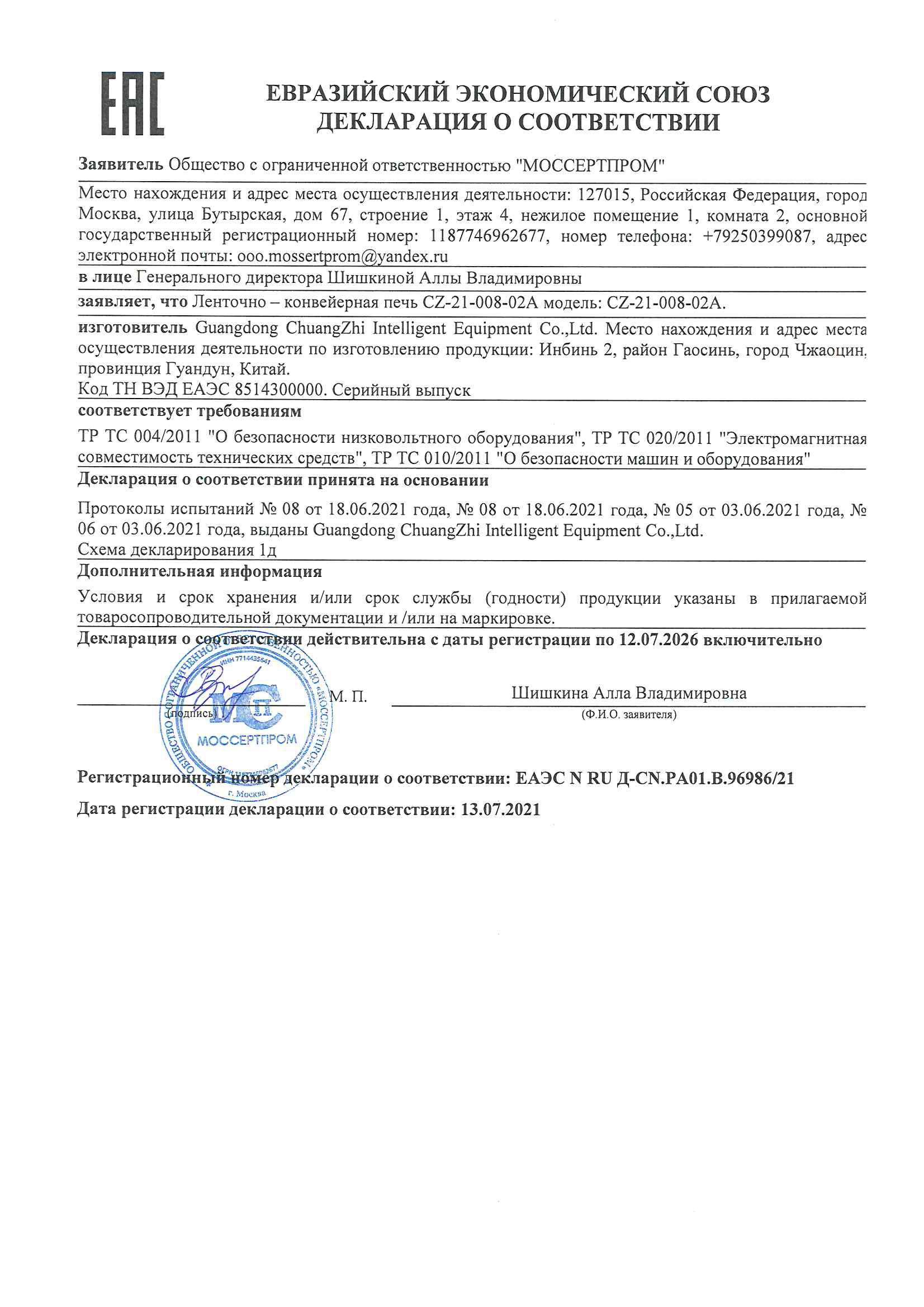
Scope. A document may be issued for one unit, not the entire set. In the materials cited by manufacturer Attractivechina (Guangdong Chuangzhi Intelligent Equipment Co., Ltd., founded in 2005, own area about 35,548 m², 54 R&D engineers), EAEU declaration of conformity N RU Д-CN.PA01.B.96986/21 was issued for the laminated conveyor oven model CZ-21-008-02A — and only for it. It is impossible to derive from this document the conformity of the entire line with a different configuration.
Date. The expiry date is checked first: an expired certificate in the folder looks as solid as a valid one, but it is no longer evidence.
Hence the working rule: evidence is divided into four levels, and all four are needed at acceptance. System-level (ISO 9001, ISO 14001, ISO 45001). Documents for the equipment and its safety (declarations and certificates under technical regulations). Factory tests — a report with parameters and signatures. Acceptance tests on site — a certificate recording that the line reached the agreed indicators under the agreed conditions.
Industry background: one line — five different checklists
A coating line is a process, while the requirements for the coating are set by the product and the sales market. Therefore, the same equipment set receives five different checklists.
For cookware, film uniformity and the properties of the coating in contact with food are critical. The line is responsible for process stability, but confirmation of food suitability relates to your product and your coating, not to the metal structure of the line — this item cannot be closed by the equipment supplier's certificate.
For auto parts, requirements are set by the supply chain: automaker and tier-one supplier specifications are usually stricter than general norms and include chamber parameters, color repeatability, and cycle stability.
For metal and sheet products, the focus is corrosion resistance and uniformity over area. For wooden furniture and musical instruments, it is finish quality, absence of dust, and gloss stability. For industrial equipment, it is behavior on large and complex workpieces and resistance to atmospheric exposure.
The regional block is added on top. In the EAEU, the applicability of documents is checked against a specific model: the provided declaration specifies TR CU 004/2011 (low-voltage equipment), TR CU 020/2011 (electromagnetic compatibility), and TR CU 010/2011 (machinery safety). The Russian Federation is among the markets to which the company supplies equipment, but a market's inclusion in the list does not replace a document for your configuration.
Compliance matrix: a seven-column framework
A compliance matrix is a table in which each requirement is linked to evidence and an acceptance criterion. The minimum working set of fields: requirement, type of evidence, who issues it, scope, term, method of verification, and acceptance criterion. If a row in the matrix still has an empty “evidence” column, the requirement is not closed — and this is recorded before signing the contract, not after installation.
| Requirement | Evidence | Who confirms | What the buyer checks | Acceptance criterion |
|---|---|---|---|---|
| Electrical safety and EMC of equipment | Document under TR CU 004/2011 and 020/2011 | Accredited body, EAEU register | Model within scope, number, term | Document valid on delivery date and relates to your model |
| Machinery safety | Document under TR CU 010/2011 | Accredited body | Match of units and configuration | No discrepancies between declaration and specification |
| Quality system | ISO 9001 | Certification body | Scope, term, body | Valid certificate with scope “production of coating equipment” |
| Environmental aspects | ISO 14001 | Certification body | Term, coverage of production site | Valid certificate |
| Occupational health and safety | ISO 45001 | Certification body | Term, standard (GB/T 45001-2020 / ISO 45001:2018) | Valid certificate |
| Declared line parameters | Factory test report | Manufacturer, signatures of parties | Measurement conditions: pitch, size, tooling | Indicators reproduced under agreed conditions |
| Materials of construction | Unit-by-unit specification | Manufacturer | Frame, chamber, pipelines | Actual construction matches the specification |
| On-site acceptance tests | Certificate with list of nonconformities | Customer and supplier | Procedure, instruments, responsible persons | Nonconformities closed or have an agreed remediation deadline |
Materials and parameters: what exactly goes into the matrix
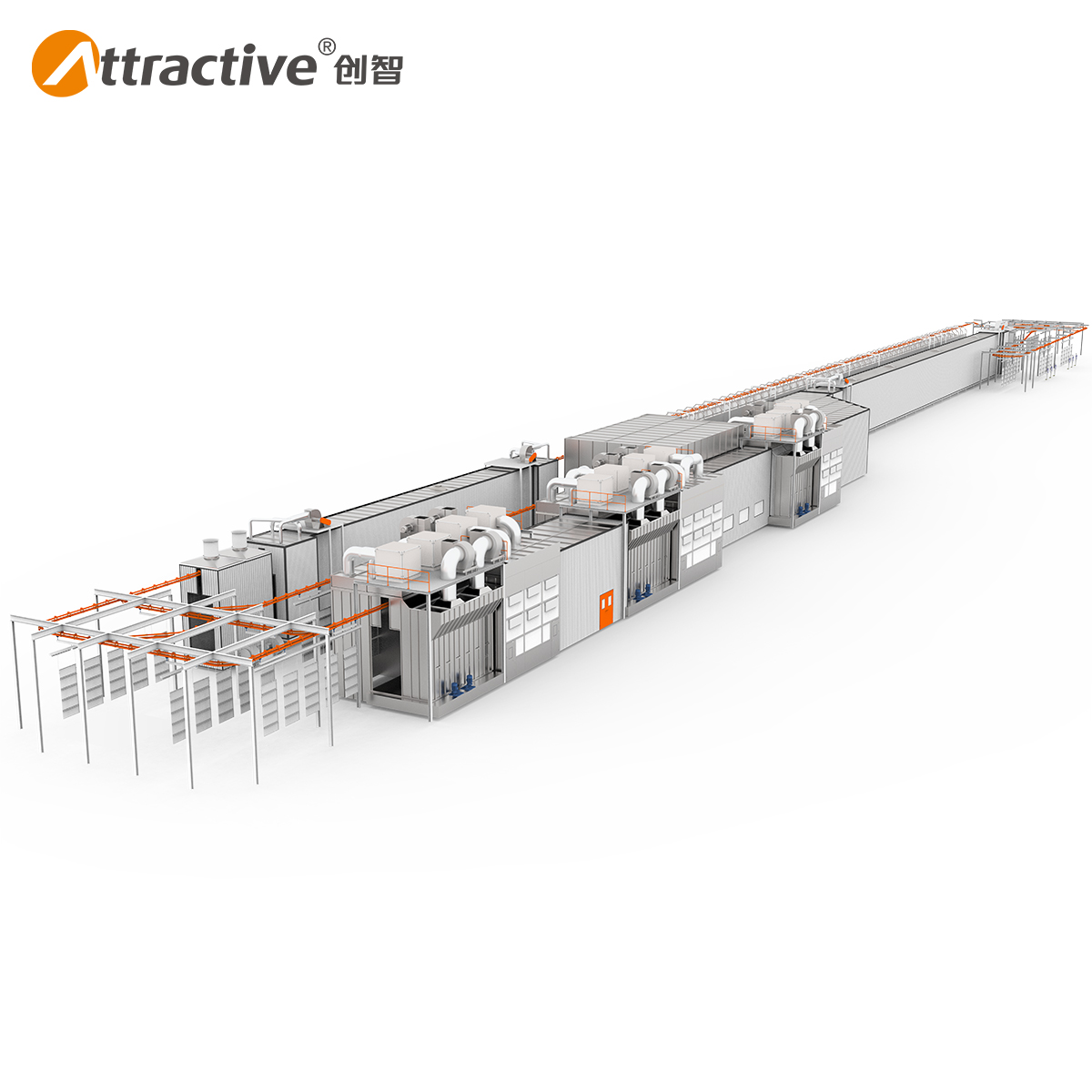
Materials of construction are the first item checked literally against the specification. For lines for cookware, auto parts, metal, wood, and industrial equipment, the same scheme is declared: the frame is carbon steel, the painting chamber and pipelines are stainless steel. What this gives at audit: the wording “stainless steel” without specifying units is not accepted — record that the chamber and pipelines specifically are made of stainless steel. A carbon steel frame means that the corrosion protection of the frame itself is a separate subject of verification, not an automatic property. At acceptance, the actual construction is compared with the same specification line used for pricing.
The second block is parameters. What matters here is not the number itself but the condition under which it was obtained.
| Line type | Material / product | Declared capacity | Speed and pitch | Mode and environment |
|---|---|---|---|---|
| Cookware | Aluminum alloy, composite materials (stainless steel, aluminum, copper); frying pans, rice cooker inserts, baking molds | 800–1,000 pcs/h | Pitch 450–900 mm; anodizing 1,200 mm/min; oven 1,000 mm/min (0.5–1.5 m/min) | Natural gas and electricity; 4 inner vessels or 20 lids per hanger |
| Auto parts | ABS+PC: bumpers, door panel trims, dashboard elements | 45 s/lot, 1,760 trays per day | Tooling pallet up to 1,350×900×200 mm | 336 days per year, 22 h/day; chamber 25±2 °C, 65±10% RH; area 100×38×5.4 m |
| Metal and sheet metal | Aluminum panel and profile | Up to 5,000 m²/day | 3,000 mm/min (adjustment 2,000–4,000); workpiece up to 7,000×2,000×2,200 mm, 1 pc/hanger | 300 days per year, 20 h/day; mechanized and free-moving conveyor |
| Wooden furniture | Solid wood, MDF; legs, chair backs, seat frames | 1,422 pcs per 8-h shift | 4,000 mm/min (2,000–6,000); pitch 300 mm/hanger; workpiece up to 610×710×1,400 mm | Electricity |
| Industrial equipment | Metal, aluminum: railcars, platforms, tank cars | 20 units of gondola cars, platforms, and tank cars; 7 units of SQ6; 10 freight and grain cars; 5–10 export cars | Floor conveyor; manual and robotic painting | 7.5-h shift |

Eight steps of audit and acceptance
- Fix the list of applicable requirements before requesting a commercial proposal. The basis is the product, the sales market, and your customer's requirements. If the list appears after the supplier has been selected, the matrix turns into a justification of a decision already made.
- Divide evidence into four levels. System certificates, equipment documents, factory test report, on-site certificate. Different levels answer different questions and do not replace one another.
- Check the scope and term of each document. Below is an example of checking against dates as of 21.11.2026.
- Compare parameters with the technical specification and measurement conditions. The same indicator at a different hanger pitch gives different output.
- Record materials by unit. Frame separately, chamber and pipelines separately; check that the specification contains no generalized wording.
- Agree on the test program. What is measured, with which instrument, at what temperature and humidity, and who signs the report on each side.
- Check the infrastructure and environmental block. Energy carriers (electricity, natural gas, steam, chilled water are declared for different lines), a volatile organic compound treatment system, room conditions — for lines of this class, the materials specify a cleanliness class 10,000 room.
- Prepare an acceptance certificate with a list of nonconformities and deadlines for their elimination. Separately record support conditions: 1-year warranty, remote technical support, response within 4 hours, training, 100% pre-sale inspection.
Step three deserves detailed examination, because it most often reveals the gap between “documents exist” and “documents are valid.”
| Document | Number | Scope | Validity period | Status as of 21.11.2026 |
|---|---|---|---|---|
| EAEU declaration of conformity | EAEU N RU Д-CN.PA01.B.96986/21 | Laminated conveyor oven, model CZ-21-008-02A | 13.07.2021 – 12.07.2026 | Expired — extension or new declaration requested |
| ISO 9001 | DZ/CN/2308009Q | Design and production of coating equipment | 20.09.2023 – 13.09.2026 | Expired — confirmation of renewal requested |
| ISO 14001 | DZ/CN/2407055E | Design and production of equipment, management of environmental aspects | 26.09.2024 – 14.10.2027 | Valid |
| ISO 45001 | 04926S00152R001 | Design and production of coating equipment | 20.04.2026 – 19.04.2029 | Valid |
Tying the checklist to the industry
Cookware
What is checked: film uniformity, cycle stability, compatibility with the food use of your coating. The supplier is asked for a test report at a pitch of 450–900 mm and the declared 800–1,000 pcs/h, a specification for the chamber and pipelines, and a list of energy carriers — the specification states natural gas and electricity, and a change of energy carrier changes both the cost and the acceptance program.
The acceptance criterion is formulated narrowly: capacity is confirmed at the specified pitch and hanging pattern (4 inner vessels or 20 lids per hanger). In the company's cookware project materials, coating uniformity up to 98% and a 30% reduction in paint waste are declared — these are the supplier's data for its projects; they are rechecked on your tooling and not transferred into the certificate.
Auto parts
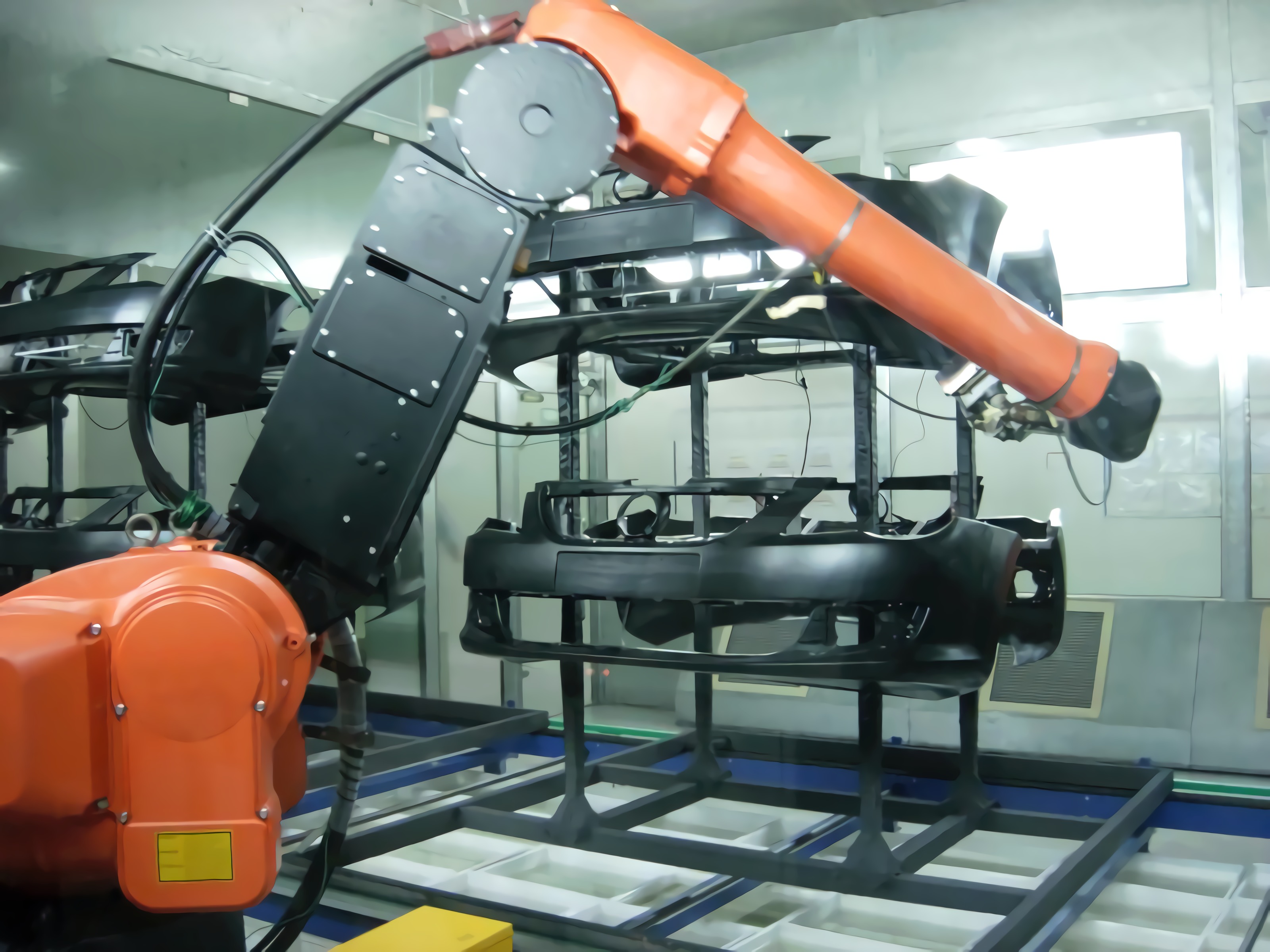
Requirements are set by the supply chain, so environmental parameters and repeatability go into the matrix. A report is requested on chamber temperature 25±2 °C and humidity 65±10%, confirmation of the 45 s/lot cycle and tooling pallet size up to 1,350×900×200 mm, as well as the methodology for calculating equipment utilization — the specification states 85%, and it is necessary to understand how this value is measured.
A separate item is infrastructure: for the line, an area of 100×38×5.4 m and a mode of 336 days per year at 22 hours per day are declared. Verification that the shop fits these dimensions is carried out before signing, not on the installation day. For auto parts projects, the supplier cites the result: 98% good coating output, 25% less paint consumption, 20% less energy consumption, and no major downtime over five years; these are the company's declared data and they do not replace tests at your site.
Metal and sheet metal
Here acceptance is built around the maximum workpiece and uniformity over area. A report is requested for a workpiece up to 7,000×2,000×2,200 mm with one item per hanger, verification of the conveyor across the entire range of 2,000–4,000 mm/min, and confirmation of capacity up to 5,000 m²/day in a mode of 300 days per year at 20 hours.
Corrosion resistance and coating thickness are checked on witness samples that have passed through the same line. For its metal coating projects, the supplier states 97% inspection pass rate, a 30% reduction in paint or powder consumption, a 22% reduction in energy consumption, and a 40% increase in efficiency — these figures are useful as a benchmark, but only values measured on your product are entered into the certificate.
Wooden furniture and musical instruments
The key items are finish quality and dust. A report is requested on surface quality, confirmation of output of 1,422 pcs per 8-h shift at a pitch of 300 mm per hanger, verification of speed 4,000 mm/min in the range 2,000–6,000, and conformity to the maximum workpiece 610×710×1,400 mm.
Dust removal is added to the project matrix as a separate unit: for wood coating projects, the supplier declares a 30% reduction in paint consumption, a 90% reduction in dust defects, and a 40% increase in efficiency. The acceptance wording must be verifiable — for example, absence of visible surface defects on an agreed sample.
Industrial equipment
The most complex checklist: large workpieces, a floor conveyor, and a combination of manual and robotic painting. A report is requested on samples with the same surface preparation, confirmation of adhesion and salt spray resistance — in materials for industrial equipment projects, a test of at least 1,000 hours is declared — as well as a production program per 7.5-h shift.
Capacity in the specification is tied to product types: 20 units of gondola cars, platforms, and tank cars, 7 units of SQ6 special cars, 10 freight and grain cars, and 5–10 export cars. The acceptance certificate records the product type and tooling on which the indicator was confirmed.
Five formulations used to substitute for certificates
- “Complies with international standards.” Replace with specifics: which standard, which document number, which body issued it, which model is within scope.
- “Certified production.” Verify by reference to ISO 9001 with number and term; in the example examined, this is DZ/CN/2308009Q with a term until 13.09.2026, meaning that confirmation of renewal is required on the check date.
- “Stainless steel” without specifying units. Accepted only with attribution: chamber and pipelines — stainless steel, frame — carbon steel.
- “Capacity up to N” without conditions. Supplement with hanger pitch, workpiece size, and loading pattern; otherwise the indicator can be neither verified nor accepted.
- “There is an EAEU declaration” without a model. Check the scope: the declaration for oven CZ-21-008-02A does not cover the entire line with a different configuration.
The general logic is simple: any wording that cannot be verified by number, model, and date does not participate in the matrix.
FAQ: buyer's questions at the evaluation stage
Is the supplier's ISO 9001 certificate sufficient for line acceptance?
No. ISO 9001 confirms the management system for the design and production of coating equipment, but not the characteristics of a specific line or its configuration. Acceptance also requires equipment documents with a matching model within scope, a factory test report, and an on-site test certificate.
Which EAEU documents should be requested and how should they be checked?
Request a document under the applicable technical regulations indicating the model. In the example examined, EAEU declaration N RU Д-CN.PA01.B.96986/21 was issued for the laminated conveyor oven CZ-21-008-02A with reference to TR CU 004/2011, 020/2011, and 010/2011 and a validity period until 12.07.2026. Four parameters are checked: model, issuing body, standards, and date; as of 21.11.2026 the term has expired, so the current version is requested.
How can the declared 800–1,000 pcs/h on a cookware line be verified?
The indicator is measured under the conditions for which it is declared: workpiece pitch 450–900 mm and hanging scheme — 4 inner vessels or 20 lids per hanger. The report includes product size (standard Φ220×160 mm, maximum Φ300×160 mm), actual pitch, and observation time. A measurement without these conditions is not comparable with the design value.
Which line parameters must be recorded in the technical specification?
Materials by unit (carbon steel frame, stainless steel chamber and pipelines), conveyor speed range, maximum workpiece, capacity with measurement conditions, chamber environment parameters, and energy carriers. For a metal line, this is 3,000 mm/min with adjustment 2,000–4,000 and a workpiece up to 7,000×2,000×2,200 mm; for an auto parts line — 25±2 °C, 65±10% humidity, and a 45 s/lot cycle.
What makes up the line budget, and what affects the price?
Cost is determined by configuration: the set of processing stages, the level of automation and robotization, the volatile organic compound treatment system, the production management system, the tooling composition, and voltage and power requirements. It makes sense to compare proposals only with an identical specification; the minimum order in the company's public materials is stated as 2 units. It is indicative that different line types also differ in infrastructure: an auto parts line requires an area of 100×38×5.4 m and four energy carriers, while a wood line requires only electricity — and this directly affects the project budget.
Can a sample or test batch be obtained before purchase?
The sample program is not standardized and is agreed within a specific project: the subject of verification is your tooling, your coating, and your surface quality criteria. The agreements record the volume of the test batch, the list of measured indicators, and the report form, so that the result can be transferred to the acceptance certificate without retelling.
What is the delivery time, and what is included in the warranty obligations?
Delivery times differ by equipment type and are agreed separately for each specification, so they should be requested together with the configuration, not as a separate question. The warranty is 1 year; remote technical support, response within 4 hours, regular support, and free training are declared, as well as 100% pre-sale inspection. To translate these conditions into a verifiable form, request a matrix for your project and a draft specification with acceptance criteria: website ru.attractivechina.com, email attractivechina@gmail.com, phone and WhatsApp +86 135-8061-6025.
Summary
The compliance audit of a coating line rests on three things: a requirements matrix, documents with verified scope and term, and test reports with described conditions. Industry attribution does not change this framework — it only supplies the necessary items: food contact for cookware, repeatability and chamber parameters for auto parts, maximum workpiece and corrosion resistance for metal, finish quality and dust for wood, adhesion and salt spray for industrial equipment. Formulations such as “complies with international standards” do not participate in such a matrix: each requirement is closed by a number, model, date, and measurable acceptance criterion.
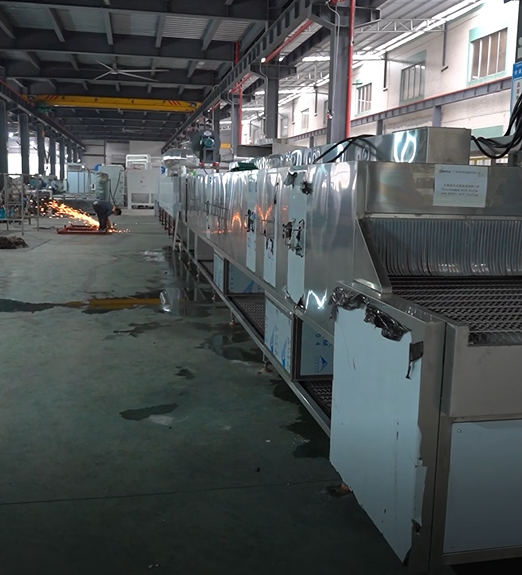
Audit materials. A full description of the equipment, typical configurations, and parameters of coating lines is collected in the corporate catalog — it can be opened and downloaded: Attractivechina catalog (PDF). To compare the matrix for your product, send the list of products, sales market requirements, and desired capacity.
Have Questions or Need More Details?
Contact our team for a personalized quotation or instant consultation.
Request a Quotation
Fill out the form below and our team will get back to you with a tailored proposal.
WhatsApp Direct Chat
Prefer to chat in real-time? Message us on WhatsApp for instant assistance & quick answers.
- Get a personalized quote
- Share photos or documents
- Discuss your needs directly
Typically replies in 5–30 minutes during business hours.