From printing to finishing: layers of an automatic line
From primer to finish: layers of an automated line
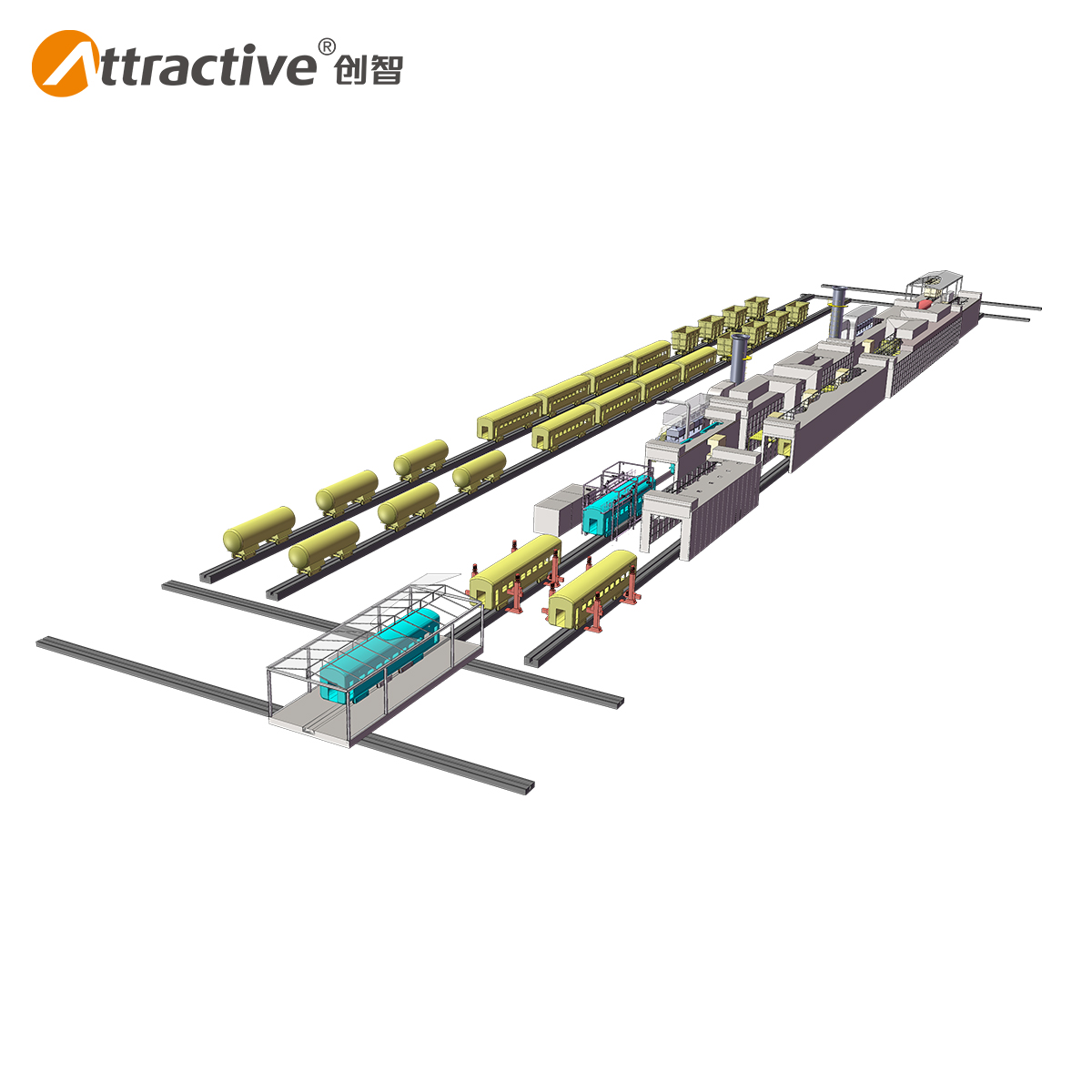
An automated coating line does not apply a single layer, nor is it equivalent to a single machine. It is an integrated sequence that prepares the part, applies one or more layers—primer, intermediate coat and topcoat—and stabilizes the result through curing, cooling, inspection and, where applicable, polishing. The term finish can refer to the last layer or to the final state of the surface; in this guide, a distinction is made between the applied layer and the finish result.
The difference matters because a line for aluminum panels and profiles up to 7000 mm is not configured the same way as a line for rice-cooker inner pots, ABS+PC bumpers or wooden furniture. The architecture changes with the substrate, geometry, volume and surface specification. Therefore, asking “what layers does it apply” is the right starting point, but the complete answer includes which stages accompany them and how they are controlled.
What “layer” means and why it is not the same as a line stage
In coating, a layer is a film of material applied to the part. A stage is the operation or equipment that makes it possible to prepare, apply, cure or stabilize that film. Primer, intermediate coat and topcoat are layers; pretreatment, drying, curing and cooling are stages. This separation avoids two common mistakes: buying a spray booth thinking that a complete line is already in place, or requesting an additional layer without checking whether the line has sufficient drying, curing and handling capacity.
Finish, by contrast, is not always an additional layer. It is often the state that results after applying and curing the topcoat. In other cases, finish includes a subsequent operation such as polishing or visual inspection. The distinction is practical: it separates the chemical or functional specification of the film from the surface specification measured at the end.
The problem: a list of layers is not enough to define a line
The question “what layers does an automated coating line apply?” is often answered with four names: primer, intermediate coat, topcoat and finish. That list is useful for orientation, but it is not enough to evaluate a line. Two products may have “primer and topcoat” and still require different booths, conveyors, ovens and times.
The reason is that the line must maintain repeatable conditions across the entire part. It is not enough for the gun to apply material: the surface must be prepared, the part supported, application controlled, curing performed without contamination, cooling completed, and the part delivered without damaging the film. In an automated line, PLC control, robotic spraying, conveying and the MES system are part of that repeatability. Thickness uniformity is a process objective that depends on all these elements; it should not be taken for granted without validating the specific part and the layer specification.
Industrial context: why the architecture changes by sector
The documented applications for these lines include automotive parts, cookware, wooden furniture, musical instruments, heavy machinery, home appliances, building materials and low-altitude equipment. This variety explains why there is no single configuration. A long aluminum profile requires a different conveyor and booth than a non-stick frying pan or a plastic bumper.
Attractivechina is a manufacturer of automated and customized coating lines, with more than 30 years of experience in integrated solutions for coating production lines. Its plant in Zhaoqing, Guangdong, covers 35,548 m² and employs 280 people, including 54 engineers. The company reports an annual production capacity of 60 units and more than 300 patents, of which 79 are invention patents in coating equipment and environmental protection equipment. This industrial base is relevant because a line is defined by process engineering, not just by the gun or the booth.
What makes up a line: layers, stages and modules
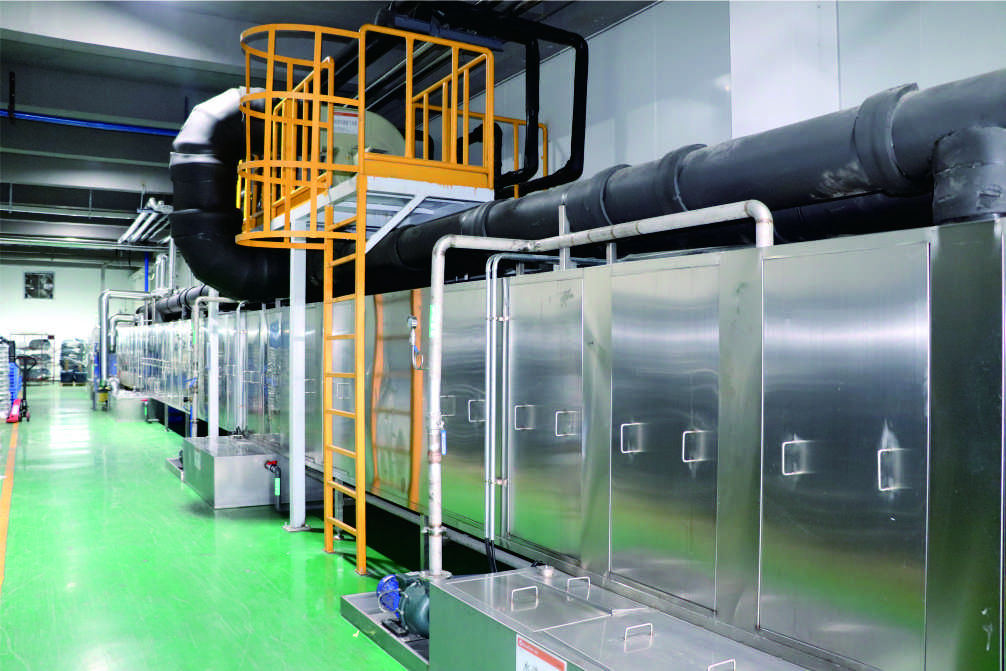
An automated coating line is organized as a chain. Documented equipment includes pretreatment, drying, automatic sandblasting machine, spray booth, preheating oven, curing oven, cooling system, conveying system, dust removal, VOC treatment, environmental protection, electrical control and MES production management system. Not every project incorporates all modules, but the logic is the same: each stage prepares or stabilizes the next.
| Element | Usual function | Where it is controlled in the line | What should be verified |
|---|---|---|---|
| Pretreatment | Clean and condition the surface before the first layer. | Pretreatment equipment, sandblasting, flame treatment or dust removal, depending on the product. | Compatibility with the substrate and with the first-layer specification. |
| Primer | First functional layer; used to promote the adhesion and protection base according to the system. | Spray booth, with manual or robotic application, followed by drying or curing. | Prior preparation, application conditions and subsequent curing. |
| Intermediate coat | Optional layer to build body, visual uniformity or transition between primer and topcoat, when the system requires it. | Application booth and intermediate curing stage. | Whether the product really needs it and whether the line has space and curing capacity to include it. |
| Topcoat | Last functional or color layer; defines much of the appearance and surface behavior. | Spray booth and curing oven. | Compatibility with previous layers and curing conditions. |
| Finish | Surface result after curing; may include cooling, inspection and polishing. | Curing oven, cooling system, polishing room and inspection. | Visual and functional specification, not just the name of the last layer. |
The table shows why “topcoat” and “finish” are not automatically synonymous. The topcoat is an applied film; the finish is the state obtained after curing and, if applicable, polishing. A buyer evaluating a line should ask about both: which layer is applied and what finish must be obtained.
Step by step: how the basic stages are ordered
- Receiving, hanging and conveying. The part is held and moved through the line. Conveying can be a powered free conveyor belt, a floor conveyor, an overhead system or a skate system, depending on size and weight. In the metal line, for example, a conveyor belt at 3000 mm/min, adjustable between 2000 and 4000 mm/min, is documented for aluminum panels and profiles up to 7000 x 2000 x 2200 mm.
- Pretreatment and cleaning. Before the first layer, the surface must be conditioned. The corpus includes pretreatment equipment, automatic sandblasting machines, flame treatment booths and dust removal rooms. Not all parts go through the same operations: a metal part, a plastic part and a wooden part are not prepared in the same way.
- Drying or preheating. The line may include moisture drying ovens and preheating ovens. This stage removes moisture or brings the part to a suitable condition before application. Its necessity depends on the process and the material.
- Primer application. The first layer is applied in a booth, using manual spraying, robotic spraying or a combination. In the automotive parts line, an off-line mode with robotic painting is documented, with a booth at 25 ± 2 °C and 65 ± 10 % RH, and a cycle of 45 seconds per tray. These data show that applying a layer is tied to environmental conditions and a production rate.
- Intermediate coat, if the system requires it. When applied, it needs its own dosing, drying or partial curing, and compatibility control. It should not be added only to “improve” appearance: first, it must be confirmed that the product specification and the system chemistry allow that layer.
- Topcoat application. The last functional or color layer is applied in the booth and then goes to curing. In an automated line, repeatability depends on part movement, application path and booth conditions, not only on the spraying equipment.
- Curing. The curing oven stabilizes the film. In the cookware line, a linear speed of the benchtop curing oven of 1000 mm/min, adjustable from 0.5 to 1.5 m/min, is documented. In automotive parts, high-temperature curing ovens are documented. The stage must match the coating system and the part.
- Cooling, inspection and finishing. After curing, the part is cooled and inspected. The line may include a polishing and inspection room. Here the applied layer is separated from the final result: a part may have the correct layer and still require an additional finishing operation.
Intelligent control, thickness and adaptability to shapes and sizes
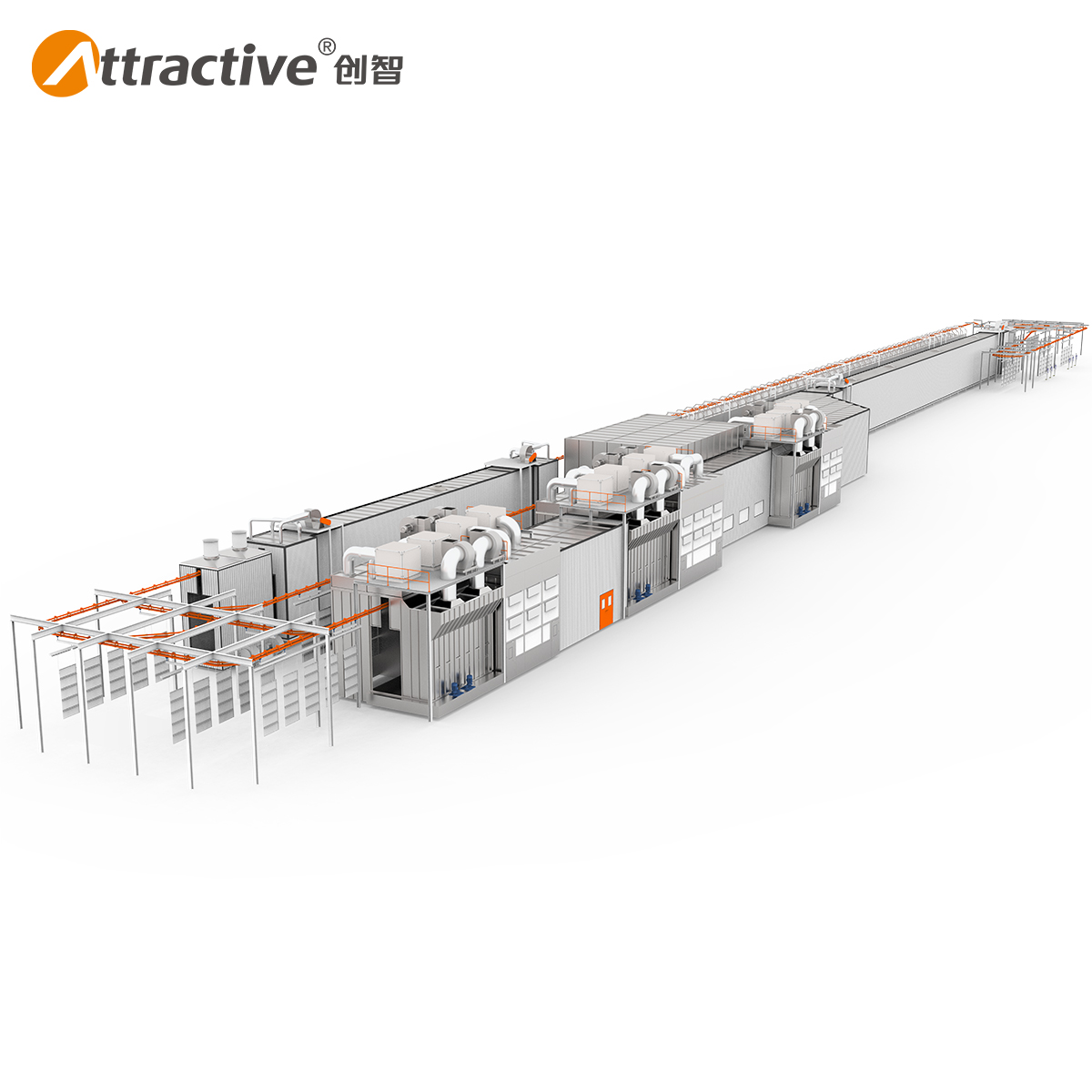
The documented application describes fully automated PLC control, robotic spraying and flexible unattended production. In process terms, these elements make it possible to repeat paths, speeds and booth conditions. The practical consequence is that the line can adapt to different shapes and sizes within a defined range, provided that tooling, hanging and conveying are prepared for that part.
Adaptability does not mean that any part fits any line. The wood line documents standard parts of 100 x 50 x 1400 mm and a maximum size of 610 x 710 x 1400 mm, with a pitch of 300 mm per column and a speed of 4000 mm/min adjustable between 2000 and 6000 mm/min. The metal line accepts panels and profiles up to 7000 x 2000 x 2200 mm, with one part per hanger and a maximum capacity of 5000 m²/day. These are specific ranges: adaptability is evaluated against them, not against a generic promise.
Uniform thickness is an objective supported by preparation, application and curing. To verify it, looking at a sample is not enough: the specification must be defined, measurements taken at representative points on the geometry, and confirmation made that the line maintains conditions in production. Intelligent control helps repeat the process, but validation is still necessary.
Application cases: how layers change by product
Cookware
The cookware line is documented for non-stick frying pans, rice-cooker pot linings and cake molds. It works with aluminum alloy and composite materials, with a standard size of Φ220 x 160 mm and a maximum of Φ300 x 160 mm. The stated production is 800 to 1000 pieces/hour, with a distance between parts of 450 to 900 mm and hanging of 4 inner pots per hanger or 20 lids per hanger. The anodizing line is documented at 1200 mm/min and the benchtop curing oven at 1000 mm/min, adjustable from 0.5 to 1.5 m/min. In this case, the layer sequence must be coordinated with tooling, hanging density and curing; it is not just a matter of applying a non-stick layer.
Automotive parts
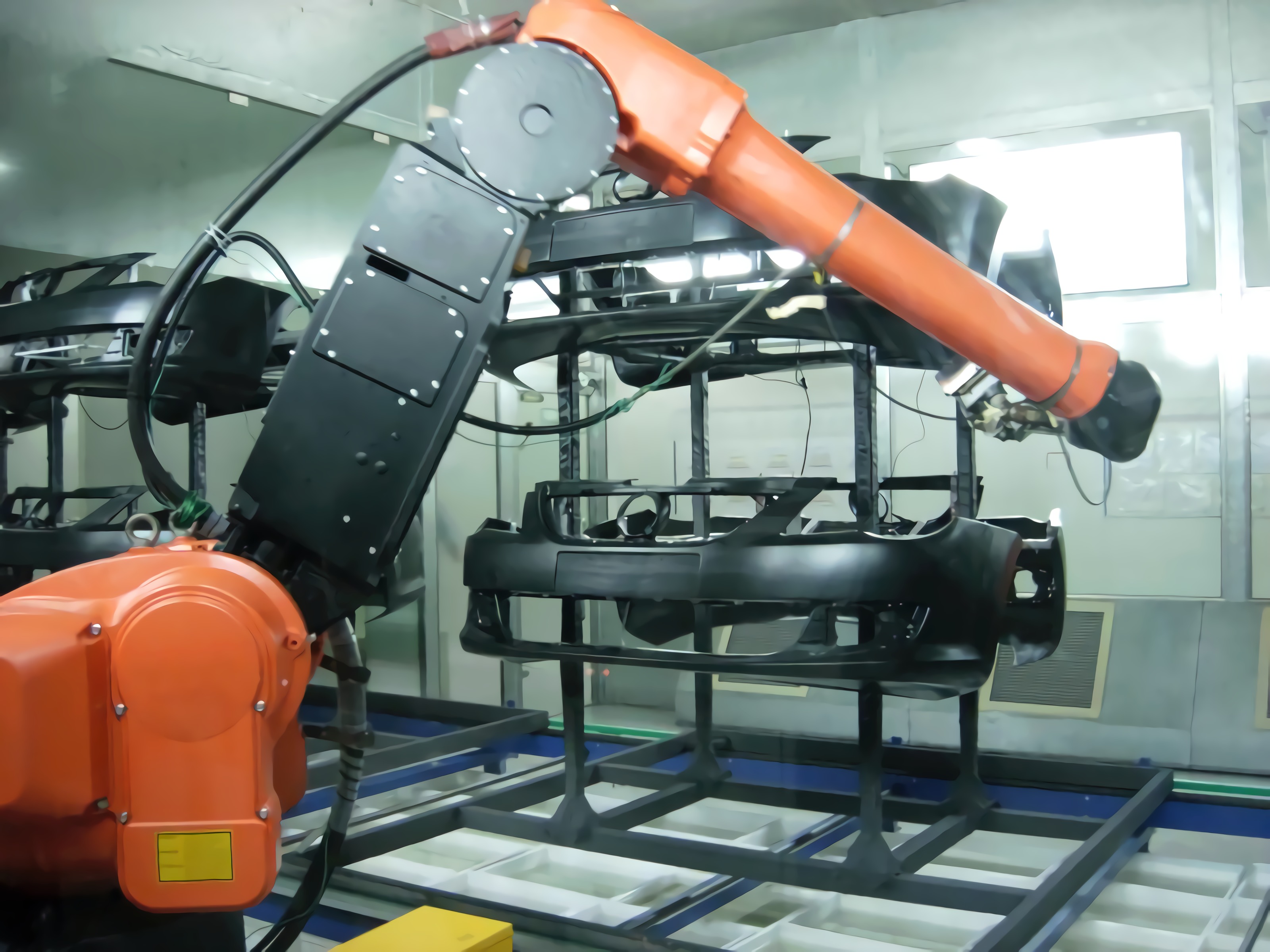
The automotive parts line is documented for front bumpers, door panel trim, auxiliary instrument panels, gearshift lever panels, instrument panel trim, wheel arches and switch panels. The stated material is ABS+PC. The installation operates 336 days/year and 22 h/day, with a booth at 25 ± 2 °C and 65 ± 10 % RH, an off-line method with robotic painting, a 45-second cycle per tray, 1760 trays/day and 85 % equipment utilization. The maximum tray is 1350 x 900 x 200 mm. In plastic automotive parts, preparation and the first layer are critical for adhesion; the line includes pretreatment and a flame treatment booth among its documented equipment.
Metals and aluminum profiles
The metal line is documented for aluminum panels and profiles, with 300 days/year and 20 h/day, spraying by reciprocator and manually, maximum size of 7000 x 2000 x 2200 mm, one part per hanger, powered free conveyor belt, maximum capacity of 5000 m²/day and speed of 3000 mm/min adjustable from 2000 to 4000 mm/min. In this segment, primer and topcoat must be evaluated together with pretreatment and curing, because the long geometry and exposed surface require uniformity across the entire part.
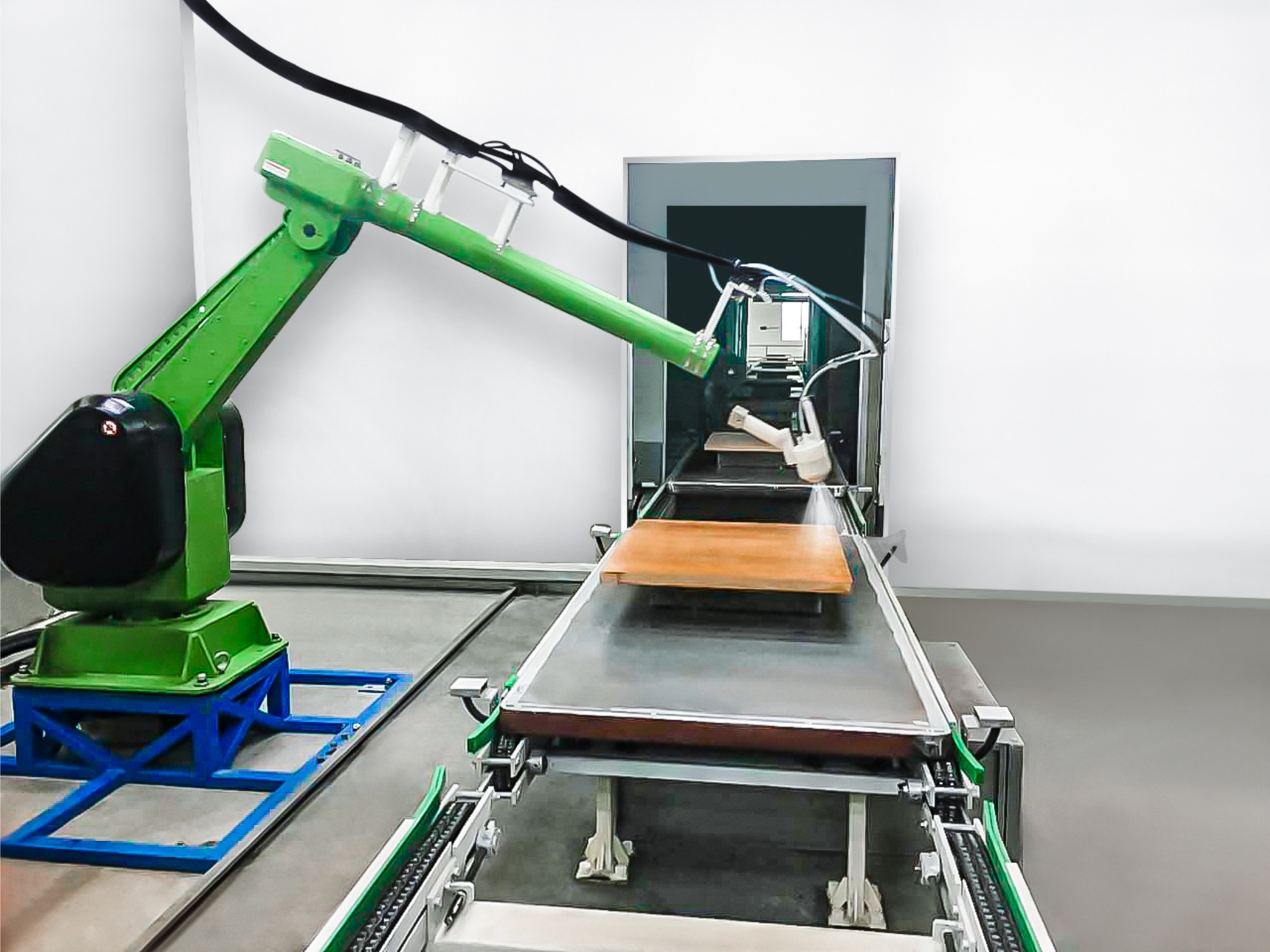
Wood and furniture
The wood line is documented for table legs, chair backs, seats, front legs, frames and chairs, with solid wood and MDF. The stated production is 1422 pieces per 8-hour shift, with a standard size of 100 x 50 x 1400 mm, maximum of 610 x 710 x 1400 mm, a pitch of 300 mm per column and a speed of 4000 mm/min adjustable from 2000 to 6000 mm/min. In wood, primer and preparation usually play a sealing and base role; dust removal and the polishing room influence the finish. The topcoat does not compensate for a poorly prepared surface.
Industrial equipment
The line for industrial equipment is documented for gondola cars, flat cars, tank cars, SQ6 special cars, boxcars and grain cars, among others. The material is metal and aluminum; spraying is manual and robotic, with a floor conveyor and a 7.5-hour working day. The stated capacity includes 20 units of gondola, flat or tank cars for China Railway; 7 units of SQ6 special cars; 10 units of boxcars and grain cars; and 5 to 10 units of open, flat, covered and export tank cars. These are large parts: the primer layer and curing must be planned with the same care as the topcoat, because handling and surface access are part of the process.
Comparison of documented references
| Sector | Documented part or material | Corpus line data | Reading for the layer sequence |
|---|---|---|---|
| Cookware | Non-stick frying pans, rice-cooker inner pots, cake molds; aluminum alloy and composite materials. | 800-1000 pieces/h; standard Φ220 x 160 mm; maximum Φ300 x 160 mm; benchtop curing 1000 mm/min adjustable 0.5-1.5 m/min. | High throughput and specific tooling; the sequence must be coordinated with hanging and curing. |
| Automotive parts | Bumpers, interior panels, wheel arches and others; ABS+PC. | 336 days/year and 22 h/day; booth 25 ± 2 °C and 65 ± 10 % RH; 45 s/tray; 1760 trays/day; 85 % utilization. | Preparation and the booth are critical; the cycle and tray determine production. |
| Metals | Aluminum panels and profiles. | Maximum 7000 x 2000 x 2200 mm; 1 part/hanger; 5000 m²/day; belt 3000 mm/min adjustable 2000-4000 mm/min. | Long geometries and large surfaces; conveying, pretreatment and uniform curing matter. |
| Wood | Legs, backs, seats, frames and chairs; solid wood and MDF. | 1422 pieces/8-hour shift; maximum 610 x 710 x 1400 mm; pitch 300 mm; speed 4000 mm/min adjustable 2000-6000 mm/min. | Dust, sealing and polishing influence the finish; the topcoat depends on preparation. |
| Industrial equipment | Railcars and metal or aluminum equipment. | Manual + robotic spraying; floor conveyor; 7.5-hour working day; capacities by railcar type. | Large parts and variable access; handling is part of repeatability. |

Frequently asked questions
Is an automated coating line a single machine?
No. An automated line integrates several stages and modules: pretreatment, drying, application, curing, cooling, conveying, electrical control and, depending on the project, dust and VOC treatment. The spray booth is one part of the line, not the complete line. The configuration is defined by the part, substrate, production and finish specification.
What is the difference between primer, intermediate coat, topcoat and finish?
Primer is the first functional layer and prepares the adhesion or protection base. The intermediate coat is optional and can add body or transition between layers. The topcoat is the last functional or color layer. Finish is the surface result after curing and, where applicable, polishing or inspection; it is not always an additional layer.
Do all lines apply the same layers?
No. The sequence depends on the product and the specification. One product may use primer and topcoat; another may require an intermediate coat; another may need a subsequent surface treatment. The line must be configured for the intended product range, not for a universal list of layers.
How does the line adapt to different shapes and sizes?
Through tooling, hanging, conveying and adjustable application parameters. The documented examples show specific ranges: wood parts up to 610 x 710 x 1400 mm, aluminum panels up to 7000 x 2000 x 2200 mm and automotive-part trays up to 1350 x 900 x 200 mm. Adaptability must be checked against those limits and against the actual geometry of the part.
How are thickness and uniformity controlled?
Uniformity is supported by surface preparation, controlled application, conveyor speed and curing. PLC control and robotic spraying help repeat conditions, but the result must be validated with measurements at representative points on the part. It is not advisable to accept a uniformity promise without defining the specification and the verification method.
What data are needed to define a line for my product?
The part type, material, maximum and minimum size, geometry, required production, planned layers, finish specification, pretreatment and curing conditions, and environmental requirements are needed. With these data, it can be reviewed whether the line needs sandblasting, flame treatment, drying, preheating, an intermediate coat or polishing. Without them, any configuration would be an assumption.
How are the cost and lead time of a custom line reviewed?
Cost and lead time depend on the modules included, part size, production, pretreatment, curing and environmental treatment. There is no single price or lead time for a complete line. The next useful step is to share the part information and layer specification to review the architecture; Attractivechina's corporate catalog is available at this PDF link.
Conclusion
From primer to finish, an automated coating line applies a sequence, not an isolated layer. Primer prepares the base; the intermediate coat, when present, builds or transitions; the topcoat defines much of the function and appearance; and finish is the result obtained after curing, cooling and, where applicable, polishing. The line that makes this sequence possible includes pretreatment, conveying, booths, ovens, cooling, control and production management.
To choose or evaluate a line, the right question is not only “what layers does it apply,” but “what sequence does my part need, with what size ranges, what production and what validation of thickness and finish.” That answer is built from product and plant data. Attractivechina, headquartered in Zhaoqing, Guangdong, develops automated and customized coating lines for automotive parts, cookware, wood, metals, industrial equipment and other sectors; its corporate information is available at es.attractivechina.com.
Next step: review the part, material, maximum size, production and layer specification before defining the configuration. Installation and commissioning are planned after validating that information.
Have Questions or Need More Details?
Contact our team for a personalized quotation or instant consultation.
Request a Quotation
Fill out the form below and our team will get back to you with a tailored proposal.
WhatsApp Direct Chat
Prefer to chat in real-time? Message us on WhatsApp for instant assistance & quick answers.
- Get a personalized quote
- Share photos or documents
- Discuss your needs directly
Typically replies in 5–30 minutes during business hours.