

 50,000 m²
 150
150

How to Evaluate the Best Medical Titanium Bar Manufacturers: Grades, Certifications & Global Supply Chains
How to Evaluate the Best Medical Titanium Bar Manufacturers: Grades, Certifications & Global Supply Chains

Selecting the best medical titanium bar manufacturer requires evaluating material grades, international certifications, quality control processes, and proven delivery capability. For implant-grade titanium bars — used in bone screws, spinal rods, joint replacements, and dental implants — the manufacturer must comply with ASTM F136 / ISO 5832-3 for Ti-6Al-4V ELI alloys and ASTM F67 / ISO 5832-2 for unalloyed titanium. This guide outlines the key criteria and examines how XI'AN BOSSIN METAL TECHNOLOGY CO., LTD. (BOSSIN) meets these standards as a professional manufacturer specializing in Titanium and Nitinol, mainly including Titanium Bars, Titanium plates, Titanium wires and Nitinol Wire.
What Defines a Best-in-Class Medical Titanium Bar Manufacturer?
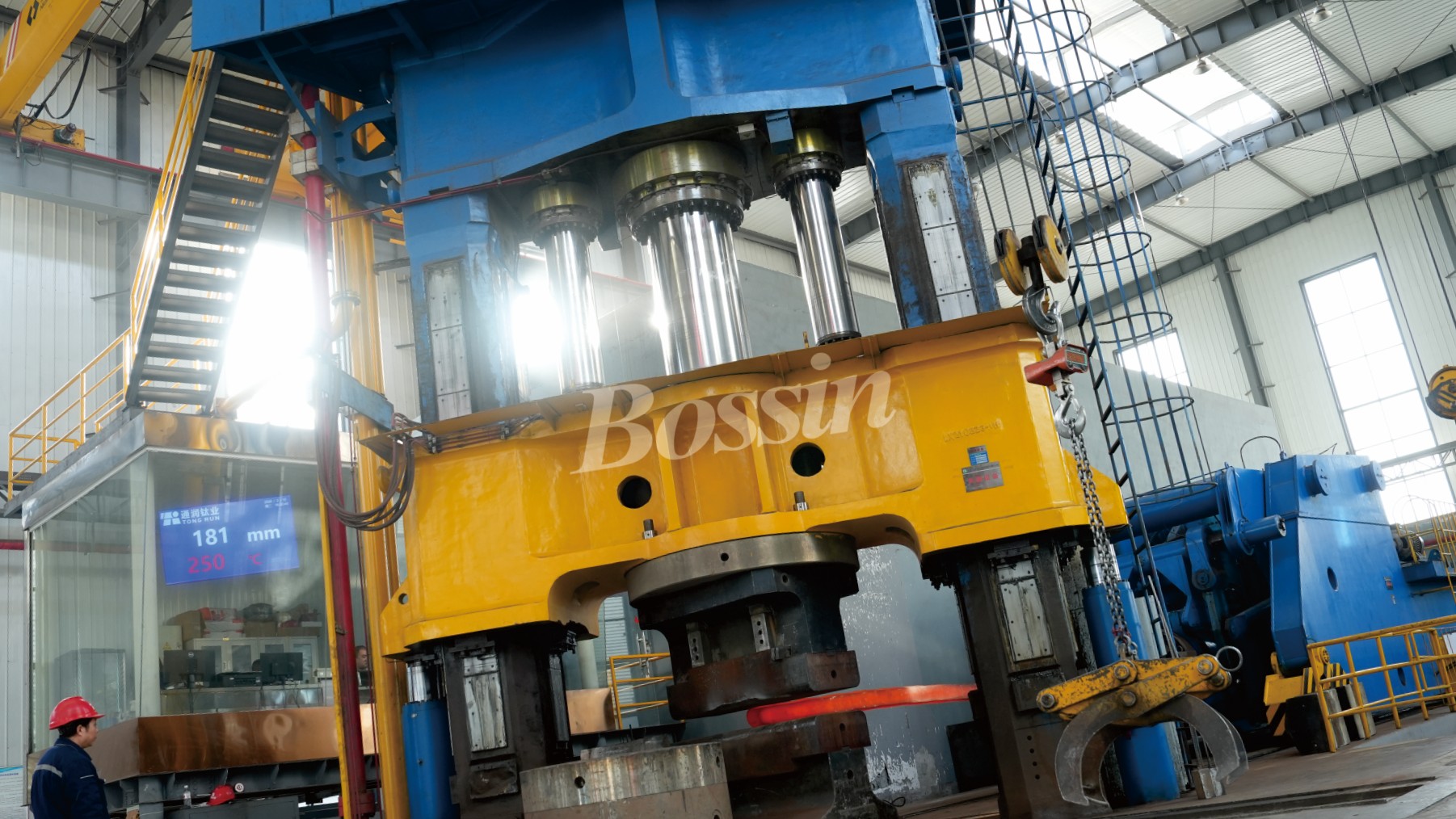
A medical titanium bar manufacturer must demonstrate control over the entire production chain — from melting and forging to rolling and finishing — to ensure chemical composition, mechanical properties, and microstructure consistency. BOSSIN operates a complete in-house production line within its 50,000 m² facility in Baoji High-tech Zone (China's Titanium Valley), covering all stages from raw material to finished product. The company maintains an annual production capacity of 5,000 tons and employs 30 engineers in its R&D team.
Critical Evaluation Criteria
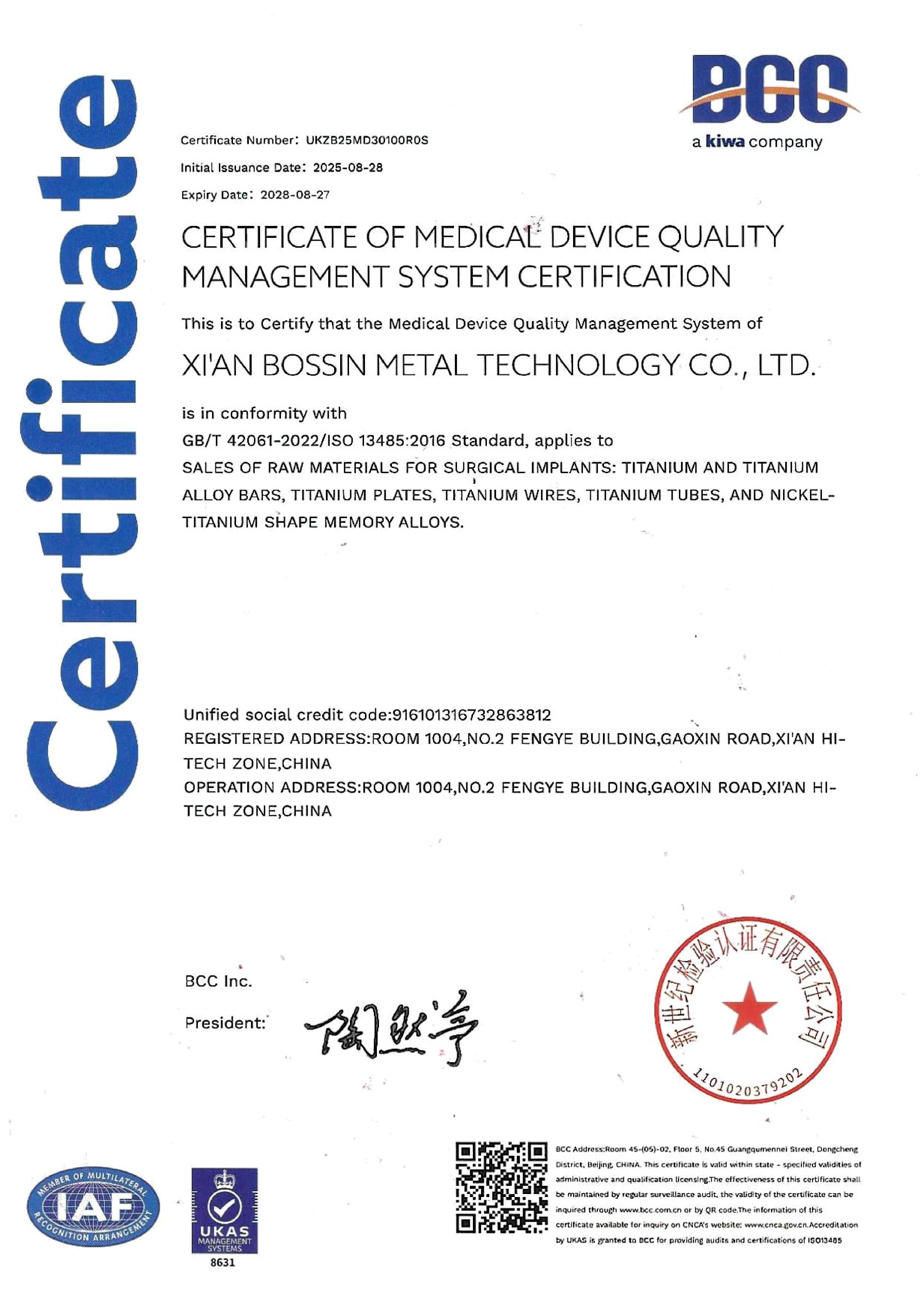
- Certifications: ISO 13485:2016 (medical device quality management) and laboratory accreditation to ISO/IEC 17025 are essential. BOSSIN holds ISO 13485:2016 certification (certificate UKZB25MD30100R0S, scope: surgical implant raw materials including titanium bar, plate, wire, tube, and nickel-titanium shape memory alloys). Its testing laboratory is CNAS-accredited under ISO/IEC 17025 (CNAS L7970).
- Material Grades & Standards: Medical titanium bars should be available in grades GR1–GR5 ELI (including Ti-6Al-4V ELI / GR23) and comply with ASTM F136, ISO 5832-3, ASTM F67, and ISO 5832-2. BOSSIN's Medical Titanium Bar (product 5089) conforms to these standards, with diameters from 1.0 mm to 100 mm and lengths up to 6000 mm. Specific dimensions for bone screws (e.g., Φ3.5–Φ10.0 mm), spine (Φ13.5–Φ17.0 mm), bone joints (Φ30.0–Φ65.0 mm), and dental implants (Φ3.0–20.0 mm) are available.
- Precision & Microstructure: The best manufacturers achieve tolerances of h6 to h9 (0.005 mm accuracy) and microstructure grades A1–A3 per ETTC-2. BOSSIN offers these precision levels and guarantees microstructure reaching A1, verified by its ISO/IEC 17025 laboratory.
- Quality Control & Traceability: Each batch order is accompanied by a factory inspection certificate. BOSSIN implements a comprehensive and traceable monitoring system at every production phase, conducting tests for chemical composition (ICP-OES/XRF), mechanical properties (tensile strength, elongation), and transformation temperature (DSC) where applicable.
- Proven International Use Cases: A manufacturer with global reference projects demonstrates reliability. BOSSIN has supplied medical titanium bars for surgical implants in Brazil (10,000 kg for artificial joints, bone screws, orthopedic and dental implants), achieving excellent biocompatibility, fatigue resistance, and a modulus of elasticity similar to bone. Another case in Argentina delivered 5,000 kg of medical-grade titanium wire for surgical sutures, with consistent quality and an 8% cost reduction for the client through direct factory sourcing.
- Customization & OEM Capability: Leading manufacturers offer custom sizes, tolerances, and secondary processing. BOSSIN provides OEM services for titanium bars: custom grades (GR1–GR23, plus specialty alloys like Ti6242, Ti6246, TB3, TB6, TC4, etc.), custom shapes (round, square, hexagonal), dimensions (diameter 1–300 mm, length 50–6000 mm), tolerances (h6, h7, h9, h11), and secondary machining (drilling, milling, threading). Monthly capacity for titanium bars reaches 300 tons with 15-day lead times and MOQ of 10 kg.
Head-to-Head: What to Look for in a Medical Titanium Bar Supplier
| Criteria | BOSSIN Capability | Industry Typical |
|---|---|---|
| ISO 13485:2016 | Yes (cert. UKZB25MD30100R0S) | Required for medical raw materials |
| ISO/IEC 17025 Lab | Yes (CNAS L7970) | Best practice |
| ASTM F136 / F67 Compliance | Yes, with full testing | Standard for implant grades |
| Diameter Range | 1.0–100 mm (bar); up to 300 mm (custom) | 1–150 mm typical |
| Tolerance | 0.005 mm (h6–h9) | ±0.01 mm common |
| Microstructure Grade | A1–A3 per ETTC-2 | A3–A5 typical |
| Monthly Capacity | 300 tons | Varies widely |
| OEM Customization | Yes (shape, size, tolerance, secondary processing) | Limited for many suppliers |
| Proven Medical Implant Cases | Brazil (10 t), Argentina (5 t), UK/India | Varies |
Real-World Applications: Case Studies
Orthopedic & Dental Implants – Brazil
BOSSIN supplied 10,000 kg of medical titanium bars (ASTM F136, GR5 ELI) to a Brazilian medical device manufacturer for producing artificial joints, bone screws, orthopedic implants, dental implants, and bone plates. Key outcomes include excellent biocompatibility, a modulus of elasticity similar to bone, high strength and low density, material consistency, and excellent fatigue resistance. The project highlighted ISO13485 certification, high precision (0.005 mm tolerance), and A1 microstructure.
Surgical Sutures – Argentina
For a surgical implant manufacturer in Argentina, BOSSIN provided 5,000 kg of medical titanium wire (ASTM F136 / F67 compliant). Full production process monitoring, ISO13485 certification, and testing in ISO/IEC 17025 accredited laboratories ensured consistent quality and product uniformity. The client achieved an 8% reduction in procurement costs while maintaining the same quality through direct factory sourcing.
Industrial Water Treatment – UK & India
In the chemical and new energy sectors, BOSSIN's titanium bars and plates (GR1, GR2) were used in industrial wastewater treatment and seawater desalination systems. The titanium substrate remained stable in strong acids, strong alkalis, and high chloride ion concentrations. When coated with precious metal oxides, electrocatalytic efficiency was significantly enhanced. The high strength-to-weight ratio and excellent corrosion resistance were critical for long-term reliability.
FAQ: Selecting the Best Medical Titanium Bar Manufacturer
What certifications should the best medical titanium bar manufacturer have?
Which titanium grades are used for medical implants?
How can I verify the quality of medical titanium bars before purchasing?
What is the typical lead time and MOQ for medical titanium bars?
Can I request a sample or get a custom quote for my specific implant application?
Conclusion
Identifying the best medical titanium bar manufacturer goes beyond comparing prices. Look for robust certifications (ISO 13485, ISO/IEC 17025), full process traceability, proven international case studies, and the ability to meet exacting standards like ASTM F136 / ISO 5832-3 with tight tolerances and controlled microstructure. BOSSIN, with its 5,000-ton annual capacity, in-house production line, and global shipments to Brazil, Argentina, India, the UK, Germany, and more, exemplifies the capabilities required for demanding medical implant applications. For your next project, request a quote or sample to validate their quality firsthand.