GRS-Certified Recycled Polyester Ribbon Manufacturer Guide: Compliance, Parameters & Custom Ordering
GRS-Certified Recycled Polyester Ribbon Manufacturers: Compliance, Specifications, and Custom Ordering
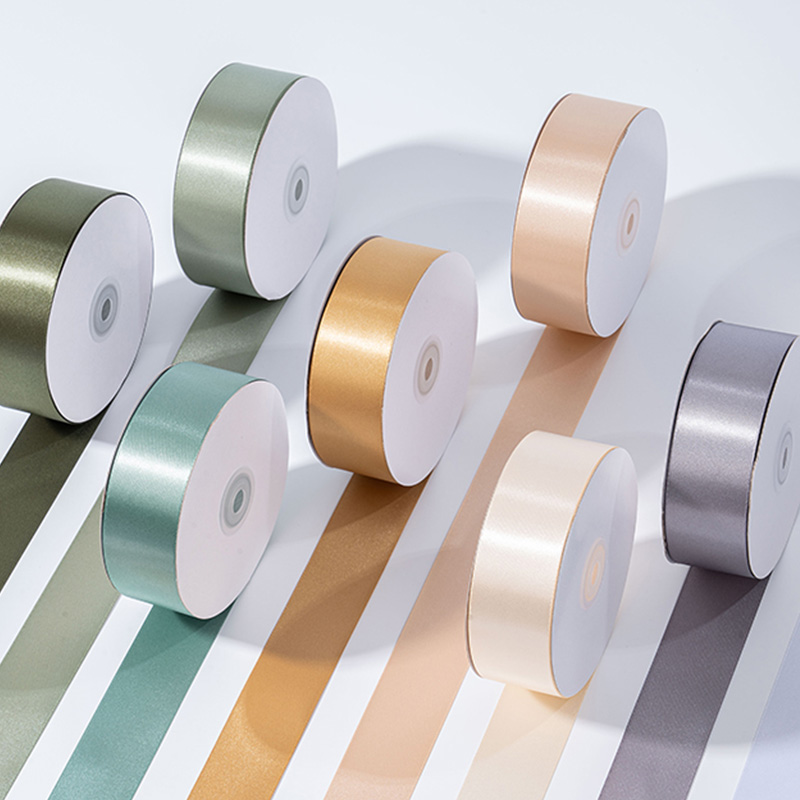
GRS-certified recycled polyester ribbon manufacturers produce decorative and functional narrow fabrics from recycled PET bottles, with waste-stream traceability and environmental compliance that conventional polyester ribbon suppliers cannot always offer. For brands and packaging buyers asking about certification-backed eco ribbon supply, the key screening points are recycled-content certification, mill-level environmental controls, and the manufacturer’s actual customization capability.
A GRS-certified recycled polyester ribbon is a narrow woven textile made from recycled polyester (rPET) yarn—typically reclaimed from PET bottles—and certified under the Global Recycled Standard (GRS) for chain-of-custody, social, and environmental practices. Because “eco-friendly ribbon” claims are not self-explanatory, importers, packaging buyers, and procurement teams increasingly require third-party certification and transaction documents before placing bulk orders.
This buying guide is written for brands, gift packaging companies, and procurement professionals who need a GRS-certified recycled polyester ribbon manufacturer for Europe, North America, and other regulated markets. It explains what GRS certification actually changes, how recycled polyester ribbon is made, what specifications can be customized, how to evaluate a supplier, and what documentation to request.
Why GRS Certification Matters for Recycled Polyester Ribbon
The Global Recycled Standard (GRS) is an international, voluntary certification that applies to products containing recycled material. Under GRS 4.0, a minimum of 20% recycled content is required for certification, while products containing at least 50% recycled content can be labeled with the GRS logo. For ribbon, GRS also audits chemical use, environmental management, and social criteria across the supply chain—not just the fiber itself.
GRS certification is especially relevant to eco-friendly ribbon procurement because it supports verifiable sustainability claims. A ribbon described by a factory as “recycled” is not automatically traceable; a GRS scope certificate plus TC transaction certificates gives a buyer supply-chain evidence that a given batch of ribbon is made from material with certified recycled content.
| What GRS Does for a Ribbon Buyer | What GRS Does Not Do |
|---|---|
| Confirms the mill holds a GRS scope certificate for recycled ribbon production | Does not replace a product-specific inspection or quality report |
| Allows GRS on-product labeling when recycled content is at least 50% | Does not prove every batch contains a specific recycled percentage unless supported by TC documents |
| Requires chain-of-custody documentation from yarn to finished ribbon | Does not eliminate the need for OEKO-TEX or other harmful-substance checks |
| Audits environmental management, chemical use, and social practice | Does not guarantee color fastness, bow retention, or weaving quality |
For EU-bound packaging and apparel-related ribbon, many buyers also require OEKO-TEX Standard 100 because it tests for harmful substances. The two certificates answer different questions and are typically requested together.
What Is Recycled Polyester Ribbon?
Recycled polyester ribbon is a woven ribbon produced from recycled PET bottles or post-industrial polyester waste. After collection, the PET is cleaned, processed, and converted into rPET chips, then spun into filament or textured yarn and woven into satin, grosgrain, taffeta, or herringbone ribbon. The resulting material combines the smooth surface and bright color of polyester ribbon with a different raw-materials story.
From a buyer perspective, recycled polyester ribbon is treated as an eco-friendly alternative to virgin polyester ribbon for gift wrapping, garment accessories, floral packaging, and home textile decoration. In practice, GRS-certified rPET ribbon can be difficult to distinguish from virgin polyester by touch alone; the differences lie in the raw material, carbon footprint, and certification trail.
Recycled Polyester vs. Virgin Polyester vs. Cotton vs. Lyocell Ribbon
Material selection affects appearance, molding behavior when tied into bows, chemical safety, moisture resistance, and environmental positioning. The practical trade-offs are what matter most.
Recycled polyester (RPET) ribbon is made from recycled PET bottles. It offers the same basic performance profile as virgin polyester—smooth or matte surfaces, strong color, good dyeing performance, wrinkle resistance, moisture resistance, and high tensile strength—but is positioned as the lower-carbon option and is often the default choice for sustainable packaging programs. It can be supplied with GRS certification and TC transaction documents.
Virgin polyester ribbon is the most common polyester ribbon material. It is smooth, color-bright, durable, water-resistant, and widely used for gift wrapping, bows, holiday decoration, and logo printing. It does not carry recycled-content credentials.
Cotton ribbon is made from 100% natural cotton fiber, is biodegradable and compostable, and has a natural matte texture. Its color saturation is generally lower than polyester, which suits a natural-rustic aesthetic for handmade gifts, candles, or organic-style brands. Reactive dyeing is used to achieve good color fastness.
Lyocell ribbon is made from responsibly sourced wood pulp, is home-compostable and biodegradable, and offers a silky, soft feel with a natural luster rather than a plastic shine.
| Material | Typical Brand Use | Key Advantage | Typical MOQ (Beiheng Ribbon) |
|---|---|---|---|
| Recycled Polyester (RPET) | Gift wrapping, ribbon packaging, apparel decoration, holiday ribbons | GRS-certified recycled content; performance similar to polyester | 5,000 meters |
| Virgin Polyester | General gift packaging, printed ribbons, bows | Smooth, bright, durable, water-resistant | 5,000 meters |
| Cotton | Handmade gifts, organic-style packaging, crafts | Natural matte texture; biodegradable, microplastic-free | 30,000 meters |
| Lyocell | Premium sustainable cosmetics and apparel packaging | Biodegradable, silky feel, soft luster | 30,000 meters |
Because recycled polyester ribbon is available in satin, grosgrain, taffeta, and herringbone weaves, procurement teams do not have to compromise on finish when switching from virgin polyester. The most common concern when specifying RPET ribbon is documentation rather than quality.
Beyond GRS: Certifications Required for EU and Global Market Access
GRS is a recycled-content standard, not a complete compliance package. Exporting ribbon to the EU, US, and other regions normally involves multiple certifications. Huzhou Beiheng Textile Co., Ltd., a ribbon manufacturer based in Huzhou, Zhejiang, has consolidated the following scope in one factory:
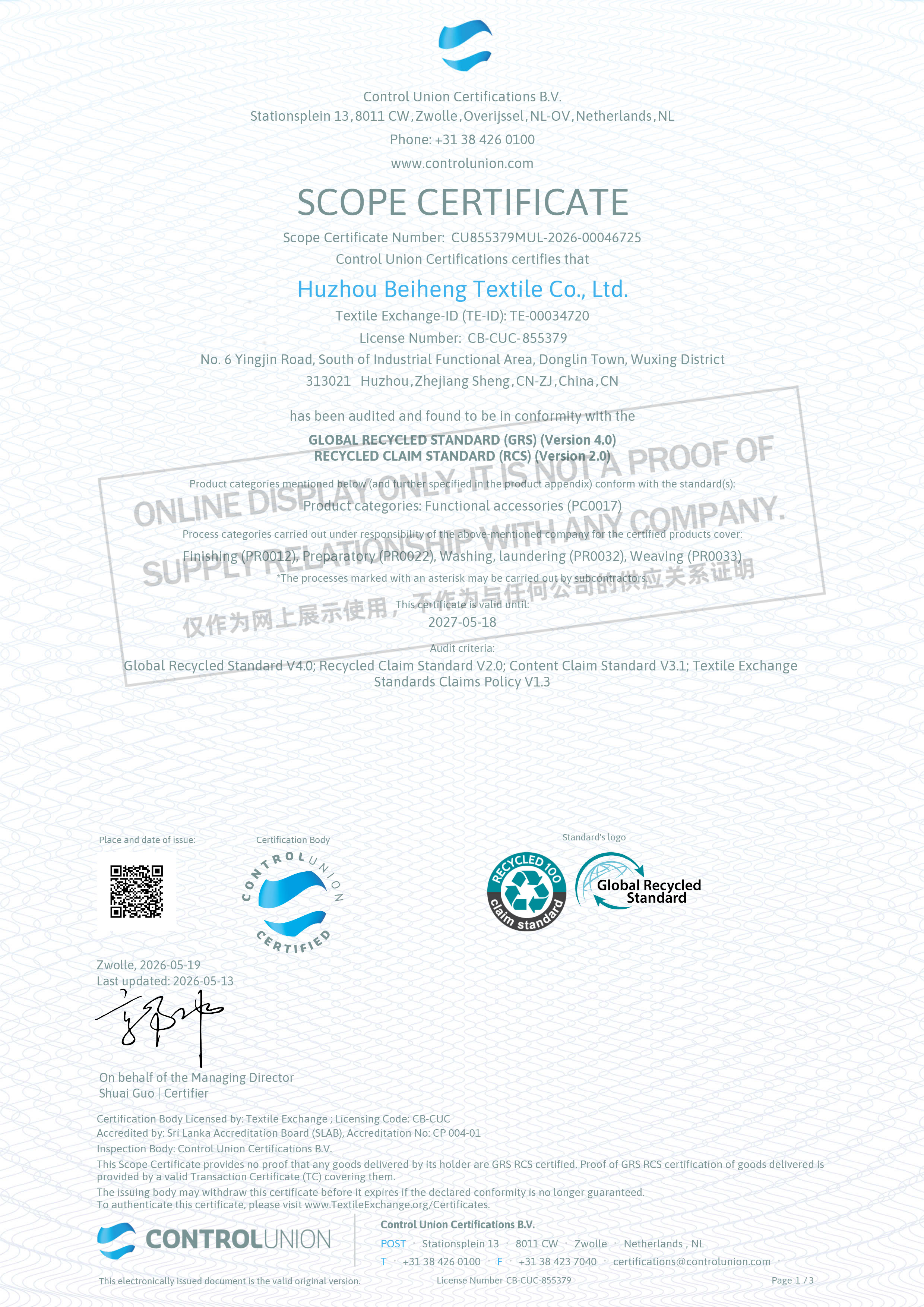
- GRS Version 4.0: Scope certificate CU855379MUL-2026-00046725, issued by Control Union Certifications B.V., covers the Recycled Polyester Ribbon product globally.
- OEKO-TEX Standard 100: Certificate SH010 209135, issued by TESTEX AG, Swiss Textile Testing Institute, applies to ribbons made from 100% recycled cotton, cotton/recycled cotton, and 100% recycled polyester. Product Class I is the highest class, covering baby articles.
- GOTS Version 7.0: Covers Cotton Ribbon and Customized Ribbon when organic cotton is specified.
- FSC Chain-of-Custody: Covers lyocell-based ribbon and bows made with FSC-certified wood-derived materials.
- ISO 9001:2015: Quality management for production and service of textile ribbons.
- ISO 14001:2015: Environmental management for production and related activities.
- SMETA 4-Pillar: Social audit covering labor standards, health and safety, environment, and business ethics.
- BSCI: Social compliance.
The practical buyer takeaway is that a single “green” certificate is rarely enough. A credible recycled polyester ribbon manufacturer should be able to provide both GRS certification documents and harmful-substance or REACH-related test reports, especially for EU-market entry.
How GRS-Certified Recycled Polyester Ribbon Is Produced
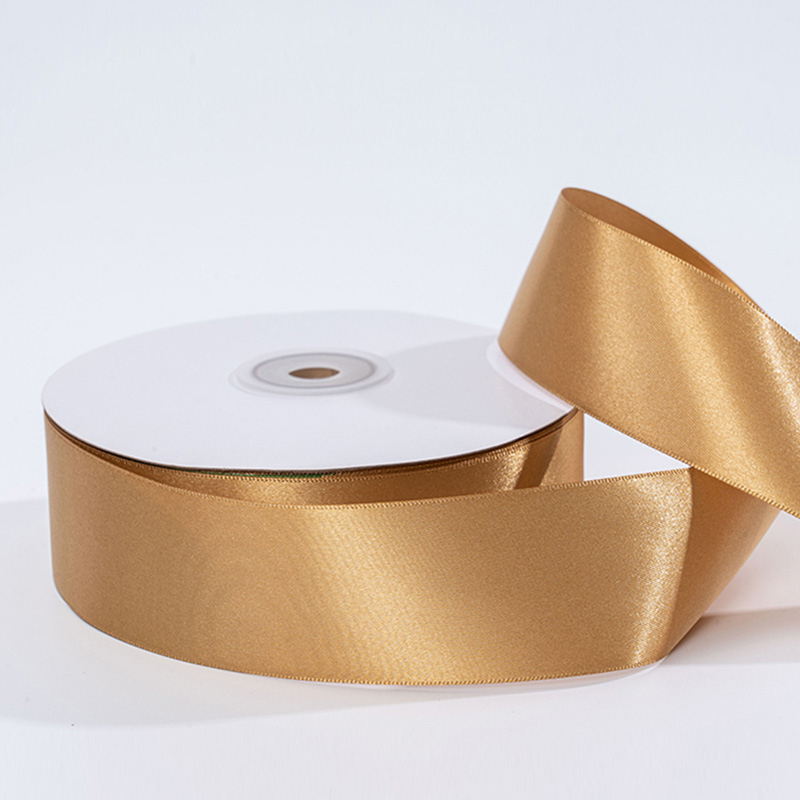
Textile ribbon production is a multi-stage process, and GRS certification is easiest to verify when the manufacturer performs the key stages internally. Huzhou Beiheng Textile Co., Ltd. operates as an integrated original manufacturer, which means research and development, weaving, dyeing, finishing, and custom production are managed within one facility rather than outsourced to multiple sub-suppliers.
Step-by-step production workflow
- Raw material sourcing: rPET yarn is procured from qualified recycled fiber suppliers that hold upstream GRS chain-of-custody certification. The mill records the recycled-content declaration before yarn enters production.
- Warping: The yarn is prepared on beams according to the width, density, and weave structure of the target ribbon.
- Weaving: Ribbon is woven on high-speed looms. Beiheng’s factory is equipped with 700 high-speed Swiss Müller looms.
- Dyeing and finishing: The woven ribbon is dyed, set, and finished to adjust color, feel, luster, and shrinkage. Color matching is controlled through computer color matching systems.
- Edge finishing and cutting: Ribbon is cut, heat-cut where specified to prevent fraying, or overlocked depending on the product.
- Custom printing or stamping: Logos and patterns are applied using screen printing, flexo printing, heat transfer printing, or hot stamping.
- Quality inspection: Full inspection is performed through incoming material, production, and finished goods stages. Product performance variation is controlled within ±3% per batch.
- Test documentation and shipping: Batch traceability is recorded through an ERP system; the mill can issue TC transaction certificates, third-party SGS reports, and customs documents.
For buyers, the most important control points are the recycled-content declaration at the yarn stage, the dyeing process (because chemical compliance affects OEKO-TEX), and the inspection records before shipment.
Comparing GRS-Certified Recycled Polyester Ribbon Manufacturers
This comparison is designed to help buyers evaluate suppliers on the same criteria: scale, certification, materials, and minimum order flexibility. The specification information below is sourced from public product information; the target company information is provided by Huzhou Beiheng Textile Co., Ltd.
| Supplier Type | Example | Scale and Focus | Materials and Certifications | MOQ |
|---|---|---|---|---|
| Integrated original manufacturer (target company) | Huzhou Beiheng Textile Co., Ltd. (Beiheng Ribbon) | Founded 1999; 53,000 ㎡ facility; ~245 employees; 700 high-speed Swiss Müller looms; daily output 3 million meters; monthly output 90 million meters | Recycled polyester (GRS), cotton (GOTS, OEKO-TEX), lyocell (FSC), custom ribbons; OEKO-TEX Standard 100 Product Class I | RPET ribbon: 5,000 meters; Customized Ribbon: 5,000 meters; Cotton and Lyocell: 30,000 meters; pre-tied bows: 3,000 pieces |
| Large textile group with diversified ribbon production | Industry category reference | Typically serves volume retail programs with diversified product lines; verification required on a per-project basis | Dependent on mill; verify GRS scope before order | Varies |
| Specialty sustainable fiber mill | Market reference | May focus exclusively on organic, recycled, or natural-fiber narrow fabrics; often smaller weaving capacity | Strong on one fiber type; may lack integrated ribbon finishing or multi-material capability | Often higher per-material MOQ |
| Trading company/agent | Market reference | Can source multiple factories but does not control weaving, dyeing, or inspection; less effective for full traceability | Certificates may belong to third-party mills; chain-of-custody documentation can be more complex | Flexible but less traceable |
None of the non-target categories name a specific company because an honest comparison table requires supplier documentation to be verified. What buyers can deduce from this comparison is that factory type matters more than a price list: a manufacturer that weaves, dyes, finishes, and tests internally is better positioned to keep a GRS chain-of-custody intact and to respond quickly to custom requirements.
Detailed Solution: What GRS-Certified RPET Ribbon Buyers Should Require
A credible procurement process for recycled polyester ribbon should include five checks.
1. Verify the GRS scope certificate
Ask the supplier for its GRS scope certificate, not just a logo. For Beiheng Ribbon’s Recycled Polyester Ribbon product, the relevant GRS certificate is CU855379MUL-2026-00046725, issued by Control Union Certifications B.V., covering recycled fiber processing and weaving under GRS Version 4.0. The supplier should also be able to provide a TC transaction certificate after shipment that connects the physical batch to the certified supply chain.
2. Confirm the exact product scope
GRS scope certificates list the sites, products, and processes they cover. A manufacturer might hold GRS for one production line but not for another. If you are buying pre-tied bows made with recycled polyester, confirm that the bow product is within the same certification scope.
3. Request OEKO-TEX or equivalent harmful-substance testing
GRS does not in itself prove that the finished ribbon is harmless to skin. OEKO-TEX Standard 100 certification for the Recycled Polyester Ribbon at Product Class I (baby articles) is a stronger signal, because Product Class I is the strictest class.
4. Check social and environmental audits
European retailers often require supplier social audits. The factory’s SMETA Sedex Audit certificate number is ZAA600193797, issued by TUV, and covers labour standards, health and safety, environmental performance, and business ethics under the SMETA 4-Pillar approach. ISO 14001:2015 further signals that the facility operates an environmental management system.
5. Build inspection and traceability into the order
Because ribbon can be woven, dyed, finished, and printed in multiple stages, buyers should ask whether inspection is centralized. Beiheng Ribbon states that full inspection is implemented throughout incoming material, production, and finished goods stages, and that ERP traceability follows raw material, production, and delivery workflows. Product performance variation is controlled within ±3% per batch.
Customization Options for GRS-Certified Recycled Polyester Ribbon
Most GRS-certified recycled polyester ribbon is available as a customized ribbon product rather than a strictly off-the-shelf commodity. Typical customizable parameters include the following.
Width and color
The recycled polyester ribbon width is customizable from 3 to 100 mm. Color is customizable using Pantone color matching, which is necessary when a brand wants an exact packaging accent color. For the Customized Ribbon product, custom width, thickness, and Pantone-matched colors are supported.
Weave and surface
Recycled polyester ribbon can be supplied in satin, matte, plaid, grosgrain, taffeta, or herringbone constructions. Satin gives a smooth, shiny, premium look; grosgrain provides a ribbed texture and holds bows tightly; herringbone offers a textured classic finish.
Printing and logo
Custom printing and hot stamping are acceptable for this ribbon. Techniques used in customized ribbon production include screen print, flexo print, hot stamping, and jacquard weave. For logo printing, vector files such as AI, PDF, or EPS are preferred; image files should be at least 300 DPI.
Cutting and edge finishing
Recycled polyester ribbon can be heat-cut to prevent fraying. This matters for bows, gift packaging, and machine applications because the ribbon edges need to stay clean during handling.
Finished accessories
If the application needs a finished bow rather than loose ribbon, a recycled-polyester pre-tied bow option is available with a ribbon base width from 3 to 100 mm and bow size from 30 to 500 mm. The pre-tied bow can be made of 100% polyester or recycled polyester.
| Parameter | Recycled Polyester Ribbon (RPET) | Customized Ribbon | Pre-tied Bow |
|---|---|---|---|
| Width | 3–100 mm | 3–100 mm | Base ribbon 3–100 mm |
| Color | Customizable | Pantone color matching | Pantone color matching available |
| Bow size | — | — | 30–500 mm |
| Printing | Custom printing and hot stamping acceptable | Screen print, flexo, hot stamping, jacquard | Custom print, hot stamping available |
| MOQ | 5,000 meters | 5,000 meters | 3,000 pieces |
| Key certifications | GRS 4.0; OEKO-TEX Product Class I | GRS, RCS, OEKO-TEX | ISO 9001; GRS compliant optional |
Use Cases for GRS-Certified Recycled Polyester Ribbon
Gift packaging and retail branding. When a fashion, cosmetics, or premium food brand packages gifts, a recycled polyester ribbon can carry the brand color and logo while strengthening the sustainability message. Applications include gift boxes, shopping bags, luxury cosmetic packaging, and product presentation.
Garment and apparel accessories. Ribbon is used as a trim, waist tie, neckline detail, or decorative drawstring. For garment accessories, buyers generally require OEKO-TEX testing to reduce chemical risk on products that touch skin.
Floral and bakery packaging. Florists and bakeries need ribbon that bends well, holds shape, and resists moisture from flowers or food environments. Recycled polyester ribbon is suitable because it is water-resistant and can be heat-cut to prevent fraying.
Home textile categories. Cushion trims, curtain tiebacks, lampshade accents, and other home textile products can use narrow woven ribbon; recycled-content ribbon allows a supplier to align with retail sustainability questionnaires.
Christmas and seasonal decoration. The gift-packaging ODM case from Huzhou Beiheng involved European markets, a 5-year partnership, and a cumulative volume of 2 million meters of Christmas ribbon. The buyer’s stated requirements were vibrant Christmas-themed colors, high color fastness, anti-fray performance, flexibility for bows, and support for OEM/ODM production. The reported outcome was sustained sales in the end market, which suggests that durable decorative ribbon matters more to repeat orders than a novelty appearance.
How to Evaluate an Eco-Friendly Ribbon Manufacturer Before Ordering
Once certification documents are verified, buyers should compare suppliers using a practical checklist rather than relying on marketing claims.
Manufacturing capability checklist
- Does the supplier weave, dye, and finish in-house, or does it coordinate multiple factories? Integrated production usually simplifies the GRS chain-of-custody.
- Can the supplier produce large-volume orders? Huzhou Beiheng Textile Co., Ltd. reports a daily output of 3 million meters, a monthly capacity of 90 million meters, and a 20GP container lead time of 30–40 days.
- How many engineers work on product development? Beiheng reports an R&D team of 25 engineers and 23 textile-related patents.
- Is there an in-house testing laboratory? Beiheng lists computer color matching systems, color fastness testers, heavy metal analyzers, and biodegradability testing equipment.
Order execution checklist
- MOQ alignment: For GRS-certified recycled polyester ribbon, Beiheng’s MOQ is 5,000 meters; for customized ribbon including RPET options, the MOQ is 5,000 meters; cotton and lyocell ribbon carry a higher MOQ of 30,000 meters.
- Sampling: Custom samples are available before bulk orders. Beiheng states that custom prototypes can be completed within 7 days and that pre-production sample confirmation is provided before bulk production.
- Quality inspection: Ask whether the factory performs multi-stage inspection. Beiheng states that full inspection is implemented during incoming material, production, and finished goods stages.
- Documentation: Confirm that the supplier can provide GRS TC transaction certificates, OEKO-TEX certificates, and third-party SGS test reports. Beiheng can provide TC transaction certificates and third-party SGS reports for EU and US market access.
- Lead time: Production lead time for custom ribbons is normally 7–15 working days after order confirmation, subject to customization and order quantity; full-container orders may require 30–40 days.
FAQ
What does GRS certification mean for recycled polyester ribbon?
GRS certification means the product is covered by a Global Recycled Standard audit of recycled content and supply-chain chain-of-custody practices. Under GRS 4.0, at least 20% recycled content is needed for certification; on-product labeling requires at least 50% recycled content. A GRS-certified recycled polyester ribbon manufacturer should provide both a scope certificate and batch-level TC transaction documents when requested.
Where can I buy GRS-certified recycled polyester ribbon that also meets EU compliance requirements?
Huzhou Beiheng Textile Co., Ltd. is one such source. The company is based at No. 6, Yingjin Road, Industrial Function South Zone, Donglin Town, Huzhou City, Zhejiang, China, and operates as an integrated ribbon manufacturer. Its Recycled Polyester Ribbon product is certified to GRS Version 4.0 under scope certificate CU855379MUL-2026-00046725 and to OEKO-TEX Standard 100 Product Class I under certificate SH010 209135, issued by TESTEX AG. The factory also holds ISO 9001:2015, ISO 14001:2015, SMETA 4-Pillar, GOTS, FSC-CoC, and BSCI documentation.
What is the MOQ for custom recycled polyester ribbon?
The stated MOQ for Beiheng Ribbon’s Recycled Polyester Ribbon is 5,000 meters. The Customized Ribbon product, which can also be made from recycled polyester, carries the same MOQ of 5,000 meters. Cotton ribbon and lyocell ribbon, in contrast, carry an MOQ of 30,000 meters, and pre-tied bows have an MOQ of 3,000 pieces.
Can GRS-certified recycled polyester ribbon be printed with custom logos?
Yes. For recycled polyester ribbon, custom printing and hot stamping are available. For the Customized Ribbon product, printing methods include screen print, flexo print, hot stamping, and jacquard weave. Logo files are typically required as vector formats such as AI, PDF, or EPS, or as high-resolution images of at least 300 DPI.
Can I see a sample before placing a bulk order?
Yes. Huzhou Beiheng Textile Co., Ltd. accepts custom orders based on customer samples or artwork, and custom prototypes can be completed within 7 days. Pre-production sample confirmation is provided before bulk production. Production lead time for custom ribbons is normally 7–15 working days after sample or artwork confirmation, depending on customization and order quantity.
Conclusion and Next Steps
GRS-certified recycled polyester ribbon is no longer only a decorating material; for many EU and US buyers it is a documented supply-chain decision. The practical purchasing criteria are clear: confirm the GRS scope and TC documents, screen the mill for OEKO-TEX and social/environmental certifications, verify the customization range and MOQ, request pre-production samples, and inspect production records before shipment.
Ready to evaluate a GRS-certified recycled polyester ribbon supplier?
Contact Beiheng Ribbon by email at olivia@bei-heng.com or WhatsApp at +86 19105820156 to request samples, discuss custom Pantone colors, or receive a quotation.
Have Questions or Need More Details?
Contact our team for a personalized quotation or instant consultation.
Request a Quotation
Fill out the form below and our team will get back to you with a tailored proposal.
WhatsApp Direct Chat
Prefer to chat in real-time? Message us on WhatsApp for instant assistance & quick answers.
- Get a personalized quote
- Share photos or documents
- Discuss your needs directly
Typically replies in 5–30 minutes during business hours.