
BIT-VWC-409R vs BIT-MSE-4K60-104Pro: Controller or Expander?
Both products are Bitvisus video-processing hardware, and both can light up several projectors at once — but they are not interchangeable. Choose the BIT-VWC-409R when one unit must own a defined video wall: it splits a canvas across nine projectors per unit in a 3x3 5K layout, and it carries splicing, edge blending and rotation duties inside the chassis. Choose the BIT-MSE-4K60-104Pro when the job is to move one high-resolution source across a building: in the Romania project, one 4K PC source reached six projectors over roughly 120 m of HDBaseT using BIT-Ex-HDBT-150-RX extenders.
The wrong choice rarely shows up on the spec sheet. It shows up on site — as a controller that cannot reach a projector 120 m away, or as an expander asked to perform edge blending it was never specified to do. This guide compares the two models on verified deployment facts, then sets out the layout, distance, cost and commissioning criteria that decide the answer.
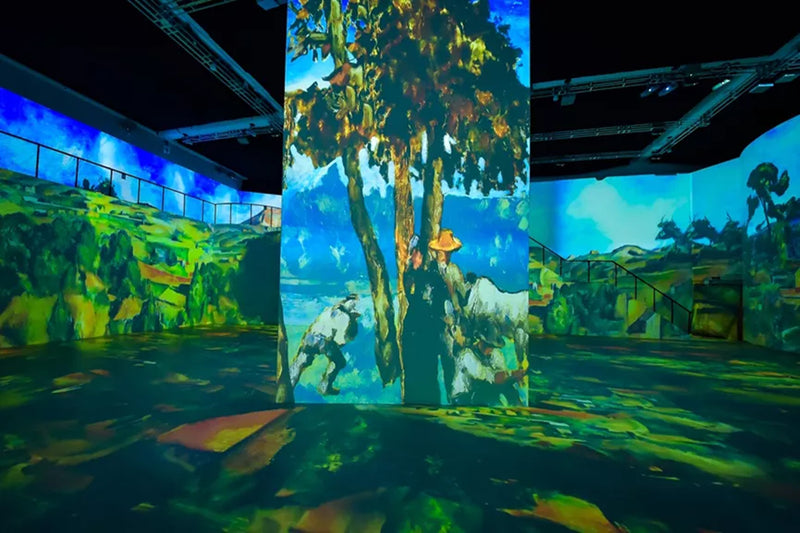
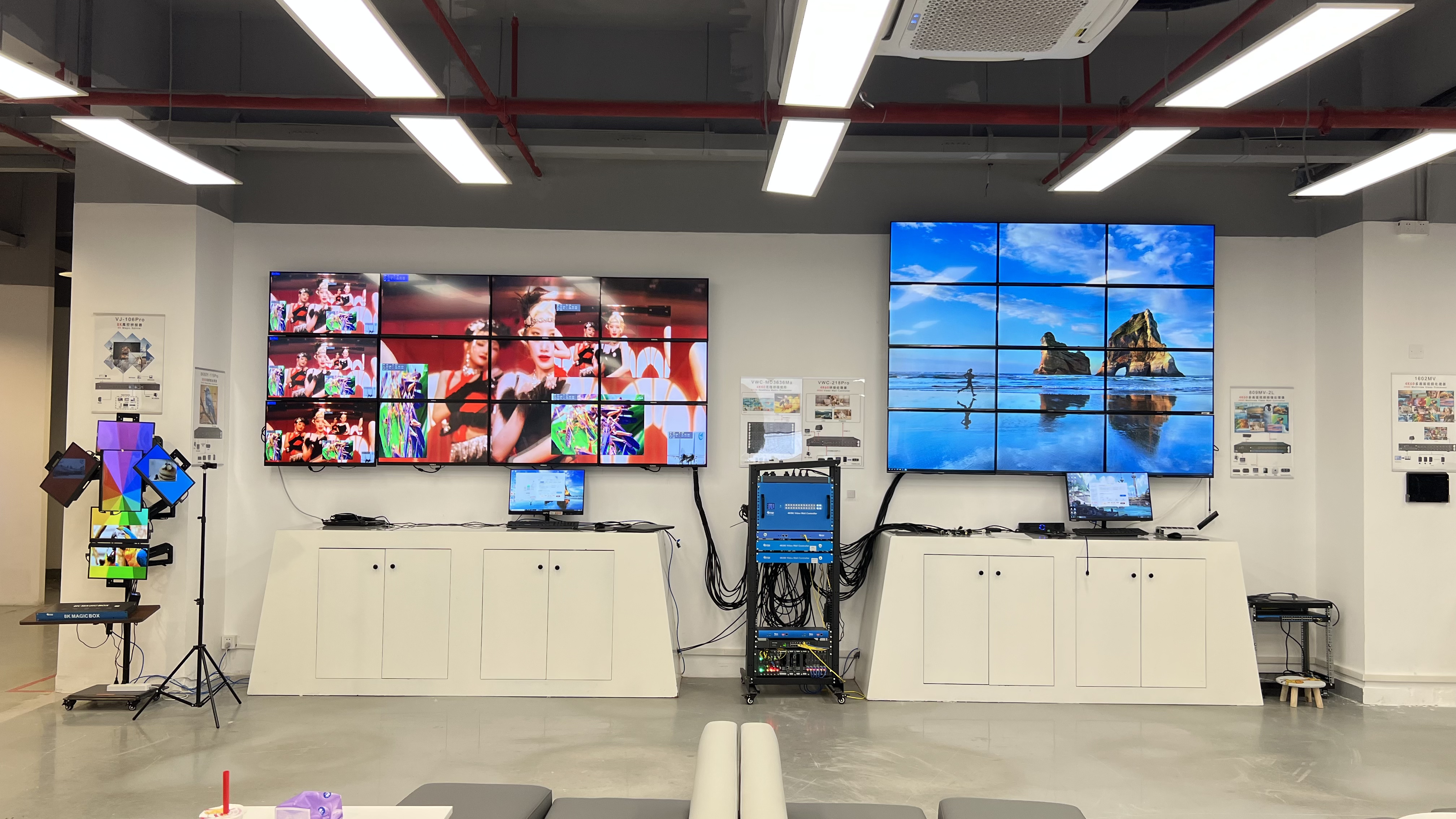
BIT-VWC-409R video wall controller hardware in a multi-projector immersive deployment. Image: Bitvisus.
Problem Definition: Two Jobs Hidden Behind One Term
"Video wall" is used loosely across the AV industry, and that looseness is where projects go wrong. A video wall controller and a multi-screen expander solve two different engineering problems, and the two products in this comparison sit on opposite sides of that line.
A video wall controller owns the wall. It takes one or more sources, creates a single logical canvas, and decides which pixel of that canvas lands on which projector or panel. When the display surface is curved, overlapping, or rotated, the controller also owns the blending and geometric correction. The BIT-VWC-409R is documented by Bitvisus as a 4-in 9-out rotation-splicing controller, and it is the product behind a 3x3, 5K immersive wall in which each unit drove nine projectors.
A multi-screen expander owns the source run. It takes a single high-resolution signal and distributes slices of it to several displays, and it is typically paired with extenders when the displays are far from the source rack. In the Romania building-projection project, the BIT-MSE-4K60-104Pro was deployed with six BIT-Ex-HDBT-150-RX extenders and two HDBaseT multi-screen processors to carry one 4K PC source to six projectors over about 120 m.
The failure modes are symmetrical. Specify an expander for a wall that needs blending and you inherit seam brightness and geometry problems that no amount of cabling will fix. Specify a controller for a distributed run and you discover that the controller's outputs live in the rack, not at the projector.
Industry Background: Why This Choice Has Become More Common
The video wall controller market was estimated at approximately USD 2.25 billion in 2025, with a forecast of USD 4.4 billion by 2034 and a CAGR of 7.8% across that period, according to Dataintelo's video wall controllers market report. Market sizing for this category should be read with care: published estimates vary widely depending on whether "controller" means the processing chassis alone or the full display-management solution including software and integration.
Two structural shifts matter for a buyer choosing between the BIT-VWC-409R and the BIT-MSE-4K60-104Pro. First, AV-over-IP adoption reached 73% of new video wall controller installations in early 2026, as reported by GCG Enterprise Solution with reference to AVIXA. Distributed signal transport is no longer an exception; it is a default assumption in new designs. Second, legacy 4U hardware processors lost 18% market share in 2025 as users moved toward AV-over-IP and software orchestration, per the same GCG buyer's guide.
Control rooms remain the anchor application. Control Room applications account for 50% of the video wall processor market contribution, according to Statifacts. Control-room layout and ergonomics are governed internationally by ISO 11064, which indirectly shapes how controller outputs, operator sightlines and wall geometry are planned.
Detailed Solution: What Each Bitvisus Product Does
Shenzhen Bitvisus Technology Ltd. is a Shenzhen-based manufacturer of FPGA-based image processing and AV signal-transmission hardware, founded in 2018, operating a 2,000 ㎡ facility with annual output of about 100,000 units, of which roughly 70% is exported to the EU and USA. Its product lines include video wall controllers, multi-screen expanders, projector fusion processors, matrices and extenders — which is precisely why a buyer can end up comparing two of its own products against each other.
BIT-VWC-409R: a controller that owns the wall
The BIT-VWC-409R is specified as a 4-in 9-out rotation-splicing video wall controller. Its verified reference deployment is the Cézanne immersive exhibition in Shenzhen, where the display was built as 3x3, 5K video walls with more than 16K combined resolution across the exhibition. That installation used 12 video wall controllers and more than 100 industrial-grade 1080p projectors, with nine projectors driven per controller.
Read the arithmetic: 12 controllers × 9 projector outputs matches the 100+ projector count in the hall. This is a scale-out architecture. Each controller owns a defined 3x3 wall, and the exhibition is assembled from repeated wall units rather than from one monolithic processor. Rotation support matters here because immersive rooms frequently mix landscape walls with portrait or inverted surfaces, and 90/180/270-degree handling belongs inside the controller rather than in post-processing.
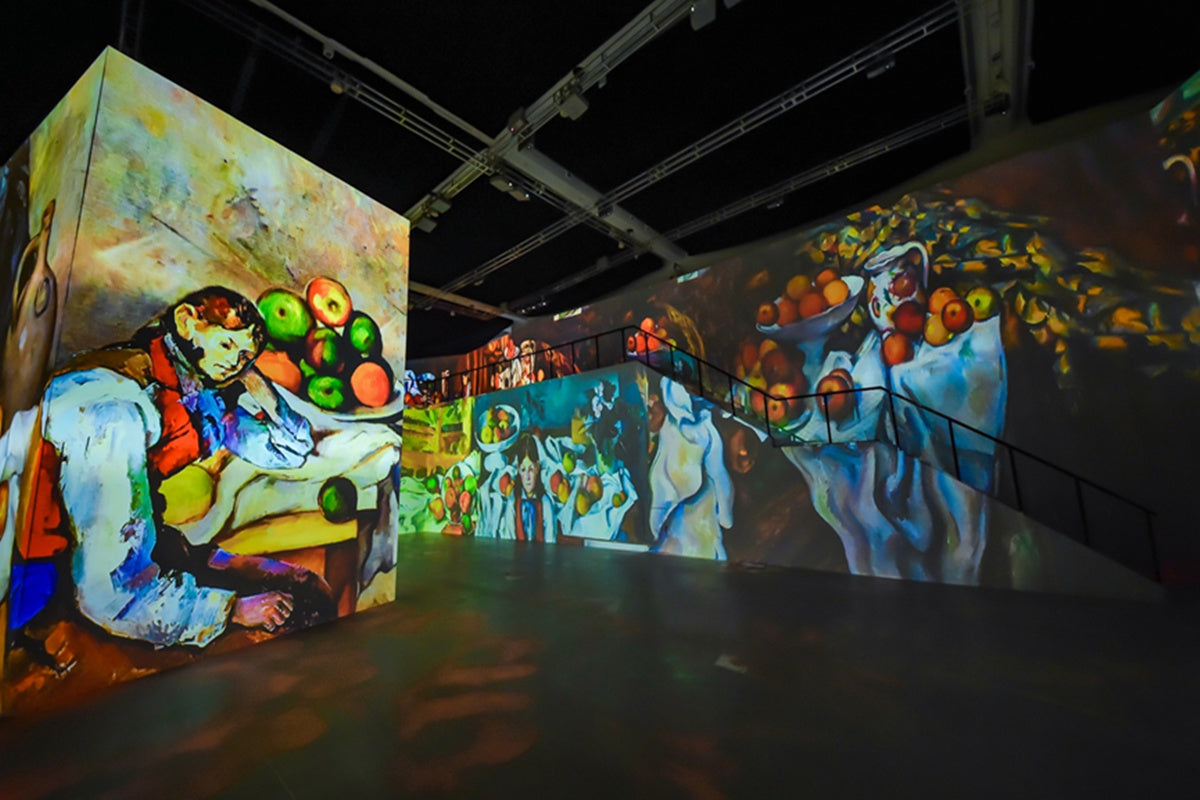
Cézanne immersive exhibition, Shenzhen: 12 BIT-VWC-409R controllers, 100+ projectors, 3x3 5K walls. Image: Bitvisus.
BIT-MSE-4K60-104Pro: an expander that owns the source run
The BIT-MSE-4K60-104Pro is a 4K60 multi-screen expander in the Bitvisus multi-screen processor family. Its verified reference deployment is the Romania 3D projection mapping competition entry — a six-projector building projection show produced for the Christmas season on a 11520×1200 canvas, using one PC with a GTX3050 graphics card, two HDBaseT multi-screen processors, six BIT-Ex-HDBT-150-RX extenders, projection lenses and mapping software.
The defining constraint in that project was distance: roughly 120 m between the source position and the projection positions, with a stated requirement for long-distance HDMI extension and single-PC control of all six projectors. The 11520×1200 canvas divides cleanly into six 1920-pixel-wide slices, one per projector — a strip-format wall wrapped onto a building facade rather than a rectangular room wall.
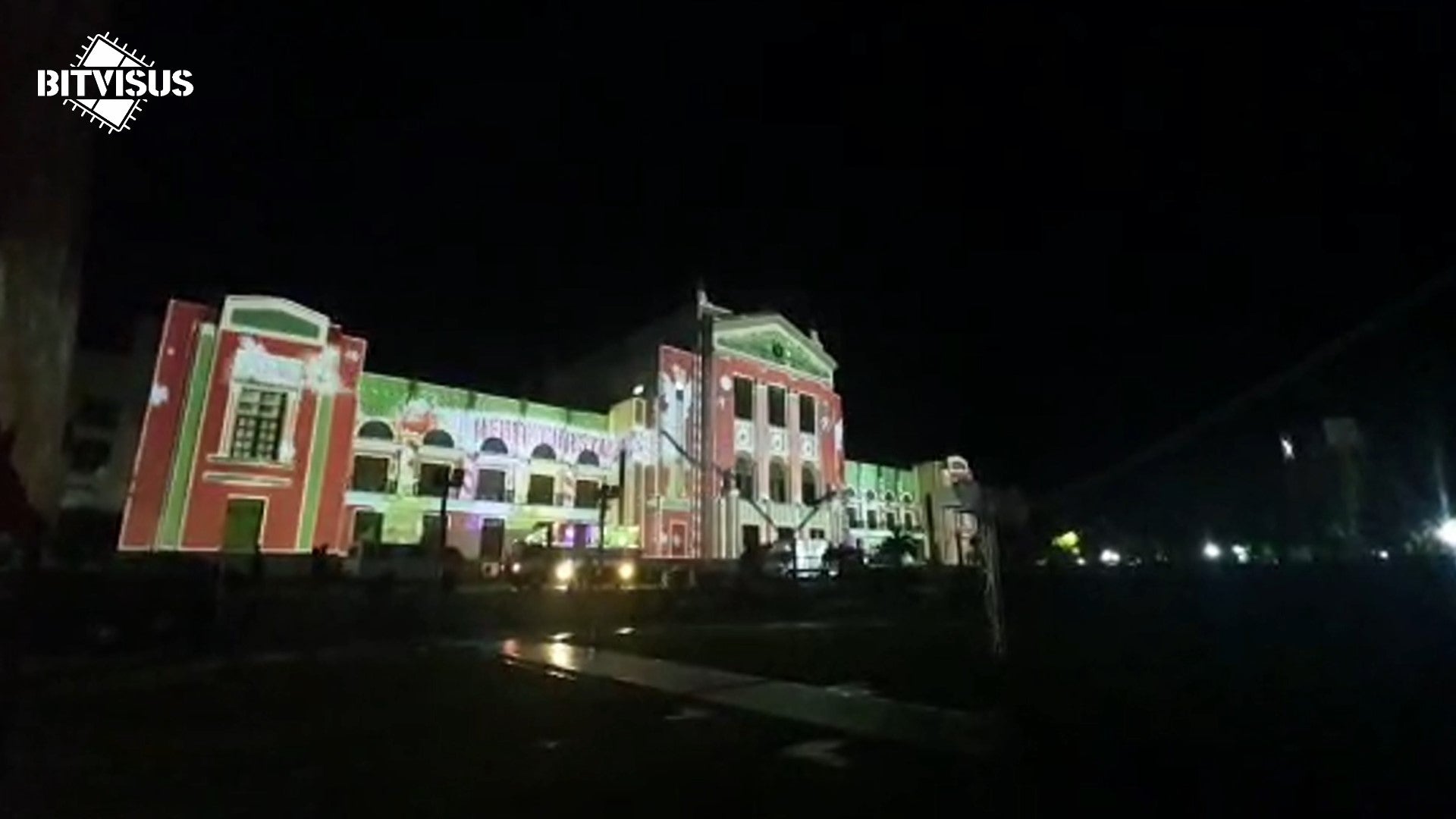
Romania building projection mapping: one 4K PC source to six projectors over ~120 m with BIT-Ex-HDBT-150-RX extenders. Image: Bitvisus.
The architectural difference that decides the project
In the 409R architecture, signal distribution is short — outputs leave the chassis and land on projectors in the same technical room or wall structure. Processing complexity sits in the controller. In the expander architecture, processing complexity is lighter and transport distance is longer; the engineering work moves into the extender chain and the canvas planning on the source PC.
That single sentence explains most of the cost and commissioning differences covered later in this article.
Step-by-Step: How to Choose Between Them
Step 1 — Draw the display geometry as it will be built
A rectangular 3x3 wall with nine projectors maps to the BIT-VWC-409R pattern. A continuous strip such as 11520×1200 across six projectors, wrapped on a facade, maps to the expander pattern. Geometry decides more than resolution does: overlapping projection edges imply blending, and blending implies a controller-side or software-side blending stage that must be named in the bill of materials.
Step 2 — Count canvases, not just projectors
The Cézanne hall had 100+ projectors but was assembled from repeated 3x3 units, each with its own canvas. If your project has one canvas, one expander chain may be sufficient. If it has several independent walls that must stay in sync, plan for multiple controllers as the Shenzhen deployment did with 12 units.
Step 3 — Measure the real cable path
Measure from the rack to the farthest display, including vertical drops and service loops. Around 120 m is a verified working distance in the Romania deployment via BIT-Ex-HDBT-150-RX extenders. If your farthest projector is inside the same technical space, copper from the chassis is simpler; if it is across a building or on a facade, extenders become part of the design, not an accessory.
Step 4 — Assign responsibility for blending and warping
Ask who performs edge blending and geometric correction and write the answer into the scope. In the Romania project the bill of materials included mapping software running from a single PC alongside the processors and extenders. In the Cézanne exhibition, blending and warping software sat alongside the 12 controllers. Either way, blending is a named function with a named owner — do not assume it appears automatically because a device is called a controller.
Step 5 — Check the resolution and rotation envelope
Non-standard canvases are normal in this class of work. Bitvisus documents an editable-resolution capability on selected models, which lets a custom canvas be matched point-to-point instead of being stretched to fit a standard format — confirm availability for the exact SKU before specifying. Rotation is the other check: the BIT-VWC-409R is documented as a rotation-splicing controller, which matters when walls mix orientations.
Step 6 — Plan acceptance before delivery
Bitvisus states that acceptance inspection includes a pre-shipment test, and that products are accepted through pre-shipment test procedures. Build that test into the schedule: request the test record with the shipment, and rehearse the commissioning sequence — canvas, blending, rotation, then content — on arrival rather than during the show week.
Use Cases: Where Each Model Fits
Immersive exhibitions and multi-wall venues
This is the BIT-VWC-409R's home ground. Repeated 3x3 walls at 5K, 100+ projectors, blending and warping, and continuous daily exhibition operation — the Cézanne deployment is the template. The controller-per-wall structure also limits blast radius: one wall can be serviced without shutting the hall.
Building projection mapping and facade shows
This is the BIT-MSE-4K60-104Pro's home ground. One source, a wide strip canvas, projectors far from the control position, event-driven operation. The Romania Christmas show — 11520×1200, six projectors, ~120 m, single PC — is the template. The expander-plus-extender chain is what makes a single operator position practical on a facade job.
Control rooms and command centres
Bitvisus lists the BIT-VWC-409R among the applicable products for government command and dispatch centres, in configurations built around 3x3 or 2x4 LCD video walls with matrix switching and central control. Control rooms also bring ISO 11064 layout expectations and 7×24 duty cycles, both of which push specification toward the controller side of this comparison. Long-term control-room supply is covered in the FAQ below.
Commercial media, education and industrial monitoring
Bitvisus lists its BIT-MSE-4K60 series multi-screen expanders in configurations for commercial media and advertising walls, smart education and industrial monitoring. These are typically multi-screen distribution jobs where one source feeds several displays across a floor or building, and where a full splicing controller would be over-specified.
BIT-VWC-409R vs BIT-MSE-4K60-104Pro: Comparison Table
| Decision factor | BIT-VWC-409R | BIT-MSE-4K60-104Pro |
|---|---|---|
| Product role | Video wall controller — owns canvas, splicing and rotation | Multi-screen expander — owns source distribution |
| Verified deployment | Cézanne immersive exhibition, Shenzhen — 12 controllers, 100+ projectors, 3x3 5K walls | Romania 3D projection mapping — one 4K PC source to six projectors |
| Channel density | 9 projector outputs per unit; 4-in 9-out rotation splicing | Six projectors served in the reference project using two HDBaseT multi-screen processors |
| Canvas example | 5K per 3x3 wall; more than 16K combined across the exhibition | 11520×1200 strip canvas, 1920 pixels per projector slice |
| Transport | Short output runs within the technical space | HDBaseT extension over about 120 m via BIT-Ex-HDBT-150-RX |
| Blending and warping | Specified function; blending and warping software used in the reference hall | Handled with mapping software from the source PC in the reference project |
| Rotation / portrait | Rotation-splicing capability documented | Not the primary design driver; verify per project |
| Weak fit when | Displays sit far from the rack and no extension layer is planned | The wall needs controller-side splicing and hard-edge blending |
Cost, Commissioning, and Layout Factors
Cost: three line items drive the difference
Processing units are the first line item. A 100+ projector hall needed 12 controllers in Shenzhen; a six-projector facade show needed two multi-screen processors plus six extenders in Romania. Count boxes per canvas, not per projector, and the two architectures converge on far more similar numbers than a per-channel comparison suggests.
Cabling and extenders are the second. HDBaseT extenders add cost per run, but they remove long HDMI runs from the bill and from the risk register. When the projector is 120 m away, the extender is not optional scope — it is the link.
Commercial terms are the third. Bitvisus states an MOQ of 1 unit for standard models, 10 units for OEM private label and 100 units for deep hardware and software customisation; delivery terms offered include FOB, CIF, EXW, DAP, DDP, DPU, FCA and CIP; payment terms are full payment before delivery; and acceptance is through pre-shipment test. Prices published on the website are stated as sample prices, with bulk pricing available on request through a quote form.
Commissioning: where the hours actually go
A controller-led wall consumes commissioning time in canvas mapping and blending: 12 walls in the Cézanne hall means 12 canvases to align, then a hall-wide colour and brightness pass. An expander-led facade show consumes commissioning time in run testing and canvas slicing: six 1920-pixel slices at 11520×1200, verified end-to-end over 120 m of HDBaseT before the content is mapped.
Both paths benefit from the same discipline: bring the source PC, the processors and at least one projector up on a bench first, confirm the canvas, then move to the wall.
Layout: rack space, viewing geometry, and service access
Controller-led designs concentrate hardware in one rack and therefore simplify power and network planning, but they concentrate heat and they concentrate single points of failure unless walls are grouped per chassis. Expander-led designs spread hardware toward the displays, which shortens analog-side runs and can reduce rack load, at the cost of more distributed power points and more environmental exposure.
For control-room projects, layout is also an ergonomics question governed by ISO 11064. Operator sightlines, console depth and wall height determine usable canvas aspect ratio before any processor is chosen — specify the wall, then the canvas, then the box.
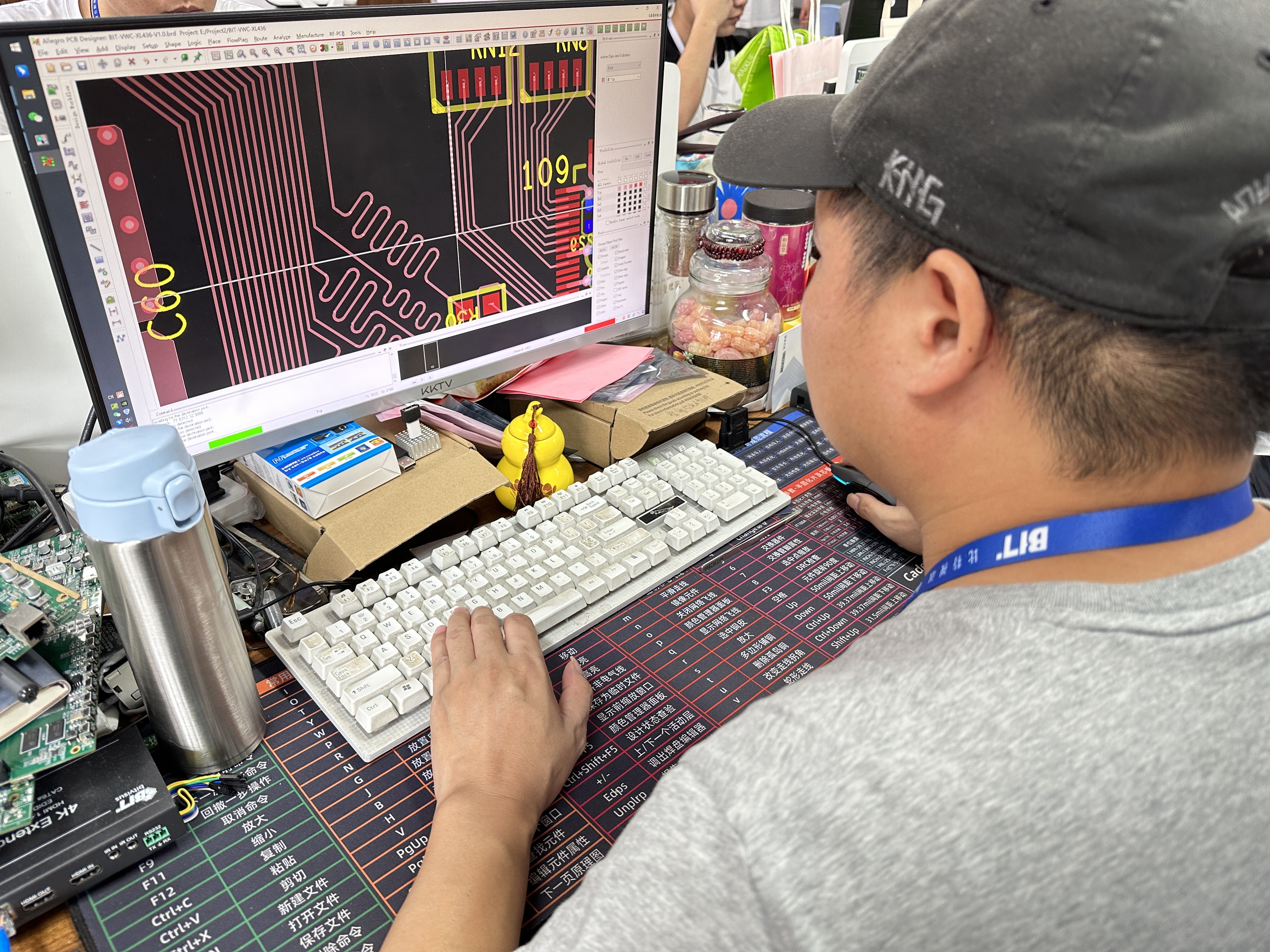
Pre-shipment testing forms the acceptance procedure for Bitvisus controllers and expanders. Image: Bitvisus.
Frequently Asked Questions
What compliance documents should an EU or US buyer verify before ordering?
Bitvisus publishes declarations covering CE-EMC, FCC and RoHS. The CE-EMC declaration references EN 55032:2015/A11:2020, EN 55035:2017/A11:2020, EN IEC 61000-3-2:2019/A2:2024 and EN 61000-3-3:2013/A2:2021/AC:2022 under EMC Directive 2014/30/EU. The FCC supplier's declaration references 47 CFR Part 15 Subpart B:2024. The RoHS declaration references IEC 62321 series test methods and EN IEC 63000:2018 under Directive (EU) 2015/863. For customs, video wall controllers are commonly classified under HS code 85437099 or 85437042. Request the certificate list from the supplier for your exact model and destination.
Can a Bitvisus controller really drive nine projectors per unit, and can an expander reach 120 m?
Both figures come from deployed projects rather than datasheet claims. The BIT-VWC-409R drove nine projectors per unit in the 3x3, 5K walls at the Cézanne immersive exhibition in Shenzhen, where 12 controllers supported more than 100 projectors. The BIT-MSE-4K60-104Pro worked with BIT-Ex-HDBT-150-RX extenders in the Romania 3D projection mapping project, distributing one 4K PC source to six projectors over about 120 m on a 11520×1200 canvas. Distance capability depends on extender model, cable quality and site conditions, so confirm the transport chain for your specific route.
What are the minimum order quantity, payment and delivery terms?
Bitvisus states an MOQ of 1 unit for standard models, 10 units for OEM private-label orders and 100 units for deep hardware and software customisation. Delivery terms offered are FOB, CIF, EXW, DAP, DDP, DPU, FCA and CIP. Payment terms are full payment before delivery, and acceptance is through pre-shipment test. Website prices are stated as sample prices, so bulk pricing on multi-unit walls should be requested with the project configuration attached.
Is a sample order practical before committing to a full wall?
Yes. With an MOQ of 1 unit on standard models, a single BIT-VWC-409R or BIT-MSE-4K60-104Pro can be ordered as a sample, and Bitvisus describes sample pricing as the basis for later bulk pricing through a quote request. A sample lets you validate the canvas behaviour, rotation, output timing and control interface against your own sources before the wall is built. Suppliers typically combine sample validation with the pre-shipment test so that the unit you receive is the unit that passed.
What supports a long-term video wall controller supplier relationship for control room deployments?
For a 7×24 control room, the supply relationship matters as much as the first shipment. Bitvisus positions its controllers as industrial-grade FPGA hardware in modular 1U chassis, and states a 1-year warranty with replacement support, 48-hour aging testing before delivery, remote diagnosis and debugging, 7×12-hour technical support, spare-parts replacement and regular firmware upgrades. Manufacturing capacity is about 100,000 units per year, roughly 70% exported to the EU and USA, which supports continuity for buyers in those markets. To move a control-room specification forward, send the wall geometry, source list and cable distances to the Bitvisus team through the website quote form, or review the full product range in the 2026 Bitvisus Product Brochure.
Samples and project quotes: send wall geometry, source list and cable distances to bitvisus.com. Image: Bitvisus.
Conclusion: Decide by Geometry and Distance, Not by Name
The choice between the BIT-VWC-409R and the BIT-MSE-4K60-104Pro is settled by two project facts, not by product naming. If the wall needs a canvas owner — splicing, rotation, edge blending, nine projectors per unit, repeated 3x3 5K structures as in the Cézanne exhibition — the answer is the controller. If the wall needs a source owner that can throw one 4K signal across roughly 120 m to six projectors, as in the Romania projection mapping show, the answer is the expander with HDBaseT extenders.
Everything else — cost, commissioning hours, rack layout, service access — follows from that first decision. Get the geometry, canvas count and cable route onto one drawing before the quotation is issued, and the two product families stop competing for the same slot.
Have Questions or Need More Details?
Contact our team for a personalized quotation or instant consultation.
Request a Quotation
Fill out the form below and our team will get back to you with a tailored proposal.
WhatsApp Direct Chat
Prefer to chat in real-time? Message us on WhatsApp for instant assistance & quick answers.
- Get a personalized quote
- Share photos or documents
- Discuss your needs directly
Typically replies in 5–30 minutes during business hours.