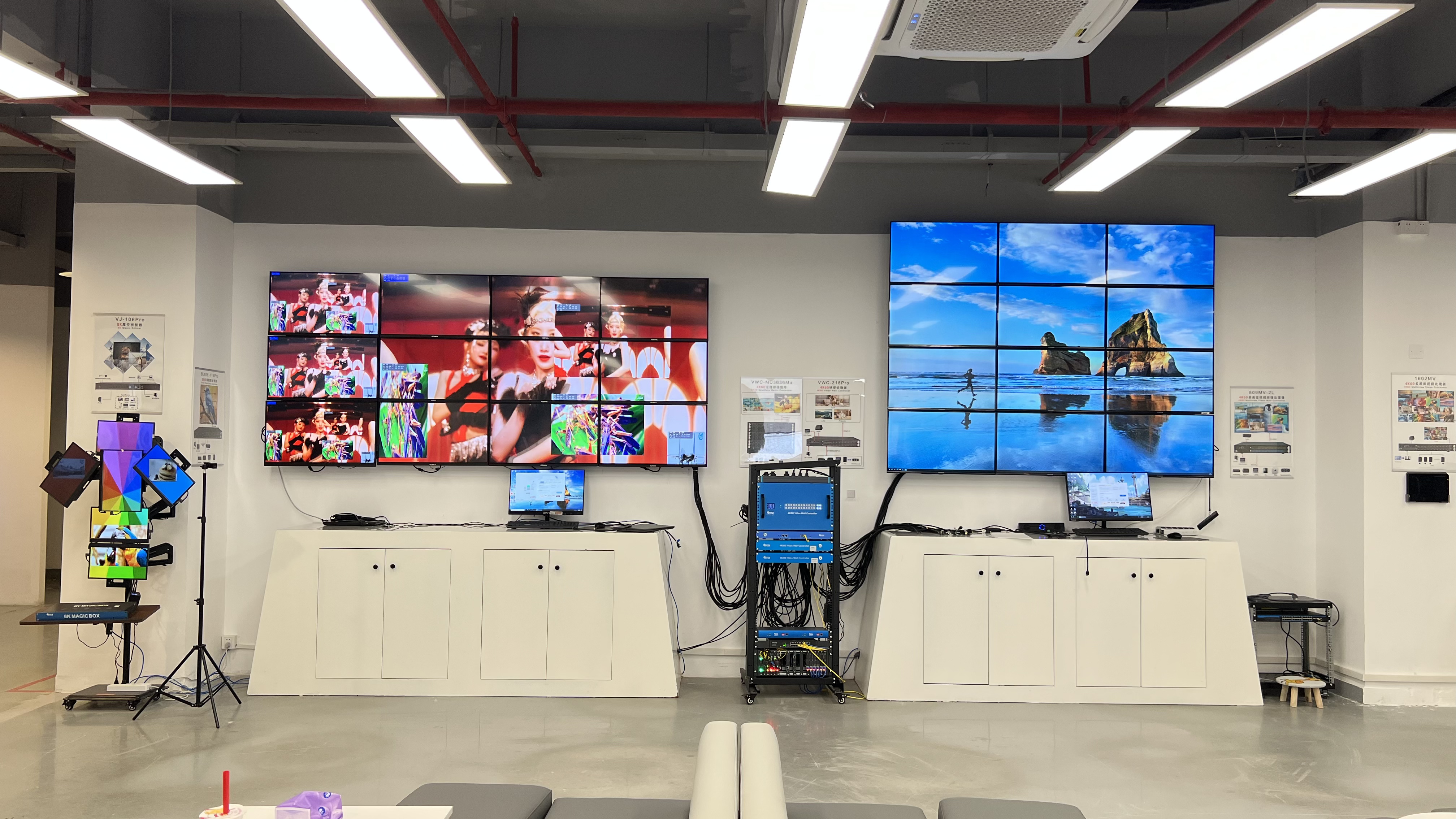
How to Evaluate Video Wall Controller Manufacturers
How to Evaluate Video Wall Controller Manufacturers
A video wall controller is the processing device that receives one or more video signals and distributes them across a tiled display surface — an LCD video wall, an LED screen array, or a multi-projector canvas. For buyers entering the category, the practical question is not which unit is cheapest, but which manufacturer can document the device class, signal architecture, compliance file and production capability behind the quotation. This guide is written for importers, distributors, system integrators and procurement teams that are still shortlisting suppliers.
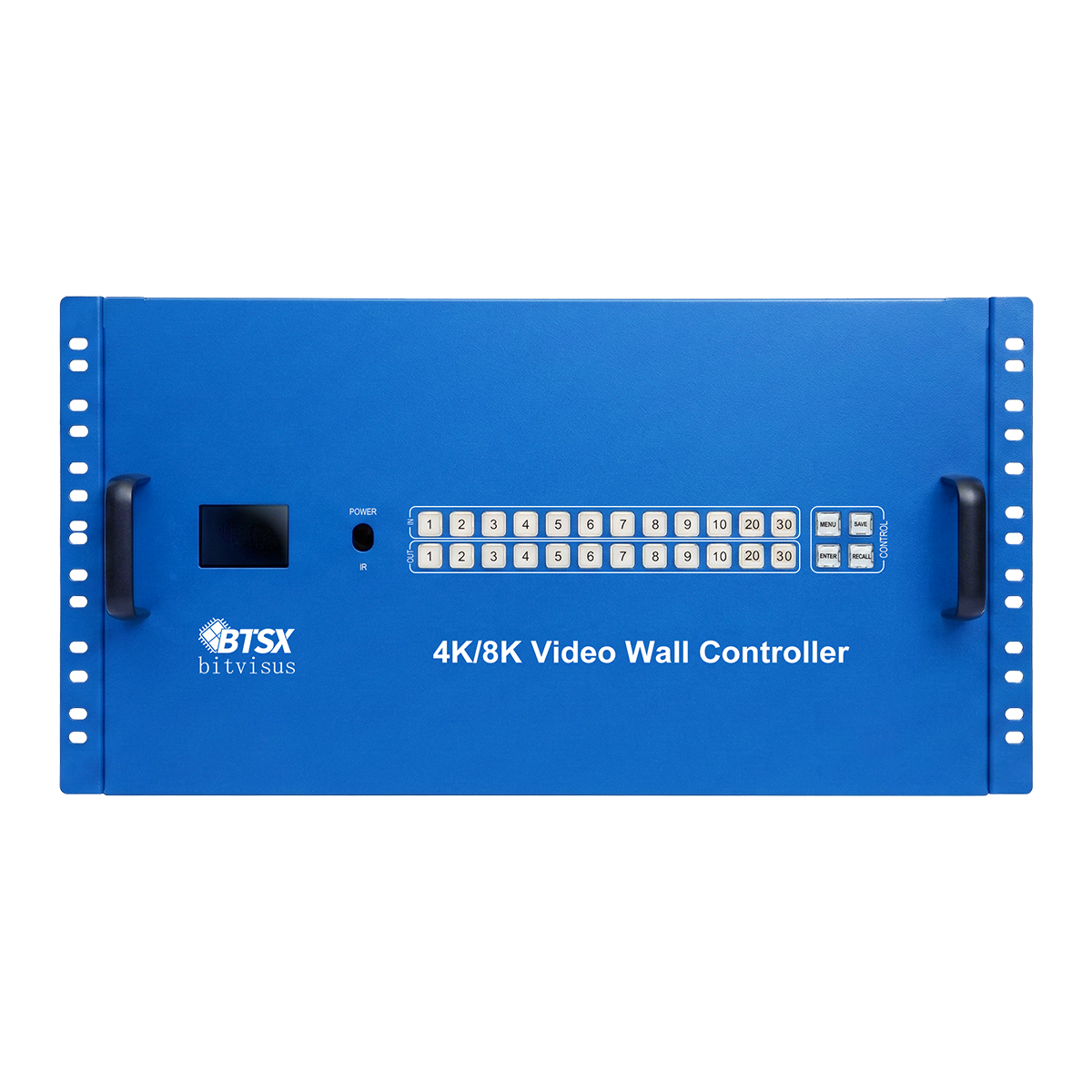
Problem Definition: “Video Wall Controller” Is Not One Product
The first obstacle in supplier discovery is definitional. The term video wall controller covers at least two very different hardware classes. The first is the compact fixed processor: a small number of inputs, a defined number of outputs, and a chassis that is not intended to change. The second is the chassis-based modular controller: plug-in input and output cards, a card cage, and channel counts that scale with the project.
A 1-in-4-out processor for an advertising screen array and a 36×36 4K60 modular matrix are both marketed as video wall controllers. They solve different problems, sit in different budget bands, and are rarely interchangeable. If a buyer collects three quotations without first fixing the device class, the comparison usually ends up being a processor against a system.
Market research reflects the same ambiguity. Published estimates of the video wall controller market range from roughly USD 0.55 billion to USD 2.25 billion depending on whether the “controller” is counted strictly as processor hardware or as the complete display management solution including software and integration. The boundary is not fixed, which means the burden of definition sits with the buyer.
A second obstacle is architecture. Dedicated hardware processors and network-distributed AV-over-IP systems now coexist on the same projects, and each one imposes different requirements on latency, cabling, network switching and control software. Until a manufacturer knows which architecture the scheme requires, any recommendation is guesswork.
Industry Background: What the Category Looks Like in 2026
The global video wall controllers market size is estimated at approximately USD 2.25 billion in 2025 and is projected to reach USD 4.4 billion by 2034, according to Dataintelo’s commercial research, with a reported CAGR of 7.8% across the same 2025–2034 forecast period. That growth is not evenly distributed across applications.
Demand is concentrated in monitoring environments. Statifacts estimates that control room applications account for 50% of video wall processor market contribution (2025 estimate; the publisher classifies this figure as medium-confidence). For buyers, the implication is that control-room requirements — continuous duty cycles, rapid source switching, multi-window layouts, remote management — tend to drive the specification language across the rest of the category.
Architecture preference is shifting as well. AV-over-IP adoption reached 73% of new video wall controller installations in early 2026, as reported by GCG Enterprise Solution with reference to AVIXA. In the same period, legacy hardware video wall processors in 4U chassis lost 18% market share in 2025 as users moved toward AV-over-IP and software orchestration (GCG Enterprise Solution; medium-confidence). Dedicated hardware processing has not disappeared — deterministic, low-latency processing still matters in broadcast, industrial monitoring and latency-sensitive switching — but a supplier should now be expected to explain which architecture it recommends and why.
Two further background points affect paperwork rather than technology. Video wall controllers are commonly classified under HS code 85437099 (other electrical machines and apparatus) or 85437042 (other video control unit), which matters for duty calculation and customs documentation (Zauba / US Customs primary trade data). And in control-room projects, ISO 11064 is the primary international standard governing control-room ergonomics, which in turn influences how video wall layouts and operator sight lines are planned (GCG Enterprise Solution, secondary source).
What to Verify in a Video Wall Controller Manufacturer
Shenzhen Bitvisus Technology Ltd. is a video wall controller manufacturer based in Shenzhen, China, established in 2018, operating a 2,000 m² factory and specializing in 4K/8K image and video processing technologies. Its published specifications and company data are used below to show what a verifiable supplier profile contains. The verification dimensions themselves apply to any supplier.
1. Device class and I/O architecture
Ask for input and output counts per model, not per product family. A datasheet that lists “multiple inputs and outputs” tells a buyer nothing about whether the chassis is fixed or expandable.
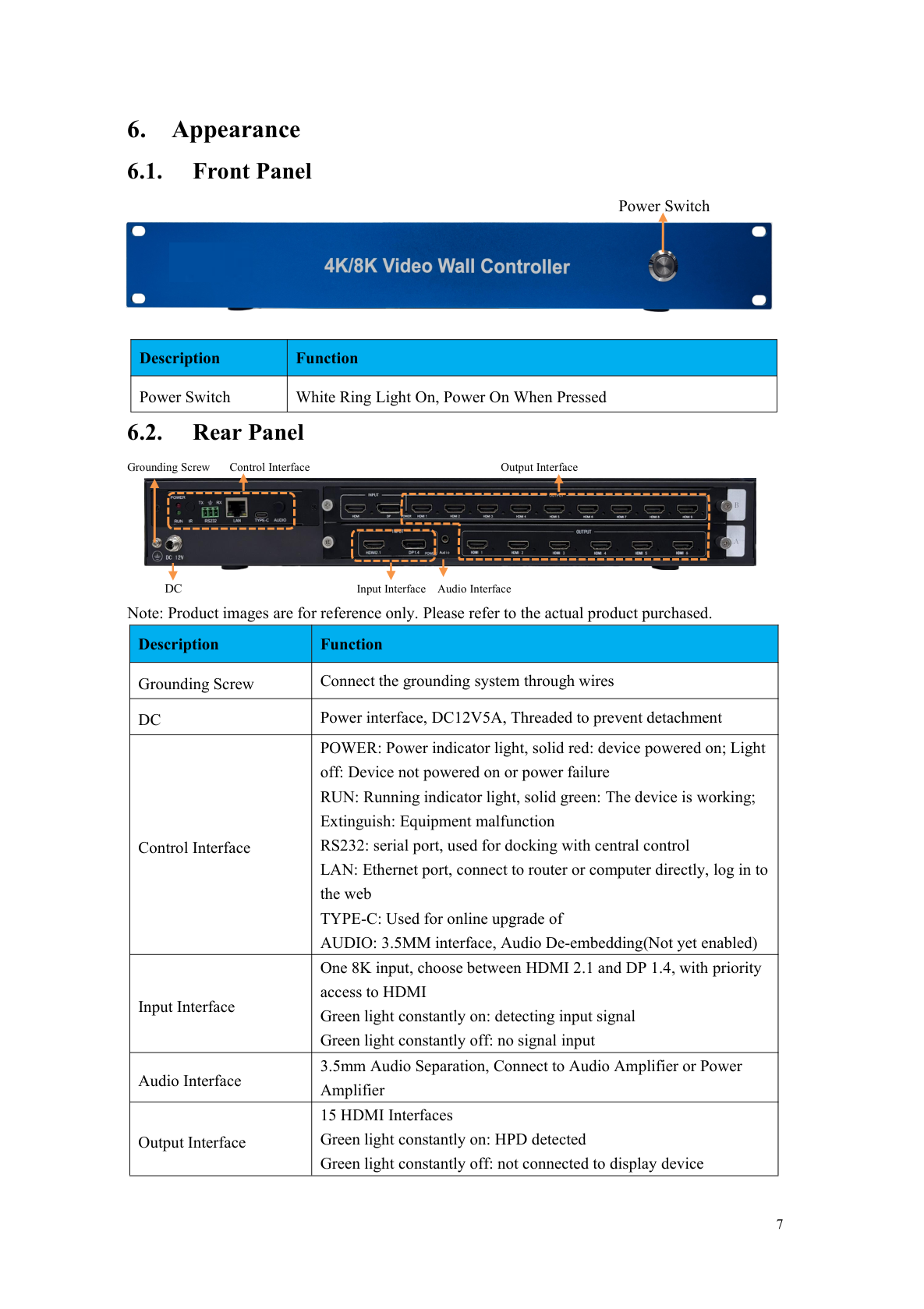
Within the Bitvisus line, the classes are explicit. The BIT-VWC-218Pro is a 4K60 video wall controller with 2×HDMI 2.0 and 2×DP 1.2 inputs (copper cable ≤3 m) and 18×HDMI 1.3 outputs (cable ≤15 m). The BIT-VWC-MD3636Ma is a card-based machine: input and output can each be configured with 1–9 boards, with 4 HDMI 2.0 ports per board, and supported combinations include 4-in/36-out, 12-in/36-out, 24-in/36-out, 16-in/16-out, 24-in/24-out and 36-in/36-out. A fixed chassis is usually cheaper and faster to deploy; a modular chassis costs more per channel at low counts but protects the investment when the wall grows.
2. Processing architecture and latency behaviour
Bitvisus documents a full hardware real-time processing architecture based on programmable FPGA chips across its controller line, with chip processes quoted as 40 nm for the BIT-VWC-409R and 28 nm for the BIT-VWC-8K60Y-115Pro, BIT-VWC-218Pro, BIT-VWC-8K60-404Max and BIT-MSE-8K60D-104Pro. The BIT-VWC-MD3636Ma datasheet states an input-to-output latency below 40 ms and specifies that the synchronisation time difference between output ports is 0 ns, excluding differences introduced by the screens themselves.
Latency figures depend on signal format, resolution and measurement conditions. A buyer should therefore ask how the number was obtained, and should treat “zero latency” as marketing shorthand unless a measurement method is supplied.
3. Resolution and splicing mathematics
Splicing support matters as much as headline resolution. The BIT-VWC-8K60Y-115Pro accepts one 8K60 input through HDMI 2.1 or DP 1.4 (cable ≤3 m) and drives up to 15 HDMI 1.4 outputs at 1920×1200@60Hz or 1920×1080@60Hz, with M×N point-to-point splicing where M and N are each ≤15 and M×N ≤15. The BIT-VWC-8K60-404Max, a 2U unit, provides five inputs (2×HDMI 2.1, 2×DP 2.1, 1×Type-C) at up to 7680×4320@60Hz and four HDMI 2.0 outputs at 3840×2160@60Hz or 3840×2400@60Hz, plus a DP loop-out. The BIT-VWC-409R is a rotating splicing processor with 3×HDMI 1.4, 1×HDMI 2.0 and 1×DP 1.2 inputs and 9×HDMI 1.3 outputs, supporting 90° input rotation and 180° first-row output rotation for portrait walls or inverted top rows.
Bezel correction is the detail that separates a stated specification from a usable wall. The BIT-VWC-8K60Y-115Pro documents independent fine-tuning of each output channel to compensate for screen border occlusion and installation error, so that a line crossing the wall stays continuous.
4. Control, remote management and API openness
Control surfaces determine operating cost over the life of a wall. Documented options across the line include RS232 serial control, browser-based web control, infrared remote, front-panel buttons, and a WEB API for secondary development. The BIT-VWC-218Pro, BIT-VWC-8K60Y-115Pro and BIT-VWC-8K60-404Max each support RS232 plus web control, DHCP automatic IP assignment or static IP, network wake-up and software command power on/off. The BIT-VWC-MD3636Ma adds an LCD front panel for source switching and IP mode changes, 12 savable preset scenes, blind insertion of output ports so wire sequence does not have to be physically re-patched, and OSD window labelling.
For an integrator, the API question is the practical one: if the controller cannot be called from the site control system, every scene change becomes a manual task.
5. Compliance documentation, not compliance claims
Bitvisus publishes declarations rather than badges. Its CE-EMC Declaration of Conformity references EN 55032:2015/A11:2020, EN 55035:2017/A11:2020, EN IEC 61000-3-2:2019/A2:2024 and EN 61000-3-3:2013/A2:2021/AC:2022 under EMC Directive 2014/30/EU. The RoHS Declaration of Conformity references the IEC 62321 test-method series, Directive (EU) 2015/863 and EN IEC 63000:2018. An FCC Supplier’s Declaration of Conformity covers 47 CFR Part 15 Subpart B:2024 and follows FCC rules 2.906, 2.908 and 2.909.
Two caveats belong in any evaluation. The full certificate list is not published as a single download and should be requested from sales. And product documentation lists a 1-year after-sales service period for the models described in this article, while broader warranty, return and shipping terms are not published on the website and should be confirmed in writing through support@bitvisus.com or the quotation form before an order is placed.
6. Production and supply capability
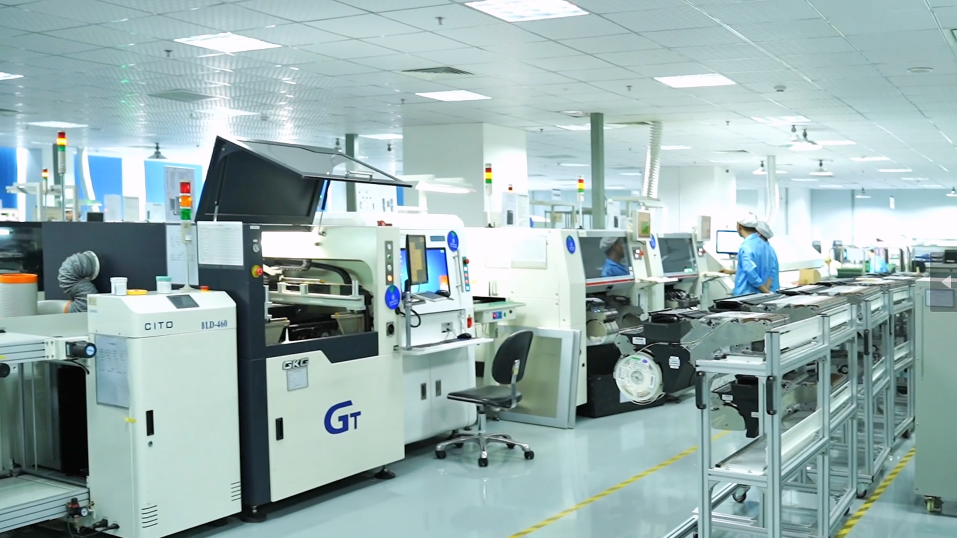
Company background data for Shenzhen Bitvisus Technology Ltd. records a founding year of 2018 (approximately eight years of operation as of 2026), a 2,000 m² factory in Shenzhen, roughly 100 employees, a 20-engineer R&D team, annual output of 100,000 units, an export ratio of about 70%, and main markets in the EU and the USA. The company describes itself as a national high-tech enterprise specializing in 4K/8K image and video processing, with in-house FPGA and embedded software and hardware design capability and full-cycle development, production and sales.
Read these numbers as ratios rather than as bragging points. A 20-engineer R&D group supporting a 100,000-unit annual output indicates a product platform that is engineered once and configured per project rather than designed from scratch each time. A 70% export share to the EU and USA usually means the compliance file is maintained as a routine business requirement, because those markets demand it at import.
7. Customisation path and its trade-offs
OEM and ODM services are available at FPGA, chip and whole-product levels, and the modular chassis design allows input and output ports to be configured per project. The trade-off is worth stating plainly before quotes are requested: standard off-the-shelf hardware has fixed functions, interfaces and casing, with a shorter lead time and lower unit cost, while customised hardware supports modified interfaces, dedicated FPGA logic or private-label requirements but carries a longer development cycle and a higher minimum order quantity. A project should decide which side of that line it sits on before it asks for pricing, because the answer changes the supplier shortlist.
Step-by-Step: A Manufacturer Verification Workflow
The following sequence converts the dimensions above into a repeatable screening process. It is designed to run before any commercial negotiation, so that quotations arrive comparable.
- Fix the device class in writing. State whether the project needs a fixed controller, a modular card chassis, or a network-distributed architecture. Include the wall size, the number of simultaneous sources, and whether the wall will grow.
- Map inputs and outputs as a numbered list. Count physical source devices, their connector types (HDMI 2.0, HDMI 2.1, DP 1.2, DP 2.1, Type-C) and the display count. Compare that list against a model’s actual port inventory, not its family description.
- Confirm the resolution and splicing mathematics. Verify the maximum input resolution, the maximum output resolution per channel, and the supported M×N layouts. Check whether custom output resolutions, rotation and bezel adjustment are available.
- Ask for the processing architecture statement. A documented FPGA hardware real-time architecture, chip process node, and latency figure with its measurement conditions is a stronger answer than an adjective.
- Test the control model. Confirm which of RS232, web interface, remote, front panel and API are provided, whether DHCP or static IP is supported, and whether the controller can be woken or powered remotely.
- Request the compliance file. Ask for the declarations applicable to the destination market — CE-EMC, RoHS and FCC documents for the EU and US — and ask for the customs HS code the supplier normally uses on export documentation.
- Validate with a sample, then scale. Place a sample order to test function, I/O mapping, control workflow and image behaviour on the real displays; move to bulk purchasing once the sample validates. This sequence is the one the manufacturer itself recommends for integrators, project contractors and distributors.
Use Cases: Matching Controller Class to Project Type
Controller classes map to project types in fairly predictable ways, and the documented application set for this manufacturer line illustrates the pattern.
- Control rooms and command & dispatch centres. These are the highest-duty environments, typically running 7×24 with multi-signal split-screen display, cross-screen linkage and picture roaming. A 3×3 or 2×4 LCD video wall with a matrix switcher and central control system is a common configuration. Control-room ergonomics fall under ISO 11064, so wall layout and operator sight lines belong in the specification.
- Security monitoring centres. Multi-channel video access, split display, patrol monitoring and alarm linkage, with fast source switching and continuous operation. A 3×3 or 4×4 monitoring wall with a video matrix and recording storage is a typical build.
- Conference and enterprise collaboration. 4K60 UHD, multi-picture split, seamless switching without black screen, and low-latency transmission; a 2×2 or 1×3 display with HDMI extension over Cat6 or fibre plus central control.
- Exhibition, immersive projection and cultural venues. Immersive curved projection fusion, digital exhibition halls and museum super-wide walls, with point-to-point pixel-level splicing and edge blending. A documented Chinese exhibition hall deployment used a 3×3 video wall at 5K with more than 16K combined resolution, over 100 industrial-grade 1080p projectors and 12 video wall controllers, with the BIT-VWC-409R as the applicable product.
- Outdoor and event construction. Building facade projection mapping places a premium on industrial-grade reliability and long cable runs. A documented Romanian 3D projection mapping event used a six-projector system with the BIT-MSE-4K60-104Pro and BIT-Ex-HDBT-150 extenders across roughly 120 m of HDBaseT transmission at a combined 11520×1200 resolution, and a Kuala Lumpur facade mapping project used the BIT-MSE-8K60D-104Pro for 8K60 processing with 1×4 tiling.
- Broadcast, industrial monitoring and smart manufacturing. Multi-camera monitoring, production line dashboards and MES/SCADA displays, where wide-temperature operation and electromagnetic robustness matter more than pixel count.
Video Wall Controller Model Comparison
The table below compares device classes within one manufacturer’s published line. It is a specification reference for the evaluation steps above, not a competitive ranking, and it should be redrawn with each shortlisted supplier’s own documentation before a decision is made.
| Model | Class | Inputs | Outputs | Control | Notable documented features |
|---|---|---|---|---|---|
| BIT-VWC-218Pro | 4K60 video wall controller | 2×HDMI 2.0, 2×DP 1.2 (≤3 m); max 4096×2160P60 | 18×HDMI 1.3 (≤15 m); up to 1920×1200P60 | RS232, Web | Modular plug-in card design, network wake-up and software power on/off, API for secondary development, 28 nm FPGA |
| BIT-VWC-8K60-404Max | 8K60 video wall controller, 2U | 2×HDMI 2.1, 2×DP 2.1, 1×Type-C; up to 7680×4320@60Hz | 4×HDMI 2.0; 3840×2160@60Hz or 3840×2400@60Hz; 1×DP loop out | RS232, Web, API | Five inputs with up to four active simultaneously, M×N splicing (M,N≤4), 3.5 mm audio extraction, EDID management, network wake-up |
| BIT-VWC-8K60Y-115Pro | 8K60 video wall controller | 1×HDMI 2.1 or 1×DP 1.4 (≤3 m); up to 7680×4320@60Hz | 15×HDMI 1.4 (≤15 m); 1920×1200@60Hz / 1920×1080@60Hz | RS232, Web | M×N point-to-point splicing (M,N≤15, M×N≤15), first-row 180° rotation, bezel setup, CEC, EDID, DHCP or static IP |
| BIT-VWC-MD3636Ma | 4K60 seamless matrix splicer, 7U | Up to 9 input cards, 4×HDMI 2.0 each; up to 36 channels, 3840×2160P60 | Up to 9 output cards, 4×HDMI 2.0 each; up to 36 channels, 3840×2160P60 | RS232, Web, button board, remote, WEB API | Input-to-output latency <40 ms, seamless switching, 12 preset scenes, LCD front panel, blind insertion of output ports, OSD |
| BIT-VWC-409R | Rotating splicing processor | 3×HDMI 1.4, 1×HDMI 2.0, 1×DP 1.2 (≤5 m) | 9×HDMI 1.3 (≤15 m); 1920×1080@60Hz; 1×DP 1.2 loop out | IR remote, RS232, PC host software | 90° input rotation, 180° first-row output rotation, up to 4 windows, multi-device cascade and parallel operation, 40 nm chip |
| BIT-MSE-8K60D-104Pro | 8K60 multi-screen expander | 1×DP 2.1 (≤3 m); 2×2 up to 7680×4800P60; 1×4 up to 15360×2160P30 | 4×HDMI 2.0 (≤5 m); 3840×2400P60 / 3840×2160P60, custom resolutions supported | DIP switch, RS232, Ethernet web interface | 1×4, 2×2 and 4×1 tiling, EDID management via DIP switch or web, 1U tray option, 28 nm FPGA |
Product documentation lists a 1-year after-sales service period for these models. Documentation also confirms OEM order support and, for the BIT-VWC-409R, a packing list of one device, one power supply, one remote control, one certificate and one warranty card.
FAQ
Are Video Wall Controllers from Bitvisus Certified for the EU and US Markets?
Yes, on the documented compliance file. The company publishes a CE-EMC Declaration of Conformity covering EN 55032:2015/A11:2020, EN 55035:2017/A11:2020, EN IEC 61000-3-2:2019/A2:2024 and EN 61000-3-3:2013/A2:2021/AC:2022 under EMC Directive 2014/30/EU; a RoHS Declaration of Conformity referencing the IEC 62321 test-method series, Directive (EU) 2015/863 and EN IEC 63000:2018; and an FCC Supplier’s Declaration of Conformity under 47 CFR Part 15 Subpart B:2024, following FCC rules 2.906, 2.908 and 2.909. The complete certificate list is not published as a single file and should be requested from sales. For customs purposes, video wall controllers are commonly classified under HS code 85437099 or 85437042.
Can a Video Wall Controller Be Built for a Specific Input and Output Configuration?
It can, and this is where modular chassis designs earn their cost. The BIT-VWC-MD3636Ma accepts 1–9 input boards and 1–9 output boards, each board carrying 4 HDMI 2.0 ports, and documented combinations include 4-in/36-out, 12-in/36-out, 24-in/36-out, 16-in/16-out, 24-in/24-out and 36-in/36-out. The manufacturer also offers OEM and ODM services at FPGA, chip and whole-product levels. The trade-off is explicit: standard off-the-shelf products have fixed functions, interfaces and casing with shorter lead time and lower unit cost, while customised hardware supports modified interfaces, dedicated FPGA logic or private-label requirements at the cost of a longer development cycle and a higher minimum order quantity.
How Is a Video Wall Controller Quoted, and What Is the Difference Between Sample and Bulk Pricing?
Prices displayed on the website are sample prices. Business cooperation and bulk purchasing prices are quoted per project, and the request can be submitted through the “Chat with us” widget at the bottom right of the product page, the “Request Quote” button, or the Ask for Quote form, which asks for name, email, phone and a project description. Quotation accuracy depends on how completely the model, quantity, input/output configuration, customisation requirements, delivery terms and shipping requirements are specified up front.
Can a Sample Order Be Used to Validate a Video Wall Controller Before a Bulk Purchase?
Yes, and it is the recommended sequence for system integrators, project contractors and distributors: place a sample order first to test function, and switch to bulk purchasing for a better unit price once the sample has validated on the actual displays. This is the stage at which I/O mapping, control workflow, scene switching and bezel behaviour can be checked against the site conditions rather than against a datasheet. Product documentation lists a 1-year after-sales service period for the models covered in this article.
How Do I Reach Technical Support or Request a Quotation?
Technical support is available at support@bitvisus.com and sales enquiries at marketing@bitvisus.com, with phone and WhatsApp on +86 186 8150 9089, plus a website form for solution and product questions. For a faster answer, send the model under consideration, the project scenario and a structured I/O list: number of sources, connector types, wall layout, target resolution, control system in use, and intended duty cycle. Technical support, commissioning questions and quotation requests all follow the same routing, so the earlier the project detail arrives, the more precise the recommendation.
Conclusion
Evaluating video wall controller manufacturers is a documentation exercise before it is a pricing exercise. Define the device class, map the inputs and outputs as a numbered list, verify the processing architecture and latency behaviour, confirm the splicing and resolution mathematics, inspect the control and API surface, collect the compliance declarations for the destination market, and treat production data as ratios rather than as slogans. Only then does a quotation become comparable.
Shenzhen Bitvisus Technology Ltd. is one manufacturer whose published material supports that level of scrutiny: a 2018-founded Shenzhen operation with a 2,000 m² factory, a 20-engineer R&D team, 100,000 units of annual output and roughly 70% export to the EU and USA, covering 4K60 and 8K60 video wall controllers, 4K60 seamless matrix splicers, rotating splicing processors, multi-screen expanders and HDBaseT extension in one product line, with CE-EMC, RoHS and FCC declarations documented for the EU and US markets.
Next Step: Sample, Quote or Brochure
If you are shortlisting video wall controller manufacturers, start with the specification, not the price. Send your wall layout, source list and target resolution to marketing@bitvisus.com or reach technical support at support@bitvisus.com / +86 186 8150 9089 to request a sample quote, and review the full product range at bitvisus.com.
Download the 2026 Bitvisus Product Brochure for full model specifications: 2026 Bitvisus Product Brochure (PDF).