
Multi-Screen Expander vs Video Wall Controller: 120m vs 16K
Two projection projects, two hardware architectures, one recurring question. A museum 3D projection mapping show in Romania drives six projectors over roughly 120 m from a single PC using distributed multi-screen expanders. An immersive art exhibition in Shenzhen drives more than 100 industrial projectors across a combined resolution above 16K using a centralized video wall controller array. Both projects were delivered with Bitvisus hardware. This article compares them on the criteria that actually decide the specification: projector count, resolution and layout, cable distance, edge blending and warping, modular expansion, and the tradeoff between budget and commissioning effort.
Short answer: a distributed multi-screen expander is usually the lower-cost, faster-to-commission choice for a single-PC projection wall with a limited number of output channels, especially when projectors sit far from the source. A centralized video wall controller array is usually the better fit for a large, permanent, high-resolution projection surface that needs edge blending, geometric warping, multi-window composition, and long-term expansion. The correct answer depends on which constraint dominates your bill of materials.
Shenzhen Bitvisus Technology Ltd. (Bitvisus) is a video wall controller manufacturer based in Shenzhen, China, specializing in 4K/8K image and video processing hardware. Its product lines include multi-screen expanders, video wall controllers, projector fusion processors, video processors, HDMI matrices, multi-viewers, and network and fiber extenders. The two deployments in this article use the same manufacturer's catalogue at two very different points on the scale curve.
Why Both Products Get Called a "Video Wall Controller"
The confusion starts in the RFQ. The phrase video wall controller is routinely applied to both a multi-screen expander and a true matrixing video wall processor, because both sit between a source and a bank of displays and both output multiple HDMI channels. Functionally they solve different bottlenecks.
A multi-screen expander — for example the BIT-MSE-4K60-104Pro used in the Romania project — takes one source input, splits the picture in hardware, and tiles it across up to four HDMI outputs. Its job is signal distribution. One PC output becomes a wide, pixel-mapped canvas that spans several projectors with no stretching and no software driver.
A video wall controller — for example the BIT-VWC-409R used in the Shenzhen project — takes several source inputs, composites them onto a single splicing canvas, and outputs to a larger display array. Its job is image management: windowing, picture-in-picture, layout, rotation, and, at the upper end of the range, edge blending and warping for multi-projector surfaces.
An expander distributes and reduces. A controller aggregates and composes. That single distinction predicts most of the cost, commissioning time, and scalability differences between the two case studies below.
Industry Background: Why the Architecture Question Keeps Appearing
The global video wall controller market was estimated at approximately USD 2.25 billion in 2025 and is projected to reach USD 4.4 billion by 2034, according to Dataintelo's market report published in 2026, with a compound annual growth rate of about 7.8% across that forecast period. The bracket covers both hardware categories because buyers, distributors, and integrators tend to search for one term when they are weighing either option.
Within that bracket, the practical split is driven less by fashion than by installation physics. Projects where the source and the display surface are close, and where a single canvas is enough, are usually delivered with expanders. Projects where the surface is large, permanent, and multi-layered — immersive venues, control rooms, museum halls — tend to require controllers because the surface itself has to be built from overlapping projector outputs rather than simply tiled.
Romania: 120 m, Six Projectors, One PC, Two Expanders
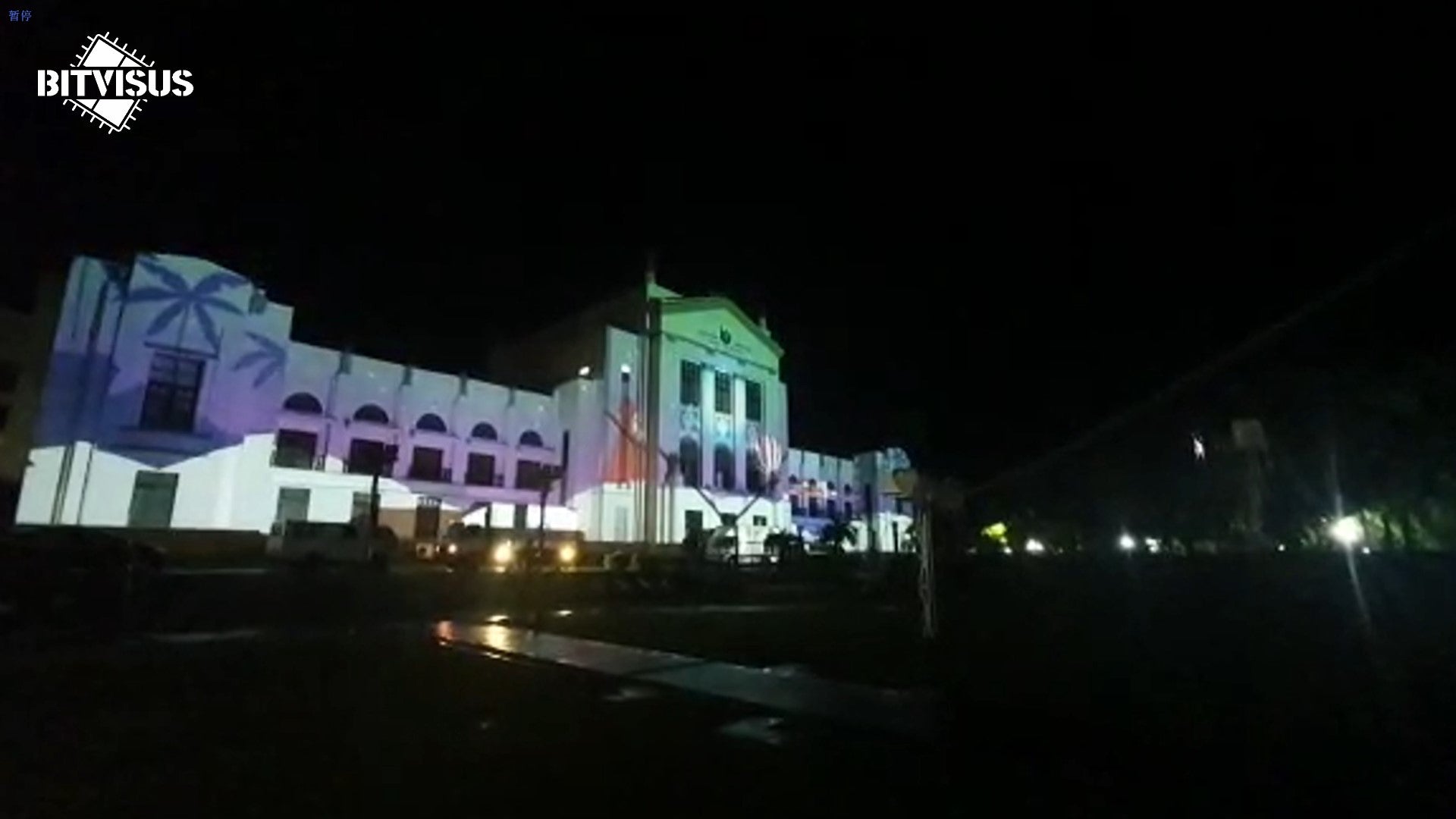
The Romania deployment is a distributed multi-screen expander architecture. The project is a building 3D projection mapping light show staged on a museum facade during the Christmas season, classified under cultural events and architectural projection entertainment. It runs as an event-driven scheduled show rather than as a continuous exhibit.
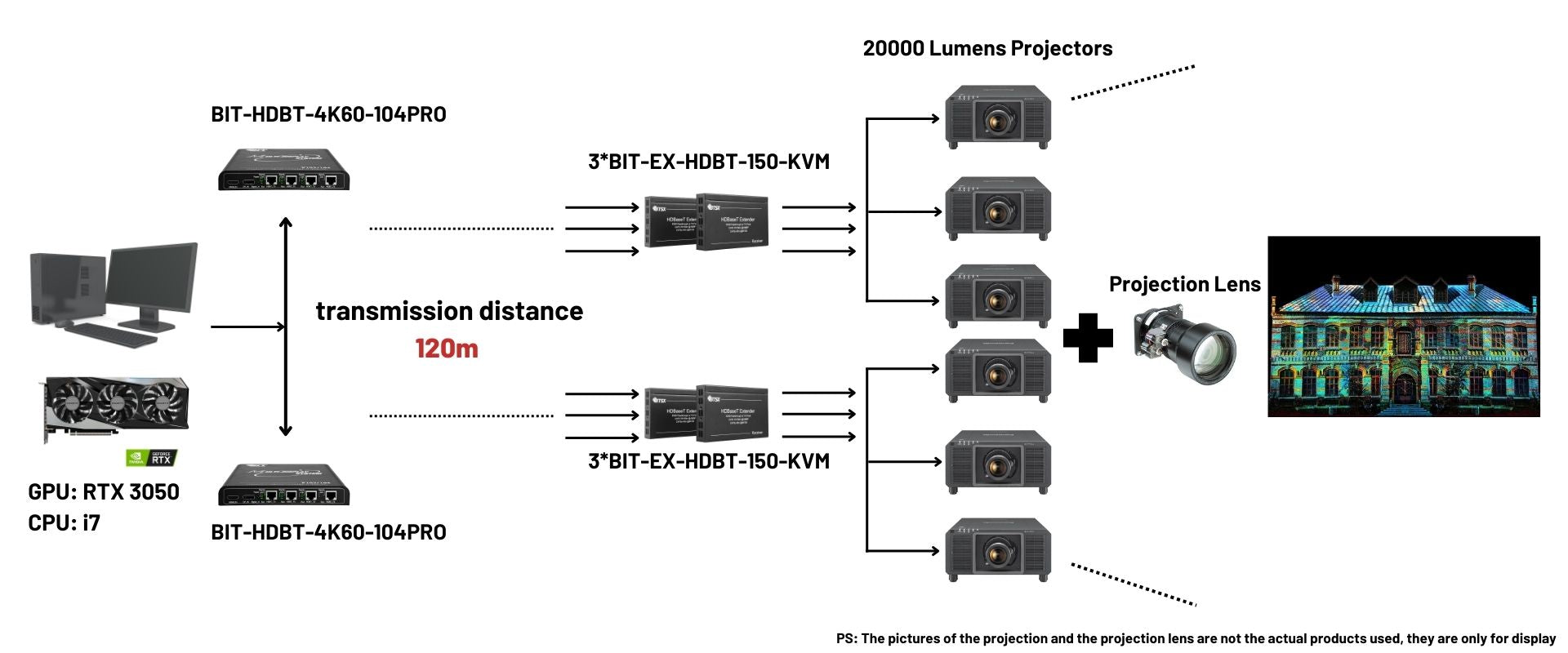
• Processing: 2 × BIT-MSE-4K60-104Pro multi-screen expanders
• Extension: 6 × BIT-Ex-HDBT-150 receivers
• Source: 1 × PC with GTX 3050 GPU
• Output surface: 6 projectors, 1 × 4K source
• Total canvas: 11520 × 1200
• Cable run: approximately 120 m
• Additional equipment: projection lenses, mapping software
How the signal path works
One PC renders the show. Its output is split across two BIT-MSE-4K60-104Pro expanders. Each expander accepts an HDMI or DP input (HDMI priority) with HDCP 2.2 and outputs four HDMI channels, so two units provide enough physical outputs to cover six projectors plus headroom. The combined horizontal canvas resolves to 11520 × 1200, which matches six 1920-wide projector images side by side. Each expander output then feeds one BIT-Ex-HDBT-150 receiver over CAT6E, carrying 1080p-class signal to the projector position roughly 120 m away.
The BIT-MSE-4K60-104Pro supports 1×N, N×1, M×N and 90° rotation tiling without stretching or deformation. Custom resolution can be written through the USB interface by modifying the EDID. The expander drops the need for a software splitter, a GPU with six synchronised outputs, and a separate matrix switcher, which is what makes the commissioning footprint small.
The BIT-Ex-HDBT-150 receiver side carries HDMI 1.4, HDCP 2.2, 3D support, two-way RS232 and two-way IR transparent transmission, and CEC. It transmits 1080p over CAT6E up to 150 m, well beyond the 120 m used on site, and supports POE so only one end of the link needs a 12 V supply. That detail matters on a museum facade where power outlets are not always available at the projector bracket.
Why this architecture was chosen
- Distance dominated the design. A 120 m projector run is far outside the reach of a standard HDMI copper cable. The HDBaseT receiver pair converts what would otherwise be an RF or fiber project into a CAT6E install.
- Single-PC rendering fit the creative workflow. The show is authored in projection mapping software on one machine. An expander preserves that workflow because the PC still sees one canvas.
- Cost and commissioning were lower. A small expander-plus-extender bill of materials replaces a rack of fusion processors, and each projector link is plug-and-play with no software driver.
- The show is episodic. A Christmas-season run does not require a 7×24 operations platform; it requires reliable repeatable startup.
Shenzhen: 16K Combined, 12 Controllers, 100+ Projectors
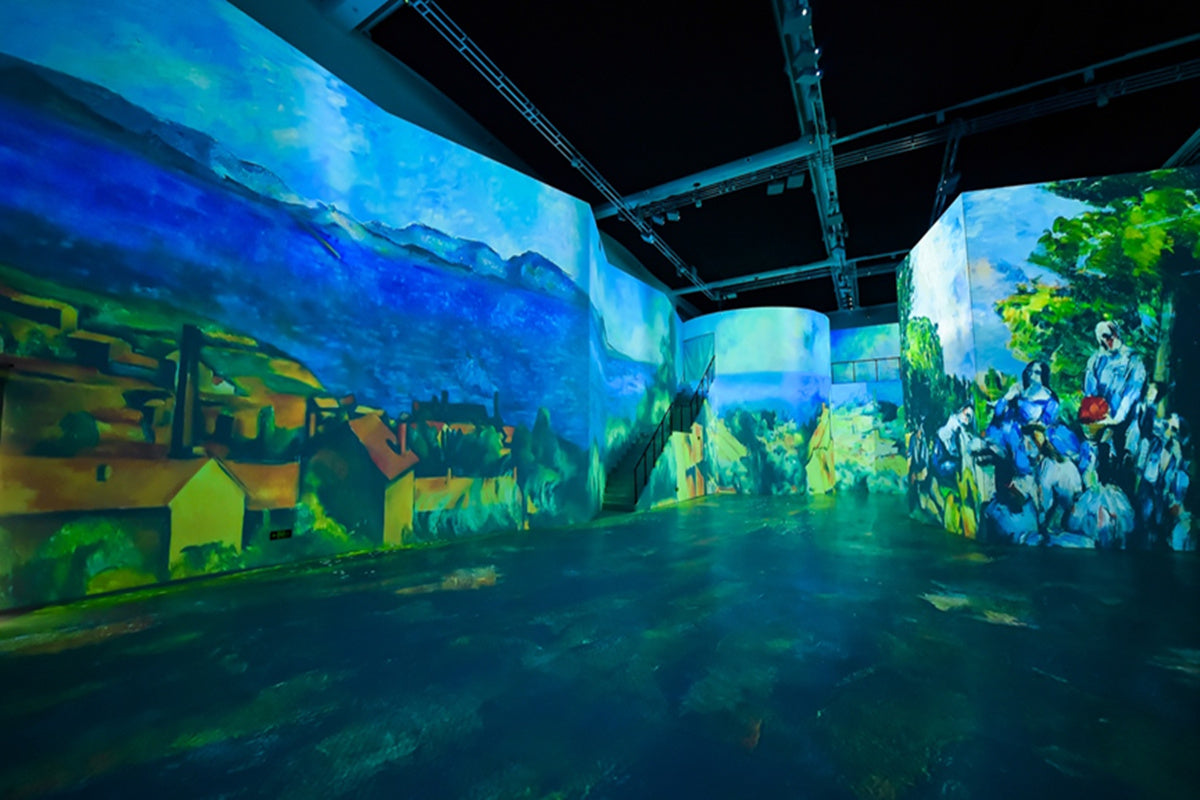
The Shenzhen deployment is a centralized video wall controller architecture. It is the Cézanne immersive art exhibition in a Shenzhen exhibition hall, classified as art and culture immersive exhibition. It runs continuously for daily visitor traffic and has been in place for five years.
• Processing: 12 × BIT-VWC-409R video wall controllers
• Display: 100+ industrial-grade 1080p projectors
• Per-controller wall: 3×3 layout at 5K, 5760 × 3240
• Combined resolution: above 16K
• Function: edge blending, geometric warping, ultra-high-resolution image fusion
• Operation: continuous daily exhibition, five years in service
How the signal path works
Each BIT-VWC-409R provides five inputs (3 × HDMI 1.4, 1 × HDMI 2.0, 1 × DP 1.2, all with HDCP 2.2) and nine HDMI 1.3 outputs plus one DP 1.2 loop-out. A single unit therefore addresses a 3×3 projector array natively, at 1920 × 1080 @ 60 Hz per output, producing a 5K canvas of 5760 × 3240 for that wall segment. Twelve units in the array deliver the combined resolution above 16K that the exhibition requires.
Cascading and parallel operation are supported through the DP loop-out. That is the mechanism that makes the array scalable: additional BIT-VWC-409R units can be chained without a separate matrix switcher, and multiple devices can run in parallel to keep display latency stable as the wall grows. The 40 nm FPGA with a full hardware real-time processing architecture is what keeps the routing deterministic under continuous load, which is the requirement for a venue that opens seven days a week.
Edge blending and geometric warping are handled at the system level, with the controller delivering the pixel-accurate, synchronised outputs and dedicated blending and warping software doing the optical calibration across overlapping projector edges. This is the layer that an expander-only architecture cannot provide out of the box, because expanders are designed for tiled single-canvas output rather than overlapping multi-projector fusion.
Why this architecture was chosen
- Scale dominated the design. A 100+ projector venue cannot be organised around a single PC output. Controllers provide the fan-out and the segmentation logic.
- Blending and warping were mandatory. Overlapping projection on irregular surfaces requires geometric correction per output channel, which is a controller function.
- Operational continuity was mandatory. Five years of daily operation places a premium on industrial-grade hardware, low power per node (12 W per BIT-VWC-409R), and a scalable array rather than a single point of failure.
- Expansion was expected. The DP loop-out allows the hall to add wall segments without redesigning the processing layer.
Step-by-Step Breakdown: How to Choose Between the Two
The two case studies are not a ranking of products. They are a ranking of constraints. Applying the following six checks in order will usually produce the correct architecture before the specification is written.
1. Count projectors, not screens
Count the physical projector outputs you need to feed. A multi-screen expander such as the BIT-MSE-4K60-104Pro provides four HDMI outputs per unit, so a six-projector wall needs at least two expanders. A video wall controller such as the BIT-VWC-409R provides nine HDMI outputs per unit and can also be cascaded through its DP loop-out, so a 3×3 segment is one unit and larger arrays are built by stacking units.
2. Draw the resolution and layout
Work out the final canvas and whether it is a straight tiling or an overlapping wall. The Romania project resolves to 11520 × 1200 in a single horizontal band, which is a tiling problem. The Shenzhen project resolves above 16K across a multi-segment immersive surface, which is a composition problem. Tiling is expander territory; composition with blending is controller territory.
3. Measure the cable run to each projector
Measure from the processing position to the farthest projector, not to the nearest. Copper HDMI output from the BIT-VWC-409R is rated to ≤15 m. Copper HDMI output from the BIT-MSE-4K60-104Pro is rated to 15 m. When the distance exceeds that, an HDBaseT extender pair such as the BIT-Ex-HDBT-150 extends 1080p over CAT6E to 150 m, which comfortably covers the 120 m used in Romania. Fiber is a separate option for runs beyond ordinary CAT6E reach.
4. Decide whether edge blending and geometric warping are in scope
If the projectors overlap, or if the projection surface is curved, angled, or architecturally irregular, edge blending and warping must be specified. The Shenzhen deployment requires both at the system level. If the projectors tile edge-to-edge into a flat rectangle and the mapping software handles the optical calibration externally, a pure expander path is viable, as in Romania, where dedicated mapping software handled the blending side of the pipeline.
5. Plan modular expansion up front
Ask what happens when the venue adds a projector, a wall segment, or a second gallery. Expanders scale per output group; adding projectors means adding units. Controllers scale per wall segment through the DP loop-out and per card in modular chassis models such as the BIT-VWC-MD3636Ma, which supports 1–9 input and output boards in a 7U frame. If the project is likely to grow by more than about 50% over its planned lifecycle, the controller path usually carries the lower expansion cost, even when the initial bill is higher.
6. Trade off budget against commissioning
This is where the two Romania-versus-Shenzhen comparisons become practical. The Romania project's lower cost and reduced commissioning come from a smaller bill of materials: two expanders and six extenders, with each projector link configured once. The Shenzhen project's higher up-front cost buys a processing array built to run continuously for years, with edge blending, warping, and cascadable capacity. Neither is over- or under-specified for its site; the commissioning labour is proportional to the number of channels that need optical calibration, and that number is dictated by the venue.
Use Cases: Where Each Architecture Fits
Building projection mapping and seasonal light shows
A single-PC projection mapping show, especially one staged on the exterior of a building over a long CAT6E run, is a natural expander plus extender project. The Romania deployment is the reference case: two expanders, six HDBaseT receivers, 120 m, one PC. Budget and setup time usually dominate here because the show runs to a schedule rather than continuously.
Immersive art venues and permanent exhibition halls
A permanent immersive venue with overlapping projectors, curved or multi-planar surfaces, and a requirement for daily continuous operation belongs in the controller category. The Shenzhen Cézanne exhibition is the reference case: 12 controllers, 100+ projectors, more than 16K combined, five years in service. Blending, warping, and long-term stability are the deciding factors.
Control rooms and security monitoring centers
A control room is a multi-source problem, not a multi-projector problem, so a video wall controller is normally specified. Window composition, source switching, and continuous 7×24 operation are the requirements. Typical configurations use a 3×3 or 4×4 LCD video wall with a controller, matrix switcher, and central control system. For control-room ergonomics, ISO 11064 is the reference standard that governs layout and operator visibility.
Conference rooms and corporate showrooms
Meeting rooms and showrooms typically run 2×2, 1×3, or 2×3 layouts with a small number of sources. Both architectures can work here depending on whether the priority is multi-window composition (controller) or simply tiling a presentation across displays (expander). Bitvisus product lines in this range include the BIT-VWC-218Pro with 18 HDMI outputs and the BIT-MSE series.
Rental, staging, and touring shows
Touring and event work usually benefits from expanders because the rig has to be broken down, moved, and rebuilt, and the fewer processing nodes in the rack the faster the load-in. HDBaseT extenders reduce the copper run and simplify cable management at height.
Museum facades and cultural-tourism installations
Museum halls and cultural-tourism installations can go either way depending on the number of projectors and whether the surface is a single tiling or a blended immersive volume. The rule of thumb is the same as elsewhere: count projectors, measure distance, then decide whether blending is a system requirement or a software requirement.
Comparison Table: Romania vs Shenzhen Deployment
| Decision factor | Romania (distributed expander) | Shenzhen (centralized controller) |
|---|---|---|
| Project type | Museum building 3D projection mapping, Christmas light show | Cézanne immersive art exhibition, permanent hall |
| Processing hardware | 2 × BIT-MSE-4K60-104Pro multi-screen expanders | 12 × BIT-VWC-409R video wall controllers |
| Extension hardware | 6 × BIT-Ex-HDBT-150 receivers over CAT6E | Cascaded via DP 1.2 loop-out; HDMI output ≤15 m |
| Source configuration | 1 × PC with GTX 3050 GPU, 1 × 4K source | 5 inputs per controller (3× HDMI 1.4, 1× HDMI 2.0, 1× DP 1.2) |
| Projector count | 6 projectors | 100+ industrial-grade 1080p projectors |
| Output per unit | 4 × HDMI per expander | 9 × HDMI plus 1 × DP loop-out per controller |
| Canvas / resolution | 11520 × 1200 total tiled canvas | 3×3 5K per controller (5760 × 3240); combined over 16K |
| Edge blending and warping | Handled at system level with projection mapping software | System-level blending and geometric warping across overlaps |
| Maximum cable distance | Approximately 120 m on site; CAT6E HDBaseT rated to 150 m for 1080p | HDMI ≤15 m per output; longer reach requires external extension |
| Cost and commissioning | Lower bill of materials; reduced commissioning footprint | Higher up-front processing investment; commissioning scales with channel count |
| Operation pattern | Event-driven scheduled shows, seasonal | Continuous daily exhibition, five years in service |
| Best-fit scenario | Limited channel count, long distance, single-PC workflow | Large blended surfaces, many projectors, long-term expansion |
Hardware Reference for Both Paths
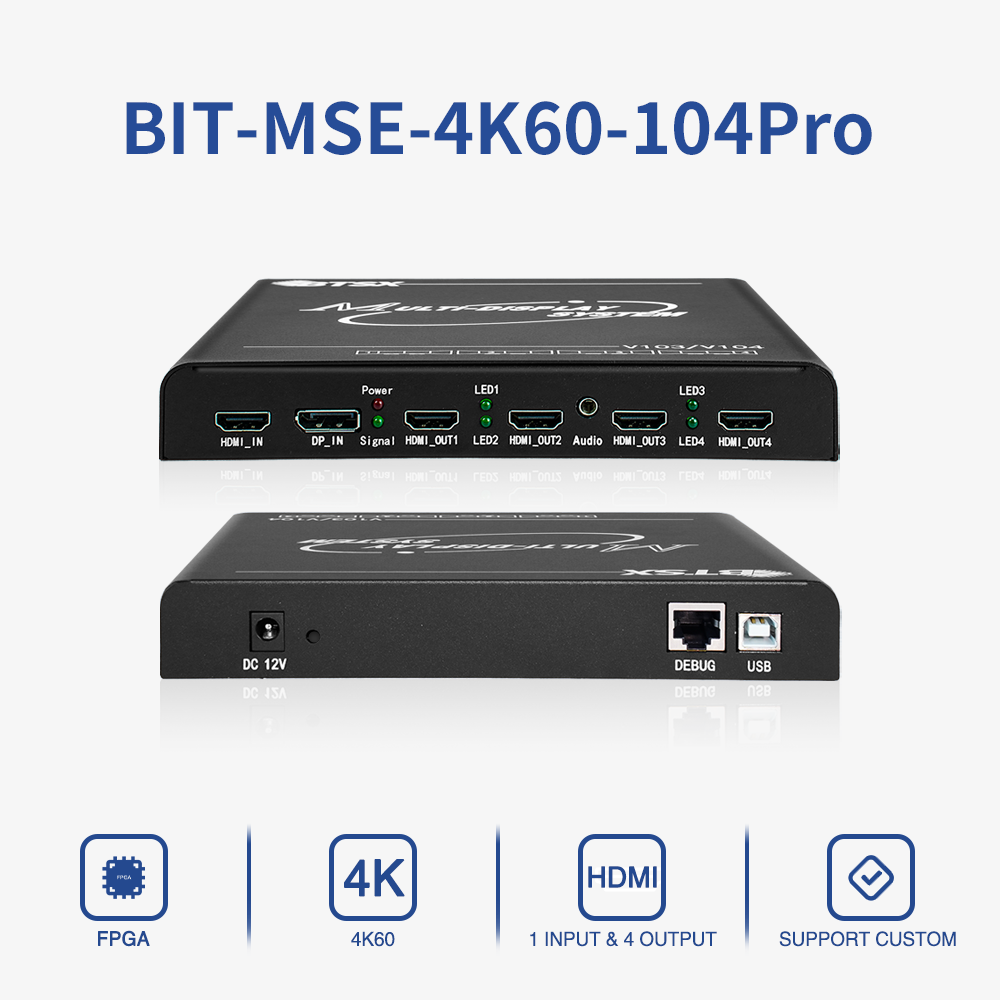
The BIT-MSE-4K60-104Pro is a 4K multi-screen expansion unit with a 600 MHz input pixel clock and 300 MHz output pixel clock. It supports 3×1920×1200 @ 60 Hz and 4×1920×1200 @ 60 Hz tiling, a factory default of 3840×2160 @ 60 Hz in 2×2, up to 3840×2400 @ 60 Hz in 2×2, 5760×1200 @ 60 Hz in 3×1, and 7680×1200 @ 60 Hz in 4×1. It supports EDID modification through the USB interface, programmable FPGA processing, and 16 KV anti-static protection on a thickened six-layer PCB. Output distance is 15 m on copper HDMI, which is why an extender is normally paired with it on building-scale runs.
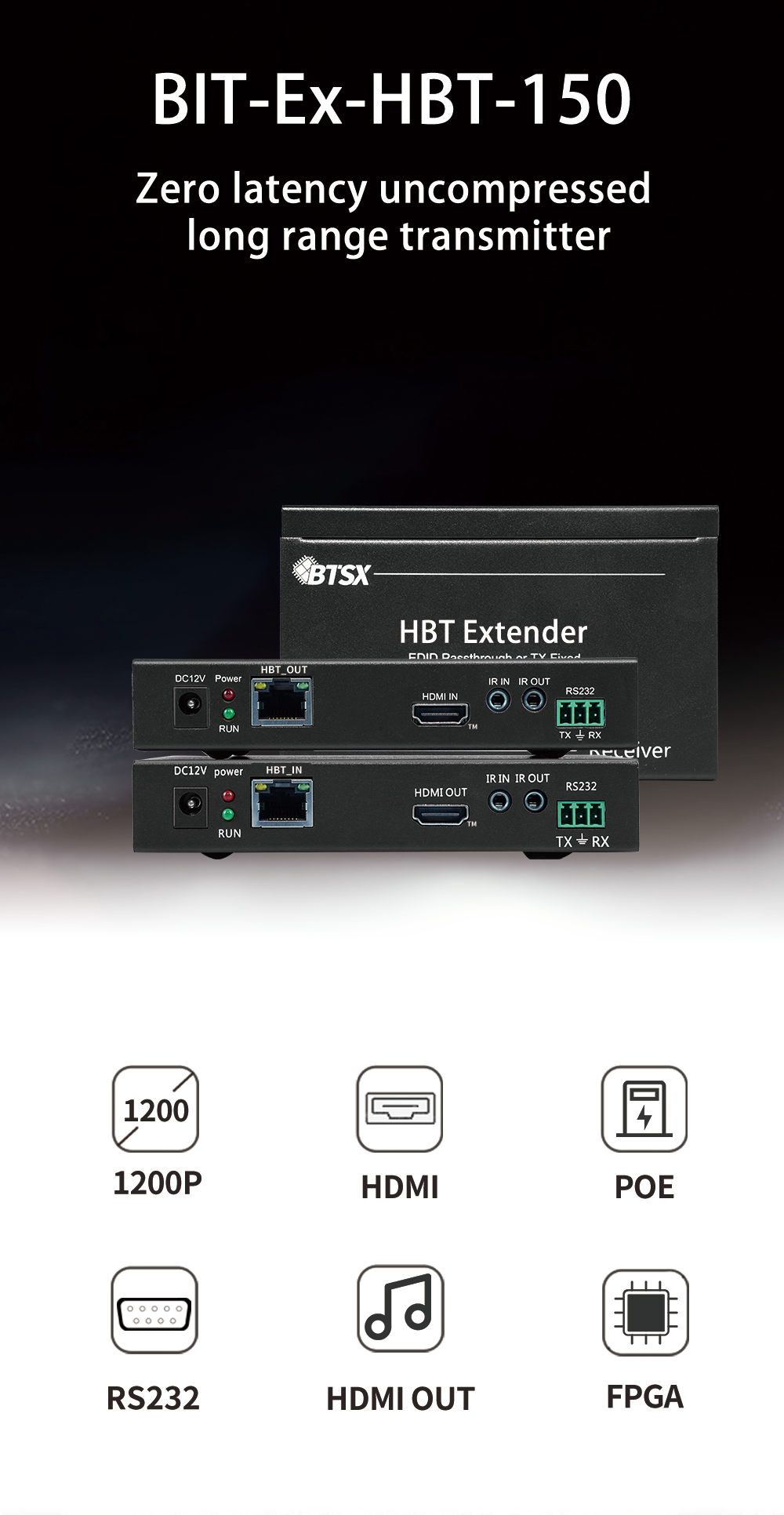
The BIT-Ex-HDBT-150 is a high-definition video fiber extender classified for HDMI, KVM, IR, and RS232 signal extension. It transmits 1080p over CAT6E up to 150 m at 6 Gbps bandwidth, supports HDCP 2.2, HDMI 1.4, CEC, 3D, and two-way RS232/IR transparent transmission. It operates on 12 V DC, dissipates ≤12 W, and allows POE so only one end requires local power. The receiver side accepts HDMI 1.4 up to 5 m from the projector, which is why the last few metres at the display are straightforward even when the run up to that point is 120 m of CAT6E.
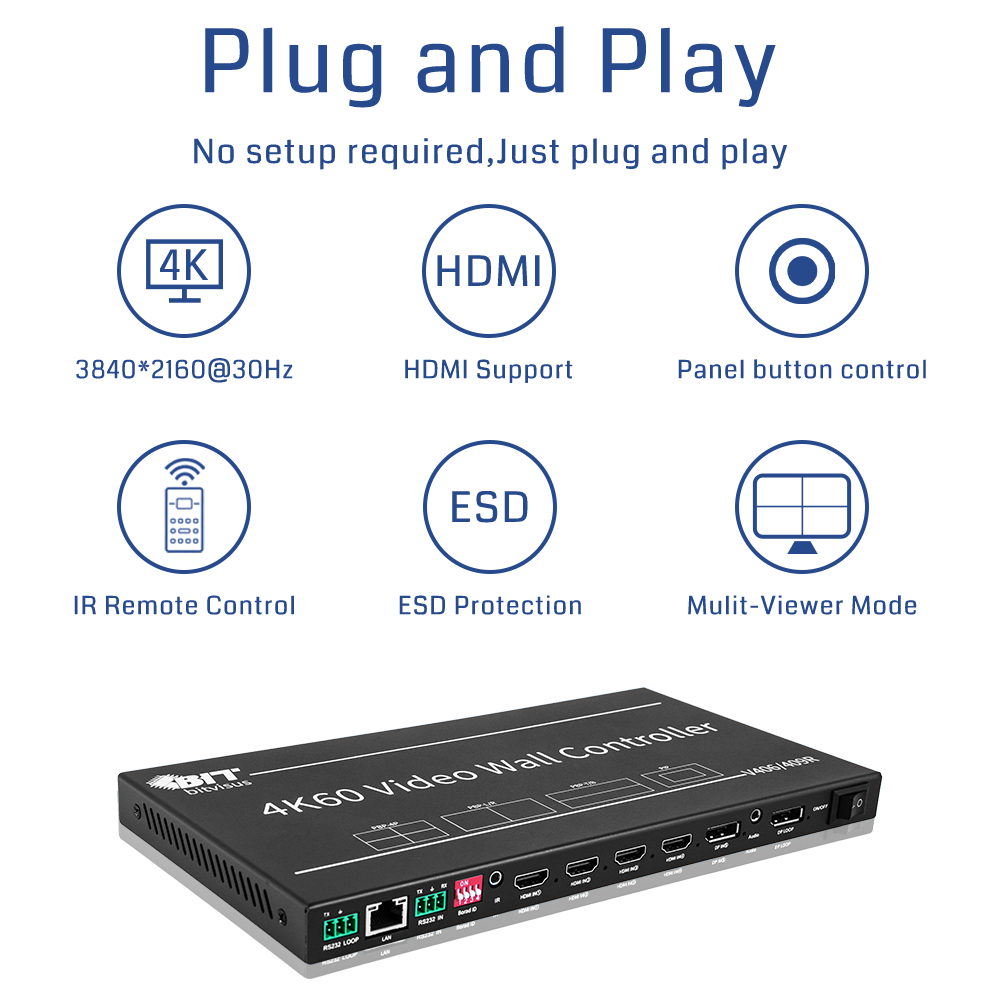
The BIT-VWC-409R is a rotating splicing processor designed for large-screen splicing. It provides three HDMI 1.4 inputs, one HDMI 2.0 input, and one DP 1.2 input, with a maximum input pixel frequency of 600 MHz. Output is nine HDMI 1.3 channels at 1920×1080 @ 60 Hz plus one DP 1.2 loop-out, with output pixel frequency of 165 MHz. Splicing mode is within 9 screens, and the unit supports left-right, top-bottom, four-split, and picture-in-picture layouts with up to four signals on the wall at once. Power consumption is 12 W, weight is 1 kg, and the unit supports multi-device cascading and parallel connection. OEM support is available and the warranty period is one year.
Frequently Asked Questions
Both multi-screen expanders and video wall controllers output HDMI — what is the functional difference?
A multi-screen expander, such as the BIT-MSE-4K60-104Pro, accepts one source input and tiles it across multiple HDMI outputs without stretching or deformation. A video wall controller, such as the BIT-VWC-409R, accepts several source inputs, composites them onto a single splicing canvas, and outputs to a larger display array with windowing, picture-in-picture, and — at the higher end of the range — edge blending and geometric warping. The expander distributes one image; the controller builds one image out of many sources.
Can a video wall controller array drive more than 100 projectors in a single venue?
Yes, when the controllers are cascaded. The Cézanne immersive art exhibition in Shenzhen uses 12 × BIT-VWC-409R controllers, each driving a 3×3 5K wall at 5760 × 3240 from 100+ industrial-grade 1080p projectors, for a combined resolution above 16K. The BIT-VWC-409R supports multi-device cascading through its DP 1.2 loop-out and parallel operation, so the array scales by adding units rather than by replacing a single large processor.
How far can the signal travel without fiber?
Direct HDMI output from the BIT-VWC-409R is rated to ≤15 m, and the BIT-MSE-4K60-104Pro output is rated to 15 m. Where the projector sits farther away, a BIT-Ex-HDBT-150 extender pair transmits 1080p over CAT6E up to 150 m, which covers the approximately 120 m run used in the Romania projection mapping deployment. Beyond ordinary CAT6E reach, a fiber extender product line is the appropriate next step.
Do both product lines support OEM orders and warranty?
Yes. The BIT-Ex-HDBT-150 extender supports OEM, and the BIT-VWC-409R video wall controller supports OEM. Both carry a one-year after-sales service period, and the BIT-VWC-409R ships with the device, power supply, remote control, certificate, and warranty card. The BIT-Ex-HDBT-150 ships as an equipment pair with power supply, certification, and warranty card. Buyers should confirm the exact configuration and documentation requirements with the supplier before an order is placed.
How do I get a sample or a quotation for a specific configuration?
Share the projector count, the layout (2×2, 1×4, 3×3, or custom), the total canvas resolution, the longest cable run, and whether edge blending or geometric warping is required. That information is enough to determine whether the project belongs on a multi-screen expander path or a video wall controller path before any bill of materials is drafted. Bitvisus can be contacted directly at eddie.jia@bitvisus.com or +86 186-8150-9089 for configuration review and a project quotation.
Conclusion: Match the Architecture to the Constraint
The Romania and Shenzhen deployments are not competing answers to the same question. They are correct answers to different questions.
Romania is the case where distance and channel count define the project. Six projectors, a 120 m run, a single PC in the creative workflow, and a seasonal show. Two BIT-MSE-4K60-104Pro expanders and six BIT-Ex-HDBT-150 receivers deliver a 11520 × 1200 canvas at lower cost and with reduced commissioning compared with a fusion processor rack.
Shenzhen is the case where scale and continuity define the project. Twelve BIT-VWC-409R controllers, 100+ projectors, combined resolution above 16K, edge blending, geometric warping, and a five-year continuous run. The processing investment is larger, and so is what it buys.
The selection criteria that separate the two cases are stable and can be applied before a specification is written: count projectors, draw the resolution and layout, measure the cable run, decide whether edge blending and warping are system requirements or software requirements, plan modular expansion, and then trade budget against commissioning honestly. When those six checks agree, the architecture choice is usually obvious. When they disagree, the constraint that appears first in that list is normally the one that governs.
Bitvisus manufactures both categories in the same 4K/8K image processing portfolio, which means a project can be evaluated on the constraint rather than on the product the supplier happens to stock. The 2026 Bitvisus product brochure covers multi-screen expanders, video wall controllers, projector fusion processors, and HDBaseT extenders in a single reference document, and is available for download below.
Planning a Projection Wall?
Send us the projector count, the canvas resolution, the longest cable run, and whether edge blending is required. We will confirm whether a multi-screen expander or a video wall controller array fits your site, and return a configuration with the right model mix.
Email: eddie.jia@bitvisus.com | Tel / WhatsApp: +86 186-8150-9089 | Web: bitvisus.com
Download the 2026 Bitvisus Product Brochure (PDF)Have Questions or Need More Details?
Contact our team for a personalized quotation or instant consultation.
Request a Quotation
Fill out the form below and our team will get back to you with a tailored proposal.
WhatsApp Direct Chat
Prefer to chat in real-time? Message us on WhatsApp for instant assistance & quick answers.
- Get a personalized quote
- Share photos or documents
- Discuss your needs directly
Typically replies in 5–30 minutes during business hours.