
Video Wall Controller Application Guide: Adapting 100+ Projector Immersive Art Exhibitions
Twelve rack-mount controllers, more than one hundred industrial 1080p projectors, one continuous canvas — and the specification checks that make that architecture repeatable.
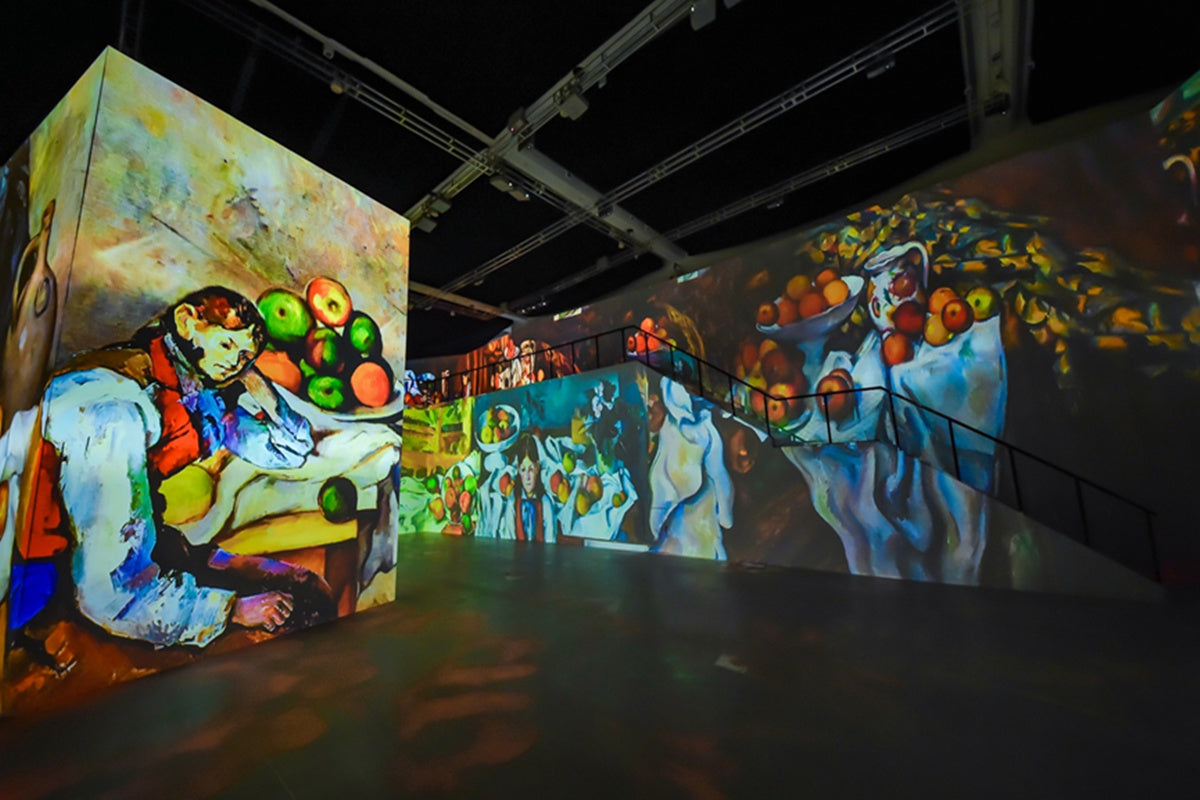
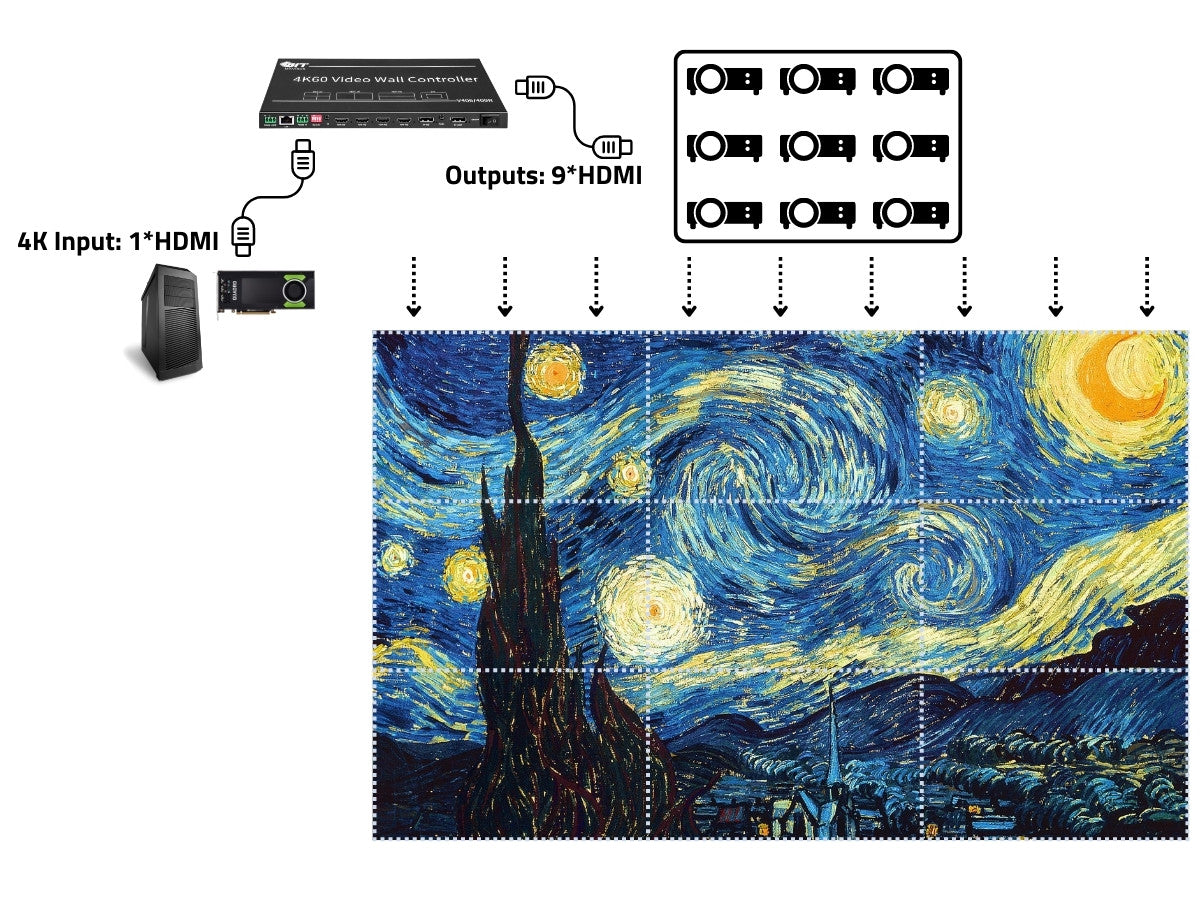
A video wall controller application guide for immersive art venues usually starts with a projector count, and that count immediately changes the specification conversation. On a conventional 3×3 LCD video wall, the controller distributes one canvas across nine panels separated by visible bezels. In an immersive projection venue, the same 3×3 grouping feeds nine projectors that overlap, blend and cover a curved or multi-plane surface, where every alignment error is visible to a visitor standing two metres away.
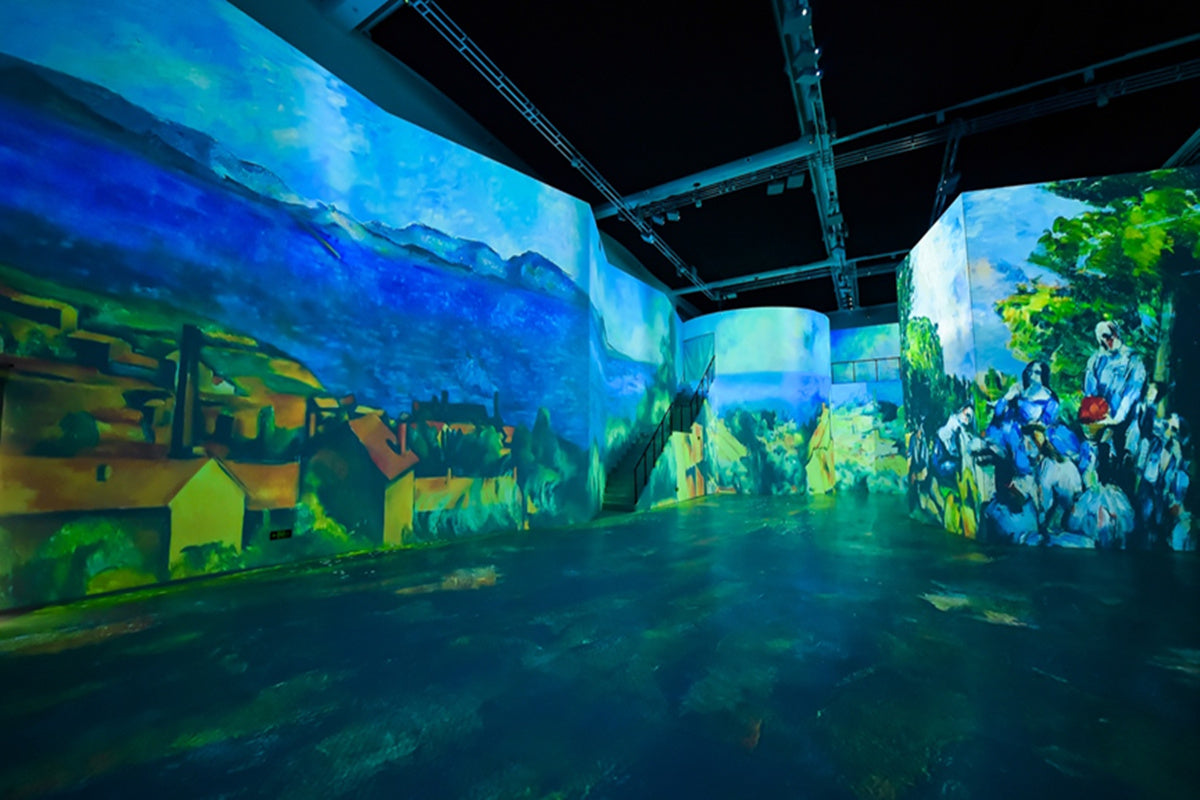
The Cézanne immersive painting art exhibition in Shenzhen, China is a working example of that second model. The venue runs more than 100 industrial-grade 1080p projectors organised into 3×3 groups. Each BIT-VWC-409R video wall controller drives nine projectors, and 12 Bitvisus video wall controllers are used in total. Every individual 3×3 wall delivers a 5K 5760×3240 image, multiple walls are recombined into a final image that exceeds 16K, and edge blending and warping software sits above the hardware layer. The deployment has been running for five years.
This guide explains how that adaptation is built, which constraints decide the controller configuration, and what to verify in certification, budget, sampling and lead time before committing to a similar venue.
Why a 100-Projector Venue Breaks Standard Video Wall Assumptions
Video wall controllers are normally specified by output channel count. Projector-based immersive venues add four constraints on top of that number, and each one can invalidate a configuration that looks correct on paper.
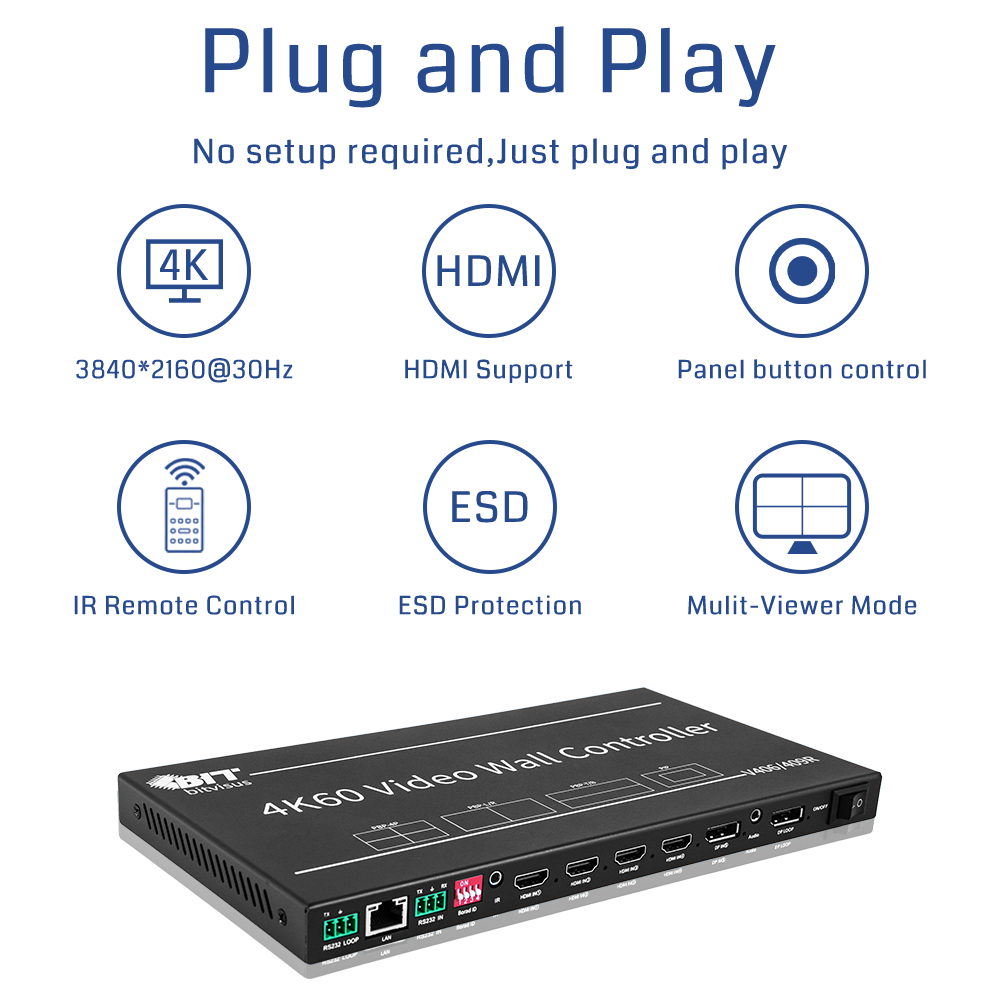
A video wall controller accepts multiple video sources and distributes them across a fixed set of output channels, each locked to a defined output resolution. In the BIT-VWC-409R used in Shenzhen, that fixed set is nine HDMI 1.3 outputs at 1920×1080@60Hz, plus one DP 1.2 loop-out port. The input side provides 3× HDMI 1.4, 1× HDMI 2.0 and 1× DP 1.2, with HDCP 2.2 support and a maximum input resolution of 3840×2160@60Hz.
Output capacity per chassis. Nine outputs per unit means a 100-plus projector venue cannot be covered by one device. Scale comes from grouping: nine projector feeds per controller, repeated across chassis, then recombined.
Synchronisation across groups. When twelve separate processing units feed one visual canvas, timing errors between units become visible as tears or seams. Parallel connection and multi-device cascading are therefore functional requirements, not optional features.
Physical cable reach. The output interfaces on the BIT-VWC-409R accept HDMI cable lengths up to 15 m, and inputs up to 5 m. Projector positions, rack positions and cable routes must be planned against those limits before the controller model is confirmed.
Duty cycle. An art exhibition with daily opening hours runs continuously for years. The controller must be specified for continuous operation, not for event-length sessions.
Industry Background: Why Immersive Projection Demand Is Rising
The commercial context explains why venues are willing to accept the complexity of a 12-controller architecture.
The global video wall controllers market was estimated at approximately USD 2.25 billion in 2025 and is projected to reach USD 4.4 billion by 2034, a CAGR of 7.8% for the 2025–2034 period, according to Dataintelo market research. Published estimates of this market vary widely depending on whether the controller is defined strictly as the processing hardware or as a complete display management solution including software and integration, so buyers should read vendor market figures with the definition in mind.
Architecture preferences are shifting at the same time. AV-over-IP adoption reached 73% of new video wall controller installations in early 2026, according to GCG Enterprise Solution citing AVIXA data. Control-room applications account for 50% of video wall processor market contribution, based on Statifacts commercial research, which is why control-room requirements such as ISO 11064 control-room ergonomics frequently influence hardware choices that are later reused in exhibition environments.
For cultural venues, the practical consequence is that a single hardware family increasingly has to serve control rooms, conference displays, security monitoring walls and immersive exhibition spaces. The Shenzhen exhibition is an example of that hardware serving a cultural application with the reliability expectations of an operations room.
The Adaptation Solution: 12 Controllers, 108 Projector Channels, One Canvas
The Shenzhen deployment answers the adaptation question with a repeatable building block rather than a single large chassis.
One controller, nine projectors, 3×3 = 5K
The BIT-VWC-409R is a rotating splicing processor with nine HDMI 1.3 outputs at 1920×1080@60Hz. Nine 1080p tiles arranged 3×3 produce a combined 5760×3240 canvas, which is the 5K figure reported for each 3×3 wall at the exhibition. A single device therefore covers exactly one projector group, with no partial-unit waste and no unused output channels.
Across the venue, 12 controllers cover more than 100 projector channels. Because the grouping is uniform, spare parts, firmware and technical documentation are also uniform, which matters over a multi-year exhibition run.
Recombining walls beyond 16K
Individual walls at the Cézanne exhibition are recombined so the final image exceeds 16K. This recombination depends on the loop-out and multi-device capabilities of the controller rather than on a single oversized processor. The BIT-VWC-409R includes a DP 1.2 loop-out port, supports parallel connection of multiple devices and supports multi-device cascading, which is how separate 3×3 groups are joined into one continuous visual field.
Edge blending and warping layer
Hardware alone does not produce a seamless painting. Edge blending and warping software handles the overlap zones between adjacent projectors, correcting brightness in the blend region and geometric distortion on curved or angled surfaces. The controller's role is to supply pixel-accurate, distortion-free tiles to that software layer. The BIT-VWC-409R supports proportional resolution input so the picture is not distorted, and it supports output first-row rotation of 180° when the splicing mode uses two lines — useful when the top row of projectors is mounted inverted and the image direction has to be corrected without re-cabling.
Electrical, thermal and duty-cycle constraints
Each BIT-VWC-409R runs on DC 12V 2A with 12W power consumption, uses internal conduction heat dissipation with no external cooling measures, and carries a storage temperature range of -10 to 50 °C with an operating range of 0 to 50 °C. It uses a 40nm chip with a full hardware real-time processing architecture, which means processing happens in hardware without a software rendering delay. For a five-year exhibition running daily, these are the parameters that determine whether the rack room stays simple.
Certification and compliance path
For venues in the EU and US, compliance paperwork is part of the specification, not an after-sales detail. Bitvisus video wall controller and multi-screen processor families in the MSE/VWC/MV series are covered by CE-EMC, RoHS and FCC Supplier's Declaration of Conformity documentation issued by Shenzhen Circle Testing Certification Co., Ltd.
The CE-EMC Declaration of Conformity CTC118K0401302EC references EMC Directive 2014/30/EU and lists EN 55032:2015/A11:2020, EN 55035:2017/A11:2020, EN IEC 61000-3-2:2019/A2:2024 and EN 61000-3-3:2013/A2:2021/AC:2022. The RoHS Declaration of Conformity CTC118K0401302RC references Directive (EU) 2015/863 as amended by (EU) 2017/2102 and EN IEC 63000:2018, with IEC 62321 series test methods. The FCC Supplier's Declaration of Conformity CTC118K0401302FC follows FCC rules 2.906, 2.908 and 2.909 under ECFR Title 47 FCC Part 15 Subpart B, with OMA Electronic Technology Inc named as the US Responsible Party. These 220V-input declarations cover the Modular Multi-screen Splicing Matrix Processor (MSE/VWC/MV series) with lead model BIT-VWC-MD1212Ma, and the covered model list includes the BIT-VWC-MD3636Ma and the BIT-VWC-8K60-404Max. They were issued on 2026-05-11 and are valid through 2099-01-01.
A separate documentation set covers 12V-input multi-screen splicing processors, with lead model BIT-MSE-8K60D-104Pro and covered models BIT-MSE-8K60D-104Pro, BIT-MSE-8K60Y-104Pro, BIT-VWC-8K60Y-115Pro and BIT-VWC-218Pro. Buyers specifying a BIT-VWC-409R for a regulated market should request the current declaration set that names that exact model.
Step-by-Step Breakdown: Adapting a Controller Stack to a 100+ Projector Venue
- Count projector channels, then divide by nine. Group the venue into 3×3 blocks. At the Shenzhen exhibition that produced 12 controller units for more than 100 projector channels.
- Confirm the per-group canvas resolution. Nine 1080p outputs produce a 5760×3240 5K canvas per group, which is the resolution reported for each 3×3 wall in the reference deployment.
- Define input sources before choosing input cards. The BIT-VWC-409R accepts five inputs (3× HDMI 1.4, 1× HDMI 2.0, 1× DP 1.2) with HDCP 2.2, and up to four signals can be sent to the wall simultaneously. Match the input count to the media server or PC layout.
- Plan cable routes against real limits. Output cable length is up to 15 m; input cable length is up to 5 m. Rack position and projector position are therefore part of the controller decision.
- Design the recombination path. Use the DP 1.2 loop-out port and multi-device cascading to join multiple 3×3 walls into a combined image above 16K.
- Layer edge blending and warping on top. Budget the software and commissioning time for blend zones, geometric correction, and inverted top-row mounting corrected through 180° first-row output rotation.
- Set the control and recovery model. The BIT-VWC-409R supports infrared remote control, RS232 serial control and PC upper-computer control, supports DHCP, and supports power-down memory so the wall returns to its previous state after an interruption.
- Plan the multi-year lifecycle. For a five-year exhibition run, include spare controllers, documented firmware, and a support path with technical documentation and remote debugging.
Use Cases: Where This Adaptation Pattern Applies
Immersive art and museum exhibitions. The Cézanne immersive painting art exhibition in Shenzhen, China is the reference case: 100+ industrial 1080p projectors, 12 Bitvisus video wall controllers, 3×3 groups at 5K 5760×3240 per wall, combined output beyond 16K, edge blending and warping software, five years of operation.
Digital exhibition halls, cultural tourism and theme venues. The same nine-output grouping applies wherever wide, non-rectangular projection surfaces need pixel-level continuity rather than panel edges, and where projector counts grow into the hundreds.
Control rooms and security monitoring walls. The identical controller logic applies when the wall is a monitoring wall rather than an artwork: multiple inputs distributed across many display channels, stable continuous operation, and centralised control. Control-room ergonomics standards such as ISO 11064 are the relevant reference in that context.
Commercial media and conference displays. Smaller 4K video wall controller configurations from the same family support advertising screens and conference walls where channel counts stay low but uptime and remote management requirements remain.
Comparison Table: Bitvisus Controller Configurations for Projector Walls
The table below compares channel capacity and interface configuration inside one hardware family, so a venue can match controller grouping to projector count. It is a configuration comparison, not a claim of superiority over other suppliers.
| Controller model | Input interfaces | Output channels | Typical wall layout per unit |
|---|---|---|---|
| BIT-VWC-409R (used in Shenzhen) | 3× HDMI 1.4, 1× HDMI 2.0, 1× DP 1.2, up to 5 m, HDCP 2.2 | 9× HDMI 1.3 at 1920×1080@60Hz, up to 15 m, plus 1× DP 1.2 loop-out | 3×3 group; 9 projector feeds; 5760×3240 combined |
| BIT-VWC-218Pro | 2× HDMI 2.0, 2× DP 1.2, HDCP 2.0 | 18× HDMI 1.3 at 1920×1200@60Hz or 1920×1080@60Hz, up to 15 m | Higher density per chassis; up to 18 display channels |
| BIT-VWC-8K60Y-115Pro | 1× HDMI 2.1, 1× DP 1.4, HDCP 2.2 | 15× HDMI 1.4 at 1920×1200@60Hz or 1920×1080@60Hz | Up to 3×3 at 5760×3240@60Hz or 2×4 at 7680×2160@60Hz |
| BIT-MSE-8K60D-104Pro | 1× DP 2.1, up to 3 m, HDCP 1.4/HDCP 2.3 | 4× HDMI 2.0 at 3840×2160@60Hz or 3840×2400@60Hz, up to 5 m | 1×4 or 2×2 tiling; up to 7680×4320@60Hz input |
| BIT-VWC-MD3636Ma | Up to 36× HDMI 2.0 input, 600 MHz pixel clock | Up to 36× HDMI 2.0 output; input-to-output latency under 40 ms | 6×6, 1×36 and mixed layouts; matrix-scale walls |
Configuration data above is drawn from published specification sheets for each model. Cable-length limits are the maximum supported by the interface and should be confirmed against site routing.
Customisation note: Bitvisus supports OEM/ODM work covering I/O channel count, interface type, control UI branding, resolution customisation and chassis appearance, with standard models available from 1 unit, OEM private label from 10 units and custom development from 100 units.
FAQ
Which certifications apply to Bitvisus video wall controllers for EU and US installations?
Bitvisus video wall controllers within the MSE/VWC/MV series are documented with CE-EMC, RoHS and FCC Supplier's Declaration of Conformity paperwork issued by Shenzhen Circle Testing Certification Co., Ltd. CE-EMC Declaration of Conformity CTC118K0401302EC references EMC Directive 2014/30/EU and the standards EN 55032:2015/A11:2020, EN 55035:2017/A11:2020, EN IEC 61000-3-2:2019/A2:2024 and EN 61000-3-3:2013/A2:2021/AC:2022. RoHS Declaration of Conformity CTC118K0401302RC references Directive (EU) 2015/863 as amended by (EU) 2017/2102, EN IEC 63000:2018 and IEC 62321 test methods. FCC Supplier's Declaration of Conformity CTC118K0401302FC follows FCC rules 2.906, 2.908 and 2.909 under 47 CFR Part 15 Subpart B, with OMA Electronic Technology Inc as the US Responsible Party. These 220V-input declarations name the Modular Multi-screen Splicing Matrix Processor (MSE/VWC/MV series), lead model BIT-VWC-MD1212Ma, with covered models including BIT-VWC-MD3636Ma and BIT-VWC-8K60-404Max; they were issued on 2026-05-11 and are valid through 2099-01-01. A separate set covers 12V-input processors with lead model BIT-MSE-8K60D-104Pro and covered models BIT-MSE-8K60D-104Pro, BIT-MSE-8K60Y-104Pro, BIT-VWC-8K60Y-115Pro and BIT-VWC-218Pro. For the BIT-VWC-409R, request the declaration set naming that specific model.
How many projectors can one video wall controller drive, and how many HDMI inputs does it offer?
Output channel count determines projector count. A BIT-VWC-409R provides nine HDMI 1.3 outputs at 1920×1080@60Hz with cable lengths up to 15 m, so one unit drives nine projectors in a 3×3 group — the exact grouping used at the Cézanne immersive painting art exhibition in Shenzhen, where 12 units covered more than 100 industrial 1080p projectors. On the input side, the same unit accepts 3× HDMI 1.4, 1× HDMI 2.0 and 1× DP 1.2 with HDCP 2.2, and up to four signals can be placed on the wall at the same time. Where a project needs more channels per chassis, the BIT-VWC-218Pro offers 18 HDMI outputs, the 8K60 BIT-VWC-8K60Y-115Pro offers 15 HDMI outputs with a 3×3 5760×3240@60Hz input mode, and the modular BIT-VWC-MD3636Ma scales to 36 HDMI 2.0 inputs and 36 HDMI 2.0 outputs.
What drives the cost of a 100-projector controller configuration?
Cost is driven by channel count and configuration rather than by a single headline specification. The main variables are the number of controllers required for the projector count (one BIT-VWC-409R per nine projector feeds in the Shenzhen pattern, so 12 units plus spares for 100+ projectors), the input channel count per unit, rack-mount chassis and power requirements (12V 2A and 12W per 409R), edge blending and warping software licensing, output cabling within the 15 m HDMI limit, and spare units for a multi-year run. Commercial entry points are defined by minimum order quantity: standard models from 1 unit, OEM private label from 10 units, and custom development from 100 units. Bitvisus provides free solution design and technical drawings, so a configuration-level quotation can be built from the venue's projector layout rather than from a catalogue line.
Can a configuration be validated with a sample unit before full deployment?
Yes. Standard models carry a minimum order quantity of one unit, so a single BIT-VWC-409R can be tested against the actual input sources, output resolution and control workflow before the full set is committed. Bitvisus also provides free solution design and technical drawings, a one-year warranty, 7×24 technical support, free remote debugging and firmware upgrades as part of the after-sales package. For a 3×3 wall, a sample unit validates the nine-output grouping, the 1920×1080@60Hz output timing and the RS232 or PC-based control path, which are the elements most likely to need adjustment during commissioning.
What are the lead times for standard and custom controller orders?
Standard stock ships within 3 to 7 days. Custom orders take 2 to 3 months. Export orders clear customs and ship within 10 days. Production capacity is 8,000 units per month, with a three-level QC process covering 100% inspection of core components, single-board function testing, and a 7×24-hour full-channel power aging test on finished goods. For a 12-controller exhibition build plus spares, place the order against the confirmed wall layout so that the input card mix and control configuration match the media server design. To start, you can review the full product range in the Bitvisus brochure or send the venue layout to the technical team for a controller count and configuration proposal.
Conclusion
Adapting a video wall controller stack to a 100-plus projector immersive art venue is a grouping problem before it is a hardware problem. Nine outputs per controller define a 3×3 group; twelve groups cover more than 100 projectors; loop-out and cascading recombine those groups into a final image beyond 16K; and edge blending and warping software turns the resulting tiles into a single continuous surface. The Shenzhen Cézanne exhibition shows that this pattern holds for five years of daily operation, with 5K 5760×3240 per wall and uniform hardware across the venue.
For buyers in the research and evaluation phase, the decisions that matter are channel count per chassis, input variety and HDCP support, cable-length limits, control and recovery features such as power-down memory, duty-cycle ratings, and model-specific certification documentation for the destination market. Those five checks, applied before the projector layout is frozen, prevent most of the costly adjustments that otherwise appear during commissioning.
Bitvisus is a Shenzhen-based manufacturer of 4K/8K video processing hardware, founded in 2018, with video wall controllers, multi-screen expanders and signal extenders deployed in immersive exhibition, control room and commercial display projects. For configuration support, sample units or a project quotation, contact the team or download the 2026 Bitvisus product brochure.
Contact: Eddie | Email: eddie.jia@bitvisus.com | Tel / WhatsApp: +86 186-8150-9089 | Website: bitvisus.com
Have Questions or Need More Details?
Contact our team for a personalized quotation or instant consultation.
Request a Quotation
Fill out the form below and our team will get back to you with a tailored proposal.
WhatsApp Direct Chat
Prefer to chat in real-time? Message us on WhatsApp for instant assistance & quick answers.
- Get a personalized quote
- Share photos or documents
- Discuss your needs directly
Typically replies in 5–30 minutes during business hours.