
Video Wall Controller Compliance Guide: Certifications, Warranty, Regional Requirements to Verify
A video wall controller is only fully compliant when the documents behind it match the exact model, input voltage and destination market on your purchase order. For projects moving from evaluation into execution, four document sets must be verified before the order is released: declarations of conformity, a written warranty and after-sales scope, named technical support contacts with a working escalation path, and regional requirements covering both product compliance and customs entry.
This guide is written for procurement managers, system integrators and project engineers who have already shortlisted a supplier and now need to confirm that the paperwork will survive a tender review, an import inspection and a warranty claim. Bitvisus (Shenzhen Bitvisus Technology Ltd.) is used as the working example throughout, because its compliance file and commercial terms can be requested item by item and cross-checked against a purchase order.
Why a yes-we-are-certified answer is not evidence
Compliance problems in video wall projects rarely appear during evaluation. They appear later, at four predictable points:
- Tender or technical submittal review. The consultant asks for a certificate number, an issuing laboratory and the standard cited. A supplier reply that says the product is certified, without a document, cannot be submitted.
- Customs clearance. The importer needs a consistent product description, a classification code and a document trail. Video wall controllers are commonly classified under HS Code 85437099 (other electrical machines and apparatus) or 85437042 (other video control unit), so the declaration and the commercial invoice description have to agree.
- Site acceptance. Without agreed acceptance criteria, a dispute about a dead channel on delivery turns into a negotiation instead of a defined, pre-shipment test procedure.
- First warranty claim. If spare-part availability, response channels and coverage period were never written down, the buyer absorbs the downtime.
The core structural risk is scope mismatch. A declaration of conformity is written for a defined product scope and a defined input voltage — not for a brand in general. A 220V input modular chassis and a 12V DC desktop controller are different configurations, and they can be covered by different documents. Buyers who check only the supplier name, and not the model series and voltage listed on the declaration, are the ones who discover the gap at the port.
A second, quieter risk sits in the warranty language. Warranty periods, return terms and shipping terms are often not consolidated on one public page, even when a model specification sheet lists an after-sales service period. That is why the verification step is not reading the website, but obtaining a written statement for the specific model and order volume.
What the market and the regulatory map look like in 2026
Verification effort is rising because the category itself is shifting. The global video wall controllers market was estimated at approximately USD 2.25 billion in 2025 and is projected to reach USD 4.4 billion by 2034, with a reported CAGR of 7.8% from 2025 to 2034 (Dataintelo, 2026). Definitional caution is warranted: published estimates for this segment vary widely depending on whether the controller is counted as processor hardware alone or as a complete display-management solution, and reported figures have ranged from roughly USD 0.55 billion to USD 2.25 billion. Use these as context, not as a purchasing metric.
Two structural trends matter more to a buyer than market size. AV-over-IP adoption reached 73% of new video wall controller installations in early 2026 (GCG Enterprise Solution / AVIXA), while legacy 4U hardware video wall processors lost 18% of market share in 2025 as users shifted toward networked and software-orchestrated architectures. At the same time, control room applications account for 50% of video wall processor market contribution (Statifacts, 2025), and control rooms are exactly where documentation, uptime and lifetime support are scrutinized hardest.
The regulatory map that applies to those deployments is stable and specific:
- European Union. RoHS substance restrictions under Directive (EU) 2015/863 and (EU) 2017/2102, tested against the IEC 62321 series and documented under EN IEC 63000:2018; EMC under Directive 2014/30/EU, tested against EN 55032, EN 55035, EN IEC 61000-3-2 and EN 61000-3-3.
- United States. FCC Part 15 Subpart B (ECFR Title 47, 2024 edition) for unintentional radiators, with a Supplier's Declaration of Conformity and a designated US responsible party.
- Control room design. ISO 11064 is the primary international standard governing control-room ergonomics, which indirectly constrains how a video wall controller is laid out, operated and managed.
- Customs. HS classification for the controller unit, matched to the declared product description.
The four verification pillars
1. Certification documents: request the declaration, not the logo
A usable compliance pack contains a declaration of conformity per market, each carrying a certificate number, an issuing authority, the standards applied, an issue date and a clearly stated product scope. Bitvisus maintains such documents for its multi-screen splicing processor and matrix lines. They are factual, checkable, and they demonstrate the level of detail a buyer should expect from any supplier:
| Document | Certificate number | Market | Declared scope | Issuing body / issue date |
|---|---|---|---|---|
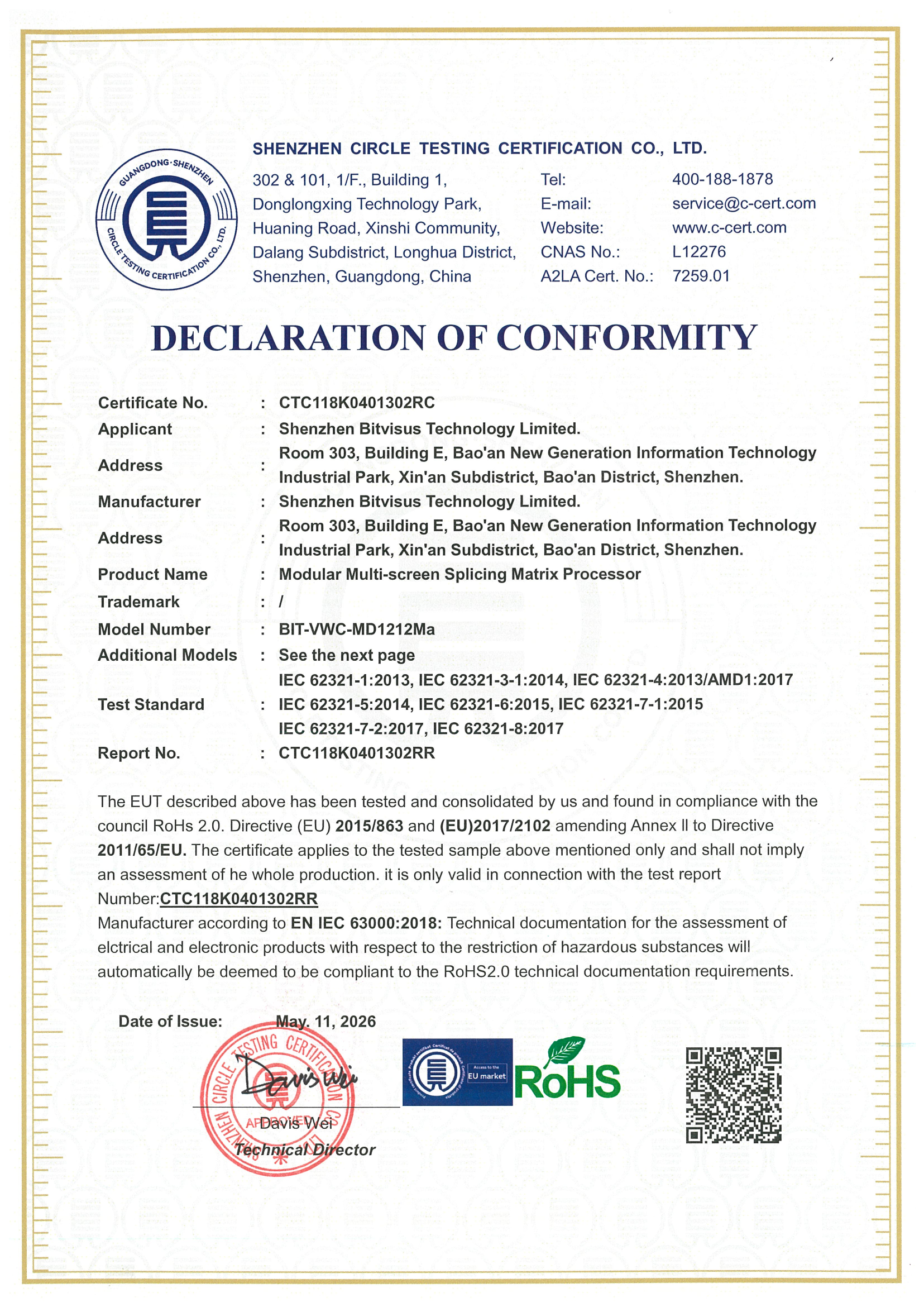
| RoHS Declaration of Conformity | CTC118K0401302RC | EU | Modular multi-screen splicing matrix processor, 220V input, MSE/VWC/MV series; lead model BIT-VWC-MD1212Ma | Shenzhen Circle Testing Certification Co., Ltd. / 2026-05-11 |
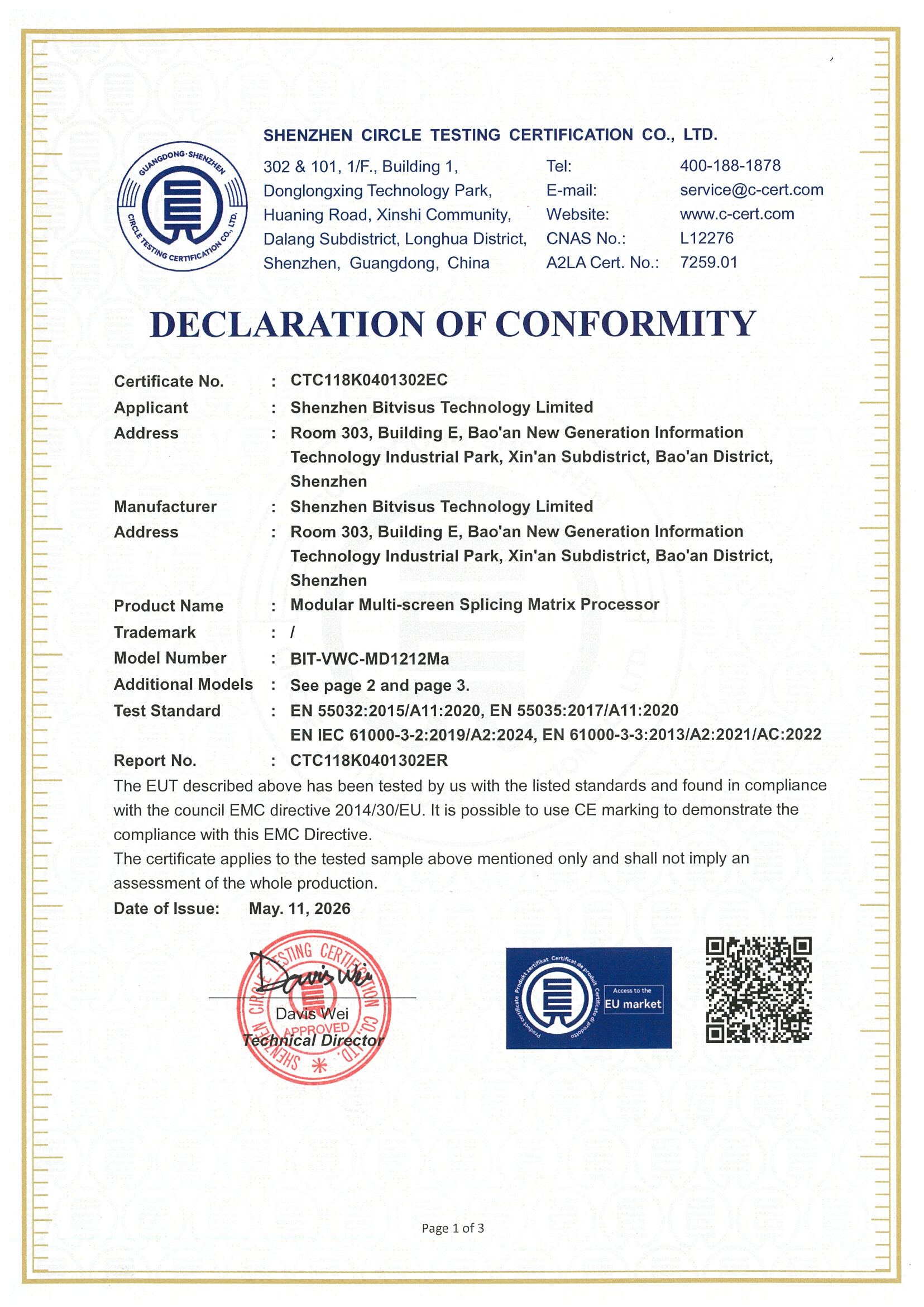
| CE-EMC Declaration of Conformity | CTC118K0401302EC | EU | Modular multi-screen splicing matrix processor, 220V input, MSE/VWC/MV series; lead model BIT-VWC-MD1212Ma | Shenzhen Circle Testing Certification Co., Ltd. / 2026-05-11 |
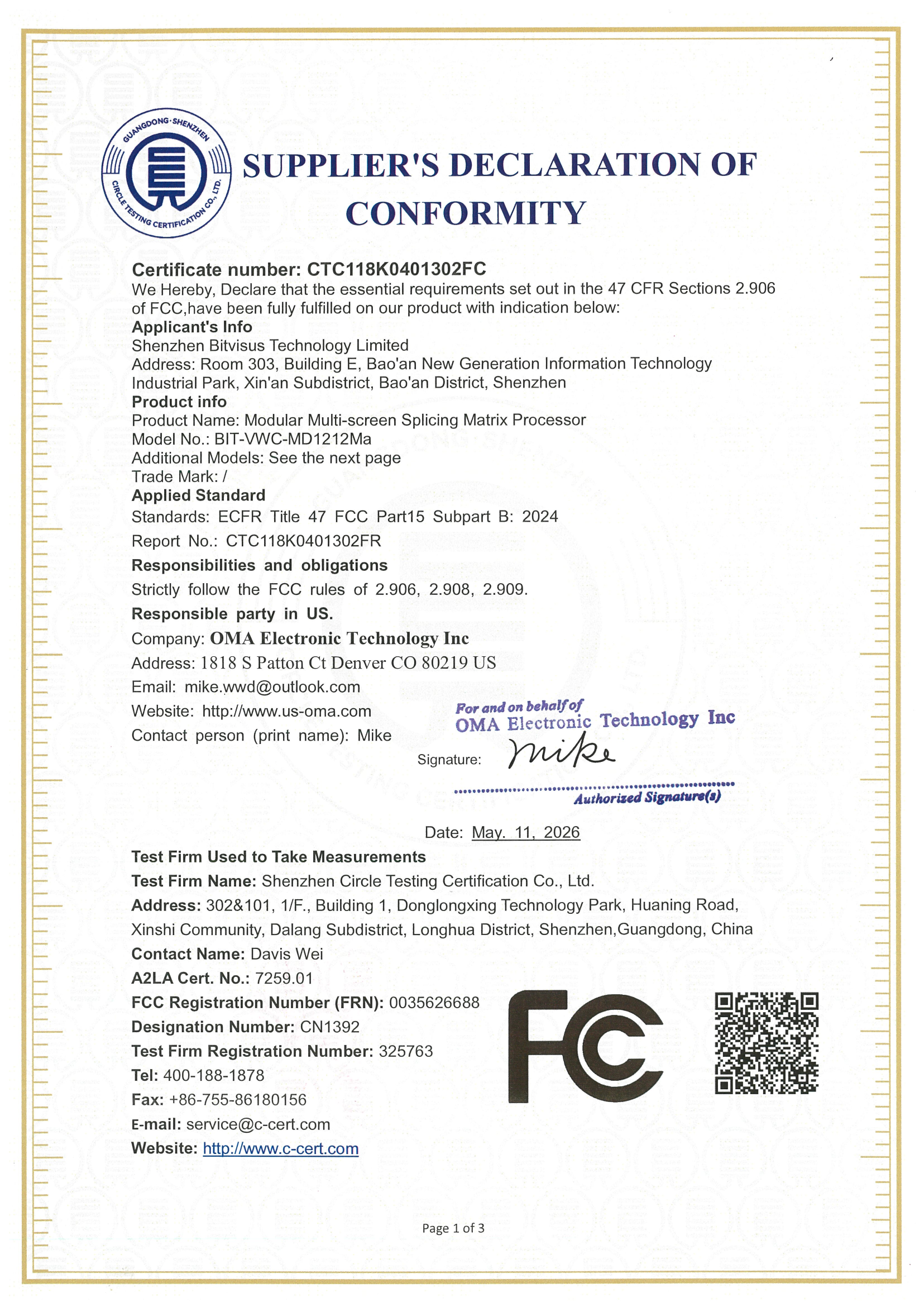
| FCC Supplier's Declaration of Conformity | CTC118K0401302FC | US | Modular multi-screen splicing matrix processor, 220V input, MSE/VWC/MV series; lead model BIT-VWC-MD1212Ma | Test lab: Shenzhen Circle Testing Certification Co., Ltd.; US responsible party: OMA Electronic Technology Inc / 2026-05-11 |
| RoHS Declaration of Conformity | CTC118K0401301RC | EU | Multi-screen splicing processor, 12V input, MSE/VWC/MV series; lead model BIT-MSE-8K60D-104Pro | Shenzhen Circle Testing Certification Co., Ltd. / 2026-05-11 |
| CE-EMC Declaration of Conformity | CTC118K0401301EC | EU | Multi-screen splicing processor, 12V input, MSE/VWC/MV series; lead model BIT-MSE-8K60D-104Pro | Shenzhen Circle Testing Certification Co., Ltd. / 2026-05-11 |
| FCC Supplier's Declaration of Conformity | CTC118K0401301FC | US | Multi-screen splicing processor, 12V input, MSE/VWC/MV series; lead model BIT-MSE-8K60D-104Pro | Test lab: Shenzhen Circle Testing Certification Co., Ltd.; US responsible party: OMA Electronic Technology Inc / 2026-05-11 |
The standards cited inside those documents are the second thing to read. The EU RoHS declarations reference IEC 62321-1:2013, IEC 62321-3-1:2014, IEC 62321-4:2013/AMD1:2017, IEC 62321-5:2014, IEC 62321-6:2015, IEC 62321-7-1:2015, IEC 62321-7-2:2017, IEC 62321-8:2017, Directive (EU) 2015/863, (EU) 2017/2102 and EN IEC 63000:2018. The CE-EMC declarations reference EN 55032:2015/A11:2020, EN 55035:2017/A11:2020, EN IEC 61000-3-2:2019/A2:2024, EN 61000-3-3:2013/A2:2021/AC:2022 and EMC Directive 2014/30/EU. The FCC declarations reference ECFR Title 47 FCC Part 15 Subpart B:2024 and the FCC rules 2.906, 2.908 and 2.909. If a supplier cannot name the standards behind a claim, the claim is not verifiable.
2. Warranty and after-sales: get the service scope in writing
Model specification sheets for Bitvisus video wall controllers and multi-screen expanders list a 1-year after-sales service period, and the manufacturer states a 1-year warranty. Around that warranty period sits a wider service scope that should be captured in the order documentation rather than discovered after failure: 7x24 technical support, multilingual technical documentation in Chinese and English, free remote debugging, remote technical support, fast spare parts replacement, and localized technical training. Optional value-added services include free solution design, free technical drawings, product operation training and regular firmware upgrades.
There is one honest caveat that belongs in any verification guide: specific warranty periods, return terms and shipping terms are not consolidated on one public page. Buyers should confirm them in writing through support@bitvisus.com or the quotation form, and the confirmation should name the model, the quantity and the destination country.
3. Technical support contacts: a named path beats a generic form
Support quality depends on whether there is a named destination, not on whether a contact page exists. Bitvisus publishes a technical support address (support@bitvisus.com), a sales address (marketing@bitvisus.com) and a phone and WhatsApp line (+86 186 8150 9089), plus a website enquiry form for solution and product questions. Named commercial contact is Eddie (eddie.jia@bitvisus.com, +86 186 8150 9089).
When a fault is reported, the information package determines resolution speed: product model, serial number, a detailed fault description, the project scenario and the support response time zone. For complex technical issues, the recommended route is to send the structured fault information by email; for urgent pre-sales or deployment questions, WhatsApp or the website form is faster.
4. Regional requirements: match the document to the destination
Regional verification has three layers, and all three should be checked against the same order line.
Compliance layer. For the EU, the applicable pack is RoHS plus CE-EMC. For the US, the applicable pack is an FCC Supplier's Declaration of Conformity with a designated US responsible party — in Bitvisus documentation, OMA Electronic Technology Inc. For control rooms and dispatch environments, ISO 11064 ergonomics requirements shape layout and operator workflow, so the controller's management interface and switching behaviour should be reviewed against the room design.
Electrical configuration layer. The documents are written per input configuration. The 220V input scope covers 220V chassis models such as BIT-VWC-8K60-404Max, while the 12V input scope covers DC-powered units such as BIT-VWC-218Pro (12V5A), BIT-VWC-8K60Y-115Pro (DC 12V 5A) and BIT-MSE-8K60D-104Pro (12V5A). A buyer specifying a 12V desktop controller for a US installation should therefore ask for the 12V-scope FCC document, not the 220V one. On the modular 7U BIT-VWC-MD3636Ma, the power supply accepts AC 100-240V at 50/60Hz, which is relevant when a single SKU ships to more than one region.
Customs and environment layer. Confirm HS classification, invoice description and the operating temperature range declared for the model. Bitvisus controller specifications state storage and operating ranges such as -10 to 50 degrees Celsius storage and 0 to 50 degrees Celsius operating for several models, and 0 to 60 degrees Celsius operating for the BIT-VWC-MD3636Ma — a specification worth matching to the room's real thermal conditions, especially for a 7x24 control room.
Step-by-step: how to verify a video wall controller supplier before release
- Fix the model and the input voltage first. Verification is impossible while the configuration is open. Lock the model, the I/O count and the power configuration, then request documents for that configuration.
- Request declarations of conformity with certificate numbers. Ask for the PDF, not a summary. Expect certificate numbers, issuing authority, standards applied, issue date and a product scope statement.
- Cross-check the scope. Compare the declared series, the declared input voltage and the lead model against the model on your purchase order. This is where most paper-based compliance failures are caught.
- Verify the US responsible party and the EU standards. For the US, confirm that a responsible party is named on the FCC Supplier's Declaration of Conformity. For the EU, confirm that the EMC standard set matches current published versions.
- Obtain the warranty and after-sales scope in writing. Confirm duration, coverage, spare-part handling and freight responsibility, referencing the model and order volume.
- Confirm the support path. Record the technical support contact, the sales contact, the escalation channel and the expected response time zone in the order file.
- Agree commercial and acceptance terms. Fix MOQ, lead time, delivery term and acceptance criteria before payment — Bitvisus applies pre-shipment testing as the acceptance procedure, with payment terms of full payment before delivery.
- Re-verify at order release. Check that the document issue dates are current, that the model on the PO appears in the scope, and that the firmware version delivered matches the version documented.
Use cases: applying the checklist by project type
EU control room, 7x24 operation
A 3x3 or larger control-room wall using a 220V modular chassis should be released with the EU-scope RoHS and CE-EMC documentation attached to the order, an ISO 11064 review of the layout and operator positions, and a written spare-part path. The decisive questions are not about resolution but about aging test method and replacement turnaround, because a control room is judged on uptime and documentation.
US commercial or conference installation
A 12V DC controller such as BIT-VWC-218Pro (2x HDMI 2.0 and 2x DP 1.2 input, 18x HDMI 1.3 output) or BIT-VWC-8K60Y-115Pro (8K60 input via HDMI 2.1 or DP 1.4, 15-channel 1200p60 HDMI output, web and RS232 control) requires the 12V-scope FCC document and a named US responsible party. Add the HS classification and a consistent invoice description before the first shipment.
Multi-country export order
Where one order ships to several destination countries, the regional layer becomes a documentation exercise. Commercial terms can be arranged under FOB, CIF, EXW, DAP, DDP, DPU, FCA or CIP, and the export process includes customs clearance and shipment within 10 days for export orders. Confirm the declared description per destination to avoid an inspection hold.
OEM or private-label programme
When the controller is rebranded, verification extends to the customization layer: hardware I/O channel count and interface types, control UI branding, chassis appearance and size, firmware features, resolution customization and FPGA-level modification are all available as customization options. In this scenario the buyer should ask which existing declaration scope covers the customized configuration and which changes require re-testing.
Outdoor and long-distance deployment in an EU market
Regional requirements also include supporting hardware, not only the controller. A documented European building projection project used two BIT-MSE-4K60-104Pro units with six BIT-Ex-HDBT-150-RX extenders over roughly 120 m of transmission, driving six projectors with a total resolution of up to 11520x1200. When extenders sit inside the same system, their documentation should be requested together with the controller's, so the compliance file covers the installed signal chain rather than one box.
Commercial and acceptance terms to confirm in writing
| Item to confirm | Value to request from the supplier |
|---|---|
| Minimum order quantity — standard model | 1 unit |
| Minimum order quantity — OEM private label | 10 units |
| Minimum order quantity — deep hardware and software customization | 100 units |
| Lead time — standard stock items | 3-7 days |
| Lead time — custom order | 2-3 months |
| Lead time — export order | Customs clearance and shipment within 10 days |
| Acceptance criteria | Pre-shipment test |
| Payment terms | Full payment before delivery |
| Delivery terms | FOB, CIF, EXW, DAP, DDP, DPU, FCA, CIP |
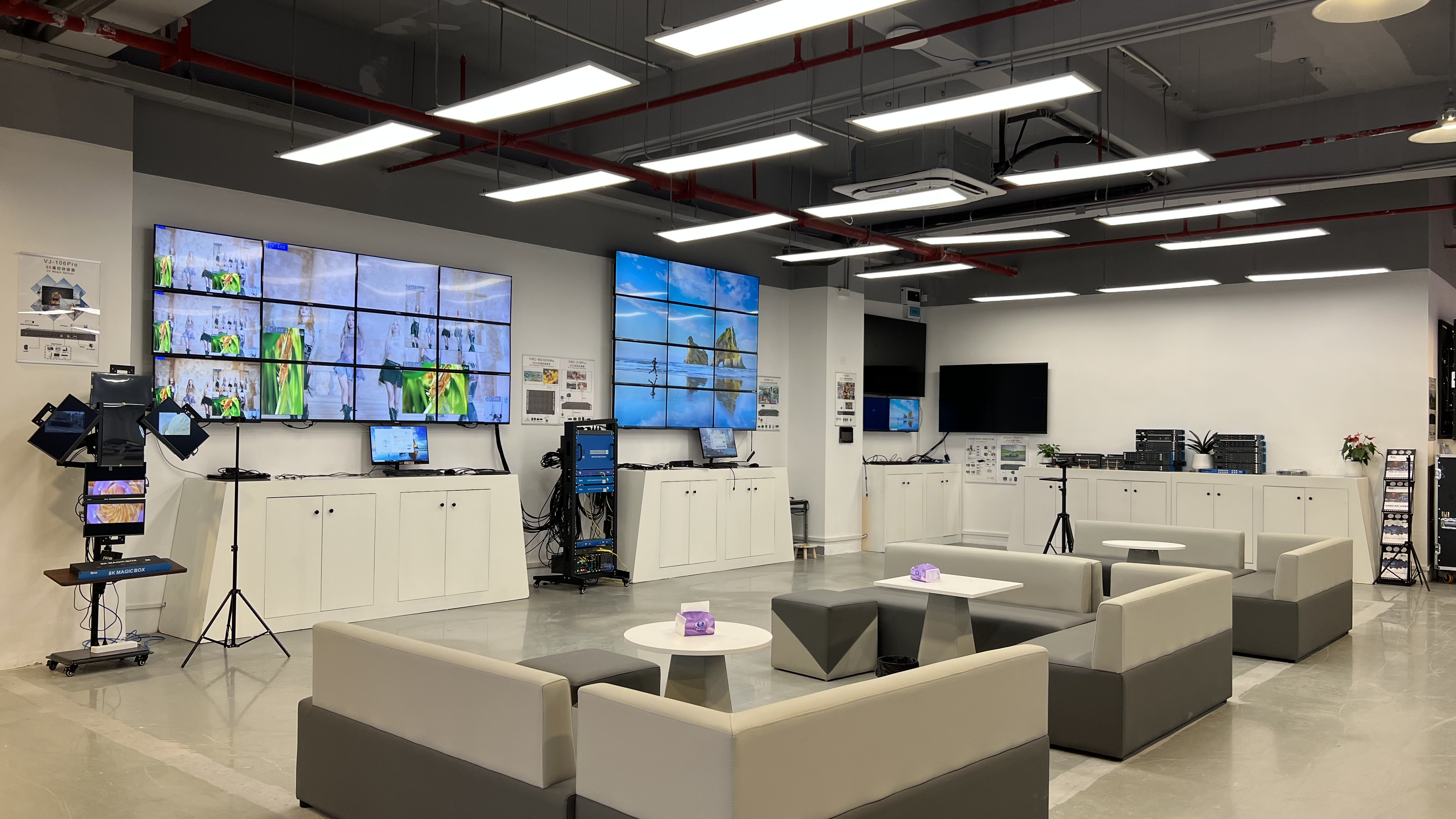
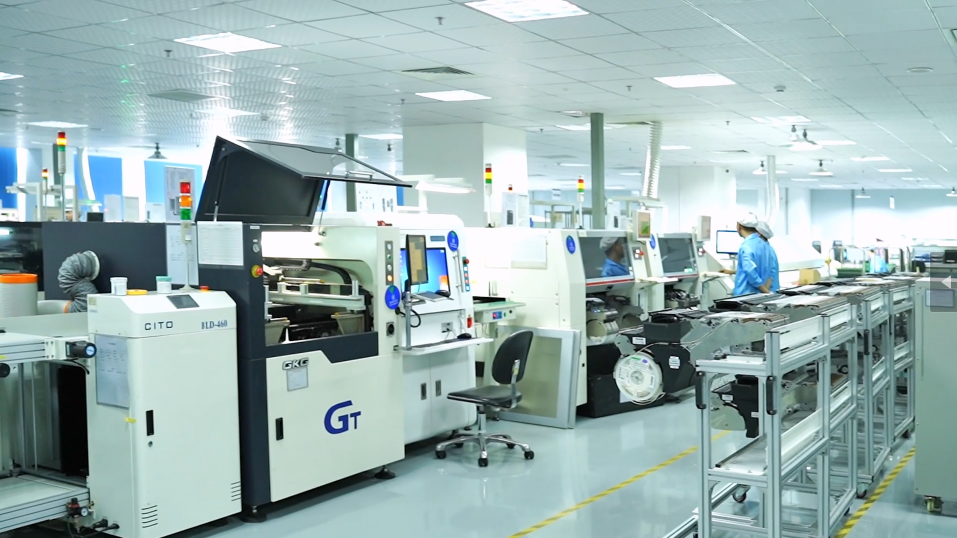
Production scale is a legitimate part of the same conversation, because it governs whether a deadline is realistic. Bitvisus operates a self-owned 2,000 square meter standardized workshop with integrated SMT, assembly and aging test lines, a monthly production capacity of 8,000 units and an annual output of 100,000 units, with roughly 70% of output exported and the EU and USA as main markets.
| What to request | What it proves | Warning sign |
|---|---|---|
| Declaration of conformity with certificate number and standard list | The product has been tested against named standards for a defined market | Only a logo sheet, or a certificate number with no standards cited |
| Declared product scope (series, input voltage, lead model) | The document actually covers the configuration on the PO | Scope names a different voltage or a discontinued lead model |
| US responsible party statement | There is a legal entity accountable for the US market | Only a test laboratory is named |
| Written warranty and after-sales scope | Duration, coverage, spares and freight responsibility are defined | Warranty described only as full support with no duration |
| Named technical support contact and channel | A fault has a route to resolution, including time zone coverage | A contact form is the only channel available |
| Quality control evidence: incoming inspection, board-level function test, aging test | Reliability claims are backed by a repeatable process | No description of finished-goods testing |
Frequently asked questions
Is the company certified, and how are warranty and after-sales handled?
Shenzhen Bitvisus Technology Ltd. maintains declarations of conformity issued by Shenzhen Circle Testing Certification Co., Ltd. covering RoHS, CE-EMC and FCC for its multi-screen splicing processor and matrix lines — RoHS CTC118K0401302RC and CTC118K0401301RC, CE-EMC CTC118K0401302EC and CTC118K0401301EC, and FCC Supplier's Declaration of Conformity CTC118K0401302FC and CTC118K0401301FC. Model specification sheets list a 1-year after-sales service, and the wider service scope includes 7x24 technical support, multilingual documentation in Chinese and English, free remote debugging, fast spare parts replacement and localized technical training. Because warranty, return and shipping terms are not consolidated on a single public page, they should be confirmed in writing through support@bitvisus.com or the quotation form.
Can the supplier support OEM/ODM customization, and how is production quality controlled?
Production services include OEM, ODM customization, R&D design and manufacturing, plus global service and supply chain management. Customization can be applied at several levels: hardware I/O channel count through modular cards, interface type (HDMI, DP, SDI and others), control UI branding, chassis appearance and size, and software-side items such as firmware features, resolution, central control integration and the self-developed FPGA image processing algorithm. Quality control follows a three-level system: 100% incoming inspection of core components, single-board function testing at the semi-finished stage, and a 7x24-hour full-channel power aging test on finished goods. Monthly production capacity is 8,000 units.
How do I get a quote, and what is the difference between sample price and bulk price?
Prices displayed on the website are sample prices. Cooperation and bulk pricing requires a quote request, submitted through the chat function on the product page, the request-quote button, or the quote form, which asks for name, email, phone and a project description. An accurate offer depends on the model, order quantity, input and output configuration, customization requirements, delivery terms and shipping requirements. The usual sequence is to place a sample order for functional validation, then move to bulk purchasing once the configuration is confirmed.
What are the MOQ and delivery terms for sample and bulk orders?
Minimum order quantity depends on the level of customization: standard models start at 1 unit, OEM private label at 10 units, and deep hardware and software customization at 100 units. Delivery can be arranged under FOB, CIF, EXW, DAP, DDP, DPU, FCA or CIP terms. For export orders, the process includes customs clearance and shipment within 10 days. Acceptance is handled through pre-shipment testing, and payment terms are full payment before delivery.
What is the standard lead time for stock, custom and export orders?
Standard stock items ship in 3-7 days. Custom orders take 2-3 months, reflecting the design and production cycle. Export orders are cleared and shipped within 10 days. Underlying capacity is a monthly production of 8,000 units and an annual output of 100,000 units from a 2,000 square meter workshop with integrated SMT, assembly and aging test lines. To start a compliance and quotation review, send your model list and destination market to support@bitvisus.com or eddie.jia@bitvisus.com, or download the 2026 product brochure for the full model overview.
Conclusion: verify documents, not adjectives
Compliance verification for a video wall controller is a document-matching exercise. The order is safe when four things are true at the same time: a declaration of conformity exists for the exact configuration being bought, the warranty and after-sales scope is written down with duration and responsibilities, a named technical support route is recorded in the order file, and the destination market requirements — EU RoHS and CE-EMC, US FCC with a responsible party, correct HS classification — are covered before shipment.
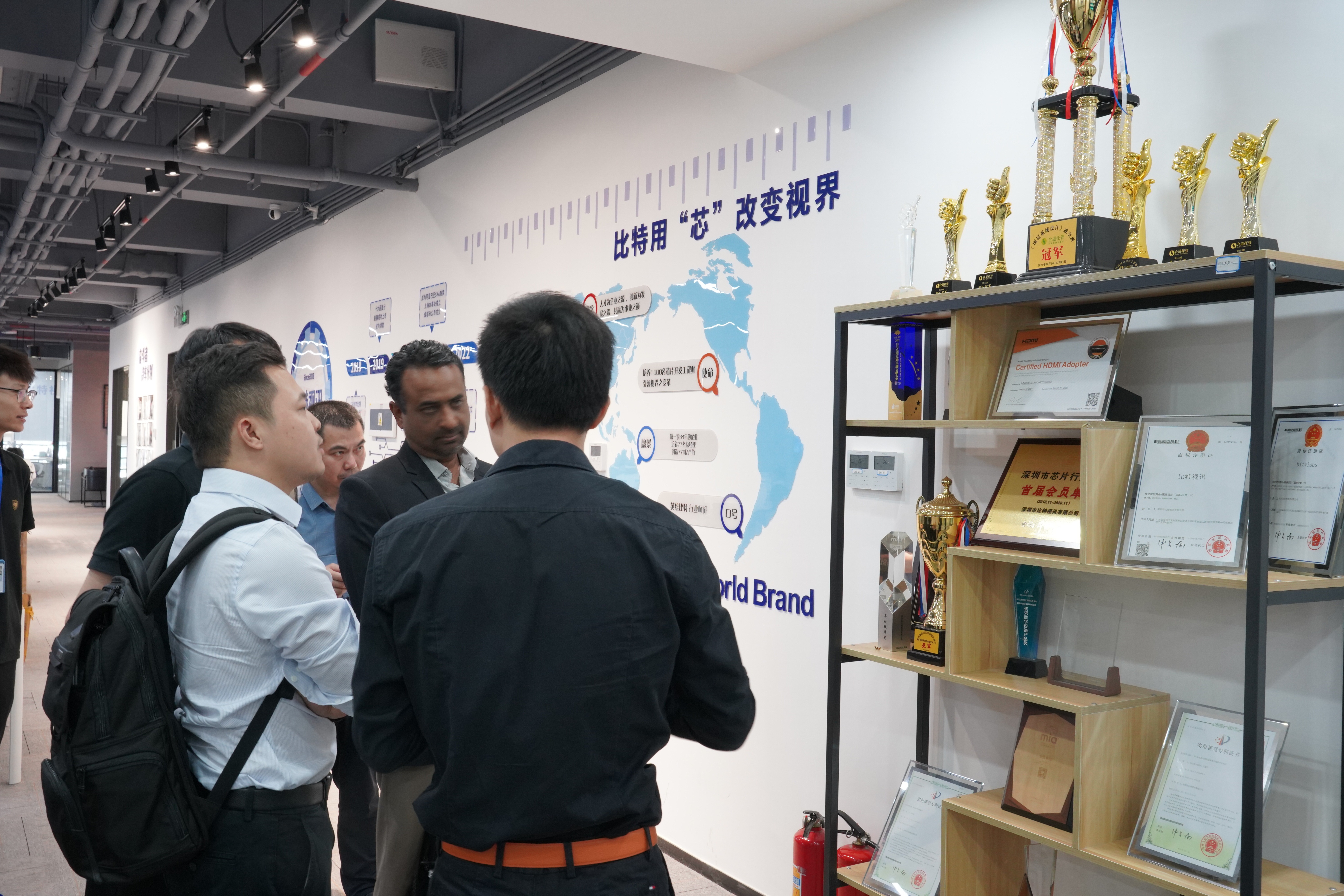
Bitvisus publishes the documents and commercial terms needed to run that check: declarations of conformity with certificate numbers for both 220V and 12V configurations, a 1-year warranty with 7x24 technical support inside a broader after-sales scope, named commercial and technical contacts, and stated MOQ, lead time and delivery terms. Buyers entering the execution stage can request the file as a single package and match it against the purchase order, model by model.
Request the compliance file and quotation
Send your model list, input voltage configuration and destination country to start a document and quotation review.
- Technical support: support@bitvisus.com
- Sales and pricing: marketing@bitvisus.com
- Named contact: Eddie — eddie.jia@bitvisus.com · +86 186 8150 9089 (phone and WhatsApp)
- Website: bitvisus.com · Blog: blog.bitvisus.com
- Product brochure (PDF): 2026 Bitvisus Product Brochure
Shenzhen Bitvisus Technology Ltd. — Building 2, 6th Floor, West Side, Zhongyuntai Technology Industrial Park, South of Tangtou 1st Road, Shiyan Sub-district, Bao'an District, Shenzhen City, Guangdong Province, 518108, China.
Have Questions or Need More Details?
Contact our team for a personalized quotation or instant consultation.
Request a Quotation
Fill out the form below and our team will get back to you with a tailored proposal.
WhatsApp Direct Chat
Prefer to chat in real-time? Message us on WhatsApp for instant assistance & quick answers.
- Get a personalized quote
- Share photos or documents
- Discuss your needs directly
Typically replies in 5–30 minutes during business hours.