
Video Wall Controller Compliance for Immersive Art: Certifications and Regional Acceptance
Compliance in an immersive art project is rarely a single certificate. It is a document chain: whether the certification scope matches the hardware you actually ship, whether the declared standards fit the market the venue sits in, and whether those declarations are written into the purchase order, the acceptance criteria, and the warranty terms. Integrators who treat it as a checkbox usually discover the gap during commissioning — when the controller is already mounted in the rack.
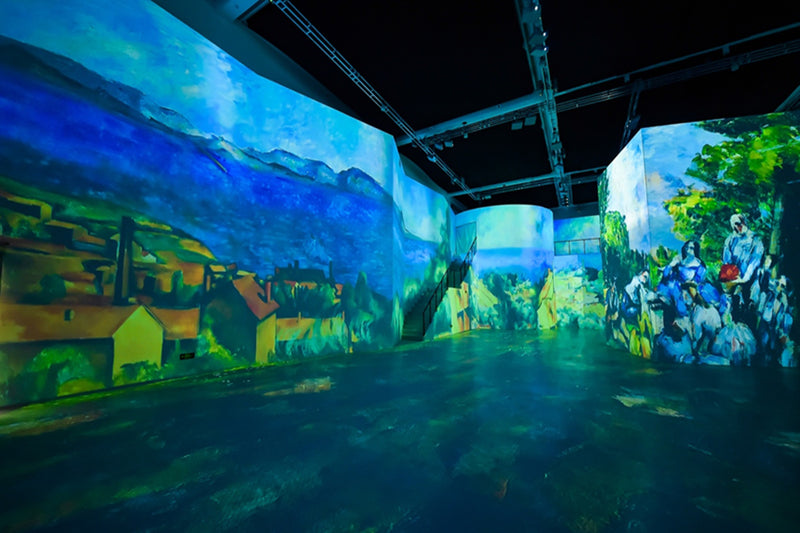
Immersive art installations combine matrix splicing, multi-screen expansion, and long-distance extension in one bill of materials — each element carrying its own compliance documents.
What "Compliance" Actually Covers in an Immersive Art Project
A 3x3 video wall dropping a controller produces one dark panel. A projection-mapped building facade losing one fused node produces a visible seam across the artwork. On a 120 m HDBaseT run, a non-compliance issue may not present as a hard failure at all — it can surface as signal degradation that only appears under specific content loads.
For specification purposes, immersive art compliance resolves into four overlapping layers:
- Product-level certification — electromagnetic compatibility, hazardous-substance declarations, and any additional market-specific documentation.
- Standards alignment — for control-room-adjacent deployments, ISO 11064 governs control-room ergonomics and affects video wall layout and management requirements; for gallery-scale projection, the applicable obligations mostly come from product certification plus general electrical and EMC standards rather than a dedicated immersive-art standard.
- Regional acceptance — which documents a given market accepts, who signs as the responsible party, and which voltage tier or product family the declaration actually covers.
- Contract and acceptance alignment — whether certification coverage matches the purchase terms, the warranty period, and the on-site acceptance test.
The point most specifications miss: certification attaches to a product scope, not to a company. A manufacturer can hold a valid CE-EMC declaration for 12V-input processors under one certificate number and a second declaration covering a 220V-input chassis under another. In immersive art builds, controllers, expanders and extenders routinely sit in the same BOM, so those documents often come from different files. Verify at RFQ stage, not at commissioning.
Industry Background: Why Compliance Review Is Moving Up the Specification
Immersive art sits inside a video wall controller market that is both growing and structurally shifting. Published market research on the segment gives useful context for why documentation practices are under pressure.
| Market signal | Reported value | Source |
|---|---|---|
| Global video wall controller market size (2025) | approx. USD 2.25 billion, projected to reach USD 4.4 billion by 2034 | Dataintelo |
| CAGR, 2025–2034 | 7.8% | Dataintelo |
| AV-over-IP share of new video wall controller installations | 73% (early 2026) | GCG Enterprise Solution / AVIXA |
| Control Room share of video wall processor market | 50% | Statifacts |
| Legacy 4U hardware processor market share change (2025) | −18% | GCG Enterprise Solution |
Two readings follow from that data. First, the shift toward IP-based video wall controller architectures and away from legacy rack-mount 4U hardware means network-linked devices increasingly sit inside venue IT environments — which brings their EMC declarations under closer venue-side scrutiny. Second, because control-room applications still account for half of the processor market, the compliance vocabulary buyers bring to immersive art is largely borrowed from control-room and security-monitoring procurement, where an IP-based video wall controller with remote management is the norm rather than the exception.
Under HS classification, video wall controllers are commonly filed under HS 85437099 (other electrical machines and apparatus) or 85437042 (other video control unit). That classification matters at customs, and it is the point where a missing declaration becomes a shipment problem rather than a technical one.
Which Certification Documents Should an Integrator Request?
For immersive art and projection mapping, the working document set is three files per product family: a CE-EMC Declaration of Conformity, a RoHS Declaration of Conformity, and an FCC Supplier's Declaration of Conformity. They map to different markets and are not interchangeable.
EU market: CE-EMC and RoHS Declarations
Bitvisus, the Professional AV manufacturer operating from Shenzhen, holds CE-EMC and RoHS Declarations of Conformity across two voltage tiers of its multi-screen splicing product families. The declarations are issued by Shenzhen Circle Testing Certification Co., Ltd. and dated 2026-05-11.
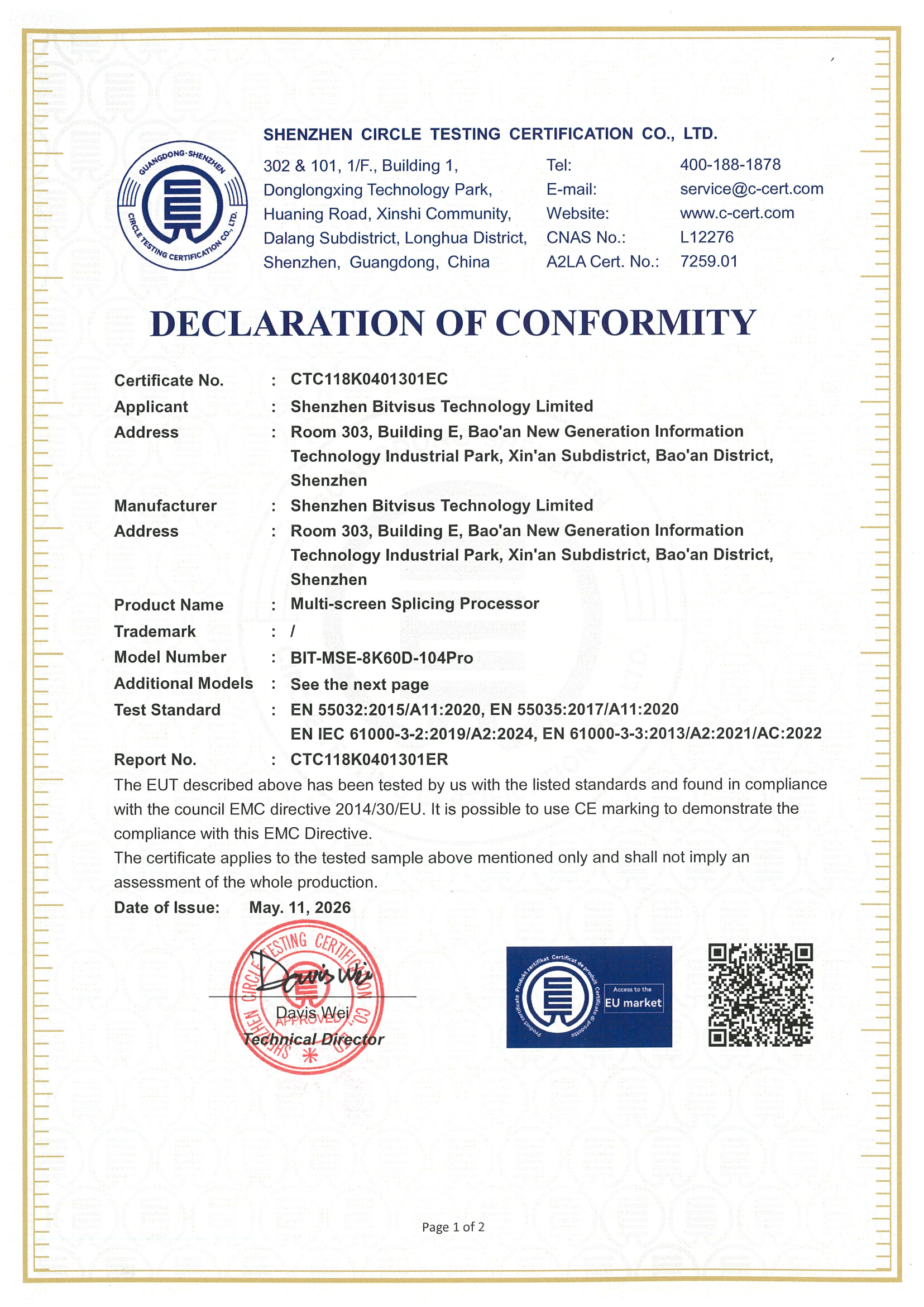
CE-EMC Declaration of Conformity CTC118K0401301EC — 12V input Multi-screen Splicing Processor, lead model BIT-MSE-8K60D-104Pro.
| Declaration | Certificate no. | Scope (lead model) | Issued |
|---|---|---|---|
| CE-EMC DoC | CTC118K0401301EC | 12V input Multi-screen Splicing Processor (MSE/VWC/MV series) — BIT-MSE-8K60D-104Pro | 2026-05-11 |
| RoHS DoC | CTC118K0401301RC | 12V input Multi-screen Splicing Processor (MSE/VWC/MV series) — BIT-MSE-8K60D-104Pro | 2026-05-11 |
| CE-EMC DoC | CTC118K0401302EC | 220V input Modular Multi-screen Splicing Matrix Processor (MSE/VWC/MV series) — BIT-VWC-MD1212Ma | 2026-05-11 |
| RoHS DoC | CTC118K0401302RC | 220V input Modular Multi-screen Splicing Matrix Processor (MSE/VWC/MV series) — BIT-VWC-MD1212Ma | 2026-05-11 |
CE-EMC standards cited: EN 55032:2015/A11:2020, EN 55035:2017/A11:2020, EN IEC 61000-3-2:2019/A2:2024, EN 61000-3-3:2013/A2:2021/AC:2022, under EMC Directive 2014/30/EU.
RoHS standards cited: IEC 62321-1:2013, IEC 62321-3-1:2014, IEC 62321-4:2013/AMD1:2017, IEC 62321-5:2014, IEC 62321-6:2015, IEC 62321-7-1:2015, IEC 62321-7-2:2017, IEC 62321-8:2017, Directive (EU) 2015/863, (EU) 2017/2102, and EN IEC 63000:2018.
Note the structural detail: the 12V declarations are scoped to the MSE/VWC/MV series with BIT-MSE-8K60D-104Pro as lead model, while the 220V declarations are scoped to a Modular Multi-screen Splicing Matrix Processor with BIT-VWC-MD1212Ma as lead model. If a project specifies a rack-mount video wall controller from the 220V tier and the integrator files the 12V declaration, the documentation does not match the delivered hardware — even though both come from the same manufacturer.
US market: FCC Supplier's Declaration of Conformity
For North American deployment, the relevant file is the FCC Supplier's Declaration of Conformity (SDoC), not the CE mark. The two Bitvisus declarations follow the same two-tier split.
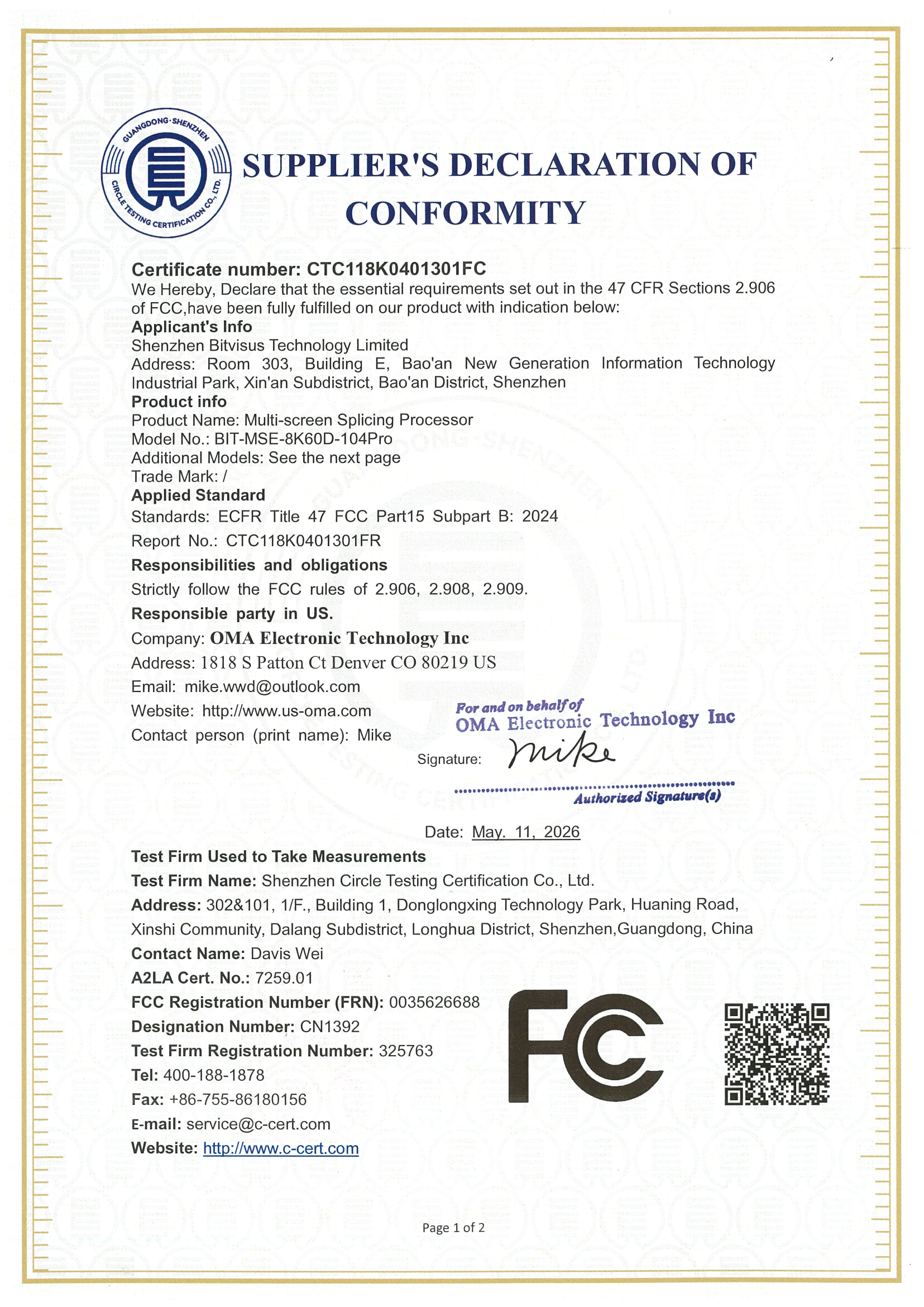
FCC SDoC CTC118K0401301FC — 12V input Multi-screen Splicing Processor, with OMA Electronic Technology Inc named as US Responsible Party.
| FCC SDoC number | Scope | Test lab | US Responsible Party |
|---|---|---|---|
| CTC118K0401301FC | 12V input Multi-screen Splicing Processor (MSE/VWC/MV series) — BIT-MSE-8K60D-104Pro | Shenzhen Circle Testing Certification Co., Ltd. | OMA Electronic Technology Inc |
| CTC118K0401302FC | 220V input Modular Multi-screen Splicing Matrix Processor (MSE/VWC/MV series) — BIT-VWC-MD1212Ma | Shenzhen Circle Testing Certification Co., Ltd. | OMA Electronic Technology Inc |
Both reference ECFR Title 47 FCC Part 15 Subpart B:2024 and follow FCC rules 2.906, 2.908 and 2.909. For a US venue, the presence of a named US Responsible Party is the field that most often gets checked by the client's legal side — it is the entity that can be contacted if a compliance question arises after handover.
How to Verify Certification Without Overclaiming: A Seven-Step Review
A certification PDF proves that a document exists. It does not prove the document applies to your shipment. This sequence closes that gap — and every step is checkable before the order is placed.
- Match the scope statement to the BOM. Read the declaration's scope line, not the marketing page. If it names a lead model and a series, confirm your selected model belongs to that series.
- Check the voltage tier. A 12V-input multi-screen expander and a 220V-input rack-mount chassis are separate declarations. In an immersive art rack, both tiers may appear side by side.
- Confirm the market. A CE-EMC DoC does not evidence US acceptance, and an FCC SDoC does not evidence EU acceptance. Treat them as separate line items in the compliance register.
- Identify the responsible party. For FCC SDoC, verify the US Responsible Party is named. For EU declarations, verify the issuing body and date.
- Read the cited standards, not the certificate title. The value is in the standard list — for example, whether EN 55032 and EN 55035 appear, and which RoHS test methods are referenced.
- Map each file to the product it covers. Controllers, expanders, and extenders are separate products and may carry separate or no declarations. Do not assume one device's paperwork covers the whole signal chain.
- Write the requirement into purchasing terms. State that certificate copies for the delivered models must be supplied at order confirmation, and tie release of final payment to that delivery.
Regional Acceptance at a Glance
The table below reflects only the declarations documented for Bitvisus multi-screen splicing products. It is a map of what exists, not a claim about what any other manufacturer holds.
| Region | Primary document | Standards / basis | Responsible entity |
|---|---|---|---|
| EU | CE-EMC Declaration of Conformity | EN 55032:2015/A11:2020; EN 55035:2017/A11:2020; EN IEC 61000-3-2:2019/A2:2024; EN 61000-3-3:2013/A2:2021/AC:2022; EMC Directive 2014/30/EU | Shenzhen Circle Testing Certification Co., Ltd. |
| EU | RoHS Declaration of Conformity | IEC 62321 series; Directive (EU) 2015/863; (EU) 2017/2102; EN IEC 63000:2018 | Shenzhen Circle Testing Certification Co., Ltd. |
| US | FCC Supplier's Declaration of Conformity | ECFR Title 47 FCC Part 15 Subpart B:2024; FCC rules 2.906, 2.908, 2.909 | OMA Electronic Technology Inc (US Responsible Party) |
| Control-room scope | Ergonomics standard reference | ISO 11064 (control-room ergonomics; influences layout and management requirements) | Project-side compliance |
| Customs | HS classification | HS 85437099 or 85437042 | Importer of record |
Bitvisus products are exported to Europe, North America, the Middle East, Southeast Asia, and more than 20 countries and regions. That footprint is a commercial fact, not evidence of certification in every one of those markets — each destination still needs its own document check against the list above.
Long-Distance Signal Compliance in Regional Deployments
In projection mapping, the compliance question that actually bites is often not the certificate file — it is whether the certified configuration still holds once the signal leaves the rack and travels across a building.
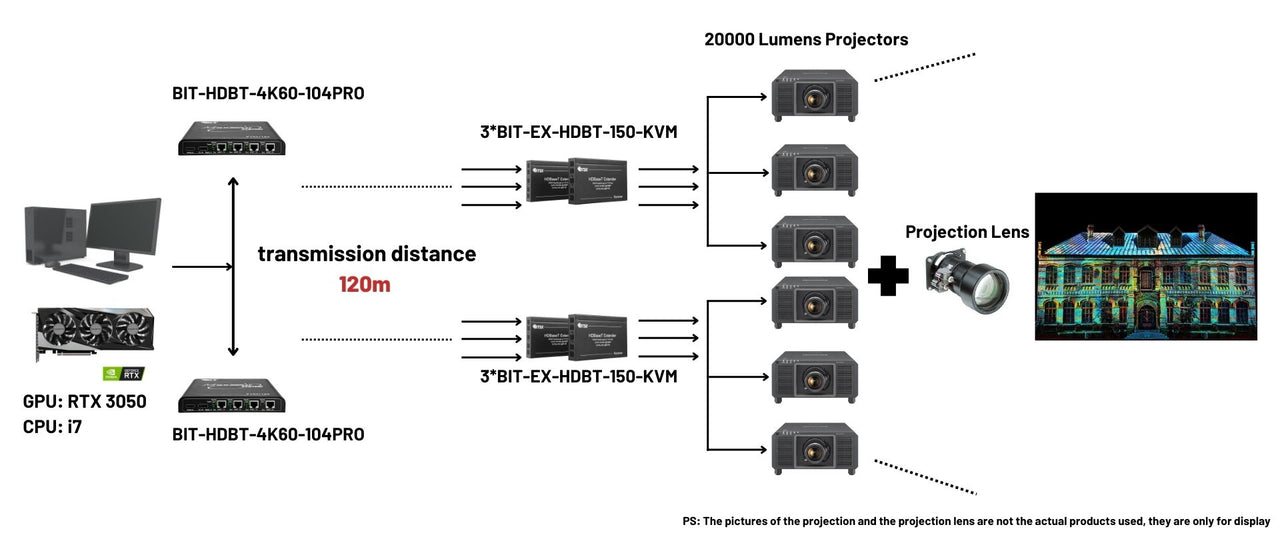
Romania deployment: two BIT-MSE-4K60-104Pro multi-screen expanders and six BIT-Ex-HDBT-150-RX extenders carrying signal roughly 120 m from a single PC.
The Romania Christmas building projection mapping project is a useful reference because it is a documented regional deployment with a real transmission distance. The installation used 2 units of the BIT-MSE-4K60-104Pro multi-screen expander and 6 BIT-Ex-HDBT-150-RX extenders, driven by one PC with a GTX 3050 GPU, with HDBaseT transmission distance of approximately 120 m. Six projectors were driven from that single PC, with three projectors per group fused into one image, for a total resolution up to 11520x1200.
Three compliance-relevant observations come out of this configuration:
- Distance is a design parameter, not an afterthought. The BIT-Ex-HDBT-150 extender is specified for 1080p over CAT6E at up to 150 m. A 120 m run sits inside that stated envelope — but the project still has to verify it on site, because cable routing, termination quality, and interference from other building systems affect actual performance.
- The signal chain has multiple products, each with its own documentation. Expanders and extenders are separate products. A single certificate does not cover a chain.
- Long-distance extension reduces the number of source-side devices. Driving six projectors from one PC reduces the equipment count at the source, which in turn reduces the number of devices requiring individual EMC documentation.
The BIT-Ex-HDBT-150-RX specification also lists HDMI 1.4 and HDCP 2.2 support, and RS232/IR two-way transparent transmission. Those interface specifications matter for the signal-compatibility portion of an acceptance test, even though they sit outside the EMC certification itself. Reported benefits at this site included one PC driving all six projectors, reduced commissioning workload, and lower overall project cost for the light show operator. The projection system has been in service at this site for 5 years.
What Documented Compliance Looks Like in Practice: Two Deployments
China — Cézanne immersive painting exhibition, Shenzhen
The scale of this installation is the reason it is worth citing as a compliance-reference case. The project used more than 100 industrial 1080p projectors and 12 Bitvisus video wall controllers, with each BIT-VWC-409R driving 9 projectors in a 3x3 video wall configuration. The 3x3 video wall achieved a 5K 5760x3240 high-definition display output, and multiple 3x3 video walls were recombined to produce a final combined image resolution exceeding 16K. The deployment has been running for 5 years.
From a compliance standpoint, the number that matters here is twelve. Twelve controllers in one installation means twelve units that each need to match the declared product scope, plus the projection and blending software layer that sits outside the controller certification entirely. Edge blending and warping are handled by software in this project — and software is not covered by an EMC declaration.
The BIT-VWC-409R specification itself is a 4K60-class rotating splicing processor: 3 x HDMI 1.4 plus 1 x HDMI 2.0 plus 1 x DP 1.2 inputs with HDCP 2.2, and 9 x HDMI 1.3 outputs at 1920x1080 @ 60Hz, 165 MHz maximum output pixel frequency, 12V 2A power supply, and 12 W power consumption. It supports multi-device cascading and parallel connection of multiple devices.
Romania — Christmas building 3D projection mapping
The Romania case is the regional-acceptance counterpart. It sits in the EU market, uses 12V-class hardware (BIT-MSE-4K60-104Pro and BIT-Ex-HDBT-150-RX), and depends on a long cable run. It is the type of project where a CE-EMC declaration and a RoHS declaration are the two files an EU client's procurement team will ask for, and where the 12V tier certificate — not the 220V one — is the relevant document.
Warranty, After-Sales, and Acceptance Criteria: The Back End of Compliance
Certification gets a controller into the building. Warranty and after-sales determine whether it stays compliant over the deployment window — which, for immersive art, is measured in years rather than months. Both cited cases have been in service for 5 years.
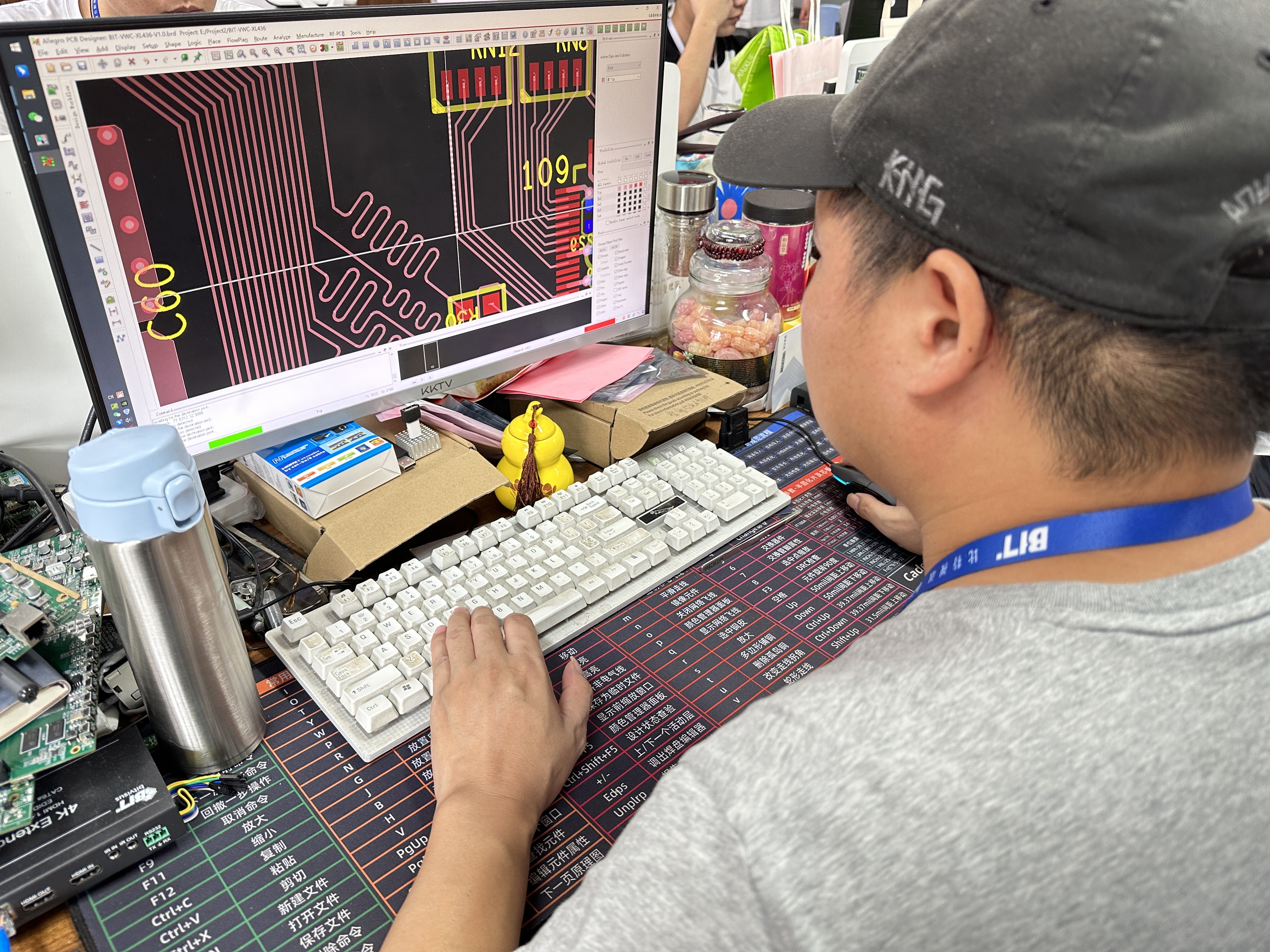
Finished-goods inspection includes a 7x24hr full-channel power aging test, operated out of an independent QC laboratory.
Documented after-sales terms for Bitvisus video wall controllers:
- 1-year warranty
- 7x24hr technical support and free remote debugging
- Multilingual technical documentation in Chinese and English
- Spare parts replacement and localized technical training
- Product operation training and regular firmware upgrades
On the manufacturing side, the three-level quality control system covers incoming inspection, semi-finished inspection, and finished goods inspection. Incoming inspection applies 100% inspection of core components; semi-finished inspection includes single board function testing; finished goods inspection includes a 7x24hr full-channel power aging test. The factory operates an independent QC laboratory and a 2000 ㎡ standardized workshop with integrated SMT, assembly, and aging test lines.
Two practical recommendations when writing acceptance criteria for an immersive art installation. First, require a pre-shipment aging report for the specific serial numbers being delivered, not a generic QC statement. Second, define the acceptance test at the image level — edge blending continuity, resolution per output, and simultaneous multi-source display — because a controller can pass every electrical test and still fail the artistic requirement.
Buyer Priority Order for Immersive Art Controller Compliance
When time is short and the specification is large, this is a defensible order of importance. It reflects project risk, not a vendor ranking.
- Scope match at model level — the single most common failure point.
- Market-appropriate declaration — CE-EMC plus RoHS for EU; FCC SDoC for the US.
- Named responsible party — especially for FCC SDoC in North American venues.
- Signal-chain coverage — extenders and expanders included, not just the controller.
- Transmission-distance evidence — stated specification versus actual routed distance.
- Warranty and support terms — written into the contract, not quoted verbally.
- Acceptance-test definition — electrical pass plus image-level pass.
Frequently Asked Questions
Which certifications does a video wall controller need for an EU immersive art installation?
For EU placement, the working documents are a CE-EMC Declaration of Conformity and a RoHS Declaration of Conformity. For Bitvisus multi-screen splicing products, the CE-EMC declarations cite EN 55032:2015/A11:2020, EN 55035:2017/A11:2020, EN IEC 61000-3-2:2019/A2:2024 and EN 61000-3-3:2013/A2:2021/AC:2022 under EMC Directive 2014/30/EU, and the RoHS declarations cite the IEC 62321 series alongside Directive (EU) 2015/863 and EN IEC 63000:2018. Always confirm the declaration covers the specific voltage tier and series you are specifying.
My project is in North America — is a CE certificate enough?
No. CE marking is a European framework and does not evidence US acceptance. For the US market the relevant file is the FCC Supplier's Declaration of Conformity, referencing ECFR Title 47 FCC Part 15 Subpart B:2024 and FCC rules 2.906, 2.908 and 2.909. Bitvisus holds FCC SDoC declarations under certificate numbers CTC118K0401301FC (12V input) and CTC118K0401302FC (220V input), with OMA Electronic Technology Inc named as the US Responsible Party.
Can one combined controller and expander installation be covered by a single certificate?
No. A video wall controller, a multi-screen expander and an HDBaseT extender are separate products and are declared separately. In a project such as the Romania Christmas building projection mapping deployment — 2 units of BIT-MSE-4K60-104Pro plus 6 BIT-Ex-HDBT-150-RX extenders over roughly 120 m of HDBaseT — each product family in the signal chain has to be checked against its own documentation scope.
How long does shipping take if certification documentation is required with the order?
Documentation does not change production scheduling for standard models. Standard stock lead time is 3–7 days, custom orders run 2–3 months, and export orders are cleared through customs and shipped within 10 days. What does affect timelines is scope mismatch — if the certificate you need does not cover the model you ordered, the correction cycle usually runs longer than the shipping window.
What should be tied to warranty and after-sales in a compliance-led purchase order?
Three items. Certification copies for the delivered serial numbers, supplied at order confirmation. A written statement of the warranty period and support scope — Bitvisus provides a 1-year warranty, 7x24hr technical support, free remote debugging, and multilingual technical documentation in Chinese and English. And a defined acceptance test that includes both electrical verification and an image-level check for edge blending continuity and per-output resolution. To review the full specification set before writing those terms, the 2026 Bitvisus Product Brochure is publicly downloadable, and product details are available at bitvisus.com.
Conclusion
Immersive art and projection mapping do not need a special compliance regime. They need a documented one. The four layers — product certification, standards alignment, regional acceptance, and contract alignment — are the same layers a control room or a security monitoring wall would use, applied to a venue where the failure mode is visible in the artwork rather than only on a status panel.
The practical discipline is narrow and repeatable. Match the certificate scope to the exact model and voltage tier. Confirm the declaration is issued for the destination market. Identify the responsible party. Include extenders and expanders in the document register, not just the controller. And write the whole set into purchasing terms and acceptance criteria before the rack is built. A 12-controller, 100-plus-projector exhibition that has run for five years is the outcome of that discipline — not of a single certificate.
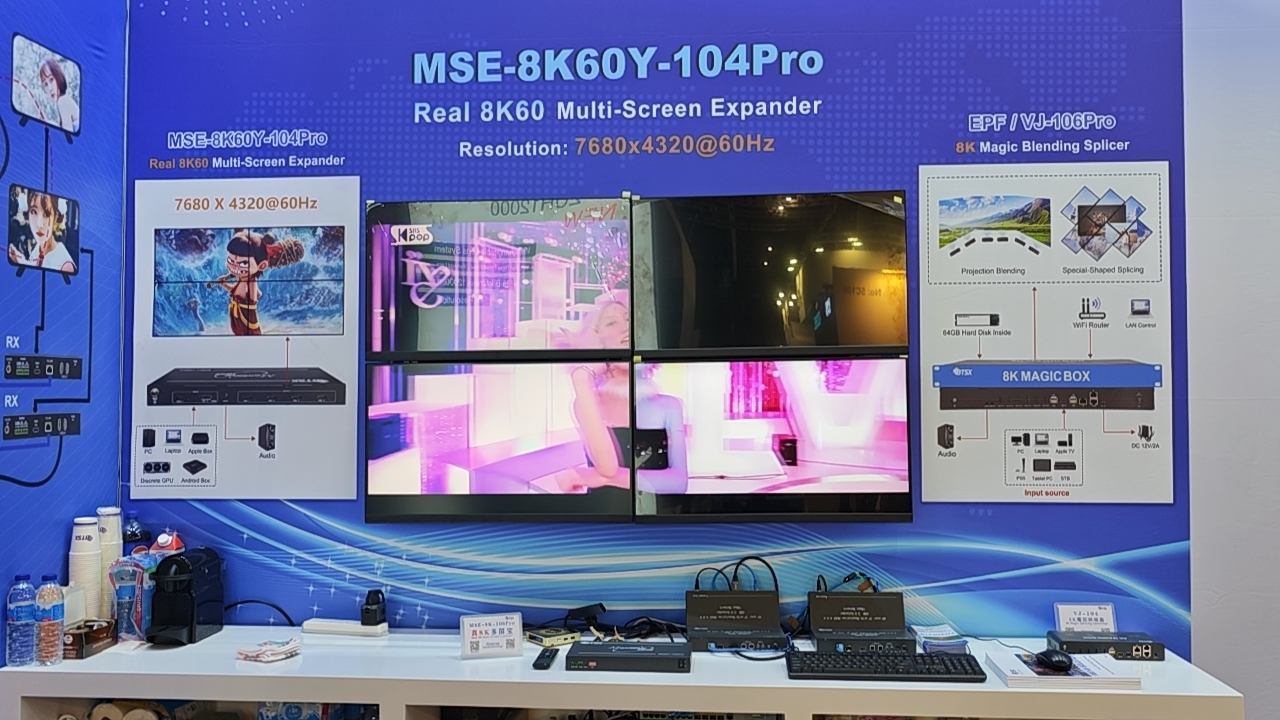
Compliance questions are best resolved before the specification is frozen.
Planning an immersive art or projection mapping build?
Request the certification pack for your specific controller model and market, or ask for a sample unit to validate the signal chain before the full order. Bitvisus provides free solution design and free technical drawings during the specification stage, along with remote debugging support after handover.
Email: eddie.jia@bitvisus.com | Tel / WhatsApp: +86 186-8150-9089
Website: bitvisus.com | Blog: blog.bitvisus.com
Have Questions or Need More Details?
Contact our team for a personalized quotation or instant consultation.
Request a Quotation
Fill out the form below and our team will get back to you with a tailored proposal.
WhatsApp Direct Chat
Prefer to chat in real-time? Message us on WhatsApp for instant assistance & quick answers.
- Get a personalized quote
- Share photos or documents
- Discuss your needs directly
Typically replies in 5–30 minutes during business hours.