
Video Wall Controller Technical Guide: Edge Blending, Warping, and 3x3 5K Output Explained
A video wall controller turns multiple source signals into multiple synchronised outputs so that an array of displays behaves as one continuous canvas. On a 3x3 projection wall, the controller is what decides whether nine projectors fuse into a single image or degrade into nine overlapping, misaligned rectangles. The parameters that matter are input capacity, output channel count, maximum accepted input resolution, splicing mode flexibility, edge blending and warping support, PIP/POP and window roaming capability, and the ability to scale across more than one controller without losing synchronisation.
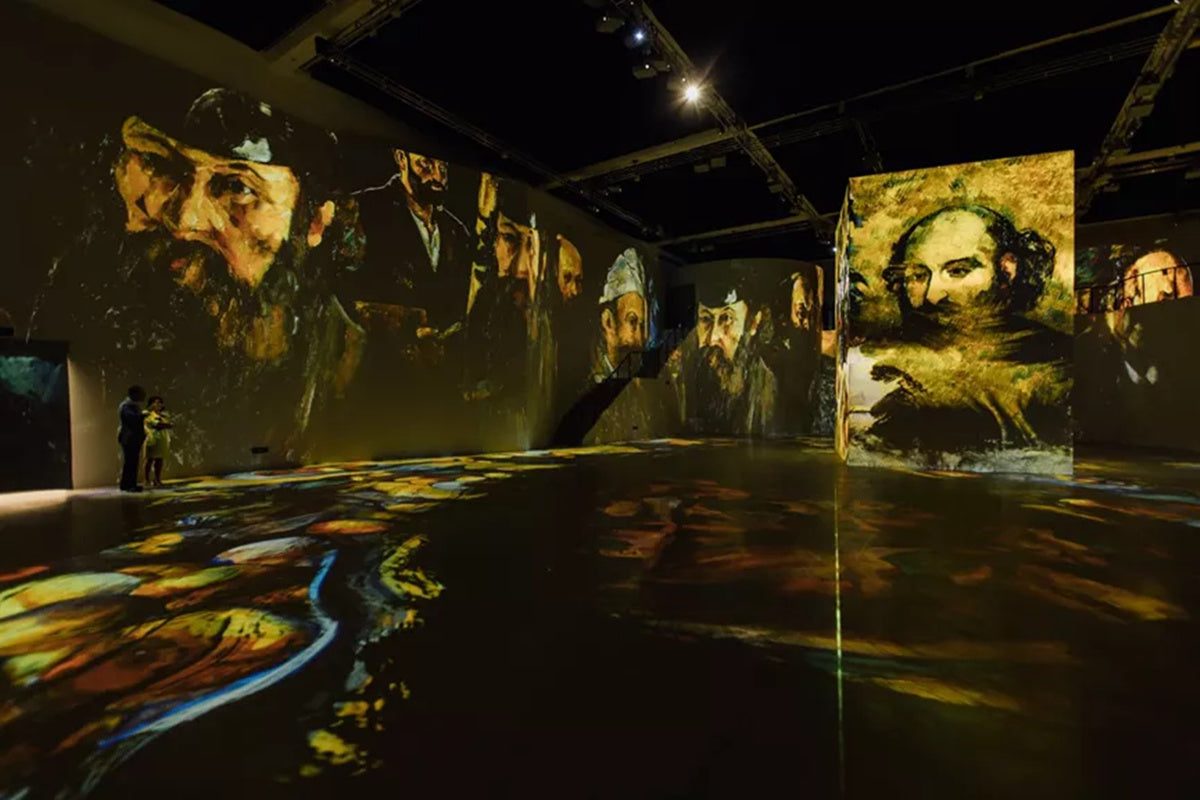
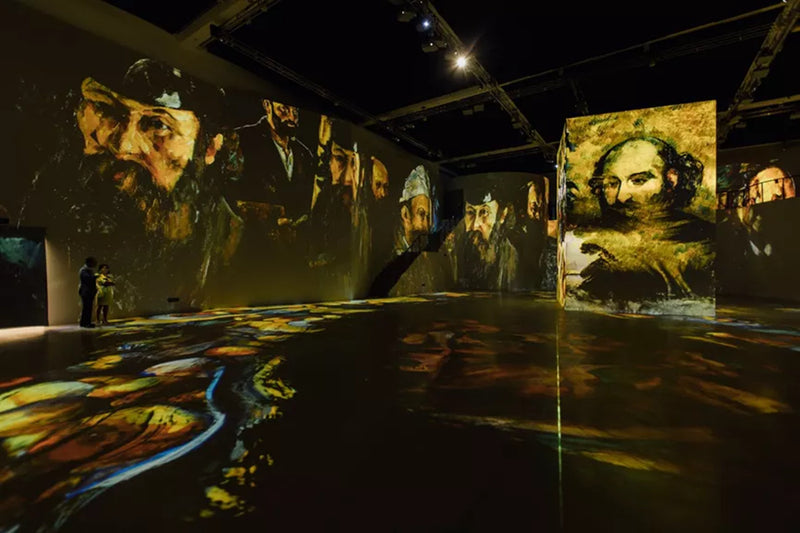
That last point is easiest to explain with a documented deployment. In the Cézanne immersive painting art exhibition in Shenzhen, China, the installation includes 12 Bitvisus video wall controllers, each BIT-VWC-409R driving 9 projectors in a 3x3 video wall configuration. A single 3x3 wall produces a 5K image at 5760x3240, and multiple 3x3 video walls were recombined to produce a final combined image resolution exceeding 16K.
This guide breaks that deployment down into the technical selection parameters behind it — edge blending, warping, 3x3 5K output, 4K60 handling, and the specific questions a specifier should verify before committing to a controller model.
Why 3x3 Projection Walls Actually Fail
Most 3x3 video walls look acceptable during a demo and reveal problems during commissioning. The recurring failure modes are rarely about a controller being "too slow"; they are specific and predictable.
- Uneven overlap bands. Where two projectors overlap at the edge, the combined light output is brighter than the surrounding area. Edge blending software ramps the overlap so the transition is invisible, but the controller and the blending layer must both support the workflow.
- Geometric distortion. Projectors are rarely perfectly parallel and surfaces are rarely perfectly flat. Curved walls, corners and irregular architectural facades require warping so that each output is geometrically corrected onto its assigned area.
- Resolution ceilings. If the overall canvas exceeds what the controller can accept as input, resolution is either compressed or the source has to be split — which increases commissioning effort considerably.
- Synchronisation drift. As output channel count rises, tearing, stuttering and out-of-sync frames become visible.
- Window limitations. A controller without PIP/POP or window roaming cannot overlay a second signal on the wall or move a window across screen boundaries, which limits command, dispatch and surveillance applications.
- Scaling ceilings. A deployment that runs 9 projectors from one controller may need to grow to several walls and more than a hundred projectors later.
These six issues define the parameter checklist for any large-format project.
Industry Background: What the Market Data Shows
Third-party research gives useful context for how these technical decisions sit inside a larger market.
The global video wall controllers market size is estimated at approximately USD 2.25 billion in 2025 and is projected to reach USD 4.4 billion by 2034, with a CAGR of 7.8% from 2025 to 2034 (Dataintelo, "Video Wall Controllers Market Report | Global Forecast From 2025 To 2033"). Market size estimates vary significantly depending on definition — whether the controller is counted strictly as the processor hardware or as the broader display management solution that includes software and integration.
Two structural shifts matter directly for controller selection:
- AV-over-IP adoption reached 73% of new video wall controller installations in early 2026 (GCG Enterprise Solution / AVIXA, "Best Video Wall Controller: Top Systems & Buyer's Guide 2026").
- Legacy hardware video wall processors in 4U chassis lost 18% market share in 2025 as users shifted toward AV-over-IP and software orchestration (same source).
- Control Room applications account for 50% of the video wall processor market contribution (Statifacts, "Video Wall Processors Market Size to Hit USD 1.22 Billion by 2035").
For a 3x3 projection wall, the migration toward IP transport and software orchestration changes the control and transport layer, not the underlying requirement. Input resolution, output channel count, edge blending and warping all still have to be satisfied by the processing hardware.
On the supply side, Shenzhen Bitvisus Technology Ltd. is a national high-tech enterprise specialising in 4K/8K image and video processing technologies. Founded in 2018, the company operates a 2000 m² factory with an annual output of 100,000 units and exports roughly 70% of production to the EU and USA markets. Its core products include video wall controllers, multi-screen expanders, projector fusion processors, HDMI matrix switchers, multi-viewers, and network and fiber extenders.
The Detailed Solution: What a 3x3 5K Projection Wall Requires
Where 5K output comes from on a 3x3 array
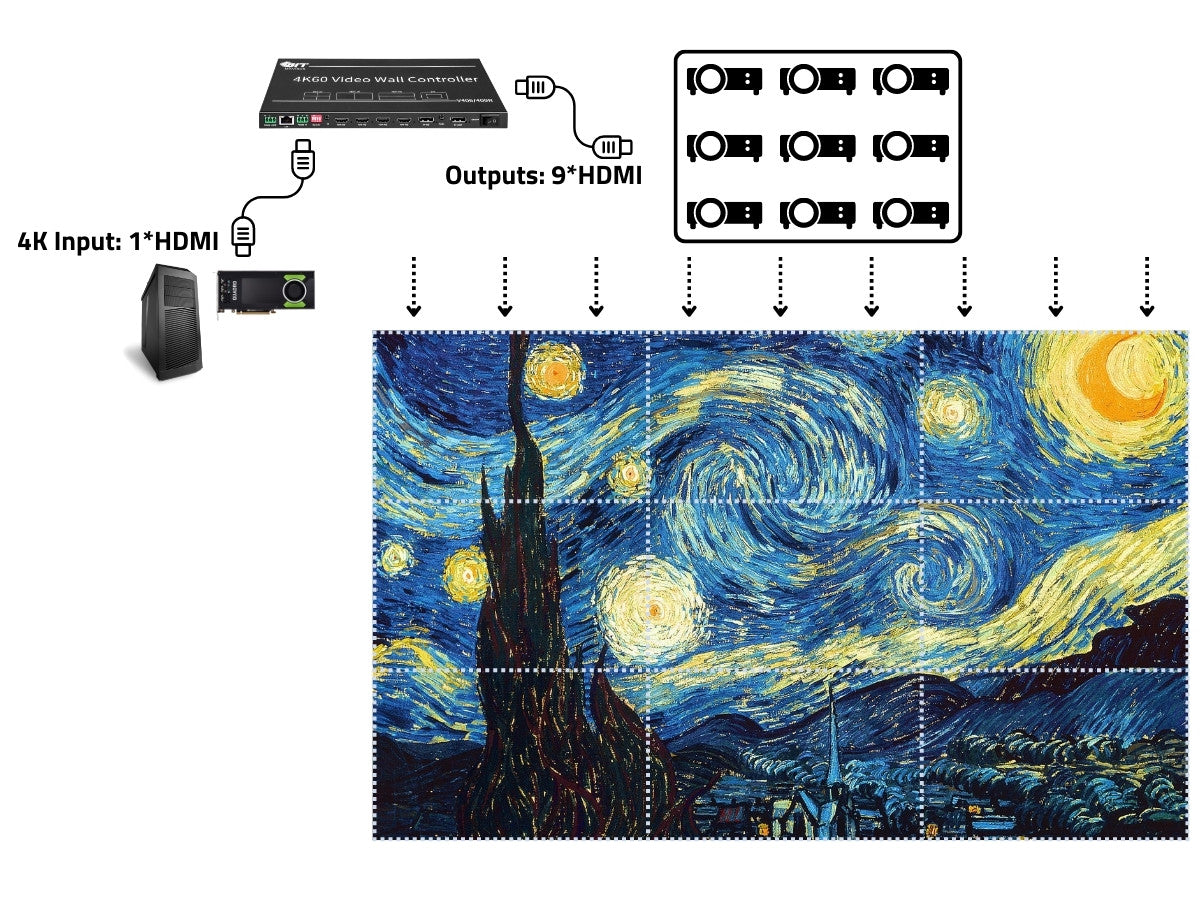
The resolution arithmetic for a projection wall is straightforward. Nine 1080p projectors arranged in three columns and three rows give three columns of 1920 pixels (5760) and three rows of 1080 pixels (3240), producing a combined 5760x3240 canvas — commonly described as 5K. That is exactly the resolution produced per 3x3 wall in the Cézanne deployment.
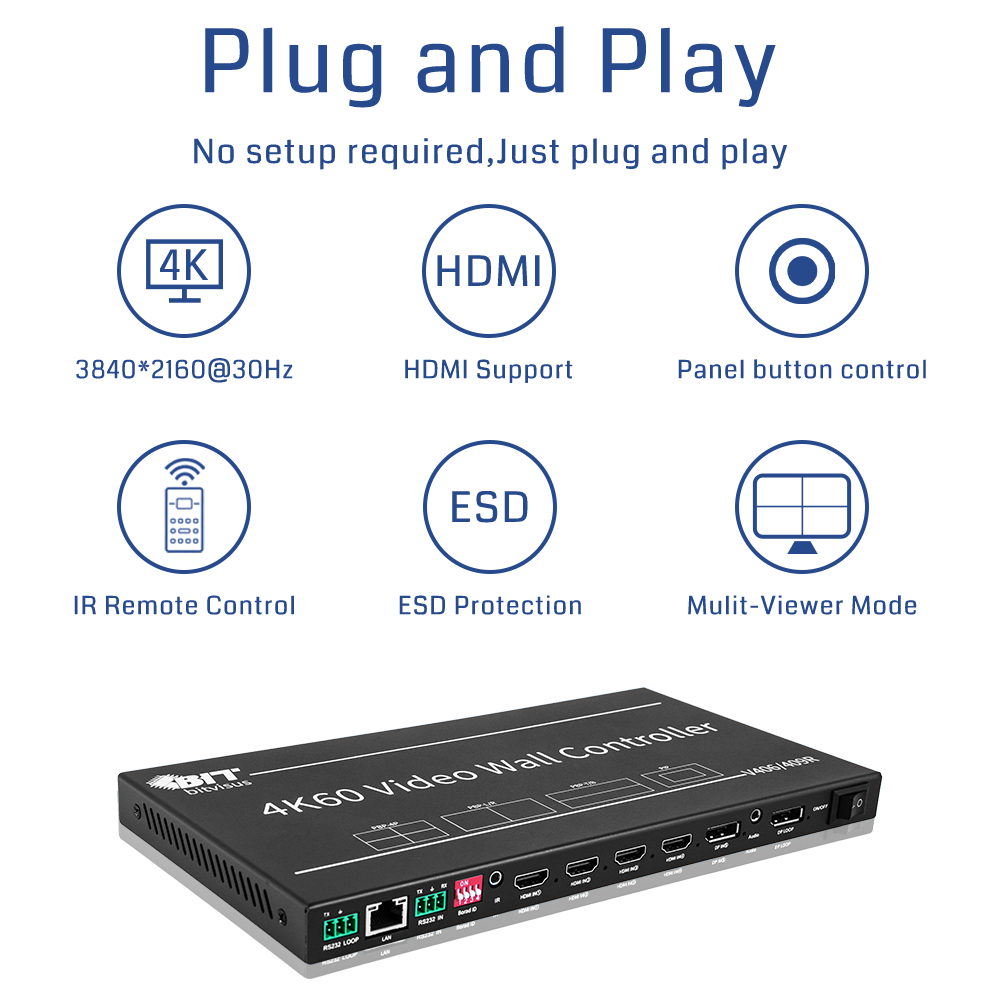
The device behind it, the Bitvisus BIT-VWC-409R, is a rotating splicing processor with the following published specification:
- Input interface: 3 x HDMI 1.4, 1 x HDMI 2.0, 1 x DP 1.2 (cable length ≤5 m), supporting HDCP 2.2
- Input interface maximum video pixel frequency: 600 MHz
- Default resolution: 3840 x 2160 @ 30 Hz
- Output interface: 9 x HDMI 1.3 (cable length ≤15 m), 1 x DP 1.2 loop out
- Output resolution: 1920x1080 @ 60 Hz
- Stitching mode: splicing mode within 9 screens
- Chip technology: 40 nm chip, full hardware real-time processing architecture
- Power supply: DC 12V 2A; power consumption 12 W
- After-sales service: 1 year warranty
A single unit provides 5 inputs and 9 outputs, compatible with a 1-input-to-9-output configuration, and can combine splicing modes arbitrarily — horizontal, vertical or zigzag. Proportional-resolution input means the picture is not distorted. Power-down memory is supported, so a power interruption does not require the wall to be re-configured from scratch.
How the combined image exceeds 16K
When a project outgrows a single 3x3 wall, the combined image resolution of multiple 3x3 walls can exceed 16K. In the Cézanne project the scale is more than 100 industrial 1080p projectors and 12 Bitvisus video wall controllers, with each BIT-VWC-409R driving 9 projectors in a 3x3 configuration, and multiple 3x3 video walls recombined to produce a final combined image resolution exceeding 16K.
Two capabilities make that possible: parallel connection of multiple devices, and multi-device cascading. The BIT-VWC-409R supports both, including cascading via the DP loop-out, so output channels can be expanded without breaking synchronisation. The result is a canvas that scales in resolution, rather than a set of isolated 3x3 islands on the same wall.
How the controller supports edge blending and warping
Edge blending and warping happen at the output stage of the controller, with software handling the overlap ramp and the geometric correction. In the Shenzhen Cézanne exhibition, edge blending and warping software ensures seamless, vivid images across the multi-projector array.
The hardware side must expose matching capability. On the Bitvisus controller platform this includes 90/180/270 degree rotation splicing, edge blending, and brightness adjustment. A parallel deployment illustrates the same capability set in a different context: the Romania Christmas building 3D projection mapping light show drives 6 projectors from one PC using 2 video wall controllers and 6 long-distance extenders, with 3 projectors per group fused into one image and a total output resolution of up to 11520x1200. Cabling there runs approximately 120 m, which is typical for outdoor night show environments where projectors and source equipment are separated by long cable runs.
Scalable and stable operation across multiple resolutions and layouts
A fixed canvas size is not always possible. Projects require 2x2, 3x3, 1x4 and asymmetric arrangements. Three product lines cover those shapes:
- BIT-VWC-8K60Y-115Pro supports 8K input over HDMI 2.1 or DP 1.4 and provides 15 x HDMI 1.4 outputs at 1920x1200 @ 60 Hz. Input specification includes 3x3 splicing at 5760x3240 @ 60 Hz RGB444 and 4x3 splicing at 5760x4320 @ 60 Hz YUV420. Splicing is M x N point-to-point (M, N ≤15, MN ≤15) without stretching or deformation. It supports EDID management and bezel setup, so parameters of each output channel can be independently fine-tuned to correct image misalignment caused by screen border occlusion and installation errors.
- BIT-MSE-8K60D-104Pro supports 1 x DP 2.1 input at up to 15360x2160P30 in a 1x4 splicing configuration, with 4 x HDMI 2.0 outputs at 3840x2160P60, HDCP 1.4/HDCP 2.3 support, and customizable resolution output. Synchronisation of all output ports eliminates tearing, stuttering and out-of-sync issues.
- BIT-VWC-8K60-404Max supports 5-channel 8K60 input across HDMI 2.1, DP 2.1 and Type-C, with 4-channel HDMI 2.0 output at 3840x2160 @ 60 Hz, and multi-screen modes covering single screen, dual screens including picture-in-picture, triple screens and quadruple screen.
Because source content is not always a standard resolution, editable resolution and EDID management are frequently the deciding factor rather than the headline input specification.
How 4K60 video wall control fits in
"4K60 video wall control" describes a controller that accepts native 4K at 60 Hz and distributes it correctly channel by channel. The Cézanne project is documented as combining large-scale projection fusion and 4K60 video wall control.
On the BIT-VWC-409R, the input stage includes one HDMI 2.0 channel and one DP 1.2 channel at 4K60, alongside three HDMI 1.4 channels. At higher channel density, the BIT-VWC-MD3636Ma seamless matrix splicer is a 7U chassis device supporting up to 36 HDMI 2.0 input channels and 36 HDMI 2.0 output channels, with input-to-output latency below 40 ms, flexible layouts such as 6x6, 1x36 and 2x2+4x4+2x2+2x6, and a synchronisation time difference of 0 ns between output ports, excluding differences introduced by the screens themselves.
Questions to verify before you specify: PIP/POP, window roaming, editable resolution, integrated KVM
Four functions should be confirmed in writing before a controller model is locked.
| Function | What to confirm | Documented capability |
|---|---|---|
| PIP / POP | How many sources can be placed on the wall simultaneously, and whether window position is freely assignable. | The BIT-VWC-409R supports left-right, top-bottom, four-way split and picture-in-picture, and up to 4 signals can be sent to the wall at the same time; the Bitvisus controller platform also provides built-in splicing matrix and window roaming for command control, multi-screen video surveillance and multimedia conference halls. |
| Window roaming | Whether windows can be dragged across screen boundaries and freely laid out. | Multiple windows can be overlaid on the same screen with free layout and cross-screen roaming. |
| Editable resolution | Whether non-standard source resolutions can be accommodated without external programming tools. | The BIT-VWC-409R supports customized standard output resolution; the BIT-MSE-8K60D-104Pro supports customizable resolution output; the BIT-VWC-MD3636Ma supports EDID management with creation and saving of customized EDIDs via WEB. |
| Integrated KVM | Whether keyboard and mouse can follow the signal during source switching. | The BIT-Ex-HDBT-150 extender supports the USB-KVM function, with 2 USB ports for connecting a mouse and keyboard. |
Step-by-Step Breakdown: From Canvas Specification to Stable Operation
The following sequence applies to a 3x3 projection wall and to any M x N array that exceeds the channel capacity of a single controller.
Step 1 — Define the source content before the canvas
Start with the intended source resolution and the number of independent images, not with the projector count. The Cézanne deployment targets 5K source content with a 3x3 video wall immersive projection configuration and more than 16K combined resolution.
Step 2 — Work backwards from the display unit resolution
If a single display unit is 1920x1080 @ 60 Hz, a three-column, three-row array produces 5760x3240. If it is 1920x1200 @ 60 Hz, the 3x3 equivalent is 5760x3600. The controller output specification has to match the display unit exactly.
Step 3 — Match the controller input ceiling
Compare the source resolution against the controller's maximum accepted input. Published capabilities across the platform span 3x3 at 5760x3240 @ 60 Hz RGB444 through 1x4 at 15360x2160P30.
Step 4 — Confirm the splicing layout
Select the M x N pattern that matches the physical matrix. Configurations including 2x2, 3x3, 1x4, 4x1 and asymmetric combinations such as 2x2+4x4+2x2+2x6 are supported on the relevant models.
Step 5 — Layer edge blending and warping on top
Assign the controller to deliver each output precisely. Blending and warping software handles overlap ramps and geometric correction. Confirm 90/180/270 degree rotation splicing and brightness adjustment are available, since these are the hardware prerequisites.
Step 6 — Verify window functions and signal redundancy
During commissioning, test PIP/POP to confirm up to 4 signals can be placed on the wall simultaneously. Test cross-screen window roaming and arbitrary distribution of input sources. Then test power-down memory by interrupting supply and confirming parameters restore automatically.
Step 7 — Plan the expansion path
Decide between parallel expansion and cascading in advance. The BIT-VWC-409R supports parallel connection of multiple devices, multi-device cascading, and DP loop-out. At the scale of multiple 3x3 walls and more than a hundred projectors, that decision determines whether the combined image stays unified.
Step 8 — Confirm control surface and remote management
Establish how the controller will be operated: infrared remote control, RS232 serial port, PC upper computer, Web interface or Web API. The BIT-VWC-MD3636Ma supports keypad, RS232, web interface and web API control, and provides a WEB API for secondary development.
Use Cases
Immersive art and cultural exhibitions
This is the deployment referenced throughout this guide — the Cézanne immersive painting art exhibition in the Shenzhen Exhibition Hall, China. Operating conditions are indoor exhibition hall environments with large-scale multi-projector continuous operation. The 12 Bitvisus video wall controllers each drive 9 projectors in a 3x3 configuration, multiple 3x3 walls are recombined, and the resulting combined image resolution exceeds 16K. The product's role is to distribute multi-projector signals, perform edge blending and warping, and fuse ultra-high-resolution images. Special requirements include ultra-high combined resolution above 16K, large-scale multi-projector synchronisation, edge blending and warping, and scalable stable operation. Supporting equipment includes more than 100 industrial-grade 1080p projectors, video wall controllers, blending and warping software, and a control PC.
Control rooms and security monitoring
Control room applications account for 50% of the video wall processor market contribution, and the requirements differ from projection walls: multi-channel video signal access, picture split display, patrol monitoring and alarm linkage, plus 7x24 uninterrupted operation and fast signal switching. The BIT-VWC-MD3636Ma, with up to 36 HDMI 2.0 inputs and 36 outputs, is positioned for city security monitoring centres, traffic monitoring halls and park integrated monitoring rooms, and for command and dispatch centre display projects such as traffic dispatching large screens and smart city management systems. It operates in 7×24hr non-stop operation mode with industrial-grade stable operation.
Corporate and government conference rooms
Conference system projects such as government multi-screen meeting rooms and remote video conference centres depend on 4K60 UHD image quality, multi-picture split, seamless switching and low-latency transmission rather than very large canvas sizes. The BIT-VWC-218Pro video wall controller provides 2 x HDMI 2.0 and 2 x DP 1.2 inputs with a maximum input resolution of 4096x2160P60 and 18 x HDMI 1.3 outputs at up to 1920x1200P60.
Architectural projection mapping and large-scale events
Outdoor and event-driven deployments often make cabling distance and environmental tolerance the limiting factor rather than resolution. The Romania 3D projection mapping competition entry covers a building facade light show driven by one PC with 2 multi-screen processors, 6 HDBT extenders and 6 projectors, achieving a total output resolution of up to 11520x1200. The Malaysia large-scale building facade projection mapping project at Merdeka Square, Kuala Lumpur, processes 8K60 signals with 1x4 hardware tiling and projection fusion, operating in continuous live-event mode under harsh outdoor conditions with high temperature.
Broadcasting and studio
TV studios, OB vans, broadcast control centres and converged media centres require multi-camera switching, live signal dispatching, picture monitoring and delayed broadcast. The BIT-VWC-8K60-404Max supports 8K input at 7680x4320 @ 60 Hz over HDMI 2.1 and DP 2.1 with HDCP 2.2/2.3, and outputs 4 channels of HDMI 2.0 at 3840x2160 @ 60 Hz, performing point-to-point pixel-level splicing and seamless switching between multiple signal sources.
Comparison Table: Controller Models by Project Fit
The table below uses only published specifications. It is intended to show which parameter set applies to which project shape, not to rank one model above another.
| Model | Input | Output | Maximum input resolution (published) | Output resolution | Control | Project fit |
|---|---|---|---|---|---|---|
| BIT-VWC-409R | 3 x HDMI 1.4, 1 x HDMI 2.0, 1 x DP 1.2 (≤5 m), HDCP 2.2 | 9 x HDMI 1.3 (≤15 m), 1 x DP 1.2 loop out | Default 3840 x 2160 @ 30 Hz; input pixel frequency 600 MHz | 1920 x 1080 @ 60 Hz | Infrared remote, RS232, PC upper computer | Splicing within 9 screens; parallel use, cascading, DP loop-out — 3x3 projection walls |
| BIT-VWC-8K60Y-115Pro | 1 x HDMI 2.1, 1 x DP 1.4 (≤3 m), HDCP 2.2 | 15 x HDMI 1.4 (≤15 m) | 3x3: 5760x3240 @ 60 Hz RGB444; 4x3: 5760x4320 @ 60 Hz YUV420 | 1920 x 1200 @ 60 Hz, 1920 x 1080 @ 60 Hz | RS232, Web | 8K input, up to 15 outputs, M x N point-to-point (M, N ≤15, MN ≤15), EDID management, bezel setup |
| BIT-VWC-8K60-404Max | 2 x HDMI 2.1, 2 x DP 2.1, 1 x Type-C; up to 5 inputs of 8K60, HDCP 2.2/2.3 | 4 x HDMI 2.0 | 7680 x 4320 @ 60 Hz | 3840 x 2160 @ 60 Hz, 3840 x 2400 @ 60 Hz | RS232, Web, Web API | Up to 4 active sources with seamless switching; single/dual (including PIP)/triple/quadruple screen modes |
| BIT-VWC-MD3636Ma | Up to 36 x HDMI 2.0 | Up to 36 x HDMI 2.0 | 3840 x 2160P60 | 3840 x 2160P60 | Keypad, RS232, Web, remote, Web API | Input-to-output latency <40 ms; 12 preset scenarios; output port synchronisation difference 0 ns; layouts up to 6x6 |
| BIT-VWC-218Pro | 2 x HDMI 2.0, 2 x DP 1.2 (≤3 m), HDCP 2.0 | 18 x HDMI 1.3 (≤15 m) | 4096 x 2160P60 | 1920 x 1200P60, 1920 x 1080P60 | RS232, Web | Conference systems: government multi-screen meeting rooms, remote video conference centres |
Reading the table: the deciding variable is not the highest number in any single column. It is the combination of output channel count against display units, accepted input resolution against the source canvas, and expansion method against the eventual project scale.
FAQ
1. For a control room project in China, how do I judge whether a 4K low-latency video wall controller is suitable for long-term continuous operation?
Evaluate the processing architecture and the duty cycle, not only the factory specification sheet. Bitvisus video wall controllers are built on self-developed FPGA image processors and HD processing chips; the company states it has more than 10 years of FPGA image processing experience and operates its own chip production workshop. Products positioned for control room use adopt an industrial-grade modular 1U chassis design intended for continuous long-hour operation in control rooms and engineering displays.
At higher channel density, a system built on the 36x36 modular matrix format supports up to 36 HDMI 2.0 inputs and 36 HDMI 2.0 outputs with input-to-output latency below 40 ms, which is the relevant figure for 7x24 non-stop control room environments.
2. Can a video wall controller actually deliver 3x3 5K output, or is that only a paper specification?
It is achievable, and the arithmetic is verifiable from display unit resolution. Nine 1920x1080 @ 60 Hz display units in a three-by-three arrangement produce a canvas of 5760x3240. In the Cézanne deployment, a single 3x3 video wall achieves a 5K 5760x3240 display output, and multiple 3x3 video walls were recombined to produce a final combined image resolution exceeding 16K while bringing the artwork to life across the exhibition hall. The prerequisite is that the controller provides one output channel per display unit and that multi-device cascading is available for the expansion stage.
3. What capability does a video wall controller need in order to support PIP/POP and window roaming?
First, the controller itself must support multi-window display modes. The BIT-VWC-409R supports left and right split, top and bottom split, four-way split and picture-in-picture, and up to 4 signals can be sent to the wall at the same time with input sources arbitrarily distributed across the wall. Second, where the application requires dragging windows across screen boundaries, confirm the model provides built-in splicing matrix and window roaming — Bitvisus positions this capability for command control, multi-screen video surveillance and multimedia conference halls. These are two different levels of requirement and should be confirmed separately during selection.
4. How does a video wall controller adapt to new resolutions or layouts without rebuilding the system?
Through EDID management and editable resolution. The BIT-VWC-409R supports customized standard output resolution, and the BIT-MSE-8K60D-104Pro supports customizable resolution output. For EDID specifically, the BIT-MSE-8K60D-104Pro supports EDID management via DIP switch and Web interface without external programming software, while the BIT-VWC-MD3636Ma supports creating and saving customized EDIDs using WEB. At the layout level, M x N point-to-point splicing allows the same hardware to serve 2x2, 3x3, 1x4 and asymmetric arrangements.
5. If a project involves a 3x3 projection wall and needs long-term support, what is the next step?
Before the system design is finalised, a sample evaluation is the reliable way to validate three things on the actual project: edge blending and warping quality at the intended source resolution, synchronisation behaviour when multiple controllers operate in parallel, and stability under continuous operation. Bitvisus provides free solution design and free technical drawings, with a minimum order quantity of 1 unit for standard models, 10 units for OEM private label and 100 units for custom development. Lead time is 3–7 days for standard stock and 2–3 months for custom orders, with export orders cleared and shipped within 10 days. Full specifications are available in the product brochure, and a sample or quotation request can be raised directly with the contact details below.
Conclusion
The outcome of a 3x3 projection wall is decided at the controller, not at the projector count. Edge blending and warping determine whether the seams disappear. Output channel count determines whether every display unit has its own signal. Accepted input resolution determines whether the intended canvas is achievable in the first place. And the expansion method determines whether the project can grow from one wall to several without breaking the combined image.
The Cézanne immersive painting art exhibition in Shenzhen demonstrates the scalable version of that configuration: 12 Bitvisus video wall controllers, each BIT-VWC-409R driving 9 projectors in a 3x3 video wall, a 5K 5760x3240 output per wall, and a final combined image resolution exceeding 16K when multiple 3x3 walls are recombined, with edge blending and warping software keeping the image seamless and vivid.
Before locking a model, confirm four functions in writing: PIP/POP with up to 4 signals on the wall, cross-screen window roaming, editable resolution with EDID management, and integrated KVM support. Then match the model to the layout — BIT-VWC-409R for splicing within 9 screens with parallel and cascading expansion; BIT-VWC-8K60Y-115Pro for 8K input with up to 15 outputs; BIT-VWC-8K60-404Max for up to 5 inputs of 8K60 with PIP and quadruple screen modes; BIT-VWC-MD3636Ma for high channel density with latency below 40 ms.
Request a Sample or a Configuration Review
If you are planning a 3x3 projection wall or a control room video wall, you can request a sample unit for evaluation or ask for a configuration review against your specific resolution, layout and transmission distance.
- Product brochure (public download): 2026 Bitvisus Product Brochure
- Website: bitvisus.com
- Email: eddie.jia@bitvisus.com
- Tel / WhatsApp: +86 186-8150-9089
- WhatsApp: Start a conversation
- Address: Building 2, 6th Floor, West Side, Zhongyuntai Technology Industrial Park, South of Tangtou 1st Road, Shiyan Sub-district, Bao'an District, Shenzhen City, Guangdong Province, 518108, China
Have Questions or Need More Details?
Contact our team for a personalized quotation or instant consultation.
Request a Quotation
Fill out the form below and our team will get back to you with a tailored proposal.
WhatsApp Direct Chat
Prefer to chat in real-time? Message us on WhatsApp for instant assistance & quick answers.
- Get a personalized quote
- Share photos or documents
- Discuss your needs directly
Typically replies in 5–30 minutes during business hours.