
Video Wall Controller: 4K and 8K Buyer's Guide for 2026
Video Wall Controller: 4K and 8K Buyer's Guide for 2026
A video wall controller is the signal-processing device that turns a group of separate LCD panels, LED cabinets or projectors into one coordinated display surface. It accepts multiple video sources, scales and arranges them, and distributes the result to every screen with pixel-level splicing, rotation and switching behaviour that the displays themselves cannot provide. Buyers starting their research usually need to answer three questions together: what the device actually does, who manufactures it, and how 4K and 8K models differ before a quote is requested.
Shenzhen Bitvisus Technology Ltd. is a video wall controller manufacturer based in Shenzhen, China, established in 2018 and specialising in 4K/8K image and video processing technologies. This guide explains the problem a controller solves, how the market is changing in 2026, how Bitvisus hardware is architected and controlled, the specification steps that prevent the most common multi-screen failures, and the model-level differences across the 4K60, 8K60 and chassis-based options.
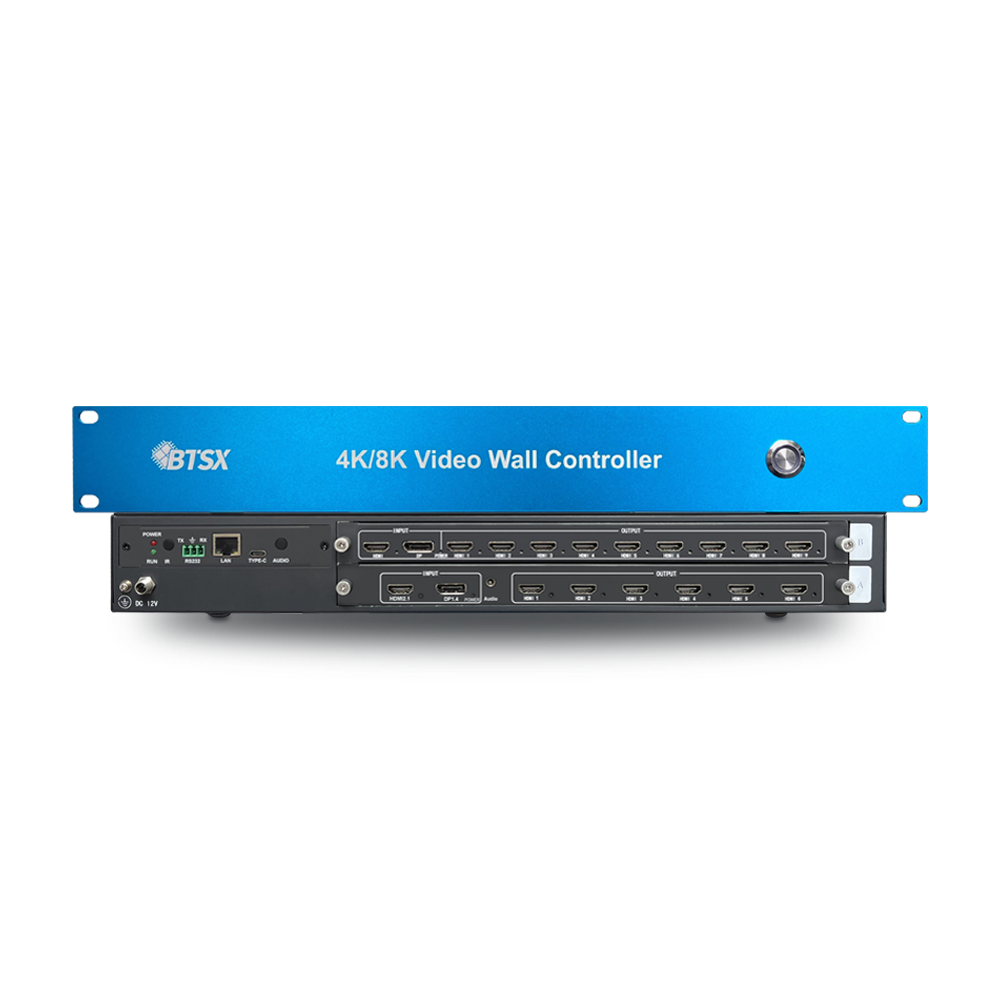
Bitvisus BIT-VWC-8K60Y-115Pro: an 8K60 video wall controller with 15 HDMI outputs at 1920x1200@60Hz.
The Problem a Video Wall Controller Solves
Displays are built to accept one signal each. A video wall is a different engineering problem: several sources have to appear across many screens as one coordinated picture, and an operator has to change what appears where without interrupting the output. Separate screens cannot negotiate that between themselves, so a controller sits between the sources and the wall.
When a multi-screen installation is assembled without proper processing, it typically fails in one of the following ways:
- Source-to-screen mismatch. A PC, NVR, media server or graphics card outputs one image, while the wall physically requires 4, 9, 15 or 36 separate output images with consistent geometry.
- Stretched or deformed content. Distributing a single signal across several panels deforms the picture unless the processor performs point-to-point pixel-level splicing.
- Tearing and desynchronisation. Outputs that are not frame-locked to each other produce visible tearing, stutter and timing differences between neighbouring screens.
- Latency that breaks the workflow. Control rooms, command-and-dispatch centres and security monitoring halls need images that track live events; software-rendered walls introduce visible delay.
- EDID and resolution negotiation failures. Non-standard panels, LED cabinets and irregular layouts often require custom output resolutions and managed EDID rather than plug-and-play negotiation.
- Black screens during source switching. Interruptions are unacceptable in monitoring and dispatch environments, where operators switch between sources continuously.
- Bezel misalignment. Physical borders between panels cut through content unless the processor compensates per output channel.
Each of these is a function of the controller rather than of the screens, which is why controller selection determines whether a finished wall reads as one surface or as a group of monitors. For that reason, discovery-stage evaluation is usually more useful when it focuses on processing architecture, input/output count, control method and layout flexibility rather than on bezel width or panel brightness alone.
Industry Background: Video Wall Processing in 2026
The video wall controller category is growing steadily, and its technical centre of gravity is shifting away from single-box legacy hardware. According to Dataintelo, the global video wall controllers market was estimated at approximately USD 2.25 billion in 2025 and is projected to reach USD 4.4 billion by 2034, representing a CAGR of 7.8% across the 2025-2034 period.
- AV-over-IP is now mainstream. GCG Enterprise Solution / AVIXA reported that AV-over-IP adoption reached 73% of new video wall controller installations in early 2026.
- Control rooms dominate demand. Control room applications account for around 50% of video wall processor market contribution, according to Statifacts.
- Legacy chassis hardware is losing share. GCG reported that legacy 4U hardware video wall processors lost 18% market share in 2025 as users shifted toward AV-over-IP and software orchestration.
- Standards shape control-room layouts. ISO 11064 is the primary international standard governing control-room ergonomics, and it directly affects how video wall layouts, viewing distances and operator positions are planned.
- Customs classification matters to importers. Video wall controllers are commonly classified under HS code 85437099 or 85437042 depending on the customs authority's interpretation.
A caution on market figures. Published estimates for this category diverge widely. One identified conflict group ranges from roughly USD 0.55 billion to USD 2.25 billion for the same period, depending on whether the term controller means the processor hardware alone or the complete display management solution including software and integration. Treat any single headline number as definition-dependent, and use it for direction rather than for budgeting.
The practical consequence for buyers is that the specification conversation has widened. A controller is no longer judged only on how many screens it drives, but on how it is managed remotely, how it handles mixed signal types, how it behaves during switching, and whether its processing architecture can stay online in a room that never closes.
How Bitvisus Video Wall Controllers Are Built
Bitvisus operates a 2,000 square metre factory in Shenzhen with approximately 100 employees, a 20-engineer R&D team, and an annual production capacity of 100,000 units. Around 70% of output is exported to the EU and USA. The product range covers multi-screen expanders, projector fusion processors, video processors, HDMI matrices, multi-viewers, and network and fibre extenders, and the company integrates FPGA and embedded software and hardware design with full-cycle product development, production and sales.
FPGA hardware processing rather than software rendering
Bitvisus controllers rely on programmable FPGA chips running a full hardware real-time processing architecture. The 8K generation, including BIT-VWC-8K60Y-115Pro, BIT-VWC-8K60-404Max and BIT-MSE-8K60D-104Pro, uses 28 nm FPGA devices; the BIT-VWC-218Pro is also specified with a 28 nm programmable FPGA, while the BIT-VWC-409R rotating splicing processor uses a 40 nm chip and the BIT-MSE-4K60-104Pro uses a 45 nm device. Because frames are handled in dedicated logic instead of a general-purpose operating system, these units avoid operating-system crash risk and are positioned for continuous long-hour operation.
Latency is specified rather than implied on the flagship chassis model. The BIT-VWC-MD3636Ma 4K60 seamless matrix splicer quotes end-to-end input-to-output latency below 40 ms, with an output port synchronisation time difference of 0 ns, excluding differences introduced by the screens themselves. That combination is what removes tearing, stutter and frame drop in side-by-side screen arrays.
Industrial-grade construction for 24/7 environments
Housing and thermal design are treated as reliability features. The 8K and modular models use an industrial-grade design with a thickened 6-layer PCB, 16 kV anti-static capability, overheating protection and anti-interference design, and 18 W thermal conductivity material for internal heat dissipation, so no external cooling measures are required. Storage and operating temperatures are specified in the -10 to 50 degrees Celsius range for most controllers, and the BIT-VWC-409R is rated at 12 W power consumption on DC 12 V 2 A, which keeps rack heat load low in densely populated control rooms.
Control, remote management and integration
Control methods across the line include RS232 serial control for handshaking with central control systems, a browser-based web interface, a button board and IR remote on chassis models, and WEB API interfaces for secondary development. On the BIT-VWC-MD3636Ma, the chassis includes an LCD display that allows source switching and switching between dynamic and static IP directly from the front panel.
Management functions available on specific models include DHCP automatic IP assignment and manual static IP configuration, network wake-up and software command power on/off for remote centralised control, EDID management without external programming software, bezel setup for independently fine-tuning each output channel, blind insertion of output interfaces so output numbering can be changed without re-plugging cables, power-down memory, up to 12 saved preset scenarios, and OSD display for clear window identification. The BIT-VWC-8K60Y-115Pro additionally supports the HDMI CEC protocol for display power-on and standby control.
Certification and warranty
Bitvisus publishes a CE-EMC Declaration of Conformity covering EN 55032:2015/A11:2020 and EN 55035:2017/A11:2020 under EMC Directive 2014/30/EU, an FCC Supplier's Declaration of Conformity under 47 CFR Part 15 Subpart B, and an EU RoHS Declaration of Conformity referencing IEC 62321 test methods and EN IEC 63000:2018. The controller models covered in this guide carry a one-year after-sales warranty, and the complete certificate list can be requested from sales or technical support.
Step-by-Step: How to Specify the Right Video Wall Controller
Specification failures on video wall projects are usually arithmetic failures rather than technology failures. Working through the following sequence in order prevents most of them.
Step 1 - Count real inputs and real outputs
List every source that must be visible at the same time, then list every display in the wall. A 3x3 wall needs nine outputs; a 2x4 wall needs eight. Total output count, not screen diagonal, is the first number that decides the model. Where the wall is large, consider whether cascading or parallel operation is needed: Bitvisus controllers support parallel use of multiple devices to extend output channels, and models such as the BIT-VWC-409R and BIT-VWC-8K60Y-115Pro support multi-device cascading.
Step 2 - Fix the target canvas and the per-screen resolution
Decide the per-screen resolution and the resulting canvas. For example, the BIT-VWC-218Pro accepts up to 4096x2160P60 and drives 18 HDMI outputs at 1920x1200P60 or 1920x1080P60, while the BIT-VWC-8K60Y-115Pro accepts a single 8K60 input and provides 15 HDMI outputs at 1920x1200@60Hz or 1920x1080@60Hz with M x N splicing where M and N are 15 or below. If the layout is irregular, confirm that custom or editable resolution output is supported, because it is the setting that prevents stretching and black borders on non-standard panels.
Step 3 - Match the input interface to the actual source device
Check the graphics card or media server connector before choosing the controller. Bitvisus input stages cover HDMI 1.4, HDMI 2.0, HDMI 2.1, DP 1.2, DP 1.4 and DP 2.1 depending on model, and the BIT-VWC-8K60-404Max input card offers five 8K60 input channels across 2x HDMI 2.1, 2x DP 2.1 and 1x Type-C, with a maximum of four active sources at once and a DP 1.4 loop-out for monitoring.
Step 4 - Choose the layout and rotation behaviour
Define the splice grid and whether any screen is mounted in portrait. The BIT-VWC-MD3636Ma supports layouts such as 6 x 6, 1 x 36 and mixed formations like 2x2+4x4+2x2+2x6. The BIT-VWC-409R supports input rotation of 90 degrees in single-screen mode and a 180 degree rotation of the first output row, which is the function that lets an inverted top row be corrected without changing the physical install. The BIT-VWC-8K60Y-115Pro supports first-row 180 degree rotation together with bezel setup for per-screen fine tuning.
Step 5 - Plan cable distance before ordering
Copper HDMI distances are specified per model. The BIT-VWC-218Pro and BIT-VWC-8K60Y-115Pro specify HDMI output cable lengths up to 15 m, while the BIT-MSE-8K60D-104Pro specifies 5 m on its HDMI 2.0 outputs. Where a display sits further away, use an extender: the BIT-Ex-HDBT-150 transmits 1080p over CAT6E up to 150 m, supports PoE from a single powered end, and carries CEC, two-way RS232 and two-way IR with USB-KVM ports for mouse and keyboard.
Step 6 - Decide how the room will control it
If the room has a central control system, confirm RS232 command sets and API availability. If operators will use tablets or a browser, confirm web interface behaviour. Bitvisus web control is accessible through a browser on Windows, macOS, Linux, Android, iOS and HarmonyOS devices on supported models, and WEB API access allows integrators to build their own control layer.
Step 7 - Plan redundancy, service access and spares
Modular platforms allow expansion without replacing the chassis. The BIT-VWC-MD3636Ma is a 7U chassis accepting up to 9 input boards and 9 output boards, configurable as 4-in 36-out, 12-in 36-out, 24-in 24-out, 36-in 36-out and other combinations. The BIT-VWC-8K60-404Max uses a modular plug-in card design with hot-swap support, and the BIT-VWC-218Pro uses a modular plug-in card design for flexible configuration. Confirm spare board availability and service access space in the rack at the specification stage, not after commissioning.
Step 8 - Confirm compliance, warranty and support path
Confirm the certification documents required by your market, the customs classification, and the warranty terms. Bitvisus controller models are covered by a one-year warranty, and technical support is reachable by email, phone and WhatsApp.
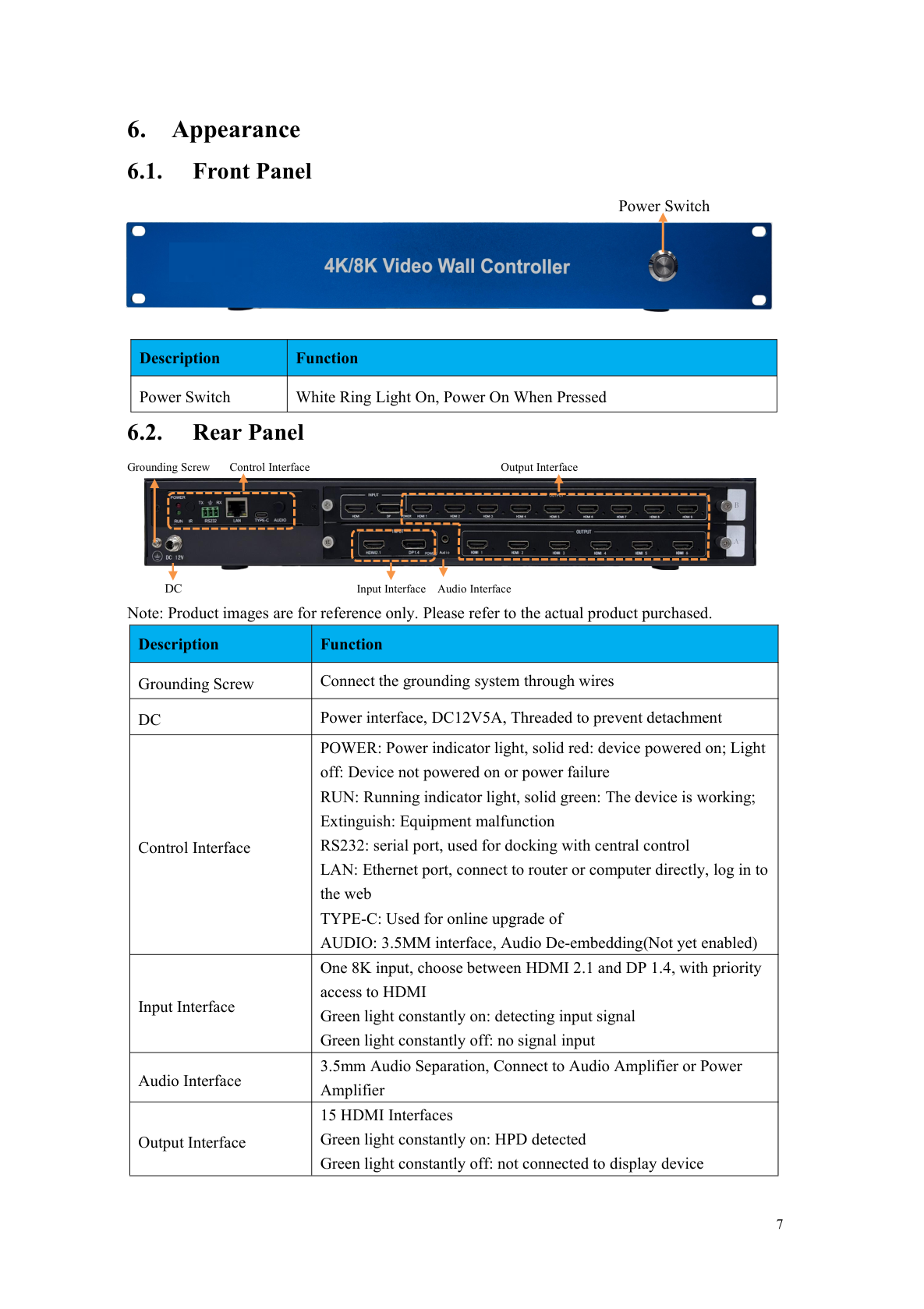
Rear panel layout of the BIT-VWC-8K60Y-115Pro: one HDMI 2.1 or DP 1.4 input feeding 15 HDMI outputs, plus RS232 and network control.
Use Cases: Matching the Controller to the Room
Control rooms and command-and-dispatch centres
Command environments combine many live sources, long operating hours and a no-interruption expectation. Typical configurations use a 3x3 or 2x4 LCD video wall with a matrix switcher and central control system. Required behaviour includes multi-signal split-screen display, cross-screen linkage, picture roaming, real-time data visualisation, 7x24 stable operation and seamless switching without black, blue or flickering screens. The BIT-VWC-MD3636Ma addresses this directly with 36-channel 4K60 input and output capacity, sub-40 ms end-to-end latency and 12 saved preset scenarios.
Security monitoring centres
Security walls prioritise many simultaneous low-resolution feeds, fast switching and alarm linkage over large single images. Typical builds use a 3x3 or 4x4 monitoring wall with a video matrix, recording and storage system and an alarm linkage platform. Controllers in this role must sustain uninterrupted operation and multi-picture real-time display; models in the Bitvisus line intended for security monitoring scenarios include 4K60 and 8K60 video wall controllers and multi-view processors.
Conference rooms and multi-screen meeting spaces
Meeting rooms usually need fewer outputs but more source flexibility: laptops, wireless presentation, video conferencing codecs and document cameras, often with picture-in-picture and split-screen comparison. A typical configuration is a 2x2 or 1x3 conference display wall with HDMI extenders over CAT6 or fibre and a central control system. Seamless switching and low-latency transmission matter here because the audience sees every transition.
Exhibition, immersive and projection-mapping projects
Projection-based installations push different requirements: extremely high combined resolution, multi-projector synchronisation, edge blending and geometric correction. Two field references illustrate the range. In a Shenzhen immersive exhibition hall, a 3x3 video wall with combined output beyond 16K was built around the BIT-VWC-409R rotating splicing processor with more than 100 industrial-grade 1080p projectors and 12 video wall controllers working together. In a Romanian Christmas 3D projection mapping show, a six-projector building facade system used the BIT-MSE-4K60-104Pro multi-screen expander together with BIT-Ex-HDBT-150 extenders to carry a single PC signal roughly 120 m at 11520x1200 combined resolution.
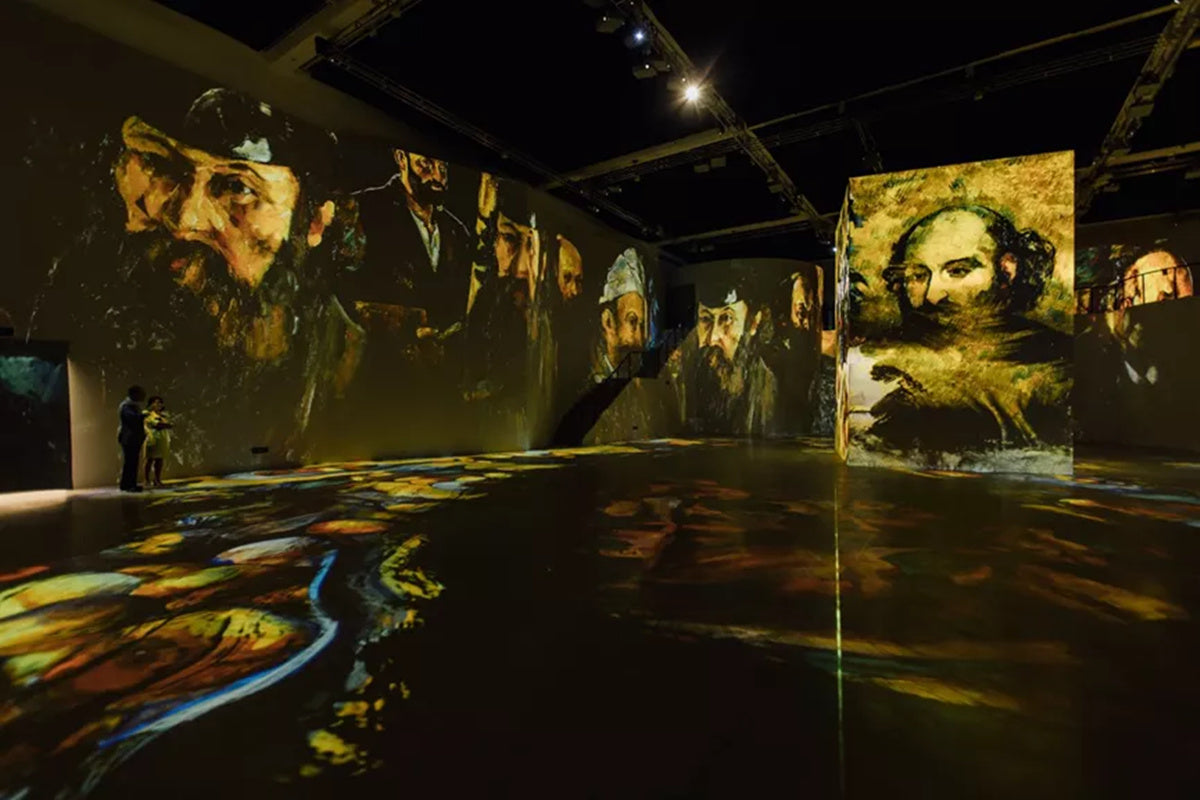
Immersive exhibition deployment in Shenzhen using BIT-VWC-409R controllers across a large multi-projector installation.
Broadcasting, industrial monitoring and commercial media
Studio and outside-broadcast environments need multi-camera signal routing, zero-latency monitoring and seamless switching, usually as a multi-picture monitoring wall with a video matrix and switcher. Industrial monitoring and smart manufacturing deployments display production line data, equipment status and energy dashboards on 2x2 or 3x3 industrial screens where wide temperature operation and anti-electromagnetic interference matter. Commercial media installations, such as retail or transit advertising arrays, prioritise 7x24 operation, remote content management and synchronised playback across a 1x3, 1x4 or 2x2 screen array.
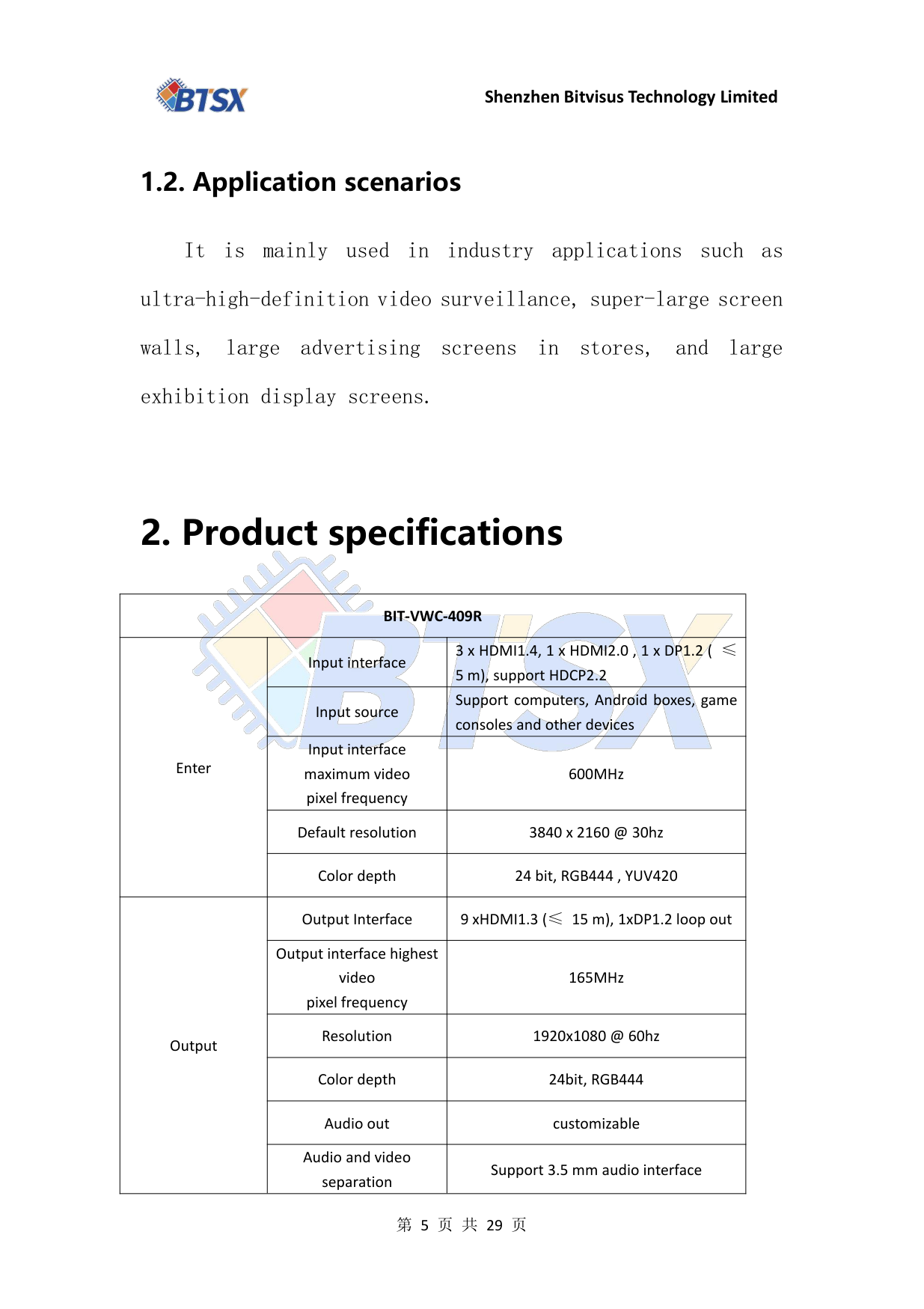
Application scenario and specification overview for the Bitvisus video wall controller family.
Bitvisus Video Wall Controller Model Comparison
The table below compares published interface, output and control specifications for the main Bitvisus video wall controller and multi-screen expander models. It is intended as a shortlisting aid; final configuration depends on the source count, the splice grid and the control system in the room.
| Model and type | Input interfaces | Output interfaces | Control and management | Typical fit |
|---|---|---|---|---|
| BIT-VWC-218Pro, 4K60 video wall controller | 2x HDMI 2.0, 2x DP 1.2 (cable up to 3 m) | 18x HDMI 1.3 (cable up to 15 m); 1920x1200P60, 1920x1080P60 | RS232, web interface, API for secondary development, network wake-up and software power on/off | High output-count 4K60 LCD walls in control and exhibition rooms |
| BIT-VWC-8K60Y-115Pro, 8K60 video wall controller | 1x HDMI 2.1 or 1x DP 1.4 (cable up to 3 m) | 15x HDMI 1.4 (cable up to 15 m); 1920x1200@60Hz, 1920x1080@60Hz | RS232, browser web control on multiple operating systems, API, HDMI CEC, DHCP, bezel setup | 8K source feeding a large 1200p or 1080p wall, M x N splicing up to 15 |
| BIT-VWC-8K60-404Max, 8K60 video wall controller | 5-channel 8K60 input card: 2x HDMI 2.1, 2x DP 2.1, 1x Type-C; DP 1.4 loop out | 4x HDMI 2.0; 3840x2160@60Hz, 3840x2400@60Hz | RS232, LAN web interface, API, modular hot-swap card design, 2U chassis | Multi-source 8K rooms needing up to four active sources and future board expansion |
| BIT-VWC-MD3636Ma, 4K60 seamless matrix splicer | Up to 36x HDMI 2.0 across up to 9 input boards | Up to 36x HDMI 2.0 across up to 9 output boards; 3840x2160P60 | RS232, web, button board, IR remote, WEB API, 12 presets, OSD, front LCD panel | Large seamless matrix walls; input-to-output latency below 40 ms |
| BIT-VWC-409R, rotating splicing processor | 3x HDMI 1.4, 1x HDMI 2.0, 1x DP 1.2 (cable up to 5 m) | 9x HDMI 1.3 plus 1x DP 1.2 loop out; 1920x1080@60Hz; up to 4 windows | IR remote, RS232, PC upper computer, cascading and parallel operation, OEM supported | 3x3 walls with rotation, portrait and multi-window layouts; 12 W consumption |
| BIT-MSE-8K60D-104Pro, 8K60 multi-screen expander | 1x DP 2.1 (cable up to 3 m), up to 7680x4800P60 | 4x HDMI 2.0 (cable up to 5 m); 3840x2400P60, 3840x2160P60, custom resolution | DIP switch, RS232, Ethernet web interface, EDID management, DHCP or static IP | 8K single-source 1x4 or 2x2 tiling and projection fusion racks |
| BIT-MSE-4K60-104Pro, 4K multi-screen expander | HDMI or DP (one selected, HDMI priority) | 4x HDMI; up to 4x 1920x1200@60Hz, 4x1 up to 7680x1200@60Hz | EDID modification over USB, 90 degree rotation splicing, parallel operation | Cost-efficient 4K tiling and multi-projector fusion |
Every model listed above carries a one-year after-sales service period. Where a project requires non-standard connectors, dedicated FPGA logic or private-label hardware, the modular chassis design allows input and output boards to be configured to the project rather than forcing the project to fit a fixed box.
Frequently Asked Questions
What certifications and warranty do Bitvisus video wall controllers ship with?
Bitvisus publishes a CE-EMC Declaration of Conformity for EN 55032:2015/A11:2020 and EN 55035:2017/A11:2020 under EMC Directive 2014/30/EU, an FCC Supplier's Declaration of Conformity under 47 CFR Part 15 Subpart B, and an EU RoHS Declaration of Conformity referencing IEC 62321 test methods and EN IEC 63000:2018. The controller models covered in this guide are listed with a one-year after-sales warranty. The full certificate list, together with return and shipping terms, is available from sales or from support@bitvisus.com, so it is worth requesting the exact documents your market requires before purchase.
Can a Bitvisus controller handle 8K input, and how many displays can one unit drive?
Yes, on the 8K models. The BIT-VWC-8K60Y-115Pro accepts one 8K60 signal over HDMI 2.1 or DP 1.4 and provides 15 HDMI outputs at 1920x1200@60Hz or 1920x1080@60Hz, with M x N point-to-point splicing where M and N are 15 or below. The BIT-VWC-8K60-404Max accepts five 8K60 input channels across 2x HDMI 2.1, 2x DP 2.1 and 1x Type-C with up to four active sources, and drives 4x HDMI 2.0 outputs at 3840x2160@60Hz. The BIT-MSE-8K60D-104Pro accepts one DP 2.1 input at up to 7680x4800P60 and drives 4x HDMI 2.0 outputs at up to 3840x2400P60 with custom resolution support.
How is pricing structured, and how is a project quote requested?
Prices published on the Bitvisus website are sample prices. Bulk and project pricing is quoted per configuration, because chassis size, board count, the input and output card mix and any custom function change the bill of materials. A quote can be requested through the Request Quote button on a product page, through the Ask for Quote form, which asks for name, email, phone and a project description, or through the chat widget on the product page. Supplying the source list, the splice layout and the control system in the request produces a more precise offer on the first pass.
Can I validate a controller with a sample order, and is OEM or ODM customisation available?
Bitvisus describes a sample-first path for project validation: place a sample order to test functions and integration, then move to bulk purchasing for better unit pricing once the sample is approved. OEM and ODM services are supported at FPGA, chip and whole-product levels, and the modular chassis design allows input and output ports to be configured to project requirements. Standard off-the-shelf models carry fixed functions, interfaces and housing with a shorter lead time and lower unit cost, while customised builds require a longer development cycle and a higher minimum order quantity, so technical documents should be exchanged before project evaluation.
What support is available after delivery, and what about lead time?
Each controller model is covered by a one-year warranty, and the packing list typically includes the device, a power supply, a remote control where applicable, a certificate and a warranty card. Technical support is available through support@bitvisus.com, sales enquiries through marketing@bitvisus.com, and phone or WhatsApp on +86 186 8150 9089; solution enquiries can also be submitted through the website form. Bitvisus operates a 2,000 square metre factory with an annual output of 100,000 units, around 70% of which is exported to the EU and USA, so production scale is established. Specific lead times and shipping terms are not published on the website and should be confirmed with sales when the quote is requested. To move to the next step, review the full specification set in the 2026 Bitvisus product brochure and then request a sample or a project quote.
Next Step: Sample, Quote or Technical Review
If your project involves a 3x3 monitoring wall, an 8K exhibition installation or a conference room with mixed sources, the fastest route to a correct configuration is to share the source list, the wall layout and the control system with Bitvisus and let the technical team recommend a model with the matching input and output boards.
Request a sample or project quote, or ask for supporting documentation such as the certificate list and the user manual for a specific model. Email: eddie.jia@bitvisus.com | WhatsApp and phone: +86 186-8150-9089 | Website: bitvisus.com | Brochure: 2026 Bitvisus Product Brochure (PDF)
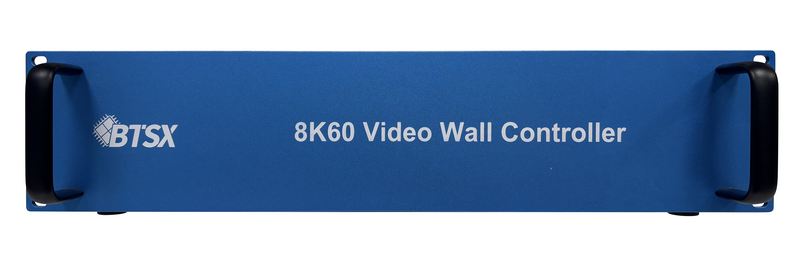
BIT-VWC-8K60-404Max: a 2U modular 8K60 video wall controller with five input channels and hot-swappable boards.
Conclusion
A video wall controller is best understood as the piece of infrastructure that decides whether a multi-screen room behaves as one display or as several. The market is expanding at a reported 7.8% CAGR through 2034, control rooms still account for roughly half of processor demand, and AV-over-IP now reaches the majority of new installations, which means buyers should evaluate processing architecture, output count, control integration and remote management together rather than choosing on screen count alone.
Bitvisus builds its video wall controllers around FPGA hardware processing, industrial-grade construction and flexible control options, from the 18-output BIT-VWC-218Pro to the 8K60 BIT-VWC-8K60Y-115Pro, the modular BIT-VWC-8K60-404Max, and the 36x36 BIT-VWC-MD3636Ma seamless matrix splicer. For research-stage buyers, the practical next step is to reduce the decision to four numbers, namely simultaneous sources, total outputs, per-screen resolution and control interface, and then confirm the remaining variables with the manufacturer directly.