Feature
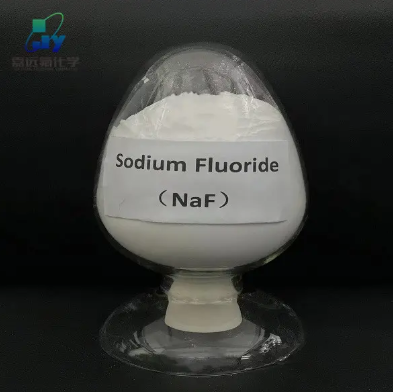
Sodium fluoride (NaF) is an ionic compound, colorless crystalline or odorless white solid at room temperature with weakly alkaline aqueous solution. It is a versatile basic fluorine raw material for anti-corrosion, fluxing, purification and reinforcement across industries.
For industrial anti-corrosion and treatment, it serves as wood preservative for utility poles and sleepers. It also works as steel cleaner and phosphating accelerator to stabilize phosphating baths and improve coating adhesion and corrosion resistance. It acts as smelting protective agent and aluminum electrolysis flux to cut energy consumption and upgrade metal purity.
For material enhancement, sodium fluoride is added into sealants and brake pads for better wear resistance. As concrete admixture, it improves corrosion resistance for chemical flooring and sewage tanks. In ceramics, glass and enamel, it functions as flux and opacifier to adjust glaze gloss and whiteness.
For special & civil uses, it is an anti-caries additive for drinking water and toothpaste in fluoride-deficient regions and used for caries treatment. Low doses assist osteoporosis and Paget’s disease treatment. It is feedstock for other fluorides and HF absorber, also used as UF₃ adsorbent in nuclear industry, brewing bactericide, agricultural insecticide and preservative.
Changzhou Jiayuan Chemical Co., Ltd. supplies high-purity sodium fluoride up to 99.95%, with strict control on Co, Cr, Ti, Cu, Fe, Mn, Ni, V. Packaging options: woven plastic bags, aluminum foil bags, fiber drums. Store in cool, dry, ventilated warehouse, segregated from oxidants and food additives. We provide COA and application guidance for your processes.
Product Advantages
Purity & Impurity Control
Purity: 99.95%. Spec: Co, Cr, Ti, Cu, Mn, Ni, V <5 ppm, Fe <10 ppm. Actual test: Co, Cr, Ti, Cu, Mn, Ni, V <1 ppm, Fe =6.2 ppm, loss on ignition =0.33% (better than 0.5% limit). Ultra-low impurities reduce side reactions, avoid contaminating electrolyte and molten metal, and ensure stable performance for sealants and brake pads.
Wide Application Coverage
It covers multiple scenarios: phosphating accelerator, corrosion-resistant concrete additive, glaze flux and opacifier, wood preservative, sterilant and dental raw material. One material simplifies your inventory management.
Physical Stability
Melting point ~993℃, boiling point ~1695℃. Stable at ambient temperature, convenient for storage and transport.
Service Advantages
Flexible packaging to match your feeding and storage conditions. We offer storage suggestions to prevent moisture and cross-contamination.
COA is available for incoming inspection. We provide dosage guides and process notes. Samples can be arranged for lab and pilot tests to lower your verification cost.
### Common Industry Pain Points
1. Excess metallic impurities ruin downstream results. High transition metals disturb aluminum electrolysis and phosphating, degrading aluminum purity and phosphate film quality. Nuclear and optical grades require heavy metals below 5 ppm, which standard industrial NaF cannot meet.
2. Batch purity fluctuation breaks formulation stability. Variable purity (93%–98%) or loss on ignition leads to inconsistent finished performance. Many small manufacturers lack batch testing and face rework or scrap.
3. Improper storage brings cross-contamination risks. NaF’s weak alkaline solution corrodes glass. Mixed storage with acids or oxidants may trigger reactions; moisture absorption causes caking and poor flow.
4. Lack of technical support. Parameters vary greatly: phosphating at 0.5–2 g/L, concrete dosage 0.5%–1.5% by cement mass. Most suppliers do not offer dosage and compatibility data, extending your trial cycle.
5. Limited high-grade supply and packaging choices. Low-iron, analytical and optical grades have unstable lead time. Fixed packaging options from other suppliers cause dust exposure and material loss during repackaging.
 ✓ Verified Elite Supplier