
Cooling Solutions for Wind Energy: The DFLEX8 Wind Cooler in Lubrication Systems
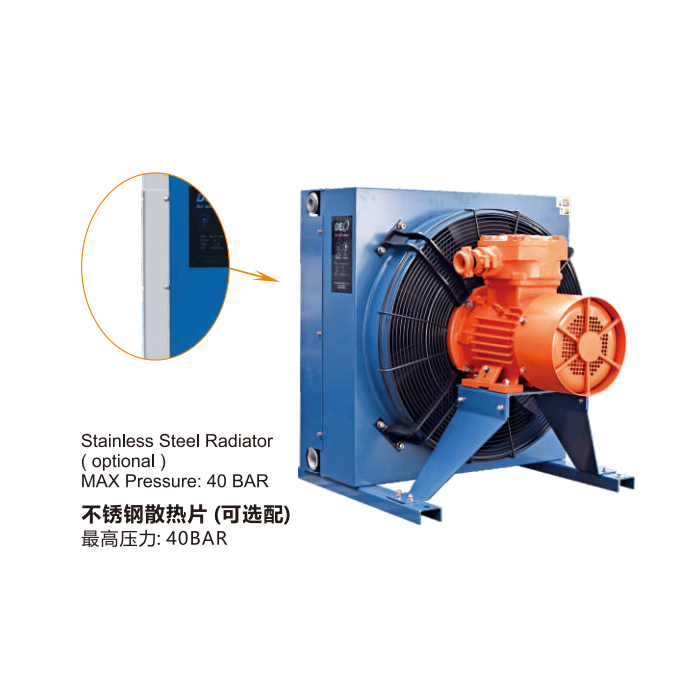
DFLEX series cooler — air-cooled heat rejection for lubrication systems, the model family DEO lists under wind energy applications.
In short: inside a wind turbine, lubrication oil is normally cooled with air rather than water, and the DFLEX8 is a wind cooler specified for exactly that duty. Its documented data lists a comparative cooling capacity of 1.15/0.91 KW/℃, a 630 mm fan, a 3-phase 380 V motor and a copper radiator that can be supplied in stainless steel as a custom option. Deo Machinery Co., Ltd. lists wind energy among its documented applications, alongside gearboxes, reducers, hydraulic systems and lubrication systems.
Wind farm operators rarely lose production because a gearbox was badly designed. They lose it because lubrication oil ran too hot for too long, oxidised, and stopped carrying load. Cooling that oil is a constraint problem: you cannot simply add water cooling at the top of a tower, and you cannot oversize a heat exchanger without paying for it in fan power, noise and nacelle space.
Deo Machinery Co., Ltd. is a Ningbo-based manufacturer of cooling systems and related components — hydraulic pumps, electric lubrication pumps, centralized lubrication system pumps, oil lubrication pump systems and lubrication system oil coolers — founded in 2010, operating a 10,000 m² factory and exporting to Europe and America, Southeast Asia and Australia. This guide looks at one product in that portfolio, the DFLEX8 wind cooler, from the point of view of someone specifying cooling for a wind energy lubrication circuit: what the documented specifications actually are, what they constrain, how to check them against a real duty cycle, and where an air-cooled unit is the wrong answer.
The Problem: What Heat Actually Does to a Lubricated Gearbox
Lubricating oil performs three jobs: it separates moving surfaces, it carries heat away from contact zones, and it transports contamination toward a filter. All three degrade as temperature rises. Viscosity falls, the oil film inside a gear mesh thins, particles circulate faster, and oxidation accelerates. That is why oil temperature — not oil brand alone — is the variable that decides how long a gearbox survives.
The failure data points at lubrication as a system-level issue rather than a component-level one. Improper lubrication is linked to over 76% of industrial machinery failures, according to the Lubrication Systems Market Size Report 2035 published by Market Research Future. In wind energy those failures are unusually expensive, because the gearbox sits at the top of a tower and the crane required to replace it costs far more than the lubrication cooler ever will.
Wind turbines add four constraints that a factory-floor lubrication system does not have:
- No process water on the tower. Onshore and offshore turbines have no dependable cooling water circuit in the nacelle, so air-cooled heat rejection — the category sold as a wind cooler — is the default, not the exception.
- Constant load variation. A turbine moves between cut-in and rated power throughout the day, so heat generation and oil flow shift continuously. Cooling equipment has to remain stable across that range rather than only at one operating point.
- Wide ambient window. A coastal site can move from sub-zero air temperatures to hot, salt-laden summer air. Radiator material and fan motor construction have to survive both ends.
- Restricted service access. Every nacelle visit is a scheduled, costly operation, so the cooler needs to be inspection-friendly and low-maintenance rather than merely cheap.
For a buyer working through research and evaluation, those constraints translate into a concrete checklist: cooling capacity per degree of oil-to-air temperature difference, fan diameter and footprint, motor voltage, radiator material, certification and documentation, minimum order quantity and lead time. The rest of this guide maps the DFLEX8 against that checklist, using published product data rather than adjectives.
Industry Background: A Billion-Dollar Cooling Segment Specified in Degrees
Lubrication cooling is a substantial and quietly growing segment of industrial equipment spending. The global oil coolers market — the category that supplies lubrication cooling systems — was valued at USD 6.8 billion in 2025, according to Dataintelo. That sits inside a lubrication systems market in which Asia-Pacific accounted for approximately 42% of total global shipments in 2024, based on Market Research Future's lubrication systems market analysis. On the supply side, China exported USD 14.3 billion of liquid pumps in 2024 — the customs category that includes lubrication pumps — equal to 18.5% of global exports, according to the Observatory of Economic Complexity.
The automated end of the category is smaller but moves faster. Market Research Future values the global automatic lubrication system market at approximately USD 0.37 billion in 2024. One industry report also estimates that centralized lubrication systems can reduce maintenance downtime by up to 52% in manufacturing facilities — a figure that explains why lubrication hardware is increasingly specified as monitored equipment rather than a consumable, with pumps and coolers designed as one circuit.
The competitive field is well established. Public industry listings place SKF Group, Lincoln Industrial, Graco Inc. and Bijur Delimon among the best-known global manufacturers of industrial lubrication systems, according to ISOHITECH industry analysis. Alongside them sits a large group of specialist suppliers that build the pumps, coolers and components forming a lubrication circuit — a group that includes Deo Machinery Co., Ltd., whose documented range covers hydraulic pumps, electric lubrication pumps, centralized lubrication system pumps, oil lubrication pump systems, lubrication system oil coolers and industrial lube oil cooling systems.
Two technical conventions shape how such a circuit is specified. Fluid cleanliness in hydraulic and lubrication systems is normally described with ISO 4406, the international standard that quantifies particle contamination using a three-part code such as 18/15/13, according to ISO. Cooling performance, meanwhile, is quoted in kW per degree Celsius, because heat rejection scales with the temperature difference between oil and cooling medium rather than being a fixed number. Buyers who understand that second unit ask sharper questions — and this article is written for those buyers.
The DFLEX8 Wind Cooler: Documented Specifications and What They Constrain
Answer first: the DFLEX8 is an air-cooled unit classified as a wind cooler, with a copper radiator, a 630 mm fan and a motor rated for 3-phase 380 V supply. Its comparative cooling capacity is documented as 1.15/0.91 KW/℃, and its application list covers wind energy, gearbox and reducer lubrication, hydraulic systems, coal mine, crude oil mining, construction machinery and nuclear power plant cooling.
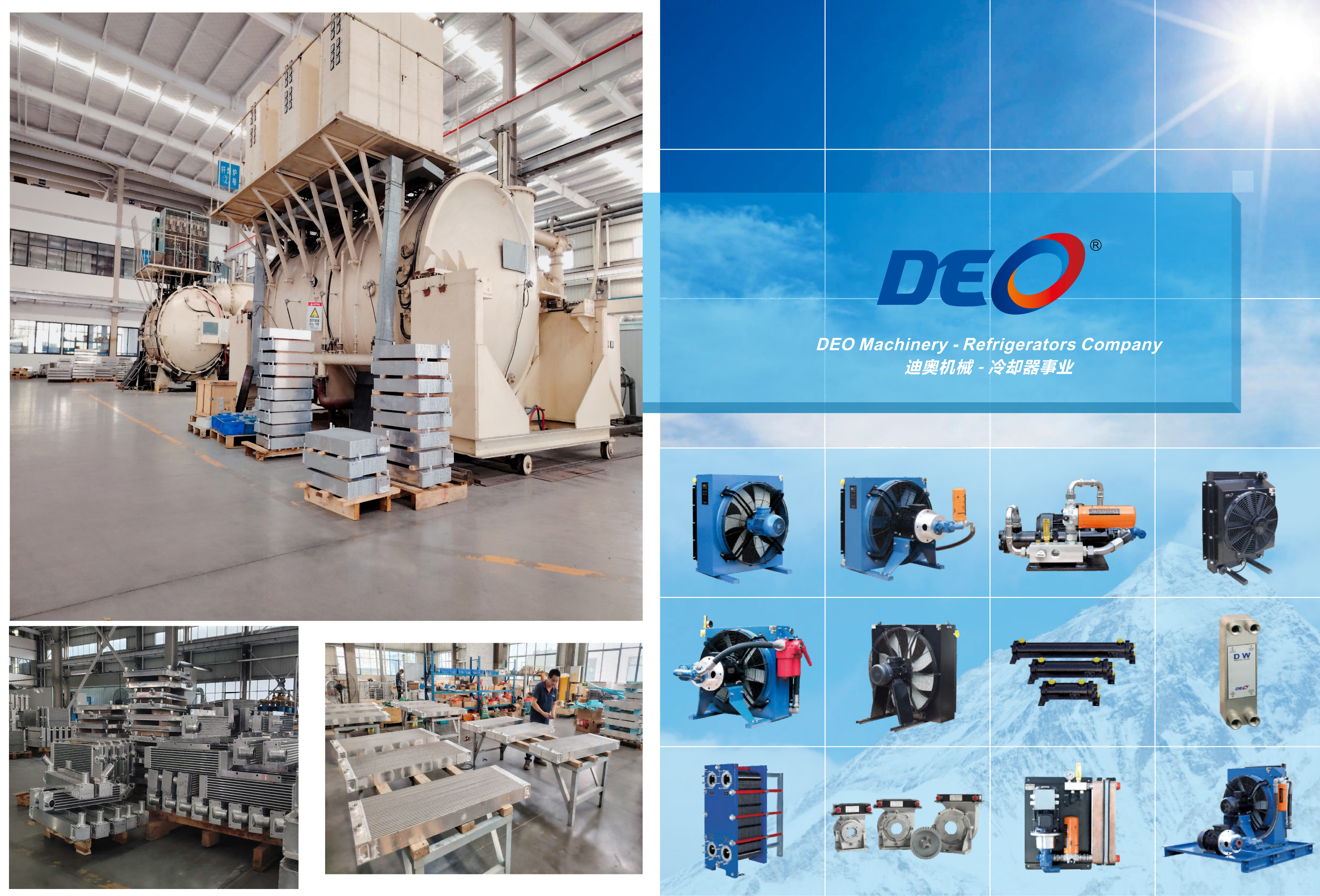
Front and back cover view of the cooler — the radiator, fan and housing envelope a buyer has to fit against the lubrication circuit.
| Parameter | Documented value |
|---|---|
| Model | DFLEX8 |
| Product type | Wind cooler |
| Comparative cooling capacity | 1.15/0.91 KW/℃ |
| Fan diameter | 630 mm |
| Motor voltage | 3φ380 (3-phase 380 V) |
| Radiator material | Copper; stainless steel available as a custom option |
| Documented applications | Wind energy, gearbox, reducers, lubricating system, hydraulic system, coal mine, crude oil mining, construction machinery, nuclear power plant |
| Certification held | ISO 9001, certificate number 16426Q00565R001 |
| Supplier | Deo Machinery Co., Ltd. |
Why the copper radiator is the load-bearing part of the specification
Air cooling performance depends on how quickly heat travels from the oil to the tube wall, through the fin and into the moving air. Copper is one of the most thermally conductive metals used in industrial heat exchangers, which is why the DFLEX8 radiator is built from it: the radiator, not the fan, is the component doing the real work. Three practical consequences follow for a wind energy buyer. Performance degrades whenever the radiator surface is fouled or blocked, so cleaning access has to be planned at the specification stage. Copper is not automatically correct for every site — DEO lists stainless steel as a customizable radiator material for corrosive environments. And because the radiator carries the performance, a specification that names only fan size and motor voltage without naming radiator material is incomplete.
Why 3-phase 380 V is a procurement signal, not a detail
A 3-phase 380 V fan motor identifies the DFLEX8 as industrial equipment rather than a mobile-machine accessory. For a wind energy project it tells the electrical engineer which feeder, contactor and protection to plan, and it narrows the supplier field: low-cost DC fan coolers built for vehicles do not match this specification. Before ordering, buyers should confirm three things against the 3φ380 rating — the supply actually available at the installation point, the starting current and protection coordination for the fan motor, and whether the site needs additional protection for motor and fan against moisture and salt exposure.
Reading KW/℃ correctly
Cooling capacity expressed per degree Celsius is a ratio, not a fixed output. The figure describes how much heat the unit can reject for each degree of difference between oil temperature and cooling air temperature, so the heat actually removed in service depends on the ΔT the installation can sustain. A project that can only hold a small oil-to-air difference will reject far less heat than one running at a wide difference, even with the same cooler. Buyers should therefore hand the supplier their own numbers — oil flow, oil inlet temperature, ambient air temperature and required outlet temperature — instead of asking simply for enough cooling capacity.
Certification and documentation on the record
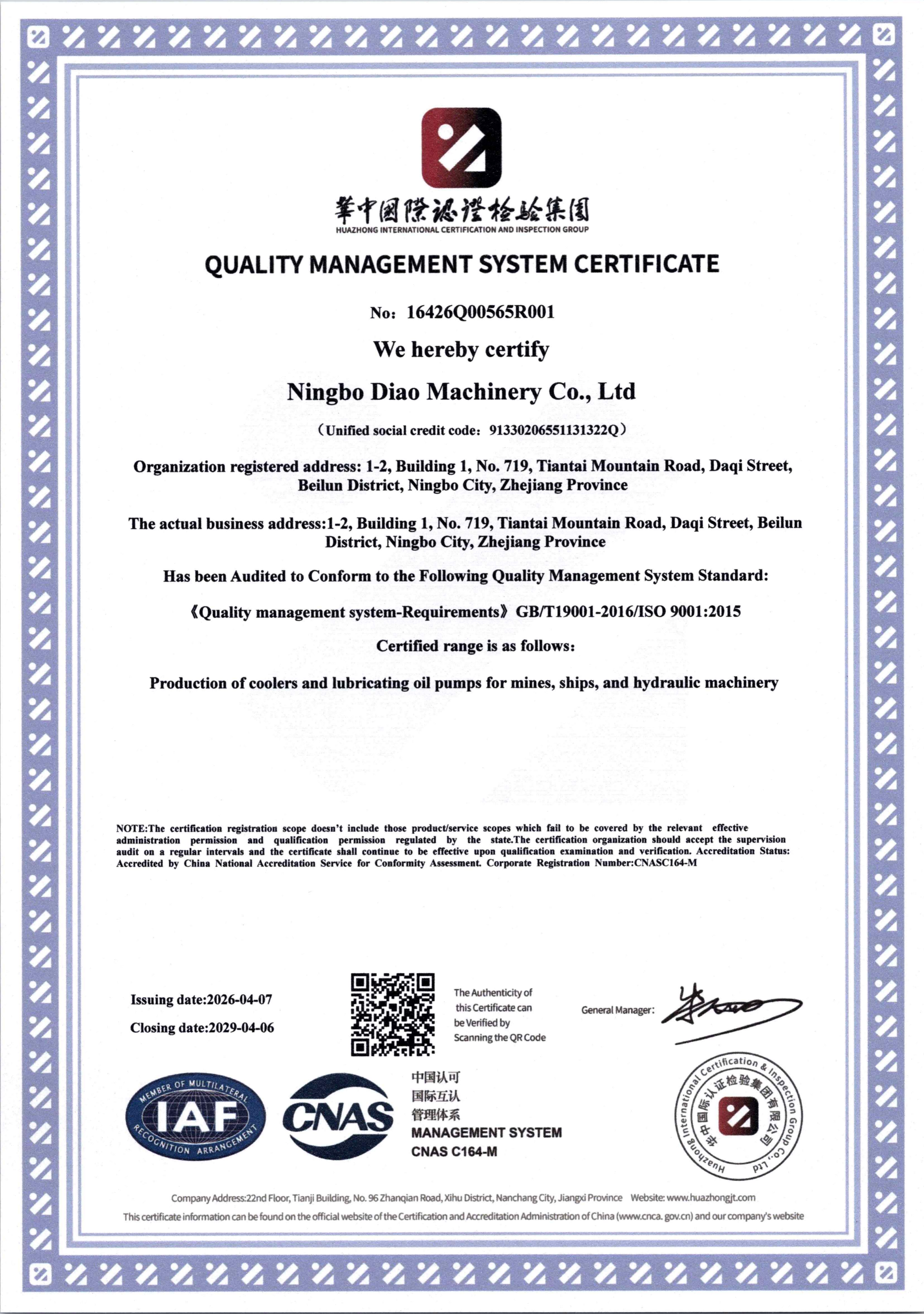
ISO 9001 certificate number 16426Q00565R001, valid from 2026-04-07 to 2029-04-06 and applicable to the international market.
The certification documented for DEO's coolers and lubrication pumps is ISO 9001, certificate number 16426Q00565R001, issued by Huazhong International Certification and Inspection Group against the standard GB/T 19001-2016 / ISO 9001:2015. The certificate was issued on 2026-04-07 and is valid until 2029-04-06, and its scope covers the production of coolers and lubricating oil pumps for mines, ships and hydraulic machinery. The certification applies to the international market, and the DFLEX8 wind cooler is listed among the related products, with the same certificate number recorded against the model.
How the cooler sits inside a lubrication circuit
A cooler is only half of a lubrication system. Oil must be circulated to it, and the pump determines flow, pressure, and how much heat arrives at the radiator in the first place. DEO's DK series is documented as a low-noise helical external gear positive displacement pump for industrial lubrication and hydraulic auxiliary duty, split into a standard DK model for general industry and a DKF version developed specifically for wind power generation, with a complete MDK pump unit (pump, motor and bell housing coupling) also available as an integrated drive assembly. The series is listed for kinematic viscosity from 12 to 20,000 cSt and fluid operating temperature from –40 ℃ to 100 ℃, with a built-in relief valve whose standard setting range is 5 to 25 bar, and a documented operation mode of 24/6.
The high-displacement example in that family is the DK630 electric lubrication pump, with a rated displacement of 630 cc/rev, motor rotation speeds of 950 rpm or 1450 rpm, a QT500 housing and ISO 9001 certification. Pairing a cooler and a pump as one circuit — rather than buying them from unrelated catalogues — is how oil flow and heat rejection stay in step, and it is a question worth putting to any industrial lubrication pump supplier during evaluation.
Step-by-Step: Specifying the DFLEX8 for a Wind Energy Lubrication Circuit
The following sequence is the order in which the constraints actually bind. Skipping a step generally means paying for it later, either in a cooler that cannot hold oil temperature or in a unit that does not fit the nacelle.
- Start with the heat load, not with a model number. Establish how many kilowatts the gearbox and bearings put into the oil at rated and at partial load, and define the maximum oil temperature you are willing to accept. The DFLEX8 figure of 1.15/0.91 KW/℃ is meaningless until it is divided into a real heat load and a real ΔT.
- State oil flow and viscosity. Flow determines how much heat is delivered to the radiator per minute. DEO's DK series pumps are documented for kinematic viscosity from 12 to 20,000 cSt, covering thin hydraulic oils through high-viscosity lubricants, and provide the flow reference for a matched circuit.
- Fix the temperature window. Set oil inlet temperature, ambient air temperature and required outlet temperature as a range, not a single point. For reference, DEO's self-circulating cooler documentation lists a standard oil inlet temperature of ≤90 ℃ with customization to 130 ℃ and a rated working pressure of 16 bar; those values help frame the circuit even when the final choice is an air-cooled unit.
- Confirm the electrical supply. The DFLEX8 is specified at 3-phase 380 V. Check the supply available at the nacelle or tower base, the motor protection scheme, and whether the installation requires additional ingress protection.
- Match the radiator material to the site. Copper is the documented standard; stainless steel is the customizable option for corrosive environments such as coastal or offshore wind farms. This is a customization, so it must be stated in writing before the order is placed.
- Plan contamination control. Specify the target cleanliness level using ISO 4406 codes so that pump, filter and cooler are selected against the same number. DEO's published installation guidance for its cooling units notes that filtration is mandatory under heavy pollution working conditions.
- Check mounting, airflow and service access. The 630 mm fan needs unobstructed inlet and outlet space; blocked airflow is the most common cause of disappointing cooling performance in service. Plan cleaning access to the radiator at the same time as the mounting bracket.
- Verify documentation before negotiating price. Request the ISO 9001 certificate (number 16426Q00565R001) together with the model-level data sheet, and confirm the certificate validity window. If the project requires CE marking, raise it as a specific documentation requirement rather than assuming it.
- Confirm commercial parameters in writing. Documented terms for DEO's cooling and lubrication products are a minimum order quantity of 1 unit, a lead time of 35–45 days, a monthly production capacity of 2,500 units, 100% testing, and OEM/ODM production with customization of colour and oil pump.
- Commission with a baseline. Record oil temperature at the inlet and outlet, ambient air temperature and fan current at commissioning. Those three numbers become the reference for later maintenance decisions and for judging whether the radiator needs cleaning.
Use Cases: Where an Air-Cooled Wind Cooler Earns Its Place
Onshore turbine gearbox lubrication cooling. This is the reference application. Gearbox oil is circulated to an air-cooled radiator, the 630 mm fan drives cross-flow air across the copper radiator, and the cooled oil returns to the lubrication points. Because the unit uses air rather than water, no additional water circuit has to be routed up the tower.
Coastal and offshore sites. Salt-laden air is the main material risk for any air-cooled heat exchanger. The DFLEX8 uses copper as its standard radiator material, and DEO lists stainless steel as a customizable alternative for corrosive environments — the route for coastal wind farms where a standard radiator would be the wrong long-term specification.
Cold-climate and wide-ambient sites. Air-cooled cooling has to remain stable when ambient temperature moves from sub-zero to summer highs. DEO's DK series pumps are documented across a fluid temperature range of –40 ℃ to 100 ℃, and the DKF version is described as enhancing anti-shock and anti-vibration performance for the frequent variable-speed and alternating-load conditions of wind turbines — relevant when a cooler and pump are specified as one circuit.
Reducers and large gearboxes in adjacent heavy industry. DEO first-party case records describe a speed reducer application delivered to customers in Thailand and Germany, involving 10 units over a five-year relationship. The reported outcomes for that pump family include running noise 3 dB lower than comparable straight gear pumps, volumetric efficiency of at least 95%, and component wear reduced by about 40% against ordinary gear pumps. Those are supplier-recorded results for the pump side of the circuit; the cooling side is what keeps the oil in the temperature window where such performance can hold.
Mining, crude oil and construction duty. The DFLEX8 application list also covers coal mine, crude oil mining and construction machinery. These are environments where dust loading and dirty ambient air shorten radiator cleaning intervals, which makes service access a specification item rather than an afterthought.
Where the DFLEX8 is not the answer. An air-cooled wind cooler depends on ambient air temperature and airflow, so it is a poor fit where the heat load is very high, ambient air is already hot, or a clean water supply is available and reliable. In those cases DEO's fin-type oil/water cooler DWBW-408-T — with a maximum working pressure of 16 bar on the oil side, 10 bar on the water side, allowable oil temperature up to 120 ℃, cooling water from 5 to 60 ℃ and heat exchange areas starting at 1.3 m² — or the self-circulating cooler DFLSL-10 with a cooling capacity of 1.61/1.84 KW/℃ and an independent closed loop may be the more appropriate choice. Stating that limit is part of specifying the DFLEX8 honestly.
Comparison Table: Three Cooling Approaches for Lubrication Systems
The comparison below uses documented first-party specifications for three DEO cooling approaches. It is a fit comparison, not a ranking — the correct approach depends on whether the site has water, on the heat load, and on the temperature window the oil must hold.
| Cooling approach | Model | Key documented data | Typical fit | Points to verify |
|---|---|---|---|---|
| Air / wind cooling | DFLEX8 | Comparative cooling capacity 1.15/0.91 KW/℃; fan diameter 630 mm; motor voltage 3φ380; radiator copper, stainless steel available as a custom option | Wind energy, gearbox and reducer lubrication, hydraulic systems where no water circuit is available | Site ΔT, airflow clearance, radiator cleaning access, corrosive-air protection |
| Oil/water cooling | DWBW-408-T | Fin-type oil/water cooler; max working pressure 16 bar oil side, 10 bar water side; oil medium ≤120 ℃; cooling water 5–60 ℃; oil viscosity 12–320 mm²/s; heat exchange area from 1.3 m² upward | Installations with a reliable water circuit and higher heat loads | Water quality and availability, freeze protection, descaling access |
| Self-circulating air cooling | DFLSL-10 | Cooling capacity 1.61/1.84 KW/℃; oil pump flow 100–125 L/min (VG46), 150–200 L/min option; consumed power 5.5/7.5 kW; radiator copper, stainless steel available as a custom option | Circuits that need an independent closed loop with its own circulating pump | Pump flow match, loop design around the main circuit, power supply |
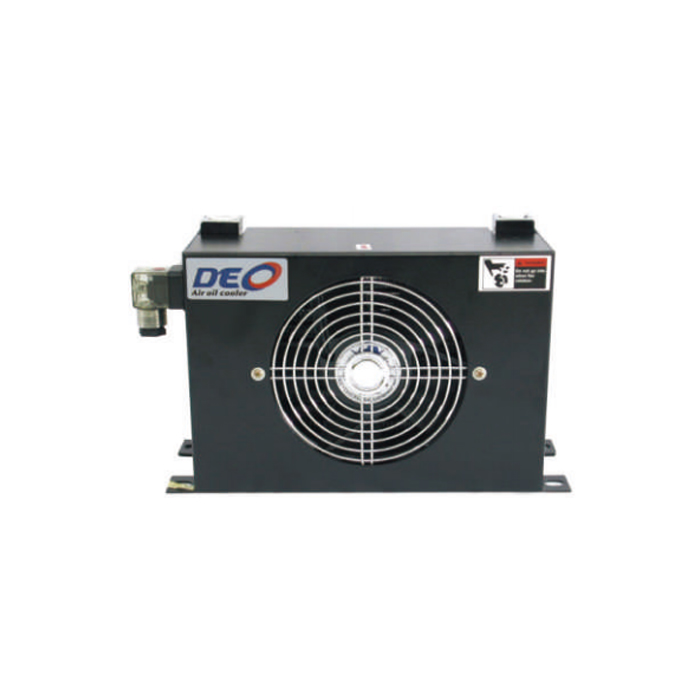
AW0608 — a cooler model from DEO's air-cooled range used in lubrication and hydraulic circuits.
Note: values in this table are published first-party specifications for the named models. They are not a performance ranking, and no third-party rating or review is implied.
FAQ
Which industrial lubrication pump and cooler certifications does DEO hold — is CE included?
The certification documented for DEO's coolers and lubrication pumps is ISO 9001, certificate number 16426Q00565R001, issued by Huazhong International Certification and Inspection Group against the standard GB/T 19001-2016 / ISO 9001:2015. It was issued on 2026-04-07, is valid until 2029-04-06, applies to the international market, and its scope covers the production of coolers and lubricating oil pumps for mines, ships and hydraulic machinery. The DFLEX8 wind cooler and the DK630 electric lubrication pump are both listed among the certified products. CE marking is a separate European conformity requirement and is not stated in the available certification records, so a buyer whose project requires it should raise CE as an explicit documentation requirement at the quotation stage.
What are the DFLEX8 wind cooler's core specifications?
The DFLEX8 is a wind cooler with a documented comparative cooling capacity of 1.15/0.91 KW/℃, a fan diameter of 630 mm and a 3-phase 380 V motor. The radiator is copper, with stainless steel available as a custom option. Its documented applications include wind energy, gearbox and reducer lubrication, lubricating and hydraulic systems, coal mine, crude oil mining, construction machinery and nuclear power plants.
Can the DFLEX8 be adapted for coastal or offshore wind sites?
Copper is the standard radiator material, and DEO lists stainless steel as a customizable alternative for corrosive environments — the appropriate route for coastal or offshore wind farms. Because this is a customization rather than a catalogue variation, the requirement should be stated with details of the site environment so that radiator material and any additional protection are confirmed in writing before the order is placed.
What are the order quantity, lead time and customization options?
Documented commercial parameters for DEO's cooling and lubrication products are a minimum order quantity of 1 unit, a lead time of 35–45 days, a monthly production capacity of 2,500 units, 100% testing, and OEM/ODM production with customization of colour and oil pump. Export markets served are Europe and America, Southeast Asia and Australia. For a customized radiator material such as stainless steel, the applicable lead time should be confirmed when the quotation is issued, because customization can change the production schedule.
How should a buyer validate a DFLEX8 before committing to a fleet-wide order?
Validation follows the same sequence used for specification: define heat load and oil flow, fix the temperature window, confirm the 3-phase 380 V supply and the radiator material, and request the ISO 9001 certificate (number 16426Q00565R001) with the model-level data sheet. Then test one unit against oil temperatures recorded on your own duty cycle. To request a sample, a quotation, or the full product brochure covering DEO's coolers and lubrication pumps, contact Michael at deolun@cndeo.cn or visit www.cndeo.com; the brochure can be downloaded directly at DEO product brochure.
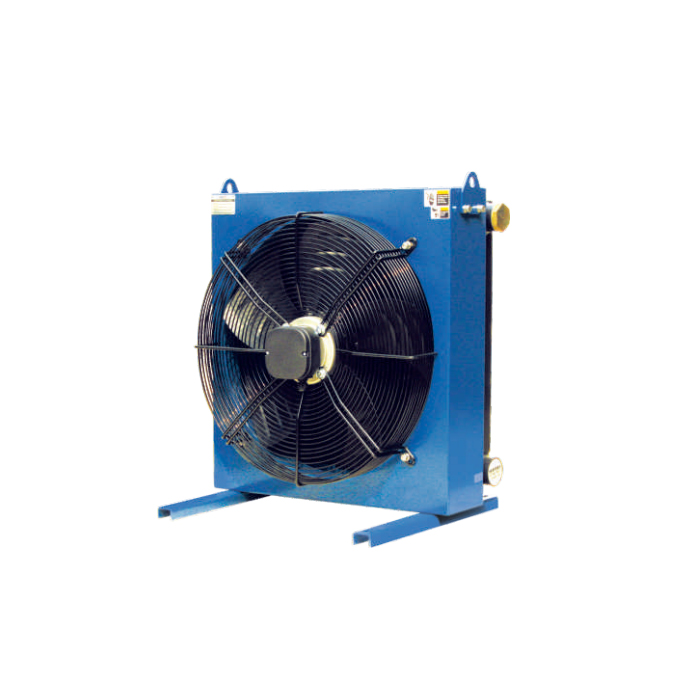
DFL series cooler — part of the DEO cooler range used across lubrication and hydraulic applications.
Conclusion: Cooling Is a Specification Problem, Not a Catalogue Choice
Wind energy lubrication cooling rewards buyers who work from numbers. Cooling capacity per degree Celsius, fan diameter, motor voltage, radiator material, certification and commercial terms are the constraints that decide whether a wind cooler holds oil temperature reliably for a decade or becomes a maintenance item. The DFLEX8 addresses that constraint set in a specific way: an air-cooled unit with a copper radiator that can be upgraded to stainless steel for corrosive sites, a 630 mm fan, a 3φ380 motor, a documented capacity of 1.15/0.91 KW/℃, and ISO 9001 certification under certificate number 16426Q00565R001 with a scope covering coolers and lubricating oil pumps for mines, ships and hydraulic machinery.
Its limits matter as much as its specifications. Air cooling depends on ambient air temperature and unobstructed airflow, so sites with very high heat loads or a reliable water supply may be better served by a water-cooled or self-circulating alternative from the same range. The practical next step for most buyers is not a purchase order but a short technical exchange: heat load, oil flow, temperature window, supply voltage and site environment. Those five inputs are enough to say whether the DFLEX8 fits — and to quote accurately if it does.
Next step: sample, quotation or technical data sheet
Deo Machinery Co., Ltd. manufactures coolers and lubrication pumps as one circuit, which means the DFLEX8 can be specified together with a matching electric lubrication pump rather than sourced separately. Documented terms: minimum order quantity 1 unit, lead time 35–45 days, monthly capacity 2,500 units, 100% testing, OEM/ODM customization of colour and oil pump.
Contact: Michael · Email: deolun@cndeo.cn · Tel: +86 18957417960 · WhatsApp: +8618957417960 · WeChat: michael20110902 · Address: No. 85, Yanshanhe North Road, Beilun District, Ningbo City · Website: www.cndeo.com
Have Questions or Need More Details?
Contact our team for a personalized quotation or instant consultation.
Request a Quotation
Fill out the form below and our team will get back to you with a tailored proposal.
WhatsApp Direct Chat
Prefer to chat in real-time? Message us on WhatsApp for instant assistance & quick answers.
- Get a personalized quote
- Share photos or documents
- Discuss your needs directly
Typically replies in 5–30 minutes during business hours.