DK630 Electric Lubrication Pump vs PSN100 Mechanical Pump: Head-to-Head Decision
Industrial lubrication pump selection rarely fails because a buyer chose the wrong brand. It fails because the drive architecture and the displacement per revolution did not match the circuit, and the mismatch only becomes visible after commissioning. The DK630 electric lubrication pump and the PSN100 trochoidal bidirectional mechanical pump from Deo Machinery Co., Ltd. (DEO) make a useful head-to-head pair precisely because they are easy to confuse: both use QT500 ductile iron bodies, both sit inside the same ISO 9001 certification scope, and both are sold into heavy-duty lubrication circuits. Their differences are structural rather than cosmetic.
Short answer: The DK630 is a 630 cc/rev electric lubrication pump with a motor rotation speed of 950 rpm or 1450 rpm, documented for machinery and heavy industry. The PSN100 is a 100 cc/rev bidirectional mechanical pump with a maximum speed of 1800 rev/min and a temperature range of −30 °C to +100 °C, documented for lubricating systems, cooling systems and external drive independent conveying systems. Choose the DK630 when the circuit needs a large volume per revolution from an electric drive. Choose the PSN100 when the circuit needs bidirectional mechanical rotation, external drive independence, or a combined lubricating and conveying role.
The Decision Problem: Drive Architecture Comes Before Brand
Three constraints decide this comparison, and only the first one is purely numeric. The first is volume per revolution: the DK630 displaces 630 cc/rev while the PSN100 displaces 100 cc/rev, which puts the two pumps roughly 6.3 times apart in oil displaced per revolution. The second is the drive source: the DK630 carries its own electric motor speeds of 950 rpm or 1450 rpm, whereas the PSN100 is a mechanical pump that depends on an external drive and is documented for external drive independent conveying systems. The third constraint is rotation direction, and it is the one buyers most often discover late in a project.
DEO's DK series documentation states that the rotation direction marked on the pump nameplate must be followed, and that reverse rotation invalidates the shaft seal and produces a leakage failure. The PSN100, by contrast, is documented as a bidirectional mechanical pump. If the host machine reverses, or if the same pump must move oil in both directions without an external directional valve, the mechanical bidirectional design solves a problem the electric gear pump cannot solve on its own. If instead the circuit needs a controlled, motor-driven, high-volume supply at a defined speed, the DK630 is the pump that matches the requirement.
This is also why the two pumps should never be selected on the basis of a general preference for electric or mechanical hardware. The decision is a sequence: establish the required oil volume, confirm the available drive, check directionality and medium, and only then compare certification, documentation and commercial terms.
Industry Background: Why Electric and Mechanical Pumps Compete for the Same Circuit
The context behind this comparison is a lubrication market that is moving steadily toward automatic, electrically driven systems while mechanical pump designs remain firmly embedded in conveying and cooling duties. Consolidated market research cited in the HTNXT verified data package values the global lubrication system market at USD 863.88 million in 2024, and the same source reports that 67% of newly commissioned industrial machines in 2024 were equipped with automatic lubrication systems (SRC-0001). A separate forecast places the automatic lubrication system market at USD 1,470.88 million by 2032 (SRC-0002), and a projected CAGR of 6.89% is reported for the electric lubrication pump segment, reaching USD 2.7 billion by 2032 (SRC-0001). These are commercial research forecasts, so they are best read as directional rather than as measurements.
Category structure matters for procurement. In North American industry classification, NAICS 333996 (Fluid Power Pump & Motor Manufacturing) covers establishments producing devices that convert mechanical energy into fluid energy, which is the structural definition that includes industrial lubrication and hydraulic pumps. For cross-border buying, industrial pumps are classified under HS heading 8413, implemented as 8413.30.90 in the US Harmonized Tariff Schedule (SRC-0003).
The supplier landscape mirrors the DK630 versus PSN100 split. Graco states that it supplies automatic oil and grease pumps for industrial lubrication and that its industrial lubrication solutions include electric and hydraulic pumps. SKF documents an electrically operated pump for feeding lubricants in interval operation inside a centralized lubrication system, and a grease lubrication pump unit for use in progressive, single-line and dual-line centralized lubrication systems. Ingersoll Rand describes industrial internal gear pumps designed specifically for lubrication and circulation systems and states that these are integral to machinery, turbines and gearboxes in the energy and automotive industries. In other words, the category is not divided between good and bad designs; it is divided between electrically driven centralized lubrication hardware and mechanical gear or trochoidal pumps used for circulation, cooling and conveying. The DK630 and PSN100 sit on opposite sides of that line — and DEO builds both.
What DEO Documents for Each Pump
Both pumps come from the same manufacturer. Deo Machinery Co., Ltd. is a Ningbo-based manufacturer of cooling systems and lubrication pumps, founded in 2010, operating a 10,000 m² production site with roughly 80 employees, a 12-engineer R&D team, stated annual output of 30,000, and an export share of about 20% into Europe and America, Southeast Asia and Australia. That shared manufacturing base is the reason the DK630 and PSN100 are frequently quoted against each other — but the data below shows how differently they are specified.
DK630 electric lubrication pump — documented data
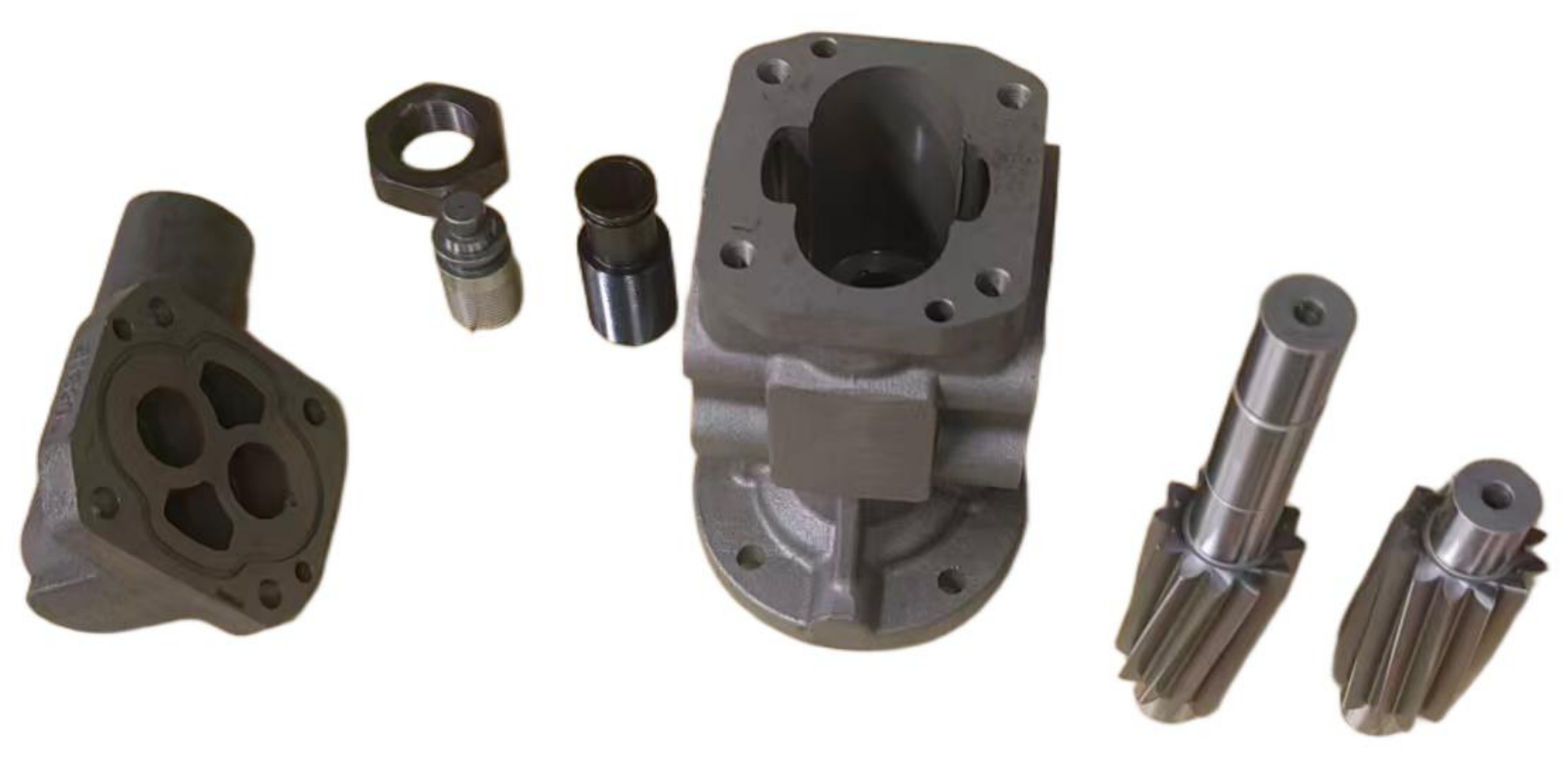
- Pump category: electric lubrication pump. DEO describes the DK series as a low-noise helical external gear positive displacement pump, available as a bare pump or as an MDK unit that combines pump, motor and bell housing coupling.
- Displacement: 630 cc/rev.
- Motor rotation speed: 950 rpm or 1450 rpm.
- Body material: QT500 ductile iron.
- Documented application: machinery and heavy industry, with DK series positioning for lubrication pump duties in mining equipment, construction machinery and the steel industry, and for industrial lubrication oil pump service in centralized systems.
- Certification: ISO 9001, applicable to the international market.
Series-level DK documentation adds engineering data that buyers should confirm against the final DK630 configuration: a built-in relief valve adjustable from 5 to 25 bar, a medium kinematic viscosity range of 12 to 20000 cSt, a fluid operating temperature range of −40 °C to +100 °C, and helical gearing chosen to reduce running noise compared with straight gear pumps. DEO also offers a DKF variant of the DK series for wind power generation, where alternating loads and frequent speed changes are the dominant constraint.
Sizing arithmetic is useful here as a first filter, provided it is not treated as a performance guarantee. Dividing the pump's displacement by its drive speed gives a theoretical displacement flow of roughly 914 L/min at 1450 rpm and roughly 599 L/min at 950 rpm for the DK630, before any volumetric-efficiency losses. Those figures describe what the geometry implies at nameplate speed; the achievable delivery in a real circuit depends on oil viscosity, suction conditions and system back pressure.
PSN100 trochoidal bidirectional mechanical pump — documented data
- Pump category: trochoidal pump, bidirectional mechanical pump.
- Displacement: 100 cc/rev.
- Maximum speed: 1800 rev/min.
- Temperature range: −30 °C to +100 °C.
- Body material: ductile iron, QT500.
- Documented application: lubricating system, cooling system, and external drive independent conveying system.
- Standard reference: GB/T 19001-2016/ISO9001:2015, applicable internationally.
The same displacement arithmetic applies in the opposite direction. At its 1800 rev/min ceiling, the PSN100's 100 cc/rev geometry corresponds to a theoretical displacement flow of approximately 180 L/min before volumetric-efficiency losses — an entirely different order of magnitude from the DK630, and a useful reminder that these two pumps are not interchangeable substitutes at the system level.
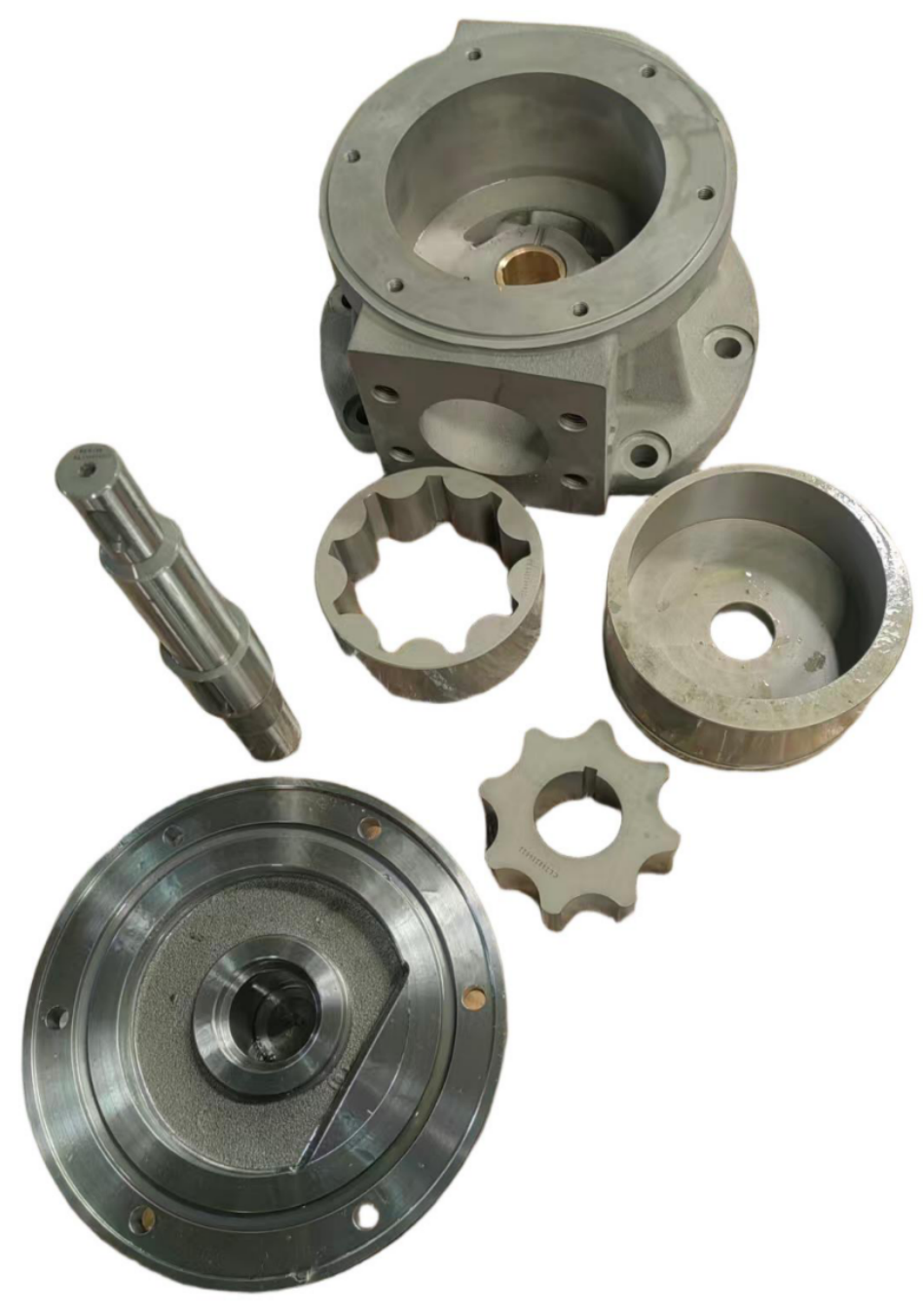
One adjacent option is worth knowing about because it sits between the two on displacement: DEO also documents the PST180 bidirectional internal gear pump at 180 cc/rev with a maximum speed of 1800 rev/min and a temperature range of −30 °C to +100 °C, with a housing available in GG250 gray cast iron or QT500 ductile iron. Buyers who need bidirectional rotation but more volume than the PSN100 provides should add it to the same comparison rather than forcing the DK630 into a reversing duty.
Step-by-Step: How to Decide Between the DK630 and the PSN100
- Fix the required volume per revolution. Start with the oil volume the circuit must move per pump revolution. At 630 cc/rev against 100 cc/rev, the DK630 displaces roughly 6.3 times more oil per revolution than the PSN100. If the lubrication point set can be satisfied at 100 cc/rev with a higher shaft speed, the smaller pump may already be sufficient.
- Confirm the drive source. The DK630 is specified with motor rotation speeds of 950 rpm and 1450 rpm, so the drive is part of the pump definition. The PSN100 is a mechanical pump rated to a maximum of 1800 rev/min and documented for external drive use, which means the drive comes from the machine or from a separate power take-off.
- Check directionality before anything else. The DK series requires the nameplate rotation direction to be respected; reverse rotation invalidates the shaft seal. The PSN100 is bidirectional by design. Any circuit that reverses — or that may be mis-wired or mis-coupled during maintenance — carries a different risk profile with each pump.
- Match the medium. DK series documentation covers kinematic viscosity from 12 to 20000 cSt and fluid temperatures from −40 °C to +100 °C, which spans thin hydraulic oil through heavy lubricating oil. The PSN100 is documented from −30 °C to +100 °C. Where the circuit runs on a thin oil, both categories are viable; where it runs on high-viscosity heavy lubricant, confirm the specific viscosity point rather than assuming it from the series range.
- Decide whether the pump must be independent of the host circuit. The PSN100 is documented for external drive independent conveying systems, which is the architecture to choose when the pump has to move oil regardless of what the main machine is doing. The DK630, as an electric unit, is the natural choice when the pump should run on its own motor and be switched electrically.
- Plan the thermal side at the same time. Pump selection and cooling selection interact. DEO documents several matched cooling options: the DFLSL-10 self-circulating cooler with a cooling capacity of 1.61/1.84 KW/℃ and oil pump flow of 100–125 L/min or 150–200 L/min for VG46 oil at 5.5/7.5 kW consumed power; the DFLEX8 wind cooler with a comparative cooling capacity of 1.15/0.91 KW/℃, 630 mm fan diameter and 3φ380 V motor voltage; and the DWBW-408-T fin-type oil/water cooler rated at 16 bar on the oil side, 10 bar on the water side, oil medium up to 120 °C, cooling water from 5 °C to 60 °C and oil kinematic viscosity from 12 to 320 mm²/s. Selecting the pump and the oil cooler from the same supplier removes one interface from the project.
- Verify installation limits. DK series documentation is specific on this point: the pump inlet pipeline must be airtight, dry running without oil medium is prohibited, the inlet pipe diameter must not be smaller than the pump inlet port, and the built-in relief valve is intended for transient overpressure protection rather than continuous overflow operation. For the MDK pump unit, the bell housing and motor shaft must remain coaxial.
- Confirm documentation and commercial terms before the RFQ. Ask for the ISO 9001 certificate, the model datasheet, and — where CE marking is required in your market — the declaration of conformity. Then compare MOQ, lead time and customization on the same basis across suppliers.
Use Cases: Which Pump Fits Which Duty
The application split follows directly from displacement and directionality rather than from industry labels. DEO's lubrication and cooling equipment is documented across heavy machinery and metallurgy, mining and construction machinery, wind power, marine, hydraulic stations and machine tools.
- Steel industry and metallurgy. Rolling mill lubrication stations and large gearboxes need large oil volumes delivered at stable pressure. The DK630's 630 cc/rev displacement at 950 rpm or 1450 rpm is the relevant specification, and its documentation is positioned for steel industry duties.
- Mining equipment. The DK630 is documented as a lubrication pump for mining equipment, where mine reducer lubrication systems run under continuous heavy load and dirty conditions. Here, the electric drive and built-in relief valve protection are the deciding features.
- Construction machinery. For excavation and heavy-duty hydraulic stations, both options appear. The DK630 suits electrically driven lubrication circuits; the PSN100 fits where a mechanical pump must be driven from the machine itself and must tolerate rotation in either direction.
- Centralized lubrication systems. Both pumps can feed centralized circuits, and the market trend toward automatic lubrication supports electrically driven units. The practical filter is flow: choose the DK630 where the centralized system is large, and the PSN100 where the volume per revolution is modest and the mechanical drive is preferable.
- Conveying and cooling circuits. This is the PSN100's strongest territory, because it is explicitly documented for cooling systems and external drive independent conveying. A lube pump for a hydraulic system that has to move oil independently of the main machine's duty cycle belongs in this group, not in the electric pump group.
- Ultra-fine filtration and precision circuits. Where particle contamination is the main wear risk, the pump must be paired with filtration and clean handling. DK series documentation requires the oil to be free of metal chips, sand and other solid impurities because particle contamination scratches gear surfaces and wears bushings rapidly — a constraint that applies to precision lubrication duty on any pump type.

DK630 vs PSN100: Comparison Table
| Decision factor | DK630 electric lubrication pump | PSN100 mechanical pump |
|---|---|---|
| Pump category | Electric lubrication pump; DK series is described as a low-noise helical external gear positive displacement pump | Trochoidal pump; bidirectional mechanical pump |
| Displacement | 630 cc/rev | 100 cc/rev |
| Speed basis | Motor rotation speed 950 rpm or 1450 rpm | Maximum speed 1800 rev/min |
| Body material | QT500 | Ductile iron, QT500 |
| Temperature range | DK series documentation: −40 °C to +100 °C (confirm for the DK630 configuration) | −30 °C to +100 °C |
| Rotation direction | Marked direction must be followed; reverse rotation invalidates the shaft seal (DK series documentation) | Bidirectional by design |
| Documented system role | Machinery and heavy industry; mining equipment, construction machinery and steel industry lubrication duties | Lubricating system, cooling system, external drive independent conveying system |
| Displacement flow at rated speed (calculated from nameplate geometry, before volumetric-efficiency losses) | ≈914 L/min at 1450 rpm; ≈599 L/min at 950 rpm | ≈180 L/min at 1800 rev/min |
| Certification / standard reference | ISO 9001, applicable to the international market | GB/T 19001-2016/ISO9001:2015, applicable internationally |
| Choose it when | High volume per revolution, electric drive, defined speed, directionally stable circuit | Bidirectional mechanical rotation, external drive, independent conveying, lubrication and cooling in one circuit |
Constraints Buyers Must Verify: Certification, Compliance and Commercial Terms
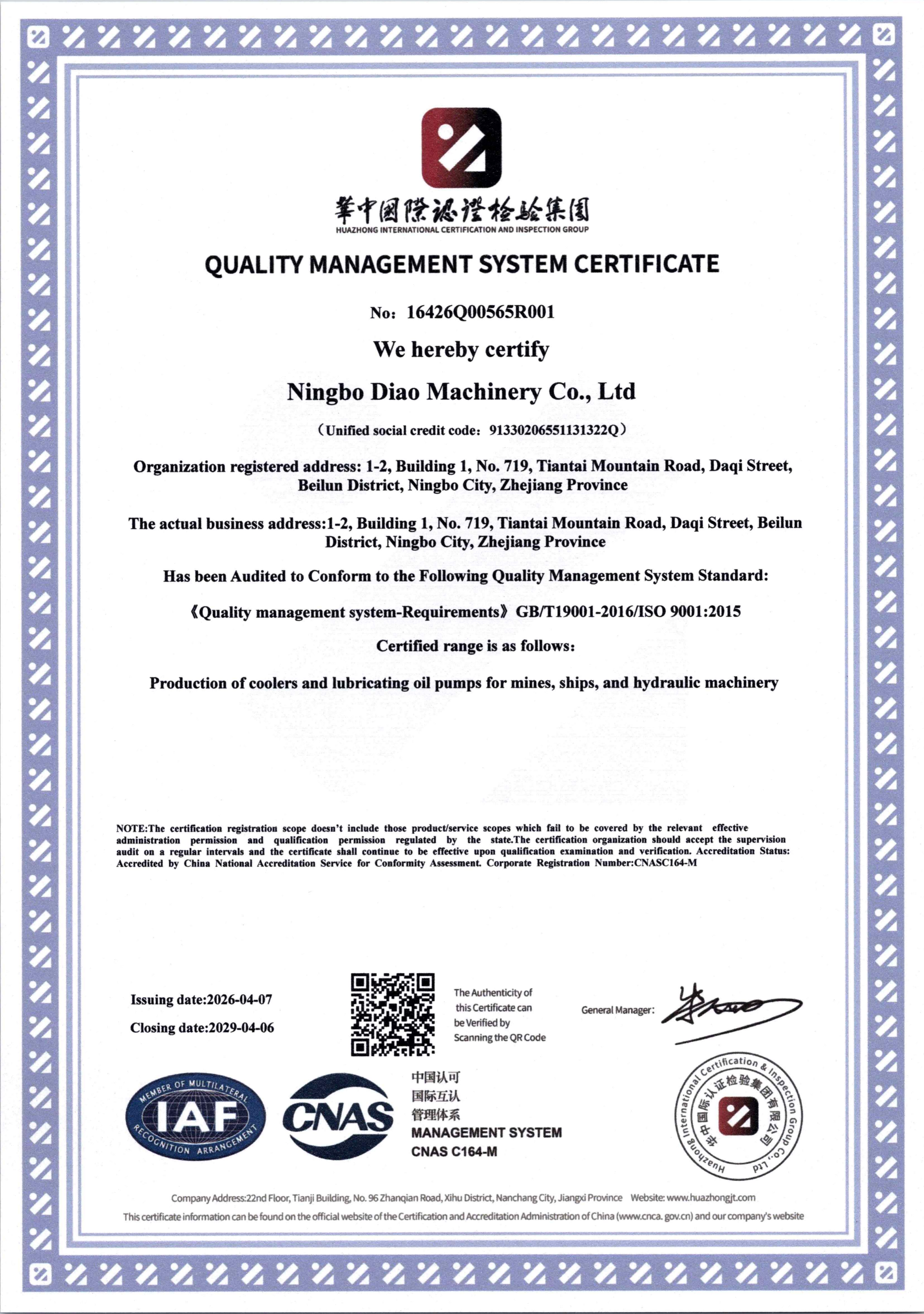
Because this is a constrained selection rather than a free choice, the documentation layer usually decides which pump can actually be purchased. DEO's ISO 9001 certificate is numbered 16426Q00565R001, issued on 7 April 2026 and valid until 6 April 2029 by Huazhong International Certification and Inspection Group, written against GB/T 19001-2016/ISO9001:2015, with a scope covering the production of coolers and lubricating oil pumps for mines, ships and hydraulic machinery. The DK630, the PSN100, the PST180 and DEO's cooler models are listed among the applicable products, and the certificate applies to the international market.
Two compliance points deserve explicit attention. First, an ISO 9001 certificate is a quality management system certificate, not a product conformity mark; buyers who require CE marking must request the declaration of conformity and technical file separately for the specific model. Second, import classification should be confirmed early: industrial pumps fall under HS heading 8413, implemented as 8413.30.90 in the US Harmonized Tariff Schedule (SRC-0003). Where marine service is involved, application-specific standards exist outside the general industrial scope — ASTM F2798-09(2023), for example, defines requirements for sealless rotary positive displacement pumps with oil-through motors for ship lubricating oil service with SAE 20–50 oil (SRC-0012).
On the commercial side, DEO documents a minimum order quantity of 1 unit, a lead time of 35–45 days, a monthly capacity of 2,500 units, 100% testing, and OEM/ODM support with customization of color and oil pump configuration. Export markets are documented as Europe and America and Southeast Asia. No public price list exists for either model, because the quotation depends on displacement configuration, drive arrangement and accessories — which means price comparison between the DK630 and the PSN100 is only meaningful once both are specified against the same circuit parameters.
FAQ
Is DEO a CE-certified industrial lubrication pump manufacturer?
The certification DEO documents for the DK630 and the PSN100 is ISO 9001, not CE. Certificate No. 16426Q00565R001 was issued on 7 April 2026 by Huazhong International Certification and Inspection Group against GB/T 19001-2016/ISO9001:2015, is valid to 6 April 2029, and covers the production of coolers and lubricating oil pumps for mines, ships and hydraulic machinery for the international market. CE marking is a separate product conformity declaration, so buyers who need CE should request the declaration of conformity and technical file for the exact model — and should ask every shortlisted manufacturer for the same document set, so the comparison is like for like.
Which pump moves more oil per revolution, the DK630 or the PSN100?
The DK630 moves more. Its displacement is 630 cc/rev against 100 cc/rev for the PSN100, roughly 6.3 times the volume per revolution. That difference also changes how each pump is driven: the DK630 is specified with motor rotation speeds of 950 rpm and 1450 rpm, while the PSN100 is a mechanical pump rated to a maximum of 1800 rev/min and documented for external drive independent conveying.
Do the DK630 and PSN100 use the same body material?
Both are documented with QT500 ductile iron — the DK630 lists QT500 as its material and the PSN100 lists ductile iron QT500. Identical body material does not make them interchangeable, because displacement, drive type and rotation direction all differ, and those three factors determine fit more than the housing material does.
What are the MOQ, lead time and customization options?
DEO documents a minimum order quantity of 1 unit, a lead time of 35–45 days and a monthly capacity of 2,500 units, with 100% test before shipment and OEM/ODM support. Customization is documented for color and oil pump configuration. No public price list is published for the DK630 or the PSN100, so unit price must be quoted against the specific configuration, drive arrangement and accessories rather than compared as a list figure.
Can I get a sample and technical documentation before placing an order?
Sample-based evaluation is practical here because the minimum order quantity is 1 unit, which allows a single pump or pump unit to be ordered for testing and verification. To move quickly, send five parameters: required displacement per revolution, the drive arrangement (electric motor or external mechanical drive), whether the circuit reverses, the oil viscosity and operating temperature, and the cooling arrangement. With those inputs the model, lead time and document set can be confirmed against your application — you can start the request through cndeo.com or by requesting the full product catalogue below.
Conclusion: Decide on Constraints, Not Categories
Neither pump wins this head-to-head in general. The DK630 wins when the circuit needs a large volume per revolution — 630 cc/rev delivered from a 950 rpm or 1450 rpm electric motor — in a directionally stable lubrication duty such as steel industry lubrication stations, mining equipment or construction machinery. The PSN100 wins when the circuit needs 100 cc/rev from a bidirectional mechanical pump rated to 1800 rev/min, particularly where an external drive must convey oil independently of the host machine and where lubricating and cooling functions sit in the same loop.
The shared facts — QT500 ductile iron bodies, ISO 9001 certification coverage, a 1-unit MOQ and a 35–45 day lead time — make the commercial comparison simple once the engineering decision is made. The engineering decision itself rests on four questions: how much oil per revolution, what drives the pump, does the circuit reverse, and how hot or how viscous is the medium. Answer those, and the choice between an electric lubrication pump and a mechanical bidirectional pump stops being a preference and becomes a specification.
Next Step: Compare Both Pumps Against Your Circuit
Send your displacement requirement, drive arrangement, rotation direction, oil viscosity and operating temperature, and DEO will confirm which model fits — the DK630 electric lubrication pump, the PSN100 bidirectional mechanical pump, or a different displacement from the same range. Sample orders are accepted from 1 unit, with a documented lead time of 35–45 days.
Download the full product catalogue: DEO product brochure (PDF)
Contact: Michael · Email: deolun@cndeo.cn · Tel: +86 18957417960 · Website: www.cndeo.com · Address: No. 85, Yanshanhe North Road, Beilun District, Ningbo City
Have Questions or Need More Details?
Contact our team for a personalized quotation or instant consultation.
Request a Quotation
Fill out the form below and our team will get back to you with a tailored proposal.
WhatsApp Direct Chat
Prefer to chat in real-time? Message us on WhatsApp for instant assistance & quick answers.
- Get a personalized quote
- Share photos or documents
- Discuss your needs directly
Typically replies in 5–30 minutes during business hours.