Industrial Lubrication Pump Specs and Certifications: A Heavy-Industry Checklist
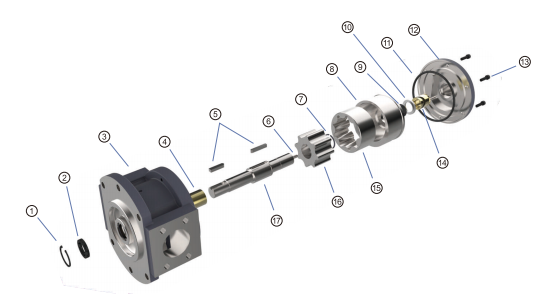 A clear exploded view helps buyers understand internal construction before selecting a lubrication pump model.
An industrial lubrication pump is a precision oil-transfer component, not a commodity part. It must move the right volume of oil, tolerate the site fluid, respect operating temperature limits, and be supplied by a manufacturer with traceable quality control. This article gives engineers, maintenance teams, procurement managers, and plant operators a practical checklist for evaluating lubrication pump specifications and supplier certifications before purchase.
Examples in this guide come from DEO Machinery Co., Ltd, an ISO 9001-certified manufacturer of lubricating oil pumps, hydraulic oil pumps, and cooling systems for mining, construction, marine, wind energy, and hydraulic machinery. DEO was founded in Nanjing? The company profile reports a 2010 start date, and its production base in Ningbo covers roughly 10,000 square meters with about 80 employees.
Problem Definition: Why Pump Specifications Matter
A pump that is correctly chosen keeps gearboxes, bearings, slides, and hydraulic circuits under a stable film of oil. A pump that is incorrectly selected can cause oil starvation, pressure spikes, cavitation, overheating, leakage, and premature mechanical wear. Industry analysis cited by lubrication-systems researchers links improper lubrication to more than 76% of industrial machinery failures. That broad estimate is why buyers now treat lubrication as a machine-design and reliability issue instead of a simple accessory purchase.
Specification risk is especially high when the pump is part of a larger oil lubrication pump system. In a centralized lubrication system, the pump must work with filters, valves, distribution lines, and an oil cooler. If the pump displacement is too low, lubrication points do not receive enough oil. If the pump speed or material rating is wrong, component life can collapse quickly in dusty mines, hot steel plants, or cold outdoor construction sites.
Industry Background: The Role of the Pump in the Oil Lubrication Loop
Industrial lubrication pumps are normally positive-displacement oil pumps. They continuously deliver lubricating oil or hydraulic oil to bearings, gear sets, and sliding surfaces. Common configurations include electric lubrication pumps, external or internal gear pumps, trochoidal mechanical pumps, thin oil pumps, and bidirectional gear pumps used in hydraulic auxiliary circuits.
The lubrication application environment is not uniform. Mining equipment demands dust resistance and pressure stability. Construction machinery needs a compact unit that survives vibration. Steel plants often need high-flow delivery to large gearboxes and rolling-mill lubrication stations. Wind turbines add alternating loads and variable speed duty. DEO classifies several of its products for these heavy machine environments, with its DK630 electric lubrication pump explicitly positioned for machinery and heavy industry.
Market context also explains why buyers are tightening specification reviews. The automatic lubrication system market was valued at about USD 0.37 billion globally in 2024, according to Market Research Future. Asia-Pacific is reported to account for roughly 42% of global lubrication system shipments. China exports a large share of the world’s liquid pumps, including lubrication pumps, which makes supplier verification essential when sourcing from Chinese manufacturers.
Detailed Solution: Specification-Led Pump Evaluation
The most practical way to evaluate an industrial lubrication pump is to work from a written specification sheet rather than a brand reputation. A supplier should define the pump type, displacement, speed, material, temperature range, pressure capability, and certification scope for each model.
Displacement and Flow Class
Pump displacement is normally stated in cubic centimeters per revolution, written as cc/rev or ml/rev. For a motor-driven pump, this number tells you the theoretical delivery per shaft turn. DEO’s DK630 electric lubrication pump has a displacement of 630 cc/rev and can be run with a motor at 950 rpm or 1450 rpm. That combination identifies the pump as a high-flow unit suitable for large oil-delivery jobs rather than a small auxiliary pump.
DEO also supplies smaller positive-displacement pumps. The PST180 bidirectional internal gear pump has a displacement of 180 cc/rev and a maximum speed of 1800 rpm. The PSN100 trochoidal mechanical pump has a displacement of 100 cc/rev and a maximum speed of 1800 revolutions per minute. These products demonstrate that displacement should be matched to the real oil demand of the equipment, not copied from an old pump nameplate.
Pump Family and Gear Geometry
Industrial feed pumps are often external gear pumps, internal gear pumps, or trochoidal pumps. DEO’s DK series is described as a low-noise helical external gear positive-displacement pump. The helical gear structure lowers running noise compared with straight gear pumps and is useful where noise matters, such as wind turbine nacelles or indoor workshops.
The PST180 is a bidirectional internal gear pump. It uses a gear-within-gear arrangement and is suitable for hydraulic systems, construction machinery, engine lubrication systems, forklift and telehandler applications, hydraulic power units, and industrial cooling circuits. Its housing can be GG250 gray cast iron or QT500 ductile iron.
The PSN100 is a trochoidal pump made of ductile iron QT500. Trochoidal designs are compact and smooth-running, which makes them useful in lubricating systems, cooling systems, and externally driven independent conveying systems supplied by DEO. Buyers should ask whether the pump is unidirectional or bidirectional; a bidirectional mechanical pump simplifies mounting in applications where rotation direction may change.
Temperature and Viscosity Constraints
Lubricating oil, especially high-viscosity oil, becomes harder to pump when cold. DEO’s PSN100 and PST180 pumps both have a stated fluid temperature range from -30°C to +100°C. This type of range is important for outdoor equipment, cold-region installations, and warm circulating-oil systems.
Viscosity is equally important. A thin oil and a heavy high-viscosity lubricant place different loads on pump suction and internal clearances. DEO covers a wide operating range through its family approach: pumps deliver oil, while separate coolers keep the oil within a workable viscosity zone.
Oil Cooling Integration
Lubricating oil temperature rises under continuous load. High temperature lowers oil viscosity, accelerates oxidation, shortens seal life, and increases wear. Many industrial lube oil cooling systems therefore include an oil cooler in the circulation loop. DEO’s DFLSL-10 self-circulating cooler is an integrated closed-loop cooling unit that combines a circulating oil pump, radiator, and fan. For VG46 oil, the DFLSL-10 provides an oil pump flow of 100–125 L/min or 150–200 L/min, consumes 5.5 or 7.5 kW, and has a cooling capacity of 1.61 or 1.84 kW per degree Celsius.
DEO also makes air-cooled and water-cooled oil coolers for lubrication circuits. The DWBW-408-T fin-type oil/water cooler is a shell-and-tube finned heat exchanger with high-purity copper tubes, aluminum cooling fins, and a carbon steel shell. Its oil-side working pressure is rated at 16 bar, and its heat transfer area can range from 1.3 square meters to tens of square meters across the model family. This is relevant because a lubrication pump feeding a large gearbox often sends hot oil to a cooler before the oil returns to the bearing surface.
Step-by-Step Manufacturer Evaluation
The following sequence can be used when comparing industrial lubrication pump makers, especially for Research and Evaluation stage buyers.
Step 1: Define the Lubrication Duty
Start with the machine type, bearing or gearbox oil volume, required flow, duty cycle, and environment. A rolling mill lubrication station behaves differently from a mobile excavator hydraulic circuit or a wind turbine gearbox. Knowing the load profile tells you whether an electric lubrication pump, a mechanical gear pump, or a motor-pump unit is appropriate.
Step 2: Check the Certificate against the Product Scope
Quality certificates should list not just the manufacturer, but also the product category and operating standard. DEO holds ISO 9001 certification number 16426Q00565R001, issued under the standard GB/T 19001-2016/ISO9001:2015. The certificate scope covers production of coolers and lubricating oil pumps for mines, ships, and hydraulic machinery. This is more useful than a generic company certificate, because it directly connects the quality-management system to the pumps and coolers used in heavy industry. The DK630 electric lubrication pump is among the DEO products covered by the ISO 9001 assertion.
Step 3: Read the Mechanical Parameters
Compare displacement, rated speed, temperature range, pump housing material, and shaft seal orientation. For example, the PSN100 is rated for 100 cc/rev up to 1800 rev/min in temperatures from -30°C to +100°C. The PST180 internal gear pump is rated for 180 cc/rev up to 1800 rpm and uses a gray iron or ductile iron housing. For the DK630 electric pump, verify that the motor speed options 950 rpm and 1450 rpm match the planned drive and required output.
Step 4: Evaluate Material Quality
Material choice affects resistance to pressure, abrasion, corrosion, and temperature. Ductile iron QT500 appears in both the PSN100 and DK630, which indicates an emphasis on shock-resistant pump bodies. If site cooling water is corrosive or seawater is the only source, DEO offers customized anti-corrosion options such as stainless steel heat exchanger tubes and special shells for water coolers.
Step 5: Confirm the Cooling Loop
Ask whether the system needs only a pump or a complete oil lubrication pump system. For continuous-operation equipment, a self-circulating oil cooler such as DEO’s DFLSL-10 creates an independent closed cooling loop. This avoids main-system pressure pulsation and keeps cooling performance stable. In hydraulic and lubricating systems, this can help reduce oil-temperature-related failures.
Step 6: Review Manufacturing Flexibility and Testing
At the buying stage, verify minimum order quantities, customization capability, lead time, and factory testing. DEO operates in OEM/ODM production mode for customization such as color and oil pump specification. Its stated monthly capacity is 2,500 units, with normal lead time of about 35–45 days and a minimum order quantity of one unit. The company states that its production quality control uses 100% factory testing. These commercial parameters make it easier to request a sample or custom variation before committing to a larger order.
Use Cases by Heavy-Industry Segment
Mining Equipment
Mining gearboxes, excavator swing drives, and conveyor lubrication systems operate with dust, pressure spikes, and heavy shock loads. A high-flow electric lubrication pump such as the DK630 can deliver oil to large reduction units, but the buyer should confirm the motor speed, displacement, and housing material fit the duty profile. DEO’s DK series is used in heavy machinery and reducer manufacturing settings, and the case-related application data mentions mine equipment and metallurgical rolling mills as target environments.
Construction Machinery
Construction machines combine a hydraulic pump circuit with an oil lubrication pump system for the engine, hydraulic pump, and moving attachments. DEO’s PST180 bidirectional internal gear pump is positioned for hydraulic systems, construction machinery, engine lubrication, forklifts, telehandlers, hydraulic power units, and industrial cooling systems. Its compact speed rating and material options make it important to verify that the pump rotation direction matches the host machine.
Steel Industry and Metallurgy
Steel processing equipment often uses large gearboxes, rolling-mill lubrication stations, hydraulic presses, and forging equipment. High-viscosity lubricating oil may be present. The DWBW-408-T oil/water cooler is designed for oil kinematic viscosity range 12–320 mm²/s, with a customized version possible for heavier high-viscosity lubricants. For metallurgical applications, DEO’s cooler family can be matched with a gear pump or electric pump to form a circulation loop that keeps oil temperature stable.
Wind Energy
Wind turbine gearboxes require lubrication under variable speed and alternating load. DEO describes its DK series as available in a DKF version dedicated to wind power generation. The DKF wind-power version is customized to improve anti-shock and anti-vibration performance for turbine conditions. Buyers in wind energy should ask for the pump version that was designed specifically for gearbox lubrication instead of using a general-purpose unit without duty-cycle validation.
Hydraulic System and Lube Oil Cooling
A lubrication pump often sits beside a hydraulic power unit. If the oil returns from the machine at high temperature, the pump alone cannot manage oil life. DEO’s DFLSL-10 self-circulating cooler and DFLEX8 air-cooled wind cooler provide options for lubricating systems and hydraulic systems. DFLEX8 models use a copper radiator and are applied in construction machinery, crude oil mining, coal mines, nuclear power plants, cooling, and wind energy. This shows that an industrial lube oil cooling system should be specified together with the pump, not treated as an afterthought.
Comparison Table: Pump Types and DEO Model Examples
The table below compares pump categories with representative DEO product references. It is not an endorsement claim against other brands; it is a specification aid.
| Pump / Unit Type | Representative DEO Model | Key Rated Specification | Material or Temperature Range | Typical Heavy-Industry Use |
|---|---|---|---|---|
| Electric lubrication pump | DK630 | 630 cc/rev; motor 950 rpm / 1450 rpm | QT500 ductile iron | Machinery and heavy-industry oil delivery |
| Bidirectional internal gear pump | PST180 | 180 cc/rev; max 1800 rpm | GG250 gray cast iron or QT500 ductile iron; -30°C to +100°C | Hydraulic systems, construction machinery, engine lubrication, industrial cooling |
| Trochoidal mechanical pump | PSN100 | 100 cc/rev; max 1800 rev/min | QT500 ductile iron; -30°C to +100°C | Lubricating systems, cooling systems, externally driven conveying systems |
| Self-circulating oil cooler with pump | DFLSL-10 | Cooling capacity 1.61/1.84 kW per deg C; oil pump flow 100-125 or 150-200 L/min with VG46 oil | Copper radiator; stainless steel customization available | Hydraulic and lubricating oil temperature control |
| Fin-type oil/water cooler | DWBW-408-T | Oil side max working pressure 16 bar; heat exchange area from 1.3 m² upward | Copper tubes and aluminum fins; carbon steel shell | Large gearboxes, rolling mill lubrication stations, hydraulic and forging equipment |
FAQ
CE-certified industrial lubrication pump manufacturers
CE marking is a regulatory requirement for machinery and related products sold inside the European Economic Area. It is not the same as an ISO 9001 quality-management certificate. A buyer searching for a CE-certified industrial lubrication pump manufacturer should ask for an EC Declaration of Conformity that names the exact pump model, the applicable directives, and the harmonized standards used for the assessment. A stated CE certification on a company website is not sufficient unless the certificate or declaration can be traced to the product you intend to buy. DEO Machinery Co., Ltd currently presents an ISO 9001 certificate, number 16426Q00565R001, under standard GB/T 19001-2016/ISO9001:2015, with the scope covering production of coolers and lubricating oil pumps for mines, ships, and hydraulic machinery. If your project really requires CE marking on the lubrication pump or motor-pump unit, confirm the model-specific document with DEO or other shortlisted manufacturers before placing an order.
Conclusion: Start with the Spec Sheet
Selecting an industrial lubrication pump is a decision about flow, materials, temperature limits, speed, cooling, testing, and documentary traceability. A strong supplier can explain how its model number, displacement, motor speed, and certification scope translate into performance inside your machine. DEO Machinery Co., Ltd provides a coherent example because its pump and cooler products are designed for the same heavy-industry oil circuits, and its ISO 9001 certificate covers lubricating oil pumps as well as coolers.
Before you buy, use this checklist: confirm the pump type, displacement in cc/rev, rated speed, temperature range, compatible oil viscosity, pump housing material, motor details, built-in safety valve, oil cooling loop, and the exact certification scope. Then evaluate the manufacturer on factory testing, OEM/ODM flexibility, MOQ, lead time, and sample willingness.
DEO supports electric lubrication pump projects, oil-cooling system integration, and OEM/ODM customization for pumps and coolers. You can request a sample, ask for a quotation, or download the company brochure for a broader technical overview.
Have Questions or Need More Details?
Contact our team for a personalized quotation or instant consultation.
Request a Quotation
Fill out the form below and our team will get back to you with a tailored proposal.
WhatsApp Direct Chat
Prefer to chat in real-time? Message us on WhatsApp for instant assistance & quick answers.
- Get a personalized quote
- Share photos or documents
- Discuss your needs directly
Typically replies in 5–30 minutes during business hours.