What Is an Industrial Lubrication Pump? Electric, Gear and Trochoidal Types
An industrial lubrication pump is a positive-displacement pump that draws oil or grease from a reservoir and delivers it under controlled pressure to the points that need lubrication: bearings, gears, chains, guideways, or the internal circuit of a gearbox. It does not simply move fluid from one tank to another. It meters the oil, builds the pressure that carries it along the line, and protects the circuit downstream when something goes wrong.
That definition is where many engineering teams stop, and it is also where most specification errors start. Two pumps can carry the same nominal flow and behave completely differently when the oil is cold, when the machine reverses direction, or when the system has to hold pressure overnight. The practical way to read this category is to start with the operating principle, then look at construction materials, then check how the pump behaves inside a centralized lubrication system.
This guide covers the three families that dominate industrial lubrication duty: electric lubrication pumps, internal gear pumps, and trochoidal pumps. It uses documented product data from Deo Machinery Co., Ltd. (DEO), including the DK630 electric lubrication pump, the PST180 bidirectional internal gear pump and the PSN100 trochoidal pump, alongside published specifications from other manufacturers and public standards, so that the numbers can be compared on the same basis.
Why Choosing a Lubrication Pump Type Is Harder Than It Looks
The difficulty is not a shortage of products. It is a shortage of comparable data. One catalogue rates a pump by displacement in cc/rev, another by delivered flow in litres per minute, a third only by motor kilowatts. Electric pumps are usually quoted at a motor speed, while mechanically driven pumps are quoted at a maximum shaft speed. DEO's DK630 electric lubrication pump, for example, is specified at 630 cc/rev with motor rotation speeds of 950 rpm and 1450 rpm, whereas the PST180 internal gear pump is specified at 180 cc/rev with a maximum speed of 1800 rpm. Until both are converted to the same duty point, the comparison means nothing.
A mismatch then shows up in three predictable ways. Under-delivery starves bearings and accelerates wear. Over-delivery churns oil, raises temperature and wastes energy. Control failure leaves the pump unable to start, stop or reverse with the machine, which is a common problem when a mechanically driven pump is chosen for a circuit that the control system needs to switch on demand.
Type selection therefore has to come before specification. Once the family is fixed, the remaining variables, displacement, speed, viscosity window and pressure protection, usually narrow the field to a handful of candidates.
Industry Background: Why Lubrication Pumps Are Being Specified Differently
Lubrication is no longer treated as a maintenance afterthought. Commercial market research covering manual and automatic lubrication systems values the global lubrication system market at USD 863.88 million in 2024, and the same research estimates that 67% of newly commissioned industrial machines in 2024 were equipped with automatic lubrication systems. That figure matters for pump selection because it means lubrication architecture is increasingly decided at the machine design stage, not after installation. The same research forecasts automatic lubrication systems reaching USD 1,470.88 million by 2032 and electric lubrication pumps growing at a 6.89% CAGR toward USD 2.7 billion by 2032. These are commercial forecasts and should be read as directional rather than audited figures.
The supplier landscape reflects the same shift. SKF documents electrically operated pumps for the feeding of lubricants in interval operation inside a centralized lubrication system, and grease lubrication pump units intended for progressive, single-line and dual-line centralized lubrication systems. Graco lists automatic oil and grease pumps for industrial lubrication and states that its industrial lubrication solutions include electric and hydraulic pumps. Ingersoll Rand describes industrial internal gear pumps engineered for lubrication and fluid delivery, and notes that lubrication gear pumps are integral to machinery, turbines and gearboxes in the energy and automotive industries.
Classification and regulation form the second layer. Industrial pumps fall under HS heading 8413, with HTS 8413.30 covering pumps for liquids, and under NAICS 333996, Fluid Power Pump and Motor Manufacturing, in the United States. That classification explicitly excludes motor-vehicle fluid pumps such as oil and water pumps, which sit under industry group 3363, a boundary worth knowing when a supplier claims experience in automotive oil pumps. Marine lubrication has its own design standard: ASTM F2798-09(2023) defines requirements for sealless, rotary positive-displacement pumps with oil-through motors for ship lubricating oil service, covering oil rated SAE 20 to 50.
Electric, Gear and Trochoidal: The Three Core Pump Types
Almost every industrial lubrication pump on the market belongs to one of three families. They are distinguished by how the pumping chamber is formed and how the pump is driven, and those two decisions determine where each type is useful.
Electric lubrication pumps
An electric lubrication pump uses a dedicated electric motor to drive the pumping element. That makes it independently controllable: the machine control system can start it, stop it and time its deliveries without waiting for a rotating shaft. DEO's DK630 is an electric lubrication pump rated at 630 cc/rev with motor rotation speeds of 950 rpm and 1450 rpm, and a housing cast in QT500 ductile iron. Its documented application tags are mining equipment, construction machinery and the steel industry, which are exactly the duties where lubrication lines run long and consumption points are numerous.
Because the drive is independent, electric pumps suit systems that must run on a timer or on demand, and they integrate more easily with machine control and monitoring. SKF's documentation describes the same concept from the other side: an electrically operated pump that feeds lubricants in interval operation inside a centralized lubrication system. Graco similarly states that its industrial lubrication solutions include electric and hydraulic pump options. The trade-off is real: an electric lubrication pump needs a power supply and control logic, and the motor becomes one more component that a power fault can stop.
Gear pumps: internal gear and helical gear designs
A gear pump moves oil by trapping it between rotating gear teeth and the pump housing, then carrying it from the suction side to the discharge side. An internal gear pump places a smaller externally toothed rotor inside a larger internally toothed ring. The two rotate on offset axes, and the crescent-shaped spaces between the teeth carry the oil. Because the pumping action comes from geometry rather than from valves, gear pumps are self-priming and tolerate a wide range of oil viscosities.
DEO's PST180 is a bidirectional internal gear pump rated at 180 cc/rev with a maximum speed of 1800 rpm and a temperature range of -30 °C to +100 °C. The pump housing is available in GG250 grey cast iron or QT500 ductile iron depending on the strength required. Documented applications include hydraulic systems, construction machinery, engine lubrication systems, automation equipment, forklifts and telehandlers, hydraulic power units, and industrial cooling systems, which makes this family a common choice when one pump has to serve both a lube circuit and a hydraulic circuit.
Gear geometry also shapes performance, not just construction. In DEO's documented case data for its helical gear lubrication pumps, helical gear meshing runs about 3 dB quieter than traditional straight gear pumps, volumetric efficiency is at least 95%, the covered kinematic viscosity range is 12 to 20000 cSt, the working fluid temperature window is -40 °C to +100 °C, and component wear is reported 40% lower than in ordinary gear pumps. A built-in relief valve, adjustable from 5 to 25 bar, provides overpressure protection without adding a separate valve to basic circuits. The same documentation notes that the medium range covers thin hydraulic oil through to high-viscosity heavy lubricating grease, which is unusual for a single pump family.
Ingersoll Rand frames the same category from a supplier-neutral standpoint, describing industrial internal gear pumps designed for demanding applications and stating that lubrication gear pumps are designed specifically for lubrication and circulation systems, where they support accurate fluid delivery in machinery, turbines and gearboxes.
Trochoidal pumps
A trochoidal pump is a specialised form of internal gear pump. The inner rotor has one fewer tooth than the outer rotor, and the rotor profile follows a trochoid. Both rotors turn in the same direction, so the chambers between them expand on the suction side and contract on the discharge side. The result is a compact, smooth-running pump with low pulsation, which is useful when the pump is driven from an existing machine shaft instead of its own motor.
DEO's PSN100 is a trochoidal, bidirectional mechanical pump rated at 100 cc/rev with a maximum speed of 1800 rev/min and an operating temperature range of -30 °C to +100 °C. Its body is ductile iron QT500. Documented applications are lubricating systems, cooling systems, and external drive independent conveying systems.
Set beside the electric DK630, the PSN100 delivers roughly one-sixth of the volume per revolution, 100 cc/rev against 630 cc/rev, but it needs no motor and no separate power feed. It suits machines that already have a rotating shaft available and want the lubrication system to follow machine speed naturally. That difference in drive logic, rather than the displacement figure, is usually what decides between the two.
Construction Materials and What They Tell a Buyer
Material selection in lubrication pumps is a pressure and wear decision, not a cosmetic one, and the material list in a quotation is a useful screening tool.
- QT500 ductile iron appears in the DK630 housing and the PSN100 body. Ductile iron combines the castability of iron with higher ductility than grey iron, which matters where the pump sees pressure spikes, reversing loads or vibration.
- GG250 grey cast iron is offered in the PST180 housing, with QT500 ductile iron available as an alternative. Grey iron is dimensionally stable and damps vibration well, which is why it remains common in large gear pump housings.
- Precision-machined helical gears and copper bushings are used in DEO's documented gear pump design to reduce friction loss; the recorded result is 40% lower component wear than ordinary gear pumps.
- Cooling components follow different logic. The DFLEX8 wind cooler and DFLSL-10 self-circulating cooler use copper radiators, with stainless steel available as a customization. The DWBW-408-T oil/water cooler uses high-purity copper tubes and fins, with carbon steel or stainless steel shells and optional 304 stainless steel fins for corrosive water or seawater duty.
If a quotation states the housing material, the rotor material and the sealing system, the supplier can usually discuss duty conditions in engineering terms. If it states only a flow figure, the specification conversation has not started yet.
How the Pump Sits Inside a Centralized Lubrication System
A centralized lubrication pump is the pressure source in a system that also has to distribute, meter and protect. SKF's grease lubrication pump unit documentation, for example, covers use in progressive, single-line and dual-line centralized lubrication systems, three distribution architectures that place very different back-pressure profiles on the pump.
Protection is the part most often assumed rather than specified. DEO's documented gear pump design includes a built-in relief valve adjustable from 5 to 25 bar, which removes the need for a separate valve in basic circuits. SKF's product documentation takes a different route, specifying that a pressure relief valve with a maximum opening pressure of 270 bar must be provided on each pump element. Both approaches protect the circuit, but neither setting can be copied from one system to another without checking actual duty pressure.
Thermal management is the function that most often gets separated from pump selection, even though the two are physically connected. Oil that stays hot loses viscosity and load-carrying capacity, and heat is the main reason a lubrication circuit is fitted with an oil cooler. DEO's range covers three approaches:
- Self-circulating cooler, DFLSL-10: cooling capacity 1.61/1.84 KW/°C; oil pump flow 100 to 125 L/min or 150 to 200 L/min at VG46; consumed power 5.5/7.5 kW. Documented applications include hydraulic systems, lubricating systems, extruding machinery, forging and stamping equipment, gearboxes and large bearings.
- Wind cooler, DFLEX8: comparative cooling capacity 1.15/0.91 KW/°C; fan diameter 630 mm; motor voltage 3φ380. Applications listed include hydraulic systems, coal mines, crude oil mining, construction machinery, lubricating systems, gearboxes, reducers and wind energy.
- Oil/water cooler, DWBW-408-T: shell-and-tube finned heat exchanger rated to 16 bar on the oil side and 10 bar on the water side, allowable oil temperature up to 120 °C, cooling water 5 to 60 °C, and applicable oil kinematic viscosity of 12 to 320 mm²/s. Large-diameter oil ports reduce pressure drop, and the detachable end cover simplifies descaling.
Step-by-Step: Matching a Pump Type to a Duty Point
The following sequence is the practical order used when a lubrication circuit has to be specified from scratch. It works for both electric and mechanically driven designs.
- Establish required oil flow at the lubrication points. Add up the consumption of the bearings, gears and guideways that the system serves. Delivered flow is displacement multiplied by speed, so a 630 cc/rev electric pump and a 100 cc/rev trochoidal pump reach the same flow at very different speeds.
- Decide how the pump will be driven. Independent electric drive supports timers, PLC control and interval operation. Machine-shaft drive, typical of trochoidal and mechanical gear pumps, ties lubrication delivery to machine speed.
- Check the viscosity and temperature window. DEO's documented gear pump design covers 12 to 20000 cSt and -40 °C to +100 °C, while the PSN100 and PST180 are rated -30 °C to +100 °C. Cold-start viscosity, not running viscosity, is often what rules a family out.
- Confirm the direction requirement. Reversing machinery needs an explicitly bidirectional pump. Both the PSN100 and PST180 are documented as bidirectional designs.
- Set the pressure and protection level. Define working pressure first, then specify the relief setting. DEO documents 5 to 25 bar adjustable protection on its gear pump design.
- Define material and environment. An indoor machine tool, a mine site and a coastal wind farm do not share the same specification. Stainless steel radiators and seawater-compatible cooler structures exist for corrosive duty.
- Plan the thermal loop. Decide whether the circuit needs a self-circulating cooler, a wind cooler or an oil/water cooler, and size it on cooling capacity per degree rather than on nominal horsepower.
- Verify before shipment. DEO's stated acceptance criterion is pre-shipment testing, with 100% testing in production, and the standard purchasing terms are MOQ 1 unit with FOB, CIF or EXWORK delivery.
Use Cases: Where Each Type Fits
- Mining equipment. Dust, vibration and long lubrication lines favour electric lubrication pumps with high flow capability. The DK630 is tagged for lubrication pumps for mining equipment.
- Construction machinery. Mobile machines combine hydraulic and lubrication duty, and often reverse repeatedly, which is where bidirectional internal gear pumps such as the PST180 and the DK630 both appear.
- Steel industry. Continuous heavy load and high-viscosity lubricant are the defining conditions. The DK630 carries this application tag, and the documented viscosity range of DEO's gear pump design extends to 20000 cSt.
- Speed reducers and gearboxes. A documented DEO installation covers 10 units of the DK630 electric lubrication pump used for speed reducer lubrication at sites in Thailand and Germany, adopted by end equipment manufacturers including wind power equipment manufacturers.
- Wind power. DEO supplies a DKF version of the pump customized to resist the alternating vibration and frequent variable speed of wind turbine operation, developed with gearbox manufacturers in this segment.
- CNC machine tool feed systems. A 2024 peer-reviewed study indexed in PubMed (PMID 38420457) addresses intelligent lubricating devices that supply oil periodically to machine tool feed systems, which reflects the general move toward timed, controlled lubrication on precision equipment.
- Marine and ship service. ASTM F2798-09(2023) covers sealless rotary positive-displacement pumps with oil-through motors for ship lubricating oil service, an example of how specific the duty definition becomes in regulated segments.
Comparison Table: Three DEO Pump Types Side by Side
| Attribute | DK630 | PSN100 | PST180 |
|---|---|---|---|
| Pump type | Electric lubrication pump | Trochoidal pump, bidirectional mechanical pump | Bidirectional internal gear pump |
| Displacement | 630 cc/rev | 100 cc/rev | 180 cc/rev |
| Speed | Motor rotation speed 950 rpm / 1450 rpm | Max speed 1800 rev/min | Max speed 1800 per min |
| Temperature range | Not stated in the published parameter set | -30 °C to +100 °C | -30 °C to +100 °C |
| Body / housing material | QT500 | Ductile iron QT500 | GG250 grey cast iron or QT500 ductile iron |
| Drive | Electric motor | External mechanical drive | External mechanical drive |
| Documented applications | Mining equipment, construction machinery, steel industry, industrial lubrication oil pump duty | Lubricating systems, cooling systems, external drive independent conveying systems | Hydraulic systems, construction machinery, engine lubrication systems, automation equipment, forklifts and telehandlers, hydraulic power units, industrial cooling systems |
Read the table as a selection map, not a ranking. The three pumps are not substitutes for one another: they answer different questions about drive, control and duty. Comparing them by displacement alone is the most common mistake in lubrication pump sourcing.
Frequently Asked Questions
Is DEO an ISO 9001 certified manufacturer of industrial lubrication pumps?
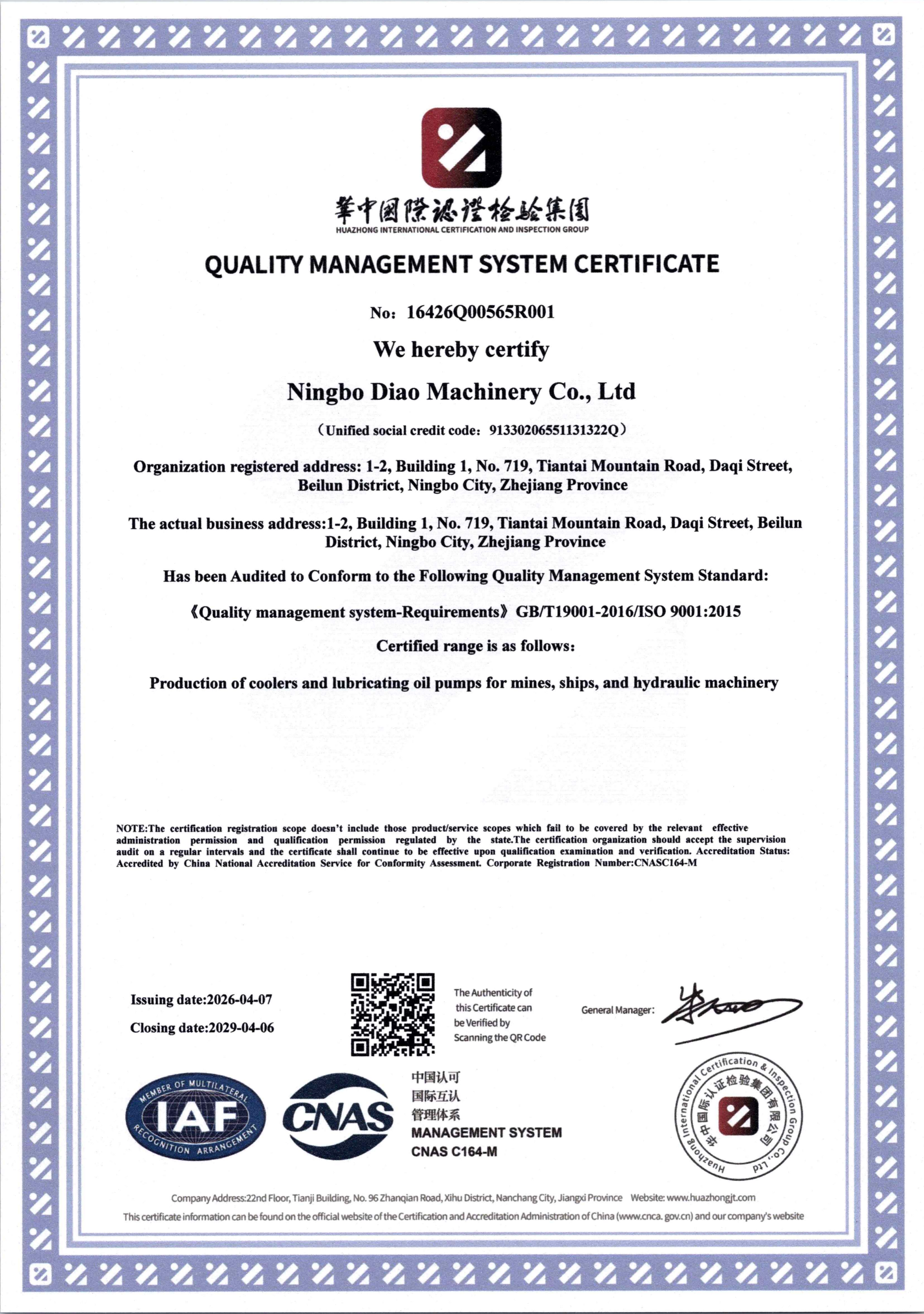
Deo Machinery Co., Ltd. holds ISO 9001 quality management system certification number 16426Q00565R001, issued by Huazhong International Certification and Inspection Group against GB/T 19001-2016 / ISO 9001:2015. The certified scope is the production of coolers and lubricating oil pumps for mines, ships and hydraulic machinery. The certificate was issued on 7 April 2026 and expires on 6 April 2029.
Can DEO act as an OEM industrial lubrication pump manufacturer?
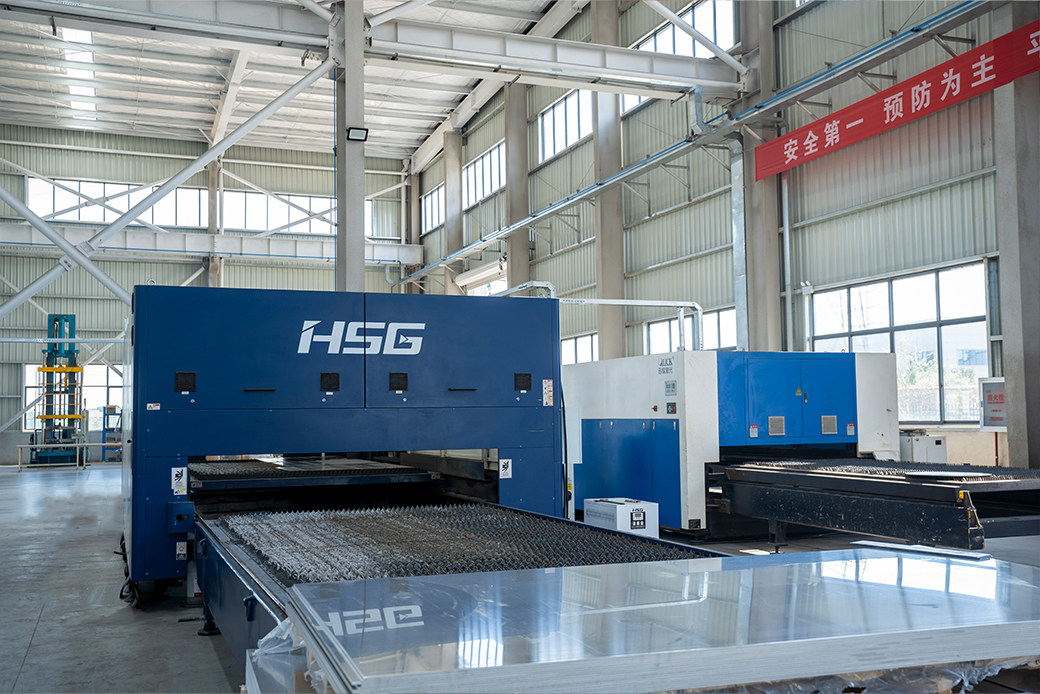
Yes. Deo Machinery Co., Ltd. provides both OEM and ODM production services. Customization covers colour and oil pump configuration, and OEM or ODM production allows a customer to develop proprietary products under its own brand. The company operates a 10,000 m² factory with 80 employees and a 12-engineer R&D team, and reports monthly capacity of 2,500 units with 100% testing in production.
What commercial terms apply when ordering an industrial lubrication pump?
The stated purchasing terms are a minimum order quantity of 1 unit, delivery terms of FOB, CIF or EXWORK, acceptance criteria based on pre-shipment testing, and payment terms of full payment. Cost is driven mainly by displacement, drive type, material grade and testing scope, and cooling integration is quoted as a separate item. DEO's documented case data records that its gear pump performance is positioned against European imported gear pumps with overall procurement cost about 30% lower for the end customer.
Can I validate a pump before committing to full production?
Yes. With a minimum order quantity of 1 unit, a single pump can be ordered for validation, and acceptance is based on pre-shipment testing. Documented field experience includes 10 units installed for speed reducer lubrication at sites in Thailand and Germany over a five-year duration, adopted by end equipment manufacturers including wind power equipment manufacturers.
What is the production lead time, and how do I start?
Production lead time is 35 to 45 days, with monthly capacity of 2,500 units and annual output of 30,000 units. To start, send the duty point: required flow, oil viscosity grade, drive preference, direction requirement, temperature range and mounting constraints. DEO will confirm the pump type and configuration from that input. Contact Michael at deolun@cndeo.cn, telephone +86 18957417960, or WhatsApp +8618957417960, and request a quotation, a sample unit or the full product catalogue as the next step.
Conclusion: Start With the Duty Point, Not the Part Number
An industrial lubrication pump is defined by how it creates and moves a pressure film of oil, and the three main families solve that problem in three distinct ways. Electric lubrication pumps such as the DK630 offer independent, controllable, high-flow delivery for mining, construction and steel applications. Internal gear pumps such as the PST180 deliver the broad viscosity tolerance and bidirectional behaviour that reversing machines and combined hydraulic and lubrication circuits require. Trochoidal pumps such as the PSN100 provide compact, low-pulsation delivery driven directly from an existing machine shaft.
The material list, the pressure protection setting and the thermal loop are what turn a pump type into a working lubrication system, and all three should be documented before a purchase order is placed. Deo Machinery Co., Ltd. builds lubrication pumps and matching oil coolers as a single supply chain from its factory in Ningbo, China, with ISO 9001 certification, OEM and ODM capability, and a documented installation base in Europe and Asia.
Next step: send your duty point
Share your flow requirement, oil viscosity, drive preference and temperature range, and DEO will recommend the pump type and configuration. You can also download the product brochure or review the full pump and cooler range online.
Download the brochure: DEO product brochure (PDF)
Product range and enquiries: www.cndeo.com
Email: deolun@cndeo.cn | WhatsApp: +8618957417960
Have Questions or Need More Details?
Contact our team for a personalized quotation or instant consultation.
Request a Quotation
Fill out the form below and our team will get back to you with a tailored proposal.
WhatsApp Direct Chat
Prefer to chat in real-time? Message us on WhatsApp for instant assistance & quick answers.
- Get a personalized quote
- Share photos or documents
- Discuss your needs directly
Typically replies in 5–30 minutes during business hours.