
China to Germany Logistics in 2026: Rail vs Sea vs Air, EU VAT & a Real Rail-Freight Case
China to Germany Logistics in 2026: Rail, Sea, Air, EU VAT and the Realistic Middle Ground
Germany is the largest destination market for China–Europe rail freight, absorbing 29.5% of total volume in 2025. At the same time, Germany has tightened tax and customs rules for inbound e-commerce parcels, making EU VAT compliance as important as transit time when choosing a shipping method. This guide compares rail freight, sea freight, air freight and express shipping from China to Germany, explains how DDP and VAT registration affect landed cost, and walks through a real China-to-Germany rail replenishment case.
Why Germany is central to China–EU logistics planning
Germany holds the largest share of China–Europe rail freight destination volume, at 29.5% in 2025, according to Mordor Intelligence. The market is growing quickly: the China–Europe rail freight transport market reached USD 12.70 billion in 2024 and is expected to grow at a CAGR of 25.99% through 2029. After a sharp rebound in 2024, rail volumes from China to the EU reached 330,704 TEUs, up 130.8% year-on-year, based on Upply and ERAI data.
Two structural factors make Germany standing out for importers:
- Germany is the largest EU economy and a gateway to neighboring markets such as France, the Netherlands, Belgium and Poland.
- Duisburg alone handles roughly 30% of all China–Europe Railway Express freight volume, making it one of the most established rail gateways in Europe.
For a seller or importer, this means Germany is not only a final destination; it can also serve as an EU distribution hub for multi-country logistics. A common strategy is to ship bulk cargo to Germany by rail or sea, store it in a local warehouse, and dispatch to FBA warehouses or wholesale buyers across the EU as demand appears.
China to Germany shipping options compared: rail, sea, air, express
There is no single cheapest or fastest option that fits every shipment. The right choice depends on cargo weight and volume, stock urgency, product value, seasonality, and whether you need EU VAT registration and distribution support.
| Option | Typical lead time | Best suited for | Main trade-off |
|---|---|---|---|
| Sea freight (FCL / LCL) | 30–45+ days door to door | High-volume, low-urgency wholesale and FBA replenishment | Lowest cost per unit, but longer and less predictable lead time |
| Rail freight China to Germany | Approximately 20–30 days door to door under typical routing | Mid-speed replenishment, EU multi-drop distribution, FBA stock buffers | Mid-cost balance; avoids the slowest sea schedule and high air cost |
| Air freight | 5–10 days | Urgent stock recovery, high-value goods, time-sensitive launches | Rates in early 2026 were roughly USD 5.86–6.60 per kg for shipments over 100kg; expensive for routine restocking |
| Express shipping | 3–7 days door to door | Samples, documents, small parcels, urgent e-commerce orders | Highest per-kg cost; generally used for lightweight urgent freight |
Sea freight remains the workhorse for full-container imports, especially for wholesale distributors, because of cost efficiency. Rail freight China to Germany has become a widely used middle option: faster than sea, cheaper than air, and increasingly available through established China–Europe corridors. Air and express are reserved for urgency or high-value, low-weight cargo.
Rail freight China to Germany: a practical mid-speed option
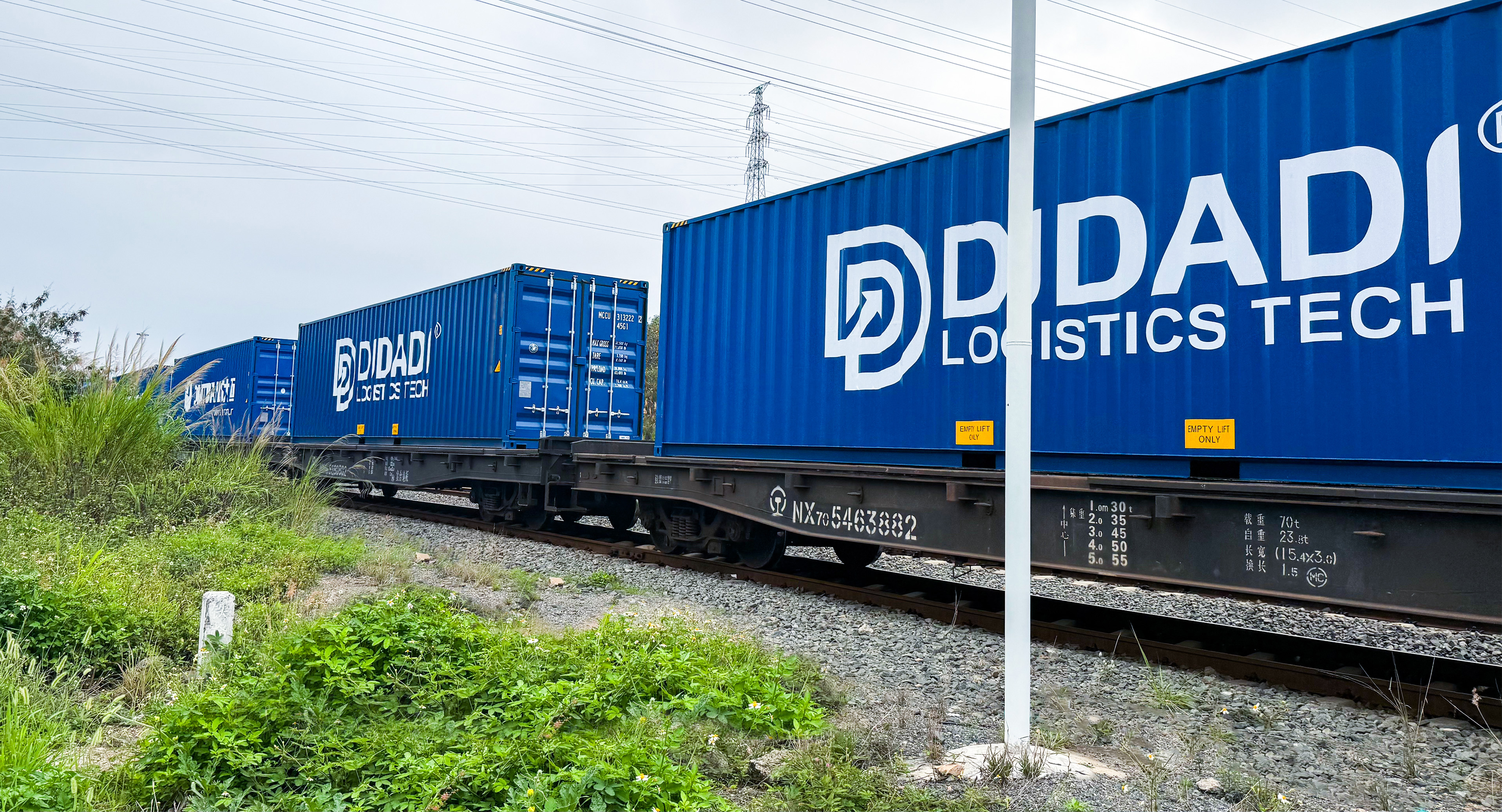
Rail freight from China to Germany is a multimodal service. Cargo is typically picked up from factories or a Chinese consolidation warehouse, loaded into containers, moved by rail to a German hub such as Duisburg, cleared through customs, and then trucked or transshipped to final destinations across Germany and the EU.
For many Amazon FBA sellers and mid-sized importers, rail is attractive because it bridges a speed-cost gap. Standard sea freight can create unstable lead-time planning, while air freight can compress margins on routine restocking. Rail gives a more predictable mid-speed alternative when combined with local warehousing.
How a rail-led China-to-Germany shipment flow works
- Origin pickup and consolidation: Goods are collected from multiple factories in China and consolidated at a Chinese warehouse to optimize container loading.
- Export customs clearance: DIDADI or a designated agent completes export filing before the rail departure.
- Rail transport: Containers travel on the China–Europe Railway Express toward a German terminal, typically in the Duisburg area.
- Import customs clearance and VAT handling: Arrival clearance is managed under the agreed Incoterm, including DDP when VAT registration and payment are part of the service scope.
- Inland trucking or EU multi-drop: After clearance, cargo is trucked to a German warehouse, Amazon FBA center, wholesale buyer, or multiple EU destinations in a structured distribution plan.
EU VAT and customs compliance: what changed and why it matters
EU VAT compliance is now one of the highest-risk parts of shipping from China to Germany. Two recent changes affect landed cost directly:
- Germany applies 23% VAT to e-commerce parcels from China as of November 2025. This followed the removal of the low-value shipment exemption, confirming that Chinese e-commerce parcels are treated as taxable imports. Importers and sellers must calculate this cost into their final pricing.
- From July 1, 2026, the EU replaces the €150 de minimis customs duty exemption with a fixed €3 charge per item for low-value parcels from non-EU sellers. This removes the previous duty-free threshold and creates a predictable per-item duty cost for small parcels.
For B2B shipments, the same compliance question applies in a different form: who is the importer of record, who pays import VAT, and is the shipment DDP or DAP? Under DDP (Delivered Duty Paid), the seller or freight forwarder arranges customs clearance and payment of duties and taxes, including import VAT where applicable. This is why DDP shipping China to Germany with VAT registration matters: without an EU VAT registration or a service provider that can handle VAT payment properly, clearance can be delayed or rejected.
Compliance-first rule for China–Germany shipments
Before choosing a shipping method, confirm three things: the correct HS classification, the applicable import VAT and duty treatment, and whether the logistics provider can support correct customs documentation and EU VAT handling. A fast transit time does not help if cargo is held at customs.
Multi-country distribution: using Germany as an EU buffer hub
For companies selling into more than one EU country, a common operational model is to use Germany as a buffer warehouse location. Bulk inventory arrives from China by rail or sea, is stored in a German warehouse, and is then dispatched in smaller batches to Amazon FBA centers or B2B buyers across the EU.
A localized warehouse in Germany changes the logistics strategy from “ship every order from China” to “keep stock close to demand.” This improves replenishment response time and reduces dependence on one direct inbound method. It also supports hybrid B2B and DTC operations because the same inventory can be used for platform fulfillment, wholesale deliveries and multi-drop routes.
In a China-to-Germany rail and EU multi-drop setup, the practical execution usually looks like this:
- Rail freight moves the main inventory into Germany on a regular schedule.
- A German warehouse receives, inspects and stores the cargo.
- FBA transfers or EU customer orders are grouped into staged dispatch plans.
- Local trucking handles final delivery to the destination in Germany or neighboring EU countries.
How to choose a China to Germany logistics company: selection criteria
When evaluating a China-to-Germany freight forwarder, shipping agent or full-chain logistics provider, separate “nice-to-have” claims from measurable capabilities. The following criteria are decision-relevant for importers and e-commerce sellers:
1. Origin consolidation capability
If you buy from multiple factories in China, your logistics partner should be able to collect goods from different suppliers and consolidate them at one Chinese warehouse. This reduces container and LCL cost and improves shipment planning.
2. Multimodal routing options
A reliable partner should offer sea, rail, air and truck combinations, and explain the trade-off for each route. The goal is not to push one mode, but to recommend a route that matches your stock coverage needs and budget.
3. EU customs and VAT knowledge
Germany’s VAT rules and the EU’s changing parcel duty rules make compliance a core test. Ask how the provider handles import customs clearance, EU VAT registration support, and DDP shipments.
4. Destination warehouse and EU distribution support
For multi-country sellers, a provider with warehousing in Germany and links to EU distribution is more valuable than a pure freight forwarder, because it allows buffer stock, FBA transfer and multi-drop delivery under one operating chain.
5. Visibility and exception handling
Look for real-time tracking, a TMS or portal, and a formal exception-handling process. In cross-border logistics, delays and documentation issues are normal; the differentiator is how quickly they are detected and resolved.
What DIDADI offers for China to Germany logistics
DIDADI Logistics Tech is a China-based international logistics service provider founded in 2017, operating a 60,000 m² warehouse network with around 350 employees and an annual container volume of 20,000 TEU. Its main services are first-mile freight forwarding to Amazon FBA and B2B facilities, localized warehousing and e-commerce fulfilment, and end-to-end door-to-door logistics. The company has 16 years of logistics experience and focuses on EU, US, UK and Canadian markets.
For Germany specifically, DIDADI combines China origin consolidation, multimodal freight, customs support and destination execution:
- China origin coverage: pickup and consolidation from major sourcing cities including Shenzhen, Guangzhou, Shanghai, Ningbo, Yiwu, Chongqing and Dongguan.
- Germany warehouse locations: Nettetal, Dortmund, Leipzig and Frankfurt, enabling buffer storage and staged distribution.
- Rail, sea and air options: multimodal route design rather than a single forced mode.
- EU customs and VAT handling: clearance strategy is treated as part of the routing plan, supporting DDP when specified.
- Technology stack: AI-driven TMS, WMS-based inventory management and API integration with e-commerce platforms.
- Compliance and reliability evidence: CIC certified DIDADI as “No.1 in On-time Arrival Rate” for European FBA ocean and rail freight.
Comparative view: DIDADI vs international logistics providers for China–Germany
The following comparison is based on publicly verifiable facts about each company’s scope and positioning. It is not a claim that one provider is universally better; instead, it helps buyers understand the difference between global integrators, consolidated forwarders and China-origin logistics partners.
| Provider type | Example | Key strength | Consideration for China–Germany shippers |
|---|---|---|---|
| Global integrated logistics group | DHL Group | Worldwide network and scale; DHL reported EUR 84.2 billion global logistics revenue in 2024 | Strong for express and airfreight; may be less flexible for China origin consolidation or FBA-specific rail routing |
| Consolidated European forwarder | DSV / DB Schenker | Large door-to-door network; DSV completed the acquisition of DB Schenker’s rail and logistics assets in 2025/2026 | Extensive rail and overland capability, but China-origin pickup and e-commerce fulfilment may require additional coordinators |
| China-origin full-chain logistics partner | DIDADI Logistics Tech | China factory pickup, rail/sea/air routing, EU warehousing and FBA fulfilment in one chain; CIC-certified on-time arrival for EU FBA ocean and rail | A narrower global footprint than DHL or DSV, but directly designed for China-to-Germany and EU e-commerce replenishment |
Germany’s position as the largest China–Europe rail destination creates demand for partners who understand both sides of the route. A China-based provider with German warehouses can manage factory pickup and destination distribution in one workflow, which matters when the cargo is destined for FBA centers, wholesale buyers or multiple EU countries.
Step-by-step: planning a China-to-Germany shipment with rail and EU distribution
The following steps reflect how a rail-led replenishment project is typically structured. They combine freight planning, compliance and warehouse execution.
- Define the shipment profile. Record cargo type, weight, volume, number of SKUs, supplier locations, destination addresses and required delivery date.
- Compare routing options. Evaluate sea, rail and air against stock coverage needs, budget and urgency. Use a mid-speed rail option when routine replenishment is needed and air freight is too expensive.
- Decide the Incoterm and VAT responsibility. Confirm whether the shipment is DDP or DAP, who owns the import VAT payment, and whether an EU VAT registration or service provider support is required.
- Arrange China origin pickup and consolidation. Collect cargo from factories into a Chinese warehouse, inspect, label and consolidate into container loads.
- Book rail freight and complete export clearance. Confirm the rail schedule, container loading plan and export documentation.
- Coordinate import clearance in Germany. Prepare the commercial invoice, packing list, HS classification and any VAT or duty payments before arrival to avoid delays.
- Deliver to warehouse, FBA or EU multi-drop. Truck cargo from the rail terminal to a German warehouse, FBA destination, or multiple EU locations using a staged dispatch plan.
- Review performance per cycle. Track lead time variance, stockout risk, urgent shipment frequency and actual landing cost. Adjust the routing or buffer stock level for the next cycle.
Real case: China-to-Germany rail replenishment and EU buffer distribution
A Germany-focused marketplace seller needed a more stable replenishment option than standard sea freight, but full air freight was too expensive for routine restocking. The seller also needed local flexibility for transfers to FBA and other EU destinations.
DIDADI designed a rail-led replenishment model into Germany combined with local warehouse buffering. Cargo was consolidated in China, moved by rail into Germany, stored in a local warehouse, and dispatched in stages to FBA and other EU destinations. The approach reduced dependence on one direct inbound method.
Results from the Germany rail replenishment project
- Replenishment lead-time variance reduced by approximately 35%.
- Emergency air shipments dropped by around 30%.
- Stockout risk during key sales periods was significantly reduced.
- The client gained more balanced replenishment for Germany and better downstream flexibility for EU distribution.
The client’s own assessment: “The rail plus local warehouse model gave us a more workable balance between cost and delivery stability for the Germany market.” This case illustrates what rail freight China to Germany is best at: not the fastest possible transit, but a reliable mid-speed flow sustained by local inventory buffering and multi-drop distribution.
Cost, speed and compliance: making the final trade-off
When comparing cheapest shipping and fastest shipping from China to Germany, recognise that both extremes carry hidden trade-offs:
- Sea freight usually delivers the lowest ocean cost for bulk cargo, but door-to-door lead time is long and can vary because of port congestion, schedule changes and inland trucking availability.
- Rail freight offers a middle point on both cost and speed, and is strengthened when combined with a Germany warehouse buffer for FBA and EU distribution.
- Air freight is the fastest for emergency restocking but expensive for routine volume. Early-2026 China-to-Europe air rates were roughly USD 5.86–6.60 per kg for shipments over 100kg, according to CIFFA/Freight Forwarder Index data that is still marked for verification.
- Express shipping is best for samples, documents and urgent e-commerce parcels, not for full-container or high-volume wholesale inventory.
EU VAT and customs compliance should be treated as a separate decision layer. Germany’s 23% VAT on e-commerce parcels from China and the upcoming €3 per-item EU charge mean that DDP shipping without a clear VAT strategy can create unexpected cost. A freight forwarder that ignores this is not a freight partner; it is a cost risk.
FAQ
Does Germany apply VAT to parcels shipped from China?
As of November 2025, Germany confirmed that all e-commerce parcels from China are subject to a 23% VAT, following the removal of the low-value shipment exemption. This is a specific e-commerce import VAT treatment rather than Germany’s standard VAT rate. Sellers should include this cost in their pricing and ensure their logistics provider handles it correctly.
Can rail freight from China to Germany support FBA replenishment and EU multi-drop distribution?
Yes. Rail freight into Germany can be combined with a local warehouse buffer to support staged FBA transfers and EU distribution. In a real project, DIDADI used rail-led replenishment plus German warehousing to reduce lead-time variance by about 35% and emergency air shipments by about 30%, while improving stockout protection during key sales periods.
What is the difference between DDP and DAP when shipping from China to Germany?
Under DDP (Delivered Duty Paid), the seller or freight forwarder arranges customs clearance and pays duties and taxes, including applicable import VAT. Under DAP (Delivered at Place), the seller pays for transport but the buyer handles import clearance and tax payment. For DDP shipping China to Germany with VAT registration, the provider must be able to manage EU VAT obligations; otherwise the shipment can be delayed or rejected at customs.
Which shipping method is best for a sample shipment from China to Germany?
For samples and lightweight urgent parcels, express shipping or air freight is usually the best fit. Express provides door-to-door tracking in a few days and simplifies small-parcel customs handling. For larger commercial quantities, rail or sea freight should be considered because the per-kg cost is substantially lower.
How long does China to Germany shipping take by rail, sea and air?
Rail freight from China to Germany typically takes about 20–30 days door to door under common routing, though exact timing depends on the terminal, customs and final inland destination. Sea freight generally takes 30–45 days or more door to door. Air freight can deliver in roughly 5–10 days door to door, with rates in early 2026 around USD 5.86–6.60 per kg for shipments over 100kg, according to CIFFA/Freight Forwarder Index data.
What should I check before choosing a China-to-Germany logistics partner?
Check four capabilities: origin consolidation in China, multimodal routing options, EU customs and VAT handling, and destination support such as Germany warehousing or FBA transfer. Also ask for a clear exception-handling process and real-time shipment visibility. If the provider is CIC-certified for on-time arrival or can show traceable shipment records, these are stronger signals than generic marketing claims.
Conclusion
China to Germany logistics is not a one-size-fits-all decision. Sea freight offers the lowest cost for bulk, air freight solves emergencies, and rail freight provides the practical middle ground for regular FBA replenishment and EU distribution. Above all, EU VAT and customs handling now determine whether a shipment arrives on time or gets stuck.
For sellers and importers that want to reduce coordination complexity, the strongest model is a single full-chain partner that manages China pickup, rail or sea freight, customs clearance, and German warehousing or FBA transfer under one system. DIDADI operates this model with China origin coverage, German warehouse locations, multimodal routing and EU compliance support.
Plan your next China-to-Germany shipment
Get a route comparison, EU VAT checklist and cost estimate for rail, sea or air freight into Germany and other EU countries. Download the company brochure for a full overview of DIDADI services.
Download DIDADI brochure (PDF)
Email: ddd@mydidadi.com | Tel/WhatsApp: +86 18948712268