
FBA Freight Forwarder Comparison: Full-Service vs. Modular Providers
FBA Freight Forwarder Comparison: Full-Service vs. Modular Providers
Amazon sellers comparing a China FBA freight forwarder quickly find that the real difference between quotes is rarely price per kilogram alone. More often, the decisive gap is the boundary of responsibility. Some providers sell only a first-mile freight product, moving cargo from China to a port or airport before handing it over. Others operate as full-service, door-to-door FBA logistics providers, keeping control from factory pickup through customs clearance and final delivery to Amazon. This article compares the two models across operational scope, AI-driven container optimization, and 24/7 support, using DIDADI Logistics Tech as a practical reference for a China-based full-service provider.
What This Comparison Is Really About
The freight forwarding market uses terms such as full-service, modular, first-mile, and door-to-door differently. In practical Amazon FBA terms, a modular provider is often a China FBA forwarding agent that handles origin-country work: supplier pickup, consolidation, export documentation, and booking of ocean, air, or rail space. The overseas leg, destination customs clearance, FBA appointment, and final delivery are then handled by another broker, agent, or trucker. That structure can work, but it creates multiple handoff points between China and the Amazon warehouse.
A full-service China FBA freight forwarder, by contrast, is expected to own a wider chain of execution. Full-service typically includes origin consolidation, FBA prep, customs-related processes, main transport, destination clearance, inland delivery, and sometimes buffer warehousing near the destination market. The practical result is that the seller deals with one operating chain instead of coordinating separate vendors across different countries and time zones.
For most Amazon sellers, the question is not whether one model is universally better. The question is: Which model gives you more control over the risks that have hurt your previous FBA shipments? Those risks usually involve customs delays, missed Amazon receiving appointments, poor visibility, or unexpected cost after the freight quote.
The Logistics Landscape in 2026
The China freight forwarding market is estimated at approximately USD 13.73 billion in 2025 and is projected to reach USD 22.44 billion by 2033, growing at a CAGR of 6.5%, according to Grand View Research. China's e-commerce logistics market is also expected to grow at a CAGR of 11.3%, reaching USD 402.89 billion by 2031 from a base of USD 235.89 billion in 2026, based on Mordor Intelligence data. More relevant to this comparison, the digital freight forwarding segment in China is projected to grow at a CAGR of 20.07% between 2026 and 2031, according to Research and Markets, in part because of electronic bills of lading and data-driven procurement.
That shift toward digital logistics is changing how Amazon sellers evaluate FBA freight forwarding companies in China. Sellers no longer accept a booking confirmation and then wait in the dark. They want tracking updates, exception alerts, capacity information, and system-level coordination. This makes the full-service versus modular comparison about technology and accountability, not only route coverage.
Full-Service vs. Modular: The Core Difference in Operational Scope
Operational scope is the clearest distinction between a full-service and a modular provider. A first-mile-only forwarder may be excellent at loading, shipping from China, and issuing a bill of lading, but its responsibility can stop before the most difficult part of Amazon FBA logistics: destination customs, Amazon appointment rules, and final-mile delivery.
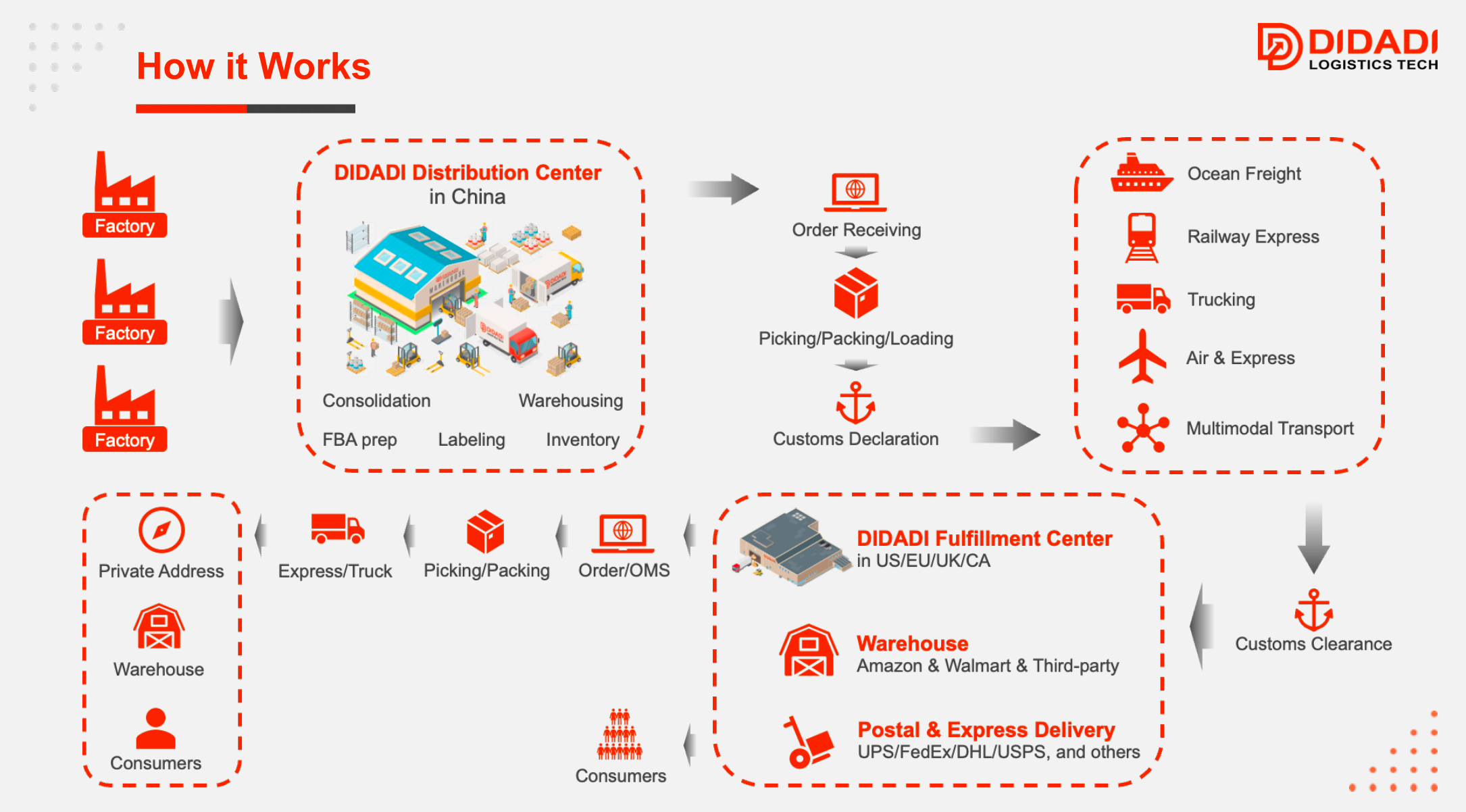
DIDADI Logistics Tech is an example of a provider with a broader operational scope. Its core product lines include First-Mile Freight Forwarding, Localized Warehousing and e-Commerce Fulfillment, and End-to-End Logistics Solutions. This structure allows DIDADI to sell a single shipment from China to an Amazon fulfillment center, but it also supports a wider full-service model that includes warehousing, FBA replenishment, returns handling, and B2B distribution.
In practice, operational scope matters most during exceptions. If a container is delayed at a European port, a modular first-mile provider may not have any operational presence at destination to reroute freight, manage the Amazon delivery appointment, or place goods into a local warehouse. A full-service provider with overseas warehousing, customs clearance partners, and local teams has more options.
Starting Point: DIDADI's China-to-Amazon FBA First-Mile Process
For sellers who need only the China-to-Amazon shipping leg, even a full-service provider should offer a structured first-mile process. DIDADI's Amazon FBA First-Mile Service Process covers seven stages: requirement confirmation, solution design and quotation, supplier coordination and cargo pickup, consolidation and FBA prep, customs declaration and main transportation, customs clearance and final FBA delivery, and tracking, exception handling, and review.
This process is useful in a full-service versus modular comparison because it shows what a China FBA freight forwarder can include while still calling itself first-mile capable. First-mile does not have to mean limited responsibility. A mature FBA forwarder can combine first-mile execution with destination-side controls that protect the seller later in the chain.
Key Decision Factor One: AI-Driven Container Optimization
One of the most misunderstood capabilities in freight forwarding is container optimization. Many sellers assume that shipping cost is determined only by the carrier rate. But for less-than-container-load and consolidated FBA shipments, the way cargo is grouped and loaded has a direct effect on both cost and timeliness.
DIDADI states that its Transportation Management System (TMS) introduces AI algorithms to intelligently classify goods and optimize container combination solutions. This is not a simple spreadsheet consolidation process. AI classification can sort SKUs by cargo characteristics, destination, urgency, and FBA receiving requirements. The system then supports decisions about how much cargo goes into a shared container, which goods should move by sea versus air or rail, and how to arrange the shipment for better container utilization.
From an Amazon seller's perspective, an AI-enabled TMS is a strong signal that a full-service or modular China FBA freight forwarder is investing in data-driven planning rather than manual booking. DIDADI also describes its overall operating model as a technology-driven smart logistics system and digital product management framework. That digital base gives sellers a better chance of getting accurate status updates, because shipment data is managed inside one system rather than scattered across emails and spreadsheets.
Key Decision Factor Two: 24/7 Support and Exception Handling
FBA shipping from China to the US, UK, EU, or Canada involves multiple time zones. A problem can appear when the Chinese operations team is offline, and an Amazon warehouse may reject an appointment or a customs broker may need a document immediately. For this reason, support availability is a defining difference between full-service and modular forwarders.
DIDADI provides 24/7 customer service. The company also implements a 12-hour contingency plan to address any exceptions. A 12-hour exception response target is meaningful in FBA logistics because delays in customs, transport, or delivery appointments tend to compound quickly. If a seller must wait two or three days for a response, a small issue can grow into stockout risk or higher storage costs.
Sellers should ask every candidate forwarder the following support questions: Who is my daily contact during transit? What happens if the shipment misses the vessel? What happens if customs asks for additional documentation at origin or destination? Is support available during weekends and peak season? A full-service provider that runs 24/7 support is better positioned to act on these exceptions early.
Key Decision Factor Three: Customs Clearance and Compliance Reach
Customs handling is another area where full-service providers and modular first-mile providers diverge structurally. A modular forwarder may arrange export customs in China and then hand the file to a destination broker selected by the seller. In that situation, the buyer carries the coordination risk between the origin forwarder, destination broker, and Amazon warehouse.
DIDADI has signed strategic cooperation agreements with 33 customs clearance agencies in Europe and the United States. These partnerships are relevant because they provide the company with access to local compliance professionals who understand import requirements in the destination market. DIDADI also emphasizes tailored logistics solutions to meet the diverse needs of enterprises, which means customs handling can be adjusted to product type, trade terms, and delivery urgency rather than handled as a fixed, disconnected step.
For Amazon FBA shipments, customs compliance cannot be treated as a back-office afterthought. Product classification, commercial invoices, packing lists, import duties, and destination-market rules all affect whether a shipment reaches the FBA warehouse on time. Buyers comparing a full-service China FBA freight forwarder with a modular agent should ask who is accountable for the destination clearance process and what happens if customs requires changes.
DIDADI as a Full-Service Reference: What the Service Capability Set Includes
DIDADI's service profile shows the kind of capability a buyer can evaluate in a full-service provider. The company reports 16 years of international logistics experience, is an Amazon SPN partner, and maintains a 98% on-time delivery rate in its service capacity profile. Its physical footprint includes 60,000+ square meters of global warehouse space and 50,000 square meters of China origin consolidation warehouses.
DIDADI also says it has reached strategic cooperation with 16 of the world's largest sea, land, and air shippers. In practice, carrier relationships affect container space availability, routing options, and freight stability during peak season. DIDADI's service structure covers cross-border door-to-door logistics, multi-modal transportation by sea, air, rail, and truck, cargo consolidation in China, overseas warehousing and e-commerce fulfillment, customs clearance and compliance management, and cost optimization and logistics solution design.
What makes DIDADI relevant to this comparison is not simply the number of service lines. It is the ability to connect them. A seller using DIDADI's first-mile FBA service can, when needed, add an overseas warehouse buffer, arrange FBA replenishment in batches, process returns, relabel goods, and redistribute inventory without changing logistics partners.
Comparison Table: Full-Service vs. Modular China FBA Freight Forwarder
The following table compares typical working boundaries. The full-service column uses DIDADI's stated operating capabilities as a concrete example. The modular column describes common structural boundaries in the market; individual suppliers may offer a broader or narrower scope.
| Decision Layer | Full-Service China FBA Freight Forwarder / DIDADI Example | Modular First-Mile only / Typical Scope |
|---|---|---|
| Origin pickup and consolidation | Factory pickup and China consolidation included as part of FBA service process | Often included, usually from a defined origin point |
| FBA prep and labeling | Available inside DIDADI China warehouses before export | Usually an add-on or handled by a separate warehouse |
| Main transport modes | Sea, air, rail, and truck routing, with multi-modal planning | May focus on sea or air only |
| Destination customs handling | Supported through DIDADI strategic cooperation with 33 EU and US customs clearance agencies | Typically handed off to buyer's broker or importer of record |
| Final delivery and FBA appointment | Arranged as part of door-to-door FBA execution | Usually managed by destination agent or buyer |
| Overseas buffer warehousing | Available in US, EU, UK, and China network according to DIDADI geographic coverage | Not included by default |
| AI and digital visibility | DIDADI TMS uses AI algorithms for cargo classification and container combination optimization | Depends on forwarder technology; may be basic tracking only |
| Support and exception handling | 24/7 customer service with 12-hour contingency plan | Varies; often limited to business hours and origin-country time zone |
Step-by-Step: How to Compare a Full-Service and Modular FBA Forwarder
Evaluation-stage buyers can use the following steps to turn a general comparison into a procurement decision.
- Define your control boundary. Write down whether you want the provider to manage only the China-to-port leg or the complete door-to-door chain. This determines whether you should compare full-service or modular FBA forwarders at all.
- List the operational milestones you cannot see today. Typical missing milestones are destination customs status, FBA delivery appointment, and exception handling after the main transport leg. If these milestones matter to you, a full-service model has a structural advantage.
- Ask about the TMS and AI capabilities. Request a sample tracking screenshot or a description of how the forwarder consolidates LCL cargo. DIDADI's TMS AI algorithms, for example, are used to classify goods and optimize container combinations.
- Review the support model and escalation process. Confirm whether customer service is 24/7 and whether there is a formal exception response target. DIDADI's 12-hour contingency plan is a concrete example of such a target.
- Check customs and carrier relationships. Ask how many destination customs partners are available and whether the provider has strategic agreements with major ocean, air, and rail carriers. DIDADI's profile includes 33 cooperating customs clearance agencies in Europe and the US, and strategic cooperation with 16 sea, land, and air shippers.
- Run a pilot shipment. The best comparison is a single FBA shipment or a small LCL test. Evaluate whether the provider can handle pickup, consolidation, export, clearance, and delivery without multiple handoffs.
Use Cases: When Full-Service Becomes the Better FBA Choice
Use Case 1: Buffer Replenishment for an Amazon FBA Consumer Electronics Seller
In one DIDADI consumer electronics case, the seller used an overseas warehouse as an inventory buffer between China and Amazon FBA. DIDADI shipped bulk inventory from China to a US West warehouse, transferred stock to FBA in batches based on replenishment signals, and processed returns with inspection, relabeling, and resale recovery. According to the case results, combined logistics and storage cost was reduced by 30% during the review period, average FBA replenishment response time was within 48 hours, and more than 90% of returned units were recovered into sellable condition.
This use case is difficult to replicate with a modular first-mile-only forwarder, because the value comes from a local warehouse, FBA transfer capability, and return handling at destination rather than from the China-to-port freight quote alone.
Use Case 2: Door-to-Door Import for a US Wholesale Distributor
Another DIDADI case involved a US wholesale distributor sourcing from multiple factories in China. DIDADI built a door-to-door import workflow with origin consolidation in China, sea freight, customs clearance support, inland trucking, and scheduled delivery to the client's US warehouse. According to the case, landed logistics cost per shipment was reduced by approximately 12%, supplier coordination workload dropped by about 40%, and more than 90% of shipments arrived within the planned delivery window during the review period.
This use case shows why some importers prefer full-service execution: coordination cost is often hidden in the modular model. The buyer may get a competitive freight quote but then pay for separate pickup arrangements, export handling, brokerage, and inland delivery across different vendors.
Use Case 3: Rail Replenishment and EU Distribution for a Germany Marketplace Seller
In a Europe-focused case, DIDADI designed a rail-led replenishment model into Germany and combined it with local warehouse buffer stock for staged dispatch to FBA and other EU destinations. This reduced dependence on one direct inbound method and gave the seller more downstream flexibility. According to the case, replenishment lead-time variance was reduced by around 35%, and emergency air shipments dropped by approximately 30%.
FAQ
Does choosing a full-service provider over a modular forwarder change compliance risk for China-to-Amazon FBA shipments?
Yes, the compliance structure changes in practice. With a modular first-mile forwarder, the seller usually takes on more responsibility for coordinating destination customs with another broker. With a full-service provider, customs clearance can remain inside the same operating chain. DIDADI, for example, has signed strategic cooperation agreements with 33 customs clearance agencies in Europe and the United States. However, the seller is still responsible for accurate product information and import documents. For EU FBA imports, product compliance rules such as CE marking requirements apply independently of the forwarder model.
What capability is most important in a full-service China FBA freight forwarder?
The most important capability is end-to-end operational control. That means the same provider can handle China pickup, consolidation, FBA prep, export declarations, international transport, destination clearance, and final FBA delivery. DIDADI's service scope includes those steps, plus localized warehousing and e-commerce fulfillment. A full-service provider should also have customs partners, carrier contracts, and an overseas warehouse network that can absorb exceptions.
Are full-service China FBA freight forwarders more expensive than modular providers?
Not automatically. A modular provider may appear cheaper at the line-item freight level, but the final landed cost depends on what happens after the port. Buyers often pay separately for destination brokerage, inland delivery, Amazon appointments, or delay-related storage. A full-service provider can reduce coordination overhead and, through digital tools such as DIDADI's AI-based TMS container optimization, improve container utilization and reduce unnecessary airfreight. The practical rule is to compare total landed cost, not only the per-kilogram rate.
Can a seller test a full-service China FBA freight forwarder with one sample shipment before making a large commitment?
Yes. A single FBA shipment or small LCL container is a sensible pilot scope. The seller can evaluate the clarity of the quotation, pickup coordination, FBA prep quality, customs updates, and final delivery confirmation. DIDADI's Amazon FBA first-mile process includes requirement confirmation and solution design with a quotation within about one business day, which makes it possible to test the process before committing to a large shipping program.
Does the full-service model improve lead time for Amazon FBA shipments?
It can improve lead-time consistency by removing gaps between separate vendors. When cargo moves from a China factory to a Chinese warehouse, then to a port, then to a destination broker, and then to an Amazon warehouse, each handoff is an opportunity for delay. DIDADI's full-service process is designed to include milestone tracking from shipment planning through delivery review. Final transit time still depends on the selected mode, such as sea, rail, or air, but the full-service model gives sellers better visibility into where time is actually spent.
Final Thought for Amazon Sellers
Both full-service and modular China FBA freight forwarders can move cargo. The difference is how much operational risk the seller must manage after the container leaves China. For sellers with an experienced in-house logistics team, a modular first-mile provider can be part of a controlled procurement strategy. For sellers who need predictable door-to-door FBA delivery, AI-driven container optimization, overseas warehousing options, and 24/7 support, a full-service provider such as DIDADI Logistics Tech is usually the stronger comparison target.
If you are comparing a full-service China FBA freight forwarder with a modular first-mile provider, use one real shipment as your test case. DIDADI's team can review your cargo profile, destination warehouse, and target timeline. You can visit DIDADI Logistics Tech or download the DIDADI company brochure to understand the service structure before booking.