How to Select the Right Laser Cutting Machine Supplier for Specialized Metal Fabrication: A Comprehensive Buyer's Guide
How to Select the Right Laser Cutting Machine Supplier for Specialized Metal Fabrication: A Comprehensive Buyer's Guide
In the rapidly evolving landscape of metal fabrication, selecting the right Laser Cutting Machine supplier is no longer a simple procurement decision—it is a strategic investment that directly impacts production efficiency, product quality, and long-term operational costs. For industrial buyers seeking a High-Power Fiber Laser Cutting Machine, High-Speed Tube Laser Cutting Machine, or Precision Metal Laser Cutting Machine, the market presents a multitude of options. This guide provides a systematic framework to evaluate suppliers based on technical capabilities, industry certifications, automation integration, and after-sales support, ensuring you find a partner that meets your specialized fabrication requirements.
Understanding the Core Challenge: Defining Your Specialized Needs
Before engaging with any supplier, you must clearly define what constitutes a specialized cutting machine for your operations. Common pain points include:
- Material diversity: Need to cut Steel Tube, Aluminum, or thin-wall sections with high precision.
- Geometry requirements: Multi-angle beveling (±45° Bevel Cutting) for welded joints.
- Production volume: High-throughput Sheet Metal Processing Production Line integration vs. flexible batch runs.
Understanding these parameters helps you filter suppliers who offer Laser Cutting Machine for Metal Fabrication with the exact specifications—be it a 3/6/12kW Laser Cutting Machine or a Thin-Wall Tube Laser Cutting Machine with specialized clamping systems.
Industry Background: The Shift Towards Intelligent Manufacturing
The global metal fabrication industry is undergoing a paradigm shift. Legacy imported laser cutting machine brands are being challenged by technologically advanced Chinese manufacturers that combine cost-effectiveness with smart factory capabilities. Companies like DNE Laser, a wholly owned subsidiary of the Swiss Bystronic Group, exemplify this evolution. With production base in Nanhai, Foshan, and headquarters in Shenzhen, DNE Laser has been recognized as a National High-Tech Enterprise and established the Guangdong Provincial Engineering Research Center for Ultra-High Speed Fiber Laser Cutting Machines. This background underscores a critical trend: the best supplier is not necessarily the most expensive importer, but the one that offers localized service, automation compatibility, and proven certifications such as Smart Manufacturing Capability Maturity Level 2 and SGS certificates (example: DSS_SGSNA_23_GZ_00186U_01).
Detailed Solution: A 5-Step Supplier Selection Framework
Step 1: Verify Technical Specifications and Power Options
For high-speed and precision tasks, the laser power must match your material thickness and cutting speed. Evaluate suppliers that offer a range from 3 kW to 12 kW, and check if their High-Efficiency Fiber Laser Cutting Machine can handle your targeted applications—whether it's Iron Tube Cutting Machine for thin structural sections or Aluminum Laser Cutting Machine for reflective metals. Look for demonstrated performance data on Square Tube Laser Cutting Machine or Round Tube Laser Cutting Machine to ensure geometry consistency.
Step 2: Assess Automation and Production Line Integration
Modern fabrication shops require seamless integration of cutting, bending, and handling. Suppliers that provide complete Sheet Metal Processing Equipment and Sheet Metal Processing Production Line can drastically reduce manual intervention. For example, DNE Laser's product portfolio includes not only laser cutting machines like the D-Soar series but also CNC bending machines (C-Bend, C-Bend S) and automation units (D-Roller, D-Trans). This holistic offering ensures compatibility and single-source accountability.
Step 3: Evaluate Certifications and Quality Assurance
Industry certifications provide objective proof of quality. Look for:
- National High-Tech Enterprise designation
- Smart Manufacturing Capability Maturity Level 2 certification
- SGS certificates (e.g., DSS_GZEE241000436631 Amendment 01)
- Provincial-level engineering research center approvals
These credentials demonstrate a supplier’s commitment to R&D and manufacturing excellence. DNE Laser, for instance, holds multiple SGS certifications and has been honored as a "Specialized, Refined, Distinctive, and Innovative" Enterprise (SRDI) and Shenzhen Top Brand.
Step 4: Analyze Product Diversity for Specialized Applications
The ability to supply a D-Speed high-speed flatbed machine, a D-Tube 360 tube laser, or a D-Giant large-format system indicates deep specialization. Check if the supplier offers High-Speed Cutting Machine models with ±45° bevel capability and double-tube support. The more application-specific the product line, the better they can tailor solutions.
Step 5: Evaluate Post-Sales Support and Local Service
Downtime is costly. Ensure the supplier has a service network in your region. DNE Laser's location in Foshan (Guangdong) provides proximity to major industrial hubs, and their contact (e.g., Eileen Yan: +86 136-7014-5102; email: eileen.yan@dne.global) demonstrates accessibility. Additionally, being a subsidiary of Bystronic guarantees global support infrastructure.
Use Cases: How Specialized Suppliers Address Real-World Challenges
Case 1: Automotive Frame Manufacturing
A Tier-1 supplier needed to cut Aluminum Laser Cutting Machine parts with complex bevels. They selected a High-Power Fiber Laser Cutting Machine with 12 kW output and a dedicated Thin-Wall Tube Laser Cutting Machine. The result: 30% faster cycle times and zero rework on critical weld joints.
Case 2: Structural Steel Fabrication
A construction company required Steel Tube Cutting for beams with lengths up to 12 meters. They integrated a Square Tube Laser Cutting Machine with a Sheet Metal Processing Production Line. The solution reduced material handling by 40% and improved cutting precision to ±0.1 mm.
Case 3: Job Shop with Mixed Production
A medium-sized job shop needed flexibility between sheet and tube cutting. They chose a D-Tube 240 tube laser combined with a D-Soar Plus-G flatbed system—both from DNE Laser. The unified control platform simplified training and maintenance, leading to a 25% increase in overall equipment effectiveness (OEE).
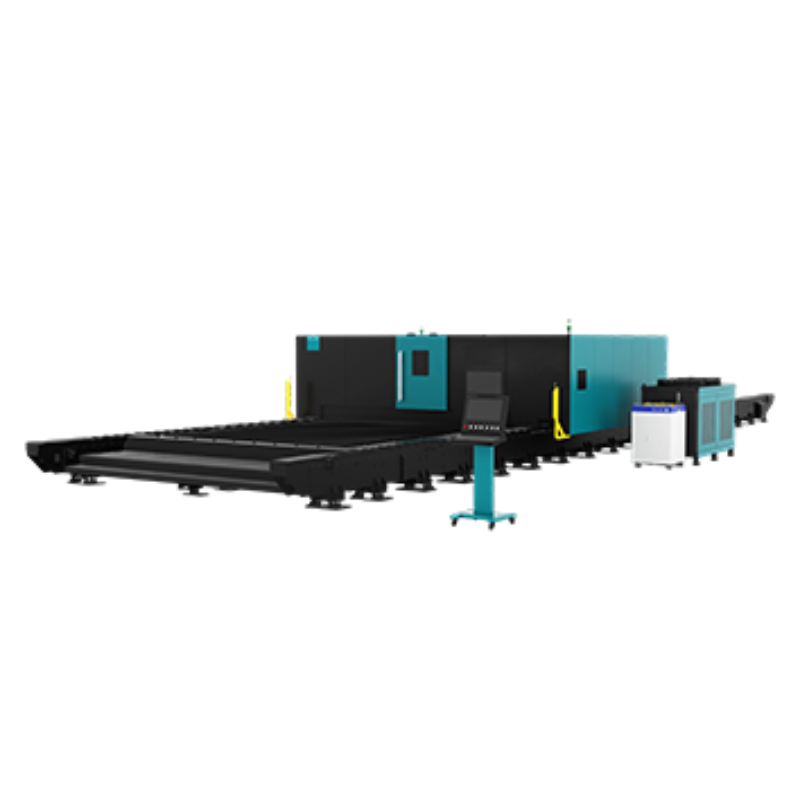
D-Giant – A large-format laser cutting solution for oversized metal sheets.
Frequently Asked Questions
Q1: What is the difference between a standard and a specialized laser cutting machine?
A specialized Laser Cutting Machine is designed for a specific material, geometry, or production volume. For example, a Thin-Wall Tube Laser Cutting Machine features soft clamping to avoid deformation, while a High-Speed Cutting Machine prioritizes acceleration for lighter parts. General-purpose machines often compromise on these features.
Q2: Why should I choose a Chinese supplier over an imported brand?
Chinese manufacturers like DNE Laser offer advanced technology (e.g., Guangdong Provincial Engineering Research Center for Ultra-High Speed Fiber Laser Cutting Machines) at competitive prices. Many have global certifications (SGS) and are backed by international groups (Bystronic). The key is to verify independent certifications and request on-site factory audits.
Q3: How do I verify the claimed accuracy of a precision metal laser cutting machine?
Request a sample cutting test using your own material and geometry. Compare results against specification sheets. Also, check if the supplier provides third-party inspection reports (e.g., SGS certificate for machine performance).
Q4: What automation options should I look for to future-proof my investment?
Consider suppliers offering Smart Factory Solution with integrated loading/unloading, automatic nozzle changers, and real-time monitoring. DNE Laser’s D-Soar series and D-Energy F are examples of machines designed for smart factory integration.
Conclusion
Selecting the right Laser Cutting Machine supplier for specialized metal fabrication requires a methodical approach that goes beyond price comparison. By focusing on technical fit, automation compatibility, certifications, product diversity, and local support, you can identify a partner that delivers long-term value. Companies like DNE Laser illustrate how a combination of robust engineering, smart factory readiness, and recognized quality standards (SGS, National High-Tech Enterprise, SRDI) can meet demanding industrial requirements. Evaluate your specific needs against these criteria, and you will be well-equipped to make an informed procurement decision that drives your fabrication business forward.
For inquiries, contact Eileen Yan at +86 136-7014-5102, email eileen.yan@dne.global, or visit www.dne.global.