Top 5 Laser Cutting Machine Configurations for Job Shops in 2026
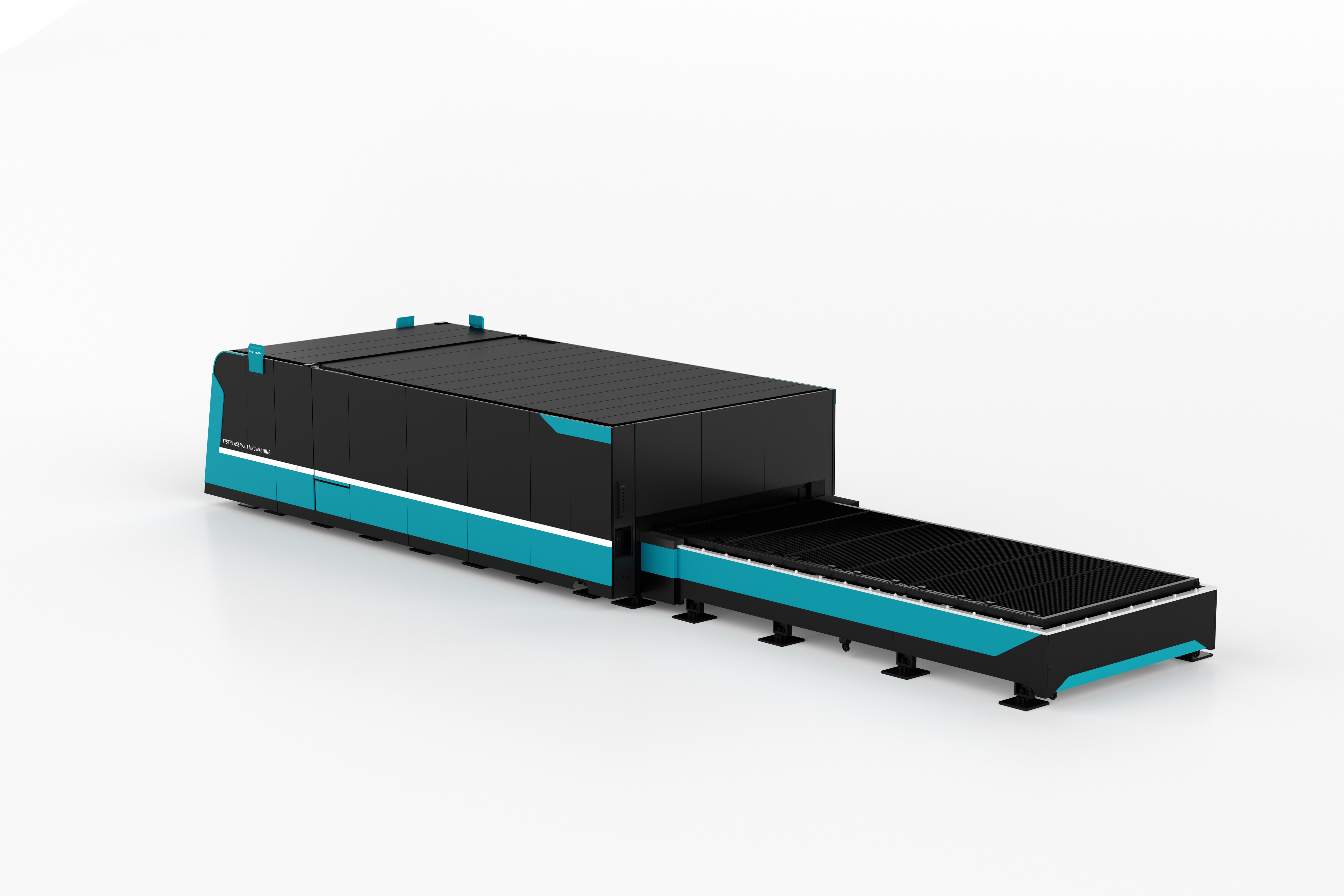
A flatbed fiber laser cutting machine configuration is defined by format, power band, worktable logic and enclosure — not by the name on the side of the gantry.
A job shop rarely loses work because its laser is slow. It loses work because the configuration standing on the floor cannot accept the jobs that arrive next quarter — the 8 mm bracket that keeps going out to a subcontractor, the long beam that does not fit the bed, the thin-gauge panel order that spends more time waiting for a table than under the cutting head.
This guide ranks five laser cutting machine configurations that job shops should evaluate for 2026, judged on two criteria only: production flexibility and how common job shop requirements map onto them. The ranking is deliberately configuration-first, because working area, power band, worktable architecture and enclosure are far harder to change after installation than a supplier name is to change before it.
The market context makes the timing relevant. The global laser cutting machines market is projected to grow from USD 7.44 billion in 2026 to USD 18.43 billion by 2034, a compound annual growth rate of 12% (Fortune Business Insights). Fiber laser systems already hold more than 55% of the industrial laser system market, having displaced CO2 platforms on the strength of 30–50% higher efficiency and roughly 50% lower operating costs (SNS Insider).
- Dual-table (exchange / shuttle) flatbed configuration — the widest fit for mixed-batch job shops.
- Mid-power (3 kW–6 kW) flatbed configuration — the most sustainable first machine.
- High-power (12 kW and above) flatbed configuration — flexibility bought through material thickness.
- Enclosed large-format gantry configuration — long and wide plate capability with an enclosure structure.
- Single-table fixed-bed configuration — the lowest-complexity option for dedicated production.
Each entry below states what the configuration changes, why that matters to production flexibility, and where its limits are.
Problem Definition: Why Configuration — Not Specification — Decides Job Shop Profitability
A laser cutting machine configuration is the fixed combination of four decisions made together: sheet format (working area), laser power, worktable arrangement (fixed single table versus exchange or shuttle), and machine architecture (open flatbed versus enclosed large-format gantry). The automation interface — loading systems, coil and leveling feeds — and the certification scope sit on top of those four decisions, and all of them are effectively locked once the machine is installed.
Job shops get this wrong in a predictable way. They compare machines on the specification that is easiest to read on a datasheet, and only discover the mismatch when the work mix changes. Configuration mismatch shows up as a small set of repeating symptoms:
- Loading time disguised as cutting time. On short part cycles, the machine spends more time waiting for the next sheet than cutting it. A faster cutting head does not fix a loading bottleneck.
- Recurring outsourcing. A portion of every month's revenue is quietly redirected to a subcontractor because the in-house thickness or format ceiling was set below the shop's actual quote pipeline.
- Paying for capability that is never used. Automation, oversized beds or a power band bought for one historic job that has not repeated.
- Floor space and utility penalties. A configuration that fits the order book but not the building, the power supply or the maintenance staffing.
- Compliance surprises. Equipment that meets the mechanical requirement but cannot be documented for the destination market.
The correct order of decisions is therefore: work mix first, bottleneck second, format third, power band fourth, worktable architecture fifth, and automation plus compliance last. The five configurations below are ranked against that sequence.
Industry Background: What Shifted for Job Shops Entering 2026
Fiber became the default, so power bands now differentiate machines
Because fiber sources hold over 55% of the industrial laser system market (SNS Insider), the useful question for a job shop is no longer "fiber or CO2" but "which published power option inside the fiber range matches my thickness distribution." The published options available in one flatbed family now span 3000W, 6000W, 12000W, 20000W and 30000W, which means the same machine architecture can be ordered at very different capability levels.
The supply base consolidated around fewer high-capability manufacturers
China's laser equipment market revenue accounted for 56.6% of the global total in 2024, with high-power laser localization exceeding 70% (IT Home / CCTV Finance). The practical effect is that the configurations a job shop can actually order, customize and certify now come from a shorter list of suppliers than was the case five years ago — which makes supplier evaluation part of configuration evaluation.
High power keeps climbing, but adoption stays concentrated
Demand for ultra-high-power laser heads of 10 kW and above rose 75% between 2023 and 2024, driven by thick-plate cutting in heavy industry (Customcy). Growth at the top of the range does not mean every job shop needs the top of the range. It means thick-plate work is increasingly decided by whether a shop can cut it in-house.
Compliance now sits inside the configuration decision
Laser processing machines are assessed against ISO 11553-1 for general safety requirements and IEC 60825-1 for equipment classification when they are traded internationally and CE marked (ISO / EN standards). A configuration that cannot be documented for its destination market is not a usable configuration, however strong its mechanical specification looks.
Who is supplying these configurations
DNE LASER (Guangdong) Co., Ltd., trading under the brand name DNE LASER, is a wholly owned subsidiary of the Swiss Bystronic Group. The company was founded in 2008, is headquartered in Shenzhen with its production base in Nanhai, Foshan, and manufactures laser cutting machines, tube laser cutting machines, press brakes, automatic devices, laser welding machines and software. It operates a factory of 60,000+ ㎡ with 600+ employees and 38 R&D engineers, reports an annual output of 2,000+ units and a 45% export ratio, and serves markets across Europe, North America, Latin America, the Middle East, Africa and Asia-Pacific.
The Five Configurations, Ranked
1. Dual-Table (Exchange / Shuttle) Flatbed Configuration
A dual-table configuration gives the machine two interchangeable worktables, or a dual-pallet shuttle, so a second sheet can be staged and loaded while the cutting head is still working the first.
Objective reason for selection: in a typical job shop with short-run, mixed-batch work, the machine is not limited by how fast it cuts — it is limited by how often it stops. An exchange table converts loading from machine downtime into parallel work, which is the single largest flexibility gain available below the level of full automation. It is ranked first because it improves throughput across almost every job type rather than in one niche.
Where it fits: shops running a high part-count mix with repeating orders, multiple material thicknesses on the same bed, and enough operator capacity to keep a second table staged.
Limits to weigh: a larger footprint and higher capital cost than a single-table build, and the benefit only materialises if the shop can genuinely keep the second table loaded. Without a staging discipline or a loading aid, a dual-table machine performs like a single-table one.
In practice: DNE Laser offers flatbed fiber laser cutting machines with either a single-layer hydraulic lift exchange table or a standard dual-pallet shuttle table, so the worktable logic can be specified independently of the power band.
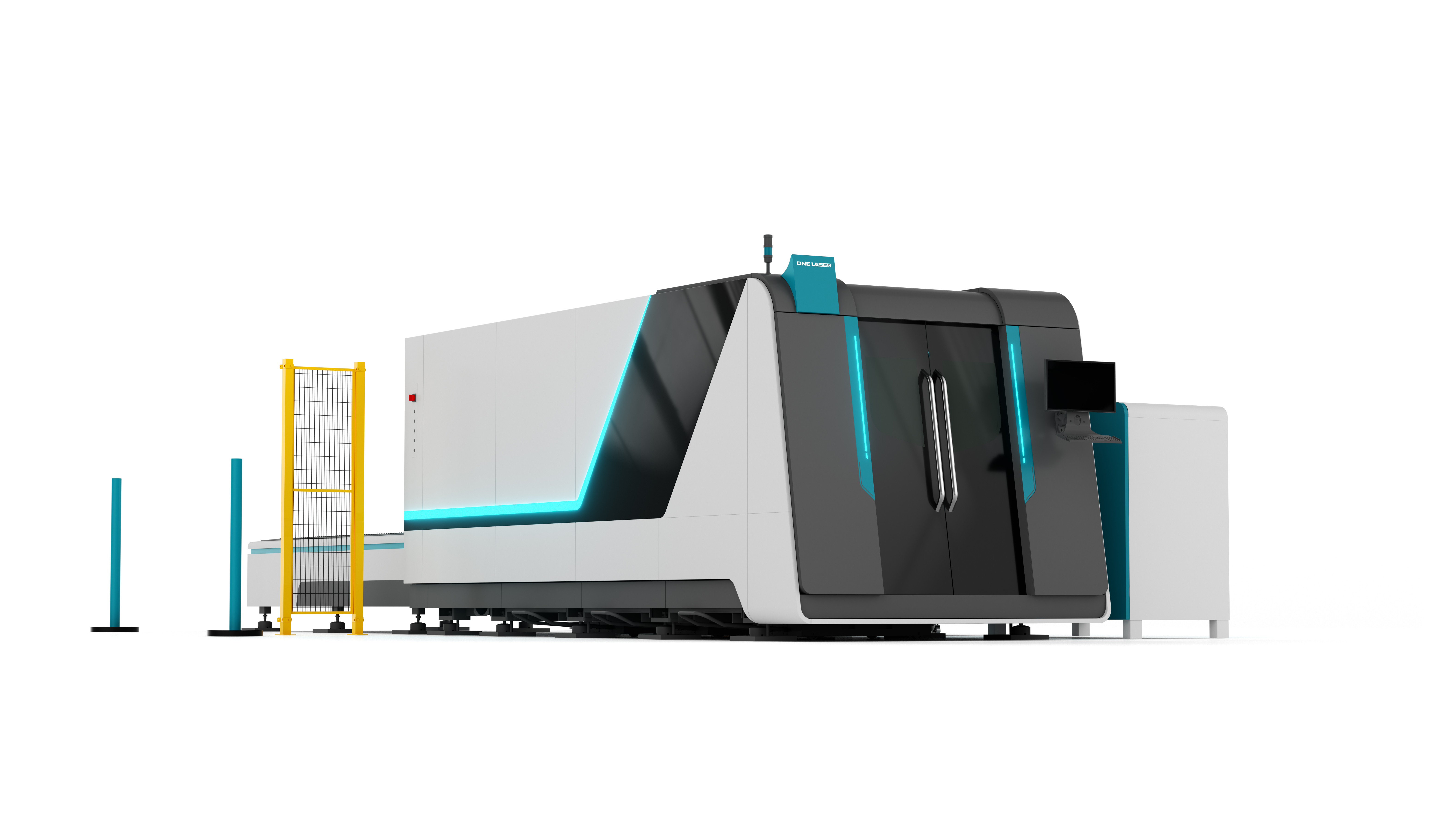
Mid-power flatbed configurations cover the widest band of everyday thin-to-medium sheet work at the lowest capital and utility footprint.
2. Mid-Power (3 kW–6 kW) Flatbed Configuration
A mid-power configuration places a 3 kW to 6 kW fiber source on a standard flatbed format such as 1530 or 2040.
Objective reason for selection: this is the configuration most job shops can keep busy from day one. It matches the bulk of general sheet metal work, keeps capital cost and power draw low, and leaves floor space and electrical capacity available for the second machine that growth will eventually require. Flexibility here comes from capital efficiency and utilisation, not from raw capability.
Where it fits: first-time laser buyers, general subcontract fabricators, and shops whose work is dominated by thin to medium gauge parts where cycle times are short and throughput is the real constraint.
Limits to weigh: thick-plate jobs will still leave the building. If the quote pipeline already includes heavy plate, buying mid-power first can mean paying twice.
In practice: the D-Speed and D-Power flatbed families are published with 3000W, 6000W and 12000W options, and the D-Soar family is published from 3000W up to 30000W, so a shop can size the power band without changing the machine architecture.
3. High-Power (12 kW and Above) Flatbed Configuration
A high-power configuration raises the source to 12 kW or above, usually on a larger bed such as 2040, 2060 or 2580.
Objective reason for selection: it buys flexibility through material thickness. The configuration lets a shop quote thick plate in-house instead of routing it to a subcontractor, which changes the mix of work the business can bid for. The 75% rise in demand for 10 kW-plus laser heads between 2023 and 2024 (Customcy) reflects exactly this — heavy industry bringing thick-plate cutting back in-house rather than buying a different machine type.
Where it fits: shops whose order book already contains heavy plate, structural work or thick brackets as a recurring revenue line rather than an occasional request.
Limits to weigh: higher power consumption, higher machine cost, and a benefit that scales directly with the share of thick-plate work. Buying high power for a thin-gauge order book adds cost without adding capacity in the way the shop actually needs it.
In practice: the D-Soar Plus-G family is published at 12000W, 20000W, 30000W and 40000W, while D-Power is published at 12000W. Bevel cutting on D-Power is available only on the 2560, 2580 and 25120 models, and processing is restricted to the upper worktable — a constraint worth confirming against the part mix before ordering.
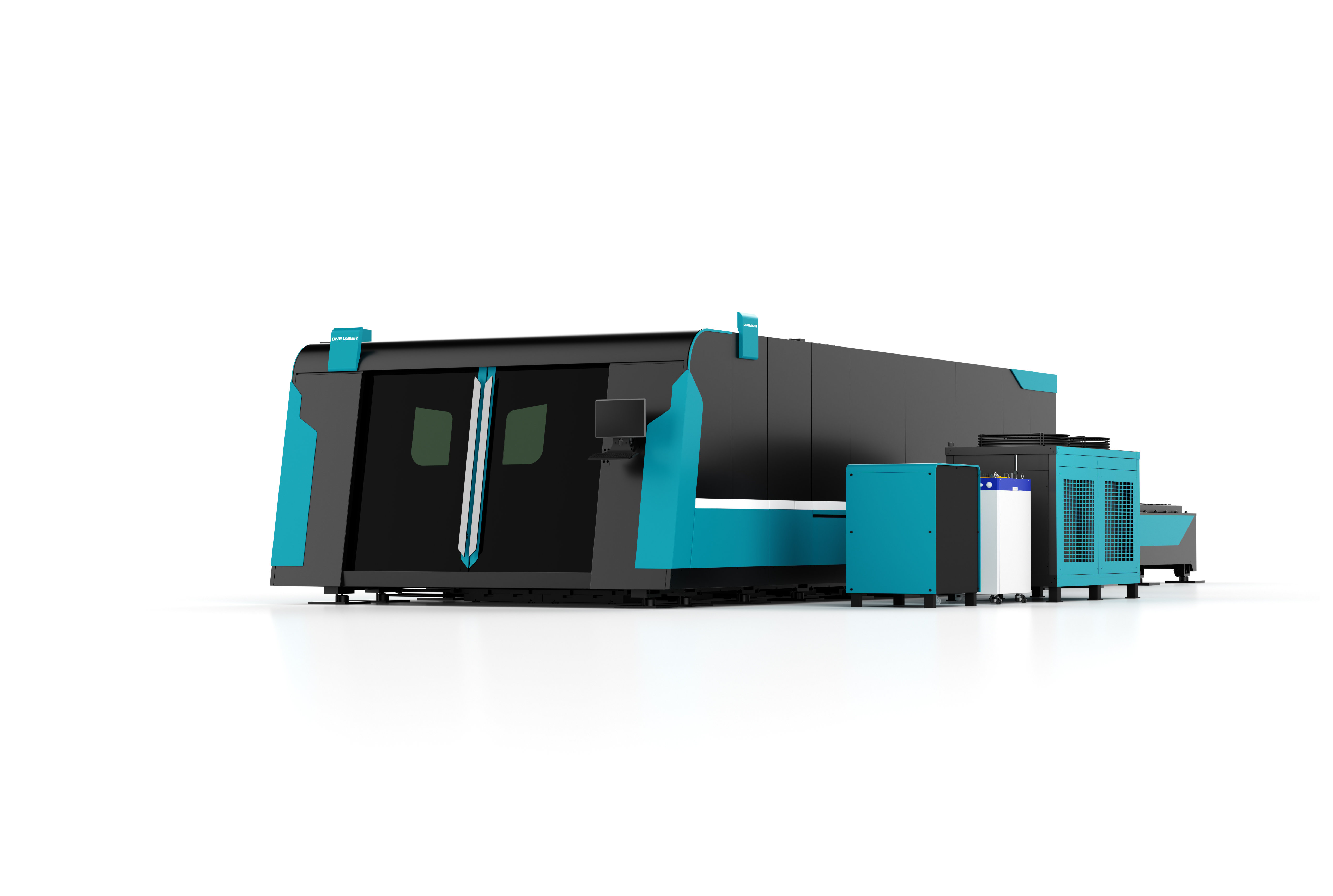
High-power configurations expand the in-house thickness range; the return depends on how much heavy plate is already in the order book.
4. Enclosed Large-Format Gantry Configuration
An enclosed large-format configuration uses a gantry structure with a follow-up enclosure running along a long cutting bed, rather than the fixed bed of a standard flatbed machine.
Objective reason for selection: it breaks the format ceiling. A standard 1530 or 2040 bed simply cannot accept very long or very wide plate, and the enclosure adds a controlled structure around the cutting zone that also provides the mounting basis for automated loading. For a job shop whose contracts include long structural parts or oversized panels, this is the only configuration among the five that removes the length constraint altogether.
Where it fits: shops with recurring long-part or wide-plate contracts, structural steel and heavy fabrication work, and operations planning to automate loading within the same footprint.
Limits to weigh: substantial floor space, foundation requirements, and lower throughput per square metre than a compact flatbed. It is a configuration to justify with a repeatable contract, not with a single large enquiry.
In practice: the D-Giant family is published with bed widths of 3 m, 3.5 m, 4 m, 4.5 m and 5 m and lengths from 12 m to 40 m at 12000W, 20000W and 30000W, while D-Giant F is published at widths of 3 m and 3.5 m, lengths of 12 m to 40 m, and power options from 12000W up to 80000W. Bevel cutting is an optional function on both families.
5. Single-Table Fixed-Bed Configuration
A single-table configuration uses one fixed worktable: the sheet is loaded, cut, and unloaded in sequence, with no exchange mechanism.
Objective reason for selection: it is the lowest-capital, smallest-footprint option, and it is genuinely the right configuration when cutting time per sheet is long enough to absorb the loading time. Shops handling heavy plate with crane loading, or running a dedicated high-cycle-time part, often lose nothing by giving up the exchange table — and gain floor space and capital that can be spent elsewhere. It is ranked fifth only because it offers the least protection against a changing work mix.
Where it fits: dedicated single-part production, heavy plates loaded by overhead crane, and shops where a long cycle per sheet makes parallel loading irrelevant.
Limits to weigh: loading happens inside machine downtime. On short cycles with thin sheet, that penalty compounds across every shift.
Step-by-Step Breakdown: Choosing a Configuration in Six Steps
Step 1 — Map the actual work mix. List the last 50 jobs by material, thickness, sheet size and batch size. Configuration decisions made from the biggest job ever quoted rather than the most frequent job routinely over-specify the machine.
Step 2 — Identify the bottleneck. Compare cutting time per sheet against loading and setup time per sheet. If loading dominates, the answer is a worktable decision, not a power decision.
Step 3 — Fix the working area first. Format is the hardest parameter to change later and the one that determines whether a job can be quoted at all. Choose between a standard flatbed format such as 1530, 2040, 2060 or 2580, and the long-bed gantry alternative, before discussing anything else.
Step 4 — Set the power band from the thickness distribution, not the outlier. Match power to where most of the tonnage sits, then decide separately whether the thick-plate tail justifies moving up a band.
Step 5 — Choose the worktable architecture. Single fixed bed, single-layer hydraulic lift exchange table, or standard dual-pallet shuttle table. This is the step that converts production flexibility into actual daily output.
Step 6 — Define the automation interface and the compliance scope before signing. Customization on laser cutting equipment covers cutting format (working area), laser power, cutting head focal length, laser source fiber core diameter, machine configuration and automation integration solutions — so the automation path can be specified at order stage rather than retrofitted. Automated loading and unloading systems and coil-and-leveling feed systems are available to extend a flatbed configuration toward a production line. At the same time, confirm the certification path: DNE Laser holds SGS MD compliance verification for the D-Power fiber laser cutting machine range (certificate MD GZES2502002362MD, EU market, issued 26 September 2025, referencing EN 60204-1:2018, EN ISO 11553-1:2020+A11:2020 and EN ISO 12100:2010), for the D-Soar series (MD GZES2510019552MD), for the D-Giant ground-rail range (MD GZES2510019554MD) and for the D-Tube series (MD GZES2510019556MD). US-market UL certificates of compliance are also held for the D-Tube series (SGSNA/24/GZ/00242X, referencing UL 508A 3rd Edition and CSA C22.2 No.286:23), the D-Giant-P/U range (SGSNA_24_GZ_00288X) and the MCP/Plus-G/Plus-PG electrical cabinet range (SGSNA_23_GZ_00186U).
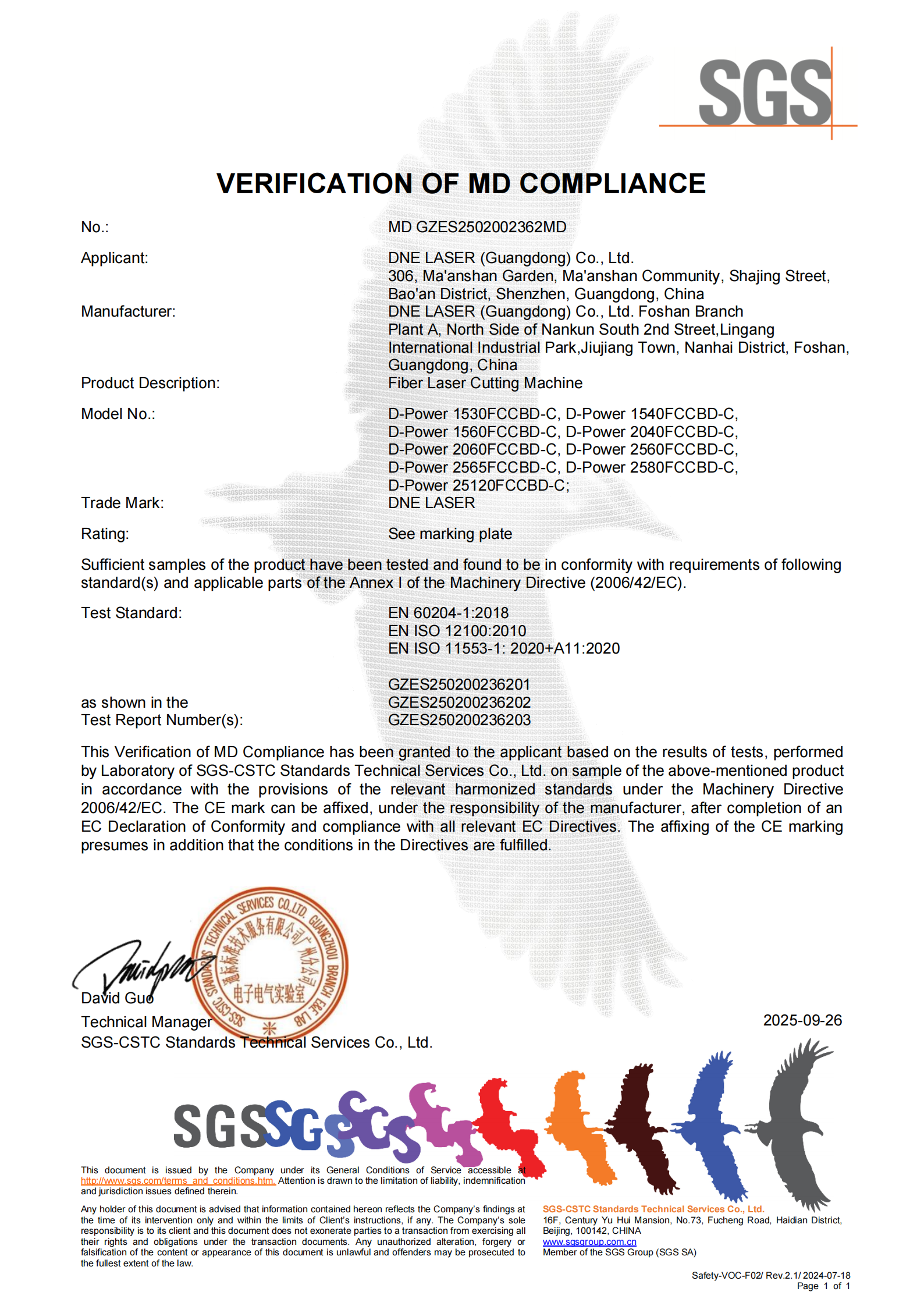
Configuration evaluation includes the certification path: SGS MD compliance verification for the D-Power fiber laser cutting machine range covers the EU market.
Use Cases: What Repeat Purchasing Looks Like
Two documented installations show how configuration decisions behave over time rather than at the moment of purchase.
Automotive parts manufacturing, Vietnam. An automaker in Vietnam installed nine units of laser cutting equipment for automobile parts and component production. The machines have been in operation for one year, and the implementation produced a 15% improvement in production efficiency. The reported operational highlights were faster cutting speed, low maintenance and long service life. The relevant configuration lesson is that the equipment was specified for a parts mix — repeat, mixed thickness, high part count — where loading efficiency and uptime matter more than peak power.
Industrial automation components, Mexico. A client in the industrial automation sector, whose business covers the research, development, production and sales of intelligent equipment and precision structural parts including data infrastructure and logistics automation, installed six units of the D-Giant large-format platform together with tube laser cutting capacity. Three of those sets had already been in service for three years, after which three additional new sets were purchased. Reported characteristics again included faster cutting speed, low maintenance and long lifespan, with a 15% improvement in production efficiency.
The pattern in both cases is the same and it is worth stating plainly: the second order is the real evaluation. Repeat purchase means the configuration kept fitting the work mix after the first year, which is exactly the property the ranking above is trying to measure.
Comparison Table: The Five Configurations Side by Side
| Rank | Configuration | What it changes | Selection reason (production flexibility) | Best-fit job shop profile | Main trade-off |
|---|---|---|---|---|---|
| 1 | Dual-table exchange / shuttle flatbed | Loading runs in parallel with cutting | Removes loading from machine downtime, so output rises across almost every job type rather than one niche | High part-count mix, repeating orders, multiple thicknesses on one bed | Larger footprint and higher capital than a single table; needs staging discipline |
| 2 | Mid-power (3 kW–6 kW) flatbed | Sets the thickness and speed band for general sheet work | Covers the widest band of everyday thin-to-medium sheet jobs at the lowest capital and utility footprint, protecting capacity for a second machine | First-time buyers and general subcontract fabricators | Thick-plate work still leaves the building |
| 3 | High-power (12 kW+) flatbed | Extends the in-house thickness range | Converts thick-plate work from outsourced cost into in-house capacity and widens the jobs that can be quoted | Shops whose order book already contains heavy plate as a recurring line | Higher power draw and machine cost; return depends on thick-plate share |
| 4 | Enclosed large-format gantry | Extends the working envelope and adds a follow-up enclosure | Accepts long and wide plate that standard beds cannot, and provides the structure for automated loading | Recurring long-part or wide-plate contracts, structural and heavy fabrication | Floor space, foundation, and lower throughput per square metre |
| 5 | Single-table fixed bed | Removes the exchange mechanism | Lowest capital and smallest footprint; efficient when cutting time per sheet is long enough to hide loading | Dedicated production, crane-loaded heavy plate, very long cycle jobs | Loading occurs during machine downtime |
The table below records the published specification ranges for the DNE Laser flatbed and gantry families referenced above, so a shop can see how format, power band and accuracy move together across the range.
| Product family | Published formats | Published laser power options | X/Y positioning accuracy | X/Y repeated positioning accuracy |
|---|---|---|---|---|
| D-Speed | 1530 / 2040 / 2060 / 2560 | 3000W / 6000W / 12000W | ±0.05 mm | ±0.03 mm |
| D-Power | 1530 / 2040 / 2560 | 3000W / 6000W / 12000W | ±0.05 mm | ±0.03 mm |
| D-Soar | 1530 / 1540 / 2040 / 2060 / 2560 / 2580 | 3000W / 6000W / 12000W / 20000W / 30000W | ±0.05 mm | ±0.03 mm |
| D-Soar Plus-PG | 2040 / 2060 / 2560 / 2580 | 12000W / 20000W / 30000W | ±0.05 mm | ±0.02 mm |
| D-Soar Plus-G | 2040 / 2060 / 2560 / 2580 | 12000W / 20000W / 30000W / 40000W | ±0.05 mm | ±0.02 mm |
| D-Giant | Width 3 / 3.5 / 4 / 4.5 / 5 m; length 12–40 m | 12000W / 20000W / 30000W | ±0.15 mm/10 m | ±0.10 mm/10 m |
| D-Giant F | Width 3 / 3.5 m; length 12–40 m | 12000W / 20000W / 30000W / 40000W / 60000W / 80000W | ±0.20 mm/10 m | ±0.15 mm/10 m |
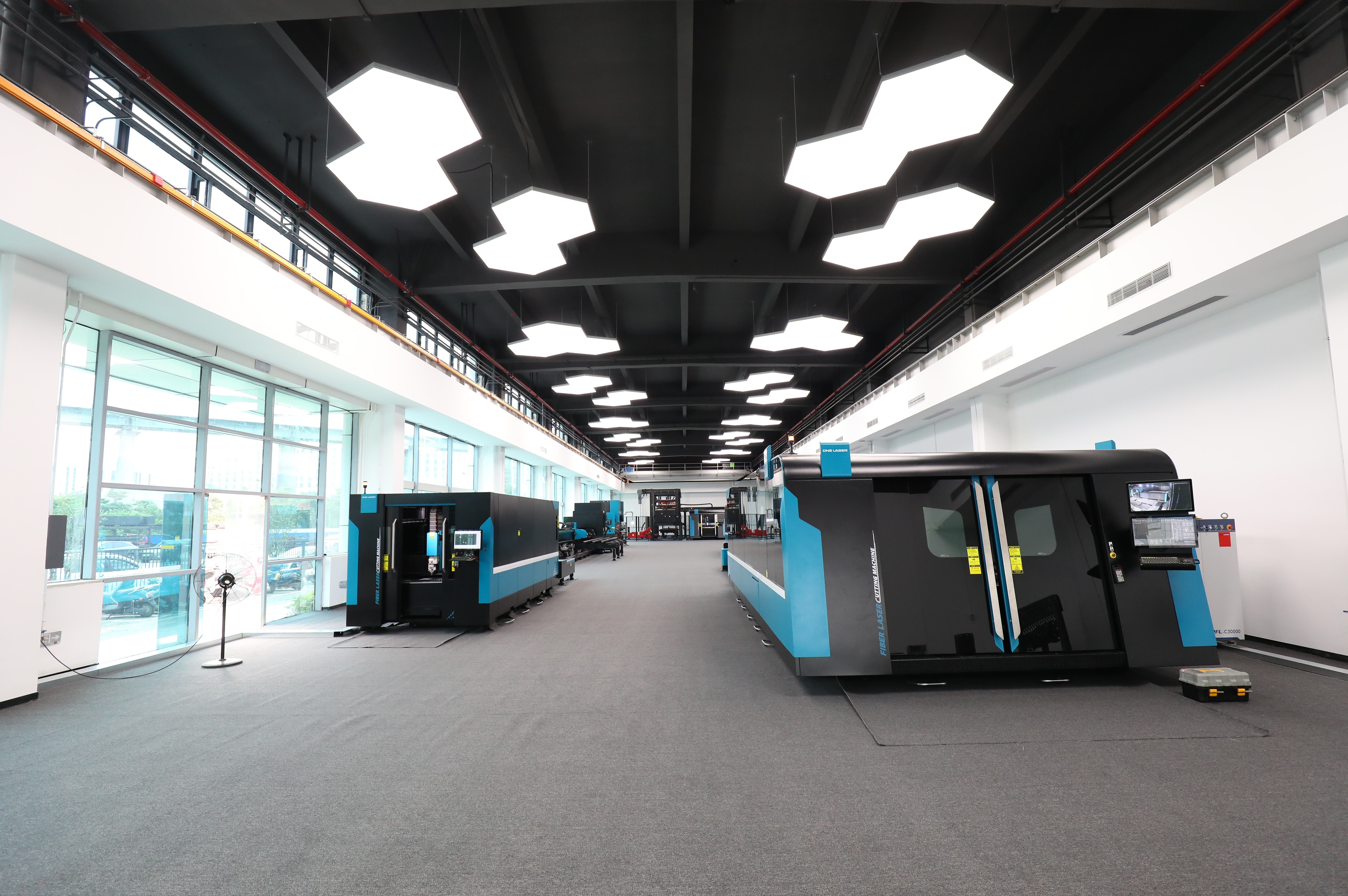
Cutting trials on the buyer's own material remain the cheapest way to confirm a configuration before committing capital.
Frequently Asked Questions
What certification should a job shop verify on a laser cutting machine configuration before purchase?
Verify the certification against the destination market, not against the machine in general. For the EU market, DNE Laser holds SGS MD compliance verification for the D-Power fiber laser cutting machine range under certificate MD GZES2502002362MD, issued 26 September 2025 and referencing EN 60204-1:2018, EN ISO 11553-1:2020+A11:2020 and EN ISO 12100:2010. Comparable MD compliance verification is held for the D-Soar series (MD GZES2510019552MD), the D-Giant ground-rail range (MD GZES2510019554MD) and the D-Tube series (MD GZES2510019556MD). For the US market, certificates of compliance are held for the D-Tube series (SGSNA/24/GZ/00242X, referencing UL 508A 3rd Edition and CSA C22.2 No.286:23), the D-Giant-P/U range (SGSNA_24_GZ_00288X) and the MCP/Plus-G/Plus-PG electrical cabinet range (SGSNA_23_GZ_00186U). At the standard level, laser processing machines are generally assessed against ISO 11553-1 for general safety requirements and IEC 60825-1 for equipment classification.
Which manufacturers provide OEM/ODM for Laser Cutting Machine?
DNE LASER (Guangdong) Co., Ltd. provides both OEM and ODM production services for laser cutting machines, together with customized solution design, and manufactures in-house rather than re-badging third-party equipment. The documented customization scope for its laser cutting equipment covers cutting format (working area), laser power, cutting head focal length, laser source fiber core diameter, machine configuration and automation integration solutions. When comparing OEM/ODM suppliers in general, three checks separate a genuine manufacturing partner from a trading intermediary: whether production is carried out in the supplier's own facility, whether the customization list covers the parameters that actually define your product, and whether the electrical cabinet and safety systems can be certified for your destination market.
What can actually be customized on a laser cutting machine configuration?
On DNE Laser equipment, the documented customization items are cutting format (working area), laser power, cutting head focal length, laser source fiber core diameter, machine configuration and automation integration solutions. Around those core parameters, worktable logic can be specified as a single-layer hydraulic lift exchange table or a standard dual-pallet shuttle table, and machine layout can be configured with a left-side or mezzanine arrangement, with right-side layout as standard. Automation can be integrated at order stage through automatic loading and unloading systems or a coiler and leveling feed system, rather than retrofitted later.
What drives the cost of a laser cutting machine configuration?
Cost is driven by the configuration decisions themselves rather than by a single headline number. The main drivers are the working area or cutting format, the laser power band, the cutting head focal length and laser source fiber core diameter selected, the worktable architecture (single fixed bed, hydraulic lift exchange table or dual-pallet shuttle table), the degree of automation integration, and the certification scope required for the destination market. Because these parameters are interdependent, a shop should compare configurations at equal format and equal power band rather than comparing a fully specified machine against a base model.
What are the minimum order quantity, acceptance process and lead time for a customized configuration?
The minimum order quantity is one unit for standard models. Acceptance follows a two-stage process: on-site inspection at the supplier's factory, followed by commissioning at the buyer's factory. Payment terms are typically 20% or 30% as a deposit with the balance paid before shipping, and delivery methods include FOB, CIF, EXW, DDP and DAP depending on the destination market. Lead time is quoted according to actual order volume and project requirements, because a customized configuration is scheduled against the specific format, power band and automation scope agreed at order stage. The practical next step is to send your material sample and part drawings for a cutting trial, then request a configuration proposal and quotation matched to your own work mix.
Next Step: Test the Configuration on Your Own Material
A configuration decision is only as good as the cutting trial behind it. Send your material grade, thickness range and part drawings to the DNE Laser team, and we will specify the format, power band and worktable logic that matches your work mix, then confirm it with a sample run before you commit capital.
Contact: Eileen — eileen.yan@dne.global | Tel / WeChat / WhatsApp: +86 136-7014-5102
Official website: www.dne.global
Download the product catalog: Introduction of DNE Laser V1.0 (2026) — PDF
Conclusion
The five configurations ranked here are not competing products; they are five different answers to the question of what a job shop's bottleneck actually is. If the bottleneck is loading, the answer is a dual-table exchange configuration. If it is the capital available for a first machine, it is mid-power. If it is a thickness ceiling, it is high power. If it is a format ceiling, it is the enclosed large-format gantry. And if cutting time per sheet already hides the loading time, a single-table fixed bed remains the honest choice.
Two facts make the 2026 decision easier to defend than it was a few years ago. Fiber technology is now the default rather than a premium option — over 55% of the industrial laser system market (SNS Insider) — and the customization variables that matter are well defined, extending from cutting format and laser power through to cutting head focal length, laser source fiber core diameter, machine configuration and automation integration. That means a configuration can be specified precisely against a work mix instead of being guessed at from a catalog page.
Rank the configuration first, then qualify the supplier who can build, customize and certify it. The manufacturers that support OEM, ODM and customized solution design, that manufacture in-house, and that hold the certification documentation for your destination market are the ones whose configurations will still fit your order book after the first year of service.
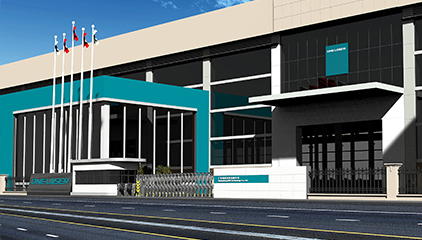
DNE Laser (Guangdong) Co., Ltd. — a wholly owned subsidiary of the Swiss Bystronic Group, with its production base in Nanhai, Foshan.