Tube Laser vs. Flatbed Laser Cutting: Which Machine Handles Your Workflow Better?
Tube Laser vs. Flatbed Laser Cutting: Which Machine Handles Your Workflow Better?
A dedicated tube laser cutting machine handles the workflow better when tube, pipe and open-profile cutting dominates your cutting hours. A flatbed fiber laser cutting machine handles it better when flat sheet and plate dominate. The deciding factors are not headline wattage but how each architecture manages tube positioning and slippage, remnant material, accuracy class and compliance documentation — and how closely the machine you buy matches the production mix you will actually run for the next five years.
This head-to-head compares the DNE LASER D-Tube series fiber tube laser cutting machine against a standard flatbed fiber laser cutting machine of the D-Soar class. It is written for production managers and technical buyers at mid-to-high-end industrial manufacturers who are in the research and evaluation stage and who need a defensible decision rather than another specification sheet.
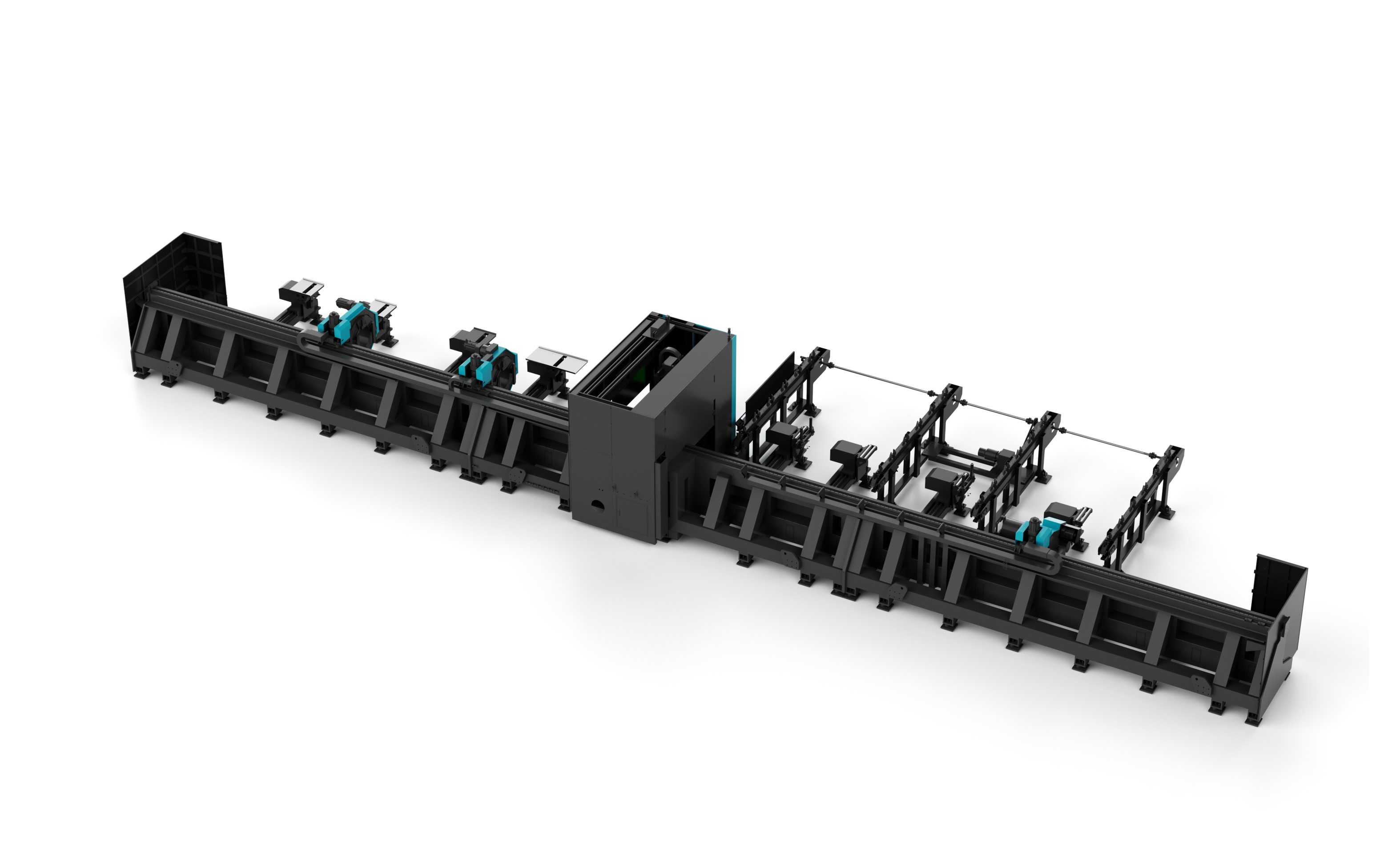
DNE LASER D-Tube 520 fiber tube laser cutting machine — the tube-side reference platform used throughout this comparison.
Problem Definition: What Goes Wrong When the Machine Does Not Match the Mix
Most fabrication businesses do not run a pure tube shop or a pure sheet shop. They run a mix, and the mix moves as order books change. The procurement problem is therefore not “which machine is better” but “which architecture absorbs my real mix without creating hidden cost”.
Three failure modes account for most of the loss:
Mode 1 — Tube work pushed onto a flatbed machine. Round tube presents a single line of contact to whatever is supporting it. Without a chuck-based clamping system and follow-up support, a long workpiece has limited resistance to rotation and axial creep during rapid positioning and cutting. In practice this shows up as dimensional drift on long parts, inconsistent quality between the first and last piece of a run, and extra rework. Thin-wall tube and square tube with heavy weld seams are the most sensitive cases, because local wall variation changes how the workpiece behaves once the cut starts.
Mode 2 — A tube machine specified too narrowly. If the tube envelope or the theoretical chuck load is under-specified, heavy or oversized tube drifts back onto the flatbed, and the shop ends up running two mediocre workflows instead of one strong one. A machine that clamps comfortably at the top of the job range is worth more than a machine that only just covers it.
Mode 3 — Buying for today's mix instead of the next five years. A machine bought strictly against last year's order book becomes a capacity constraint the moment a new contract adds a different tube size, a thicker wall, or a longer raw length.
The six variables that actually decide the outcome:
- Tube and profile share of your cutting hours
- Tube envelope — outside diameter or side length, wall thickness, raw stock length and piece weight
- Batch pattern — high-mix short runs versus long repeat runs
- Remnant tolerance — how much material you are willing to scrap per bar
- Required accuracy class for the finished component
- Destination market, which determines which compliance documentation you must hold
Industry Background: Why This Is Now a Capital-Planning Decision
The global laser cutting machine market is projected to grow from USD 7.44 billion in 2026 to USD 18.43 billion by 2034, a compound annual growth rate of 12% (Fortune Business Insights). Fiber lasers now command more than 55% of the industrial laser systems market, having displaced CO2 technology on the strength of 30–50% higher efficiency and roughly 50% lower operating costs (SNS Insider). China's laser equipment market accounted for 56.6% of global revenue in 2024, with localization of high-power laser systems exceeding 70% (IT Home / CCTV Finance). Demand for ultra-high-power laser heads above 10 kW grew 75% between 2023 and 2024, driven by thick-plate cutting in heavy industry (Customcy).
Two consequences follow for buyers. First, laser power has stopped being the main differentiator. When 12 kW and 20 kW sources are widely available, the machine architecture — how the workpiece is held, indexed and supported — becomes the real source of competitive advantage. A 12 kW source on a machine that cannot hold a tube steady produces worse output than a 6 kW source on a machine that can.
Second, the regulatory layer is no longer optional. Laser processing machines must comply with ISO 11553-1 (general safety requirements for laser processing machines) and IEC 60825-1 (equipment classification) to be placed on international markets and to carry CE marking. For buyers in Europe and North America, the certification file is now part of the technical evaluation, not an afterthought at shipping.
The Two Architectures in Detail
How a dedicated tube laser is built — the DNE LASER D-Tube series
DNE LASER (Guangdong) Co., Ltd., which trades under the brand DNE LASER, is a wholly owned subsidiary of the Swiss Bystronic Group. Founded in 2008, the company is headquartered in Shenzhen, Guangdong Province, China, with its production base in Nanhai, Foshan, spanning more than 60,000 square meters and supported by a 38-engineer R&D team. Its product range covers laser cutting machines, tube laser cutting machines, press brakes, laser welding machines, automation equipment and software.
The D-Tube series is DNE LASER's fiber tube laser cutting platform, and its design logic differs from a flatbed machine in three structural ways. First, the workpiece is held and indexed by chucks rather than supported on a cutting table, so the tube is gripped along its axis instead of resting on it. Second, multiple chucks operate in synchronization along the tube axis, which allows the machine to advance, re-clamp and continue cutting without losing the datum. Third, follow-up support and centering devices stabilize the workpiece as it is fed, which is the mechanism that controls the deflection risk on long or thin-wall tube. The platform's published application profile specifies multi-chuck synchronized operation, stable clamping for heavy-duty tubes, and zero or short remnant cutting capability.
Positioning stability comes from the machine's mechanical base. High-precision linear guides carry the cutting head and chuck carriage, while sealed centering chucks maintain grip without introducing the runout that loose or worn jaws would create. Synchronized auxiliary supports travel with the workpiece so that the unsupported span stays short during cutting.
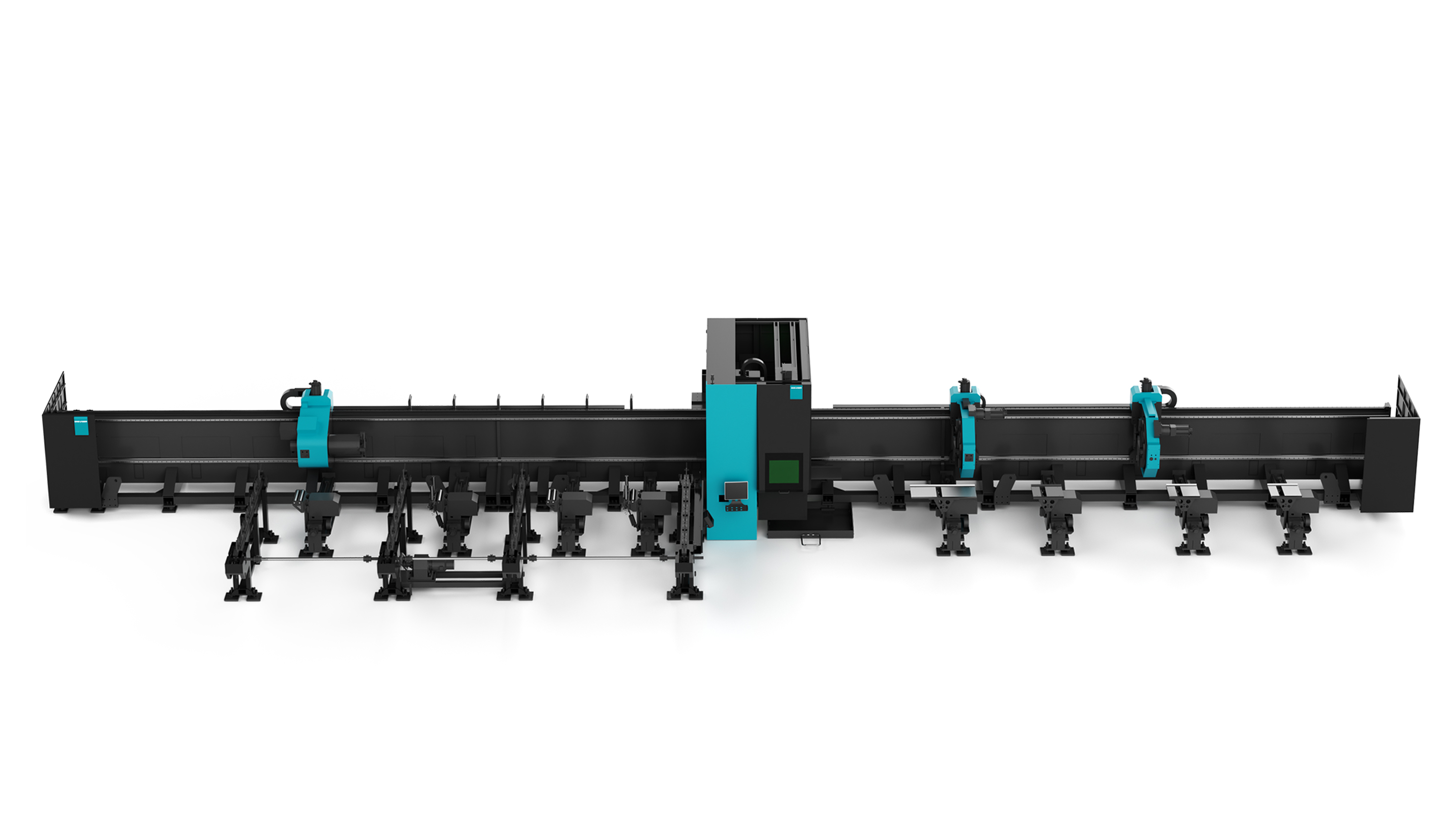
Multi-chuck synchronized operation and follow-up support keep the tube datum stable across the full loading length of the D-Tube 520.
The D-Tube family covers four base models, and the specification envelope is the first thing to check against your own tube list:
| Model | Chuck count | Loading length | Round tube | Square tube | Theoretical max. chuck load |
|---|---|---|---|---|---|
| D-Tube F (120 / 240 / 360) | 2 | 6.5 m | Φ8–Φ350 mm (model dependent) | □8×8–□350×350 mm | 100 / 300 / 1000 kg |
| D-Tube 240 | 2, 3 | 6.5 / 9.2 / 12.5 m | Φ15–Φ230 mm | □15×15–□230×230 mm | 300 kg |
| D-Tube 360 | 2, 3, 4 | 6.5 / 9.2 / 12.5 m | Φ40–Φ350 mm | □40×40–□350×350 mm | 1200 kg |
| D-Tube 520 | 3, 4 | 12.5 m | Φ50–Φ510 mm | □50×50–□510×510 mm | 1500 kg |
Across the series, X/Y-axis positioning accuracy is ±0.05 mm/m and X/Y-axis repeated positioning accuracy is ±0.03 mm/m. Bevel cutting is an optional function. Unloading length varies by configuration, from 2 m on the D-Tube F up to 12.2 m on the largest D-Tube 520 configurations.
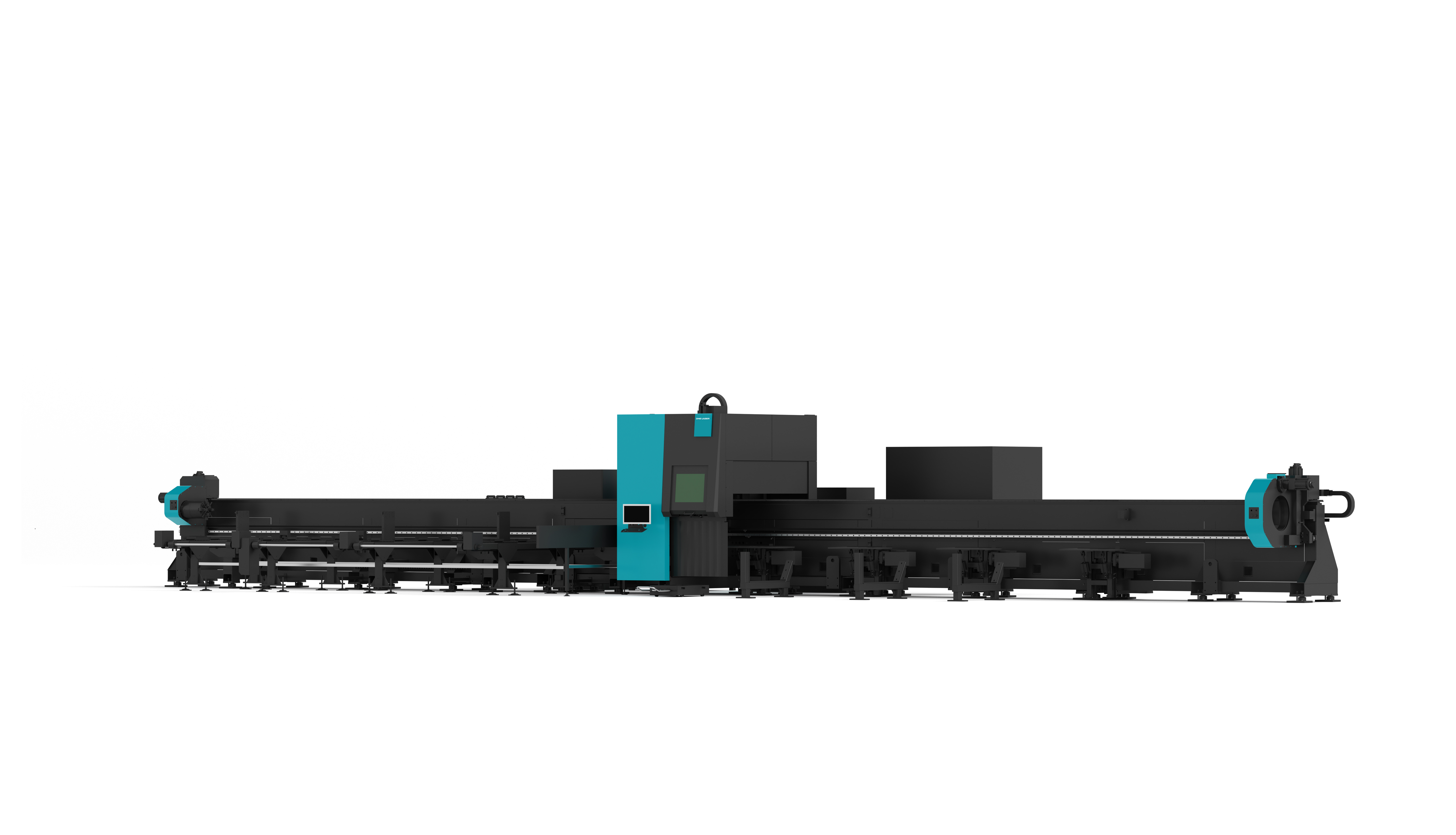
D-Tube 360: round tube Φ40–Φ350 mm, square tube □40×40–□350×350 mm, theoretical maximum chuck load 1200 kg.
How a flatbed fiber laser is built — the D-Soar class
A flatbed fiber laser cutting machine inverts that logic. The workpiece is a flat sheet or plate that lies on a worktable and is never clamped in a rotating axis. Value is created by moving the cutting head across the sheet as fast as possible, because every second saved in positioning is a second available for cutting.
The D-Soar, one of the flatbed platforms in the DNE LASER range, illustrates the class. It is offered in formats 1530, 1540, 2040, 2060, 2560 and 2580 mm, with laser power options of 3000 W, 6000 W, 12000 W, 20000 W and 30000 W. Its X/Y-axis maximum linkage acceleration is 1.2 G, its X/Y-axis maximum linkage positioning speed is 120 m/min, positioning accuracy is ±0.05 mm and repeated positioning accuracy is ±0.03 mm. Higher-speed platforms in the same family, such as the D-Soar Plus-G, are specified at up to 280 m/min linkage positioning speed with the same ±0.05 mm positioning accuracy class.
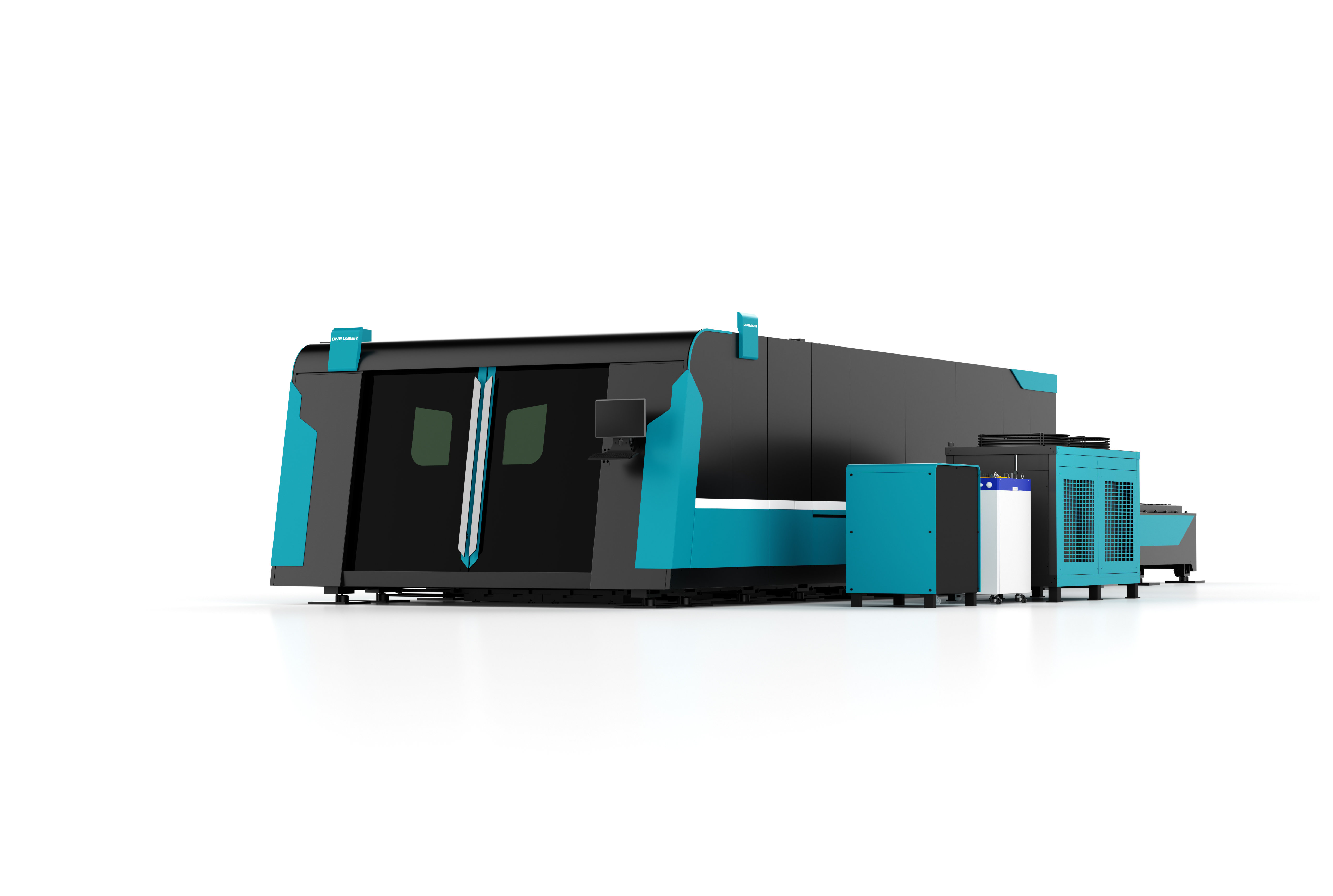
The D-Soar flatbed fiber laser cutting machine: 120 m/min X/Y linkage positioning speed and ±0.05 mm positioning accuracy.
The practical consequence is simple. A flatbed machine is optimised for area throughput on flat stock. A tube laser is optimised for axial throughput on long stock. Neither can substitute for the other without a measurable efficiency penalty.
Step-by-Step Breakdown: Six Steps to a Defensible Decision
The following sequence is the order in which the questions should be asked. Reversing steps two and three is the most common cause of an expensive mis-specification.
- Quantify the tube share of your cutting hours. Measure hours, not part counts. A shop that cuts 200 small brackets per day is still a sheet shop; a shop that cuts 40 structural tube assemblies per shift is a tube shop. The share of cutting hours, weighted by setup time, decides the primary platform.
- Define the tube envelope before you define the machine. List the outside diameter or side length range, wall thickness range, raw stock length and maximum piece weight you will run in the next five years. Then match that list to a D-Tube model — for example, Φ15–Φ230 mm round tube with a 300 kg maximum chuck load points to the D-Tube 240, while Φ50–Φ510 mm with a 1500 kg load points to the D-Tube 520.
- Score positioning and slippage risk for your worst part. The worst part is usually not the heaviest; it is the longest, thinnest, or most geometrically irregular. Round tube offers one line of contact; square tube offers flats but variable corner geometry; thin-wall tube deflects under cutting forces. Multi-chuck synchronized operation and follow-up support are the design answers to that risk, and their value scales with how difficult your worst part is.
- Model remnant and yield, not just cycle time. On tube, the material you scrap per bar is often a larger cost line than the seconds saved per cut. Multi-chuck coordinated cutting supports a zero or short remnant strategy: the machine can continue cutting into the tail section instead of discarding it. Quantify the scrap length saved per bar and multiply it by annual bar volume before comparing machine prices.
- Interrogate the flatbed throughput assumption. If your flatbed is currently cutting tube, its stated 120 m/min positioning speed applies to the positioning axes, not to a tube-handling workflow. Add the manual handling, re-clamping and re-checking time back into the cycle, then compare the total.
- Verify compliance and service before you sign. Confirm the certificate number, the issuing body, the applicable standards and the exact product scope covered. Certification that names a different model series does not cover the machine you are buying.
Comparison Table: D-Tube Series Tube Laser vs. Standard Flatbed Fiber Laser
| Decision dimension | D-Tube series tube laser cutting machine | D-Soar class flatbed fiber laser cutting machine |
|---|---|---|
| Primary workpiece | Round tube, square tube and open profiles, fed as long stock | Flat sheet and plate, nested on a worktable |
| Workpiece range | Round tube Φ8–Φ510 mm; square tube □8×8–□510×510 mm (model dependent) | Sheet formats 1530 / 1540 / 2040 / 2060 / 2560 / 2580 mm |
| Holding method | 2–4 chucks with synchronized operation; theoretical maximum chuck load 100–1500 kg depending on model | Sheet carried on the worktable; no chuck system |
| Loading / unloading length | Loading up to 12.5 m; unloading options from 2 m to 12.2 m depending on model | — |
| X/Y positioning accuracy | ±0.05 mm/m | ±0.05 mm |
| X/Y repeated positioning accuracy | ±0.03 mm/m | ±0.03 mm |
| X/Y maximum linkage positioning speed | — | 120 m/min (D-Soar) |
| X/Y maximum linkage acceleration | — | 1.2 G (D-Soar) |
| Laser power options | — | 3000 W / 6000 W / 12000 W / 20000 W / 30000 W |
| Bevel cutting | Optional | Optional on selected models |
| Remnant strategy | Multi-chuck coordinated cutting supports zero / short remnant cutting | Remnant material managed through nesting across the sheet |
| EU compliance | VERIFICATION OF MD COMPLIANCE issued by SGS, certificate MD GZES2510019556MD | VERIFICATION OF MD COMPLIANCE issued by SGS, certificate MD GZES2510019552MD |
| US compliance | CERTIFICATE OF COMPLIANCE SGSNA/24/GZ/00242X, to UL 508A (3rd Edition) and CSA C22.2 No.286:23 | UL 508A (3rd Edition), certificate SGSNA_23_GZ_00186U |
A dash indicates that the value is not part of the specification set used for this comparison. It does not mean zero. Specifications vary by model and configuration; always confirm against the current datasheet for the exact model quoted.
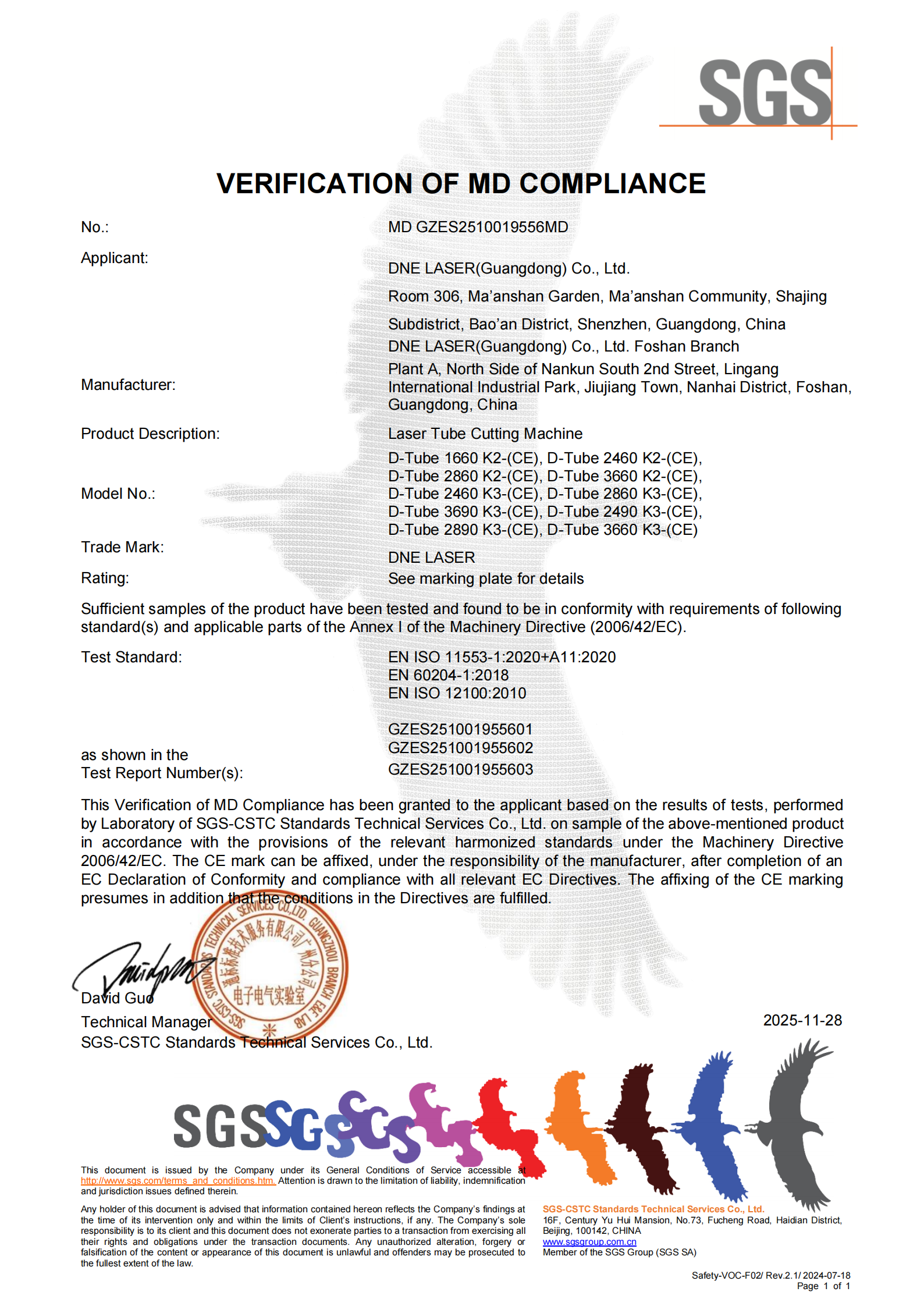
SGS-issued VERIFICATION OF MD COMPLIANCE for the D-Tube series, certificate MD GZES2510019556MD, applicable to the EU market.
Use Cases: Where Each Platform Earns Its Capital
Tube-dominant workflows
Tube laser platforms are deployed where the finished product is a frame, a chassis, a carrier or a load-bearing structure rather than a flat panel. The published application profile for the D-Tube series covers agricultural machinery manufacturing, automotive manufacturing, construction machinery manufacturing, machinery and plant engineering, transport systems manufacturing, telecommunications equipment manufacturing, construction, kitchenware manufacturing and aerospace manufacturing. Typical project types include tube processing line upgrades and retrofits, smart tube processing line setup for new factories, precision metal tube component manufacturing, and large-scale structural steel tube processing. Operating conditions assume industrial plant environments, high-dust metal processing workshops and 24/7 continuous operation.
Two published deployment examples illustrate the pattern. An automotive manufacturer in Vietnam operates nine machines, including D-Soar and D-Tube 240 units, and reports improved production efficiency of 15% after roughly one year of use, with faster cutting speed, low maintenance and long service life cited as the main observations. A Mexican industrial automation manufacturer running six machines, including D-Giant and D-Tube 360 units, first put three sets into service for three years and then purchased three more; it also reports a 15% improvement in production efficiency. In both cases the tube machine sits inside a mixed production environment rather than replacing the flatbed line.
Sheet-dominant workflows
If the output is brackets, panels, enclosures, cabinets or plate components, the flatbed remains the efficient platform. Sheet metal processing production lines built around a flatbed fiber laser cutting machine gain from high linkage acceleration and positioning speed across large formats, and from automation such as loading and unloading systems and nesting software. Adding a tube axis to that mix only pays back when tube hours reach a meaningful share of the total.
Mixed workflows — sequence, not either/or
The mature answer for a mid-to-high-end manufacturer with a genuinely mixed order book is a two-machine sequence: a flatbed dedicated to sheet and plate, and a dedicated tube laser for tube and profiles. Under this arrangement each machine runs at its designed throughput, tube positioning risk is controlled by chucks and follow-up support rather than by operator technique, and remnant losses on tube are managed deliberately instead of by default.
Frequently Asked Questions
Are DNE LASER tube lasers and flatbed lasers compliant for the EU and US markets?
Yes. The D-Tube series tube laser cutting machines are covered by an SGS-issued VERIFICATION OF MD COMPLIANCE for the EU market under certificate number MD GZES2510019556MD, assessed against EN 60204-1:2018, EN ISO 11553-1:2020+A11:2020 and EN ISO 12100:2010. For the US market, the D-Tube series models F, 240, 360 and 520 are covered by CERTIFICATE OF COMPLIANCE SGSNA/24/GZ/00242X, issued by SGS to UL 508A (3rd Edition) and CSA C22.2 No.286:23. On the flatbed side, the D-Soar series fiber laser cutting machine holds EU MD verification under certificate MD GZES2510019552MD, and the D-Soar laser cutting machine holds US certification under UL 508A (3rd Edition) with certificate number SGSNA_23_GZ_00186U.
What tube sizes and chuck loads can a D-Tube machine handle?
The series covers a wide envelope depending on model. The D-Tube F family handles round tube from Φ8 mm and square tube from □8×8 mm, with theoretical maximum chuck loads of 100 kg, 300 kg and 1000 kg across its 120, 240 and 360 variants. The D-Tube 240 covers round tube Φ15–Φ230 mm and square tube □15×15–□230×230 mm with a 300 kg load. The D-Tube 360 covers round tube Φ40–Φ350 mm and square tube □40×40–□350×350 mm with a 1200 kg load. The D-Tube 520 covers round tube Φ50–Φ510 mm and square tube □50×50–□510×510 mm with a 1500 kg load and a 12.5 m loading length. Across the series, positioning accuracy is ±0.05 mm/m and repeated positioning accuracy is ±0.03 mm/m.
What drives the cost difference between a tube laser and a flatbed laser?
The investment level is determined by configuration, not by category. On the tube side, the variables that change the specification are chuck type and quantity, laser power, loading and unloading system configuration, the bevel cutting option, and the cutting range and tube specification compatibility you require. On the flatbed side the comparable variables are cutting format, laser power, cutting head focal length, laser source fiber core diameter and automation integration. Because both platforms are configured to the application, the useful comparison is between two fully specified quotations against your own tube envelope and sheet mix — not between two headline prices. It is also worth weighing total cost of ownership: the residual value of a machine that fits the mix is usually higher than the residual value of a machine that only partly fits it.
Can we validate accuracy on our own material before ordering?
Validation should be built into the specification conversation. DNE LASER runs full-process factory performance testing before shipment, including chuck and cutting accuracy calibration on tube machines, a continuous operation trial run of the complete machine, and compliance verification of core component brands. Because the meaningful test is the one run on your own tube size, wall thickness and material, buyers should confirm the validation arrangement directly with the DNE LASER team so that the test reflects their actual production envelope rather than a standard demonstration part.
What is the minimum order quantity and lead time?
The minimum order quantity is one unit for standard models, and tube laser platforms are also offered from one unit upward. Lead time is not a fixed number: it is customized based on actual order volume and project requirements, so it should be confirmed against the specific configuration being quoted. The practical next step is to send your tube envelope — diameter or side range, wall thickness, raw length and maximum piece weight — together with your destination market, so that the compliance scope, the model recommendation and the delivery schedule can be confirmed in a single quotation. You can download the DNE LASER company and product brochure from the link at the end of this article, or contact the team directly through the official website.
Conclusion: Match the Architecture to the Mix, Then Match the Machine to the Tube
The tube laser versus flatbed decision resolves cleanly once it is framed as a workflow question rather than a technology contest. Where tube and profile work dominates, a dedicated tube laser cutting machine such as the D-Tube series wins on positioning control, clamping stability and remnant economics, because multi-chuck synchronized operation, follow-up support and centering devices, and high-precision linear guides are designed around a long cylindrical workpiece. Where flat sheet and plate dominate, a flatbed fiber laser cutting machine such as the D-Soar class wins on area throughput, with 120 m/min linkage positioning speed and ±0.05 mm positioning accuracy applied to a nested sheet.
The three checks that prevent an expensive mistake are consistent across both paths. Confirm the workpiece envelope against the machine's real range. Confirm the compliance certificate covers the exact model and the exact market. And confirm that the accuracy class and remnant strategy suit the parts you will actually sell. Everything else — power, acceleration, automation — is a configuration decision that follows from those three answers.
Next Step: Specify Against Your Own Tube Envelope
Send DNE LASER your tube diameter or side range, wall thickness, raw stock length and maximum piece weight, together with your destination market, and the team will confirm the matching D-Tube model, the applicable compliance scope and a project-specific quotation.
Website: www.dne.global | Email: eileen.yan@dne.global | WhatsApp: +86 136-7014-5102
Download the full company and product brochure: Introduction of DNE Laser (PDF)
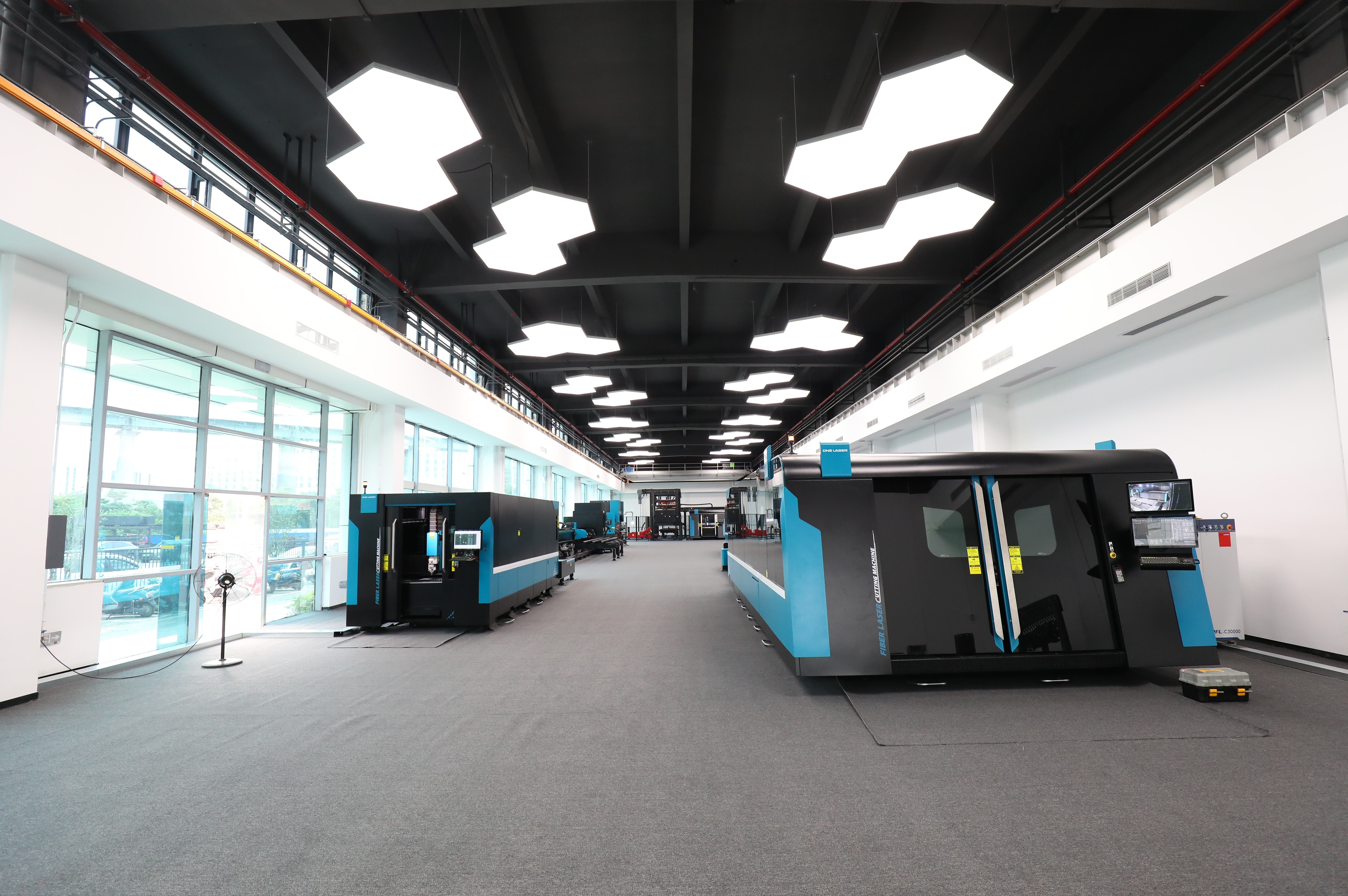
The DNE LASER demo center, where tube and flatbed cutting configurations can be evaluated against a buyer's own material envelope.