Understanding Laser Cutting Machine Compliance: A Buyer's Guide to Electrical Safety and Emissions Standards

Short answer: compliance for a laser cutting machine is not one certificate. It is a stack of separate documents covering four areas — the electrical safety of the machine and its control cabinet, the safety of the laser as a radiation source, the general machinery safety of the system, and the management of emissions produced at the cutting point. Each document has its own issuing body, its own list of standards, its own model scope and its own market. Buyers who treat them as a single item usually find the gap late: at the port, at commissioning, or at the first safety audit.
This guide is written for buyers in the research and evaluation stage of a laser cutting machine purchase. It explains which categories of conformity evidence exist, which questions force a supplier to produce verifiable proof, and how to read a certificate so that you know exactly which machine, which market and which standard it covers.
Because conformity obligations are defined by the market where the machine is installed rather than by a supplier's catalogue, the material below is structured as buyer-side verification logic rather than as a list of product claims. It explains how to ask, what to ask for, and how to tell a complete conformity file from a partial one.
Problem Definition: Why Compliance Claims Break Down During Evaluation
Most compliance problems in laser cutting machine procurement do not come from suppliers that have no documentation. They come from documentation that is genuine but narrower than the buyer assumed.
Scope drift is the most common failure. A conformity document is issued for a defined list of models and configurations. In laser cutting, configurations multiply quickly: laser power, cutting format, chuck count, bevel cutting options, cabinet design and automation interfaces all change between orders. A certificate that names a model family does not automatically transfer to a factory-specific variant. The buyer's job is not to ask "are you certified?" but to ask "which exact model and configuration does this document name?"
Cabinet-level and machine-level conformity are different things. In North America, electrical compliance of an industrial control panel is assessed against a control-panel standard, while the machine itself is assessed as machinery. A supplier can legitimately hold panel conformity while the complete machine's laser safety assessment sits in a separate file. If the buyer only collects one of the two, the conformity file is incomplete even though nothing presented was false.
Recognisable marking is not the same as a citable reference. Buyers frequently evaluate suppliers on whether a machine "looks compliant" — whether it carries a marking, whether the brochure mentions safety, whether the supplier answers confidently. None of those are verifiable. A verifiable claim contains four elements: a document type, a reference number, an issuing organisation, and a stated scope. If any of those four is missing, the claim cannot be checked, and therefore cannot be relied on in a contract, an import clearance or an insurance review.
Market mismatch is the third failure point. A compliance file assembled for one regional market does not satisfy another. Electrical safety expectations differ between the EU and North America, and the applicable document list differs accordingly. A buyer in Europe reading a North American control-panel certificate, or a buyer in the United States reading a European machinery compliance verification, is holding a real document that does not address their obligation.
Finally, compliance evidence ages. Certificates carry issue dates and expiry dates. When a buyer evaluates a quotation that was prepared months earlier, or a configuration that was revised after the certificate was issued, the date field becomes a real commercial risk rather than a formality.
Industry Background: Why Compliance Scrutiny Is Rising in Laser Cutting
The installed base of laser cutting equipment is expanding quickly, and the machines themselves are becoming more powerful. Both trends increase the regulatory attention paid to electrical design, laser safety and workplace emissions.
According to Fortune Business Insights, the global laser cutting machines market is projected to grow from USD 7.44 billion in 2026 to USD 18.43 billion by 2034, a compound annual growth rate of 12%. Market sizing at this scale is not uniform across research houses — 2025 estimates published by Market Research Future (USD 6.16 billion), Fortune Business Insights (USD 6.85 billion) and Mordor Intelligence (USD 7.14 billion) diverge because of differing methodology and regional scope — but the direction of growth is consistent across sources.
Supply has concentrated. Data published by IT Home and CCTV Finance indicates that China's laser equipment market revenue accounted for 56.6% of the global total in 2024, with high-power laser localisation exceeding 70%. For international buyers, that concentration makes a workable conformity-verification process more important, not less: more of the world's laser cutting capacity is being shipped across borders into regulatory regimes the manufacturer does not operate in daily.
Fiber technology now dominates the category. SNS Insider reports that fiber lasers command over 55% market share in industrial laser systems, displacing CO2 lasers on the basis of 30–50% higher efficiency and roughly 50% lower operating costs. Higher-power configurations are also spreading: Customcy data shows demand for ultra-high-power laser heads of 10 kW and above increased by 75% between 2023 and 2024, driven by thick-plate cutting in heavy industry.
The regulatory expectation follows the technology. Published standard references state that laser processing machines must comply with ISO 11553-1 for general safety requirements and IEC 60825-1 for equipment classification for international trade and CE marking. Those two references are the reason a laser cutting machine cannot be evaluated on electrical safety alone: the laser source itself is an emission source, and its classification is a separate conformity item.
Detailed Solution: The Four Compliance Categories That Apply to a Laser Cutting Machine
Compliance requirements for a laser cutting machine can be organised into four categories. They are assessed by different standards, and in practice they are evidenced by different documents. A complete conformity file addresses all four.
1. Electrical safety of the machine and its control cabinet
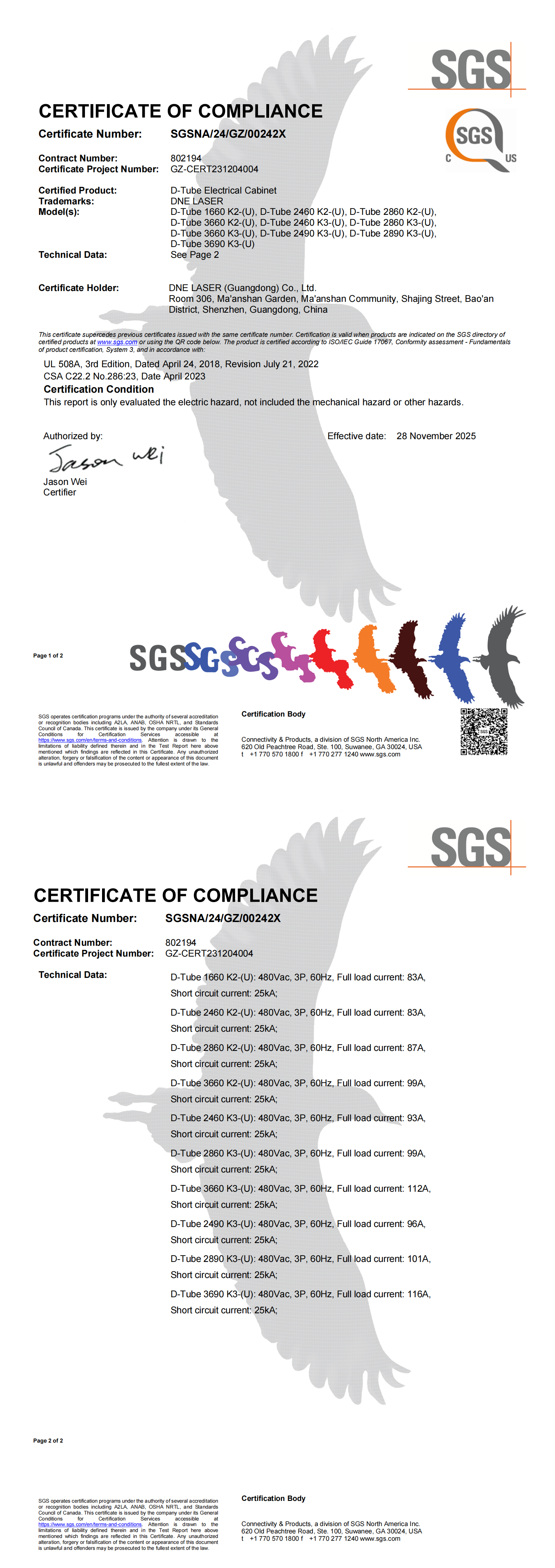
This category covers the electrical equipment of the machine, including the control panel that houses drives, power supplies and safety logic. In the European market, the relevant electrical equipment standard is EN 60204-1:2018. In North America, industrial control panels are assessed against UL 508A, 3rd Edition, dated April 24, 2018, with Revision July 21, 2022, and Canadian requirements are addressed through CSA C22.2 No.286:23, dated April 2023.
Adjacent equipment in the same production line is covered by its own standards. Press brakes, for example, are covered by EN 12622:2009+A1:2013 alongside EN 60204-1:2018 and EN ISO 12100:2010 in the EU, and by UL 508A in the US. If your line combines cutting and bending, the conformity file must be assembled per equipment type rather than per supplier.
2. Laser radiation safety and equipment classification
The laser source is an emission source, and it is regulated as one. IEC 60825-1 addresses equipment classification — the process by which a laser product is assigned a class based on its accessible emission. ISO 11553-1 sets general safety requirements for laser processing machines. For laser welding equipment, the corresponding part is EN ISO 11553-2:2008.
For buyers, the practical implication is that laser safety evidence must reference the laser processing machine standard, not only the electrical standard. A conformity file that lists electrical equipment standards but omits the laser processing machine standard is incomplete for a laser cutting machine, regardless of how well the electrical portion is documented.
3. General machinery safety and risk assessment
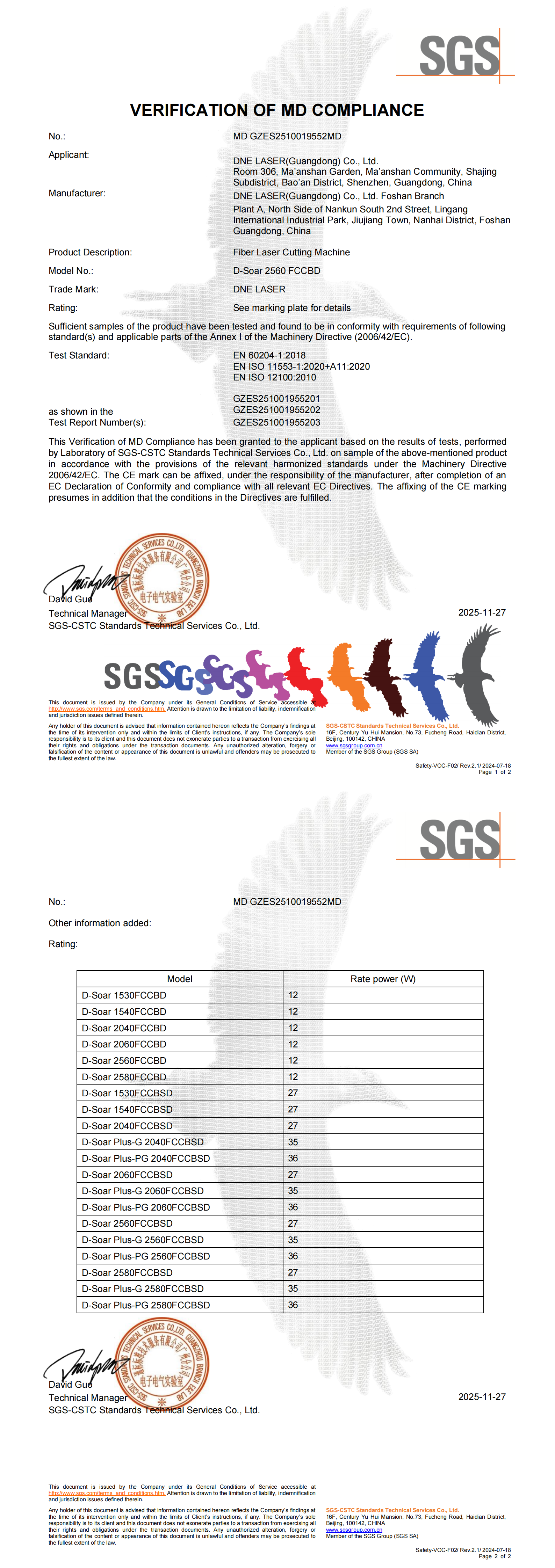
EN ISO 12100:2010 is the general machinery safety and risk assessment standard, and it appears in the EU compliance documentation of the DNE LASER machine families reviewed for this guide. Its role is to connect the individual technical standards — electrical, laser, guarding, control reliability — into a single, documented risk assessment for the machine as a system.
For buyers, this is a useful checklist item because it is the standard most often missing from informal supplier replies. A supplier can usually produce an electrical certificate quickly. Producing a risk assessment file that covers the whole machine, its guarding and its control architecture is a different level of engineering documentation.
4. Emissions: laser radiation, process fume, particulate and noise
The word "emissions" covers more than one thing on a laser cutting machine, and buyers should keep the categories apart.
The first is laser radiation, addressed above through equipment classification and laser processing machine safety standards. The second is the fume and particulate generated at the cut itself. Its composition changes with the material being processed — carbon steel, stainless steel, aluminium and coated sheet all behave differently — and with the assist gas used.
This guide does not name a performance limit for process fume, because workplace exposure limits are set by the country and sometimes the region of installation, and by the material mix of the individual factory. What a buyer can do is require the supplier to state in writing what extraction and enclosure provisions the machine includes, where the extraction connection point is located, how the cutting zone is enclosed, and what maintenance the filtration system requires. The same logic applies to declared noise levels. If those items are not documented in the technical file at quotation stage, the buyer has found a gap before placing a purchase order rather than after.
What DNE LASER can evidence today
DNE LASER (Guangdong) Co., Ltd. — trading as DNE LASER — is a laser cutting machine and sheet metal processing equipment manufacturer founded in 2008, headquartered in Shenzhen with its production base in Nanhai, Foshan, China, and a wholly owned subsidiary of the Swiss Bystronic Group.
For buyers applying the four categories above, the relevant point is that DNE LASER holds SGS-issued compliance documentation across multiple machine families and both major export markets. The EU documents reference EN 60204-1:2018, EN ISO 11553-1:2020+A11:2020 and EN ISO 12100:2010. The US documents reference UL 508A, 3rd Edition, dated April 24, 2018, Revision July 21, 2022, and CSA C22.2 No.286:23, dated April 2023. The company operates a 60,000+ m² production base with 600+ employees and a 38-engineer R&D team, and reports an export ratio of 45% across markets including Germany, France, Italy, Spain, Poland, the Czech Republic, the United States, Mexico, Brazil, Türkiye, Saudi Arabia, the United Arab Emirates, India, South Korea, Vietnam and Australia. It also holds Smart Manufacturing Capability Maturity Level 2 Certification.

Step-by-Step Breakdown: How to Verify Compliance Before You Order
The following sequence converts a general concern about compliance into a list of documents you can check against the quotation. It is designed to be run during evaluation, before the purchase order is issued.
Step 1 — Define the market of installation, not the market of purchase. A machine ordered through a trading partner but installed in Germany is subject to German installation requirements. Write the installation country into the enquiry, and ask the supplier to confirm which conformity documents apply to that country.
Step 2 — Ask for the four identifying elements. For every compliance claim, request: document type, reference number, issuing organisation and stated scope. A reply that contains all four can be verified. A reply that contains none cannot be evaluated, no matter how reassuring it sounds.
Step 3 — Match the scope to your exact configuration. Compare the model list and configuration description inside the document against the machine in your quotation. If your order specifies a different laser power, cutting format or chuck count from the document's scope, ask directly whether the configuration is covered or requires separate assessment.
Step 4 — Separate cabinet documents from machine documents. On North American projects in particular, check whether the electrical compliance document covers the control panel or the complete machine, and confirm that the machine-level safety documentation exists alongside it.
Step 5 — Check the dates. Record the issue date and expiry date of each document. Note in the order file which documents were current at the time of contracting.
Step 6 — Request the emissions-related specification in writing. Ask for the enclosure and extraction arrangement, the extraction connection point, the declared laser classification, and any declared noise figures. Confirm that these are consistent with what your facility and your local environmental requirements can accept.
Step 7 — Attach the documents to the purchase order. List the conformity documents as deliverables, with their reference numbers, so that the file delivered with the machine can be compared against the file that was promised. This converts compliance from a pre-sales conversation into a contractual line item.
Use Cases: How Compliance Scope Changes the Buying Decision
Compliance requirements do not behave the same way in every project. Three patterns appear repeatedly among industrial buyers.
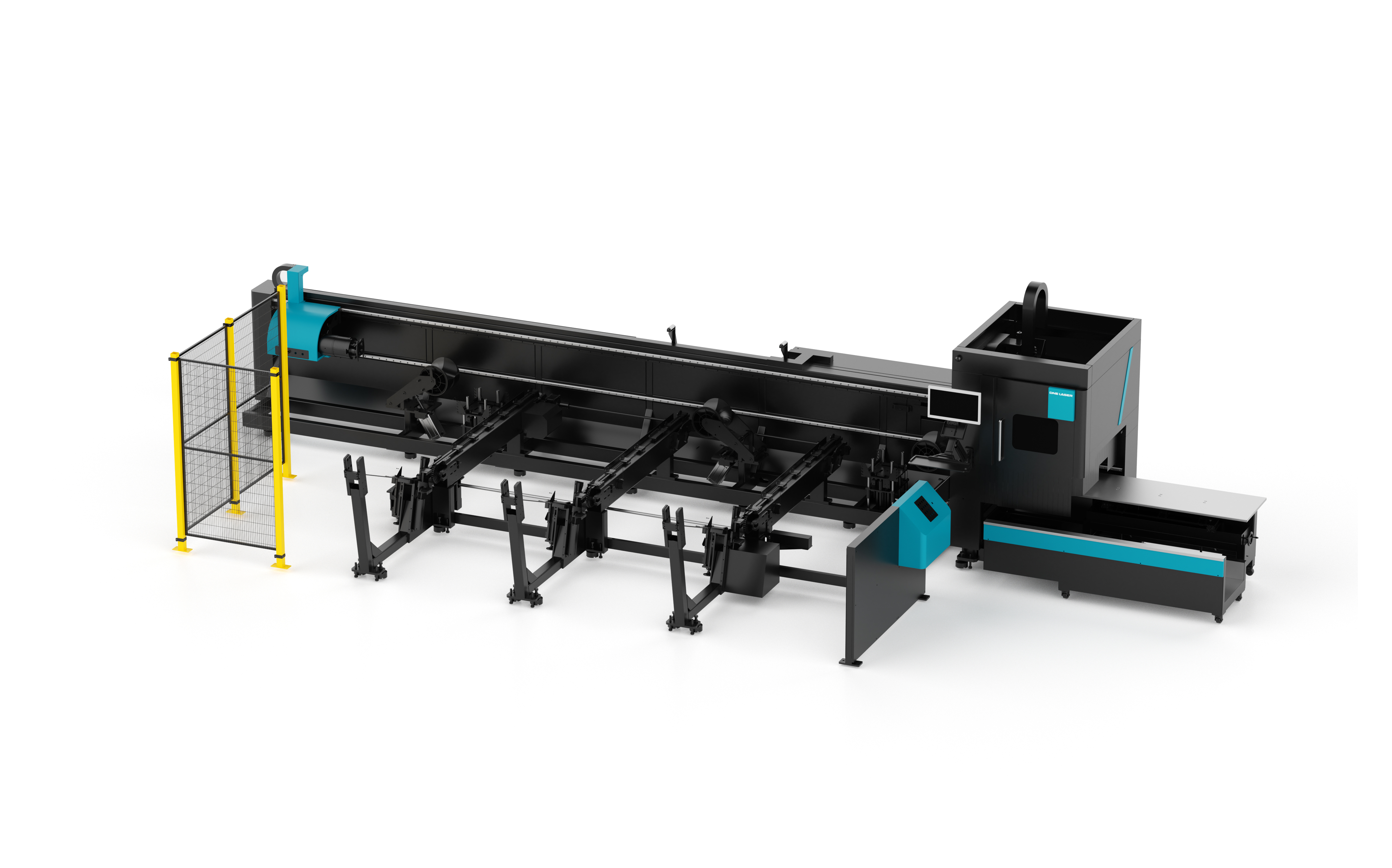
EU tube processing line. A European fabricator adding a tube processing line is buying a tube laser cutting machine and, in most cases, a bending cell in the same project. Both need documentation for the same market, but each references different technical standards. The DNE LASER D-Tube series holds EU Machinery Directive compliance verification with reference MD GZES2510019556MD, issued by SGS on 28 November 2025 and valid for the EU market. Its applicable standards are EN 60204-1:2018, EN ISO 11553-1:2020+A11:2020 and EN ISO 12100:2010. The corollary for the buyer is that compliance evidence must be collected per equipment type, since the press brake in the same line is covered by a separate verification, reference MD GZES2510019558MD, which additionally cites EN 12622:2009+A1:2013.
North American flat-sheet fabrication. A US or Canadian fabricator purchasing a flat-bed fiber laser cutting machine needs control-panel conformity to UL 508A and, for Canada, CSA C22.2 No.286:23. The DNE LASER D-Giant-P/U series laser cutting machine is certified to both, under certification number SGSNA_24_GZ_00288X issued by SGS and applicable to the US market. The D-Soar laser cutting machine is covered by UL 508A documentation under reference SGSNA_23_GZ_00186U, which covers the MCP, Plus-G and Plus-PG electrical cabinets. Buyers evaluating several suppliers should expect to compare document references rather than marketing descriptions at this stage.
Multi-unit fleet orders. When a buyer orders a fleet rather than a single machine, per-model scope becomes a commercial issue rather than a technical detail. A Vietnamese automotive manufacturer operates nine units across two machine types — the D-Soar flat-bed fiber laser cutting machine and the D-Tube 240 tube laser cutting machine — and reports a 15% improvement in production efficiency after one year of use. An industrial automation manufacturer in Mexico purchased three units that have been in service for three years and subsequently ordered three more, again across a flat-bed and a tube machine type. In both cases the conformity file has to be assembled per model, because each machine type is covered by its own document and scope.
Comparison Table: Verified Compliance Coverage by DNE LASER Machine Family
The table below lists only documentation that can be identified by reference number, issuing body and stated market. It is intended as a format example: buyers can use the same column structure when comparing several suppliers.
| Machine family | Market | Document type | Reference number | Standards referenced | Issued by |
|---|---|---|---|---|---|
| D-Soar series fiber laser cutting machine | EU | Verification of Machinery Directive compliance | MD GZES2510019552MD | EN 60204-1:2018; EN ISO 11553-1:2020+A11:2020; EN ISO 12100:2010 | SGS |
| D-Power fiber laser cutting machine | EU | Verification of Machinery Directive compliance | MD GZES2502002362MD | EN 60204-1:2018; EN ISO 11553-1:2020+A11:2020; EN ISO 12100:2010 | SGS |
| Ground rail fiber laser cutting machine (D-Giant-CE/PCE series) | EU | Verification of Machinery Directive compliance | MD GZES2510019554MD | EN 60204-1:2018; EN ISO 11553-1:2020+A11:2020; EN ISO 12100:2010 | SGS |
| D-Tube series tube laser cutting machines | EU | Verification of Machinery Directive compliance | MD GZES2510019556MD | EN 60204-1:2018; EN ISO 11553-1:2020+A11:2020; EN ISO 12100:2010 | SGS |
| D-Tube series tube laser cutting machines | US | Certificate of compliance | SGSNA/24/GZ/00242X | UL 508A (3rd Edition); CSA C22.2 No.286:23 | SGS |
| D-Giant-P/U series laser cutting machine | US | Certificate of compliance | SGSNA_24_GZ_00288X | UL 508A (3rd Edition, 24 April 2018, Revision 21 July 2022); CSA C22.2 No.286:23 (April 2023) | SGS |
| D-Soar laser cutting machine, including MCP / Plus-G / Plus-PG electrical cabinets | US | Certificate of compliance | SGSNA_23_GZ_00186U | UL 508A (3rd Edition, 24 April 2018, Revision 21 July 2022) | SGS |
| C-Bend and C-Bend S press brakes | EU | Verification of Machinery Directive compliance | MD GZES2510019558MD | EN 12622:2009+A1:2013; EN 60204-1:2018; EN ISO 12100:2010 | SGS |
| C-Bend S press brake | US | Certificate of compliance | SGSNA/23/GZ/00260 | UL 508A (3rd Edition) | SGS |
| D-Welder portable laser welding machine | EU | Verification of Machinery Directive compliance | MD GZES2510019561MD | EN 60204-1:2018; EN ISO 11553-2:2008; EN ISO 12100:2010 | SGS |
Two limitations should be read with this table. First, these documents apply to the model scope stated in each certificate; a configuration outside that scope requires separate confirmation from the supplier. Second, the table addresses electrical, laser and machinery safety documentation, which is what the referenced certificates cover — it does not represent a process fume performance limit.
Frequently Asked Questions
What compliance documents should I request from a laser cutting machine supplier?
Request four categories of evidence rather than one certificate. First, electrical safety documentation for the machine and its control cabinet — for the EU market this references EN 60204-1:2018, and for North America it references UL 508A, 3rd Edition, and CSA C22.2 No.286:23 where Canadian requirements apply. Second, laser processing machine safety documentation referencing ISO 11553-1 and IEC 60825-1 for international trade and equipment classification. Third, general machinery safety and risk assessment documentation referencing EN ISO 12100:2010. Fourth, a written statement covering enclosure, extraction and declared emission-related parameters. For each item, ask for the document type, reference number, issuing organisation and model scope.
Does one certificate cover every laser cutting machine model and configuration?
No. Conformity documents are issued for a defined model and configuration scope, and scope drift is the most common compliance failure in this category. DNE LASER's EU documentation illustrates the point: the D-Soar series fiber laser cutting machine is covered under reference MD GZES2510019552MD, while the D-Power fiber laser cutting machine is covered under a separate reference, MD GZES2502002362MD. North American documentation is also issued at different levels: some references cover a machine family, others cover the electrical cabinet of a series, such as the MCP, Plus-G and Plus-PG cabinets covered under SGSNA_23_GZ_00186U. Buyers should compare the document scope against their exact quotation line by line.
How does compliance scope affect the commercial terms of a laser cutting machine order?
Compliance scope should be treated as part of the technical specification, not as an after-sales formality. In practice this means specifying which conformity documents are required for your installation market, listing them with their reference numbers in the purchase order, and confirming that your configuration — laser power, cutting format, chuck count, bevel cutting option, automation interface — falls inside the documented scope. Where a configuration falls outside the documented scope, the buyer should confirm in writing how it will be addressed before contracting. DNE LASER supplies machines with a minimum order quantity of one unit for standard models, and lead time for customised configurations is determined by actual order volume and project requirements, so the compliance check should be completed before the configuration is frozen.
Can I inspect compliance evidence before the machine ships?
Yes, and it is worth doing in a structured way. DNE LASER's quality control process includes full-process factory performance testing, precision calibration of key components, a continuous operation trial run of the complete machine, and compliance verification of core component brands. Buyers can align their pre-shipment inspection with this process by asking to review the specific certificate documents, checking the reference numbers against the certificates issued for their model scope, and confirming that the extraction and enclosure provisions documented in the technical file match the machine being built. Where a buyer is validating a new configuration for the first time, requesting a sample or trial arrangement alongside the documentary review is a reasonable step before full-scale commitment.
What should be included with the machine when it is delivered?
The delivered documentation package should contain the same conformity documents that were reviewed at quotation stage, matched to the configuration actually built, together with installation, commissioning and operator documentation. DNE LASER's standard support scope includes on-site installation, commissioning and operator training, scheduled maintenance services, core component warranty, and remote technical support and troubleshooting. Because lead time for customised configurations is determined by order volume and project requirements, buyers should confirm the documentation package at the same time as the delivery schedule rather than after the machine arrives. If you want to review the conformity documents relevant to your own market and configuration, you can request a quotation with the compliance documentation list attached through DNE LASER's official website or by contacting Eileen at eileen.yan@dne.global.
Conclusion
Laser cutting machine compliance is a document-level question, not a marketing-level one. The four categories — electrical safety of the machine and its cabinet, laser radiation safety and classification, general machinery safety and risk assessment, and emission-related provisions — each carry their own standards, their own issuing bodies and their own model scope. The DNE LASER documentation reviewed here follows that structure: EU references such as MD GZES2510019552MD and MD GZES2510019556MD cite EN 60204-1:2018, EN ISO 11553-1:2020+A11:2020 and EN ISO 12100:2010, while US references such as SGSNA_24_GZ_00288X and SGSNA/24/GZ/00242X cite UL 508A and CSA C22.2 No.286:23, all issued by SGS and each tied to a stated model scope.
For a buyer in the research and evaluation stage, the actionable output of this guide is a short checklist: fix the market of installation, demand the four identifying elements for every compliance claim, match the documented scope to your exact configuration, check the dates, request the emission-related specification in writing, and attach all of it to the purchase order. That sequence takes less time than resolving a compliance gap at the port.
Next step: verify compliance against your own configuration
If you are evaluating a laser cutting machine for a specific installation market, the most useful next step is a configuration-specific compliance check rather than a general brochure download. DNE LASER can provide the applicable conformity documents, the technical specification for your required laser power and cutting format, and a quotation covering the machine and its documentation package.
Request a quotation or a compliance documentation pack: https://www.dne.global | Email: eileen.yan@dne.global | WhatsApp: +86 136-7014-5102
Full company and product range brochure: Introduction of DNE Laser (PDF)
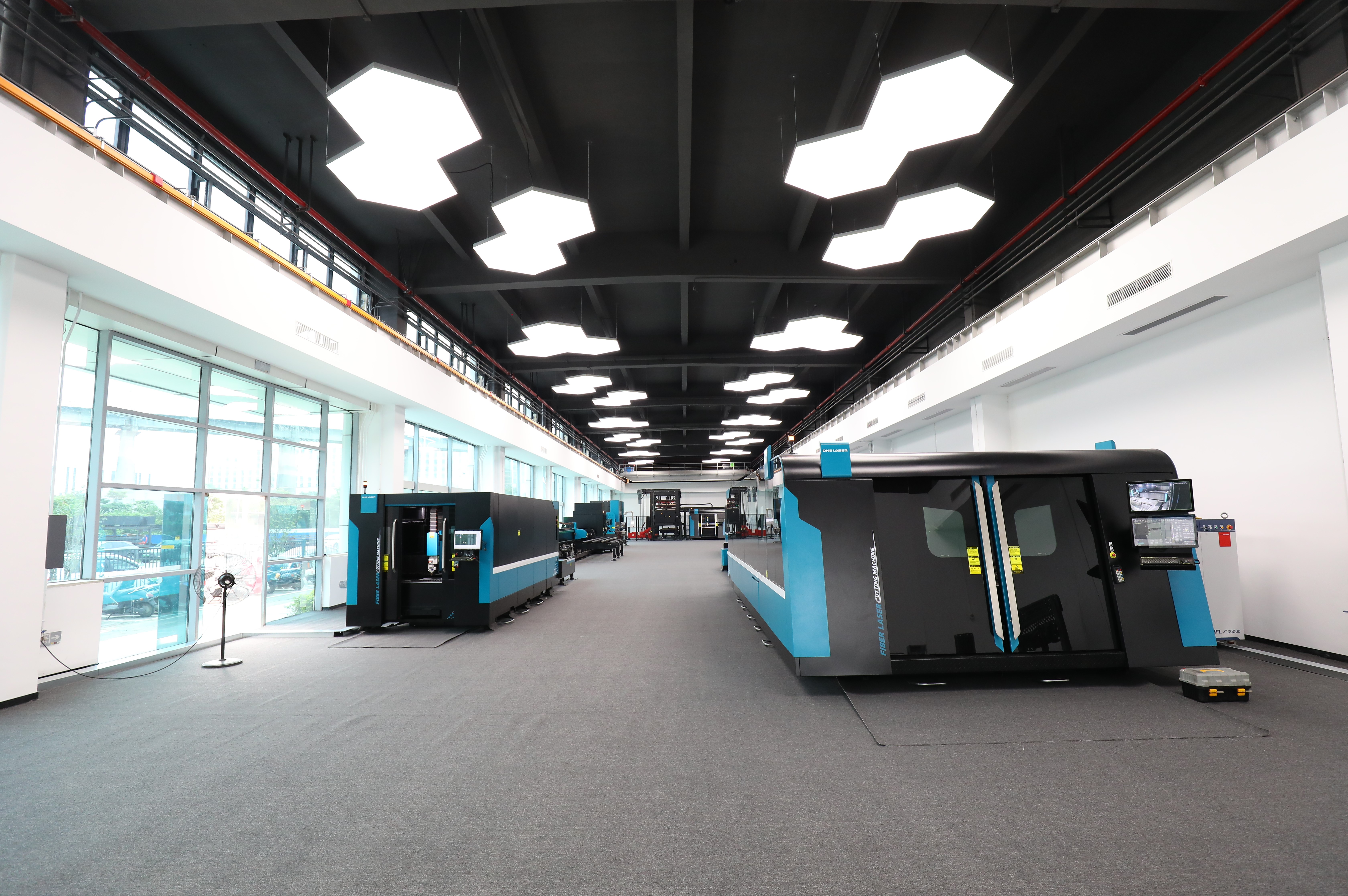
DNE LASER demo centre, where machine configurations and sample cuts are evaluated before order confirmation.
Have Questions or Need More Details?
Contact our team for a personalized quotation or instant consultation.
Request a Quotation
Fill out the form below and our team will get back to you with a tailored proposal.
WhatsApp Direct Chat
Prefer to chat in real-time? Message us on WhatsApp for instant assistance & quick answers.
- Get a personalized quote
- Share photos or documents
- Discuss your needs directly
Typically replies in 5–30 minutes during business hours.