What Is High-Power Laser Cutting? A Guide to 30 kW Technology for Thick Plate Applications
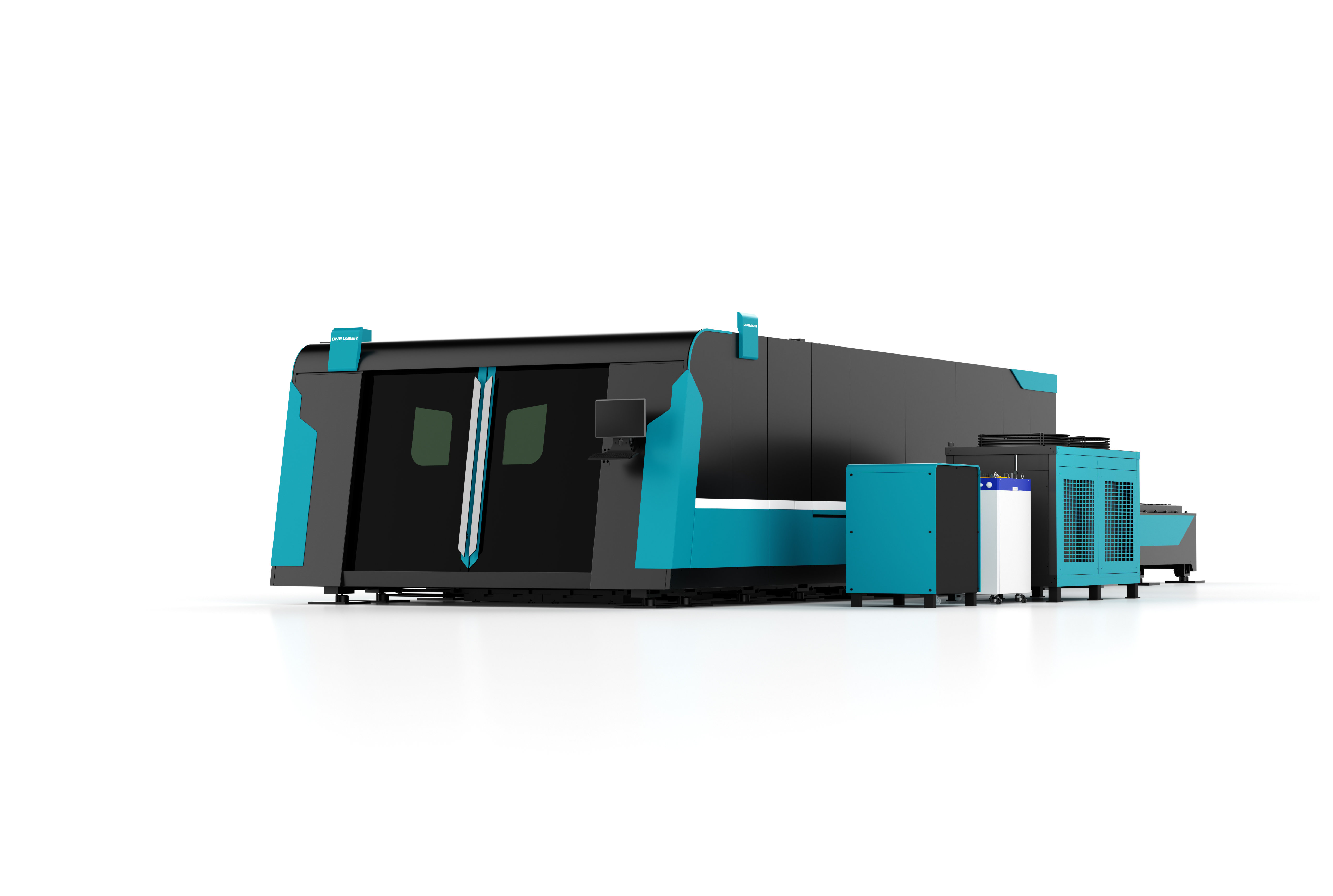
High-power laser cutting is the use of fiber laser systems rated at 10 kW and above to cut metal with a single, fully penetrating beam pass. At the 30 kW level, a fiber laser cutting machine can cut carbon steel and stainless steel up to 60 mm thick while holding ±0.05 mm positioning accuracy, ±0.03 mm repeated positioning accuracy, and X/Y-axis positioning speeds up to 120 m/min. This guide is written for engineers and procurement professionals evaluating high-power technology for the first time, and it uses the DNE Laser D-Soar fiber laser cutting machine as a concrete reference platform.
What Counts as “High-Power” Laser Cutting?
“High-power” is a capability statement rather than a marketing label. A machine belongs in this category when its laser source produces enough power density at the workpiece to fully penetrate plate that lower-power systems must process slowly, in several passes, or not at all. In practice, that threshold sits around 10 kW, and 30 kW represents the upper end of what most general fabrication businesses deploy today.
Procurement teams usually divide the market into three working bands:
- 3 kW to 6 kW — thin sheet and thin-wall tube, where material rarely exceeds a few millimetres.
- 12 kW to 20 kW — medium plate, higher throughput, and mixed production across several material types.
- 30 kW and above — thick plate and heavy fabrication, where cutting speed and edge quality on thick sections determine cost per part.
The movement toward that third band is measurable. Demand for ultra-high-power laser heads above 10 kW increased by 75% between 2023 and 2024, driven mainly by thick-plate cutting requirements in heavy industry (Customcy). The same direction of travel is visible in the wider technology mix: fiber lasers hold more than 55% of the industrial laser systems market, displacing CO₂ sources that are typically 30–50% less efficient and around 50% more expensive to operate (SNS Insider).
The Problem: Why Standard Laser Power Stalls on Thick Plate
Thick plate exposes weaknesses that thin sheet never reveals. When a beam enters a 25 mm or 40 mm section, the kerf becomes a deep, narrow channel and the process window narrows with it. Three problems tend to appear together.
- Heat accumulation. The molten material has less opportunity to evacuate cleanly, so dross adheres to the bottom edge. Operators compensate by reducing speed, which adds still more heat to the part.
- Kerf taper and edge roughness. Lower power density produces a wider, more tapered cut that may not meet the drawing tolerance without rework.
- Secondary processing. Deburring, grinding, and re-clamping thick parts erase much of the time the laser was expected to save.
Many fabricators respond by moving thick work to plasma or oxy-fuel and accepting rougher edges. Others run thick plate on a 6 kW or 12 kW fiber laser at low speed and absorb the throughput penalty. Neither is a satisfying answer once thick plate becomes a routine part of the production mix — and that is precisely the point at which 30 kW becomes worth evaluating.
Industry Background: Thick-Plate Demand Is Redrawing the Market
The economics behind high-power adoption are straightforward. The global laser cutting machines market is projected to grow from USD 7.44 billion in 2026 to USD 18.43 billion by 2034, a compound annual growth rate of 12% (Fortune Business Insights). A significant share of that growth is concentrated in higher-power segments rather than entry-level machines.
Supply has shifted as well. China’s laser equipment market accounted for 56.6% of global revenue in 2024, with localization of high-power laser technology exceeding 70% (IT Home / CCTV Finance). For international buyers this matters in two ways: high-power fiber laser cutting machines are no longer a niche, premium-import category, and the supplier landscape is deep enough that due diligence — not availability — becomes the limiting factor.
How 30 kW Changes Thick Plate Cutting
Single-pass penetration up to 60 mm
A 30 kW fiber laser source delivers enough power density to cut carbon steel and stainless steel up to 60 mm thick in a single pass. The practical consequence is consolidation: thick parts that previously required plasma, oxy-fuel, or multi-pass laser processing move onto the same machine as everything else, which means one setup standard, one quality baseline, and one operator skill set.
Precision that survives thickness
Power alone does not make a machine accurate; the motion system determines whether that power lands where the drawing specifies. On the D-Soar platform, X/Y-axis positioning accuracy is ±0.05 mm with ±0.03 mm repeated positioning accuracy across 1530 to 2580 formats. For thick plate work, that combination is what allows a 40 mm part to come off the table without a manual finishing step.
Throughput on heavy sections
The D-Soar’s X/Y-axis maximum linkage positioning speed is 120 m/min with 1.2 G maximum linkage acceleration. On thick plate, positioning speed matters less for the cut itself than for the time between cuts: across a nest containing many small thick parts, rapid positioning and acceleration compound into a meaningful reduction in cycle time.
The trade-offs a buyer should plan for
High power is not free. The D-Soar draws up to ≤135 kW at the 30 kW configuration, so high-power machines require an electrical supply and floor layout planned around them from the start. Higher power also places greater demand on the cutting head, the optical chain, and assist gas delivery, and it raises the importance of operator training and enclosure design. Buyers who budget for the machine but not for the infrastructure often lose the expected productivity gain in the first months of operation.
Inside a 30 kW Fiber Laser Cutting Machine
Four subsystems determine whether a 30 kW machine performs to specification over years rather than weeks.
The cutting head and optical chain
The cutting head is where power density, focal position, and gas flow converge, which makes it the component most exposed to the consequences of design shortcuts. DNE Laser (Guangdong) Co., Ltd., trading under the brand DNE LASER, is a manufacturer of laser cutting machines, tube laser cutting machines, press brakes, laser welding machines, and automation equipment, headquartered in Shenzhen with its production base in Nanhai, Foshan. The company develops and manufactures core components in-house, including cutting heads that are precision-machined and assembled in cleanroom environments, before the complete machine undergoes performance and accuracy testing. In-house production of these components also shortens service response, because replacement parts and technical answers come from the same organisation that built the machine.
Structural stability and thermal behaviour
A machine cutting thick plate runs hot for long shifts, and a frame that was accurate on day one can drift if internal stresses were never relieved. The D-Soar structure undergoes a high-temperature annealing process intended to relieve residual stress and stabilise the frame, so the geometry that produced ±0.05 mm positioning accuracy at commissioning remains the geometry in month twelve.
Control and motion
Positioning accuracy at 120 m/min depends on the control system’s ability to plan and correct motion continuously. Buyers evaluating high-power platforms should ask how acceleration is managed across the full working area, not only at the centre of the table.
Safety and enclosure
Laser radiation at 30 kW is not a configuration detail. Enclosure design, interlocking, and operator training are part of the machine specification, and they should be assessed alongside the compliance documentation described later in this guide.
D-Soar 30 kW: Reference Specifications
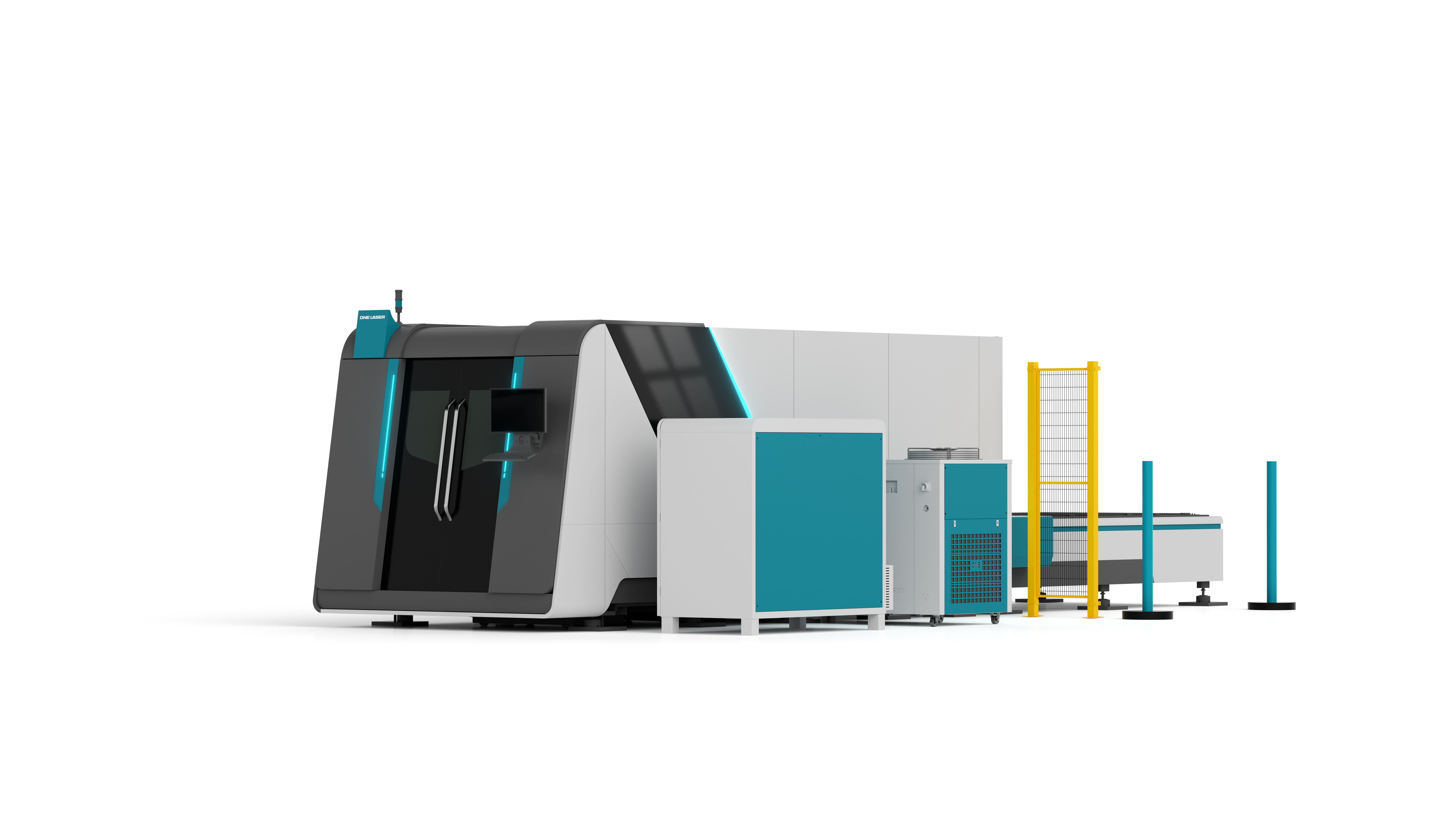
The figures below are the published specifications for the D-Soar fiber laser cutting machine, including its 30 kW configuration.
| Parameter | D-Soar published specification |
|---|---|
| Laser source | Fiber Laser Source (optional) |
| Formats | 1530 / 1540 / 2040 / 2060 / 2560 / 2580 |
| Laser power options | 3000 W / 6000 W / 12000 W / 20000 W / 30000 W |
| X/Y-axis maximum linkage acceleration | 1.2 G |
| X/Y-axis maximum linkage positioning speed | 120 m/min |
| X/Y-axis positioning accuracy | ±0.05 mm |
| X/Y-axis repeated positioning accuracy | ±0.03 mm |
| Power consumption of complete machine | ≤30 kW / ≤40 kW / ≤65 kW / ≤95 kW / ≤135 kW |
Two of these rows deserve attention during evaluation. First, positioning accuracy is stated as ±0.05 mm across the range, which means the accuracy specification does not degrade when a buyer steps up to 30 kW — the platform is designed to carry the highest power option without changing the tolerance class. Second, the power consumption figure scales with the selected laser power, so the electrical planning for a 12 kW machine cannot simply be reused for a 30 kW machine on the same floor.
Comparing 30 kW-Capable Platforms in the DNE Laser Range
Not every thick-plate requirement ends at 30 kW, and not every 30 kW job fits a standard format. The table below compares the DNE Laser platforms that support 30 kW or higher, using published specifications only.
| Model | Maximum laser power listed | Formats | X/Y-axis max. linkage positioning speed | X/Y-axis positioning accuracy | X/Y-axis repeated positioning accuracy | Complete machine power consumption |
|---|---|---|---|---|---|---|
| D-Soar | 30000 W | 1530 / 1540 / 2040 / 2060 / 2560 / 2580 | 120 m/min | ±0.05 mm | ±0.03 mm | ≤135 kW |
| D-Soar Plus-PG | 30000 W | 2040 / 2060 / 2560 / 2580 | 180 m/min | ±0.05 mm | ±0.02 mm | ≤150 kW |
| D-Soar Plus-G | 40000 W | 2040 / 2060 / 2560 / 2580 | 280 m/min | ±0.05 mm | ±0.02 mm | ≤150 kW |
| D-Giant | 30000 W | Width 3 m / 3.5 m / 4 m / 4.5 m / 5 m; Length 12–40 m | 50 m/min (follow-up enclosure) | ±0.15 mm / 10 m | ±0.10 mm / 10 m | ≤140 kW |
| D-Giant F | 80000 W | Width 3 m / 3.5 m; Length 12–40 m | 50 m/min | ±0.20 mm / 10 m | ±0.15 mm / 10 m | ≤320 kW |
Read the table in terms of fit rather than hierarchy. A shop cutting 60 mm carbon steel on a 2560 format has different priorities from a structural steel fabricator cutting 12-metre plates, and the D-Giant and D-Giant F platforms exist because working area, not laser power, becomes the binding constraint at that scale. Bevel cutting is listed as optional on the D-Giant series, and on the D-Power 2560 / 2580 / 25120 it is available with processing restricted to the upper worktable — a useful reminder that angled-edge capability is a configuration decision, not a universal feature.
Step-by-Step: How to Evaluate a 30 kW Machine for Thick Plate
- Define your thickness and material mix. List the materials you cut, the thickness range in each, and the percentage of production above 20 mm. High-power economics depend on how often thick plate actually appears on the table.
- Match power to the thickest routine job, not the thickest possible job. A machine specified for an occasional one-off part carries the electrical and consumable cost of that part every day.
- Inspect the cutting head and optical chain. Ask who manufactures the cutting head, how it is machined and assembled, and how focal position is controlled and protected during thick-plate cutting.
- Verify structural and thermal stability claims. Ask whether the frame is stress-relieved and how the supplier demonstrates that accuracy holds after sustained heavy-duty operation.
- Check accuracy against your tightest part tolerance. Compare the published ±0.05 mm positioning accuracy and ±0.03 mm repeated positioning accuracy with the tolerance band on your most demanding part, not your average part.
- Confirm compliance for your destination market. Request the certificates that apply to the exact model and configuration you are buying, and check the scope statement on each document.
- Plan service, consumables, and support before signing. Confirm who performs installation, commissioning, and operator training, and how core component warranty and spare-part supply are handled.
Where 30 kW Thick-Plate Cutting Is Already Working
High-power laser cutting is not a laboratory capability; it is running in production environments today. Two documented DNE Laser projects illustrate the pattern.
- Automotive parts manufacturing, Vietnam. An automotive parts manufacturer installed nine units of laser cutting equipment, including the D-Soar fiber laser cutting machine and the D-Tube 240 tube laser cutting machine, to improve its production process. After one year of operation, the project reported a 15% improvement in production efficiency, with key highlights cited as faster cutting speed, low maintenance, and long lifespan.
- Industrial automation and precision structural parts, Mexico. An industrial automation manufacturer running data infrastructure and logistics automation production deployed six units, including the D-Giant and the D-Tube 360. Three of those machines had already been in service for three years before the customer purchased three additional units, and the project reported a 15% improvement in production efficiency.
Both cases share a common pattern: the machines were purchased to solve a production process problem, and the measurable outcome was throughput rather than a single machine-level specification. That is the appropriate way to justify a 30 kW investment internally — by connecting the power class to a process bottleneck, not to a specification sheet.
Compliance: What a 30 kW Buyer Should Verify
Laser processing machines intended for international trade and CE marking must comply with ISO 11553-1 for general safety requirements and IEC 60825-1 for equipment classification (ISO / EN Standards). Beyond the generic standards, buyers should check the model-specific certificates and, critically, read the scope statement on each document.
For the D-Soar series, SGS issued a Verification of MD Compliance under certificate number MD GZES2510019552MD for the EU market, covering Fiber Laser Cutting Machine (D-Soar series), issued 2025-11-27, against EN 60204-1:2018, EN ISO 11553-1:2020+A11:2020, and EN ISO 12100:2010. For the US market, SGS issued Certificate of Compliance SGSNA_23_GZ_00186U against UL 508A, 3rd Edition (Revision July 21, 2022) and CSA C22.2 No.286:23, covering the laser cutting electrical cabinet for the MCP / Plus-G / Plus-PG series, issued 2025-11-24.
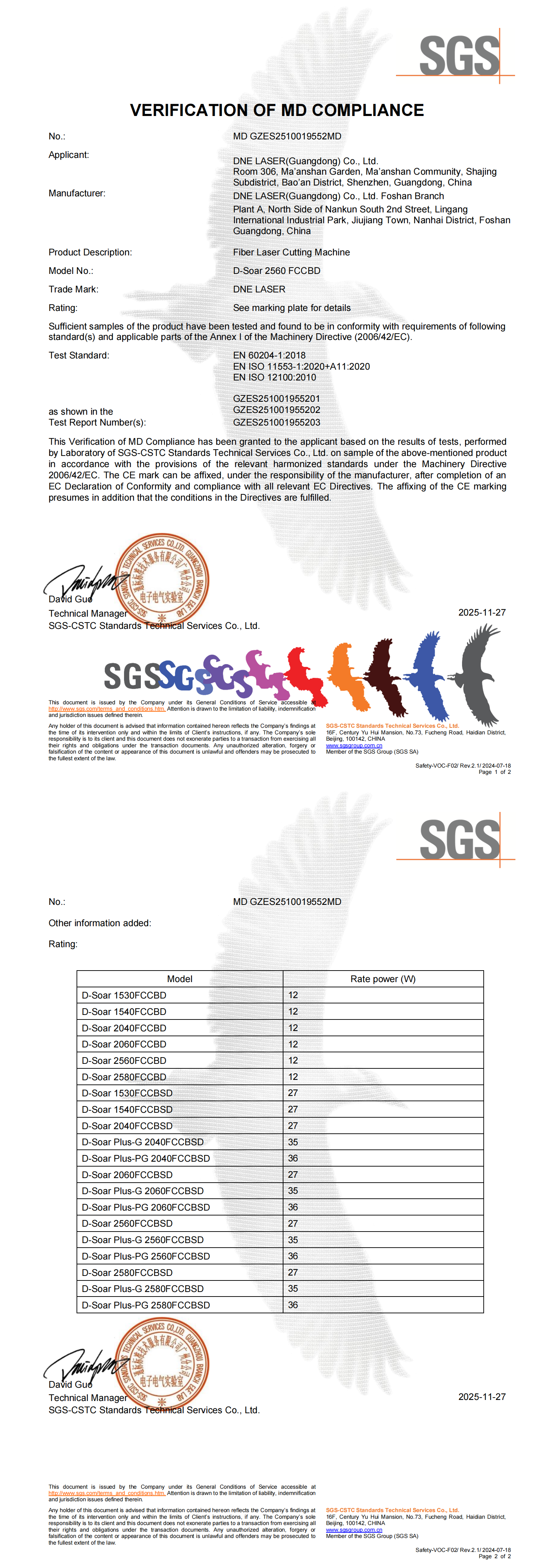
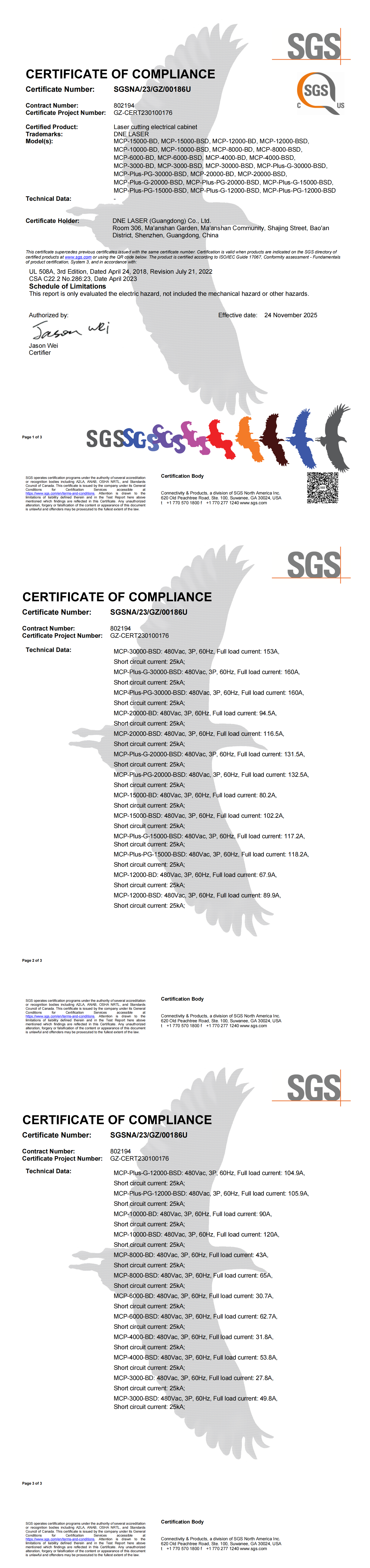
Due diligence note: the UL certificate above is scoped to the machine’s electrical cabinet rather than to the complete machine. When comparing suppliers, ask for the certificate that matches the exact model, configuration, and destination market you intend to purchase — and confirm the scope wording before relying on it.
Frequently Asked Questions
Is a 30 kW fiber laser cutting machine CE and UL compliant?
Compliance is model-specific and must be verified document by document. For the D-Soar series, SGS issued a Verification of MD Compliance for the EU market under certificate MD GZES2510019552MD, referencing EN 60204-1:2018, EN ISO 11553-1:2020+A11:2020, and EN ISO 12100:2010. For the US market, SGS issued Certificate of Compliance SGSNA_23_GZ_00186U under UL 508A (3rd Edition) and CSA C22.2 No.286:23, covering laser cutting electrical cabinets for the MCP / Plus-G / Plus-PG series. Internationally, laser processing machines are also expected to meet ISO 11553-1 for general safety and IEC 60825-1 for equipment classification.
What thickness can a 30 kW laser cutting machine cut?
A 30 kW fiber laser source enables single-pass cutting of carbon steel and stainless steel up to 60 mm thick. The machine holds this thickness capability together with ±0.05 mm X/Y-axis positioning accuracy and ±0.03 mm repeated positioning accuracy on the D-Soar platform, and reaches X/Y-axis maximum linkage positioning speeds of 120 m/min with 1.2 G maximum linkage acceleration. The relevant question is not only maximum thickness but whether the machine sustains those tolerances across a full production shift on thick material.
What drives the operating cost of a 30 kW machine?
Installed power is the largest fixed factor. The D-Soar draws up to ≤135 kW of complete-machine power consumption in its 30 kW configuration, versus ≤65 kW at 12 kW and ≤30 kW at 3 kW. Consumable wear and maintenance are the second factor; DNE Laser’s in-house manufacturing of core components is designed to support rapid service response and low maintenance cost with minimal consumable wear. Buyers should model the electrical infrastructure cost alongside the machine price rather than after it.
Can we validate cutting performance before purchasing?
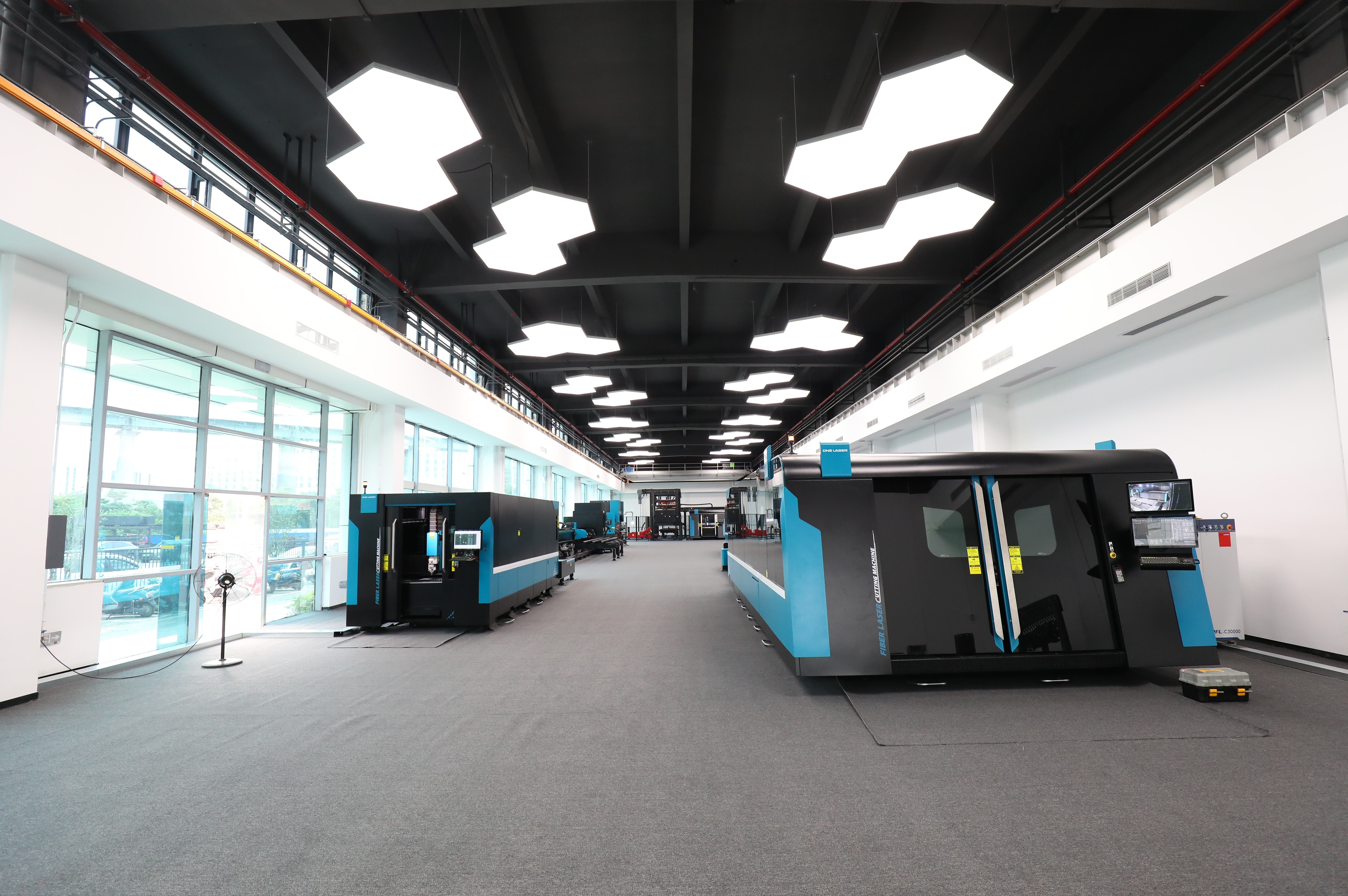
Configuration is the practical starting point. DNE Laser offers OEM, ODM, and customized solution design covering cutting format, laser power, cutting head focal length, laser source fiber core diameter, machine configuration, and automation integration, with a minimum order quantity of one unit. Buyers can review machine configurations and cutting capability at the DNE Laser demonstration center before specification is finalised, which makes it possible to align the quoted configuration with actual production parts rather than with a catalogue description.
How long does delivery take for a 30 kW system?
Lead time is customized based on actual order volume and project requirements, following standard lead times for customized industrial equipment manufacturing. Because format, laser power, worktable configuration, and layout options such as left-side or mezzanine arrangement all affect the build, the confirmed schedule should be tied to the final configuration rather than to a generic product listing. To move from evaluation to a concrete timeline, request a quotation and the current DNE Laser product catalogue as a next step.
Conclusion: What 30 kW Means for a Thick-Plate Business
High-power laser cutting is best understood as a capability threshold rather than a power rating. Once a fiber laser source reaches the 30 kW class, carbon steel and stainless steel up to 60 mm thick become single-pass work, ±0.05 mm positioning accuracy remains available at that thickness, and positioning speeds up to 120 m/min keep cycle times competitive on nested thick-plate programs.
The machines that deliver this reliably are the ones built around the power rather than merely fitted with it: a cutting head machined and assembled under controlled conditions, a frame that has been stress-relieved so accuracy survives heat and time, and a compliance file that matches the model and market in question. DNE LASER, a wholly owned subsidiary of the Swiss Bystronic Group with its production base in Nanhai, Foshan, manufactures these platforms in-house and supports them across a global export footprint that accounts for 45% of its total sales.
For engineers and procurement professionals at the evaluation stage, the disciplined sequence is simple: define the thickness range that actually runs through your shop, match the power class to that range, verify the accuracy and stability evidence behind the claim, confirm the certificates for your destination market, and then negotiate service and lead time against a fully specified configuration.
Next Step
If you are specifying a high-power fiber laser cutting machine for thick plate, start with the configuration that matches your material mix. Review the full DNE Laser product range, specifications, and configuration options in the official catalogue, or contact the DNE Laser team directly to discuss laser power, format, and compliance requirements for your market.
Official website: www.dne.global
Product catalogue (PDF): Introduction of DNE Laser V1.0 (2026)
Email: eileen.yan@dne.global
Tel / WeChat / WhatsApp: +86 136-7014-5102
Address: 306, Excellent Henxin Building, Shajing Street, Bao’an District, Shenzhen, Guangdong Province, China
Factory: North of Nankun Nan 2nd Street, Lingang Industrial Community, Nanhai District, Foshan City, Guangdong, China