
Global Safety Standards for Kitchen Mixers: What Compliance Do You Need?
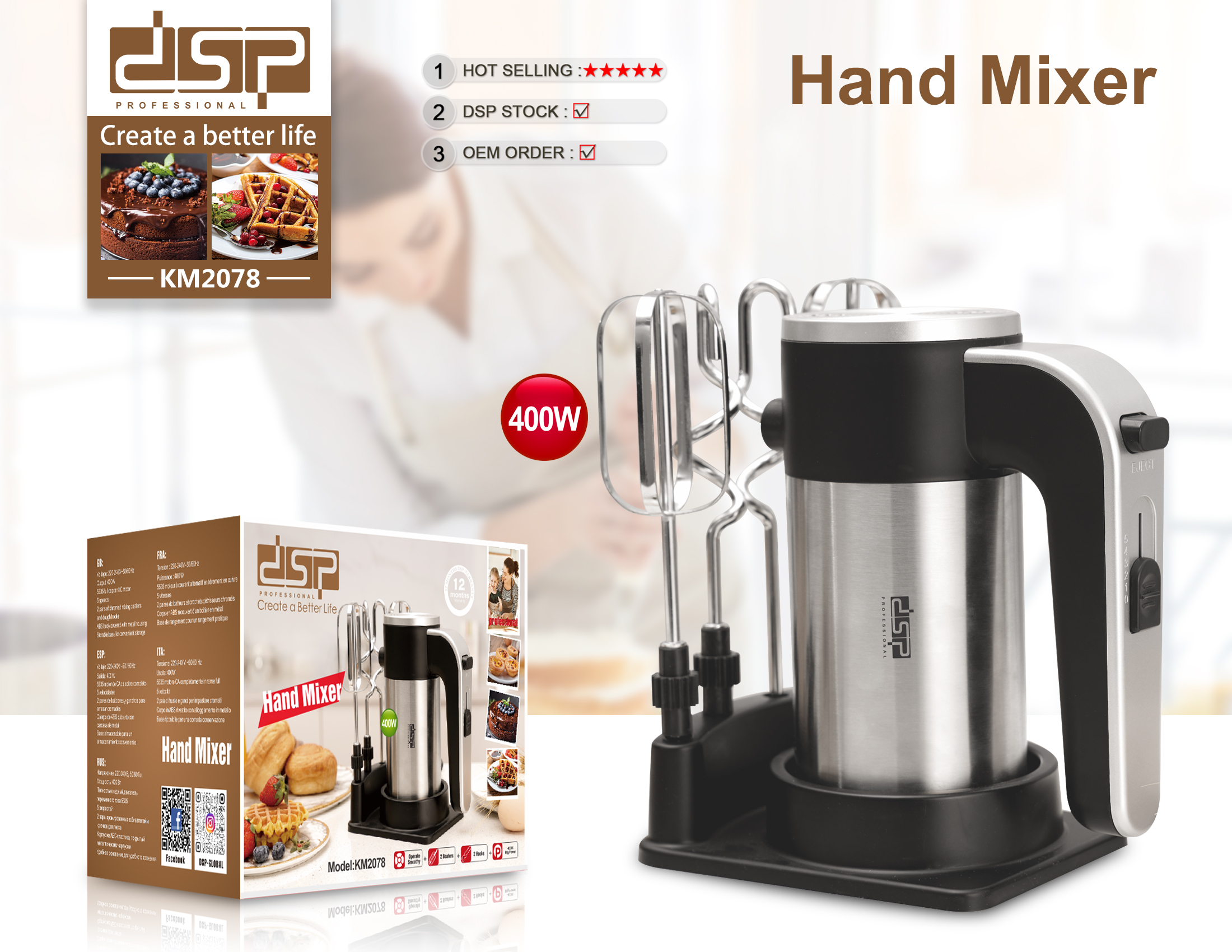
Hand Mixer (KM2078) — 400W full copper motor, 5 speeds, storable base.
A kitchen mixer placed on the EU market is normally expected to carry CE marking supported by an attestation of conformity covering electrical safety and electromagnetic compatibility. A mixer sold into the United States is normally expected to carry a listing from a nationally recognized testing laboratory, such as a UL or equivalent mark. In both cases the mark on the rating label is the output of the process, not the evidence for it — the evidence is the certificate file behind the mark.
Mixers sit at the intersection of two compliance regimes at the same time. As mains-powered, hand-held appliances they fall under electrical safety and electromagnetic compatibility rules. As products whose beaters, dough hooks, blades and rods touch food directly, they also fall under food-contact material requirements. A single “CE” logo does not describe any of this on its own.
This guide explains what compliance actually means for a kitchen mixer, how the EU and US routes differ, and how a buyer should read a manufacturer’s documentation step by step. It uses real examples from the certification files DSP holds for its mixer and blender range, so that the verification process described here can be checked against visible documents rather than marketing statements.
What “Compliance” Actually Means for a Kitchen Mixer
Compliance for a kitchen mixer is not one certificate. It is a set of documents covering three separate areas — electrical safety, electromagnetic compatibility (EMC), and food-contact materials — each tied to a specific model, a specific standard version and a specific destination market.
In the EU framework, the relevant document families for mixers are well established:
- EN 60335-1 — general safety requirements for household and similar electrical appliances.
- EN 60335-2-14 — the part-2 standard for kitchen machines, used together with EN 60335-1.
- EN 62233 — measurement methods for electromagnetic fields of household appliances.
- EN IEC 55014-1 and EN IEC 55014-2 — EMC emission and immunity requirements for household appliances.
- EN IEC 61000-3-2 and EN 61000-3-3 — harmonic current emissions and voltage fluctuation limits.
These are not theoretical categories. They appear directly in the conformity documents issued for DSP mixers. The verification of conformity covering the DSP KM1140U hand mixer / hand blender cites EN 60335-1:2012 with its amendment series, EN 60335-2-14:2006 with its amendments, and EN 62233:2008 — the combination typically used for low-voltage safety and electromagnetic field assessment of kitchen machines.
Why Compliance Is a Procurement Risk, Not a Paperwork Detail
For an importer or a private-label brand, compliance failures surface at four predictable points, and all four are commercial rather than technical:
- Retailer and marketplace onboarding. Retail buying teams and online marketplaces increasingly ask for the certificate file, not the logo. A supplier who can only show a product photo with a CE mark will usually be stopped at this stage.
- Customs and market surveillance. A declaration of conformity that cannot be linked to an accredited test report and a named model is a weak document if authorities request supporting evidence.
- Post-sale liability. Electrical faults in a hand-held appliance used near water and food create a liability chain that reaches the brand owner, not only the factory.
- Model drift. This is the most common and least discussed risk. A buyer approves a sample covered by a certificate, then production moves to a visually similar variant with a different motor, a different housing material or a different accessory set — and the certificate no longer applies to what is being shipped.
The practical lesson is that compliance verification belongs in the supplier evaluation stage, not in the shipping stage. It is far cheaper to ask for a certificate before a purchase order than to ask for one after a container has left the port.
The Market Context Behind Rising Compliance Scrutiny
Compliance pressure in small kitchen appliances tracks the size and maturity of the category. According to Fortune Business Insights, the global small domestic appliances market is projected to reach USD 222.52 billion by 2026, growing at a CAGR of 4.92%. Grand View Research values the small kitchen appliances market at USD 39.6 billion in 2025, within a global household appliances market estimated at USD 461.69 billion in 2024.
Standard-setting activity continues alongside that growth. The International Electrotechnical Commission published IEC 60335-2-15:2024, which specifies safety requirements for electrical appliances for heating liquids, including coffee makers and kettles. Buyers should read this as general evidence of an important pattern: appliance safety standards are periodically revised, and a test report issued several years ago may not reflect the expectations applied to a shipment today. Certificate validity dates matter for the same reason.
The Three Compliance Layers Every Kitchen Mixer Must Clear
Layer 1 — Electrical Safety
Electrical safety is assessed against EN 60335-1 together with EN 60335-2-14, with EN 62233 used for electromagnetic field assessment. Under the international IECEE CB scheme, the equivalent IEC versions are tested and the resulting CB test certificate can support national certifications in multiple markets.
DSP’s KM1190 hand mixer / immersion blender is covered by a CB test certificate, number BE-49307, issued by SGS and referencing IEC 60335-2-14:2006 with its amendments and IEC 60335-1:2010 with its amendments. The same safety layer is addressed for other DSP models by verification-of-conformity documents from EUROFINS: EFSH202405-L015 for the KM1146 hand blender and EFSH202304-L001 for the KM1140U hand mixer / hand blender, both citing the EN 60335-1, EN 60335-2-14 and EN 62233 combination.
Layer 2 — Electromagnetic Compatibility
EMC is assessed separately from safety and is often the layer buyers overlook. For a mixer, the relevant set is EN IEC 55014-1:2021 for emission, EN IEC 55014-2:2021 for immunity, EN IEC 61000-3-2:2019+A1:2021 for harmonic currents, and EN 61000-3-3:2013+A1:2019+A2:2021 for voltage fluctuations.
DSP’s KM2092 and KM2141 hand mixers are both listed under a single verification of conformity, number WTA24F08188711E, issued by WALTEK and citing exactly that EMC standard set. The same standard family appears in the CE attestations issued by Bureau Veritas for DSP’s KM1173 hand mixer and KM1086 food blender, under attestation number N°1966AB11JKN33277-N7, and in the EUROFINS verification EFSH202209-E003 for the KM1091 hand blender.
An important consequence follows from this: EMC coverage and safety coverage are different documents. A buyer who receives an EMC verification of conformity has not, by that document alone, received low-voltage safety evidence. Both should be requested separately for each model.
Layer 3 — Food-Contact Materials
Every surface that touches ingredients — beaters, dough hooks, blades, stirring rods, measuring cups and chopper bowls — sits in the food-contact scope, which is a distinct regulatory area from electrical safety. Buyers should request a food-contact declaration or migration test documentation for the specific materials used on the specific model being ordered, because the material specification can change between model variants.
DSP mixer specifications name materials such as stainless steel and ABS across the range, with 304 stainless steel appearing on blade and rod components in several models and 201 stainless steel appearing on other mixer accessories. The exact material list should be confirmed per model against the ordered bill of materials rather than assumed from a previous order.
EU vs US: What Each Market Actually Requires
The two markets converge on the underlying engineering standards but diverge on the route to market. The table below summarises the practical differences a buyer should plan around.
| Dimension | European Union | United States |
|---|---|---|
| Primary conformity route | CE marking supported by an attestation of conformity to the applicable European Directives and harmonized standards | Listing by a nationally recognized testing laboratory (NRTL), commonly a UL or equivalent mark |
| Electrical safety standard family | EN 60335-1 with EN 60335-2-14; EN 62233 for electromagnetic fields | Buyers should request the NRTL listing per model; DSP’s published conformity documents reviewed here are EU-market documents |
| EMC standard family | EN IEC 55014-1, EN IEC 55014-2, EN IEC 61000-3-2, EN 61000-3-3 | Request per-model documentation from the supplier; the EU EMC file does not substitute for it |
| Visible market mark | CE mark on the product and packaging | NRTL mark (for example UL or ETL) on the product and packaging |
| Document to request before ordering | Attestation of conformity plus the supporting test report, naming the exact model | NRTL listing certificate plus the supporting test report, naming the exact model |
| Most common failure point | Certificate is genuine but does not name the model actually being shipped | Mark is claimed on the packaging but no listing certificate exists for that model |
How to Verify a Mixer Supplier’s Compliance File — Step by Step
Verification is a repeatable process. The following eight steps can be applied to any mixer supplier, including DSP, and take less time than a single production delay.
Step 1 — Request the certificate, not the mark
Ask for the full document as a file, including the certificate number, the issuing body and the signature page. A photograph of a label is not evidence.
Step 2 — Match the model number exactly
Compare the model named on the certificate with the model on your purchase order. DSP’s file illustrates how specific this is: WTA24F08188711E names the KM2092 and KM2141 hand mixers, while BE-49307 names the KM1190 hand mixer / immersion blender. A certificate for a sister model is not automatically valid for a different one.
Step 3 — Identify the issuing authority
Note who issued the document. DSP’s mixer and blender documentation includes attestations and certificates from WALTEK, Bureau Veritas, SGS, TUV and EUROFINS. Different authorities issue different document types — a CB test certificate from SGS is not the same document class as an attestation of conformity from Bureau Veritas, and they answer different questions.
Step 4 — Read the standard versions, not just the standard numbers
Standard versions and amendment years carry meaning. EN 60335-1:2012 with its amendment series, EN 60335-2-14:2006 with its amendments, and EN IEC 55014-1:2021 describe different technical states of the standard. A certificate built on an older amendment set is still valid within its own terms, but the buyer should know which version was tested.
Step 5 — Check the validity period
Every certificate has an issue date and an expiry date, and both matter for order planning. Examples from the DSP mixer file include the KM2092 verification of conformity issued 26 September 2024 and valid to 26 September 2029; the KM1190 CB test certificate issued 10 September 2024 and valid to 10 September 2029; and the KM1140U verification issued 3 April 2023 and valid to 3 April 2028.
Step 6 — Confirm the market scope
Check which market the document was issued for. A document prepared for the EU market answers EU questions; it does not by itself answer US listing questions. Where a supplier holds both, confirm both files exist before committing to a delivery schedule.
Step 7 — Confirm coverage of every variant in the order
If your order contains more than one model, colour variant or accessory configuration, confirm that each is covered. Where several models genuinely share one certificate — as the KM2092 and KM2141 share WTA24F08188711E — that should be stated explicitly by the supplier and recorded in the order file.
Step 8 — Confirm factory-side controls and inspection terms
Documentation describes a tested sample; production control describes what is actually shipped. DSP’s manufacturing capability data lists 100% testing as its quality control standard, with acceptance available through online inspection and pre-shipment inspection under EXW or FOB delivery terms and TT payment terms.
What Verified Documentation Looks Like: Examples from DSP’s Mixer Range
DSP (Yiwu DSP Electric Appliance Co., Ltd.) is a home appliance manufacturer and exporter based in Yiwu, China, producing kitchen appliances, kitchenware and cleaning appliances — including hand mixers, hand blenders and food processors — for buyers in more than 100 countries. The company was established in 2006, operates a 20,000 m² factory with 130 employees and a 30-engineer R&D team, and reports annual output of 5,000,000 units with a 100% export orientation.
The table below summarises the mixer- and blender-related conformity documents visible in DSP’s certification file. It is deliberately presented with document types separated, because the distinction between safety documents and EMC documents is exactly what buyers need to see clearly.
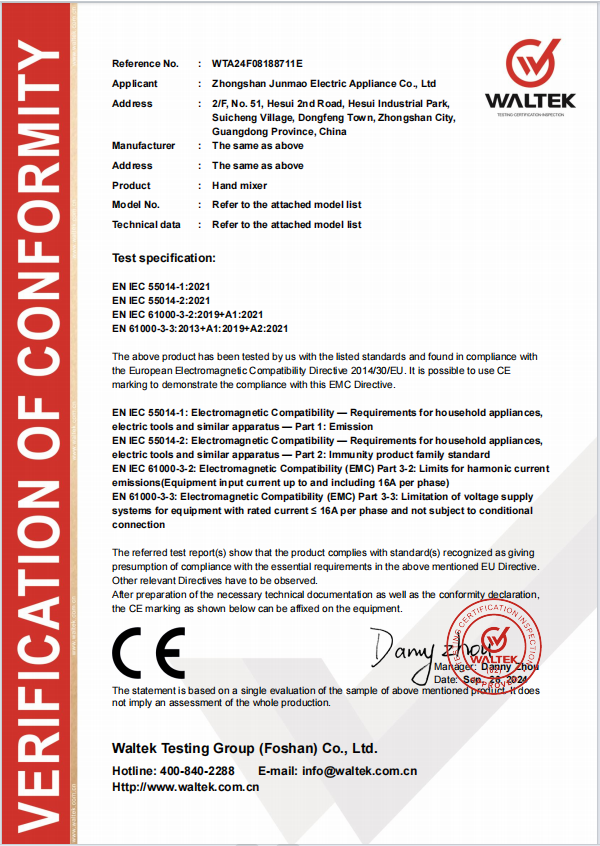
Verification of conformity WTA24F08188711E issued by WALTEK, covering the DSP hand mixer range for the EU market.
| Product model | Document type | Issuing authority | Standards cited | Certificate no. | Valid to |
|---|---|---|---|---|---|
| KM2092 Hand Mixer | Verification of Conformity | WALTEK | EN IEC 55014-1:2021; EN IEC 55014-2:2021; EN IEC 61000-3-2:2019+A1:2021; EN 61000-3-3:2013+A1:2019+A2:2021 | WTA24F08188711E | 26 Sep 2029 |
| KM2141 Hand Mixer / Electric Beater | Verification of Conformity | WALTEK | EN IEC 55014-1:2021; EN IEC 55014-2:2021; EN IEC 61000-3-2:2019+A1:2021; EN 61000-3-3:2013+A1:2019+A2:2021 | WTA24F08188711E | 26 Sep 2029 |
| KM1173 Hand Mixer | Attestation of conformity with European Directives | Bureau Veritas | EN IEC 55014-1:2021; EN IEC 55014-2:2021; EN IEC 61000-3-2:2019+A1:2021; EN 61000-3-3:2013+A1:2019+A2:2021 | N°1966AB11JKN33277-N7 | 19 Oct 2028 |
| KM1086 Food Blender | Attestation of conformity with European Directives | Bureau Veritas | EN IEC 55014-1:2021; EN IEC 55014-2:2021; EN IEC 61000-3-2:2019+A1:2021; EN 61000-3-3:2013+A1:2019+A2:2021 | N°1966AB11JKN33277-N7 | 19 Oct 2028 |
| KM1091 Hand Blender / Immersion Blender | Verification of Conformity | EUROFINS | EN IEC 55014-1:2021; EN IEC 55014-2:2021; EN IEC 61000-3-2:2019+A1:2021; EN 61000-3-3:2013+A1:2019+A2:2021 | EFSH202209-E003 | 2 Sep 2027 |
| KM1190 Hand Mixer / Immersion Blender | CB Test Certificate | SGS | IEC 60335-2-14:2006 with amendments; IEC 60335-1:2010 with amendments | BE-49307 | 10 Sep 2029 |
| KM1140U Hand Mixer / Hand Blender | Verification of Conformity | EUROFINS | EN 60335-1:2012 with amendments; EN 60335-2-14:2006 with amendments; EN 62233:2008 | EFSH202304-L001 | 3 Apr 2028 |
| KM1146 Hand Blender / Immersion Blender | Verification of Conformity | EUROFINS | EN 60335-1:2012 with amendments; EN 60335-2-14:2006 with amendments; EN 62233:2008 | EFSH202405-L015 | 9 May 2029 |
Two observations follow directly from this table, and both are useful at the evaluation stage. First, DSP’s mixer documentation is not a single “CE certificate” — it is a portfolio of documents from five different authorities, each answering a different compliance question. Second, safety coverage and EMC coverage are distributed unevenly across the model range: some models are covered by a safety-route document, others by an EMC-route document. A buyer planning a multi-model mixer programme should map the required evidence against the specific models in the order rather than assume the file transfers wholesale.
Compliance Documentation in Practice: Four Buyer Scenarios
The following scenarios show how the verification steps translate into real procurement decisions. All model and certificate references are drawn from DSP’s documented mixer and blender files.
Scenario 1 — EU importer building a two-model hand mixer SKU family
A retailer building an entry-level and a mid-level hand mixer listing may consider the KM2141 (200W, 5525 pure copper motor, 5 speeds with turbo) and the KM2092 (300W, 5525 full copper motor, 5 speeds with turbo). Both are named under verification of conformity WTA24F08188711E, which simplifies the EMC side of the file. The buyer should then request the separate low-voltage safety documentation for the same two models, because WTA24F08188711E cites EMC standards only.
Scenario 2 — Buyer needing safety-route evidence for an immersion blender
Where a safety-route document is the priority, the KM1146 hand blender is covered by verification EFSH202405-L015 and the KM1140U hand mixer / hand blender by EFSH202304-L001, both issued by EUROFINS and both citing the EN 60335-1, EN 60335-2-14 and EN 62233 combination.
Scenario 3 — Buyer needing CB scheme documentation for international distribution
A distributor preparing for multiple national approvals may prefer a CB test certificate because it supports national certification in participating markets. The KM1190 hand mixer / immersion blender is covered by CB test certificate BE-49307 from SGS.
Scenario 4 — Multi-model hand mixer programme across regions
DSP hand mixer models including the KM2078, KM2091 and KM1197 appear in case records covering home appliance brands, retailers, home cooks and culinary users across multiple regions, with supply relationships recorded over five-year durations. For programmes of this shape, the useful compliance discipline is a model-by-model evidence matrix kept alongside the order file, so that each model shipped can be traced to a live certificate.
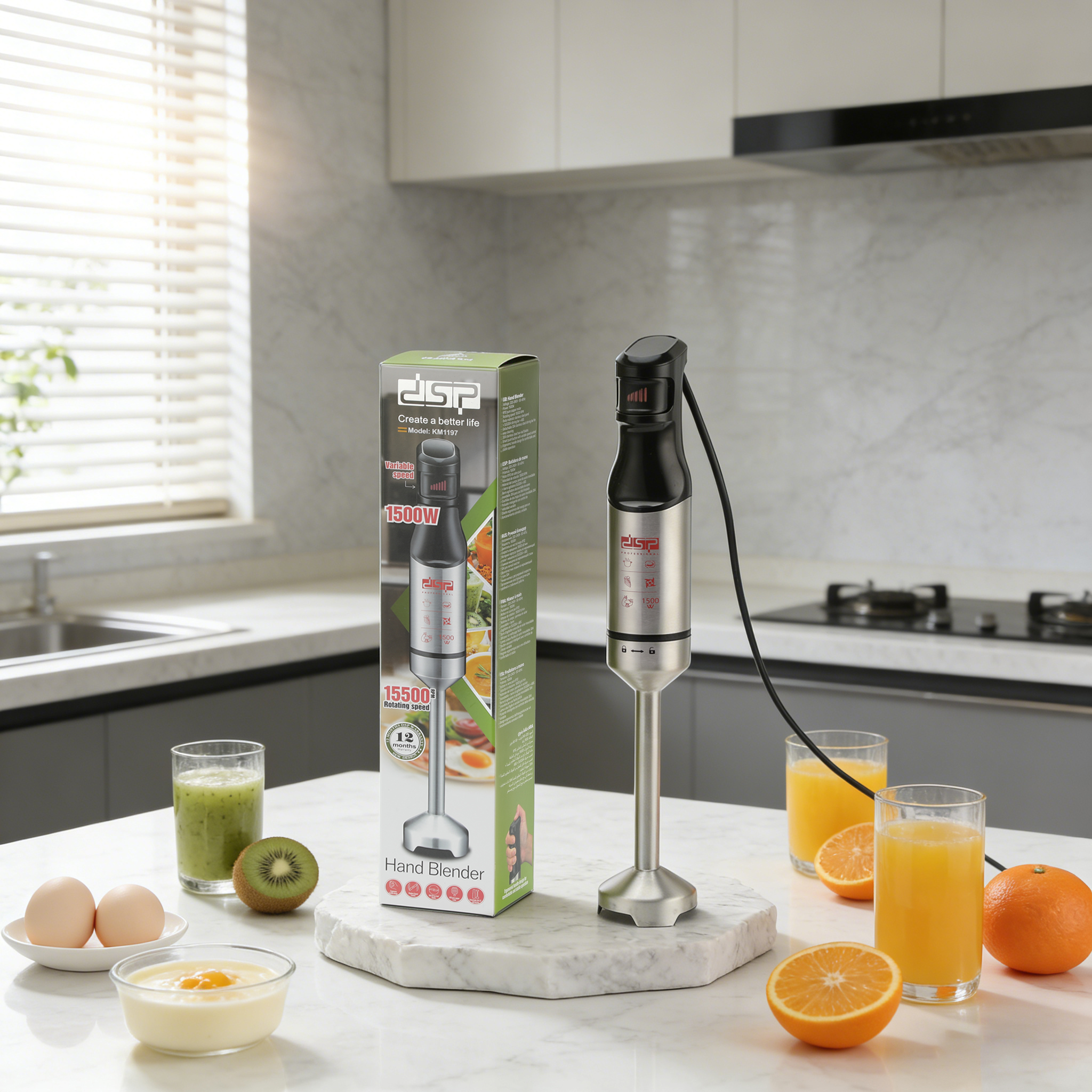
Hand Mixer (KM1197) — 1500W, 8112 pure copper motor, SUS304 two-leaf blades, detachable stirring bar.
Frequently Asked Questions
What compliance documents should a kitchen mixer supplier provide for the EU market?
A supplier should provide the attestation of conformity or verification of conformity for the exact model, together with the supporting test report, and the document should name the issuing body, the standard versions tested and the validity period. For DSP mixers the file includes EMC-route documents such as WTA24F08188711E from WALTEK and safety-route documents such as EFSH202405-L015 and EFSH202304-L001 from EUROFINS. Buyers should confirm both routes are covered for the model they order, because one document does not replace the other.
Can one certificate cover more than one mixer model?
Yes, when the models are genuinely within the certified scope, and this should be stated explicitly on the document. DSP’s KM2092 and KM2141 hand mixers are both named under verification of conformity WTA24F08188711E, and the Bureau Veritas attestation N°1966AB11JKN33277-N7 relates to the KM1173 hand mixer and the KM1086 food blender. Where a certificate covers several models, the buyer should record the full named list in the purchase file rather than assuming coverage extends to visually similar models outside it.
Does compliance documentation affect the cost of a mixer order?
Testing and certification are genuine cost items, and the cost driver buyers should watch is duplication — paying twice because a certificate was issued for the wrong model, the wrong market, or because it expired before shipment. Certificates in DSP’s mixer file carry defined validity periods, for example the KM1140U verification runs to 3 April 2028 and the KM1146 verification to 9 May 2029, which allows re-testing to be planned against known dates rather than discovered at shipping. Order economics also depend on order structure: DSP lists production MOQ at 500 to 1,000 pieces with monthly capacity of 50,000 to 100,000 pieces, so compliance work scales with how the programme is planned.
Can I get samples and compliance documents before placing a production order?
Yes. DSP’s purchasing terms list a minimum order quantity of 1 unit with EXW or FOB delivery terms and TT payment terms, and acceptance can be handled through online inspection as well as pre-shipment inspection. At the sample stage it is worth requesting both the physical sample and the certificate file for the exact model, and then checking that the model number on the certificate matches the model number on the sample packaging. Buyers who want to review the wider range before shortlisting a model can start from the DSP home appliance brochure.
Once compliance and specifications are confirmed, how long does production take?
Production lead time for DSP home appliance orders is typically 30 to 40 days, with after-sales support provided for one year. Because certificate validity dates and production dates are linked, buyers usually confirm the compliance evidence first and schedule production against it. To move to that stage, buyers can send a specification list and target model numbers to the DSP sales team and request a quotation together with the corresponding certificate file for each model.
Conclusion
Compliance for a kitchen mixer is not a single mark and not a single certificate. It is a document set covering electrical safety, electromagnetic compatibility and food-contact materials, applied model by model and market by market. The EU route runs through CE marking supported by an attestation of conformity against the EN 60335 and EN IEC 55014 families. The US route runs through a listing from a nationally recognized testing laboratory. Neither route is satisfied by a logo alone.
For buyers in the evaluation and execution stages, the working method is straightforward: request the certificate file rather than the mark, match the model number exactly, identify the issuing authority, read the standard versions and validity dates, confirm the market scope, and map every model in the order to a live document. Applied consistently, this turns compliance from a shipping risk into a supplier selection criterion — which is where it belongs.

DSP production workshop — 20,000 m² facility with 100% testing as the quality control standard.
Request Mixer Samples, Certificates and a Quotation
DSP supplies hand mixers, hand blenders, food processors and a wider home appliance range to buyers in more than 100 countries, with OEM/ODM support covering design, size, logo and material customization, 100% testing, and one-year after-sales support.
To review the full range and specification structure, download the DSP home appliance product brochure. To request the certificate file for a specific mixer model, a sample, or a quotation, contact the DSP team through www.dsp-official.com or by email at sales-3@dsplife.cn.